
Asia-Pacific Transportation Technical Textiles Market Size and Share
Market Overview
| Study Period | 2021 - 2032 |
|---|---|
| Forecast Data Period | 2027 - 2032 |
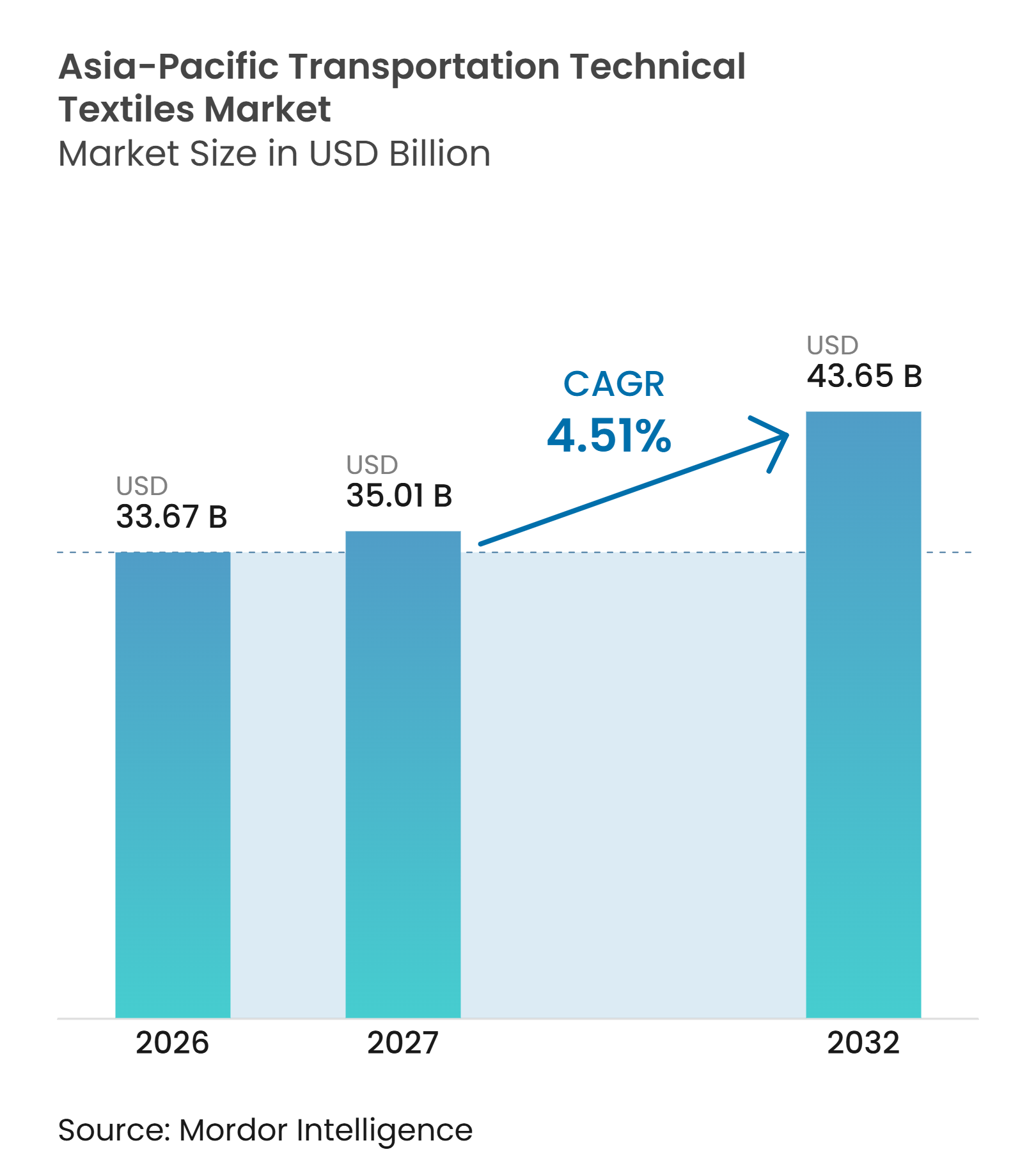
| Base Year Market Size (2026) | USD 33.67 Billion |
| Market Size (2027) | USD 35.01 Billion |
| Market Size (2032) | USD 43.65 Billion |
| Growth Rate (2027 - 2032) | 4.51 % |
| Market Concentration | Medium |
Major Players *Disclaimer: Major Players sorted in no particular order Image © Mordor Intelligence. Reuse requires attribution under CC BY 4.0. | |
Asia-Pacific Transportation Technical Textiles Market Analysis by Mordor Intelligence
The Asia-Pacific Transportation Technical Textiles Market size is projected to be USD 33.67 billion in 2026, USD 35.01 billion in 2027, and reach USD 43.65 billion by 2032, growing at a CAGR of 4.51% from 2027 to 2032.
Vehicle production, the shift toward electric vehicles, and wider adoption of safety equipment support demand for transportation textiles across the region. Asia-Pacific produced 59.2 million vehicles in 2025, representing more than 61% of worldwide vehicle output, which gives material suppliers a large local customer base. China remains central to the Asia-Pacific transportation technical textiles market because its automotive production, new-energy vehicle output, and local materials chain support demand from yarn through finished modules. Demand is also shifting toward lighter composite parts, battery insulation, acoustic layers, and recycled-content materials, which creates opportunities for suppliers that can meet technical and environmental requirements. Cost pressure in nylon, polyester, and specialty coatings, along with the difficulty of recycling layered materials, continues to limit returns for some converters.
Key Report Takeaways
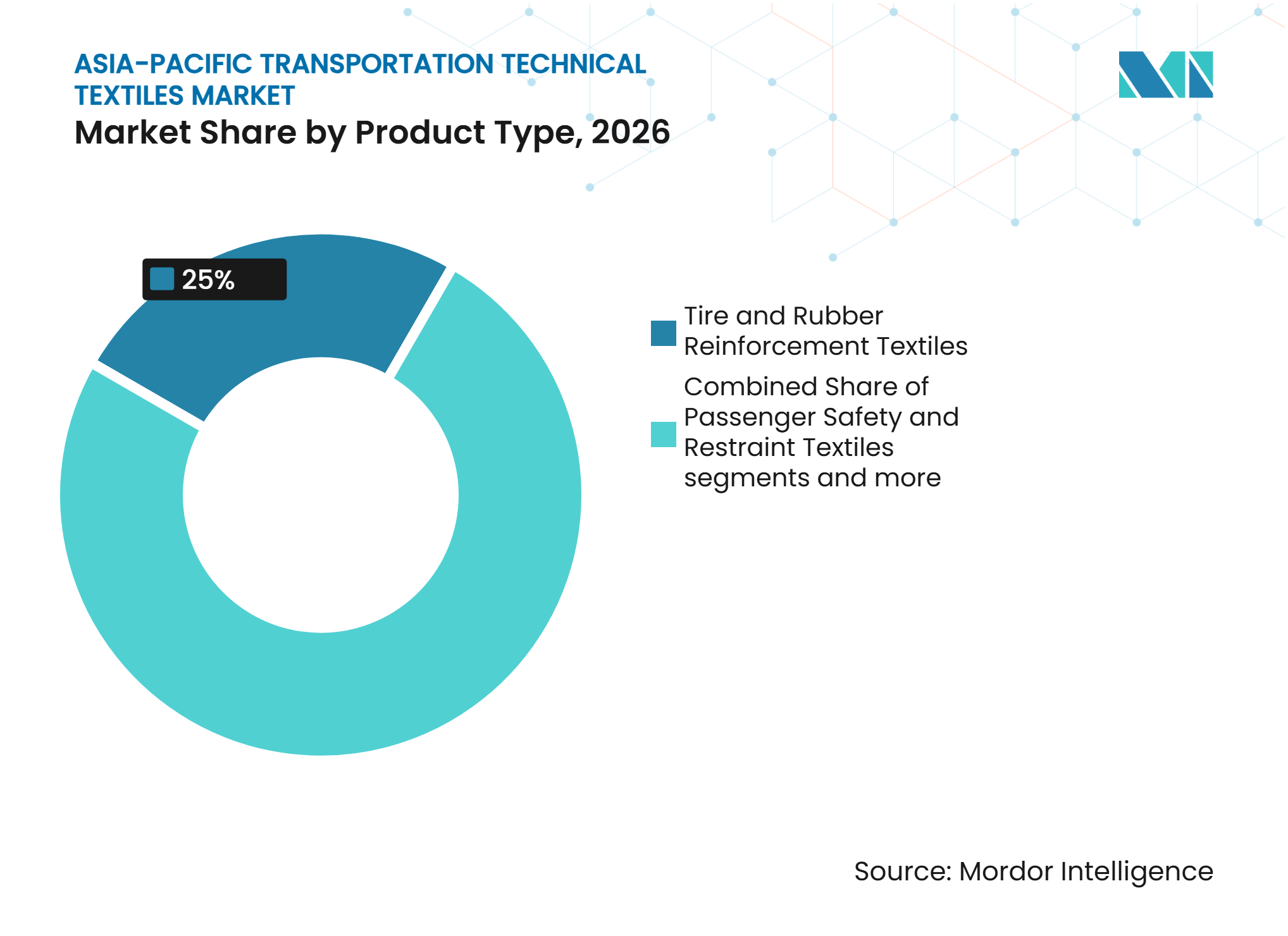
- By product type, tire and rubber reinforcement textiles held 25% of the Asia-Pacific transportation technical textiles market share in 2026, while structural and composite reinforcement textiles are forecast to grow at a 7% CAGR through 2032.
- By material type, polyester held 37% of regional value in 2026, while carbon fibers are forecast to grow at an 8% CAGR through 2032.
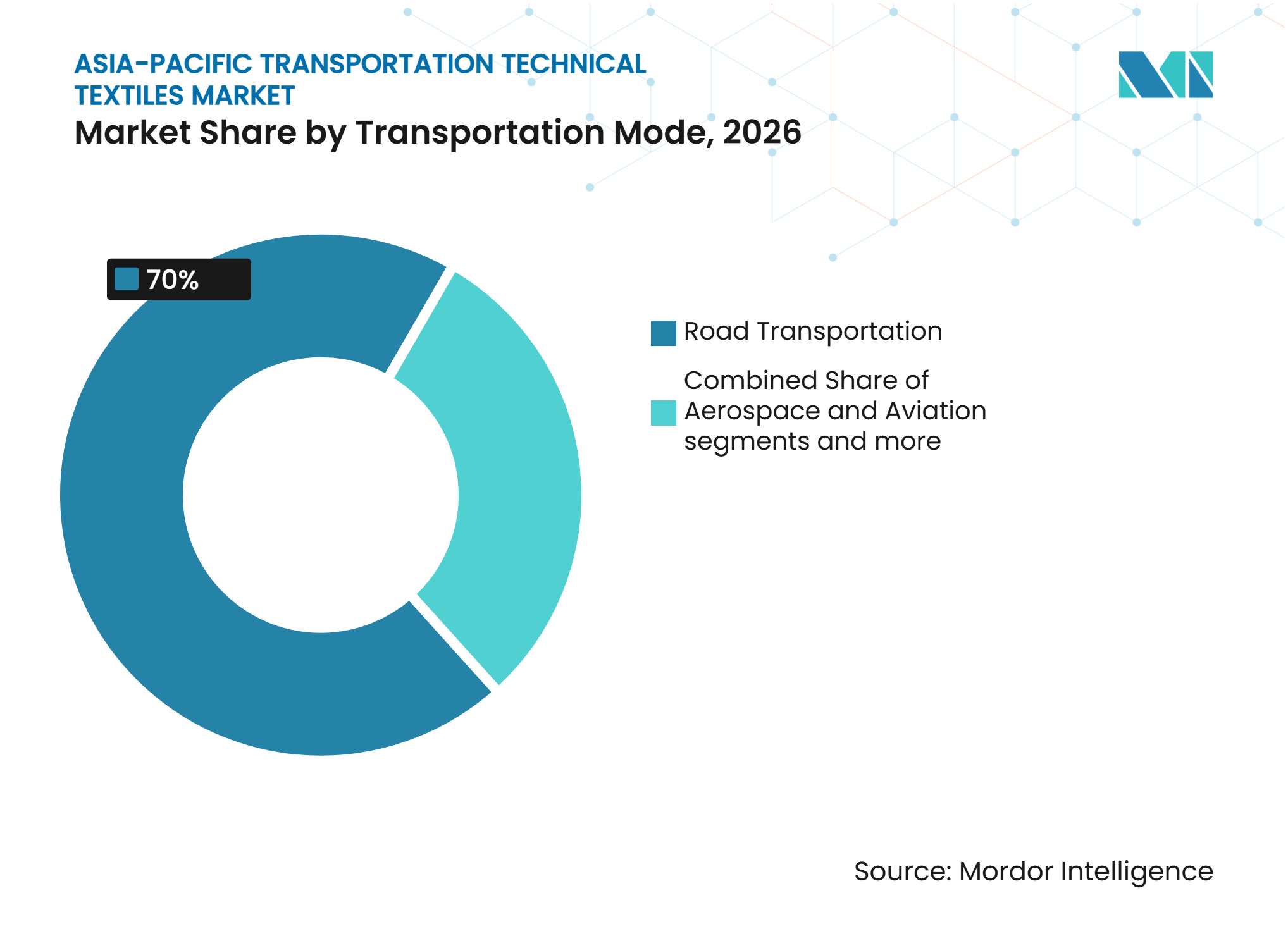
- By transportation mode, road transportation accounted for 70% of the Asia-Pacific transportation technical textiles market size in 2026, while aerospace and aviation are forecast to grow at a 6.5% CAGR through 2032.
- By geography, China held 40% of the regional value in 2026, while India is forecast to grow at a 6.5% CAGR through 2032.
Note: Market numbers in this report are based on Mordor Intelligence's proprietary estimation framework, which combines nine months of actuals with Q4 projections for base year 2026.
Market Trends and Insights
Drivers Impact Analysis of Asia-Pacific Transportation Technical Textiles Market*
| Driver | (~) % Impact on CAGR Forecast | Geographic Relevance | Impact Timeline |
|---|---|---|---|
| Asia-Pacific Vehicle Production and Mobility Manufacturing Scale | +1.5% | China, India, ASEAN | Short term (≤ 2 years) |
| Electric Vehicle Lightweighting and Battery Thermal Management | +1% | China, South Korea, Japan | Medium term (2-4 years) |
| Mandatory Occupant Safety Systems | +0.8% | India, ASEAN, China | Medium term (2-4 years) |
| Regionalization of Automotive and Airbag Supply Chains | +0.6% | Vietnam, India, Indonesia | Medium term (2-4 years) |
| Low-Emission, Recyclable, and Bio-Based Interior Materials | +0.4% | China, Japan, South Korea | Long term (≥ 4 years) |
| EV Cabin Noise and Comfort Engineering | +0.3% | China, Japan | Medium term (2-4 years) |
| Source: Mordor Intelligence | |||
Asia-Pacific Vehicle Production and Mobility Manufacturing Scale
Asia-Pacific vehicle production is the main volume driver for the Asia-Pacific transportation technical textiles market. The region produced 59.2 million vehicles in 2025, while India produced 6.49 million vehicles in the same year. Autoliv reported Asia light vehicle production of 54.07 million units in 2025 and said that its sales to Chinese original equipment manufacturers rose 23%. Vehicle output directly raises demand for airbag fabrics, seat belt webbing, tire cord, acoustic nonwovens, and interior fabrics. The region also has connected supply chains for polymer feedstock, yarn, fabric, and module production, which can shorten supply routes. This manufacturing base supports the Asia-Pacific transportation technical textiles market and its role as a supply source for automotive textile products.
Electric Vehicle Lightweighting and Battery Thermal Management
Electric vehicles are changing the material mix used in the Asia-Pacific transportation technical textiles market. China produced 16.626 million new-energy vehicles in 2025, up 29% from 2024, and new-energy vehicles made up 47.9% of domestic new-car sales. Battery electric vehicle platforms require thermal barriers, insulation layers, and electromagnetic shielding components in addition to standard vehicle textiles. Technical textile content in a battery electric vehicle is estimated at 10 to 15 kilograms, compared with 8 to 12 kilograms in a comparable internal combustion vehicle. Carbon fiber composites are used in battery housings and body components, and Hyundai Motor Group and Toray Group agreed in October 2025 to develop composite materials for future mobility platforms. Suppliers with thermal and structural design capabilities can serve requirements that differ from conventional vehicle specifications.
Mandatory Occupant Safety Systems
Vehicle safety requirements are increasing demand for airbag fabrics and restraint materials across ASEAN, China, and India. ASEAN NCAP adopted its 2026 to 2030 assessment protocol in 2026, which raises testing requirements and encourages wider use of curtain airbags and head-protection technology.[1] Each additional airbag module uses 0.5 to 1 square meter of coated or uncoated nylon fabric. Autoliv reported that safety content per vehicle in India grew 20% annually in 2025. China’s C-NCAP 2024 rules include side-barrier and side-pillar crash tests, which increase the importance of side-impact protection in vehicle design.[2] These compliance factors support both standard airbag fabrics and low-emission-coated products within the Asia-Pacific transportation technical textiles market.
Regionalization of Automotive and Airbag Supply Chains
Airbag fabric and restraint textile production is moving beyond the long-established manufacturing centers in Northeast Asia. Toray has identified the normalization of 6-airbag installations in India as a source of demand for high-tenacity nylon 66 airbag fabric. Japanese and South Korean suppliers are directing weaving and coating investment toward Vietnam, India, and Indonesia to serve several original equipment manufacturers from regional sites. These facilities can reduce procurement concentration and improve delivery times for vehicle manufacturers and safety-system integrators. The shift also gives local converters a clearer route into qualified automotive supply chains.
Restraints Impact Analysis of Asia-Pacific Transportation Technical Textiles Market*
| Restraint | (~) % Impact on CAGR Forecast | Geographic Relevance | Impact Timeline |
|---|---|---|---|
| Multilayer Composite Recycling Complexity | -0.5% | Japan, China, South Korea | Long term (≥ 4 years) |
| Volatile Nylon, Polyester, and Coating-Input Costs | -0.4% | Asia-Pacific | Short term (≤ 2 years) |
| Qualification Cycles and OEM Design-In Concentration | -0.3% | Japan, South Korea, China | Medium term (2-4 years) |
| Inconsistent Recycled-Fiber Appearance and Performance | -0.2% | China, India, ASEAN | Long term (≥ 4 years) |
| Source: Mordor Intelligence | |||
Multilayer Composite Recycling Complexity
Recycling layered automotive textile products remains a long-term constraint for the Asia-Pacific transportation technical textiles market. Automotive sound-absorbing and insulation assemblies often combine PET nonwoven, polyurethane foam, aluminum foil, adhesive scrim, and other layers that are difficult to separate after use. China’s National Automotive Standardization Technical Committee published for comment a project on recycled-material use in road vehicles in February 2025, showing that material recovery is becoming a compliance issue.[3] The proposed standard has an 18-month project cycle and covers general principles for using recycled materials in road vehicles. Material designs based on a single polymer or reversible bonding can reduce recycling constraints.
Volatile Nylon, Polyester, and Coating-Input Costs
Fluctuations in the prices of nylon, polyester, and specialty coating chemicals increase production costs for transportation technical textile manufacturers across Asia-Pacific. These materials are essential for manufacturing automotive airbags, seat fabrics, upholstery, tire cords, conveyor belts, and protective interior textiles. Changes in crude oil prices, petrochemical feedstock availability, and regional supply-demand conditions create uncertainty in the procurement of synthetic fibers and coating inputs. Manufacturers in countries such as India, China, Japan, and South Korea also face exposure to imported specialty chemicals and chemical intermediates, making production costs vulnerable to currency fluctuations and supply-chain disruptions. Smaller manufacturers often have limited bargaining power and face difficulties passing higher input costs to automotive OEMs and other customers under fixed-price supply agreements. Consequently, persistent raw material price volatility can compress profit margins, delay capacity expansion, and restrict investment in advanced technical textile materials.
*Our forecasts treat driver/restraint impacts as directional, not additive. The impact forecasts reflect baseline growth, mix effects, and variable interactions.
Asia-Pacific Transportation Technical Textiles Market Segment Analysis
By Product Type:
Tire and Rubber Reinforcement Textiles Lead as Composites AccelerateTire and rubber reinforcement textiles held 25% of the Asia-Pacific transportation technical textiles market share in 2026, making them the largest product category. The segment benefits from the region’s large vehicle and tire manufacturing base. China, India, Japan, and South Korea have major tire producers and retreading operations that use nylon and polyester tire cord fabric. SRF reported INR 2,029 crore (USD 225.8 million) in fiscal 2025 technical textiles revenue and said that its tire cord business reached its highest production volume to date. Passenger Safety and Restraint Textiles form the next major product group. Airbag fabrics, seat belt webbing, and related restraint products benefit from higher safety requirements and wider 6-airbag fitment in mid-priced vehicles.
Structural and composite reinforcement textiles are forecast to grow at a 7% CAGR from 2027 to 2032. Their use in battery housings, underbody panels, and performance vehicle components is expanding as vehicle makers reduce weight and develop electric platforms. Hyundai Motor Group and Toray Group’s October 2025 agreement shows how vehicle makers and materials suppliers are working together before large-scale deployment. Transportation Interior and Upholstery Textiles remain supported by higher cabin specifications in China and India. Acoustic, Thermal and Protective Insulation Textiles gain importance in battery electric vehicles because low-speed noise is up to 20 dB lower than in combustion vehicles. Transportation Filtration and Air Management Textiles, along with Exterior and Protective Textiles, serve smaller applications related to cabin air quality and commercial vehicle durability.



By Material Type:
Polyester Dominant, Carbon Fibers Scaling FastestPolyester held 37% of the regional value in 2026 and remains the leading material type in the Asia-Pacific transportation technical textiles market. Its use spans tire cord, seat belt webbing, acoustic nonwovens, and interior upholstery. Teijin Frontier announced in September 2025 that it would add 620 tons per year of high-tenacity recycled polyester filament yarn capacity in Thailand. The expansion responds to demand for recycled-content yarns for automotive tire cord, reinforcement, and seat belt applications. Autoneum’s Ultra-Silent products use 100% polyester and can include up to 70% recycled PET. Polyamide, especially nylon 66 and nylon 6, remains important for airbag fabric because of its heat resistance and burst-pressure performance.
Carbon fibers are forecast to grow at an 8% CAGR from 2027 to 2032. Demand is concentrated in structural reinforcement for aerospace, performance vehicles, and battery electric vehicle architectures in Japan, South Korea, and China. Nagoya University’s National Composites Center is working with 12 automotive partners on recycled carbon fiber standardization and quasi-continuous fiber materials for automotive shredder residue recovery. Polypropylene is used in carpets and filtration media, while glass fibers are used in composite reinforcement for commercial vehicle body panels. Aramid fibers serve protective and military transportation applications. Mitsubishi Chemical Group launched its BiOpreg #500 series in February 2025 with ISCC PLUS certification for carbon and glass fiber prepregs using plant-derived epoxy resin.
By Transportation Mode:
Road Commands, Aerospace Leads GrowthRoad transportation accounted for 70% of the Asia-Pacific transportation technical textiles market size in 2026. Passenger cars, commercial vehicles, and two- and three-wheelers each require different textile specifications. Battery electric passenger vehicles use additional thermal-management and acoustic nonwoven materials compared with internal combustion engine vehicles. Two- and three-wheelers are especially relevant in India, Indonesia, Vietnam, and Thailand, where motorcycles make up a large part of local mobility. Commercial vehicles use tire cords, belting fabrics, cab textiles, and nonwoven filtration. Road transportation is expected to remain the main demand base through 2032, with higher-value acoustic and thermal products taking a larger role as electric vehicle adoption rises.
Aerospace and aviation is forecast to grow at a 6.5% CAGR from 2027 to 2032. Carbon fiber composites, reinforcement fabrics, and thermal-management textiles support weight reduction in commercial aviation, military aircraft, and emerging electric vertical takeoff and landing platforms. Military aircraft and helicopters use aramid and high-tenacity fabrics in ballistic protection, structural components, and cockpit materials. Rail Transportation supports demand for flame-resistant interior laminates and composite parts as metro systems expand in India, the Philippines, and Singapore. Marine Transportation uses fire-resistant interior laminates and structural composite materials in cargo and passenger vessels. These applications broaden the Asia-Pacific transportation technical textiles industry beyond road vehicle demand.

Geography Analysis
China: Dominant Scale with Accelerating Material Sophistication
China held 40% of regional value in 2026. It produced 34.53 million vehicles in 2025 and 16.626 million new-energy vehicles, with the latter figure rising 29% from 2024. This scale supports local demand for tire cords, airbag fabric, acoustic nonwovens, and battery thermal-management layers. Autoneum received orders for its Ultra-Silent Frunk system from 3 original equipment manufacturers in Asia and Europe, and series production was already operating in China in early 2026. The product uses a polyester-based construction and up to 70% recycled PET. China’s C-NCAP 2024 framework has increased the attention given to side-impact testing and safety equipment. The Asia-Pacific transportation technical textiles market in China is therefore moving toward more technically specified safety, acoustic, and recycled-content materials.
India: Policy and Safety Uplift Propel Fastest Growth
India is forecast to grow at a 6.5% CAGR through 2032. The country produced 6.49 million vehicles in 2025, while Autoliv reported 20% annual growth in safety content per Indian vehicle. More airbag cushions, seat belt webbing, and restraint textiles are needed as safety equipment becomes more widely fitted. The Ministry of Heavy Industries activated the Scheme to Promote Manufacturing of Electric Passenger Cars in India in June 2025. The program requires at least USD 500 million of committed investment from each approved electric vehicle manufacturer within 3 years. India’s National Technical Textiles Mission continued through fiscal 2025 to 2026 with an INR 1,480 crore (USD 164.7 million) budget and supported 168 research projects. These programs support local converter capability and create demand for electric vehicle acoustic and thermal materials.
Japan and Rest of Asia-Pacific: Emerging Markets Diversify Regional Supply
Japan produced 8.41 million vehicles in 2025 and remains an important source of advanced transportation material research. Toray’s nylon 66 recycling work and Nagoya University’s recycled carbon fiber program show Japan’s role in next-generation material development. South Korea remains important in airbag cushion, tire cord, and composite textiles, supported by the Hyundai and Toray partnership. Thailand supports Japanese and Chinese vehicle makers through regional production of airbag fabrics, tire cord, and interior materials. Teijin Frontier’s Thailand expansion adds recycled polyester yarn capacity for transport applications. Vietnam is attracting airbag weaving and coating capacity because of its textile workforce and trade access. Indonesia’s growing vehicle base and infrastructure program, together with Malaysia’s assembly operations, expands demand across the Rest of Asia-Pacific segment.
Competitive Landscape
Market Concentration
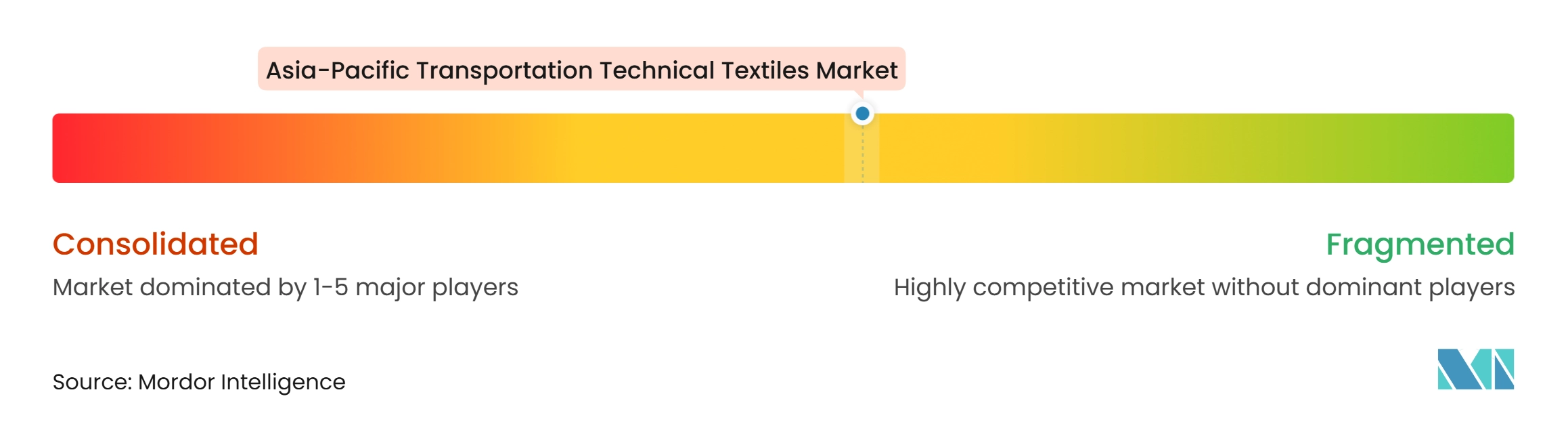
The Asia-Pacific transportation technical textiles market exhibits a medium level of market concentration in airbag fabric and tire cord, where technical qualification, large capital needs, and original equipment manufacturer approval limit the supplier base. The landscape is more fragmented in upholstery, acoustic nonwovens, and filtration products. Japanese, South Korean, and multinational materials suppliers hold strong positions in premium airbag and restraint products. These firms often supply through long-term agreements with safety-module integrators and have operations that extend from high-tenacity yarn to woven, coated, and finished fabric. Toray’s work on depolymerizing nylon 66 from post-consumer airbags supports the use of recycling credentials as a product differentiator. This makes technical capability and traceable recycled content important in the Asia-Pacific transportation technical textiles market.
Original equipment manufacturer and materials supplier partnerships are shaping the next group of products. Hyundai Motor Group and Toray Group signed their October 2025 joint development agreement for carbon fiber composite intermediates and components for future mobility platforms. Autoneum launched its Ultra-Silent Frunk solution in February 2026 and confirmed orders for 3 battery electric vehicle models. Teijin Frontier is also expanding recycled polyester capacity in Thailand for automotive industrial yarn applications. These moves show that suppliers are developing materials alongside vehicle programs rather than competing only after specifications have been set. The approach can preserve qualified suppliers position in high-value products.
Opportunities remain in recyclable multilayer interior systems, localized airbag fabric production in India and Vietnam, and recycled-content acoustic textiles for electric vehicles. Domestic Chinese converters and Indian producers are adding capability in tire cord and airbag fabric. Their participation can increase price competition in lower-specification products. Premium coated one-piece-woven airbag fabrics remain protected by testing, engineering, and qualification requirements. Southeast Asian capacity additions also make local supply reliability an important competitive factor.
Asia-Pacific Transportation Technical Textiles Industry Leaders
-
Autoneum
-
Freudenberg Performance Materials
-
Hyosung Advanced Materials
-
Toyobo Co., Ltd.
-
Autoliv, Inc.
- *Disclaimer: Major Players sorted in no particular order
Asia-Pacific Transportation Technical Textiles Market Companies Covered in this Report
- Autoneum
- Freudenberg Performance Materials
- Hyosung Advanced Materials
- Toyobo Co., Ltd.
- Autoliv, Inc.
- Toyota Boshoku Corporation
- Antolin
- Lear Corporation
- Adient plc
- Toray Industries, Inc.
- Teijin Limited
- Asahi Kasei Corporation
- Mitsui Chemicals, Inc.
- Indorama Ventures Public Company Limited
- SEIREN Co., Ltd.
- SUMINOE Co., Ltd.
- Hayashi Telempu Corporation
- Kasai Kogyo Co., Ltd.
- Kolon Industries, Inc.
- SRF Limited
Recent Industry Developments in Asia-Pacific Transportation Technical Textiles Market
- February 2026: Hyosung Advanced Materials invested USD 100 million to expand manufacturing at HS Hyosung Quang Nam in Vietnam, adding capacity for polyester curtain airbag fabrics and nylon airbag fabrics. The development supports regional airbag module demand as the ASEAN NCAP 2026 to 2030 protocol raises safety expectations.
- February 2026: Autoneum commercially launched its Ultra-Silent Frunk, a polyester-based front trunk solution for battery electric vehicles using up to 70% recycled PET. The company confirmed orders from 3 original equipment manufacturers in Asia and Europe for 3 battery electric vehicle models, with series production operating in China and Germany.
- October 2025: Hyundai Motor Group and Toray Group signed a Strategic Joint Development Agreement to develop carbon fiber composite intermediate materials and components for future mobility platforms. Hyundai’s Materials Research and Engineering Center will validate vehicles, while Toray’s subsidiaries in South Korea, the Netherlands, and Germany will develop materials.
- September 2025: Teijin Frontier announced that Teijin Polyester Thailand Limited would add 620 tons per year of high-tenacity recycled polyester filament yarn capacity for automotive tire cord, reinforcement, and seat belt yarns.
Asia-Pacific Transportation Technical Textiles Market Report Scope
The Asia-Pacific Transportation Technical Textiles Report is Segmented by Product Type (Passenger Safety and Restraint Textiles, Transportation Interior and Upholstery Textiles, and More), by Material Type (Polyester (PET), Polyamide (Nylon), and More), by Transportation Mode (Road Transportation, Aerospace and Aviation, and More), and by Geography (China, Japan, and More). The Market Forecasts are Provided in Terms of Value (USD).
Segmentation Overview
| Passenger Safety and Restraint Textiles | Automotive Airbag Fabrics and Textile Cushions |
| Seat Belt Webbing | |
| Other Transportation Safety and Restraint Textiles | |
| Transportation Interior and Upholstery Textiles | Seat Upholstery and Seating Fabrics |
| Automotive and Transportation Carpets | |
| Other Transportation Interior Textiles (Headliner, Window-Shading, etc.) | |
| Tire and Rubber Reinforcement Textiles | |
| Acoustic, Thermal, and Protective Insulation Textiles | |
| Transportation Filtration and Air Management Textiles | |
| Structural and Composite Reinforcement Textiles (carbon fiber, glass fiber reinforcement fabric, etc.) | |
| Transportation Exterior and Protective Textiles | |
| Other Transportation Technical Textiles |
| Polyester (PET) |
| Polyamide (Nylon) |
| Polypropylene (PP) |
| Polyethylene (PE) |
| Glass Fibers |
| Carbon Fibers |
| Aramid and Other High-Performance Synthetic Fibers |
| Natural and Regenerated Fibers |
| Other Specialty Fibers and Materials |
| Road Transportation | Passenger Cars | Internal Combustion Engine and Hybrid Passenger Cars |
| Battery Electric Passenger Cars | ||
| Commercial Vehicles | ||
| Two-Wheelers, Three-Wheelers, and Other Road Vehicles | ||
| Aerospace and Aviation | Commercial and Business Aircraft | |
| Military Aircraft and Helicopters | ||
| Spacecraft and Other Aerospace Platforms | ||
| Rail Transportation | ||
| Marine Transportation | Commercial and Cargo Vessels | |
| Passenger, Cruise Vessels, Recreational and Other Marine Vessels | ||
| Other Specialized Transportation Platforms |
| China |
| Japan |
| India |
| South Korea |
| Thailand |
| Indonesia |
| Vietnam |
| Rest of Asia-Pacific |
| By Product Type | Passenger Safety and Restraint Textiles | Automotive Airbag Fabrics and Textile Cushions | |
| Seat Belt Webbing | |||
| Other Transportation Safety and Restraint Textiles | |||
| Transportation Interior and Upholstery Textiles | Seat Upholstery and Seating Fabrics | ||
| Automotive and Transportation Carpets | |||
| Other Transportation Interior Textiles (Headliner, Window-Shading, etc.) | |||
| Tire and Rubber Reinforcement Textiles | |||
| Acoustic, Thermal, and Protective Insulation Textiles | |||
| Transportation Filtration and Air Management Textiles | |||
| Structural and Composite Reinforcement Textiles (carbon fiber, glass fiber reinforcement fabric, etc.) | |||
| Transportation Exterior and Protective Textiles | |||
| Other Transportation Technical Textiles | |||
| By Material Type | Polyester (PET) | ||
| Polyamide (Nylon) | |||
| Polypropylene (PP) | |||
| Polyethylene (PE) | |||
| Glass Fibers | |||
| Carbon Fibers | |||
| Aramid and Other High-Performance Synthetic Fibers | |||
| Natural and Regenerated Fibers | |||
| Other Specialty Fibers and Materials | |||
| By Transportation Mode | Road Transportation | Passenger Cars | Internal Combustion Engine and Hybrid Passenger Cars |
| Battery Electric Passenger Cars | |||
| Commercial Vehicles | |||
| Two-Wheelers, Three-Wheelers, and Other Road Vehicles | |||
| Aerospace and Aviation | Commercial and Business Aircraft | ||
| Military Aircraft and Helicopters | |||
| Spacecraft and Other Aerospace Platforms | |||
| Rail Transportation | |||
| Marine Transportation | Commercial and Cargo Vessels | ||
| Passenger, Cruise Vessels, Recreational and Other Marine Vessels | |||
| Other Specialized Transportation Platforms | |||
| By Geography | China | ||
| Japan | |||
| India | |||
| South Korea | |||
| Thailand | |||
| Indonesia | |||
| Vietnam | |||
| Rest of Asia-Pacific | |||
Key Questions Answered in the Report
What is the forecast growth rate for Asia-Pacific transportation technical textiles?
The sector is forecast to grow at a 4.51% CAGR from 2027 to 2032, reaching USD 43.65 billion by 2032.
Which product category leads transportation technical textiles in Asia-Pacific?
Tire and Rubber Reinforcement Textiles lead with a 25% share in 2026, supported by the region’s vehicle and tire production base.
Which material is growing fastest in transportation technical textiles?
Carbon Fibers are forecast to grow at an 8% CAGR through 2032, supported by structural uses in aerospace and battery electric vehicles.
Why are airbag fabrics becoming more important in Asia-Pacific vehicles?
Wider safety-system fitment and the ASEAN NCAP 2026 to 2030 protocol are increasing demand for airbag fabrics and restraint materials.
Which country is expected to grow fastest in regional transportation technical textiles?
India is forecast to grow at a 6.5% CAGR through 2032 as vehicle output, safety content, and electric vehicle investment rise.
How are recycled materials changing automotive textile sourcing?
Vehicle makers are increasing demand for recycled polyester, recyclable designs, and traceable material content, especially in acoustic and interior applications.