
Asia - Pacific Scaffolding Rental Market Size and Share
Market Overview
| Study Period | 2021 - 2032 |
|---|---|
| Forecast Data Period | 2027 - 2032 |
| Base Year Market Size (2026) | USD 8.83 Billion |
| Market Size (2027) | USD 9.47 Billion |
| Market Size (2032) | USD 13.45 Billion |
| Growth Rate (2027 - 2032) | 7.28 % |
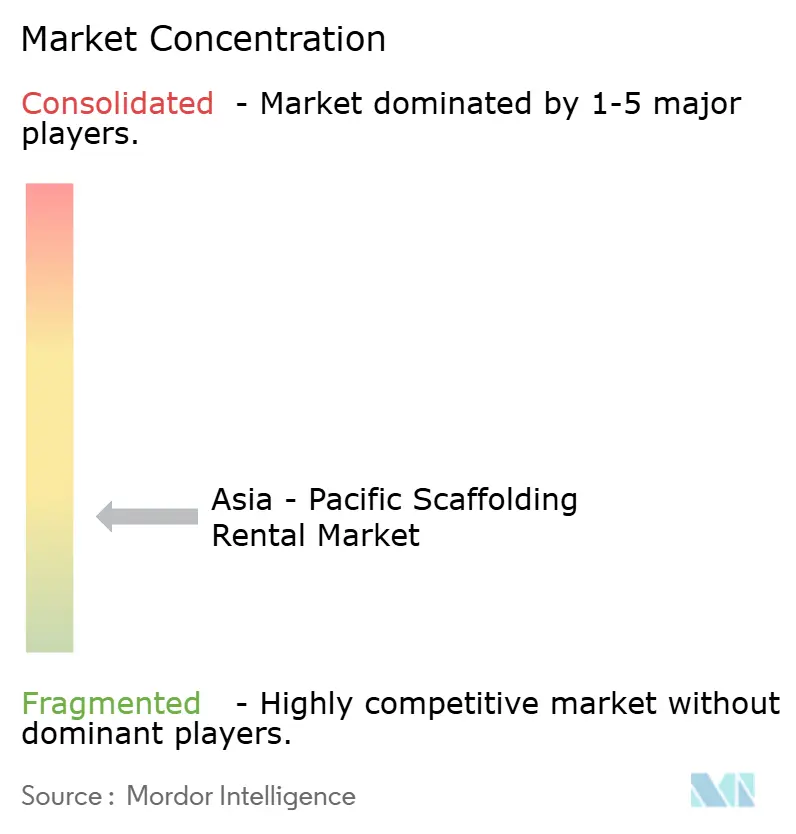
| Market Concentration | Medium |
Major Players *Disclaimer: Major Players sorted in no particular order Image © Mordor Intelligence. Reuse requires attribution under CC BY 4.0. | |
Asia - Pacific Scaffolding Rental Market Analysis by Mordor Intelligence
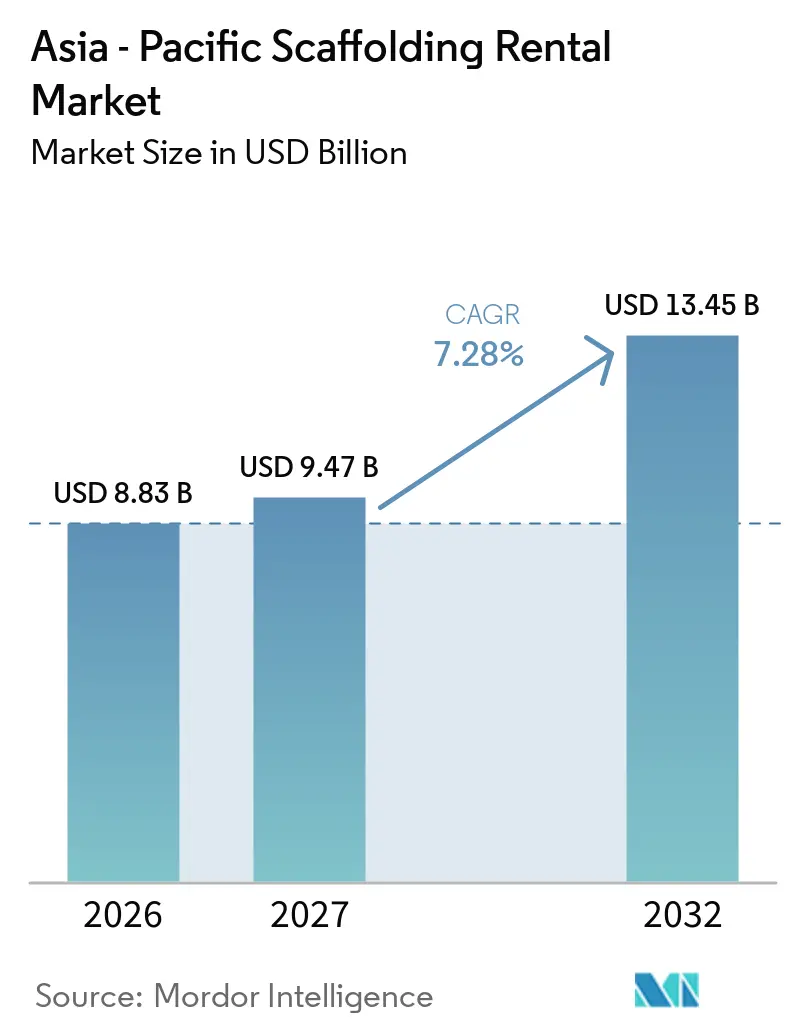
The Asia - Pacific Scaffolding Rental Market size is expected to increase from USD 8.83 billion in 2026 to USD 9.47 billion in 2027 and reach USD 13.45 billion by 2032, growing at a CAGR of 7.28% over 2027-2032.
Demand is supported by public spending on transport, energy, and urban assets, which require access equipment during construction and maintenance. Rental is also becoming more attractive to contractors that need equipment across several sites without holding large fleet inventories. Certified modular systems are gaining preference where public procurement and site-safety rules require documented equipment and inspection practices. China remains important because of its scale, although weaker property construction changes the mix of projects served by rental providers. India offers a stronger growth path as public capital spending and major transport projects increase the need for durable, quickly deployed systems.
Key Report Takeaways
- By type, Supported Scaffold held 61% of the Asia-Pacific scaffolding rental market share in 2026, while Mobile Scaffold is forecast to grow at an 8.8% CAGR through 2032.
- By system, Modular and Ringlock accounted for 37% of the Asia-Pacific scaffolding rental market size in 2026 and are forecast to grow at a 9.1% CAGR through 2032.
- By material type, Steel held 68% of the Asia-Pacific scaffolding rental market share in 2026, while Aluminum is forecast to expand at an 8.9% CAGR through 2032.
- By sector, Infrastructure accounted for 36% of the Asia-Pacific scaffolding rental market size in 2026, while Industrial and Logistics is forecast to grow at an 8.5% CAGR through 2032.
- By geography, China held 45% of the Asia-Pacific scaffolding rental market in 2026, while India is forecast to expand at a 9.6% CAGR through 2032.
Note: Market numbers in this report are based on Mordor Intelligence's proprietary estimation framework, which combines nine months of actuals with Q4 projections for base year 2026.
Market Trends and Insights
Drivers Impact Analysis of Asia - Pacific Scaffolding Rental Market*
| Drivers | (~) % Impact on CAGR Forecast | Geographic Relevance | Impact Timeline |
|---|---|---|---|
| Large-Scale Transport, Urban and Energy Infrastructure Pipelines | +2.5% | APAC-wide, especially India, Southeast Asia, and non-residential China | Long term (≥ 4 years) |
| Manufacturing Relocation Across Southeast Asia | +1.8% | Vietnam, Indonesia, Thailand, Malaysia, and the Philippines | Medium term (2-4 years) |
| Shift to Modular and Ringlock Systems | +1.2% | Hong Kong, China, Vietnam, South Korea, and Singapore | Medium term (2-4 years) |
| Rental Adoption Among Small and Mid-Sized Contractors | +0.9% | India, Indonesia, Vietnam, and the Philippines | Long term (≥ 4 years) |
| Tightening Construction Safety Standards | +0.5% | Hong Kong, Singapore, Australia, and South Korea | Short term (≤ 2 years) |
| High-Rise Residential and Commercial Construction in Megacities | +0.4% | India, Vietnam, Indonesia, and the Philippines | Medium term (2-4 years) |
| Source: Mordor Intelligence | |||
Large-Scale Transport, Urban and Energy Infrastructure Pipelines
Public investment in roads, railways, utilities, and urban assets supports steady access-equipment demand across the Asia-Pacific scaffolding rental market. India’s national highway network reached 146,572 km by fiscal year 2026 after expanding 60% from its earlier level, creating construction and maintenance work across elevated corridors and related structures. The same projects require periodic inspection and repair after the initial build phase, which can extend the use of rental scaffolding. Grid and renewable-energy work also needs safe access around towers, substations, and generation assets. These activities usually involve longer site periods than standard building projects and can improve fleet use for organized operators. The demand base is therefore spread between new capital projects and ongoing asset maintenance. This gives suppliers a steadier mix of work than a business tied only to building starts. Fleet planning remains important because infrastructure customers may need large volumes of equipment for an extended period. Providers also need to coordinate delivery, collection, inspection, and replacement parts without slowing the wider project schedule. Rental firms must keep enough standard stock near major corridors because delivery delays can affect contractor schedules. This makes depot placement and fleet planning relevant commercial decisions for providers serving public works. It also reduces reliance on any single construction category when infrastructure work is staged over several years. Project sequencing can keep equipment in use across adjacent contracts and follow-on maintenance programs.
Manufacturing Relocation Across Southeast Asia
Manufacturing investment is shifting more activity toward Southeast Asia, which supports factory, warehouse, and industrial-park construction. Chinese manufacturing investment in the Association of Southeast Asian Nations increased from an annual average of USD 6.1 billion during 2016 to 2019 to USD 12.9 billion during 2020 to 2023, according to ISEAS analysis drawing on World Bank data[1]. Vietnam, Indonesia, Thailand, and Malaysia are important destinations for electronics, electric-vehicle, and mineral-processing activity. These sites need temporary access during assembly, installation, and later maintenance. The work often places greater value on predictable delivery and documented equipment condition than informal short-term rental arrangements. This gives suppliers with nearby depots and reliable stock a clearer opportunity in industrial districts. Plant construction also brings requirements that differ from ordinary building work, including access around equipment, piping, and high internal spaces. Providers able to support this work can retain customers after construction when periodic shutdowns create maintenance demand. Local service capacity is therefore as important as fleet volume in these locations.
Shift to Modular and Ringlock Systems
Engineered modular systems are gaining use as contractors seek faster assembly and a more consistent safety record. Hong Kong required 50% of new government public-works building projects tendered from March 21, 2025, to use metal scaffolding[2]. The requirement creates a direct path from safety policy to equipment selection on publicly funded work. Doka introduced its Ringlock system in 2024, giving contractors another modular option for complex access requirements. Such systems can be configured for different structures, which can reduce the need to maintain separate equipment sets. The move away from bamboo and loose tube arrangements favors suppliers that can provide certified components, records, and trained support. It can also make contractor choices more consistent across projects because the equipment can be specified before a site begins. Suppliers must still train users and maintain inspection discipline, since engineered components do not replace site supervision. The resulting preference is strongest in work where project owners face visible safety and delivery risks. This also supports more planned equipment scheduling and helps contractors use common configurations across related sites.
Rental Adoption, Safety Rules, and High-Rise Construction
Smaller contractors in India and Southeast Asia increasingly face pressure to control upfront equipment spending while serving projects with uncertain schedules. Rental avoids the cost of owning, transporting, storing, and maintaining scaffold fleets across dispersed sites. Safety requirements also make documented equipment and competent inspection more relevant in formal construction work. Hong Kong’s Labour Department convened industry representatives in January 2025 to address putlog requirements, inspection frequency, and risks from concurrent work near external scaffolds[3]. These compliance factors can shift demand toward organized rental providers on government, high-rise, and international projects. Expanding apartment, commercial, and urban-renewal activity in major cities supports the need for systems that can be delivered and removed quickly.
Restraints Impact Analysis of Asia - Pacific Scaffolding Rental Market*
| Restraints | (~) % Impact on CAGR Forecast | Geographic Relevance | Impact Timeline |
|---|---|---|---|
| Property-Sector Slowdown in China | -1.3% | China, with indirect effects on steel pricing across Asia-Pacific | Long term (≥ 4 years) |
| Price Competition from Unorganized Local Rental Operators | -0.6% | India, Indonesia, Vietnam, the Philippines, and Bangladesh | Medium term (2-4 years) |
| Steel Price Volatility | -0.5% | APAC-wide, especially steel-intensive markets | Short term (≤ 2 years) |
| Skilled Erection Labor Shortages in Developed Markets | -0.3% | Japan, South Korea, Australia, and Singapore | Medium term (2-4 years) |
| Source: Mordor Intelligence | |||
Property-Sector Slowdown in China
China’s real estate downturn continues to reduce demand from residential and commercial construction. Property development investment fell 20.6% year over year from January through September 2026, while newly started floor space declined 24.9% over the same period. This reduces both the number and duration of scaffold rental contracts tied to new housing. The effect matters because China accounts for 45% of regional demand in 2026. Infrastructure, industrial maintenance, and urban-renewal work can partly offset the shortfall, but they do not fully replace lost residential starts. Providers with exposure across several end uses are better positioned than operators focused on housing construction.
Price Competition, Steel Costs, and Labor Availability
Informal operators in several Southeast Asian and South Asian markets can compete on low daily rates, particularly on small projects with limited inspection requirements. This restricts margin expansion for formal rental firms even when fleet use increases. Steel costs can also change quickly, which affects fleet replacement decisions for suppliers relying on steel systems. The Organisation for Economic Co-operation and Development noted that Chinese rebar prices were under pressure from weak domestic construction demand in 2026. Labor shortages in Japan, South Korea, Australia, and Singapore add another operating constraint because complex systems require qualified erection teams. Mobile and pre-engineered systems can reduce some labor needs, but they do not remove the requirement for safe supervision and inspection.
*Our forecasts treat driver/restraint impacts as directional, not additive. The impact forecasts reflect baseline growth, mix effects, and variable interactions.
Asia - Pacific Scaffolding Rental Market Segment Analysis
By Type:
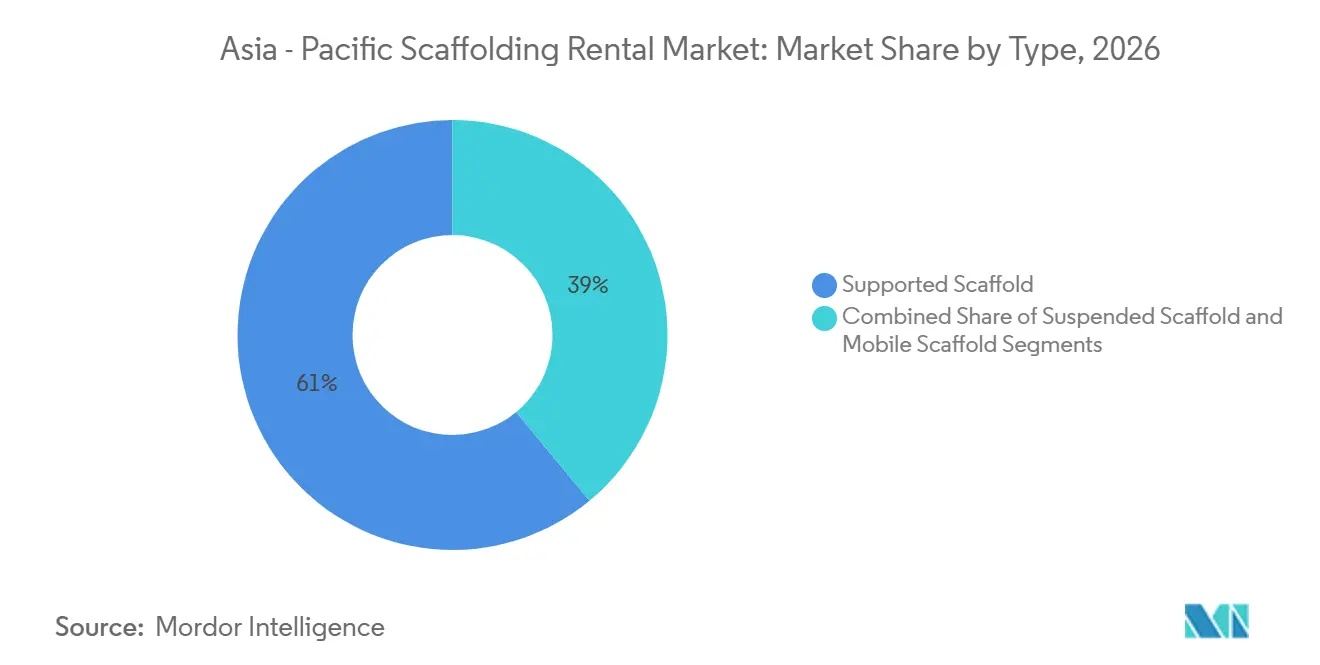
Supported Scaffold Holds the Broadest Project BaseSupported Scaffold held 61% of the Asia-Pacific scaffolding rental market share in 2026, reflecting its use across high-rise construction, infrastructure, and building maintenance. Its configuration works for both lower-level repairs and multi-story projects. This makes it a common choice in China, India, and Vietnam, where demand includes a large volume of urban construction. The system also serves work that requires a stable platform near building facades and structural elements. Its broad use creates consistent demand for fleet operators with standard components and local delivery capacity.
Mobile Scaffold is forecast to grow at an 8.8% CAGR through 2032. Its use is increasing in warehouse projects, interior work, data-center fit-outs, and urban retrofits where crews need to move access platforms across short distances. Mobile units can reduce repeated dismantling and erection when work locations change frequently. Suspended systems remain necessary for façade repairs, curtain-wall work, and bridge inspection where access must come from above the structure. Japan and South Korea provide a relevant maintenance base because commercial building stock requires periodic repair. Safety procedures remain important across every type, especially when equipment is used near occupied assets or active traffic areas.

By System:
Modular and Ringlock Leads System ChangeModular and Ringlock held 37% of the Asia-Pacific scaffolding rental market size in 2026. It is the largest system category because it can be adapted to varied structures while providing repeatable connection points. Contractors use it where assembly speed, load management, and documented configuration matter. Organized rental providers benefit from the system because standardized inventories can be used across several project types. Public procurement rules and client safety requirements reinforce this preference in Hong Kong, Singapore, South Korea, and other formal construction environments.
Modular and Ringlock is also forecast to grow at a 9.1% CAGR through 2032. Tube and Coupler retains a role in irregular buildings, heritage structures, bridges, and industrial sites where nonstandard dimensions require flexible positioning. Cuplock remains familiar to contractors in residential and light commercial projects across South and Southeast Asia. Frame and H-Frame serve low-rise renovation and repeatable housing tasks in Japan, South Korea, and Australia. The system mix will continue to depend on local fleet availability, worker familiarity, safety standards, and the nature of each project. The transition toward modular equipment is strongest where certification and planning records are part of the job requirement. It does not mean that legacy systems disappear quickly, since contractors may retain systems they know well and can access locally. Instead, the installed base is likely to change gradually as new public, industrial, and high-specification projects select modular solutions. Rental providers need to hold a balanced mix while that transition continues.
By Material Type:
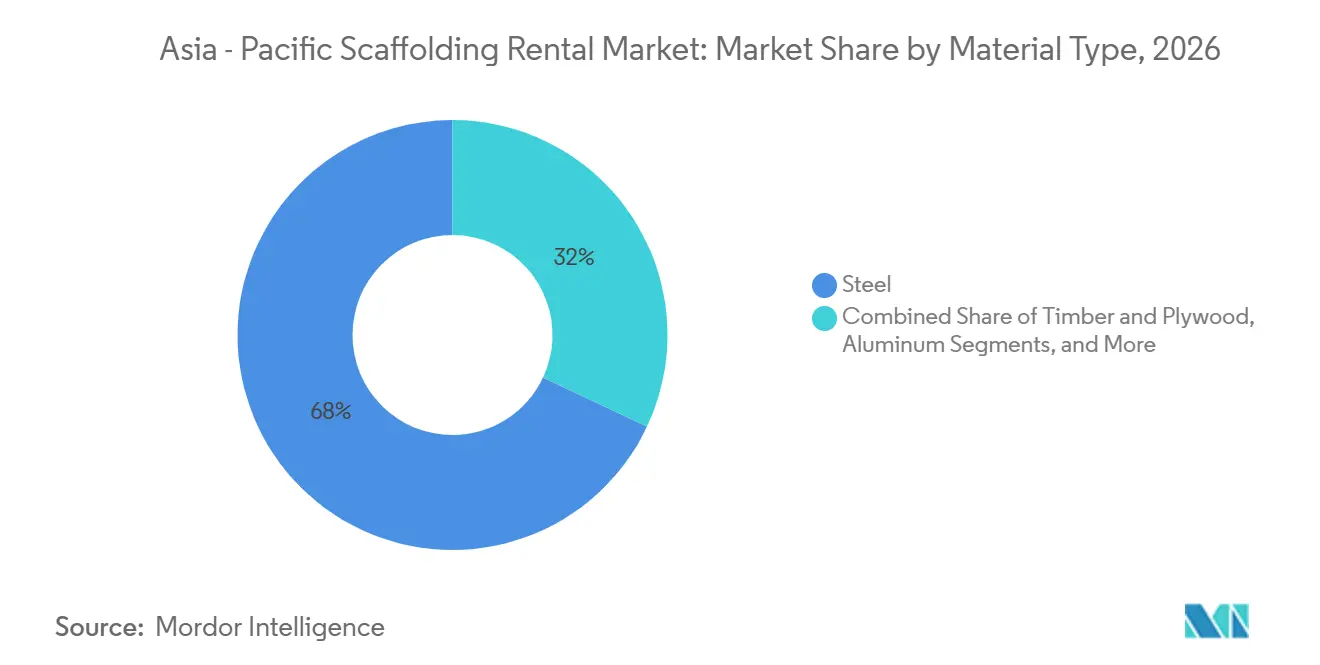
Steel Retains the Core Fleet PositionSteel held 68% of the Asia-Pacific scaffolding rental market share in 2026. Its load-bearing capability and established installed fleet make it suitable for bridges, industrial plants, elevated highways, and other heavy-duty applications. The material remains cost-effective for providers that already hold significant steel inventory. It also fits projects where high load ratings are necessary for workers, tools, and materials. The large installed base gives steel an operational advantage across both mature and developing markets. It can be a practical choice where equipment must tolerate demanding outdoor use and carry substantial loads. Rental operators also understand its repair and inspection requirements, which supports continued deployment on familiar project types. Aluminum will be considered more often when handling speed and transport weight matter more than maximum load capacity. Rental companies can repair, replenish, and redeploy existing steel components through established supply channels. This practical advantage will slow the shift toward lighter materials in heavy-access applications. Material choice will remain dependent on load, site conditions, labor availability, and total handling needs rather than weight alone.
Aluminum is forecast to grow at an 8.9% CAGR through 2032. Its lower weight can reduce handling effort and support faster erection for interior, maintenance, and mobile applications. This is relevant where access to trained workers is limited, or project durations are short. Steel still benefits when lower raw-material prices support fleet acquisition costs, although price movement can affect replacement timing. Timber and plywood remain present in lower-cost and rural applications but have a smaller role on formal projects. Plastic and fiberglass systems serve specialized uses where corrosion resistance is needed, including chemical and marine settings.
By Sector:
Infrastructure Provides the Largest Demand PoolInfrastructure accounted for 36% of the Asia-Pacific scaffolding rental market size in 2026. Transport corridors, energy systems, telecommunications assets, and public works require access equipment across lengthy construction schedules. These projects often create higher transaction values because the structures are large, elevated, or technically complex. Maintenance work can continue after the initial build phase, helping extend demand beyond individual project awards. India’s road expansion illustrates the scale of the regional infrastructure base.
Industrial and Logistics is forecast to grow at an 8.5% CAGR through 2032. New factories, semiconductor facilities, electric-vehicle plants, warehouses, and industrial-maintenance programs require access during installation and ongoing operations. Southeast Asian manufacturing relocation supports this demand as companies develop industrial capacity in several countries. Residential construction remains significant in India, Vietnam, and Indonesia, although China’s property weakness moderates regional growth. Commercial demand covers offices, retail assets, and specialized construction sites. The sector mix increasingly rewards rental providers that can serve infrastructure and industrial clients rather than relying on residential construction alone. Contractors in these sectors may require systems for complex geometry, controlled work areas, and long equipment holding periods. This creates room for engineering support alongside basic rental supply. Industrial customers often work to defined installation and maintenance windows, making reliable access equipment a practical part of project execution. Suppliers that understand these operating conditions can compete on service quality as well as equipment availability. Such work can also provide repeat business when assets move from construction to regular maintenance. It also raises the value of reliable inspection records and component traceability. Well-managed fleets can improve asset utilization by matching equipment to the requirements of each contract. This operational discipline matters when several large projects run at the same time across several locations simultaneously.
Geography Analysis
China
China held 45% of the Asia-Pacific scaffolding rental market share in 2026, equal to USD 4 billion at the stated regional value. The country’s property slowdown is limiting residential and commercial work, with property development investment falling 20.6% year over year in the first 9 months of 2026. Newly started floor space declined 24.9% over the same period, which reduces demand for early-stage building access. Infrastructure, energy assets, industrial maintenance, and urban renewal provide a partial alternative source of work. Chinese manufacturers also supply scaffold equipment across Southeast Asia, supported by competitive production costs. The Organisation for Economic Co-operation and Development reported weak domestic rebar pricing in 2026, which can lower fleet acquisition costs for rental firms.
India
India is forecast to grow at a 9.6% CAGR through 2032, the highest country rate in the Asia-Pacific scaffolding rental market. National infrastructure spending reached INR 12.2 trillion for fiscal year 2027, equivalent to USD 133 billion based on the conversion supplied in the source draft, and represented an 11.4% year-over-year increase. Roads, railways, urban projects, and energy infrastructure support deployments with long site durations. India’s national highway network reached 146,572 km in fiscal year 2026, creating construction and later maintenance requirements. Safety requirements under the Bureau of Indian Standards, including IS 2750 and IS 3696, support demand for documented systems on formal projects. The country also presents a large opportunity for rental providers serving smaller contractors that cannot justify ownership of dedicated fleets. Contractors working across several states may prefer rental arrangements because local availability reduces transport and storage needs. The same model enables fleet providers to refresh systems as technical and safety requirements develop. This can help formal operators distinguish their offer from short-term, lower-cost alternatives that lack comparable records or service support. The approach also helps customers use a familiar source of equipment when projects progress from early structural work to later finishing and maintenance activities. For rental firms, regular customer contact can improve visibility into demand and support more effective planning of equipment movements between sites.
Rest of Asia-Pacific
Japan has a mature rental base with multi-depot operators serving dense urban construction and maintenance. ASNOVA acquired Singapore-based Qool Enviro in April 2025 for USD 13 million, based on the currency conversion in the supplied material, showing a move by a Japanese operator into Southeast Asia. South Korea combines demand from high-rise development, industrial facilities, and advanced manufacturing construction. Australia adds demand from resources maintenance and urban infrastructure, while its safety guidance has been refreshed through updated scaffolding industry standards. Indonesia and Vietnam benefit from manufacturing investment and industrial-estate development. Hong Kong’s metal-scaffold requirement is a regional example of regulatory influence shifting procurement toward engineered equipment. Across the region, operators must match their system mix to each country’s construction activity, safety rules, and customer preferences. This makes a single regional fleet model less effective than a network that combines common equipment with local stock and service. Mature economies may place more emphasis on maintenance, inspection, and labor efficiency, while developing markets can have more new construction activity. Local rules can also determine which materials and systems are accepted on public works. A flexible network helps providers respond to these different operating conditions.
Competitive Landscape
The Asia-Pacific scaffolding rental market is moderately fragmented because global system providers compete alongside national rental firms and lower-cost local operators. PERI, Layher, Altrad, and BrandSafway serve large, compliance-driven projects through engineered systems, planning support, and broad product ranges. Local specialists compete through depot proximity, knowledge of contractor practices, and rapid fleet availability. Informal providers remain relevant on low-specification jobs where customers focus on immediate rental cost. This creates a clear division between formal projects that need records and inspection support and smaller jobs that remain price sensitive. Rental companies must decide where to invest in standardized systems, maintenance capacity, and regional service teams. The choice is particularly important when customers require rapid replacement equipment during active work. A provider that can respond quickly may retain business when construction schedules change without notice. It can also build longer customer relationships through maintenance, refurbishment, and renewal work after completion of the original project.
Technology and system durability are central parts of competition. PERI announced a EUR 60 million investment in manufacturing technologies and its PERIskin corrosion-protection system during 2025. The investment shows how established suppliers seek to improve product life and operating performance for demanding construction conditions. Doka’s Ringlock launch also adds a modular alternative for contractors that value flexible configurations. These moves support differentiation beyond day-rate pricing. They also help major suppliers compete for infrastructure and industrial jobs where the cost of site disruption can outweigh equipment rental cost.
Regional expansion is another competitive theme. ASNOVA’s April 2025 purchase of Qool Enviro gives the Japanese company a direct entry point into Singapore and the wider Southeast Asian construction-rental space. Providers that build local depot networks near manufacturing zones can respond more quickly to short-cycle maintenance work. Regulatory compliance will become a more important market-access factor as public authorities strengthen inspection and material expectations. Hong Kong’s public-works requirement for metal scaffolding is one such example. The available draft does not provide combined market-share data for leading companies, so a numerical concentration score cannot be assigned without creating unsupported data. Competition will continue to vary by country because local fleet density and contractor relationships can be difficult for global suppliers to replicate. At the same time, global companies retain advantages on large projects where engineering capability and certified systems matter. The competitive balance is therefore shaped by both scale and local responsiveness.
Asia - Pacific Scaffolding Rental Industry Leaders
-
PERI SE
-
Doka GmbH
-
Layher Holding GmbH & Co. KG
-
Altrad Group
-
BrandSafway
- *Disclaimer: Major Players sorted in no particular order
Asia - Pacific Scaffolding Rental Market Companies Covered in this Report
- PERI SE
- Doka GmbH
- Layher Holding GmbH & Co. KG
- Altrad Group
- BrandSafway
- ULMA Construction
- Waco International
- Nishio Rent All Co., Ltd.
- Beijing Zulin Formwork & Scaffolding Co., Ltd.
- ADTO Group
- Acrow Group
- Nikken Lease Kogyo Co., Ltd.
- ASNOVA Co., Ltd.
- Alinco Inc.
- Pee Kay Scaffolding and Shuttering Ltd.
- Technocraft Industries (India) Ltd.
- Altrad Sparrows Indonesia
- PT Beton Perkasa Wijaksana
- Uni-Span Group (Australia)
- Ladder & Scaffold Hire Group
Recent Industry Developments in Asia - Pacific Scaffolding Rental Market
- October 2026: ASNOVA Co., Ltd. transitioned to a pure holding company structure under ASNOVA Companies, Inc. The restructuring separates group management from scaffolding rental operations and is intended to support faster mergers and acquisitions and expansion into additional businesses. Its ASNOVA Singapore Pte. Ltd. unit, formed in April 2026, acts as a regional platform for extending temporary-equipment rental operations into Southeast Asian markets.
- October 2026: BWYS Group Bhd, through BW Scaffold Industries Sdn Bhd, entered an agreement to acquire 28.92 acres of freehold industrial land in Selangor for USD 21.3 million, based on the conversion supplied in the source material. The intended facility will consolidate scaffolding rental and supply operations, sheet-metal manufacturing, and steel-material storage. The company expects the site to increase operational capacity and eliminate USD 0.6 million in annual rental payments, based on the conversion supplied in the source material.
- March 2026: Carlyle agreed to acquire SUGIKO, a leading Japanese scaffolding and temporary construction-material rental company, from ORIX through the transfer of SGK Holdings for approximately USD 605 million. SUGIKO operates nationwide and serves construction and plant customers, while using BIM to improve construction-project information management and operational efficiency. The transaction strengthens consolidation in Japan’s scaffolding rental market and gives Carlyle an opportunity to support SUGIKO’s long-term growth through its infrastructure investment expertise.
Asia - Pacific Scaffolding Rental Market Report Scope
Segmentation Overview
| Supported Scaffold |
| Suspended Scaffold |
| Mobile Scaffold |
| Tube and Coupler |
| Cuplock |
| Modular and Ringlock |
| Frame and H-Frame |
| Timber and Plywood |
| Steel |
| Aluminum |
| Plastic and Fiberglass |
| Others |
| Residential |
| Commercial |
| Industrial and Logistics |
| Infrastructure |
| China |
| India |
| Japan |
| South Korea |
| Australia |
| Indonesia |
| Vietnam |
| Rest of Asia-Pacific |
| By Type | Supported Scaffold |
| Suspended Scaffold | |
| Mobile Scaffold | |
| By System | Tube and Coupler |
| Cuplock | |
| Modular and Ringlock | |
| Frame and H-Frame | |
| By Material Type | Timber and Plywood |
| Steel | |
| Aluminum | |
| Plastic and Fiberglass | |
| Others | |
| By Sector | Residential |
| Commercial | |
| Industrial and Logistics | |
| Infrastructure | |
| By Country | China |
| India | |
| Japan | |
| South Korea | |
| Australia | |
| Indonesia | |
| Vietnam | |
| Rest of Asia-Pacific |
Key Questions Answered in the Report
What is the projected value of the Asia-Pacific scaffolding rental sector by 2032?
The sector is projected to reach USD 13.5 billion by 2032, rising from USD 9.5 billion in 2027 to a 7.28% CAGR.
Which scaffolding type holds the largest share in Asia-Pacific?
Supported Scaffold leads with a 61% share in 2026 because it serves high-rise construction, infrastructure, and maintenance work.
Which scaffolding system is growing fastest in Asia-Pacific?
Modular and Ringlock are forecast to grow at a 9.1% CAGR through 2032, supported by safety requirements and faster assembly.
Why is India important for scaffolding rental providers?
India is forecast to grow at a 9.6% CAGR through 2032, supported by public infrastructure spending and a large contractor base.
How does China’s property slowdown affect rental demand?
Lower property investment and new construction starts are reducing residential scaffold demand, although infrastructure and industrial maintenance provide partial support.
Which end-use sector will grow fastest through 2032?
Industrial and Logistics is forecast to expand at an 8.5% CAGR, supported by factories, warehouses, semiconductor facilities, and maintenance programs.