
Asia-Pacific Robotic Lawn Mower Market Size and Share
Market Overview
| Study Period | 2021 - 2031 |
|---|---|
| Forecast Data Period | 2026 - 2031 |
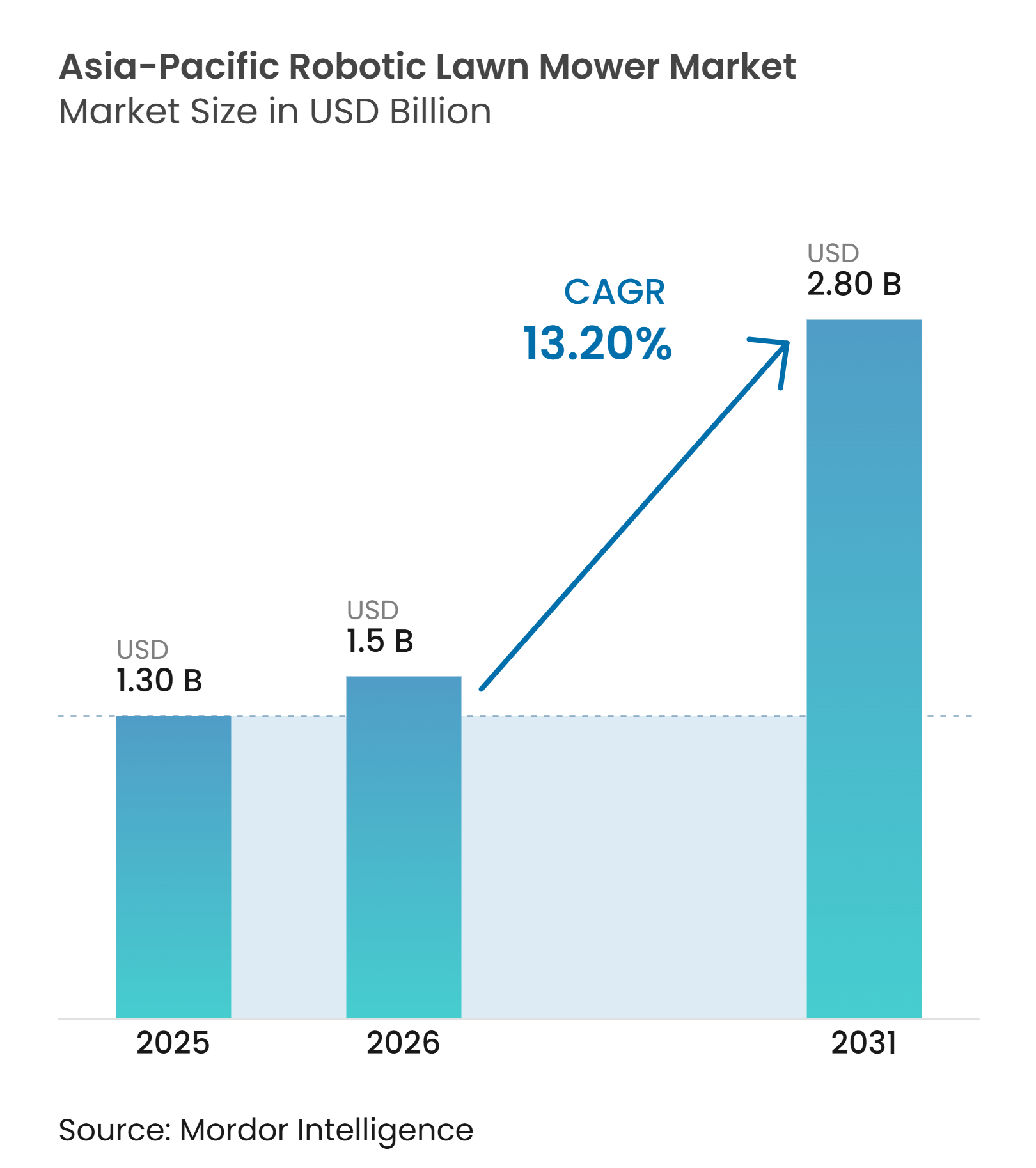
| Base Year Market Size (2025) | USD 1.30 Billion |
| Market Size (2026) | USD 1.5 Billion |
| Market Size (2031) | USD 2.80 Billion |
| Growth Rate (2026 - 2031) | 13.20 % |
| Market Concentration | Medium |
Major Players *Disclaimer: Major Players sorted in no particular order Image © Mordor Intelligence. Reuse requires attribution under CC BY 4.0. | |
Asia-Pacific Robotic Lawn Mower Market Analysis by Mordor Intelligence
The Asia Pacific robotic lawn mower market size was valued at USD 1.3 billion in 2025 and is estimated to grow from USD 1.5 billion in 2026 to reach USD 2.8 billion by 2031, at a CAGR of 13.2% during the forecast period from 2026 to 2031. The Asia Pacific robotic lawn mower market is shifting from labor-intensive mowing toward autonomous and battery-powered equipment in residential and commercial settings. Wire-free navigation is gaining importance as RTK, LiDAR, and vision systems reduce installation requirements on compact properties. Manufacturers are adapting products for dense urban gardens, managed communities, and shared green spaces across the region. Chinese suppliers are expanding product ranges and competing on cost, while established brands continue to rely on dealer networks, engineering capability, and after-sales service. The market also presents opportunities in commercial properties where unattended mowing can reduce routine labor needs.to autonomous,
Key Report Takeaways
- By range, the medium-range segment held 42.9% of the Asia Pacific robotic lawn mower market share in 2025, while the high-range segment is forecast to grow fastest at a 17.1% CAGR through 2031.
- By sales channel, specialty stores held the largest share at 40% in 2025, while online channels are the fastest-growing segment, with a 17% CAGR through 2031.
- By application, residential equipment accounted for 62.9% of the Asia Pacific robotic lawn mower market size in 2025, while commercial equipment is forecast to be the fastest growing at a 16.6% CAGR through 2031.
- By connectivity, boundary-wire systems accounted for 50.4% of revenue in 2025, while vision-guided camera and LiDAR systems are fastest growing at an 18.9% CAGR through 2031.
- By end user, homeowners accounted for 52% of revenue in 2025, while golf courses is the fastest growing segment at an 18% CAGR through 2031.
- China held 38% of the market in 2025, while India is fastest growing country at a 16% CAGR through 2031.
Note: Market size and forecast figures in this report are generated using Mordor Intelligence’s proprietary estimation framework, updated with the latest available data and insights as of January 2026.
Market Trends and Insights
Drivers Impact Analysis of Asia-Pacific Robotic Lawn Mower Market*
| Driver | (~) % Impact on CAGR Forecast | Geographic Relevance | Impact Timeline |
|---|---|---|---|
| Smart-home and connected outdoor equipment expansion | +2.80% | China, South Korea, Singapore, and Australia | Short term (≤ 2 years) |
| Landscaping labor shortages in developed markets | +2.50% | Japan, Australia, Singapore, and South Korea | Short term (≤ 2 years) |
| Premium residential and managed-community landscaping growth | +2% | China, Singapore, India, and Australia | Medium term (2-4 years) |
| Retail and distributor expansion for battery garden equipment | +1.50% | China, Australia, South Korea, and Japan | Short term (≤ 2 years) |
| Compact wire-free navigation for urban properties | +1.80% | China, Singapore, South Korea, and Japan | Short term (≤ 2 years) |
| Commercial fleets for public green spaces | +1.50% | Singapore, Australia, China, and Japan | Medium term (2-4 years) |
| Source: Mordor Intelligence | |||
Expansion of Smart-Home and Connected Outdoor Equipment
Smart-home integration is positioning robotic mowers as components of broader connected-home systems rather than standalone garden appliances. App-based scheduling gives homeowners greater control over operating times and mowing area management. This capability is particularly relevant in South Korea, Singapore, China, and Australia, where consumers are already familiar with connected household devices. Cloud-supported positioning can reduce the need for a separate on-property reference station and lower installation requirements. Husqvarna Group introduced its Automower iQ range with cloud-served EPOS satellite technology and AI Vision for Australia and New Zealand in 2026, reflecting the current direction of product development. The Asia Pacific robotic lawn mower market stands to benefit when connected functions become standard features on mid-range models rather than optional upgrades. As voice assistants and mobile applications become common purchase expectations, manufacturers must offer simple setup and reliable remote support.
Declining Availability of Landscaping Labor in Developed Asia-Pacific Markets
A limited supply of landscaping workers is strengthening the economic case for autonomous mowing in Japan, Australia, Singapore, and South Korea. Japan's population aged 65 and older exceeded 29% in 2025, adding pressure on the availability of labor for outdoor maintenance activities[1]. Commercial users can assign routine mowing to autonomous equipment while employees focus on detailed maintenance and customer-facing work. This operating model is relevant for sites with frequent and predictable mowing needs. However, the same labor shortage can limit the availability of trained installers and service technicians, particularly in newer markets. The Asia Pacific robotic lawn mower market depends on manufacturers building local training and maintenance capacity alongside product sales. A strong dealer service network can become a deciding factor when users require assistance with site mapping, repairs, and seasonal maintenance.
Growth of Premium Residential and Managed Community Landscaping
Premium housing developments, gated communities, and managed properties are creating organized buying channels for robotic mowing equipment. Property managers can purchase multiple units for communal areas rather than relying on individual household purchases. This approach is relevant in China, Singapore, India, and Australia, where centrally managed landscaping is common in higher-value developments. Corporate campuses in India are also considering battery-powered equipment to reduce noise and emissions from routine grounds maintenance. Segway Navimow introduced the Terranox commercial series at CES 2026 with fleet management tools designed for multi-unit commercial use. The Asia Pacific robotic lawn mower market stands to benefit from these buyers, as they evaluate equipment against recurring labor costs and service outcomes. Larger contracts also allow suppliers to offer training, maintenance plans, and software support as part of the purchase.
Retailer and Distributor Expansion of Battery-Powered Garden Equipment
Retailers and distributors in China, Australia, South Korea, and Japan are expanding their ranges of battery-powered garden equipment, creating more points of contact for buyers unfamiliar with robotic mowing equipment. Physical stores remain important, as many customers want to see navigation, obstacle detection, and charging functions demonstrated before making a purchase. Dealers also provide installation support for boundary-wire products and assist customers in setting up newer wire-free models. In 2026, Robert Bosch GmbH expanded its 18V Power for All offering with semi-autonomous VISIMOW models for smaller gardens, linking robotic mowing to an existing cordless-tool ecosystem. Shared battery platforms can reduce purchase hesitation for customers who already own compatible garden tools. The Asia Pacific robotic lawn mower market benefits from this retail transition, as it makes the category easier to compare with other battery-powered outdoor products. Distributor coverage remains especially important in locations where online buyers still expect in-person service after purchase.
Restraints Impact Analysis of Asia-Pacific Robotic Lawn Mower Market*
| Restraint | (~) % Impact on CAGR Forecast | Geographic Relevance | Impact Timeline |
|---|---|---|---|
| High purchase and installation cost | -2.20% | India, Malaysia, Southeast Asia, and other price-sensitive markets | Short term (≤ 2 years) |
| Performance limits on tropical grass and uneven terrain | -1.50% | Malaysia, Singapore, India, and parts of Southeast Asia | Medium term (2-4 years) |
| Fragmented after-sales service and installation networks | -1.30% | India, Malaysia, and Rest of Asia-Pacific | Medium term (2-4 years) |
| Signal reliability and data-privacy concerns | -1% | China, South Korea, and Singapore | Short term (≤ 2 years) |
| Source: Mordor Intelligence | |||
High Upfront Purchase and Installation Cost
Premium wire-free robotic mowers priced between USD 1,000 and USD 3,000 cost significantly more than conventional push mowers. Professional installation can add USD 200 to USD 500 where dealer support is available. These costs limit early adoption in India and developing Southeast Asian markets, where most households remain price-sensitive. Chinese manufacturers are lowering entry prices for wire-free models, including those designed for smaller lawns. However, the initial price does not reflect total ownership costs, which include connectivity services, replacement blades, battery degradation, and dealer servicing. Buyers in the Asia Pacific robotic lawn mower market require clearer total-cost information to compare robotic mowers against outsourced landscaping or conventional equipment. Customers who encounter unexpected costs are less likely to recommend the category. Financing options, rental plans, and service-inclusive packages could reduce this barrier for both residential and commercial users.
Limited Performance on Tropical Grass, Tall Grass, and Uneven Terrain
Tropical grass growth, heavy rainfall, slopes, uneven terrain, and thick vegetation can affect mowing performance. These conditions are particularly relevant in Malaysia, Singapore, India, and other Southeast Asian markets. Products designed for dry and temperate lawns may require more power, stronger traction, and better cutting systems in these locations. Poor performance on wet or overgrown grass can reduce user confidence, even when navigation functions work as intended. Larger all-wheel-drive systems can handle more challenging terrain, but higher specifications can also increase the purchase price. In 2026, Mammotion introduced the LUBA 4 AWD with Quad-Vision, Tri-Fusion positioning, and models designed for complex terrain and lawns of up to 12,000 square meters. The Asia Pacific robotic lawn mower market requires products tested for local grass types, rainfall patterns, and soil conditions. Suppliers also need to communicate realistic operating limits rather than applying performance claims from other regions without adjustment.
*Our forecasts treat driver/restraint impacts as directional, not additive. The impact forecasts reflect baseline growth, mix effects, and variable interactions.
Asia-Pacific Robotic Lawn Mower Market Segment Analysis
By Range:
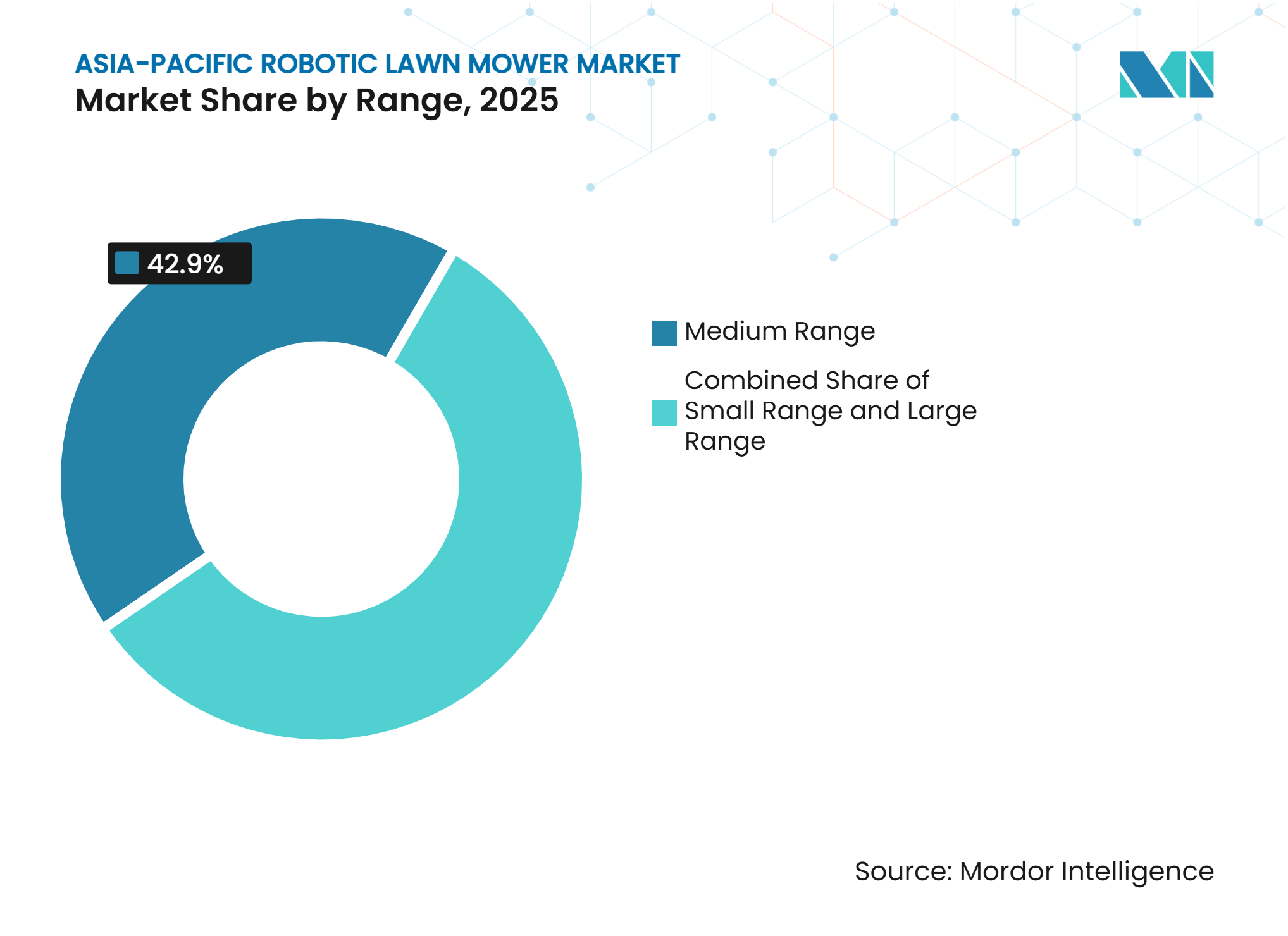
High-Range Systems Gain Ground in Commercial ChannelsThe medium-range segment accounted for 42.9% of revenue in 2025, representing the volume base for buyers with lawns between 501 and 2,000 square meters. These products suit premium residential properties that require more capacity than entry-level equipment but do not need commercial-scale coverage. The high-range segment is forecast to grow at a 17.1% CAGR through 2031, the fastest rate among segments. Commercial users requiring coverage above 2,000 square meters often deploy multiple machines across a site. Golf courses, managed campuses, and municipal spaces are increasingly adopting fleets of 3 to 5 units instead of a single large mower. This approach distributes work across zones and provides greater operational flexibility. The Asia Pacific robotic lawn mower market presents a clear opportunity for high-range models that support fleet coordination and longer continuous operation. Low-range models remain relevant in Japan and Singapore, where garden sizes frequently fall within their coverage limits.
The low-range segment serves smaller properties below 500 square meters and faces strong competition from conventional electric equipment. Its growth is more limited, as buyers can directly compare its price with corded and handheld products. High-range systems are differentiated by operating time, slope performance, mapping capability, and commercial support. STIGA has stated that its APX Pro can use up to 6 removable ePower Pro batteries, supporting extended operation across commercial sites[2]. Manufacturers are therefore designing systems around duty cycles rather than lawn area alone. This is particularly relevant for operators managing sports facilities and golf sites in the Asia Pacific robotic lawn mower market. Suppliers also need to provide reliable maintenance arrangements, as commercial users face direct service disruption when a machine is unavailable. Improved battery management and fleet software are expected to support the high-range segment's faster expansion.



By Battery Capacity:
High-Voltage Platforms Become the Efficiency StandardBattery systems above 30 V represented the leading battery configuration in 2025. High-voltage systems support larger cutting areas, steeper inclines, and longer operating periods. Premium wire-free models from Mammotion, Segway Navimow, and Husqvarna use higher-output battery platforms to power navigation and mowing functions. Systems below 20 V are better suited to small residential lawns. The 20-30 V category addresses mid-sized gardens where users require a balance between price and runtime. Higher-capacity products are increasingly relevant to the Asia Pacific robotic lawn mower market as commercial users need predictable operating time. Battery choice also affects charging frequency, replacement needs, and the ability to run connected sensors. Buyers are likely to compare voltage alongside coverage area and terrain capability rather than treating it as a separate technical feature.
Battery cost trends in China support the availability of larger packs for domestic equipment manufacturers. Chinese suppliers can benefit from local battery procurement and manufacturing scale when producing high-capacity wire-free products. European brands may offset some cost pressure through established dealer networks, product design, and customer support. Australia's transport and recycling requirements add a compliance consideration for suppliers seeking wider distribution of battery-powered equipment. Manufacturers therefore need to manage battery safety, collection, and disposal as part of their product strategy. The Asia Pacific robotic lawn mower market requires batteries that perform reliably in warm climates and during repeated charging cycles. Product differentiation is shifting toward runtime, fast battery changes, and power management rather than voltage specifications alone. This shift also gives modular battery systems a stronger role in professional mowing applications.
By Sales Channel:
Online Channels Disrupt the Installation-Centric ModelSpecialty stores held the largest revenue share of 40% in 2025, as many buyers continue to value product demonstrations, installation advice, and local service. Online sales channels are forecast to grow at a 17% CAGR through 2031. Digital channels are particularly effective for wire-free models, where the installation process can be presented as simpler and faster. China, South Korea, and Australia have established e-commerce markets for high-consideration consumer equipment. Brands that provide clear online guidance on lawn size, slope limits, charging needs, and navigation coverage are better positioned to capture demand in the Asia Pacific robotic lawn mower market. Retailers remain important for boundary-wire systems, as these models often require site-specific installation support. Physical stores also allow customers to evaluate build quality and ask questions before purchase. The primary channel shift is toward a hybrid model, where product discovery occurs online, and support remains available locally.
Direct-to-consumer launches can help brands reach early adopters before establishing full retail coverage. Segway Navimow used its own digital storefronts for pre-order events associated with the X4 and i2 AWD series in 2026. This approach can capture demand from buyers who are already familiar with wire-free technology, but it also requires strong customer onboarding, as a poor setup experience can result in returns and negative reviews. Dealers are likely to remain central for commercial products, where users require site surveys, training, and repair support. Physical channels are expected to be retained in the Asia Pacific robotic lawn mower market even as online sales expand. Suppliers that connect online ordering with local installation options can reduce friction for first-time buyers. Channel strategy will increasingly depend on a product's installation complexity and the availability of nearby service providers.
By Application:
Residential Scale, Commercial MomentumThe residential segment accounted for 62.9% of revenue in 2025 and remained the largest application area. Homeowner demand is strongest in Australia, Japan, South Korea, and higher-income urban locations in China. Commercial applications are forecast to grow at a 16.6% CAGR through 2031, the fastest rate within this segmentation. Commercial buyers can more easily absorb upfront equipment costs when weighed against recurring labor expenses, and they operate larger sites that require regular, scheduled mowing. Fleet sales in the commercial segment may lead to larger individual orders, benefiting the Asia-Pacific robotic lawn mower market. Residential demand will continue to provide volume, while commercial demand may drive advanced product specifications. These different buying patterns require manufacturers to offer both simple consumer models and managed fleet solutions.
Golf courses in Japan and Australia are among the early commercial adopters, as turf quality and labor scheduling are central to their operations. Commercial autonomous mower offerings are being developed for golf facilities and other managed turf sites. Australia and Japan are further along in commercial adoption, while South Korea and Singapore are transitioning toward wider use. India and Malaysia remain more residential-focused, with selective trials at campuses and managed properties. Commercial buyers require equipment capable of operating across larger areas and integrating into existing maintenance processes. Suppliers will need to demonstrate uptime, service response, and site-level cost control to grow within the Asia Pacific robotic lawn mower market. Residential products, in contrast, require easier setup, reliable obstacle handling, and clear value for homeowners. These differing requirements will shape product portfolios and distribution strategies across the region.
By Connectivity:
Wire-Free Overtakes the Market's Installed BaseBoundary-wire systems accounted for 50.4% of connectivity revenue in 2025, equal to USD 675.1 million. The installed base and replacement demand supported this position. Vision-guided camera and LiDAR systems are forecast to grow at an 18.9% CAGR through 2031, the fastest rate among connectivity types. Falling sensor costs are making wire-free equipment more accessible to premium residential buyers. Smart-GPS and Wi-Fi models occupy the middle segment for users who want simplified installation without a full LiDAR package. The Asia Pacific robotic lawn mower market is shifting toward wire-free navigation as customers look to avoid perimeter installation work. Boundary-wire products retain value where users already have a functioning wire layout. The transition is therefore expected to be gradual rather than immediate.
Existing boundary-wire users may choose replacement models with the same architecture, as the wire represents a prior investment and a familiar setup. New property buyers and commercial projects may be more open to wire-free equipment where there is no existing system to retain. Segway Navimow stated in 2026 that it had led global wire-free robotic lawn mower volume sales for two consecutive years and sold products in more than 40 countries, including Australia. The Asia Pacific robotic lawn mower market will require reliable positioning to support this transition in dense urban areas and under tree cover. Users also need assurance that camera and location data are managed responsibly. Suppliers that improve setup, mapping, and boundary editing can make wire-free systems easier for new buyers to adopt. Connectivity will become a key point of competition as it affects installation, reliability, and user experience. Dealers can support customers by helping them evaluate which architecture suits their property.
By End-User:
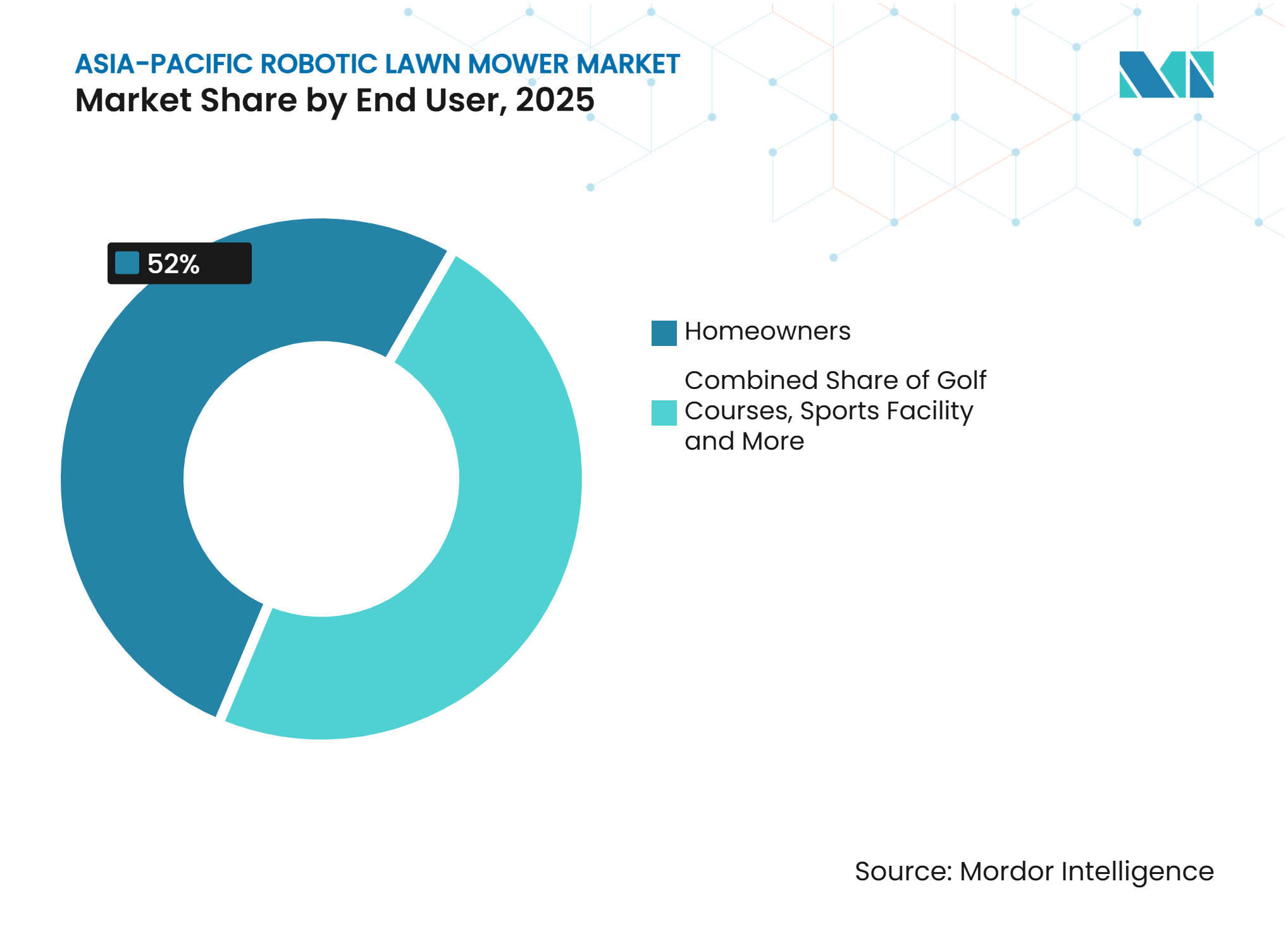
Golf Courses Lead Commercial AdoptionHomeowners accounted for 52% of revenue in 2025, making them the largest end-user group. Golf courses are forecast to grow at an 18% CAGR through 2031, the highest rate among all end-user segments. Course operators face rising labor costs and require consistent turf presentation for members and visitors. Australia had 1,600 registered golf courses, Japan had more than 2,300, and South Korea had more than 500, providing a substantial base for commercial equipment sales. Landscaping companies are also adopting autonomous mowing to protect service margins as wage costs rise. Municipalities and sports grounds are important long-term buyers, as public procurement typically requires detailed testing and compliance reviews. These end users are well-suited to the Asia Pacific robotic lawn mower market because their mowing schedules are regular, and their operational value can be measured. Homeowners remain important as they represent the broadest base of annual unit demand.
Sports facility operators require more than basic mowing, as they may also manage field markings and complex grounds layouts. FJDynamics promoted its Map-Mow-Mark-Manage ecosystem for sports turf at SFMA 2026, combining mowing, field mapping, and line-marking functions[3]. This type of product design addresses the broader operational needs of professional grounds teams. Golf courses can evaluate robotic mowing against weekly greenkeeping hours, while contractors can incorporate it into recurring service contracts. Municipal projects may progress more slowly, as public buyers often require formal pilots and safety validation. Serving these end users in the Asia Pacific robotic lawn mower market requires specialized sales and support capabilities. Product features such as remote fleet monitoring, modular batteries, and scheduled mowing are particularly valuable for commercial operators. The range of end users also means that brands must support different price points and service expectations.

Geography Analysis
China accounted for 38% of regional revenue in 2025, supported by a large domestic manufacturing base, a well-developed smart-device ecosystem, and demand from managed residential communities. Japan and South Korea are projected to grow, with Japan's aging population driving demand for automation in routine garden maintenance, while South Korea's connected-device retail ecosystem offers a relevant channel for consumers interested in smart outdoor equipment.
Australia's growth is supported by larger residential plots, high labor costs, and commercial trials at golf facilities. The country's product-safety requirements for robotic lawn mowers favor suppliers that meet established safety and engineering standards. New Zealand and Malaysia require different product approaches due to variations in climate, property size, service networks, and buyer expectations. Australia is likely to remain an important market for large lawns and commercial use cases within the Asia-Pacific robotic lawn mower market.
India is the fastest-growing country market in the region, with a projected CAGR of 16%, driven by a low installed base and growing adoption of automation to improve productivity. Singapore's growth is tied to high-value managed green spaces and high labor costs. Growth across the rest of Asia Pacific is supported by wire-free products sold through e-commerce, where formal dealer networks are limited. Converting this interest into sustained adoption will require local service infrastructure and product education.
Competitive Landscape
Market Concentration
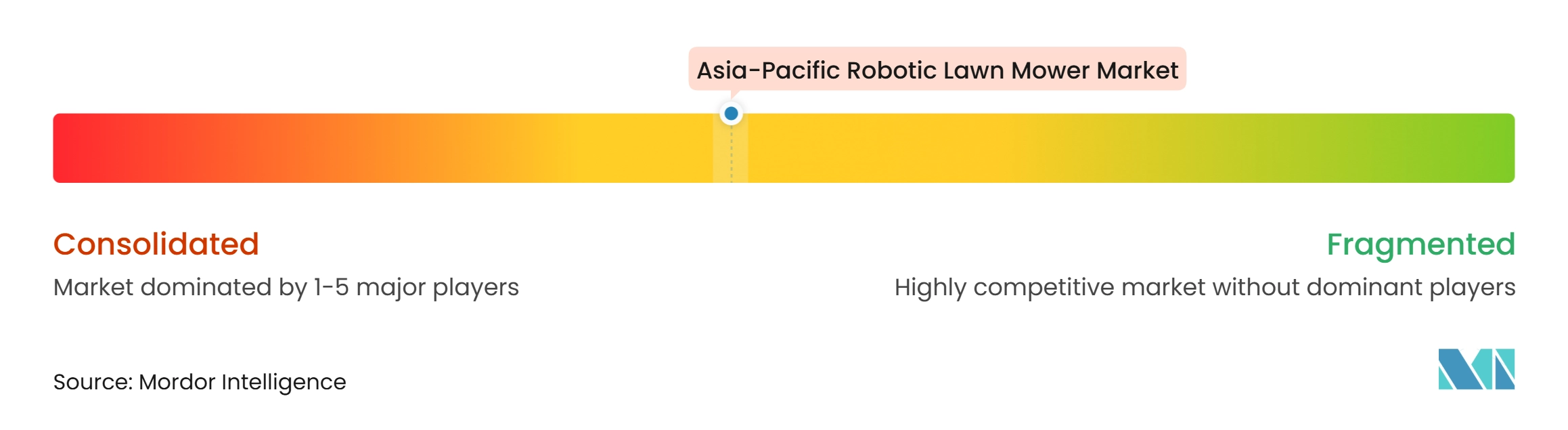
The Asia Pacific robotic lawn mower market is moderately concentrated in 2025. Husqvarna AB, Segway-Ninebot Group, Honda Motor Co., Ltd., Robert Bosch GmbH, and Shenzhen Mammotion Technology Co., Ltd. are among the prominent players in the market. Established European and Japanese brands compete through dealer networks, engineering experience, and after-sales support, while Chinese suppliers compete through rapid product development, wire-free navigation, and competitive pricing. Husqvarna AB launched its Automower Vision and iQ products in Australia and New Zealand in 2026, featuring cloud-referenced EPOS satellite technology and AI Vision cameras. Competition is most intense in the premium wire-free segment, where navigation accuracy, installation simplicity, and local service influence buyer decisions.
Mammotion expanded from 1 product line in 2022 to 6 series by September 2026, including the Maston commercial fleet platform. STIGA launched 8 autonomous mowers in 2026 using Vista Technology and introduced the APX Pro for larger professional sites. FJDynamics is targeting professional sports turf through a platform that combines mowing, mapping, and line marking. These developments indicate that companies are pursuing positions beyond standard residential mowing. The Asia Pacific robotic lawn mower market presents opportunities for products suited to tropical terrain and for providers that establish installation support networks in India and secondary Australian cities.
Yamabiko Europe entered an agreement with The Toro Company in 2025 to jointly develop robotic mowers and range pickers for golf and sports turf markets. Kress developed its Voyager KR800 commercial mower for route-based landscaping use, with planned availability through dealers in Australia in 2026. Potential European trade measures on Chinese robotic mower imports could shift greater commercial attention toward Southeast Asia and Australia. Companies need to pair technology launches with safety compliance, local service capability, and clear customer value propositions.
Asia-Pacific Robotic Lawn Mower Industry Leaders
-
Husqvarna AB
-
Segway-Ninebot Group
-
Honda Motor Co., Ltd.
-
Robert Bosch GmbH
-
Shenzhen Mammotion Technology Co., Ltd.
- *Disclaimer: Major Players sorted in no particular order
Asia-Pacific Robotic Lawn Mower Market Companies Covered in this Report
- Husqvarna AB
- Segway-Ninebot Group
- ANDREAS STIHL AG and Co. KG
- Robert Bosch GmbH
- Honda Motor Co., Ltd.
- Deere and Company
- Shenzhen Mammotion Technology Co., Ltd.
- Positec Technology (China) Co., Ltd.
- The Toro Company
- STIGA S.p.A.
- Stanley Black and Decker, Inc.
- Globe (Guangdong) Intelligent Technology Co., Ltd.
- Yamabiko Corporation
- iRobot Corporation
- EcoFlow Inc.
- FJDynamics Technology Co., Ltd.
Recent Industry Developments in Asia-Pacific Robotic Lawn Mower Market
- September 2026: Mammotion unveiled the LUBA 4 AWD series at IFA 2026 in Berlin, featuring Surround Quad-Vision, Tri-Fusion positioning using LiDAR, RTK, and AI Vision, and bidirectional mowing across 3 models covering lawns from 3,000 to 12,000 square meters. The company also introduced the Maston commercial robotic mowing solution for large professional grounds.
- September 2026: Segway Navimow launched the H5 Pro at IFA 2026 with the EdgeMaestro extendable robotic arm for edge mowing along fences and walls. The product was launched across more than 40 countries, including Australia.
- March 2026: STIGA S.p.A. launched 8 autonomous robot mowers using Vista Technology and Antenna-FREE navigation globally, including the Asia-Pacific region. The company also launched the APX Pro commercial mower for sports facilities, municipalities, and golf clubs.
Asia-Pacific Robotic Lawn Mower Market Report Scope
A robotic lawn mower is an autonomous, battery-powered machine designed to mow and maintain grass with minimal human intervention. It uses sensors, navigation systems, and intelligent controls to operate within a defined lawn area, avoid obstacles, maintain the desired grass height, and recharge automatically when required.
The Asia-Pacific robotic lawn mower market report is segmented by range (low, medium, and high), by battery capacity(less than 20 V, 20 to 30 V, and more than 30 V), by sales channel(retailers, specialty stores, and online), by connectivity(boundary-wire, smart GPS and Wi-Fi, and vision-guided, camera, and LiDAR systems), by end-user(homeowners, landscaping companies, sports grounds and parks, municipalities, golf courses, and others) and by geography (China, India, Australia, Malaysia and Rest of Asia-Pacific). Market forecasts are presented in terms of value in USD.
Segmentation Overview
| Low Range |
| Medium Range |
| High Range |
| Less Than 20 V |
| 20 to 30 V |
| More Than 30 V |
| Retailers |
| Specialty Stores |
| Online |
| Residential |
| Commercial |
| Homeowners |
| Landscaping Companies |
| Sports Grounds and Parks |
| Municipalities |
| Golf Courses |
| Rest of End-User Applications |
| Boundary-Wire |
| Smart-GPS and Wi-Fi |
| Vision-Guided, Camera and LiDAR |
| China |
| Japan |
| India |
| South Korea |
| Australia |
| Malaysia |
| Rest of Asia-Pacific |
| By Range | Low Range |
| Medium Range | |
| High Range | |
| By Battery Capacity | Less Than 20 V |
| 20 to 30 V | |
| More Than 30 V | |
| By Sales Channel | Retailers |
| Specialty Stores | |
| Online | |
| By Application | Residential |
| Commercial | |
| By End-User | Homeowners |
| Landscaping Companies | |
| Sports Grounds and Parks | |
| Municipalities | |
| Golf Courses | |
| Rest of End-User Applications | |
| By Connectivity | Boundary-Wire |
| Smart-GPS and Wi-Fi | |
| Vision-Guided, Camera and LiDAR | |
| By Geography | China |
| Japan | |
| India | |
| South Korea | |
| Australia | |
| Malaysia | |
| Rest of Asia-Pacific |
Key Questions Answered in the Report
What is the projected value of robotic lawn mowers in Asia Pacific by 2031?
The Asia Pacific robotic lawn mower market is projected to reach USD 2.8 billion by 2031, growing at a 13.2% CAGR from 2026.
Which application is growing fastest for robotic lawn mowers in Asia Pacific?
Commercial applications are forecast to grow at a 16.6% CAGR through 2031, supported by golf courses, campuses, parks, and managed properties.
Why are wire-free robotic mowers gaining adoption in Asia Pacific?
Wire-free RTK, LiDAR, and vision systems reduce installation work and are better suited to compact gardens, shared boundaries, and complex urban layouts.
Which country has the largest regional revenue share?
China held 38% of regional revenue in 2025, supported by domestic manufacturing capacity, connected-device adoption, and managed residential landscaping.
Which end user has the strongest forecast growth?
Golf courses are forecast to grow at an 18% CAGR through 2031 because operators can measure the value of automation against recurring labor and turf-maintenance needs.