
Asia-Pacific Kitchen Sink Market Size and Share
Market Overview
| Study Period | 2020 - 2031 |
|---|---|
| Forecast Data Period | 2026 - 2031 |
| Base Year Market Size (2025) | USD 0.9 Billion |
| Market Size (2026) | USD 0.96 Billion |
| Market Size (2031) | USD 1.30 Billion |
| Growth Rate (2026 - 2031) | 6.32 % |
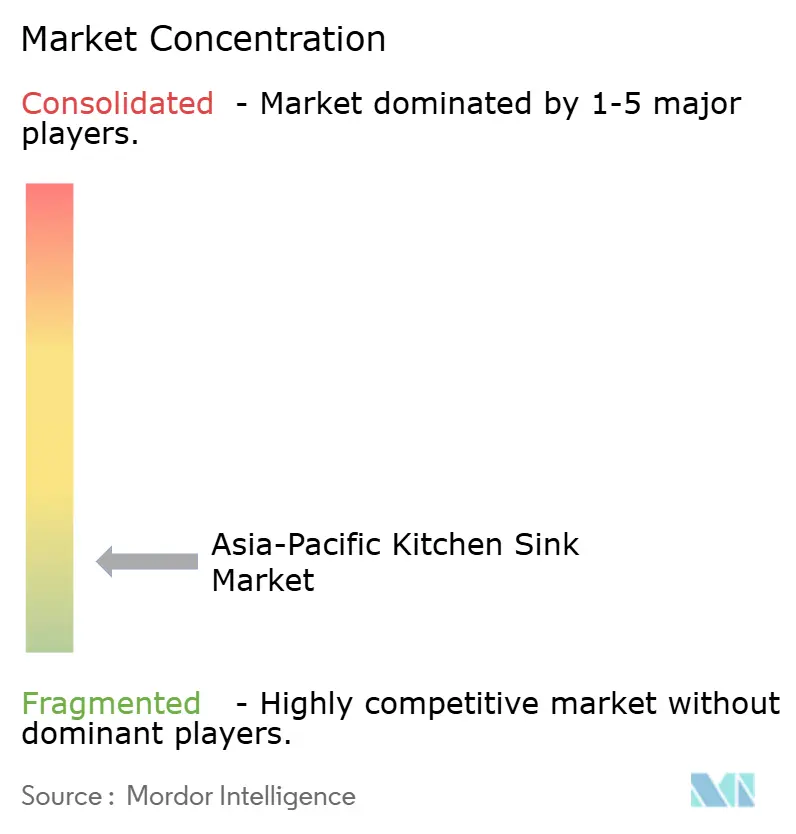
| Market Concentration | Low |
Major Players *Disclaimer: Major Players sorted in no particular order Image © Mordor Intelligence. Reuse requires attribution under CC BY 4.0. | |
Asia-Pacific Kitchen Sink Market Analysis by Mordor Intelligence
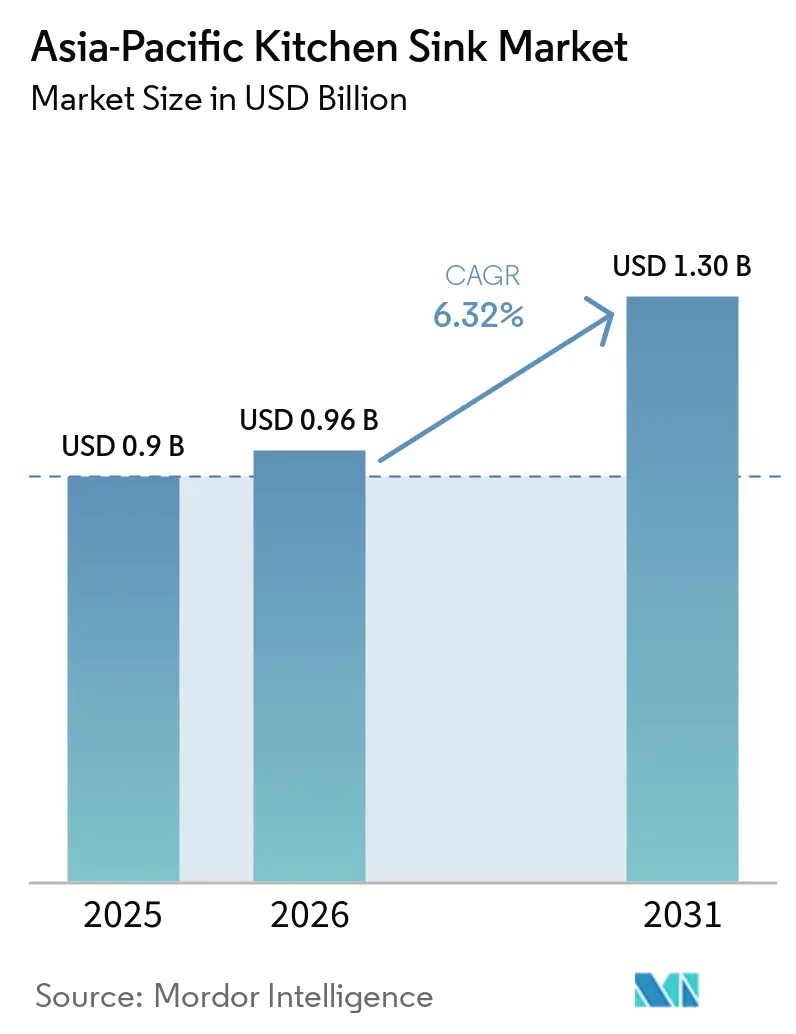
The Asia-Pacific kitchen sink market size is projected to expand from USD 0.9 billion in 2025 and USD 0.96 billion in 2026 to USD 1.30 billion by 2031, registering a CAGR of 6.32% between 2026 and 2031. Demand is moving from basic stainless steel replacement products toward composite, fireclay, and workstation formats with higher selling prices, particularly where a kitchen renovation includes new counters, cabinetry, and food preparation accessories. China remained the region’s largest demand base, although its weaker property cycle limited volume growth and reduced the number of new-build projects using standard builder-grade fittings. India’s housing programs and expanding modular kitchen base supported a broader pipeline for new installations, while the pace of urban household formation created demand across both affordable and branded product categories. Premium renovation demand in mature markets also supported sales of integrated and design-focused products, since homeowners can upgrade a sink and countertop together without undertaking an entire home renovation. Manufacturers are responding through local production, wider retail coverage, and digital product discovery tools that help purchasers compare materials and installation choices before selecting a product.
Key Report Takeaways
- By material, stainless steel held 58.79% of the Asia-Pacific kitchen sink market share in 2025, while fireclay is projected to grow at a 7% CAGR through 2031.
- By installation type, top-mount and drop-in products accounted for 45% of the Asia-Pacific kitchen sink market share in 2025, while undermount products are forecast to expand at a 7.5% CAGR through 2031.
- By bowl configuration, single-bowl products held 52% revenue share in 2025, while dual-bowl products are forecast to grow at a 7% CAGR through 2031.
- By end user, residential applications accounted for 82% revenue share in 2025, while commercial applications are projected to grow at a 8.57% CAGR through 2031.
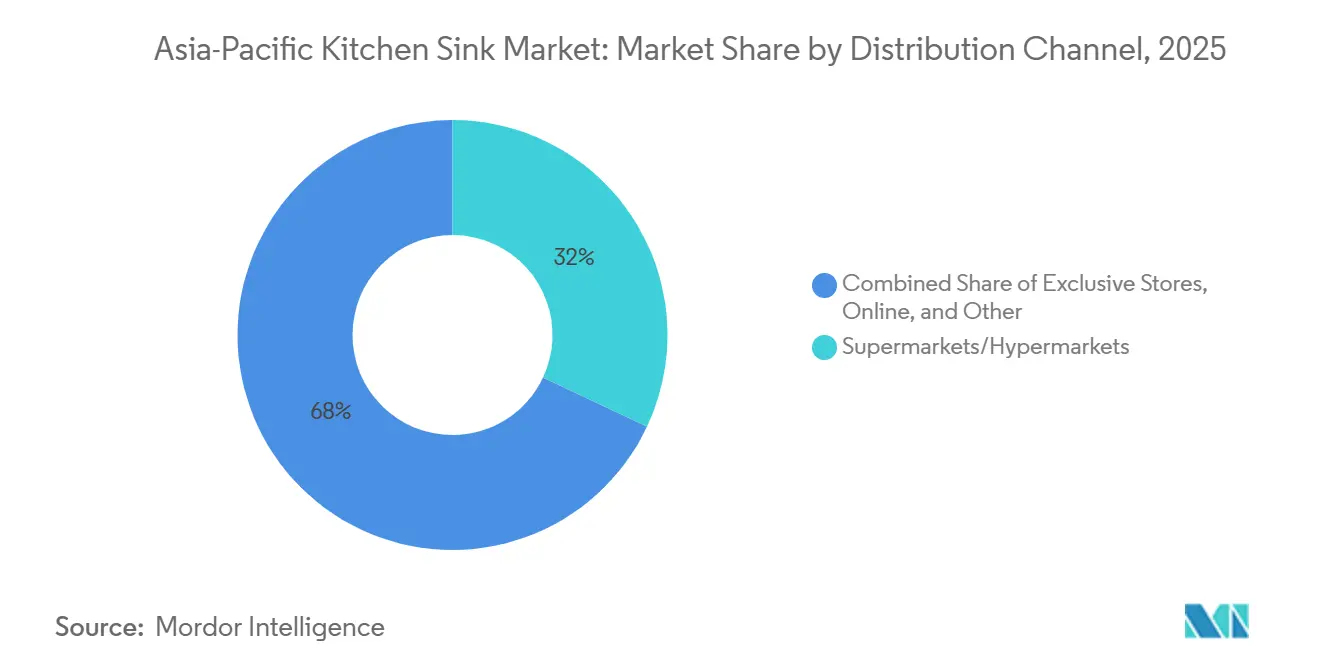
- By distribution channel, supermarkets and hypermarkets held 32% revenue share in 2025, while online channels are forecast to grow at an 8.5% CAGR through 2031.
- By geography, China led with a 38.2% regional share in 2025 in the kitchen sink market, while the India is the fastest growing at a 11.24% CAGR through 2031.
Note: Market size and forecast figures in this report are generated using Mordor Intelligence’s proprietary estimation framework, updated with the latest available data and insights as of January 2026.
Asia-Pacific Kitchen Sink Market Trends and Insights
Drivers Impact Analysis*
| Driver | (~) % Impact on CAGR Forecast | Geographic Relevance | Impact Timeline |
|---|---|---|---|
| Urban Housing and Modular Kitchen Formation | +2.1% | India, China tier-2 and tier-3 cities, Southeast Asia | Medium term (2-4 years) |
| Hospitality, Foodservice, and Cloud Kitchen Build-Out | +1% | Asia-Pacific, led by India, Southeast Asia, and South Korea | Short term (≤ 2 years) |
| Disposable Income and Premium Fixture Upgrades | +0.9% | Australia, South Korea, Japan, and urban India | Medium term (2-4 years) |
| E-Commerce and Omnichannel Home Improvement Expansion | +0.8% | China, India, and Southeast Asia | Short term (≤ 2 years) |
| Retrofit Demand from Compact Urban Kitchens | +0.5% | Japan, South Korea, Australia, and Singapore | Long term (≥ 4 years) |
| Export Manufacturing Clusters Lowering Premium Sink Costs | +0.4% | India, including Gujarat and Rajasthan, and China, including Guangdong and Fujian | Medium term (2-4 years) |
| Source: Mordor Intelligence | |||
Accelerating Urban Housing and Modular Kitchen Formation
India’s Pradhan Mantri Awas Yojana Urban program had sanctioned 1.18 crore homes by November 2024, with more than 89 lakh homes completed[1]. PMAY-U 2.0 was launched in September 2024 and targets an additional 1 crore households, sustaining the housing supply pipeline through the forecast period. This construction pipeline supports continued demand for kitchen fixtures across affordable and mid-income homes, where builders increasingly specify basic but durable kitchen components during construction. Developers are increasingly using fitted kitchen layouts to shorten the time between completion and occupancy and to deliver a usable home without a separate post-possession fitting process. That practice creates a direct specification opportunity for sinks rather than leaving the purchase to a later renovation cycle, especially for projects using standardized cabinet and countertop layouts. The Asia-Pacific kitchen sink market benefits where modular kitchen adoption rises alongside new urban housing, because each completed kitchen requires a functional washing and preparation area.
Hospitality, Foodservice, and Cloud Kitchen Build-Out
The Asia-Pacific hotel pipeline excluding China reached 2,262 projects and 434,593 rooms at the end of the third quarter of 2025[2]. The pipeline included 311 planned hotel openings and 63,544 rooms in 2026, extending the need for kitchen equipment into the current year. Hotels require durable sink installations in food preparation, washing, and service areas, where frequent use places greater importance on material strength and drainage performance. KKR completed an investment in Rebel Foods in December 2024 to support its expansion across India and the Middle East[3]. Rebel Foods operated 450 cloud kitchens and more than 5,000 internet restaurants when the investment was announced, illustrating the scale of commercial food preparation infrastructure. These projects support commercial demand for robust stainless steel installations in the Asia-Pacific kitchen sink market, rather than the lighter-duty products often selected for standard residential kitchens.
Rising Disposable Income and Premium Fixture Upgrades
Premium fixture upgrades are becoming more relevant in Australia, South Korea, Japan, and urban India as households allocate renovation budgets to kitchens that are used daily and remain visible within open-plan homes. Kitchen renovation projects in Australia commonly include stainless steel, quartz, and fireclay products within the overall project specification, rather than treating the sink as an isolated replacement purchase. In South Korea, partial renovation has created a route for consumers to replace a sink or countertop without rebuilding the entire kitchen and without the time or expense of extensive interior work. This approach can shorten the replacement cycle for individual fixtures by making a focused upgrade more practical for an occupied household. It also supports demand for products that offer a visible design change with limited construction work, including seamless installations and coordinated countertop finishes. The Asia-Pacific kitchen sink market therefore has opportunities in renovation projects as well as in new homes, particularly where homeowners value practical improvements alongside material and design choices.
Expansion of E-Commerce and Omnichannel Home Improvement
Online product research has changed how consumers compare kitchen fixtures across Asia-Pacific, placing material, size, configuration, and accessory information before the buyer earlier in the decision process. Consumers can review materials, dimensions, accessories, and installation formats before visiting a store, which helps them narrow options based on cabinet space and intended kitchen use. Digital channels are particularly relevant in locations where specialist kitchen showrooms are limited and where buyers may otherwise have access only to a small local retail range. Physical stores still matter because buyers often want to assess finish, depth, surface texture, and the practical scale of a product before purchase. The combination of online comparison and offline validation supports premium trade-up decisions because it gives buyers more confidence in selecting a higher-value format. This channel shift gives the Asia-Pacific kitchen sink market a wider route to tier-2 and tier-3 buyers while allowing brands to use stores for product demonstration and installation support.
Restraints Impact Analysis*
| Restraint | (~) % Impact on CAGR Forecast | Geographic Relevance | Impact Timeline |
|---|---|---|---|
| Stainless Steel, Granite, and Ceramic Input Price Volatility | -1.2% | Asia-Pacific, especially China and India | Short term (≤ 2 years) |
| Price Competition from Local and Global Brands | -0.7% | China, India, and Southeast Asia | Short term (≤ 2 years) |
| Countertop Fabrication Constraints for Undermount and Integrated Sinks | -0.5% | Australia, South Korea, Japan, and urban India | Medium term (2-4 years) |
| Inconsistent Plumbing and Cabinet Standards | -0.8% | Southeast Asia, India tier-2 and tier-3 cities, and Rest of Asia-Pacific | Long term (≥ 4 years) |
| Source: Mordor Intelligence | |||
Stainless Steel, Granite, and Ceramic Input Price Volatility
Nickel is a major cost component for 300-series stainless steel products, so changes in the metal’s price quickly influence procurement decisions for manufacturers and their suppliers. Changes in nickel pricing can affect finished sink pricing across the supply chain, particularly for standard steel models that compete closely on retail price. Producers serving price-sensitive buyers have less ability to recover a higher material cost through selling prices, because buyers can shift between local and international brands. This can compress margins and delay production decisions for domestic manufacturers, even when the underlying demand for replacement products remains steady. The pressure is particularly relevant for suppliers focused on lower-priced channels in India and China, where scale and basic functionality are important purchase criteria. Cost volatility can therefore limit the ability of the Asia-Pacific kitchen sink market to translate premium demand into higher margins across its broader product range.
Inconsistent Plumbing and Cabinet Standards Across Fast-Growth Markets
Plumbing connections, cabinet depths, and countertop tolerances differ across several fast-growing Asian markets, even where buyers are seeking similar kitchen layouts and product features. Indonesia, Vietnam, Thailand, and the Philippines present varied installation requirements that prevent a single sink format from fitting every local project without adjustment. Manufacturers may need to carry multiple product configurations for a similar sink model, including different drainage connections and dimensions for cabinet openings. This raises inventory and logistics needs while reducing the benefits of a uniform regional product range and making smaller production runs less efficient. Fitment issues can also extend installation timelines during renovation projects, especially when sink replacement, countertop work, and plumbing changes take place at the same time. These conditions slow adoption of the more installation-sensitive formats in the Asia-Pacific kitchen sink market, including undermount and integrated workstation products.
*Our forecasts treat driver/restraint impacts as directional, not additive. The impact forecasts reflect baseline growth, mix effects, and variable interactions.
Segment Analysis
By Material: Premium Demand Extends Beyond Stainless Steel
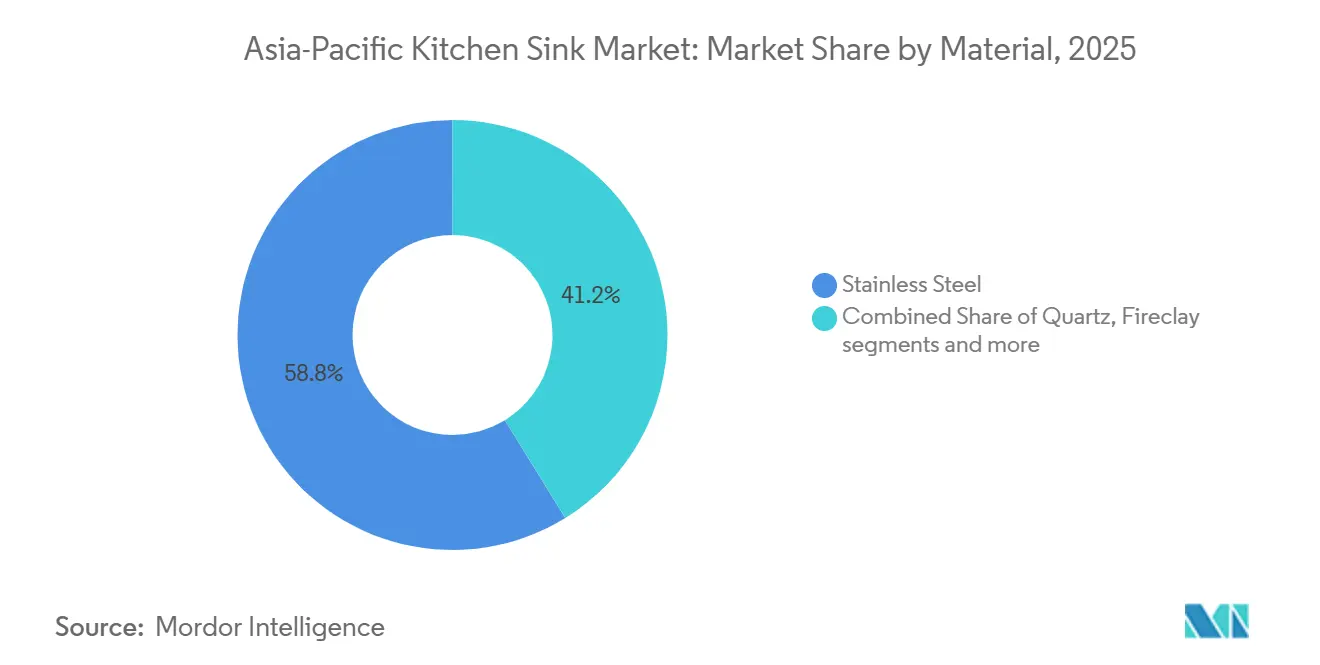
Stainless steel held 58.79% of the Asia-Pacific kitchen sink market share in 2025. Its position reflected cost efficiency, hygiene, and compatibility with builder specifications across China, India, and Southeast Asia. Grade 304 and Grade 316 products remain relevant in coastal markets because they suit demanding environmental conditions. These grades also retain a pricing advantage in high-volume channels. Quartz composite and granite or marble products serve buyers seeking nonporous and scratch-resistant surfaces. Their appeal is strongest among consumers planning integrated workstations and coordinated countertop designs. Acrylic products remain relevant for affordable housing because they are lightweight and simple to install. Other materials include niche cast-iron and copper formats with narrower demand.
Fireclay is projected to be the fastest-growing material, with the Asia-Pacific kitchen sink market size for this segment advancing at a 7% CAGR through 2031. Demand is supported by apron-front and farmhouse designs in premium residential projects across India, South Korea, and Australia. Kohler introduced its Audrine kitchen sink collection in January 2026, using nonporous fireclay and a built-in accessory ledge[4]. The launch reflected demand for products that combine visual distinction with practical kitchen features. Fireclay’s deeper form and finished appearance distinguish it from standard steel options in open-plan kitchens. Its higher price remains a limitation in smaller cities. However, wider online access and lower fabrication costs are making the material more accessible.

By Installation Type: Undermount Products Gain in Premium Renovations
Top-mount and drop-in products accounted for 45% of the Asia-Pacific kitchen sink market share in 2025. Builder-grade projects in China and India continue to prefer this format because it works with common countertop designs. Installation costs are also lower than for more complex configurations. Top-mount products can be replaced without major countertop work. This makes them suitable for rental properties and developer-built homes. Flush-mount and dual-mount designs serve more specialized uses in Japan’s integrated kitchen systems. Farmhouse and apron-front formats follow demand for fireclay in higher-priced kitchens. Other installations include workstation models with integrated accessory ledges.
Undermount products are forecast to grow at a 7.5% CAGR through 2031. The format is supported by engineered quartz and granite countertops in South Korean renovation projects and Australian homes. Buyers value the uninterrupted countertop edge and easier cleaning surface. Installation requires accurate countertop fabrication and professional fitting. Cabinetry must also support the additional fixture weight. These requirements raise total project costs and concentrate demand in markets with developed installation networks. The Asia-Pacific kitchen sink market has stronger undermount demand where renovation budgets can support specialist labor and coordinated kitchen upgrades.
By Bowl Configuration: Dual-Bowl Formats Support Task Separation
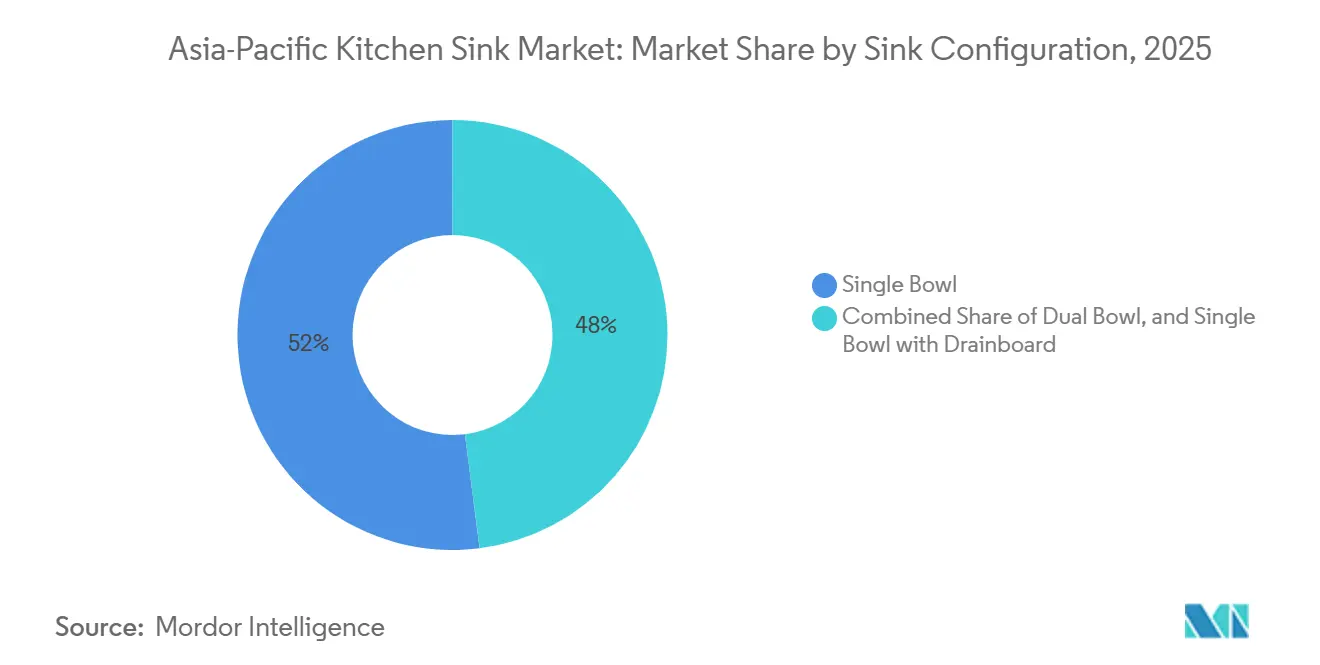
Single-bowl products held 52% revenue share in 2025. Their position reflects their fit with compact apartments, where counter depth and cabinet width are constrained. Single bowls are widely used in Indian affordable housing and China’s high-volume residential stock. Buyers in these channels often prioritize functional fit over premium features. Single-bowl products with drainboards also provide an integrated drying area where dishwashers are less common. This design remains useful in price-sensitive markets. Workstation versions of single-bowl sinks can extend the format into premium kitchens. Their integrated accessories add preparation and serving functions without requiring a larger cabinet.
Dual-bowl products are forecast to expand at a 7% CAGR through 2031. The design allows food preparation and dishwashing to take place separately. This feature is relevant for larger modular kitchens and multigenerational households across South and Southeast Asia. Rising income in India’s metro areas and Australia’s renovation activity support this format. Compact dual-bowl units also suit partial upgrades in Japan, where a household may improve workflow without replacing cabinetry. Carysil offers dual-bowl composite products within its export range. The Asia-Pacific kitchen sink market gains from this configuration as consumers place greater value on task separation and flexible kitchen use.
By End User: Residential Demand Remains Largest While Commercial Demand Expands
Residential applications accounted for 82% of the Asia-Pacific kitchen sink market share in 2025. The segment depends on new home completion, replacement demand, and modular kitchen adoption. India’s housing program and urban construction pipeline provide a substantial base for new residential specifications. A completed home creates at least 1 kitchen sink requirement. Higher-value homes may include an additional preparation sink or integrated workstation. Renovation also supports sales when new construction slows. LIXIL reported that renovation-related sales supported its Japanese business in fiscal year 2025. This demand helps maintain residential purchases in mature markets.
Commercial applications are forecast to grow at a 8.57% CAGR through 2031. Hotel construction and cloud kitchen investment create a separate stream of kitchen infrastructure demand. The regional hotel pipeline reached a record 2,262 projects and 434,593 rooms in the third quarter of 2025. Commercial projects commonly require heavy-gauge stainless steel products and reinforced installation systems. Foodservice operators also need practical drainage arrangements in high-use work areas. These specifications can have a higher value than comparable residential products. The Asia-Pacific kitchen sink market therefore receives a meaningful revenue contribution from a commercial segment that remains smaller by volume.
By Distribution Channel: Digital Discovery Expands Product Access
Supermarkets and hypermarkets held 32% revenue share in 2025. These outlets benefit from routine customer traffic, promotional space, and convenience for replacement purchases. Exclusive stores and kitchen studios remain important for premium renovation buyers. They let consumers inspect product surfaces and compare a sink with countertop and cabinet finishes. BLANCO reported sales growth in its Asia-Pacific international partner business during 2024. The company had more than 100 mono-brand showrooms and was present in more than 1,800 multi-brand showrooms across Asia-Pacific. Jaquar also opened a 58,000 sq. ft. flagship showroom in Indore during late 2025.
Online channels are projected to grow at an 8.5% CAGR through 2031. This is the fastest rate among the distribution types in the Asia-Pacific kitchen sink market. Online platforms support direct purchases in lower-density locations with fewer specialist stores. They also provide a research route for buyers planning premium renovations. Consumers can compare material options and accessory systems before making a showroom visit. JOMOO launched its official U.S. online store in November 2024. Its digital approach shows how manufacturers can build brand recognition while maintaining a competitive price position. Physical retail and online tools are likely to remain complementary rather than interchangeable.
Geography Analysis
China held 38.2% of the Asia-Pacific kitchen sink market share in 2025. Its scale comes from the size of the national residential construction base and its large domestic manufacturing capacity. Residential completions fell 20.2% in 2025 to 428.3 million square meters. New residential starts declined 19.8% to 429.84 million square meters in the same year. This reduced the demand for volume-led kitchen fixtures. Remaining buyers are more likely to seek durable and design-focused products as they spend on a completed home. JOMOO uses smart manufacturing capabilities through its work with Siemens Advanta to support customized products and shorter production cycles. China’s kitchen plumbing standards also create a quality threshold for product suppliers.
India is forecast to be the fastest-growing geography, with the Asia-Pacific kitchen sink market size in the country expanding at a 11.24% CAGR through 2031. PMAY-U 2.0 targets 1 crore additional households and provides a continuing base for housing-linked fixture demand. Urbanization and modular kitchen adoption add to the demand created by public housing programs. Registered residential transactions in key cities rose to 5.44 lakh units in fiscal year 2025. Carysil continues to expand in India’s branded sink segment alongside its export activity. The Bureau of Indian Standards certification framework for stainless steel products can favor suppliers with established compliance practices. India also has manufacturing clusters that can support a wider range of premium and affordable products.
Japan and South Korea are mature markets where renovation matters more than new-build volume. Japan’s large stock of vacant homes supports recurring renovation opportunities. LIXIL reported a 1% increase in Living Business revenue in the first quarter of fiscal year 2026, with renovation-related sales supporting results. South Korea’s partial renovation activity supports sink and countertop replacement without a full kitchen rebuild. Australia’s demand is tied to higher-value kitchen renovations and a preference for finished materials. BLANCO’s partnership with Shriro in Australia illustrates the use of broad retail distribution to reach kitchen upgrade buyers. Southeast Asia and the Rest of the Asia-Pacific region remain smaller demand bases, but hotel construction and urban growth create new installation opportunities. Vietnam, Indonesia, and the Philippines contribute demand from hospitality projects and first-time kitchen fitouts.
Competitive Landscape
The Asia-Pacific kitchen sink market is fragmented, with no single supplier reported to have a decisive regional position. LIXIL and TOTO have strong positions in Japan through integrated kitchen systems and renovation channels. European brands, including Franke, BLANCO, and Teka, compete through materials, design, and showroom-led sales. Franke acquired Nokite EcoSmart Water Heating Systems in China in 2024. The acquisition added stainless steel taps and accessories to Franke’s Home Solutions offering in China. It also gave the company a domestic production base for serving volume channels. Franke reported that Asia and Oceania represented 14.8% of group revenue in its 2025 profile.
Regional suppliers compete through manufacturing efficiency, export reach, and digital distribution. Carysil is an important Indian producer of quartz sink products and supplies international customers. Jaquar is expanding its showroom footprint to serve buyers in Indian tier-2 cities. Its Indore flagship opened in late 2025 and covered 58,000 sq. ft. JOMOO uses smart factory capabilities and a customer-to-factory model for customization. These capabilities allow regional manufacturers to address both volume and more design-focused orders. Local manufacturers in India and China also sustain price pressure across basic sink categories.
Affordable composite products remain an open opportunity in tier-2 and tier-3 cities across India and Southeast Asia. Premium European suppliers can have limited reach in this price-sensitive space. Export-focused producers may also focus more on higher-value overseas demand. Compliance requirements for drainage connections and quality systems can favor established branded suppliers in commercial specifications. POSCO signed a stainless steel supply agreement with Franke in July 2025 for premium product lines. The agreement reflected the importance of material sourcing and environmental credentials in premium positioning. The Asia-Pacific kitchen sink industry, therefore, combines global brand investment with regional manufacturing competition.
Asia-Pacific Kitchen Sink Industry Leaders
-
Franke Group
-
Kohler Co.
-
BLANCO GmbH + Co KG
-
Teka Industrial S.A.
-
Carysil Limited
- *Disclaimer: Major Players sorted in no particular order
Recent Industry Developments
- January 2026: Kohler Co. launched the Audrine kitchen sink collection, crafted from smooth nonporous fireclay, in partnership with designer Shea McGee of Studio McGee. Available in White and Dune finishes with a built-in accessory ledge, the launch marks Kohler’s first kitchen sink collaboration with Studio McGee and directly targets premium farmhouse aesthetic demand in premium residential markets.
- November 2025: Kohler introduced the Synthos Workstation Sink, a 16-gauge stainless steel, multi-accessory kitchen system available in 30-inch to 72-inch widths with SilentShield Plus sound-deadening technology. The launch reinforces the workstation sink format as a premium upsell that commands higher average selling prices than conventional drop-in or undermount units.
- October 2025: Indonesian cloud kitchen operator Hangry raised USD 10.5 million in a Series A5 round led by Alpha JWC Ventures to upgrade kitchen infrastructure across its 118-plus outlets and enter Malaysia. The capital deployment directly adds commercial-grade kitchen sink demand across new kitchen builds.
Asia-Pacific Kitchen Sink Market Report Scope
| Stainless Steel |
| Quartz |
| Fireclay |
| Granite/Marble |
| Acrylic |
| Others |
| Top-Mount / Drop-In |
| Undermount |
| Farmhouse / Apron-Front |
| Flush Mount |
| Dual Mount |
| Others |
| Single Bowl |
| Dual Bowl |
| Single Bowl with Drainboard |
| Residential |
| Commercial |
| Supermarkets/Hypermarkets |
| Exclusive Stores |
| Online |
| Other |
| India |
| China |
| Japan |
| Australia |
| South Korea |
| South-East Asia |
| Rest of Asia-Pacific |
| By Material | Stainless Steel |
| Quartz | |
| Fireclay | |
| Granite/Marble | |
| Acrylic | |
| Others | |
| By Installation Type | Top-Mount / Drop-In |
| Undermount | |
| Farmhouse / Apron-Front | |
| Flush Mount | |
| Dual Mount | |
| Others | |
| By Bowl Configuration | Single Bowl |
| Dual Bowl | |
| Single Bowl with Drainboard | |
| By End-User | Residential |
| Commercial | |
| By Distribution Channel | Supermarkets/Hypermarkets |
| Exclusive Stores | |
| Online | |
| Other | |
| By Geography | India |
| China | |
| Japan | |
| Australia | |
| South Korea | |
| South-East Asia | |
| Rest of Asia-Pacific |
Key Questions Answered in the Report
What is the forecast for the Asia-Pacific kitchen sink market?
The market is estimated to grow from USD 664.57 million in 2026 to USD 828.17 million by 2031, at a 4.5% CAGR. Growth is supported by new housing, modular kitchen adoption, and renovation spending on higher-value materials and integrated sink formats.
Which material leads kitchen sink demand in Asia-Pacific?
Stainless steel led with a 46.1% share in 2025 because it remains cost-effective, hygienic, and suitable for high-volume residential projects. Grade 304 and Grade 316 products also remain relevant where buyers need a durable and familiar solution.
Which kitchen sink format is growing fastest in Asia-Pacific?
Online distribution is projected to grow at an 8.5% CAGR through 2031 because it expands product access and supports pre-purchase comparison. Among installation formats, undermount sinks are projected to grow at a 7.5% CAGR as premium renovations increasingly use engineered stone countertops.
Why is India important for kitchen sink suppliers?
India is forecast to grow at a 7% CAGR through 2031, supported by housing programs, urbanization, and modular kitchen adoption. Public housing completions and a growing branded fixture base provide opportunities for both basic residential formats and premium renovation products.