
Market Overview
| Study Period | 2020 - 2031 |
|---|---|
| Forecast Data Period | 2026 - 2031 |
| Base Year Market Size (2025) | USD 1.04 Billion |
| Market Size (2026) | USD 1.06 Billion |
| Market Size (2031) | USD 1.21 Billion |
| Growth Rate (2026 - 2031) | 2.62 % |
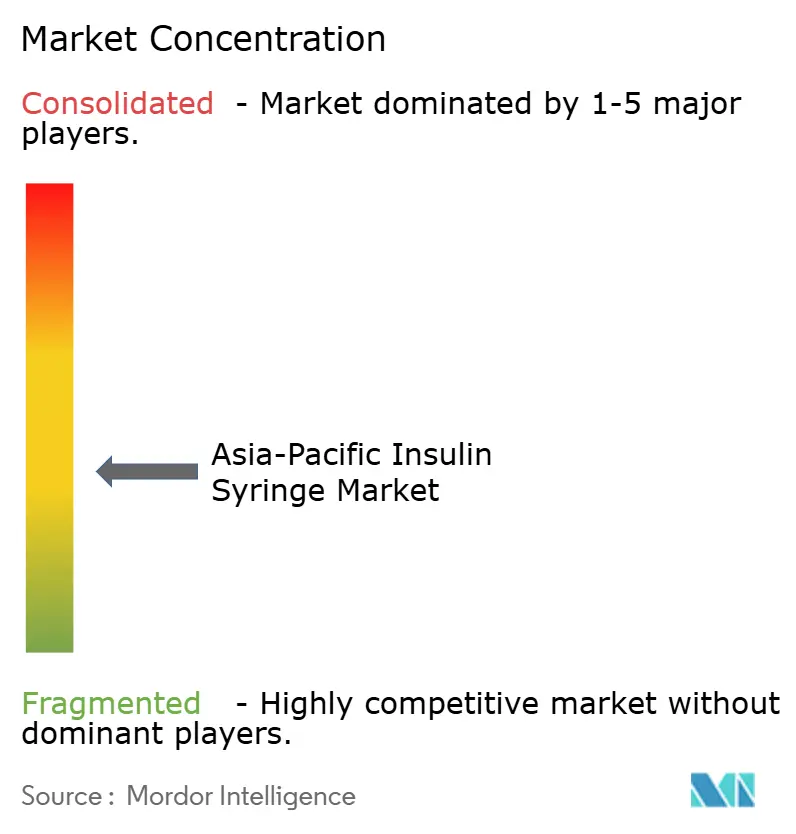
| Market Concentration | Medium |
Major Players *Disclaimer: Major Players sorted in no particular order Image © Mordor Intelligence. Reuse requires attribution under CC BY 4.0. | |
Asia-Pacific Insulin Syringe Market Analysis by Mordor Intelligence
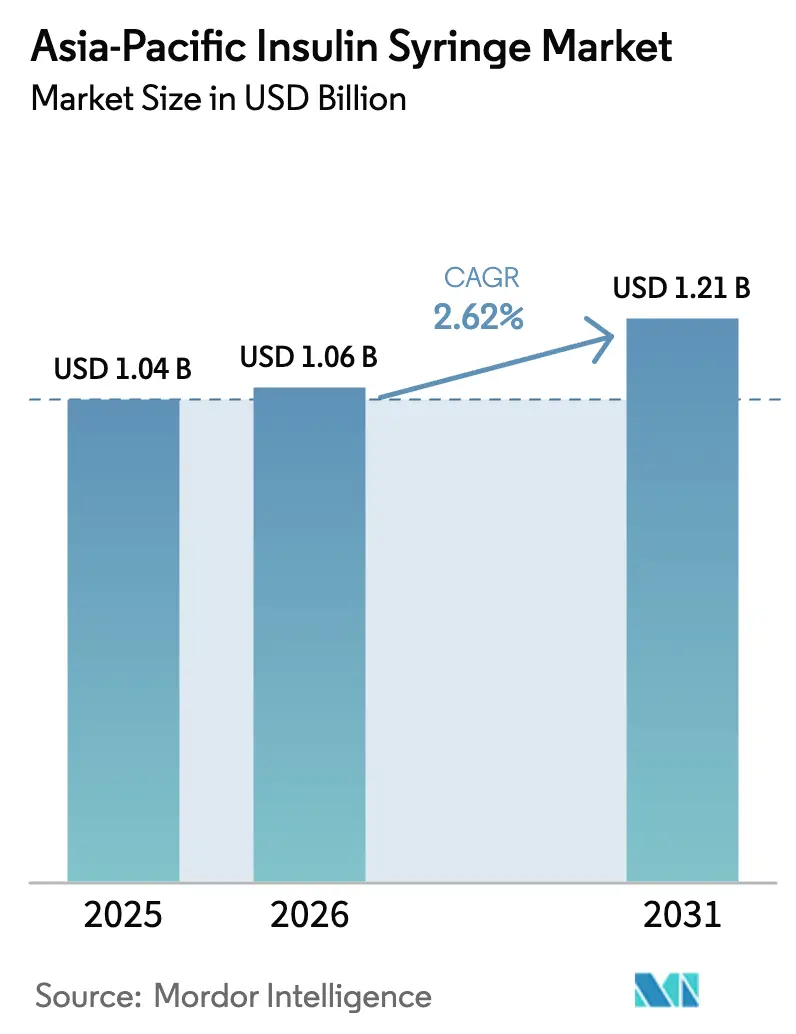
The Asia-Pacific Insulin Syringe Market size is projected to be USD 1.04 billion in 2025, USD 1.06 billion in 2026, and reach USD 1.21 billion by 2031, growing at a CAGR of 2.62% from 2026 to 2031.
Uptake remains anchored by the region’s 238 million diagnosed diabetics, yet the steady migration toward insulin pens and pumps tempers volume growth in the low-margin syringe category. Governments are widening screening and reimbursement, which enlarges the addressable pool of insulin prescribers, while price-cap policies in China and India compress manufacturer margins. Cost leadership, therefore, dominates competitive strategy, but suppliers simultaneously pursue ultrathin-wall needle innovations to defend pricing in urban hospitals. Near-shoring production to Malaysia and India shortens lead times and blunts China-centric supply risks, a shift that will influence raw-material sourcing and logistics during the forecast period.
Key Report Takeaways
- By syringe capacity, the 0.5 mL format led with 45.67% revenue share in 2025, while the 0.3 mL is projected to expand at a 3.25% CAGR through 2031.
- By needle length, 6 mm captured 31.28% of revenue in 2025; 4 mm is on track for a 4.42% CAGR to 2031.
- By technology, conventional syringes accounted for 69.02% of 2025 shipments, whereas safety-engineered devices are advancing at a 2.98% CAGR.
- By end user, hospitals and clinics held a 57.39% share in 2025, yet home-care settings are growing the fastest at 3.87% through 2031.
- By geography, China accounted for 29.38% of 2025 revenue, and India is forecast to grow at a 5.18% CAGR during 2026-2031.
Note: Market size and forecast figures in this report are generated using Mordor Intelligence’s proprietary estimation framework, updated with the latest available data and insights as of 2026.
Market Trends and Insights
Drivers Impact Analysis of Asia-Pacific Insulin Syringe Market*
| Driver | (~) % Impact on CAGR Forecast | Geographic Relevance | Impact Timeline |
|---|---|---|---|
| Rising Prevalence of Diabetes Across Asia-Pacific | +0.7% | Global APAC, concentrated in China, India, Indonesia, with spillover to Southeast Asia | Long term (≥ 4 years) |
| Expanding Self-Administration of Insulin Therapies | +0.5% | India, Southeast Asia, China tier-2/3 cities | Medium term (2-4 years) |
| Favourable Government Reimbursement & Awareness Programmes | +0.4% | China, India, with early gains in Indonesia, Philippines, Malaysia | Medium term (2-4 years) |
| Ultra-Fine Gauge Innovation Boosting Patient Adherence | +0.3% | Japan, Australia, urban China, South Korea | Short term (≤ 2 years) |
| Growth of E-Pharmacy Supply Chains | +0.4% | China, India, urban Southeast Asia | Short term (≤ 2 years) |
| Near-Shoring of Syringe Manufacturing for Supply Security | +0.3% | Malaysia, Indonesia, Thailand, Vietnam | Medium term (2-4 years) |
| Source: Mordor Intelligence | |||
Rising Prevalence of Diabetes Across Asia-Pacific
More than 300 million adults in the Western Pacific and Southeast Asia were living with diabetes in 2024, yet undiagnosed rates still hovered near 50%.[1] Indonesia’s undiagnosed share reached a staggering 73.2%, underlining the reservoir of latent demand that new screening programs can unlock. China’s 148 million diagnosed patients and India’s 90 million ensure a structural demand floor for the Asia-Pacific insulin syringe market even as pens gain ground. Rural affordability constraints keep syringes the default option where cold-chain infrastructure is weak. Earlier insulin initiation among younger cohorts also lengthens each patient’s lifetime device consumption.
Expanding Self-Administration of Insulin Therapies
Home-care settings are growing 3.87% per year as telemedicine removes geographic barriers to titration support. Syringes cost one-fifth as much as disposable pens in India and Indonesia, reinforcing their role as a cost-saving measure for out-of-pocket payers.[2] Government reimbursement, such as India’s Ayushman Bharat, now covers both insulin and delivery devices, extending reach into low-income segments. Structured education programs mitigate dosing-error risks, although improved technique sometimes nudges urban patients toward pens, segmenting demand along socioeconomic lines. Manufacturers must therefore balance price leadership with patient-centric training materials.
Growth of E-Pharmacy Supply Chains
China’s online pharmacies processed over 1 billion prescriptions in 2024, with diabetes supplies ranking near the top. India’s e-commerce platforms expanded syringe listings by 35% after investing in cold-chain logistics for tier-3 cities. Regulators are tightening oversight; India’s drug-safety authority issued 12 alerts for counterfeit insulin syringes sold on unverified sites, making brand reputation critical. Indonesia and Malaysia granted dozens of new e-pharmacy licenses, accelerating direct-to-consumer penetration. Suppliers that secure preferred placement on these portals gain a price-volume edge, but must police gray-market imitators more vigorously.
Near-Shoring of Syringe Manufacturing for Supply Security
Malaysia will host a USD 67 million facility capable of packaging 30 million insulin doses annually from 2026, integrating on-site syringe assembly. Insulet’s USD 200 million Johor plant, opened in 2024, underscores Southeast Asia’s attractiveness as a hedge against China-centric risk. India’s Production Linked Incentive scheme reserves USD 1.2 billion for medical-device localization, targeting 50% import substitution by 2027.[3] As a result, landed costs across ASEAN will converge, eroding China’s historic 20-30% price advantage and pushing suppliers to compete on ISO 13485 quality credentials.
Restraints Impact Analysis of Asia-Pacific Insulin Syringe Market*
| Restraint | (~) % Impact on CAGR Forecast | Geographic Relevance | Impact Timeline |
|---|---|---|---|
| Rapid Uptake of Insulin Pens & Pumps | -0.6% | Japan, Australia, New Zealand, urban China, South Korea | Short term (≤ 2 years) |
| Stringent Needle-Safety Compliance Costs | -0.3% | China, India, ASEAN markets implementing WHO sharps safety guidelines | Medium term (2-4 years) |
| Environmental Pressure on Single-Use Plastics | -0.2% | Australia, Japan, South Korea, with emerging regulations in China | Long term (≥ 4 years) |
| Domestic Price-Cap Policies in Emerging APAC | -0.4% | China, India, Indonesia, Philippines, Vietnam | Long term (≥ 4 years) |
| Source: Mordor Intelligence | |||
Rapid Uptake of Insulin Pens & Pumps
Insulin pens accounted for 60% of new initiations in Japan and Australia in 2025, reflecting parity reimbursement and patient preference for discreet, pre-filled devices. New Zealand’s public funder now supports pump-CGM systems, cutting syringe demand in Type 1 patients. China’s tier-1 cities show similar momentum, with 48% of newly diagnosed Type 2 patients opting for pens in 2024. Yet syringes remain dominant in rural markets where affordability and limited cold-chain infrastructure inhibit pen adoption. Suppliers must therefore target value-conscious segments and public tenders while conceding market share in urban areas.
Domestic Price-Cap Policies in Emerging APAC
China’s 2024 volume-based procurement lowered median insulin prices by 42% and is now expanding to syringes, clipping margins by up to 20%. India’s price ceiling of INR 8-12 (USD 0.10-0.15) per unit forces multinationals either to localize production or exit high-volume tenders. Indonesia and the Philippines are drafting similar frameworks that favor scale players able to operate at unit costs below USD 0.05. Smaller firms face consolidation pressure as compliance costs for ISO certificates rise, even while selling prices fall.
*Our forecasts treat driver/restraint impacts as directional, not additive. The impact forecasts reflect baseline growth, mix effects, and variable interactions.
Asia-Pacific Insulin Syringe Market Segment Analysis
By Syringe Capacity:
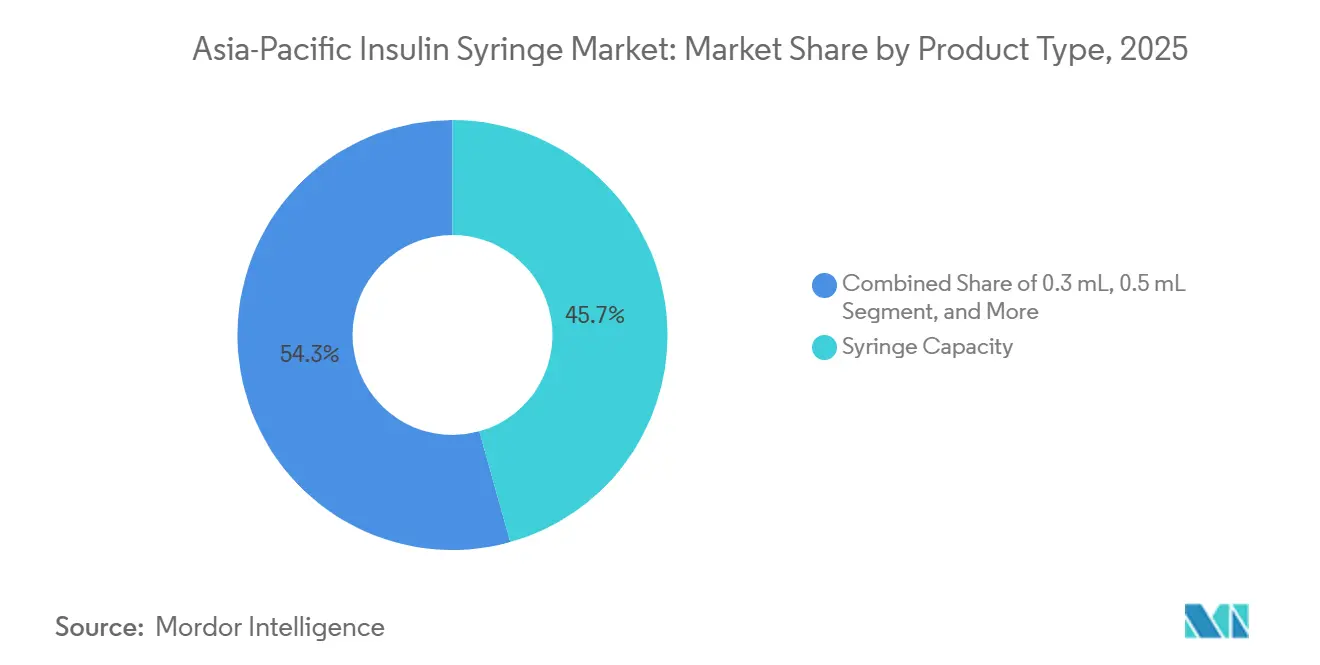
Pediatric Miniaturization Reinforces 0.3 mL MomentumThe Asia-Pacific insulin syringe market size for 0.5 mL formats accounted for 45.67% of 2025 revenue, yet 0.3 mL units are set to grow at 3.25% CAGR through 2031, driven by rising pediatric incidence and low-dose titration regimens. Endocrinologists prescribe smaller barrels to reduce insulin waste for children and elderly users who use 10 units or fewer per dose. China’s regulator approved six new pediatric designs in 2024, indicating policy support for diversifying capacity. However, tighter tolerances and 30-32G needles increase production costs by 8-12%, and India’s uniform price cap limits the ability to pass that premium to consumers.
The 1 mL format continues to be used for basal regimens above 30 units and remains common in obese Type 2 cohorts with insulin resistance. Syringes larger than 1 mL play a niche role in hospitals that handle U-500 insulin, but are losing relevance as pharmaceutical firms phase out high-volume vials in favor of concentrated pen cartridges. Consequently, the capacity mix will tilt toward sub-1 mL sizes while >1 mL volumes retreat to specialty clinics.

By Needle Length:
Clinical Consensus Shifts Toward 4 mmSix-millimeter needles retained 31.28% market share of the Asia-Pacific insulin syringe market in 2025, yet 4 mm variants are rising 4.42% per year as guidelines endorse shorter lengths to prevent intramuscular injections. Japan, Australia, and China integrated the 4 mm standard into 2025 protocols, accelerating hospital conversions. Manufacturers roll out ultrathin-wall steel and beveled-tip geometry that lowers insertion force by 18%, appealing to needle-phobic users.
Eight-millimeter products are declining, while ≥10 mm devices linger mainly in legacy rural inventories. Uptake of 4 mm requires a perpendicular technique and fresh patient training, driving demand for pictorial instructions and QR-code videos. Firms that embed education aids gain stickiness in the home-care channel.
By Technology:
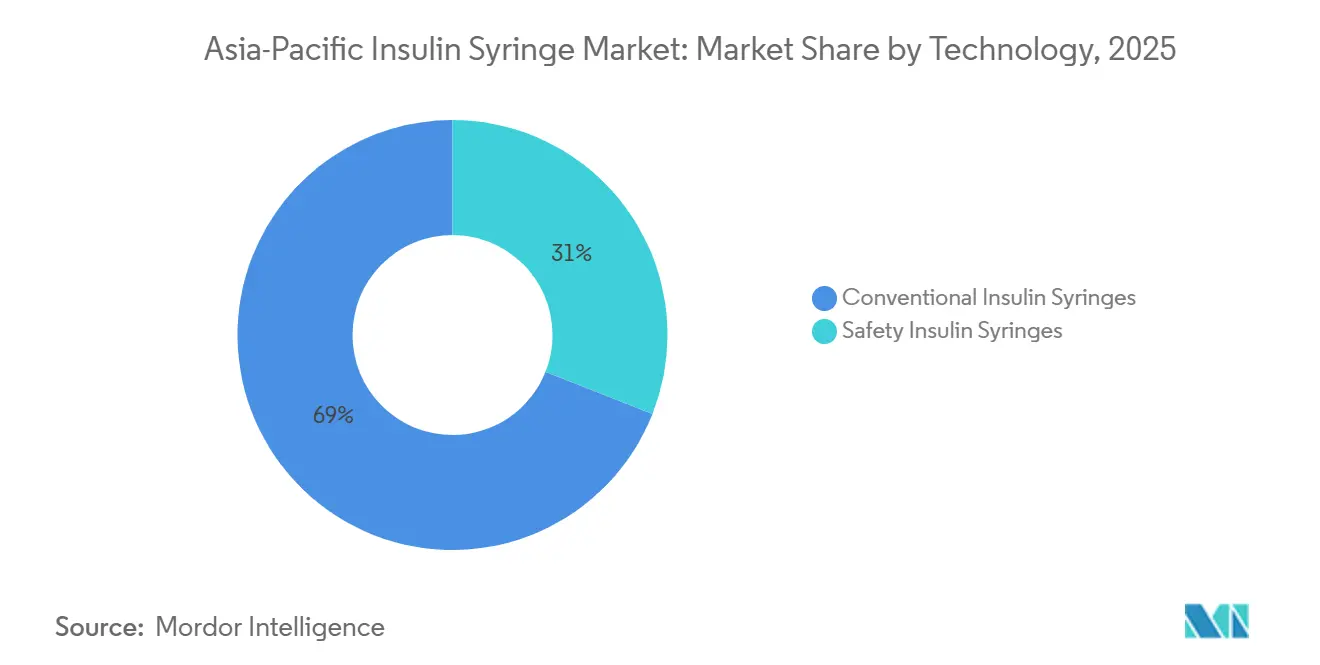
Safety Mechanisms Gain Reimbursement TractionConventional products accounted for 69.02% of 2025 volume, but safety syringes are advancing at 2.98% annually as WHO sharps-injury guidelines influence hospital tenders. China’s tertiary hospitals must now specify passive-retraction or shielding designs, although budget gaps delayed full roll-out. India mandated safety devices for government facilities in 2025, yet compliance reached only 38% by mid-2025 due to lagging allocations.
Home-care adoption is slower because users often reuse syringes, blunting the value proposition for single-use safety locks. Hybrid retractable needles that permit optional reuse are emerging, but their classification under ISO 23908 rules remains ambiguous. Thus, safety penetration will stay concentrated in hospitals until coverage expands
By End User:
Home-Care Surge Alters Distribution EconomicsHospitals and clinics accounted for 57.39% of 2025 demand, yet home care is growing at a 3.87% CAGR as telehealth guidelines allow endocrinologists to adjust doses remotely. E-pharmacies fulfill doorstep delivery, reducing stock-out risk for chronic users. India plugged its national digital-health records into central syringe warehouses, bypassing district pharmacies prone to shortages.
Home-care growth obliges suppliers to refine packaging. A 2024 study found that 62% of first-time Indonesian users could not assemble syringes from written instructions alone; firms therefore embed multilingual QR videos to reduce error rates. Long-term care facilities and military medical services exhibit flat demand because they increasingly favor prefilled pens for workflow efficiency.
Geography Analysis
China Insulin Syringe Market
China accounted for 29.38% of 2025 revenue in the Asia-Pacific insulin syringe market, underpinned by its vast diabetic population and provincial procurement muscle. National price cuts suppress margins, and tier-1 cities now skew toward pens, yet rural areas continue to favor syringes due to affordability and limited cold-chain support. Domestic manufacturers such as Weigao secure tenders by coupling ISO 13485 compliance with low landed cost.
APAC and Oceania Insulin Syringe Market
Japan shows the slowest growth, with pens capturing 68% of new prescriptions in 2025, and updated protocols advocate pump-CGM integration for Type 1 users. Australia follows suit after its regulator cleared four new pump models in 2024; private insurers widened coverage, compressing syringe uptake in metropolitan markets. New Zealand’s public funding for pumps in late 2024 will trim syringe volumes across Oceania.
India and South Korea Insulin Syringe Market
India is forecast to expand at a 5.18% CAGR, propelled by 90 million diabetics and Production Linked Incentive support that encourages domestic syringe manufacturing. Price caps enlarge affordability but compel multinationals to localize or cede share. South Korea reimburses syringes for all Type 2 patients, but Seoul’s urban preference for pens exceeds 55%, creating a two-tier market dynamic.
ASEAN Insulin Syringe Market
The rest of Asia-Pacific, Indonesia, Thailand, Vietnam, and the Philippines, present the fastest aggregate growth. Indonesia’s 73.2% undiagnosed rate represents a sizable conversion pool as new screening programs roll out. Regulatory fragmentation across ASEAN, however, extends device registration by up to 18 months, favoring incumbents with regional compliance teams.
Regulatory Landscape
Regulation in the Asia-Pacific insulin syringe market is anchored in device quality, sterility, and safety standards that increasingly influence tender eligibility and product specifications. In China, sterile insulin syringes are governed by national requirements such as GB 15810-2019 for sterile single-use syringes, while the National Medical Products Administration issued YY/T 0497-2025 for sterile insulin syringes for single use, effective October 1, 2026. The standard covers 40 U/mL and 100 U/mL formats and replaces the prior 2018 version.
India continues to reference Bureau of Indian Standards specification IS 10258 (2002) for sterile hypodermic syringes for single use, which manufacturers and importers commonly use for conformance documentation and procurement checks. Across the region, hospital procurement is also increasingly shaped by sharps-injury prevention requirements aligned with WHO guidance, which raises the compliance bar and distinguishes conventional syringes from safety-engineered devices in public-sector purchasing.
Competitive Landscape
The Asia-Pacific insulin syringe market is moderately fragmented. Becton, Dickinson, and Terumo lead the premium tier, leveraging ultrathin-wall needle technology and global ISO certifications to justify pricing in hospitals and diabetes centers. Chinese suppliers Weigao, Jiangsu Excel, and Zhejiang KangKang dominate public tenders through aggressive cost positioning.
Technology races center on flow-rate optimization. BD’s Neopak XtraFlow, introduced in September 2024, delivers 30% faster injection of high-viscosity formulations and pairs with Ypsomed’s autoinjector under an October 2024 alliance. Yet price-capped markets dilute returns on such R&D, forcing companies to reserve advanced products for private insurance or export channels.
Near-shoring reshapes supply chains. Pharmaniaga’s Malaysian plant will reduce transit times into Indonesia’s 20.4 million-patient market, while Insulet’s Johor facility underscores the region’s appeal to device makers hedging geopolitical risk. Mid-tier competitors lacking scale, such as Owen Mumford, which exited insulin pens in 2024, face exit or merger as compliance costs rise. E-pharmacy giants Alibaba Health and JD Health vertically integrate distribution, squeezing wholesale margins and giving preferred brands a jump in direct-to-patient volumes.
Asia-Pacific Insulin Syringe Industry Leaders
-
Terumo Corporation
-
Nipro Corporation
-
HMD Healthcare Ltd.
-
Cardinal Health Inc.
-
Becton, Dickinson and Company
- *Disclaimer: Major Players sorted in no particular order
Asia-Pacific Insulin Syringe Market Companies Covered in this Report
- Allison Medical
- Artsana Group
- B. Braun
- Beckton Dickinson
- Cardinal Health
- HMD Healthcare
- Jiangsu Excel Medical Instruments
- Medline Industries
- Nipro
- Owen Mumford
- Smiths Group
- Terumo
- Ultimed
- Weigao Group
- Wuxi Yushou Medical Appliances
- Ypsomed
- Zhejiang KangKang Medical
Market Opportunities and Future Outlook
Opportunities cluster around localization, compliance-driven upgrades, and channel shifts toward direct-to-patient fulfillment. Indonesia is an example where culturally and regulatorily aligned products resonate in a large, price-sensitive market, after Terumo launched the T1 Syringe as a locally produced halal-certified syringe in collaboration with PT Oneject. In parallel, tighter product standards, including China moving to YY/T 0497-2025 effective October 1, 2026, create more space for suppliers that can assemble conformance documentation quickly and support hospitals with tender-ready dossiers.
Supply security and regional execution are also becoming more visible competitive levers. Nipro established Nipro Asia Pacific Group Pte Ltd in Singapore (announced in late 2025 and formed in 2026) to strengthen regional governance and oversight of local subsidiaries, supporting faster responses to country-specific registration and procurement requirements. Manufacturers investing in higher-precision components and fill-finish compatible platforms for syringe systems can also better match the premiumization seen in urban hospitals, while keeping a cost-led portfolio for public tenders and home-care distribution through e-pharmacies.
Recent Industry Developments in Asia-Pacific Insulin Syringe Market
- March 2026: Nipro Corporation introduced the D2F platform configuration featuring a 1 inch cannula for pre-fillable glass syringes, targeting modern fill-finish workflows. The launch strengthens Nipro's position in regional advanced syringe technology and supply-chain integration, with direct impact on APAC syringe utilization in hospitals and clinics.
- February 2026: Nipro Corporation planned establishment of a new regional headquarters in Singapore (Nipro Asia Pacific Group Pte Ltd) to oversee group companies in the Asia-Pacific region. This action enhances regional responsiveness and near-term supply-security for APAC customers, facilitating regional governance and local production facilitation in APAC.
- January 2026: Terumo Corporation launched the T1 Syringe in Indonesia, the first locally produced halal-certified syringe, developed with PT Oneject. This development improves Terumo's competitive differentiation in key APAC market and supports local manufacturing strategy.
Asia-Pacific Insulin Syringe Market Report Scope and Research Methodology
Market Definition and Coverage
For this study, the market covers revenue generated from insulin syringes sold across Asia Pacific for insulin administration, captured as the value of products supplied to hospitals, clinics, and home-care channels, and then aggregated at the regional level.
Scope exclusions: Excludes insulin pens, pen needles, pumps, CGM devices, and general-purpose hypodermic syringes that are not intended for insulin use.
Segments Covered in This Report
- By Syringe Capacity
- 0.3 mL
- 0.5 mL
- 1 mL
- Greater than 1 mL
- By Needle Length
- 4 mm
- 6 mm
- 8 mm
- ≥10 mm
- By Technology
- Conventional Insulin Syringes
- Safety Insulin Syringes
- By End User
- Hospitals & Clinics
- Home-care Settings
- Diabetes Centres
- Other End Users
- By Country
- China
- Japan
- India
- Australia
- South Korea
- Rest of Asia-Pacific
Data Sources, Market Sizing, and Validation
Desk Research
Desk research starts with mapping the treated diabetes pool and how injection-based therapy is used across major Asia Pacific countries, then linking that to observed syringe consumption patterns. Public health statistics and clinical guidelines help prevent over-counting, especially where oral therapies, insulin pens, or pumps reduce syringe use for specific patient segments.
We referenced non-paywalled sources such as International Diabetes Federation country data, World Health Organization health statistics, OECD health indicators (where applicable), national health ministry publications, and UN Comtrade trade statistics for medical devices. Company annual reports, investor presentations, and medical-device association websites were also reviewed to understand pricing bands, procurement practices, and product mix shifts. Paid subscriptions were used for company financials, and patent landscaping was used as a secondary check on innovation direction and manufacturing footprint. This list is illustrative only, and other sources were also used for data collection, validation, and follow-up clarification.
Primary Interviews and Surveys
Primary work focused on confirming how insulin syringes are purchased and used across hospitals, diabetes centers, and home-care settings, since the mix of buyers and the adoption of safety syringes can differ by country. Interviews and surveys included manufacturers, distributors, procurement stakeholders, clinicians, and diabetes educators across key Asia Pacific markets, so assumptions on usage rates, safety-syringe adoption, and pricing trends could be adjusted where needed.
Distribution of primary research fieldwork respondents
| Company type | Respondent position |
|---|---|
| Top tier: 35% | CXOs: 15% |
| Mid tier: 43% | Functional/Unit leaders: 41% |
| Smaller Players: 22% | Managers: 44% |
Market-Sizing & Forecasting
Sizing starts from the demand pool, where diabetes prevalence and insulin-treated patient counts are translated into likely syringe usage, then scaled to Asia Pacific using country health system coverage and access indicators. A top-down approach was used by building country demand from insulin-treated population estimates, typical injections per day, and an adjustment factor for reuse practices, which is then converted into annual unit need and multiplied by an average selling price band.
To keep the model realistic, we used a small set of market fingerprints as inputs, such as the insulin-treated diabetic population trend, injection frequency patterns, the split between home-care versus hospital initiation, safety-syringe penetration in institutional purchasing, and import dependency signals from trade data. Bottom-up checks were applied selectively, including supplier and distributor channel checks on pricing and mix by syringe capacity and needle length, and ASP time and volume sanity checks where disclosure was available. When data gaps existed for smaller countries in Rest of Asia-Pacific, we used proxy ratios from comparable markets and then retested them using primary feedback before final totals were set.
Forecasting used scenario analysis with trend smoothing. Key drivers were varied within realistic bands agreed in interviews, including diabetes growth, pen and pump substitution pace, and procurement-led price movement. The final forecast path was kept consistent with observed healthcare spend direction and product mix changes, without forcing aggressive adoption assumptions.
Data Validation & Update Cycle
Validation was handled through cross-checks between the demand-built totals and independent signals, including trade flows, institutional procurement behavior, and the expected split between care settings. Outliers were reviewed country by country, and any sharp shifts in implied units per patient or pricing were flagged, reworked, and then rechecked with follow-up calls where required.
Before sign-off, the model and assumptions were taken through multiple analyst review steps to keep the logic, math, and narrative consistent. Reports are refreshed annually, and interim updates are triggered when material events occur, such as policy changes affecting diabetes coverage or meaningful pricing shocks. Just before delivery, a final review is completed to ensure the latest updated view is reflected.
Mordor Intelligence's Asia Pacific Insulin Syringe Market Size Compared Against Other Published Estimates
Published estimates for this market do not always match, because the included product set, the way patient demand is translated into syringe consumption, and how pricing is averaged across channels can differ. Differences can also come from older base-year pricing and whether reuse and substitution effects are rechecked, since these can move volumes meaningfully.
The main gap comes from product scope and demand conversion. Mordor Intelligence counts only insulin syringes used for insulin injection in Asia Pacific and builds demand from insulin-treated population, injection frequency, and reuse adjustments, rather than blending in broader syringes or applying a single fixed usage rate across countries.
Benchmark comparison
| Source | Market Size | Gaps in Research Methodology |
|---|---|---|
| Mordor Intelligence | USD 1.04 B (2025) | |
| Trade Journal A | USD 0.92 B (2025) | Uses a narrower channel view that underweights home-care purchasing, and applies a flatter ASP assumption that does not reflect country mix and safety-syringe price premiums. |
| Industry Association B | USD 1.18 B (2025) | Expands the definition to include adjacent general-purpose syringe demand used in diabetes care settings, which inflates totals compared with insulin-specific consumption modeling. |
The spread across the three figures is mainly explained by whether the estimate is tied to an insulin-specific demand pool and whether pricing and channel mix are updated at the country level. By keeping inputs traceable to patient counts, usage behavior, and realistic ASP bands, the resulting number stays repeatable and easier to audit when assumptions change.
Key Questions Answered in the Report
How large will the Asia-Pacific insulin syringe market be in 2031?
The Asia-Pacific insulin syringe market size is projected to reach USD 1.21 billion by 2031, reflecting a 2.62% CAGR from 2026 to 2031.
Which syringe capacity is growing the fastest?
The 0.3 mL capacity segment is forecast to post a 3.25% CAGR through 2031 as clinicians favor low-dose precision for pediatric and elderly patients.
Why are 4 mm needles gaining share?
Clinical guidelines released in 2024 recommend 4 mm lengths to cut intramuscular risk and injection pain, propelling 4.42% annual growth in this segment.
What factors are driving India’s demand?
India benefits from a 90 million-strong diabetic population, expanded insurance under Ayushman Bharat, and government incentives that localize syringe production, supporting a 5.18% CAGR.
How are e-pharmacies changing distribution?
Platforms like Alibaba Health and PharmEasy deliver syringes directly to patients, trimming stock-outs and prices while pushing manufacturers to secure digital shelf-space.