
Asia-Pacific Data Center Climate Risk and Resilience Market Size and Share
Market Overview
| Study Period | 2021 - 2032 |
|---|---|
| Forecast Data Period | 2027 - 2032 |
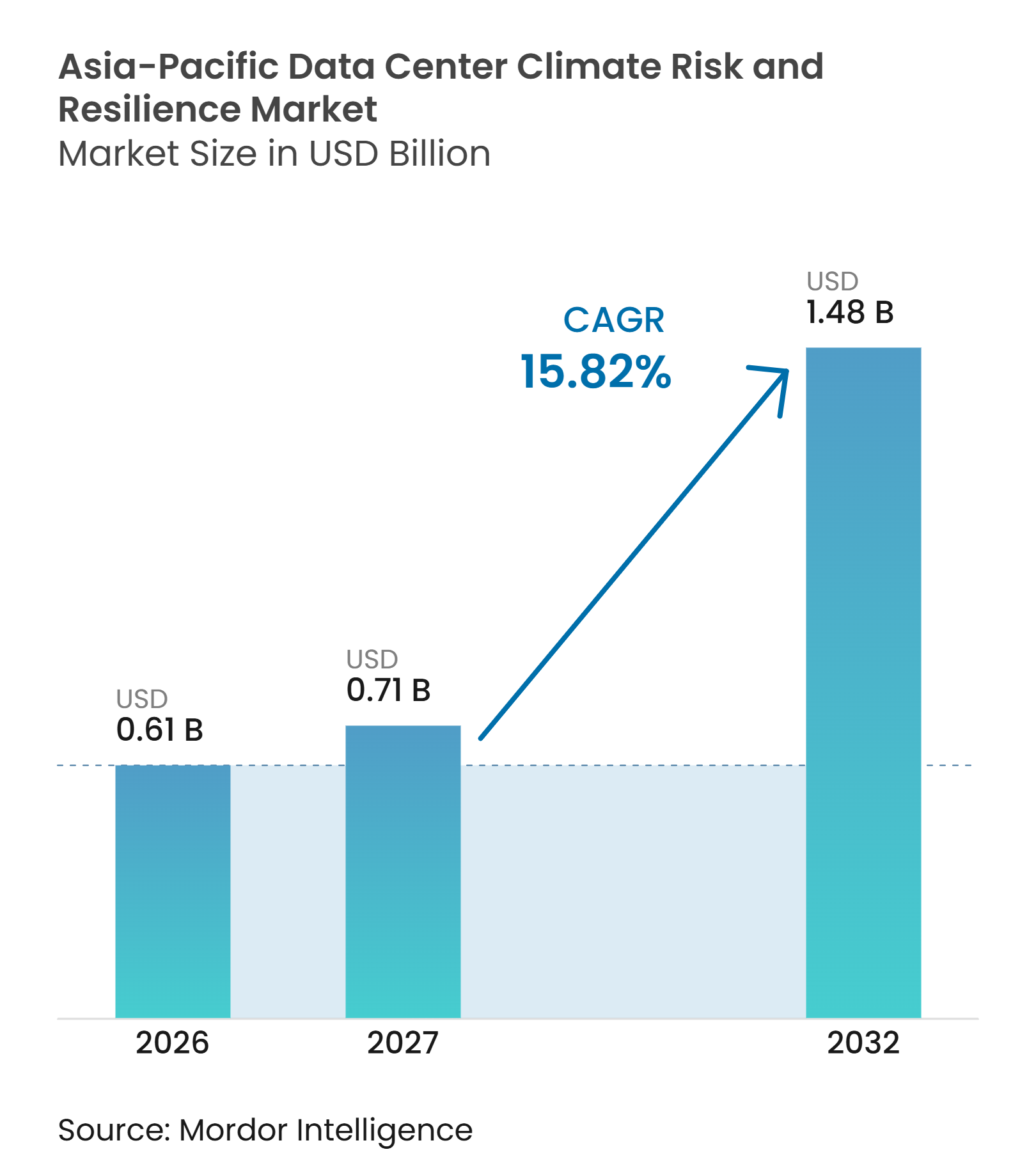
| Base Year Market Size (2026) | USD 0.61 Billion |
| Market Size (2027) | USD 0.71 Billion |
| Market Size (2032) | USD 1.48 Billion |
| Growth Rate (2027 - 2032) | 15.82 % |
| Market Concentration | Medium |
Major Players *Disclaimer: Major Players sorted in no particular order Image © Mordor Intelligence. Reuse requires attribution under CC BY 4.0. | |
Asia-Pacific Data Center Climate Risk and Resilience Market Analysis by Mordor Intelligence
The Asia-Pacific data center climate risk and resilience market size is USD 0.61 billion in 2026 and is projected to reach USD 1.48 billion by 2032, growing at a CAGR of 15.82% from 2027 to 2032. The Asia-Pacific data center climate risk and resilience market is expanding as owners treat physical climate exposure as a financial and operating issue rather than a limited site-planning exercise. AI capacity is being built in coastal and tropical hubs where heat, water, flooding, and power reliability can affect construction decisions and operating performance. Disclosure rules are also shifting demand toward auditable, asset-level analysis that can support lender, insurer, and compliance decisions. Vendors that can connect mapping, scenario analysis, cooling design, and ongoing monitoring are better placed to serve operators moving from assessment to implementation. High adaptation costs and limited specialist skills remain material constraints, particularly for smaller facilities and fast-growing emerging markets.
Key Report Takeaways
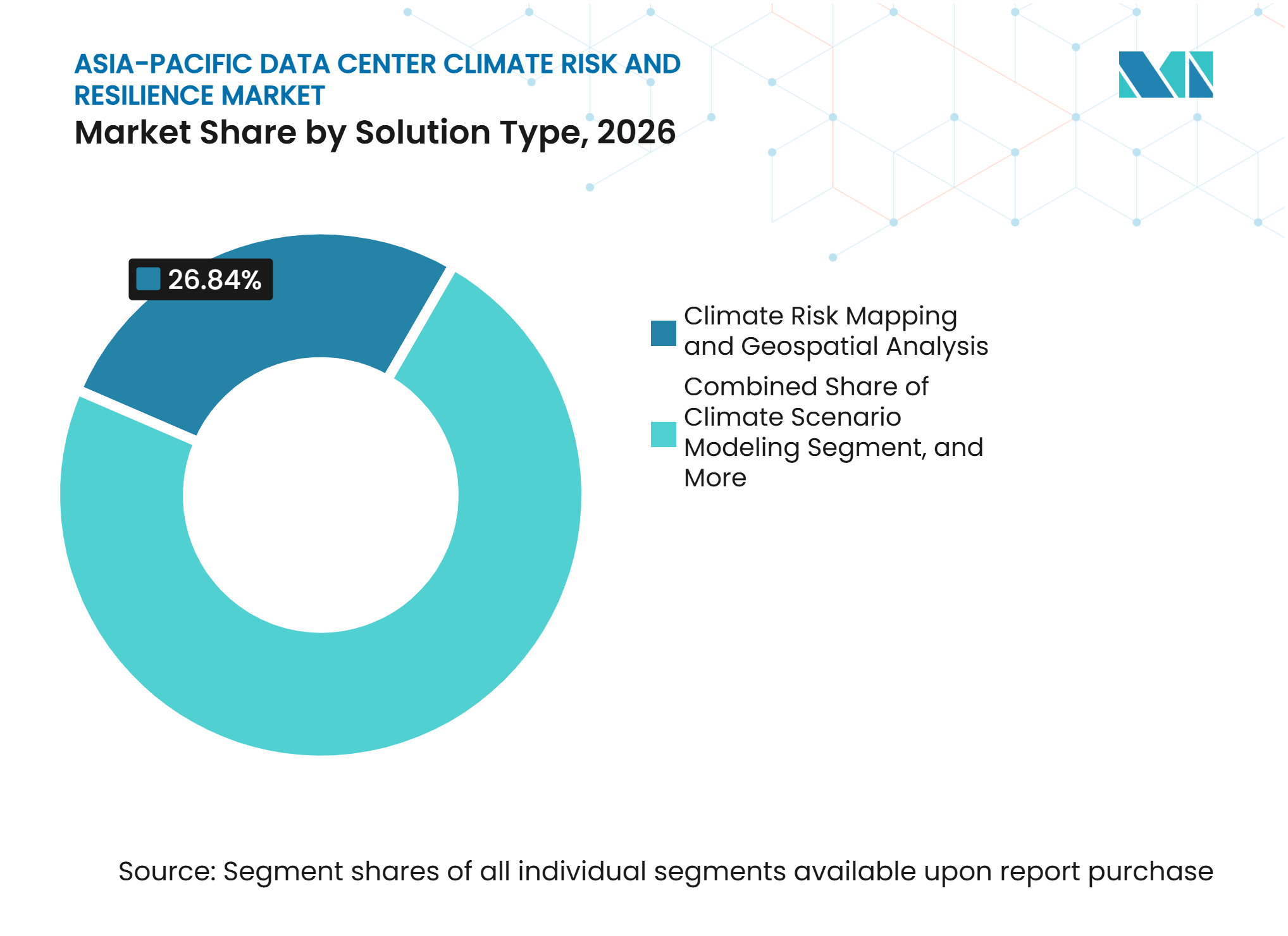
- By solution type, Climate Risk Mapping and Geospatial Analysis held 26.84% of the Asia-Pacific data center climate risk and resilience market share in 2026, while Climate Risk Monitoring and Early Warning is projected to expand at a 16.42% CAGR through 2032.
- By climate hazard, Flooding and Sea-Level Rise accounted for 31.79% of revenue in 2026, while Compound and Multi-Hazard Events are expected to grow at a 16.43% CAGR through 2032.
- By assessment method, Geographic and Geospatial Risk Mapping captured 28.63% of revenue in 2026, while Financial and Asset-Level Climate Risk Quantification is projected to grow at a 16.29% CAGR through 2032.
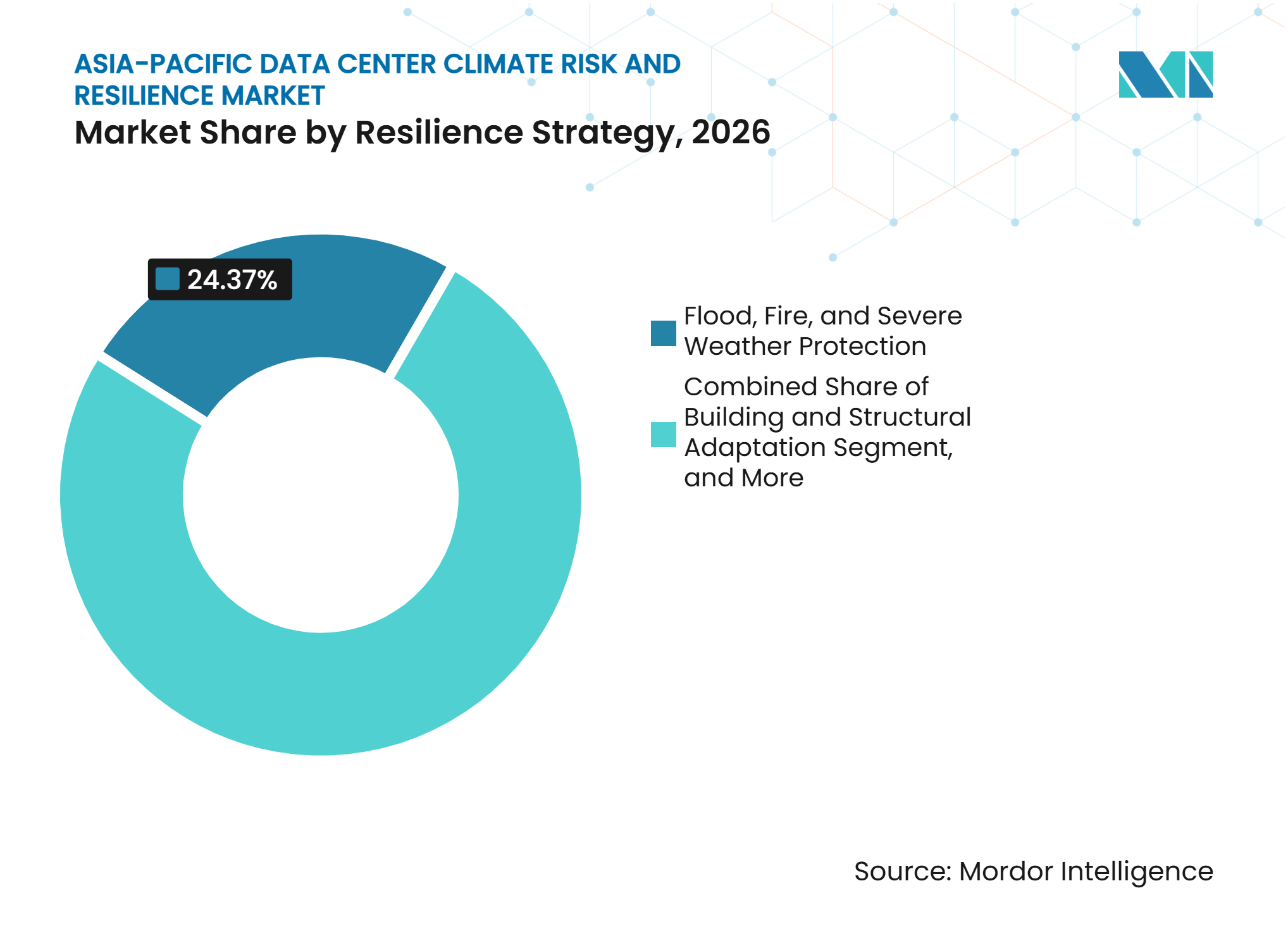
- By resilience strategy, Flood, Fire, and Severe Weather Protection held 24.37% of revenue in 2026, while Cooling and Thermal Resilience is expected to expand at a 16.37% CAGR through 2032.
- By service type, Climate Risk Consulting accounted for 35.92% of revenue in 2026, while Monitoring and Early Warning Services is projected to advance at a 16.46% CAGR through 2032.
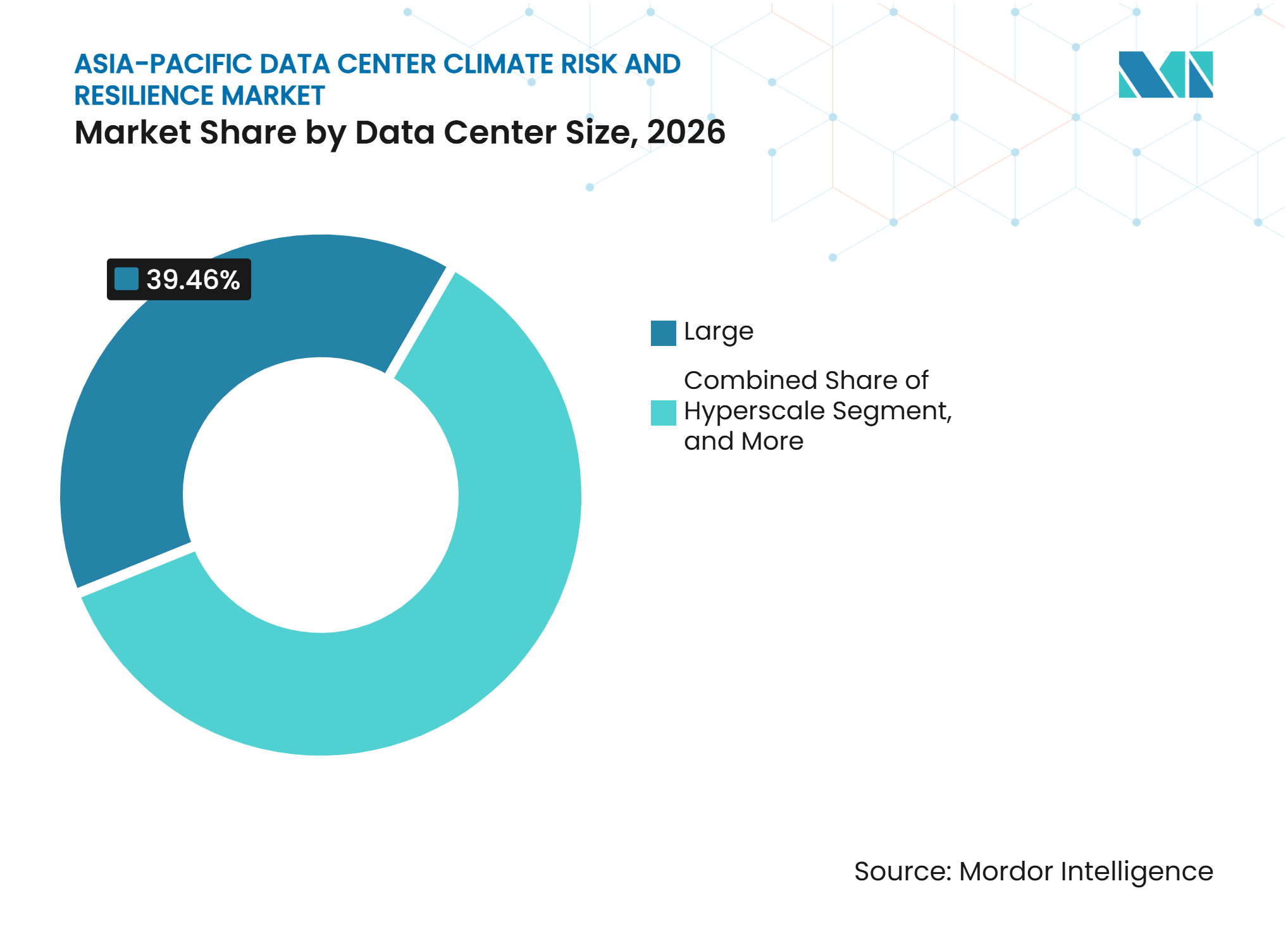
- By data center size, Large data centers held 39.46% of revenue in 2026, while Hyperscale data centers are expected to grow at a 16.34% CAGR through 2032.
- By data center type, Colocation data centers represented 37.28% of revenue in 2026, while Cloud Service Providers are projected to expand at a 16.64% CAGR through 2032.
- By geography, China held 43.59% of revenue in 2026, while India is expected to record the highest CAGR at 16.58% through 2032.
Note: Market numbers in this report are based on Mordor Intelligence's proprietary estimation framework, which combines nine months of actuals with Q4 projections for base year 2026.
Market Trends and Insights
AI and Hyperscale Capacity Expansion in Climate-Exposed Hubs
AI infrastructure investment is increasing the need for climate risk and resilience services in exposed locations. Asia-Pacific data center electricity consumption roughly doubled between 2020 and 2024 and is expected to continue rising as new AI facilities enter service. The location of this capacity is as important as its scale, because XDI identified Jiangsu as the world’s most exposed data center hub, with 64% of facilities projected to face high physical risk by 2050. Coastal clusters in Shanghai, Tokyo, and Hong Kong also face overlapping exposure to floods, storms, and heat. Operators investing in these hubs need hazard mapping, scenario modeling, and adaptation plans before they can complete financing, insurance, and site decisions.
Mandatory Climate Disclosure and Asset-Level Risk Pricing
Climate reporting requirements are making physical-risk analysis a more formal business requirement. Australia, Singapore, Hong Kong, Malaysia, and other regional markets are introducing or phasing in reporting that aligns with IFRS S2 principles. Singapore’s Accounting and Corporate Regulatory Authority extended implementation timelines for many companies while retaining the direction toward climate-related reporting.[1] China also released a Corporate Climate Reporting Standard in January 2026 as a voluntary trial before phased mandatory adoption. These frameworks support demand for financial and asset-level quantification because operators need defensible inputs for forward-looking disclosures, lending reviews, and insurance underwriting.
Rising Cooling Stress and High-Density Rack Deployment
Higher ambient temperatures and dense AI computing loads are moving cooling from a facilities issue to a resilience requirement. Singapore introduced SS 726:2026, a liquid-cooling standard for tropical data centers that provides guidance on the design, deployment, and operation of these systems. High-density racks can exceed 100 kilowatts, which places conventional air-cooling systems under greater pressure. Preferred Networks, Internet Initiative Japan, and JAIST began testing liquid-cooled, high-density AI servers in 2025 to address unresolved deployment issues at scale. The Asia-Pacific data center climate risk and resilience market therefore benefits from demand for thermal scenario analysis, direct-to-chip cooling design, and operational monitoring that links weather conditions with equipment performance.
Grid Congestion and Power Reliability Concerns
Power access has become a climate resilience issue because heat, floods, and severe storms can also disrupt grid reliability. Developers increasingly need battery storage, load management, and proof that a facility can support grid stability as part of the connection process. Connection requirements are becoming more demanding where data center capacity growth is concentrated. Grid-stability expectations can require operators to examine how their facilities respond to voltage and frequency disruptions. This places greater value on tools that test power-supply reliability under weather-related failure scenarios.
Restraints Impact Analysis of Asia-Pacific Data Center Climate Risk and Resilience Market*
| Restraint | (~) % Impact on CAGR Forecast | Geographic Relevance | Impact Timeline |
|---|---|---|---|
| High Upfront Cost of Structural Adaptation and Redundant Systems | -2.3% | Global, most acute in emerging Southeast Asia and India secondary markets | Short term (≤ 2 years) |
| Scarcity of Climate-Engineering and Liquid-Cooling Skills | -1.6% | APAC-wide, most severe in India, Indonesia, Thailand, Vietnam | Medium term (2-4 years) |
| Permitting, Land, Power, and Water Interconnection Delays | -1.0% | South Korea, Australia, Japan, Singapore, Malaysia | Medium term (2-4 years) |
| Fragmented Climate Data and Limited Asset-Level Validation | -0.7% | Global, concentrated in emerging APAC markets | Long term (≥ 4 years) |
| Source: Mordor Intelligence | |||
High Upfront Cost of Structural Adaptation and Redundant Systems
Upfront capital needs remain the immediate barrier to broad adoption of structural resilience measures. XDI found that targeted adaptations could reduce the number of high-risk data centers by more than two-thirds by 2050, but the cost burden limits near-term adoption. Flood barriers, raised critical equipment, redundant cooling, and on-site power add substantial cost to new and existing facilities. Smaller colocation and edge operators often cannot justify these investments without a regulatory requirement or favorable financing. The resulting gap can create a two-tier adoption pattern, with hyperscalers proceeding faster than smaller providers.
Scarcity of Climate-Engineering and Liquid-Cooling Skills
Limited specialist talent restricts the pace at which operators can deploy climate-adaptive facilities. Resilience projects need skills that combine climate science, electrical systems, building engineering, and data center operations. Liquid cooling adds requirements for plumbing, fluid management, and leak detection that remain limited in several Asia-Pacific markets. The 2025 PFN, IIJ, and JAIST pilot demonstrates that these technical challenges are still being tested in operating environments. India, Indonesia, Thailand, and Vietnam face the strongest pressure because facility construction is outpacing the available pool of specialist labor.
*Our forecasts treat driver/restraint impacts as directional, not additive. The impact forecasts reflect baseline growth, mix effects, and variable interactions.
Asia-Pacific Data Center Climate Risk and Resilience Market Segment Analysis
By Solution Type:
Geospatial Tools Lead While Real-Time Monitoring ExpandsClimate Risk Mapping and Geospatial Analysis held 26.84% of solution-type revenue in 2026. Within the Asia-Pacific data center climate risk and resilience market, the segment leads because site-level hazard mapping is normally the first capability an operator obtains before moving to scenario testing or detailed adaptation planning. GIS-based tools can combine exposure data, local terrain, asset locations, and hazard projections in a single operating view. A 2025 study on climate-resilient data center siting found that GIS-driven AI methods can support better site selection and operating decisions.[2] Climate Risk Assessment and Analytics and Climate Scenario Modeling serve operators who have already completed initial screening. Their use is growing where operators need forward-looking analysis that aligns with climate reporting requirements.
Climate Risk Monitoring and Early Warning is projected to expand at a 16.42% CAGR through 2032. Continuous service support, facility alerts, emergency protocols, insurance discussions, and more frequent reviews of local conditions. This approach changes the Asia-Pacific data center climate risk and resilience market from periodic consulting engagements toward operational information that can be used every day. Climate Adaptation and Resilience Planning remains important when a facility turns assessment results into investment priorities. Climate Risk Advisory and Engineering Services also grow as operators need technical support to apply resilience measures across cooling, structures, and power systems. The move toward continuous monitoring favors platforms that can integrate climate data with facility and asset-management workflows.


By Climate Hazard:
Flood Exposure Leads as Multi-Hazard Planning Gains PriorityFlooding and Sea-Level Rise accounted for 31.79% of climate hazard-type revenue in 2026. Low-lying data center clusters in Shanghai, Jakarta, Ho Chi Minh City, and Mumbai are exposed to coastal, heavy rainfall, and river flooding. A 2025 Scientific Reports study estimated annual coastal flood losses across Asia and the Pacific at USD 26.8 billion and projected a material increase by 2050. This exposure makes flood mapping, elevated-system design, and flood-protection engineering central to resilience programs. Extreme Heat and Heatwaves also require attention where high temperatures increase cooling demand. Hurricanes, Cyclones, and Severe Windstorms are significant in tropical and typhoon-prone markets, where wind, water, and power disruptions can occur simultaneously.
Compound and Multi-Hazard Events are expected to grow at a 16.43% CAGR through 2032. The segment reflects a stronger focus on linked failures rather than an isolated flood, heatwave, or storm event. Flooding can damage grid connections, while power disruption can weaken the cooling systems needed during a heat event. This interconnected exposure requires analysis that considers equipment, electricity, water, communications, and site access together. Wildfires and Smoke Exposure, Drought and Water Scarcity, and Extreme Cold, Ice, and Snow Events address risks that differ across Australia, South Asia, and northern East Asia. The Asia-Pacific data center climate risk and resilience market is gaining scope as operators recognize that a single-hazard plan cannot address their full risk profile.
By Assessment Method:
Geospatial Mapping Remains Foundational as Financial Quantification RisesGeographic and Geospatial Risk Mapping held 28.63% of assessment-method revenue in 2026. Operators use these maps to identify local exposure before making financial, engineering, or site-selection decisions. Terrain, drainage, coastal conditions, and infrastructure links can alter risk materially within the same city or industrial district. Research on data center development in Indonesia found that terrestrial surveys, photogrammetry, and GIS analysis improve land-condition mapping for site decisions. Historical Hazard Analysis and Physical Risk and Vulnerability Assessment complement mapping by showing past events and asset-specific weaknesses. Together, these methods provide the baseline needed for more advanced scenario analysis.
Financial and Asset-Level Climate Risk Quantification is projected to advance at a 16.29% CAGR through 2032. Insurers, lenders, and boards increasingly need climate risk expressed in terms that can inform premiums, financing conditions, and investment plans. The Asia-Pacific data center climate risk and resilience market size for this service is supported by disclosure rules that require forward-looking evaluation rather than historic data alone. Forward-Looking Climate Scenario Analysis and Climate Stress Testing help operators assess exposure to several temperature, flooding, and power scenarios. These methods can also support discussions with finance providers that link environmental performance with capital access. Standardized quantification is becoming increasingly important as facilities need to demonstrate that their resilience plans are credible and measurable.
By Resilience Strategy:
Physical Protection Leads While Thermal Resilience AcceleratesFlood, Fire, and Severe Weather Protection held 24.37% of resilience-strategy revenue in 2026. This segment includes flood barriers, elevated critical systems, fire-suppression upgrades, and structural reinforcement. These actions are often the most visible response to an identified physical threat. XDI reported that targeted adaptation could reduce the number of high-risk facilities by more than two-thirds when applied systematically. Site Selection and Climate-Informed Planning is important before construction begins. Building and Structural Adaptation becomes increasingly relevant when existing campuses require retrofitting.
Cooling and Thermal Resilience is expected to grow at a 16.37% CAGR through 2032. Higher ambient temperatures and denser AI racks increase the need for thermal designs that can perform during severe conditions. Singapore’s SS 726:2026 provides a technical reference point for tropical liquid-cooling deployments. Water Availability and Conservation Measures, and Power Supply and Grid Resilience, address interconnected operating risks that can be constrained during the same climate event. Multi-Hazard Adaptation Planning helps owners coordinate these measures across a campus. The share of thermal services is likely to strengthen as liquid cooling moves from a specialist solution to a larger part of AI facility design.


By Service Type:
Consulting Anchors Demand While Monitoring Services ScaleClimate Risk Consulting accounted for 35.92% of service-type revenue in 2026. Many operators are still establishing their internal approach to physical risk and depend on external advisors to interpret requirements, assess exposure, and prepare adaptation road maps. Climate Engineering and Design translates these findings into equipment, structural, and site specifications. Climate Adaptation Planning helps owners sequence their investments across immediate operating issues and longer-term upgrades. Risk Auditing and Disclosure Support is also expanding as companies need verifiable methods for climate-related reporting. This pattern shows that the Asia-Pacific data center climate risk and resilience market is still in the early stages of capability building across much of the region.
Monitoring and Early Warning Services is projected to grow at a 16.46% CAGR through 2032. These services use analytics, facility data, and climate indicators to provide a more continuous view of operating exposure. Intensel Limited exemplifies its niche by offering AI-driven climate risk analytics for Asia-Pacific data centers. The model responds to customer demand for recurring information instead of a single project report. It can also support event response when weather conditions change quickly. This shift changes competition within the Asia-Pacific data center climate risk and resilience market because firms with persistent data and workable facility integrations can offer a different value proposition from traditional consulting providers.
By Data Center Size:
Large Facilities Lead Spending While Hyperscale Projects ExpandLarge data centers held 39.46% of revenue by size segment in 2026. Multi-megawatt facilities can fund broader assessments and have greater exposure to operating disruption, insurance costs, and compliance requirements. Their scale also makes it easier to demonstrate the value of better siting and resilient design. Small and Medium data centers constitute a meaningful but underserved group because many face cost and capability barriers. They may adopt basic mapping or advisory support before committing to full structural adaptation. Reporting thresholds in regional jurisdictions can further make resilience spending more immediate for larger facilities.
Hyperscale data centers are expected to grow at a 16.34% CAGR through 2032. New projects can exceed 100 MW, which means small improvements in risk assessment can affect insurance and financing costs across a large asset base. The Asia-Pacific data center climate risk and resilience market therefore has a strong opportunity to support large-scale AI campus design. Green financing can strengthen this demand when environmental and resilience standards are included in funding conditions. DayOne Data Centers secured USD 1.7 billion in syndicated Islamic financing to develop LEED Gold-certified facilities in the Johor-Singapore Special Economic Zone. Large operators can use these requirements to connect capital access with operating resilience.
By Data Center Type:
Colocation Leads While Cloud Providers Drive GrowthColocation data centers represented 37.28% of revenue by data center type in 2026. These operators must meet the resilience expectations of several tenants, including firms with different regulatory and internal reporting obligations. A facility serving both a regulated financial institution and a lightly regulated enterprise may need to meet the stricter requirement. This dynamic raises the operating standard beyond what a single-tenant site might establish on its own. Enterprise and Edge data centers also face growing pressure from sustainability commitments that are passed down from parent companies to infrastructure providers. Colocation operators therefore need evidence that their facilities can manage climate-related disruption and provide credible reporting support.
Cloud Service Providers are projected to expand at a 16.64% CAGR through 2032. Their growth in India and Southeast Asia increases demand for climate assessments and resilient design before large campuses are built. These providers also face scrutiny from investors, tenants, and regulators over exposure to physical climate risks. Climate services can help cloud operators compare sites, set design requirements, and prepare disclosure evidence across several countries. Their use of colocation capacity creates additional demand for providers with strong resilience credentials. The Asia-Pacific data center climate risk and resilience market benefits as cloud buyers embed climate and operational resilience expectations in tenancy and procurement decisions.
Geography Analysis
China: Dominant Market With Expanding Risk Complexity
China held 43.59% of the Asia-Pacific data center climate risk and resilience market share in 2026. The country’s large data center base creates strong demand for risk mapping, cooling assessments, and adaptation work across both coastal and inland locations. XDI identified Jiangsu as the world’s most at-risk data center hub, with 64% of facilities projected to face high physical risk by 2050. Shanghai also faces exposure from sea-level rise and river flooding. The Eastern Data and Western Computing initiative aims to reduce coastal concentration by guiding development toward national hub nodes. China’s 15th Five-Year Plan requires new large facilities at these nodes to achieve a PUE of 1.25 or lower, while research in 2026 found that coordinated spatial governance could reduce projected emissions from data center expansion.
India: Rapid Capacity Growth Under Compounding Climate Pressure
India is projected to record a 16.58% CAGR through 2032. Across the Asia-Pacific data center climate risk and resilience market, India’s growth occurs amid exposure to floods, heat, and water stress, making site assessment and climate-informed design important before capacity enters service. The NITI Aayog Data Centre Evaluation Framework requires states to assess forward-looking coastal, flood, cyclone, seismic, and heat risks when evaluating new facilities.[3] Water stewardship is also becoming more important as operators assess cooling choices and local supply constraints. Regulatory influence is creating a clearer role for geospatial analysis and scenario planning in project approval and investment decisions.
Varied Drivers Across the Remaining Region
Japan faces combined exposure to earthquakes, severe storms, and river floods, while its government is encouraging greater geographic diversity and stronger grid capacity outside major hubs. In South Korea, surface-water flooding is a major concern, and community-related delays at permitted projects add a social dimension to resilience planning. Australia’s heat exposure drives demand for thermal resilience, while planned grid-stability rules introduce compliance requirements for larger sites. Indonesia, Malaysia, Thailand, Vietnam, and the Philippines face distinct water and coastal pressures, with XDI classifying 20% of Southeast Asian data centers as high risk. The Water Services Commission's requirements for the evaluation of reclaimed water and desalination before approvals show how water availability can become a direct operating condition. Across these markets, liquid cooling, water conservation, and multi-hazard planning are emerging as practical responses to local conditions.
Competitive Landscape
Market Concentration
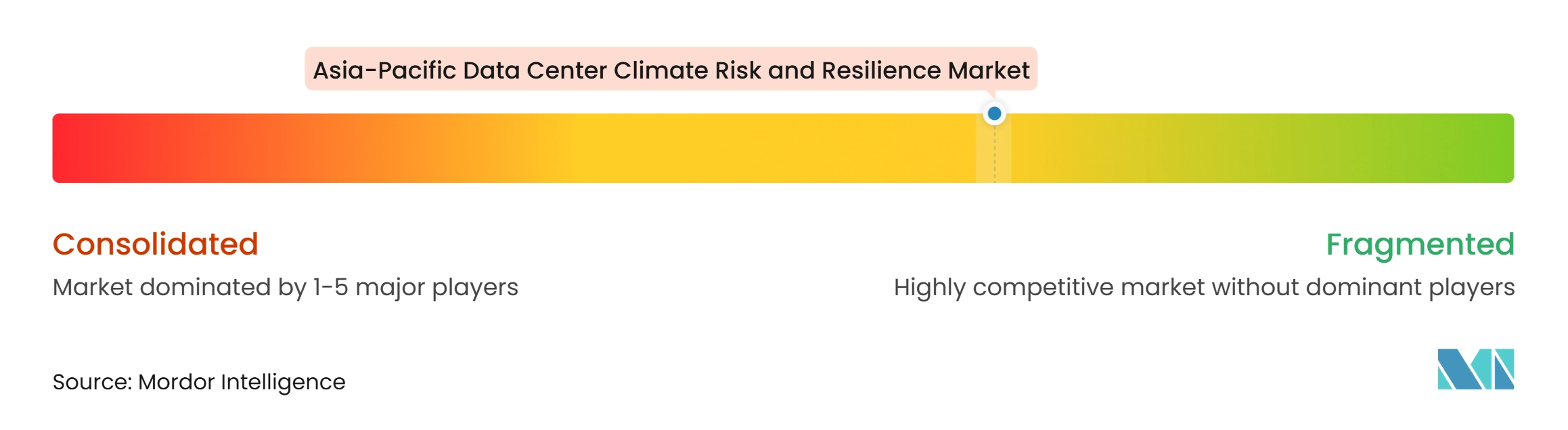
The Asia-Pacific data center climate risk and resilience market is fragmented. Global thermal-management and critical-infrastructure vendors compete alongside specialist analytics firms that focus on climate-risk quantification. Vertiv, Schneider Electric, Johnson Controls, and Trane Technologies are established in implementation because they can build on existing relationships with data center operators. Digital twins, AI-driven thermal analysis, and GIS-based risk visualization are becoming important areas of differentiation. These capabilities help suppliers move beyond equipment sales into assessment, design, monitoring, and compliance support.
Trane Technologies completed its acquisition of LiquidStack in March 2026 after announcing the agreement in February. The transaction gave Trane a thermal management portfolio covering chillers, coolant distribution units, direct-to-chip cooling, and cooling-plant design. In September 2026, Trane launched the LiquidStack CDU 2.X platform with flow capability up to 3,750 liters per minute at 3.5 bar.[4] Schneider Electric also launched its WCDU coolant distribution unit in 2026, integrating liquid and air cooling for high-density data center deployments. These moves support vendors that can combine cooling equipment with engineering and risk-management services.
Within the Asia-Pacific data center climate risk and resilience market, smaller operators represent an open area for Monitoring and Early Warning Services, as many lack internal climate-engineering capabilities. Specialists such as Intensel Limited are using proprietary climate-risk scoring to create a data-led advisory niche. Singapore’s licensing requirements and China’s PUE standards favor suppliers that can integrate compliance needs into their technical offerings. Point-solution providers may find it harder to compete when customers need linked assessment, design, monitoring, and reporting services.
Asia-Pacific Data Center Climate Risk and Resilience Industry Leaders
-
Vertiv Group Corp.
-
Schneider Electric SE
-
Johnson Controls International plc
-
Daikin Industries, Ltd.
-
Mitsubishi Electric Corporation
- *Disclaimer: Major Players sorted in no particular order
Asia-Pacific Data Center Climate Risk and Resilience Market Companies Covered in this Report
- Vertiv Group Corp.
- Schneider Electric SE
- Johnson Controls International plc
- Daikin Industries, Ltd.
- Mitsubishi Electric Corporation
- Huawei Digital Power Technologies Co., Ltd.
- Munters Group AB
- STULZ GmbH
- Rittal GmbH & Co. KG
- Trane Technologies plc
- Delta Electronics, Inc.
- Asetek A/S
- CoolIT Systems, Inc.
- Submer Technologies, S.L.
- Iceotope Technologies Ltd.
- LiquidStack Inc.
- Green Revolution Cooling, Inc.
- Alfa Laval AB
- Xylem Inc.
- Grundfos Holding A/S
- NTT Facilities, Inc.
- EkkoSense Ltd.
- Intensel Limited
Recent Industry Developments in Asia-Pacific Data Center Climate Risk and Resilience Market
- October 2026: Singapore's Parliament passed the Digital Infrastructure Bill, introducing mandatory licensing for data centers with at least 3 MW of critical IT load and setting minimum energy-efficiency benchmarks for licensed operators. This is the first comprehensive national regulatory framework of its kind in Southeast Asia and is expected to accelerate climate risk compliance investment across licensed facilities.
- September 2026: Trane Technologies launched the LiquidStack CDU 2.X platform at the Yotta 2026 conference, offering flow capability up to 3,750 liters per minute at 3.5 bar. The platform qualifies as an NVIDIA DSX Ready CDU and supports current and next-generation GPU rack densities, positioning Trane as a preferred thermal vendor for hyperscale AI factory deployments across Asia-Pacific.
- September 2026: Schneider Electric launched the WCDU coolant distribution unit, which integrates with fan-wall air-cooling systems for hybrid cooling in high-density AI data centers. A single unit achieves up to 3.5 MW of cooling capacity, and up to 20 units operating in group mode can support 30-40 MW data halls. Shipping commenced in select regions in October 2026.
- June 2026: GDS Holdings signed a strategic cooperation agreement with the Ulanqab municipal government to invest over CNY 30 billion (USD 4.1 billion) over 5 years in high-density data center parks and GW-scale campus development with 80% or more green electricity coverage, forming a large-scale zero-carbon data center cluster within China’s Eastern Data and Western Computing framework.
Asia-Pacific Data Center Climate Risk and Resilience Market Report Scope
The Asia-Pacific Data Center Climate Risk and Resilience Report is Segmented by Solution Type (Climate Risk Assessment and Analytics, Climate Scenario Modeling, Climate Risk Mapping and Geospatial Analysis, Climate Adaptation and Resilience Planning, Climate Risk Monitoring and Early Warning, and Climate Risk Advisory and Engineering Services), Climate Hazard (Extreme Heat and Heatwaves, Flooding and Sea-Level Rise, Hurricanes, Cyclones, and Severe Windstorms, Wildfires and Smoke Exposure, Drought and Water Scarcity, Extreme Cold, Ice, and Snow Events, and Compound and Multi-Hazard Events), Assessment Method (Historical Hazard Analysis, Forward-Looking Climate Scenario Analysis, Physical Risk and Vulnerability Assessment, Geographic and Geospatial Risk Mapping, Climate Stress Testing, and Financial and Asset-Level Climate Risk Quantification), Resilience Strategy (Site Selection and Climate-Informed Planning, Building and Structural Adaptation, Cooling and Thermal Resilience, Water Availability and Conservation Measures, Power Supply and Grid Resilience, Flood, Fire, and Severe Weather Protection, and Multi-Hazard Adaptation Planning), Service Type (Climate Risk Consulting, Climate Engineering and Design, Climate Adaptation Planning, Monitoring and Early Warning Services, and Risk Auditing and Disclosure Support), Data Center Size (Small, Medium, Large, and Hyperscale), Data Center Type (Colocation, Cloud Service Providers (CSPs), and Enterprise and Edge), and Geography (China, India, Japan, South Korea, Australia, and Rest of Asia-Pacific). The Market Forecasts are Provided in Terms of Value (USD).
Segmentation Overview
| Climate Risk Assessment and Analytics |
| Climate Scenario Modeling |
| Climate Risk Mapping and Geospatial Analysis |
| Climate Adaptation and Resilience Planning |
| Climate Risk Monitoring and Early Warning |
| Climate Risk Advisory and Engineering Services |
| Extreme Heat and Heatwaves |
| Flooding and Sea-Level Rise |
| Hurricanes, Cyclones, and Severe Windstorms |
| Wildfires and Smoke Exposure |
| Drought and Water Scarcity |
| Extreme Cold, Ice, and Snow Events |
| Compound and Multi-Hazard Events |
| Historical Hazard Analysis |
| Forward-Looking Climate Scenario Analysis |
| Physical Risk and Vulnerability Assessment |
| Geographic and Geospatial Risk Mapping |
| Climate Stress Testing |
| Financial and Asset-Level Climate Risk Quantification |
| Site Selection and Climate-Informed Planning |
| Building and Structural Adaptation |
| Cooling and Thermal Resilience |
| Water Availability and Conservation Measures |
| Power Supply and Grid Resilience |
| Flood, Fire, and Severe Weather Protection |
| Multi-Hazard Adaptation Planning |
| Climate Risk Consulting |
| Climate Engineering and Design |
| Climate Adaptation Planning |
| Monitoring and Early Warning Services |
| Risk Auditing and Disclosure Support |
| Small |
| Medium |
| Large |
| Hyperscale |
| Colocation |
| Cloud Service Providers (CSPs) |
| Enterprise and Edge |
| China |
| India |
| Japan |
| South Korea |
| Australia |
| Rest of Asia-Pacific |
| By Solution Type | Climate Risk Assessment and Analytics |
| Climate Scenario Modeling | |
| Climate Risk Mapping and Geospatial Analysis | |
| Climate Adaptation and Resilience Planning | |
| Climate Risk Monitoring and Early Warning | |
| Climate Risk Advisory and Engineering Services | |
| By Climate Hazard | Extreme Heat and Heatwaves |
| Flooding and Sea-Level Rise | |
| Hurricanes, Cyclones, and Severe Windstorms | |
| Wildfires and Smoke Exposure | |
| Drought and Water Scarcity | |
| Extreme Cold, Ice, and Snow Events | |
| Compound and Multi-Hazard Events | |
| By Assessment Method | Historical Hazard Analysis |
| Forward-Looking Climate Scenario Analysis | |
| Physical Risk and Vulnerability Assessment | |
| Geographic and Geospatial Risk Mapping | |
| Climate Stress Testing | |
| Financial and Asset-Level Climate Risk Quantification | |
| By Resilience Strategy | Site Selection and Climate-Informed Planning |
| Building and Structural Adaptation | |
| Cooling and Thermal Resilience | |
| Water Availability and Conservation Measures | |
| Power Supply and Grid Resilience | |
| Flood, Fire, and Severe Weather Protection | |
| Multi-Hazard Adaptation Planning | |
| By Service Type | Climate Risk Consulting |
| Climate Engineering and Design | |
| Climate Adaptation Planning | |
| Monitoring and Early Warning Services | |
| Risk Auditing and Disclosure Support | |
| By Data Center Size | Small |
| Medium | |
| Large | |
| Hyperscale | |
| By Data Center Type | Colocation |
| Cloud Service Providers (CSPs) | |
| Enterprise and Edge | |
| By Geography | China |
| India | |
| Japan | |
| South Korea | |
| Australia | |
| Rest of Asia-Pacific |
Key Questions Answered in the Report
What is the size of the Asia-Pacific data center climate risk and resilience market?
The market is valued at USD 0.61 billion in 2026 and is projected to reach USD 1.48 billion by 2032, at a 15.82% CAGR from 2027 to 2032.
What is driving demand for climate resilience services in Asia-Pacific data centers?
AI capacity growth in exposed hubs, climate reporting requirements, high-density cooling needs, and grid reliability concerns are increasing demand.
Which solution type leads the Asia-Pacific data center climate risk and resilience market?
Climate Risk Mapping and Geospatial Analysis leads solution-type revenue with a 26.84% share in 2026.
Which climate hazard has the largest revenue share for data center resilience services?
Flooding and Sea-Level Rise leads with 31.79% of climate hazard-type revenue in 2026.
Why is India a high-growth location for climate risk services?
India is projected to grow at a 16.58% CAGR through 2032, while forward-looking risk assessment requirements and exposure to heat, flood, and water stress support demand.