
Asia-Pacific Bathtub Market Size and Share
Market Overview
| Study Period | 2021 - 2031 |
|---|---|
| Forecast Data Period | 2026 - 2031 |
| Base Year Market Size (2025) | USD 3.30 Billion |
| Market Size (2026) | USD 3.44 Billion |
| Market Size (2031) | USD 4.64 Billion |
| Growth Rate (2026 - 2031) | 6.20 % |
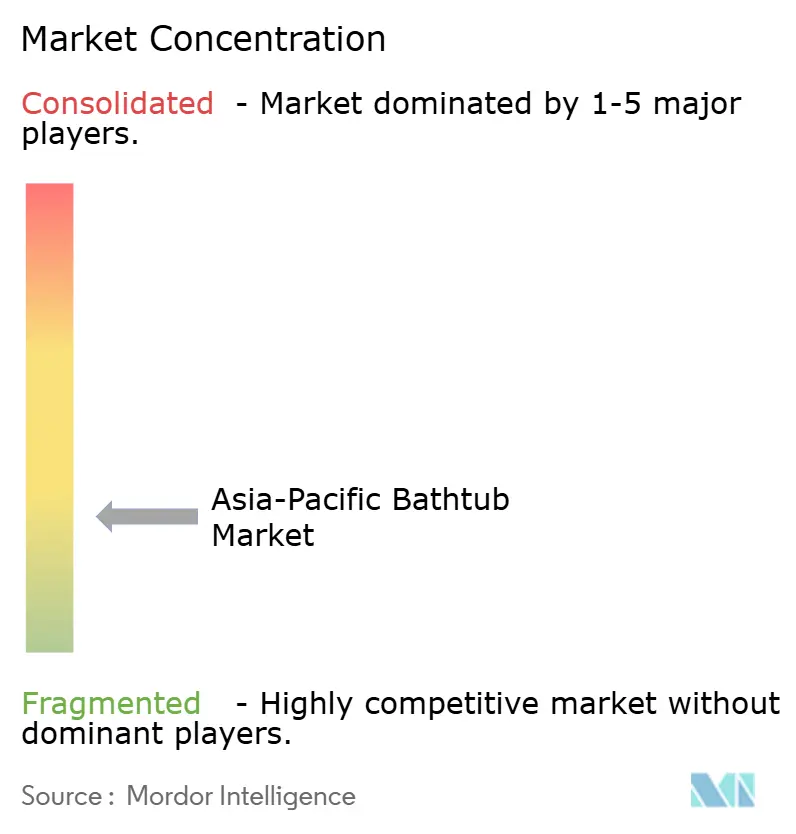
| Market Concentration | Low |
Major Players *Disclaimer: Major Players sorted in no particular order Image © Mordor Intelligence. Reuse requires attribution under CC BY 4.0. | |
Asia-Pacific Bathtub Market Analysis by Mordor Intelligence
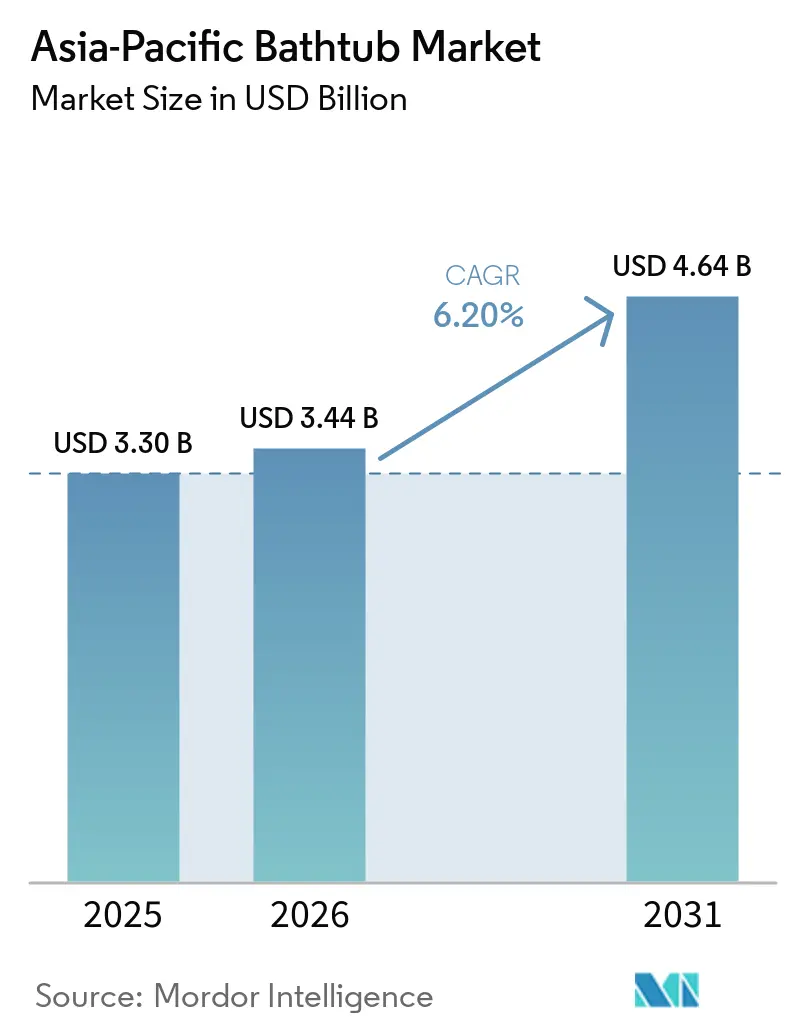
The Asia-Pacific bathtub market is expected to grow from USD 3.30 billion in 2025 to USD 3.44 billion in 2026 and is forecast to reach USD 4.64 billion by 2031, growing at a 6.20% CAGR from 2026 to 2031. Luxury housing activity in India, replacement demand in Japan and South Korea, and wellness-focused hospitality projects across Southeast Asia support the Asia-Pacific bathtub market. China remains the largest contributor, although weaker property activity shifts demand away from new installations and toward higher-value renovation projects. This change favors walk-in tubs, hydrotherapy products, and connected bathing systems that can justify a higher selling price. Shower substitution in dense cities and the full cost of installation continue to limit adoption outside higher-income households.
Key Report Takeaways
- By product type, alcove bathtubs accounted for 35.6% of the Asia-Pacific bathtub market in 2025, while freestanding bathtubs are projected to register an 8.11% CAGR through 2031.
- By material, acrylic accounted for 41.8% of the Asia-Pacific bathtub market in 2025, while solid surface and stone resin are projected to record a 7.62% CAGR through 2031.
- By end user, residential applications accounted for 69.5% of the Asia-Pacific bathtub market in 2025, while commercial applications are projected to achieve a 7.75% CAGR through 2031.
- By distribution channel, B2C and retail accounted for 81.5% of regional revenue in 2025, while B2B and direct procurement are projected to post a 7.36% CAGR through 2031.
- By geography, China accounted for 42.5% of regional revenue in 2025, while India is projected to deliver an 8.41% CAGR through 2031.
Note: Market size and forecast figures in this report are generated using Mordor Intelligence’s proprietary estimation framework, updated with the latest available data and insights as of January 2026.
Market Trends and Insights
Drivers Impact Analysis of Asia-Pacific Bathtub Market*
| Driver | (~) % Impact on CAGR Forecast | Geographic Relevance | Impact Timeline |
|---|---|---|---|
| Growing Demand for Space-Efficient and Compact Bathtub Designs | +0.8% | Region-wide, highest in India, China, and Southeast Asia | Short term (≤ 2 years) |
| Bathroom Renovation and Replacement in Mature Markets | +1.3% | Japan, South Korea, Australia | Medium term (2-4 years) |
| Premiumization of Bathroom Interiors | +1.4% | India, China Tier-1 cities, South Korea | Medium term (2-4 years) |
| Wellness, Hydrotherapy and Spa-Oriented Bathing | +1.2% | Australia, Japan, India, Southeast Asia | Long term (≥ 4 years) |
| Smart Water, Temperature and Hygiene Controls | +0.7% | Japan, South Korea, China, Australia | Medium term (2-4 years) |
| Aging-in-Place and Accessible Bathing Demand | +0.9% | Japan, China, South Korea, Australia | Long term (≥ 4 years) |
| Source: Mordor Intelligence | |||
Growing Demand for Space-Efficient and Compact Bathtub Designs
The bathtub market is benefiting from demand for space-efficient bathing solutions in densely populated urban centers such as Mumbai, Jakarta, and Shenzhen, where compact residential layouts limit bathroom space. Compact, deep-soaking bathtubs offer a practical alternative to conventional alcove designs by providing bathing comfort within smaller footprints. Japan’s established ofuro-style bathing tradition has influenced compact bathtub design, with manufacturers adapting similar concepts for consumers in China, South Korea, and India. Designs incorporating hydrotherapy features within compact dimensions, such as 1,200 mm × 700 mm, can appeal to households seeking enhanced bathing experiences without extensive bathroom renovations. At the same time, accessibility requirements and minimum clearance considerations make efficient bathroom planning an important factor in product selection and installation.
Bathroom Renovation and Replacement in Mature Markets
Bathroom renovation and fixture replacement support bathtub demand across mature Asia-Pacific markets, including Japan, South Korea, and Australia. In Japan, residential renovation and renewal contract orders reached JPY 4.13 trillion (USD 26.4 billion) in FY2024, demonstrating the substantial scale of renovation activity in existing homes [1]. In Australia, residential alterations and additions also represent an established component of housing investment alongside new construction. These renovation projects create opportunities for bathtub manufacturers as homeowners replace ageing fixtures, modernize bathroom interiors, and improve comfort without undertaking complete reconstruction. Demand is therefore supported by replacement-friendly dimensions, durable materials, contemporary finishes, and installation solutions suited to existing plumbing and bathroom layouts.
Premiumization of Bathroom Interiors and Wellness Bathing
Premium bathroom products are gaining attention in India, China’s major cities, South Korea, and Australia. The Asia-Pacific bathtub market benefits when developers use distinctive fixtures to support the positioning of higher-priced homes. Wellness features also move bathing from a purely functional purchase toward a design and self-care decision. The Global Wellness Institute reported in 2025 that communal hydrothermal bathing is being repositioned by resorts and urban bathhouses as a core wellness offer[2]. This hospitality activity increases consumer exposure to hydrotherapy, thermal bathing, and spa-like settings. Suppliers can extend their role beyond the tub itself through replacement jets, aromatherapy modules, and smart-control upgrades.
Smart Controls and Accessible Bathing Demand
Smart water, temperature, and hygiene controls strengthen differentiation in Japan, South Korea, China, and Australia. These functions can improve comfort and support the premium positioning of connected bathroom systems. Demand for accessible bathing is also rising as aging households seek lower-threshold entry and safer use. China’s 2025 Government Work Report included age-friendly design within its good-housing quality direction[3]. Walk-in tubs can combine hydrotherapy, simple entry, emergency alert connections, and specialized drainage. The Asia-Pacific bathtub market has a practical opportunity where accessibility features are integrated into attractive products rather than treated as institutional equipment.
Restraints Impact Analysis of Asia-Pacific Bathtub Market*
| Restraint | (~) % Impact on CAGR Forecast | Geographic Relevance | Impact Timeline |
|---|---|---|---|
| Limited Bathroom Footprint in Dense Asian Housing | -1.3% | India, China, Vietnam, Indonesia | Short term (≤ 2 years) |
| High Installation, Waterproofing and Maintenance Cost | -0.8% | Region-wide, most acute in Southeast Asia retrofit market | Medium term (2-4 years) |
| Water and Energy Use Scrutiny Versus Shower Substitution | -1.0% | Singapore, Malaysia, Australia, India urban centers | Medium term (2-4 years) |
| Raw-Material, Freight and Currency Volatility | -0.6% | Global supply chains affecting Asia-Pacific manufacturers | Short term (≤ 2 years) |
| Source: Mordor Intelligence | |||
Limited Bathroom Footprint and Installation Cost
Limited bathroom space is a lasting constraint on bathtub adoption in dense Asian cities. Main bathrooms in standard 2-bedroom apartments across Mumbai, Jakarta, Ho Chi Minh City, and Shenzhen commonly occupy less than 4 square meters. Conventional alcove and freestanding units may require costly structural changes in these homes. In India’s volume apartment segment, shower enclosures often win because they use space more efficiently. Hong Kong’s Housing Authority includes bathtub-to-shower conversions in its modification programs[4]. Installation costs can add waterproofing, plumbing changes, tiling, labor, drainage, and maintenance to the product price. These combined barriers mean that the Asia-Pacific bathtub market depends more on higher-value projects than broad household penetration.
Water, Energy, and Supply-Chain Pressures
Showers remain a strong substitute where households prioritize water use, energy use, and fast daily routines. This pressure is especially relevant in urban centers in Singapore, Malaysia, Australia, and India. Manufacturers need to explain the wellness, accessibility, and design value of a bathtub rather than rely on functional necessity alone. Material, freight, and currency changes also affect suppliers serving regional markets from cross-border production networks. These movements can raise costs for acrylic, metal, resin, fittings, and finished goods. They can also make retail prices and installation budgets less predictable for buyers. The Asia-Pacific bathtub market therefore favors firms that can manage sourcing, local distribution, and project planning with consistent quality.
*Our forecasts treat driver/restraint impacts as directional, not additive. The impact forecasts reflect baseline growth, mix effects, and variable interactions.
Asia-Pacific Bathtub Market Segment Analysis
By Product Type:
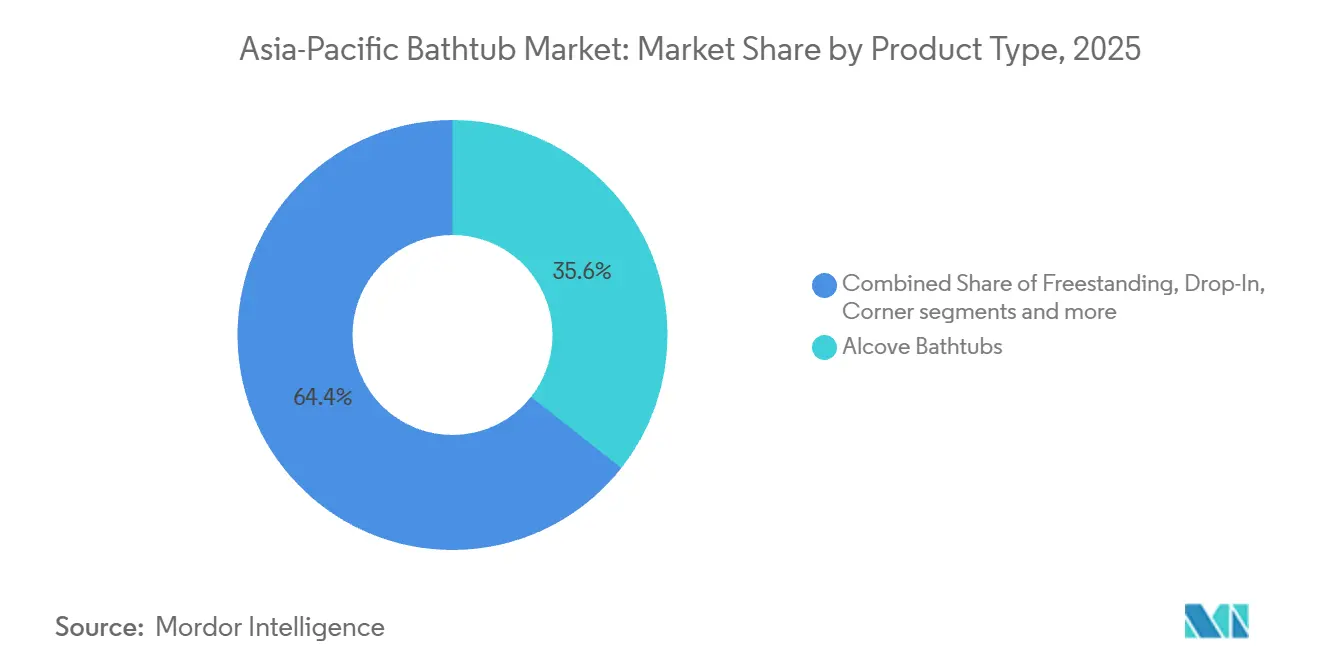
Alcove Remains the Backbone, Freestanding Redefines ValueAlcove bathtubs held 35.6% of the Asia-Pacific bathtub market size in 2025, while freestanding bathtubs are forecast to expand at an 8.11% CAGR through 2031. Alcove designs remain the standard choice in mid-tier residential projects in China, Japan, South Korea, and Australia. Their familiar format suits planned bathroom layouts and supports broad-volume construction. Freestanding units command higher prices because they act as visible fixtures in luxury homes and hospitality suites. Kohler presented wellness-integrated freestanding bathing and premium finishes at its 2025 Asia-Pacific Distributor Conference in Bangkok. This product format lets developers create a focal point without changing the broader bath category.
Drop-in tubs remain relevant in premium show units where a tiled surround provides a custom appearance. Corner models respond to angular or difficult room layouts. Whirlpool products are being specified more often in luxury hotels and standalone wellness venues across Southeast Asia. Their attraction lies in the ability to combine a bathing fixture with jets and a stronger wellness proposition. Walk-in tubs form a smaller but important category for aging households and rehabilitation settings. These products address entry safety, access, and the need for a more controlled bathing environment. Shanxi Province offers subsidies of up to CNY 18,000 (~USD 2,571) for elderly-accessible home upgrades that include walk-in tubs. The subsidy gives households a clearer route to make an accessibility-related purchase. Manufacturers that offer flexible dimensions and low-disruption replacement options can address the installed base of older alcove units. This matters where a household wants to upgrade a fixture without changing the room plan. It supports renovation demand in mature markets where full bathroom reconstruction is less common. It also gives suppliers a reason to maintain products that fit familiar alcove dimensions.

By Material:
Acrylic Anchors Volume, Stone Resin Resets the Price CeilingAcrylic held 41.8% of regional revenue in 2025, while solid surface and stone resin are forecast to record a 7.62% CAGR through 2031. Acrylic remains widely used because it is lighter than cast iron, simpler to ship, and easier to install. Its lower weight reduces handling costs for distributors and installers across diverse regional markets. Solid surface and stone resin appeal to affluent homeowners and hospitality developers seeking heat retention, scratch resistance, and a warm feel. These materials are most relevant to premium demand in India, China’s largest cities, South Korea, and Australia. Their visual weight also helps freestanding tubs communicate a higher-value finish.
Cast iron retains a premium following in Japanese and Australian renovation projects. Its established place in these projects reflects buyer preference for a substantial and durable fixture. Porcelain-enameled steel continues to serve a middle segment that balances price and durability. Cultured marble has a role in bespoke commercial and senior-living projects that require more dimensional flexibility. Material choice is therefore linked to the room, the installation plan, and the level of finish that a project requires. Kuraray decided in 2025 to transfer its cast methacrylic resin sheet business in China, citing weaker acrylic bathtub sales amid property market uncertainty. This illustrates acrylic’s exposure to construction activity in China. It also shows why volume leadership does not eliminate sensitivity to the housing cycle. As renovation replaces part of the new-build demand, product selection can shift toward materials with stronger perceived quality and longer replacement value. Manufacturers can respond by making the functional case for lighter materials while also offering finishes that better fit premium renovation projects.
By End User:
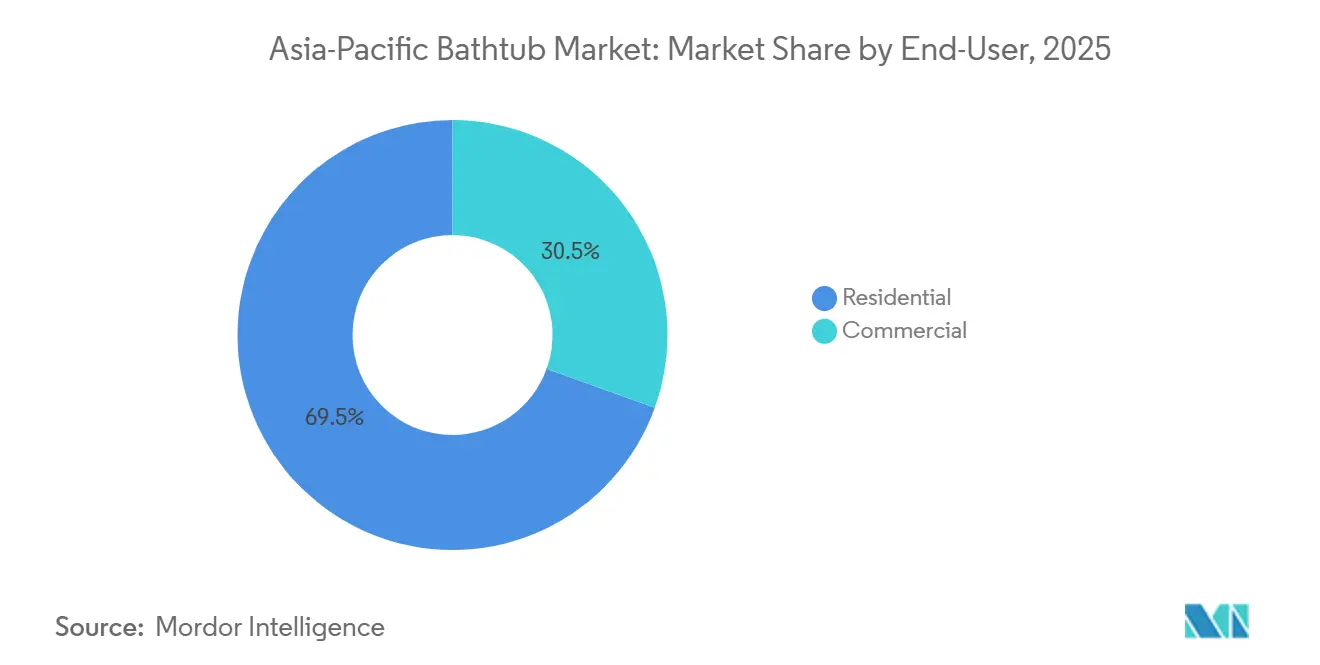
Residential Leads, Commercial Accelerates on Wellness InfrastructureResidential applications accounted for 69.5% of the Asia-Pacific bathtub market size in 2025, while commercial use is forecast to grow at a 7.75% CAGR through 2031. Residential demand remains the main volume base for the region. Luxury projects in India increasingly specify hydrotherapy-enabled tubs in higher-priced homes. In China, apartment improvement and renovation projects create a separate stream of household demand. Japan and South Korea also offer a growing base of senior-living projects where barrier-free tubs can become a standard feature. This mix gives the residential segment exposure to both premium housing and age-friendly construction.
Commercial demand is supported by hotels, resorts, spas, healthcare facilities, and senior-living developments. Luxury resort activity in Thailand, Bali, Singapore, and the Maldives supports suite-level specifications for freestanding and whirlpool tubs. In these settings, the product forms part of the room experience rather than a basic bathroom fixture. Thailand’s RXV Wellness Village opened a dedicated hydrotherapy area in 2025 with vitality pools, soda baths, and cold-plunge facilities. The Grand Hyatt Singapore’s Damai hub also positions thermal hydrotherapy as a core offering. These projects give guests direct exposure to wellness-oriented water experiences. They also make hospitality operators more attentive to the visual quality, maintenance needs, and reliability of each installation. Such projects create demand for products that offer a clear guest experience and reliable maintenance. Commercial buyers require manufacturers to provide project support, custom finishes, and consistent quality documentation. This favors suppliers that can work with designers and operators before the final fixture specification is set.
By Distribution Channel:
Retail Commands Volume, B2B Channels Gain Specification PowerB2C and retail channels held 81.5% of regional revenue in 2025, while B2B and direct procurement are forecast to grow at a 7.36% CAGR through 2031. Retail remains the leading route because many residential buyers prefer to examine a high-value fixture before purchase. A bathtub’s size, surface, depth, and finish are easier to assess in person than through a standard catalog image. Specialty showrooms serve higher-income customers who need help selecting finishes and coordinating a bathroom design. Big-box home improvement stores serve the larger volume tier. These stores give buyers a more familiar purchase setting for standard products and replacement needs. Online channels are also useful in China and India because detailed specifications and 3D tools can reduce uncertainty around remote purchases. Digital content can help a buyer understand dimensions before a showroom visit or a final order. The retail channel remains important where the physical feel and finishing of a product affect purchase decisions.
Direct procurement is gaining ground with hotel groups, developers, and design-build contractors. These buyers need custom sizes, project pricing, and finishes that retail channels do not always provide. They may also need product delivery aligned with a construction or renovation schedule. Contract-sales teams and architect-specification support can help manufacturers win these accounts. The trade-off is a longer sales cycle and more concentration in project-related revenue. A single hospitality project can create a meaningful order, but it can also tie the supplier to design approvals and construction timing. LIXIL launched its 1,000-square-meter Experience Centre in Hanoi in 2025, expanding a regional showroom format that connects design professionals and consumers with its product range. Kohler also opened a Bali showroom in May 2025 to serve residential, hospitality, and villa customers. Such locations can support both retail consideration and professional specification, which links the two channel models more closely.
Geography Analysis
China held 42.5% of regional revenue in 2025, making it the region’s largest national market. Reuters reported in June 2025 that Goldman Sachs expected China’s annual new-home demand to settle near 5 million units, compared with the 2017 peak of 20 million units. This environment shifts the country’s demand toward apartment improvement, renovation, accessible products, and hydrotherapy models. The change is important because these purchases depend more on household preferences and existing homes than on broad new-build output. Manufacturers are more likely to create value through replacement and premium features than by relying on new-construction unit volumes. A product that fits an existing room and adds visible comfort can have a stronger position in this setting. Age-friendly upgrades are a further source of demand, as local subsidies support accessible home modifications in parts of the country. The direction of demand makes walk-in products and controlled bathing features more relevant to suppliers serving renovation buyers.
India is forecast to grow at an 8.41% CAGR through 2031, the fastest rate in the Asia-Pacific bathtub market. Hansgrohe announced in September 2025 that it would quadruple production capacity in India as China sales slowed. The decision indicates that international suppliers see India as a durable location for premium bathroom demand and regional production. It also signals a supply-chain response to differences in growth between the two countries. BRG Building Solutions reported in November 2025 that sales of hydromassage and standard baths were rising in urban India. Demand is concentrated in Delhi, Mumbai, Bengaluru, and Hyderabad, where luxury housing and spa-oriented consumption have a stronger presence. These cities offer suppliers a more defined group of consumers and projects than a broad national market. They also give showroom and dealer networks a basis for targeted expansion. Product availability, local production, and premium project specifications can reinforce each other in these metropolitan areas.
Japan and South Korea form a renovation-and-technology cluster for the Asia-Pacific bathtub market. Japan’s strong partial-refurbishment activity supports fixture replacement, while South Korea’s aging apartment stock favors modern bathroom upgrades. In both countries, the replacement decision can be tied to comfort, water control, finish quality, and the usability of a familiar space. Australia is an important design and wellness market, where freestanding tubs and hydrotherapy features are common in premium coastal projects around Melbourne, Sydney, and Brisbane. The country illustrates the value of design-led products in residential projects with a strong lifestyle component. Southeast Asia offers a parallel hospitality opportunity across Vietnam, Indonesia, Thailand, Singapore, and Bali. LIXIL opened its third Indonesian Experience Centre in Central Jakarta in 2025 and announced further locations in Medan, Surabaya, and Bali. These locations help bring premium sanitaryware closer to a growing group of residential and hospitality customers. The subregion combines urban housing activity, luxury tourism, and a wider interest in wellness facilities. It is therefore a meaningful setting for both project sales and consumer showroom activity.
Competitive Landscape
The Asia-Pacific bathtub market is moderately fragmented because global premium brands and Chinese domestic suppliers serve different value tiers. Kohler, TOTO, LIXIL, Duravit, and Jacuzzi compete through technology, premium finishes, wellness features, and showroom experiences. JOMOO Group, Arrow Home Group, SSWW, and Appollo Bathroom compete more directly in the mid-tier through pricing and regional availability. A market concentration score cannot be assigned because the supplied material does not provide verified, comparable market shares for leading suppliers.
Kohler used its 2025 Asia-Pacific Distributor Conference in Bangkok to prioritize wellness-integrated bathing, hydrotherapy, and premium finishes. LIXIL opened Experience Centres in Hanoi and Central Jakarta during 2025, strengthening its experiential retail strategy. These centers bring products to consumers, designers, and project decision-makers. LIXIL also partnered with American Bath Group in April 2025, enabling the company to focus development capital on its APAC-facing roadmap. These actions show that leading companies are investing in product capability as well as consumer access.
Accessible and elderly-care bathing remains an open competitive area in the Asia-Pacific bathtub market. Haier Smart Health introduced an IoT-enabled walk-in bathtub in 2025 with occupant monitoring, emergency alerts, and low-threshold entry. This category may require specialized drainage, ozone sterilization, emergency wiring, and easy-access doors. Smart controls also increase the importance of dependable water and temperature management. Suppliers with credible installation support, wellness features, and accessibility expertise are better placed to serve this developing category.
Asia-Pacific Bathtub Industry Leaders
-
Kohler Co.
-
TOTO LTD.
-
LIXIL Corporation
-
Roca Sanitario, S.A.
-
Duravit AG
- *Disclaimer: Major Players sorted in no particular order
Asia-Pacific Bathtub Market Companies Covered in this Report
- Kohler Co.
- TOTO LTD.
- LIXIL Corporation
- Roca Sanitario, S.A.
- Duravit AG
- Jacuzzi Brands LLC
- Villeroy & Boch AG
- RAK Ceramics PJSC
- American Standard Brands
- Hansgrohe SE
- Huida Sanitary Ware Co., Ltd.
- Hindware Homes Limited
- Porcelanosa Group
- Appollo Bathroom Co., Ltd.
- T&W Sanitary Ware Co., Ltd.
- Arrow Home Group Co., Ltd.
- JOMOO Group
- SSWW Sanitary Ware Co., Ltd.
- CERA Sanitaryware Limited
- Jaquar and Company Private Limited
Recent Industry Developments in Asia-Pacific Bathtub Market
- September 2025: Hansgrohe SE announced plans to quadruple its India manufacturing output, targeting the country’s expanding premium residential segment as an alternative to a slowing premium market in China.
- June 2025: Kohler held its 2025 Asia-Pacific Distributor Conference at Rosewood Bangkok, presenting wellness-integrated bathing, hydrotherapy, and premium finish options including Vibrant Brushed Rose Gold and Vibrant Brushed Titanium
- May 2025: Kohler opened a new Bali showroom through distribution partner PT. Gastro Gizi Sarana on Sunset Road, Kuta, targeting the residential, hospitality, and villa segments.
Asia-Pacific Bathtub Market Report Scope
Segmentation Overview
| Freestanding Bathtubs |
| Alcove Bathtubs |
| Drop-In Bathtubs |
| Corner Bathtubs |
| Walk-In Bathtubs |
| Whirlpool Bathtubs |
| Other Product Types |
| Acrylic |
| Fiberglass |
| Cast Iron |
| Porcelain-Enameled Steel |
| Solid Surface and Stone Resin |
| Cultured Marble |
| Ceramic and Other Materials |
| Residential | |
| Commercial | Hotels and Resorts |
| Spas and Wellness Centers | |
| Healthcare and Senior Living | |
| Gyms and Other Commercial Facilities |
| B2C/Retail | Big-Box & Home-Improvement Stores |
| Specialty Retail Stores | |
| Online | |
| Other Distribution Channels | |
| B2B/Direct From Manufacturers |
| India |
| China |
| Japan |
| Australia |
| South Korea |
| Southeast Asia |
| Rest of Asia-Pacific |
| By Product Type | Freestanding Bathtubs | |
| Alcove Bathtubs | ||
| Drop-In Bathtubs | ||
| Corner Bathtubs | ||
| Walk-In Bathtubs | ||
| Whirlpool Bathtubs | ||
| Other Product Types | ||
| By Material | Acrylic | |
| Fiberglass | ||
| Cast Iron | ||
| Porcelain-Enameled Steel | ||
| Solid Surface and Stone Resin | ||
| Cultured Marble | ||
| Ceramic and Other Materials | ||
| By End User | Residential | |
| Commercial | Hotels and Resorts | |
| Spas and Wellness Centers | ||
| Healthcare and Senior Living | ||
| Gyms and Other Commercial Facilities | ||
| By Distribution Channel | B2C/Retail | Big-Box & Home-Improvement Stores |
| Specialty Retail Stores | ||
| Online | ||
| Other Distribution Channels | ||
| B2B/Direct From Manufacturers | ||
| By Geography | India | |
| China | ||
| Japan | ||
| Australia | ||
| South Korea | ||
| Southeast Asia | ||
| Rest of Asia-Pacific | ||
Key Questions Answered in the Report
What is the projected value of the Asia-Pacific bathtub market by 2031?
The Asia-Pacific bathtub market is forecast to reach USD 4.64 billion by 2031, expanding at a 6.20% CAGR from 2026 to 2031.
Which bathtub product type is growing fastest in Asia-Pacific?
Freestanding bathtubs are forecast to grow at an 8.11% CAGR through 2031, supported by luxury residential and hospitality demand.
Which bathtub material leads regional demand?
Acrylic led in 2025 with a 41.8% share because its lower weight helps reduce shipping and installation costs.
Why is India important for bathtub suppliers?
India is forecast to grow at an 8.41% CAGR through 2031, and Hansgrohe announced plans in 2025 to quadruple production capacity in the country.
What is driving commercial bathtub demand in Asia-Pacific?
Hotels, resorts, spas, healthcare facilities, and senior-living projects support commercial demand, which is forecast to grow at a 7.75% CAGR through 2031.