
Asia-Pacific 5G Core Network Market Size and Share
Market Overview
| Study Period | 2020 - 2031 |
|---|---|
| Forecast Data Period | 2026 - 2031 |
| Base Year Market Size (2025) | USD 2.06 Billion |
| Market Size (2026) | USD 2.5 Billion |
| Market Size (2031) | USD 6.59 Billion |
| Growth Rate (2026 - 2031) | 21.39 % |
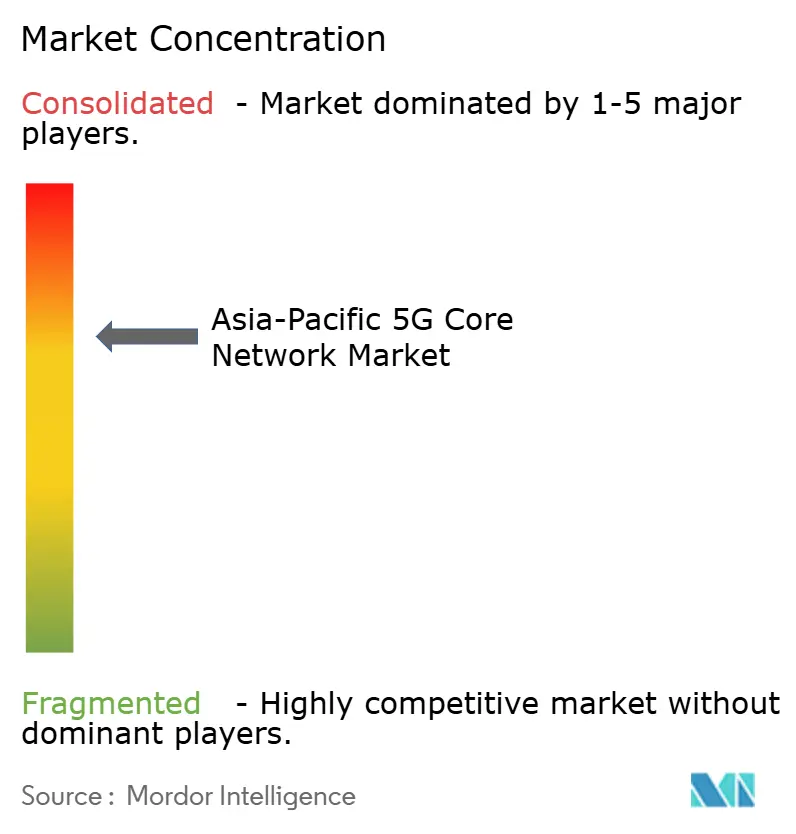
| Market Concentration | Medium |
Major Players *Disclaimer: Major Players sorted in no particular order Image © Mordor Intelligence. Reuse requires attribution under CC BY 4.0. | |
Asia-Pacific 5G Core Network Market Analysis by Mordor Intelligence
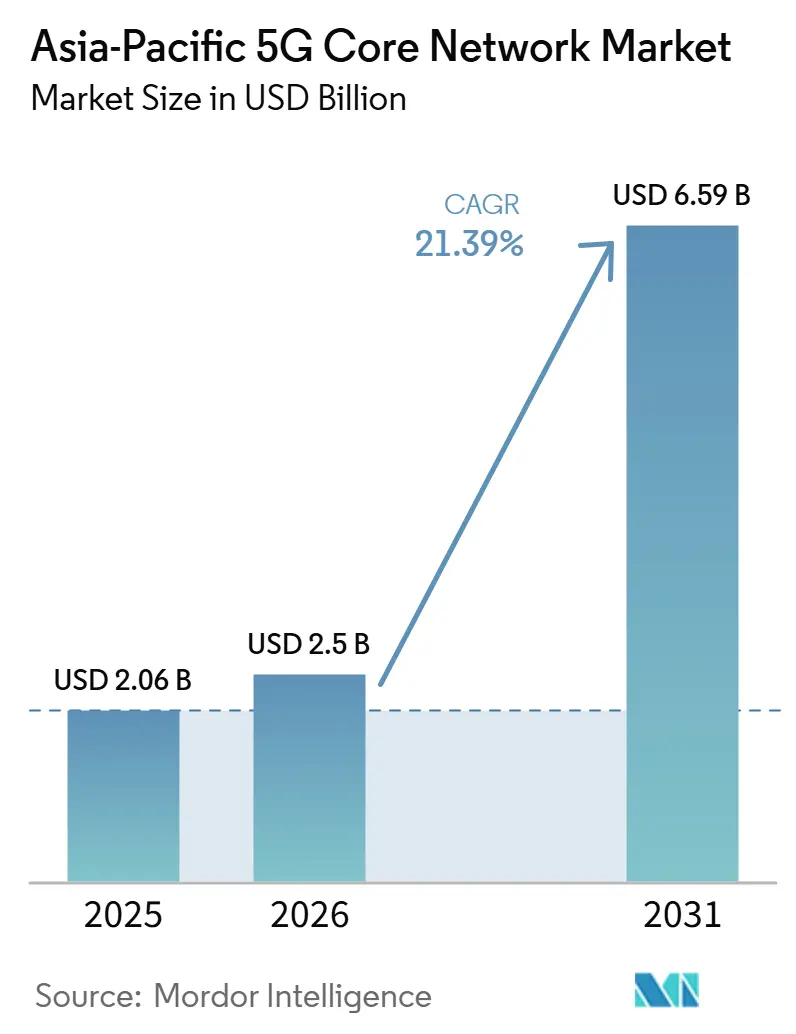
The Asia-Pacific 5G core network market size is projected to expand from USD 2.06 billion in 2025 and USD 2.5 billion in 2026 to USD 6.59 billion by 2031, registering a CAGR of 21.39% between 2026 to 2031. The move from non-standalone 5G to standalone architecture is shifting procurement from incremental radio upgrades to full core-replacement programs. This shift provides operators with the technical foundation for network slicing, low-latency application programming interfaces, and private networks. Cloud-native software also allows operators to separate network functions from underlying hardware and adjust capacity more efficiently. The Asia-Pacific 5G core network market is therefore shaped by a split between public-cloud deployment models and sovereign, dedicated deployments that address local data requirements. Vendor strategies in the Asia-Pacific 5G core network market increasingly focus on migration support, automation, energy performance, and multi-vendor integration, because operators want clearer implementation paths and lower operating burdens as they modernize their networks.
Key Report Takeaways
- By component, solutions held 61.19% of the Asia-Pacific 5G core network market share in 2025, while services are projected to expand at a 23.44% CAGR through 2031.
- By deployment model, on-premise and dedicated deployments held 51.69% share in 2025, while public cloud is projected to expand at a 26.50% CAGR through 2031 in the Asia-Pacific 5G core network market.
- By end user, telecom operators held 72.25% share in 2025, while enterprises are projected to expand at a 25.88% CAGR through 2031 in the Asia-Pacific 5G core network market.
- By network function, the User Plane Function held 20.79% share in 2025, while the Network Exposure Function is projected to expand at a 27.71% CAGR through 2031.
- By geography, China held 49.50% share in 2025, while India is projected to expand at a 25.00% CAGR through 2031 in the Asia-Pacific 5G core network market.
Note: Market size and forecast figures in this report are generated using Mordor Intelligence’s proprietary estimation framework, updated with the latest available data and insights as of January 2026.
Asia-Pacific 5G Core Network Market Trends and Insights
Drivers Impact Analysis*
| DRIVER | (~) % IMPACT ON CAGR FORECAST | GEOGRAPHIC RELEVANCE | IMPACT TIMELINE |
|---|---|---|---|
| Accelerated 5G Standalone Core Migration | +5.2% | Global, with the highest concentration in China, India, South Korea, and Japan | Short term (≤2 years) |
| Cloud-Native Core Modernization in Tier-1 Networks | +4.1% | China, Japan, South Korea, and India | Medium term (2–4 years) |
| Network Slicing for Manufacturing and Industrial IoT | +3.3% | China, Japan, South Korea, and Southeast Asian manufacturing hubs | Medium term (2–4 years) |
| Private Networks and Enterprise API Monetization | +2.7% | China, India, Japan, and Southeast Asian enterprise clusters | Medium term (2–4 years) |
| Energy-Efficient Core Virtualization and Server Consolidation | +1.5% | Global, with early traction in Japan and Australia | Long term (≥4 years) |
| Open RAN and Multi-Vendor Core Procurement | +1.2% | Japan, Southeast Asia, and India | Long term (≥4 years) |
| Source: Mordor Intelligence | |||
Accelerated 5G Standalone Core Migration
Operators across the Asia-Pacific 5G core network market are moving away from non-standalone architecture because advanced 5G services require a standalone core. Network slicing, private networks, and low-latency APIs cannot offer their intended capabilities through a 4G Evolved Packet Core. This requirement turns migration into a broad software, infrastructure, and integration program, involving new packet-core functions, lifecycle tools, data migration, testing, security validation, and operational preparation before commercial traffic can be moved. NTT DOCOMO and NEC launched Japan's first commercial 5G core on AWS in February 2026. The companies said AI-based construction cut deployment time by 80%, and AWS Graviton2 processors reduced power consumption by 70%.[1] Reliance Jio's standalone core supported 130 million users and carried 33% of its total data traffic in 2025, showing the scale available once a migration is complete.
Cloud-Native Core Modernization in Tier-1 Operator Networks
Cloud-native modernization has become central to how large operators in the Asia-Pacific 5G core network market plan future network operations. Containerized functions and automated orchestration can reduce the time required to deploy and update network services. Ericsson signed a multiyear agreement with SoftBank in March 2026 to modernize nationwide core functions with a cloud-native dual-mode 5G Core. The program covers access and mobility management, mobility management entity functions, voice gateways, and policy control.[2] Tune Talk completed the first phase of its cloud-native core modernization with Nokia in January 2026, becoming the first Southeast Asian telecommunications operator to deploy the architecture at scale. These deployments place public cloud providers more firmly within the core network supply chain, while leaving operators responsible for selecting which functions can run centrally and which require local processing for latency, resilience, or data control.
Network Slicing Demand from Manufacturing and Industrial IoT
Manufacturing and logistics facilities are creating a clear commercial case for network slicing in the Asia-Pacific 5G core network market. These sites need predictable connectivity for automated guided vehicles, production control, machine vision, and maintenance systems. Telkomsel and Pegatron deployed a standalone 5G private network at a factory in Batam with sub-10-millisecond latency and network slicing. The deployment supported production reconfiguration that was more than 70% faster, a 5% improvement in overall equipment effectiveness, and 99.9% uptime for automated guided vehicles.[3] Bharti Airtel launched commercial 5G network slicing in India with Ericsson technology in 2025. Dedicated service levels allow operators to charge enterprises for assured network performance rather than only for data volume, thereby linking service pricing to measurable operational requirements such as response time, reliability, traffic priority, and consistent coverage within a facility.
Private Networks and Enterprise API Monetization
Private networks and standardized network APIs are expanding the revenue options available to core network operators. A standalone core can expose controlled features, including location, session control, and quality of service, to approved third-party applications. The GSMA reported that its CAMARA initiative had commitments from 47 operator groups representing 239 networks and 65% of global connections. This common interface gives developers a more consistent way to use network capabilities across operators. Reliance Jio launched 10 active 5G network slices nationwide in August 2025 for IoT, gaming, fixed wireless access, and mission-critical uses. The Network Exposure Function is consequently becoming more important because it provides the controlled gateway for these API services, allowing an operator to apply permissions, service rules, and quality controls before network capabilities are made available to enterprise users and developers.
Restraints Impact Analysis*
| RESTRAINT | (~) % IMPACT ON CAGR FORECAST | GEOGRAPHIC RELEVANCE | IMPACT TIMELINE |
|---|---|---|---|
| High Upfront Integration Cost and Long Payback Cycles | -3.0% | Southeast Asia and the Rest of Asia-Pacific, particularly smaller and mid-tier operators | Medium term (2–4 years) |
| Legacy EPC Coexistence Delays and Migration Complexity | -2.0% | China, India, and South Korea | Medium term (2–4 years) |
| Cloud-Native Talent Shortage Across Telecom Operations | -1.3% | Southeast Asia, the Rest of Asia-Pacific, and India | Medium term (2–4 years) |
| Security, Sovereignty, and Certification Friction for Cross-Border Deployments | -0.7% | Global, especially Southeast Asia and South Asia | Long term (≥4 years) |
| Source: Mordor Intelligence | |||
High Upfront Integration Cost and Long Payback Cycles
Full standalone core programs require spending on software licenses, cloud infrastructure, orchestration tools, and multiyear integration services. This burden is particularly difficult for smaller operators in Southeast Asia, Pacific markets, and South Asia. Lower average revenue per user limits their ability to absorb the cost within normal investment cycles. Integration work for testing, multi-vendor orchestration, and live traffic migration can account for 30-40% of the project cost. These expenses can emerge late in the project and postpone the launch of enterprise services. Managed service and core-as-a-service models can reduce this pressure by spreading implementation and operating costs over a longer period, but availability outside Japan and Australia remains limited for operators that need local support and proven delivery partners.
Legacy EPC Coexistence Delays and Migration Complexity
Operators often need to run a 4G Evolved Packet Core and a standalone 5G core in parallel during migration. This arrangement duplicates infrastructure costs and creates difficult interworking tasks. It also makes subscriber migration more sensitive, as operators must avoid disrupting existing services. Bharti Airtel has taken a phased approach in India, with fixed wireless access already using standalone 5G while mobile customers move in stages. The longer coexistence period extends payments for legacy maintenance alongside spending on new core equipment. These conditions can delay expected vendor returns and slow growth in the Asia-Pacific 5G core network market in countries with complex legacy estates, especially when operators must maintain old contracts, protect service continuity, and train teams to support two very different core environments simultaneously.
*Our forecasts treat driver/restraint impacts as directional, not additive. The impact forecasts reflect baseline growth, mix effects, and variable interactions.
Segment Analysis
By Component: Software Architecture Anchors Long-Term Revenue
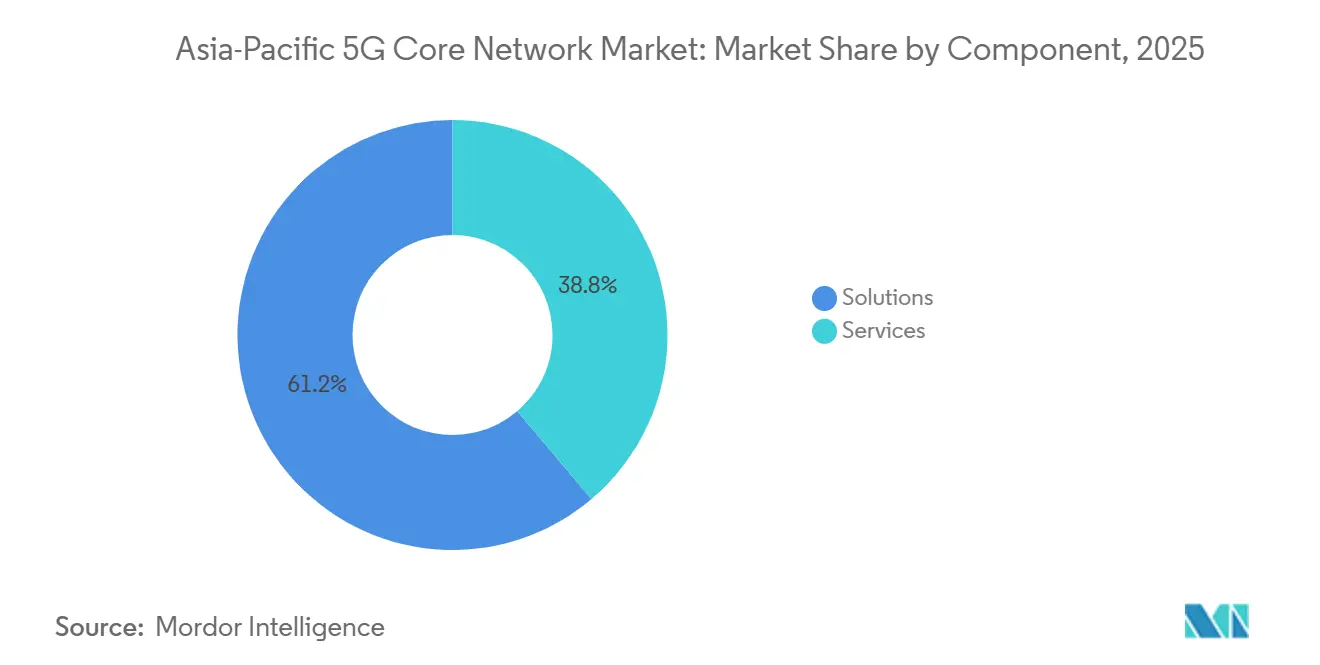
Solutions are expected to hold 61.19% of the Asia-Pacific 5G core network market share in 2025. This category includes packet-core software, network functions virtualization infrastructure, and orchestration and management tools. Packet-core software is highly valuable because operators license separate functions that they can upgrade and scale without replacing every hardware layer. Access and mobility management, session management, and user plane functions are examples of these disaggregated functions. Commercial off-the-shelf servers and Kubernetes platforms remain important parts of the infrastructure stack. However, public-cloud contracts are taking on some infrastructure spending that previously went to owned platforms.
Services are projected to expand at a CAGR of 23.44% through 2031 within the Asia-Pacific 5G core network industry. This category covers integration and deployment, consulting and advisory work, and support and maintenance. Integration remains the main service activity for greenfield standalone deployments in India and upgrades in Japan and South Korea. Legacy core coexistence adds testing and traffic cutover work to these projects. Consulting demand is also rising among mid-tier operators that lack deep internal cloud engineering teams. Therefore, the service opportunity in the Asia-Pacific 5G core network market extends beyond the initial buildout, as operators manage and optimize multi-vendor networks, adjust automation policies, and handle regular software releases required in a cloud-native environment.
By Deployment Model: Public Cloud Gains Ground as Operators Pursue Elastic Capacity
On-premises and dedicated architectures are expected to account for 51.69% of the Asia-Pacific 5G core network market size in 2025. Their lead reflects the scale of Chinese Tier-1 operators and the preference for controlled core environments under state-directed infrastructure programs. China Mobile, China Telecom, and China Unicom use standalone core deployments at a national scale. Domestic suppliers Huawei and ZTE have supported these programs. Dedicated installations also suit operators who must keep sensitive data and real-time processing within their own environments. This model remains important where sovereignty requirements are strict or latency guarantees are central to the service.
Public cloud is projected to expand at a CAGR of 26.50% through 2031. NTT DOCOMO's commercial AWS deployment gives regional peers a carrier-scale reference point for cloud-hosted core functions. Tune Talk uses AWS in Malaysia for its control plane while retaining its user plane locally on AWS Outposts at the edge. This arrangement addresses both latency and data residency requirements. Hybrid and telco edge models are also gaining traction in Japan, South Korea, and Australia. These models allow operators to use cloud capacity for less latency-sensitive functions while retaining local processing for enterprise services.
By End User: Operator Scale Underpins Revenue While Enterprises Reshape Growth
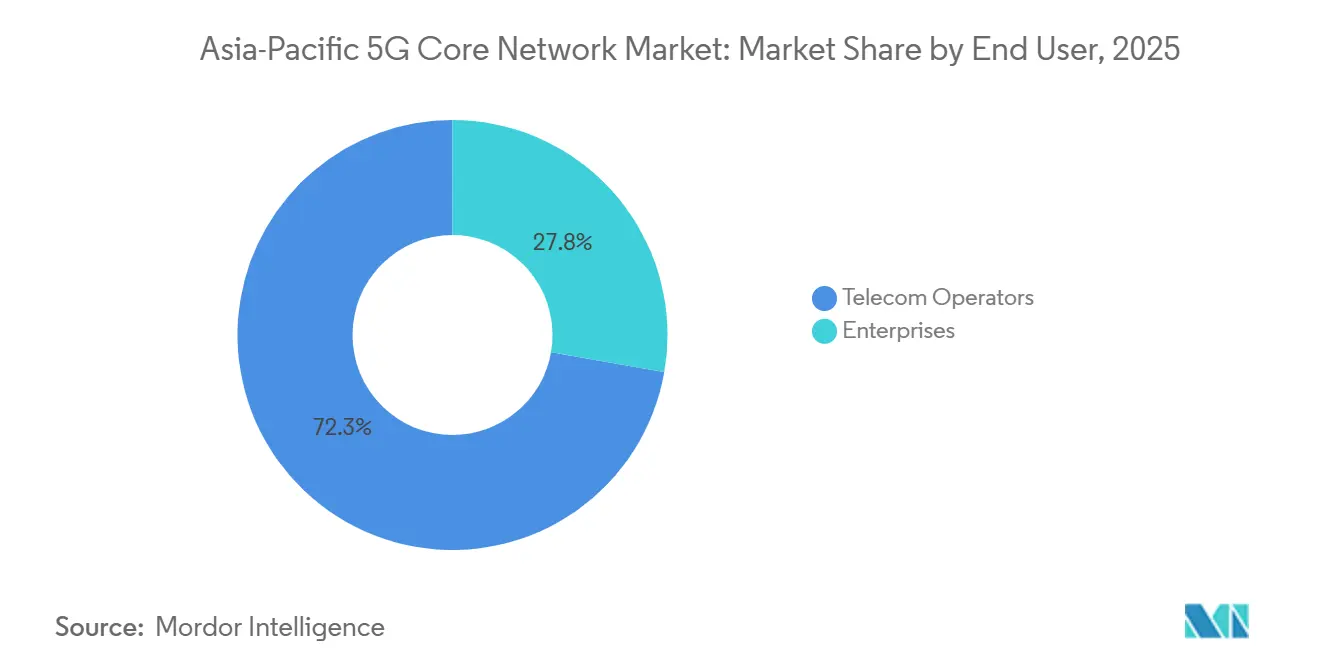
Telecom operators are expected to account for 72.25% of end-user revenue in the Asia-Pacific 5G core network market in 2025. National core refresh programs at China Mobile, NTT DOCOMO, Reliance Jio, SK Telecom, and comparable operators are creating the largest purchasing volumes. These companies procure core software, infrastructure, integration, and long-term support at substantial scale. Their role remains central because they operate the public networks that carry most mobile traffic. The Asia-Pacific 5G core network market will continue to rely on these refresh cycles for much of its revenue base. However, operator spending is becoming a smaller share of total demand as dedicated enterprise deployments increase.
Enterprises are projected to expand at a CAGR of 25.88% through 2031. Manufacturing is adopting 5G private networks because they can support measurable improvements in production and maintenance processes. At Pegatron's Batam factory, Telkomsel reported a 20% cost reduction, with 50% of the savings linked to reduced cabling.[4] Energy and utilities, transportation and logistics, public safety, and smart city projects are also building cases for dedicated connectivity. Government procurement in Singapore, South Korean industrial corridors, and Chinese pilot zones can help fund initial deployment costs. This trend broadens the buyer base beyond conventional telecommunications operators and requires vendors to serve organizations with procurement cycles, operating priorities, security expectations, and technical teams that differ from those of the national carriers that historically purchased most core network infrastructure.
By Network Function: UPF Anchors the Data Plane While NEF Drives Monetization
The User Plane Function is expected to hold 20.79% of the Asia-Pacific 5G core network share in 2025. It processes subscriber data traffic, so its deployment value rises with subscriber scale and traffic volume. Mavenir's Converged Packet Core, including User Plane Function capabilities, is expected to go live on Rakuten Mobile's network in April 2026. The platform supports the infrastructure used for Japan's emergency roaming service. Access and Mobility Management Function and Session Management Function deployments follow closely because they govern access, authentication, and session management. Together, these functions provide the operational base for large public 5G networks.
The Network Exposure Function is projected to expand at a CAGR of 27.71% through 2031. It provides the controlled API layer through which third parties can use network capabilities. CAMARA's common specifications make this interface more consistent across participating operators. Authentication Server Function, Unified Data Management, and Network Repository Function remain essential to a complete standalone architecture. Deployments of the Network Slice Selection Function, Policy Control Function, and Application Function are also increasing as operators offer differentiated services. These capabilities help align enterprise service requirements with the underlying core network.
Geography Analysis
China is expected to account for 49.50% of the regional total in 2025. State-directed deployment programs have supported the national scale of China Mobile, China Telecom, and China Unicom. The country is expected to have more than 3.6 million 5G base stations operating across these carriers. This radio footprint requires substantial core capacity and supports continued software procurement. China also favors controlled and sovereign core deployments that align with domestic infrastructure policies. Japan has a smaller geographic footprint but maintains a high concentration of cloud-native core deployments.
India is projected to expand at a 25.00% CAGR through 2031 in the Asia-Pacific 5G core network market. Reliance Jio operates an indigenous cloud-native standalone stack, while Bharti Airtel is using a hybrid rollout with Nokia and Ericsson technologies. These models indicate that the India opportunity includes both locally developed and international vendor approaches. India has also expanded the addressable need for core functions through 5G spectrum planning, including the 6 GHz band. South Korea follows a separate path based on its government-led standalone upgrade requirement. KT operates standalone services commercially, while SK Telecom has targeted a commercial standalone launch during Q4 2026.
Southeast Asia remains fragmented, but early deployments provide practical templates for other operators in the subregion. Tune Talk's cloud-native core program in Malaysia showed that the model can work beyond the largest carriers. ZTE and Telkomsel are also expected to introduce a hybrid private network in Indonesia in 2025 for automotive manufacturing. Australia, New Zealand, and Pacific markets are pursuing cloud-native voice core modernization. This pattern places the Asia-Pacific 5G core network market on a varied path, with large national networks, industrial deployments, and cloud-based voice upgrades advancing together. However, local regulation and operator scale continue to determine the preferred core architecture in each country.
Competitive Landscape
The Asia-Pacific 5G core network market is moderately consolidated among Huawei, Ericsson, Nokia, and ZTE. Nokia identified these four suppliers as core vendors with more than 100 5G core deals globally in 2025. Huawei holds a strong position in China and maintains a meaningful presence in Southeast Asia, the Middle East, and Africa. Ericsson and Nokia compete closely in Japan, South Korea, India, and Australia. Procurement policies in these countries create opportunities where Huawei's participation is more limited. The Asia-Pacific 5G core network market also includes Mavenir, NEC, and Oracle as challengers in multi-vendor deployments.
Nokia's move away from its proprietary cloud infrastructure layer is creating migration opportunities for other infrastructure suppliers. Ericsson's agreement with SoftBank illustrates its effort to support cloud-native core modernization in Japan. Mavenir's packet core deployment with Rakuten Mobile shows the role of challengers in national cloud-native networks. Energy performance is becoming a procurement consideration alongside functional capabilities. Mavenir and Deutsche Telekom reported energy savings of up to 65% in a live-network validation. This development adds pressure on vendors to demonstrate operational savings through their software and infrastructure.
Security certification is also becoming more important as operators connect core networks across borders and support international roaming. Mavenir is expected to receive BSI NESAS certification for a 5G Packet Core network function in June 2026. Large vendors retain an advantage through established carrier relationships and broad product portfolios. Challengers can compete where operators prefer independent network functions and reduced reliance on a single supplier. Southeast Asian Tier-2 operators and Japan's industrial 5G deployments remain areas where dominant managed-service relationships are lacking. Competitive outcomes in the Asia-Pacific 5G core network market will depend on each supplier's integration capability, cloud deployment record, and ability to meet local security needs. Therefore, the Asia-Pacific 5G core network industry remains competitive at the project level while staying concentrated among a limited group of established suppliers.
Asia-Pacific 5G Core Network Industry Leaders
-
Huawei Technologies Co. Ltd.
-
Nokia Corporation
-
ZTE Corporation
-
Samsung Electronics Co. Ltd.
-
Telefonaktiebolaget LM Ericsson (publ)
- *Disclaimer: Major Players sorted in no particular order
Recent Industry Developments
- July 2026: China Unicom's Beijing branch and Huawei launched the world's largest 5G-Advanced massive uplink commercial network in Beijing, deploying over 10,000 base stations to deliver continuous 100 Mbps uplink coverage across all key urban areas. The deployment signals China's transition from 5G coverage rollout to capability differentiation, with massive uplink enabling industrial AI applications and real-time video analytics at scale.
- July 2026: China Unicom's Beijing branch and Huawei launched the world's largest 5G-Advanced massive uplink commercial network in Beijing, deploying over 10,000 base stations to deliver continuous 100 Mbps uplink coverage across all key urban areas. The deployment signals China's transition from 5G coverage rollout to capability differentiation, with massive uplink enabling industrial AI applications and real-time video analytics at scale.
- April 2026: Mavenir's Converged Packet Core went live on Rakuten Mobile's nationwide mobile network on the Rakuten Cloud Platform, enabling Japan's first cross-carrier emergency roaming service ("JAPAN Roaming") launched on April 1, 2026, by Japan's major carriers. The deployment provides 4G LTE voice, SMS, data, and emergency-only access during large-scale disasters, strengthening national communications resilience.
- April 2026: Rakuten Symphony was selected by Japan's Ministry of Economy, Trade, and Industry for a grant of up to JPY 8 billion (USD 50.2 million) to deploy Open RAN and RAN Intelligent Controller technology across 7 countries in the Global South, including 3 Southeast Asian member states, Indonesia, Vietnam, and Malaysia.
Asia-Pacific 5G Core Network Market Report Scope
The Asia-Pacific 5G Core Network Market Report is Segmented by Component (Solutions [Packet-Core Software. NFV Infrastructure, and Orchestration and Management], and Services [Integration and Deployment, Consulting and Advisory, Support and Maintenance]), Deployment Model (On-Premises/Dedicated, Public Cloud, and Hybrid and Telco Edge Cloud), End-User (Telecom Operators, and Enterprises [Manufacturing, Energy and Utilities, Transportation and Logistics, Public Safety and Emergency, and Smart Cities and Municipalities]), Network Function (Network Exposure Function, User Plane Function, Application Function, Unified Data Management, Session Management Function, Network Slice Selection Function, Policy Control Function, Network Repository Function, Authentication Server Function, and Access and Mobility Management), and Country (China, India, Japan, South Korea, and Rest of Asia-Pacific). The Market Forecasts are Provided in Terms of Value (USD).
| Solutions | Packet-Core Software |
| NFV Infrastructure | |
| Orchestration and Management | |
| Services | Integration and Deployment |
| Consulting and Advisory | |
| Support and Maintenance |
| On-Premise/Dedicated |
| Public Cloud |
| Hybrid and Telco Edge Cloud |
| Telecom Operators | |
| Enterprises | Manufacturing |
| Energy and Utilities | |
| Transportation and Logistics | |
| Public Safety and Emergency | |
| Smart Cities and Municipalities |
| Network Exposure Function (NEF) |
| User Plane Function (UPF) |
| Application Function (AF) |
| Unified Data Management (UDM) |
| Session Management Function (SMF) |
| Network Slice Selection Function (NSSF) |
| Policy Control Function (PCF) |
| Network Repository Function (NRF) |
| Authentication Server Function (AUSF) |
| Access and Mobility Management (AMF) |
| China |
| India |
| Japan |
| South Korea |
| Rest of Asia-Pacific |
| By Component | Solutions | Packet-Core Software |
| NFV Infrastructure | ||
| Orchestration and Management | ||
| Services | Integration and Deployment | |
| Consulting and Advisory | ||
| Support and Maintenance | ||
| By Deployment Model | On-Premise/Dedicated | |
| Public Cloud | ||
| Hybrid and Telco Edge Cloud | ||
| By End-User | Telecom Operators | |
| Enterprises | Manufacturing | |
| Energy and Utilities | ||
| Transportation and Logistics | ||
| Public Safety and Emergency | ||
| Smart Cities and Municipalities | ||
| By Network Function | Network Exposure Function (NEF) | |
| User Plane Function (UPF) | ||
| Application Function (AF) | ||
| Unified Data Management (UDM) | ||
| Session Management Function (SMF) | ||
| Network Slice Selection Function (NSSF) | ||
| Policy Control Function (PCF) | ||
| Network Repository Function (NRF) | ||
| Authentication Server Function (AUSF) | ||
| Access and Mobility Management (AMF) | ||
| By Country | China | |
| India | ||
| Japan | ||
| South Korea | ||
| Rest of Asia-Pacific | ||
Key Questions Answered in the Report
What is the size of the Asia-Pacific 5G core network market?
The Asia-Pacific 5G core network market size is projected to reach USD 2.5 billion in 2026 and USD 6.59 billion by 2031, at a 21.39% CAGR.
What is driving standalone 5G core adoption in Asia-Pacific?
Operators need a standalone core to deliver network slicing, private networks, low-latency services, and controlled network APIs.
Which deployment model is expanding fastest for 5G core networks?
Public cloud is projected to expand at a 26.50% CAGR through 2031, supported by carrier-scale deployments in Japan and Malaysia.
Which end users are creating new demand for 5G core systems?
Enterprises are projected to expand at a 25.88% CAGR through 2031, with manufacturing leading demand for private 5G connectivity.
Why is the Network Exposure Function important for operators?
The Network Exposure Function is projected to expand at a 27.71% CAGR because it enables controlled APIs for enterprise applications and developer platforms.
Which Asia-Pacific country is expanding 5G core deployment the fastest?
India is projected to expand at a 25.00% CAGR through 2031, supported by Reliance Jio, Bharti Airtel, and government-backed network programs.