
ASEAN Switchgear Market Size and Share
Market Overview
| Study Period | 2021 - 2031 |
|---|---|
| Forecast Data Period | 2026 - 2031 |
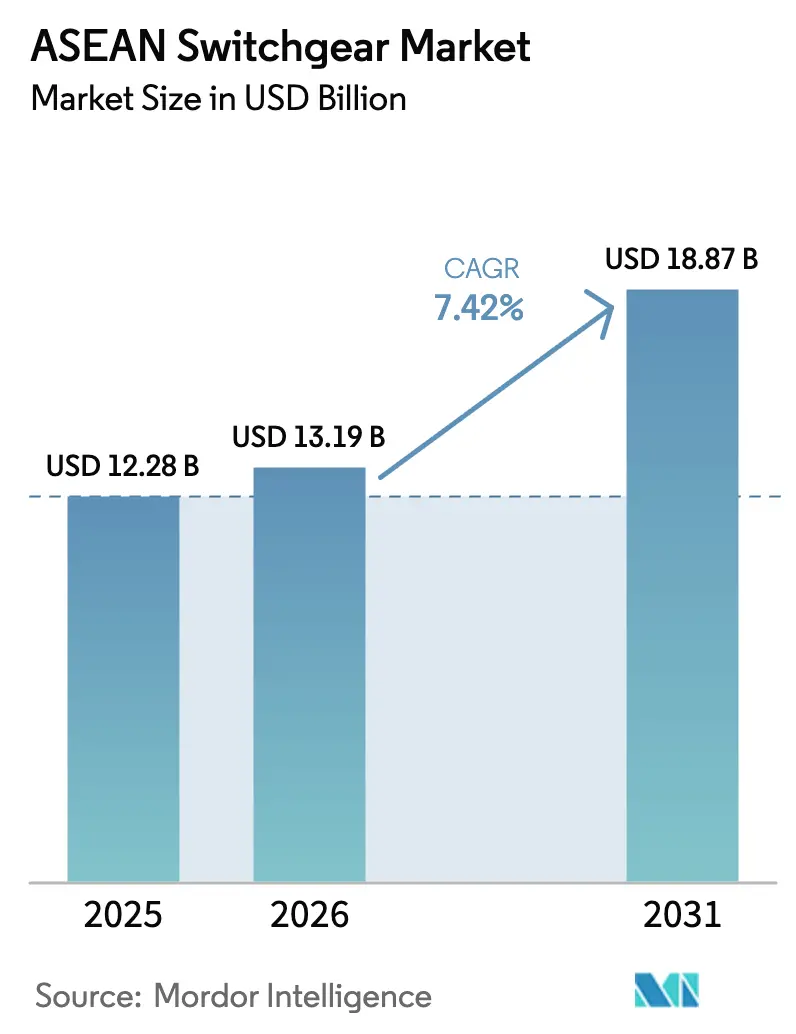
| Base Year Market Size (2025) | USD 12.28 Billion |
| Market Size (2026) | USD 13.19 Billion |
| Market Size (2031) | USD 18.87 Billion |
| Growth Rate (2026 - 2031) | 7.42 % |
| Market Concentration | Medium |
Major Players *Disclaimer: Major Players sorted in no particular order Image © Mordor Intelligence. Reuse requires attribution under CC BY 4.0. | |
ASEAN Switchgear Market Analysis by Mordor Intelligence
The ASEAN Switchgear Market size was valued at USD 12.28 billion in 2025 and estimated to grow from USD 13.19 billion in 2026 to reach USD 18.87 billion by 2031, at a CAGR of 7.42% during the forecast period (2026-2031).
Rising grid modernization budgets, hyperscale data center construction, and industrial electrification programs anchor demand, while commodity price swings and policy uncertainty temper near-term spending cycles. Utilities continue to procure intelligent medium- and high-voltage gear to upgrade substations, whereas commercial builders specify low-voltage solutions that integrate with smart-building platforms. Manufacturers compete on digital functionality, SF₆-free insulation, and local manufacturing footprints that satisfy domestic value-add rules. Cross-border HVDC interconnectors and rail electrification projects amplify the need for specialized outdoor and DC-rated assemblies, positioning the ASEAN switchgear market as a focal point for next-generation power infrastructure.
Key Report Takeaways
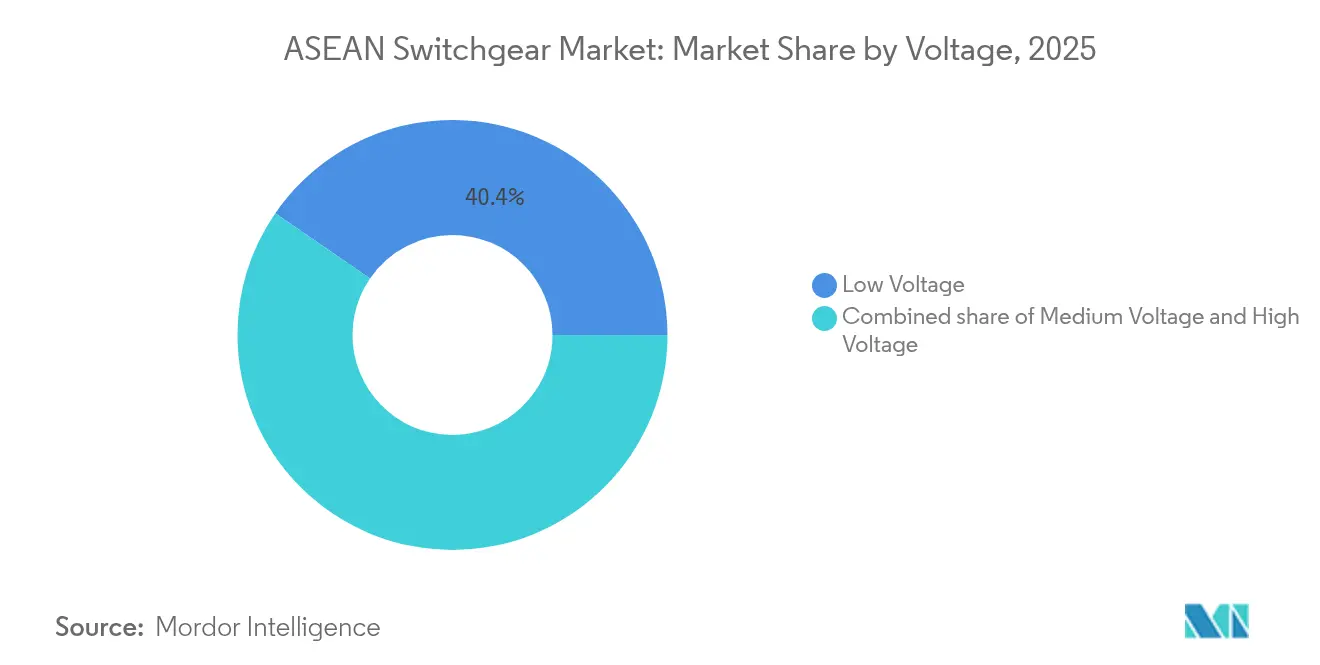
- By voltage class, low-voltage products led with 40.42% revenue share in 2025, while high-voltage products recorded the fastest expansion at a 9.35% CAGR through 2031.
- By insulation type, air-insulated units held 70.95% of the ASEAN switchgear market share in 2025; SF₆-free and hybrid alternatives are projected to grow at a 15.48% CAGR to 2031.
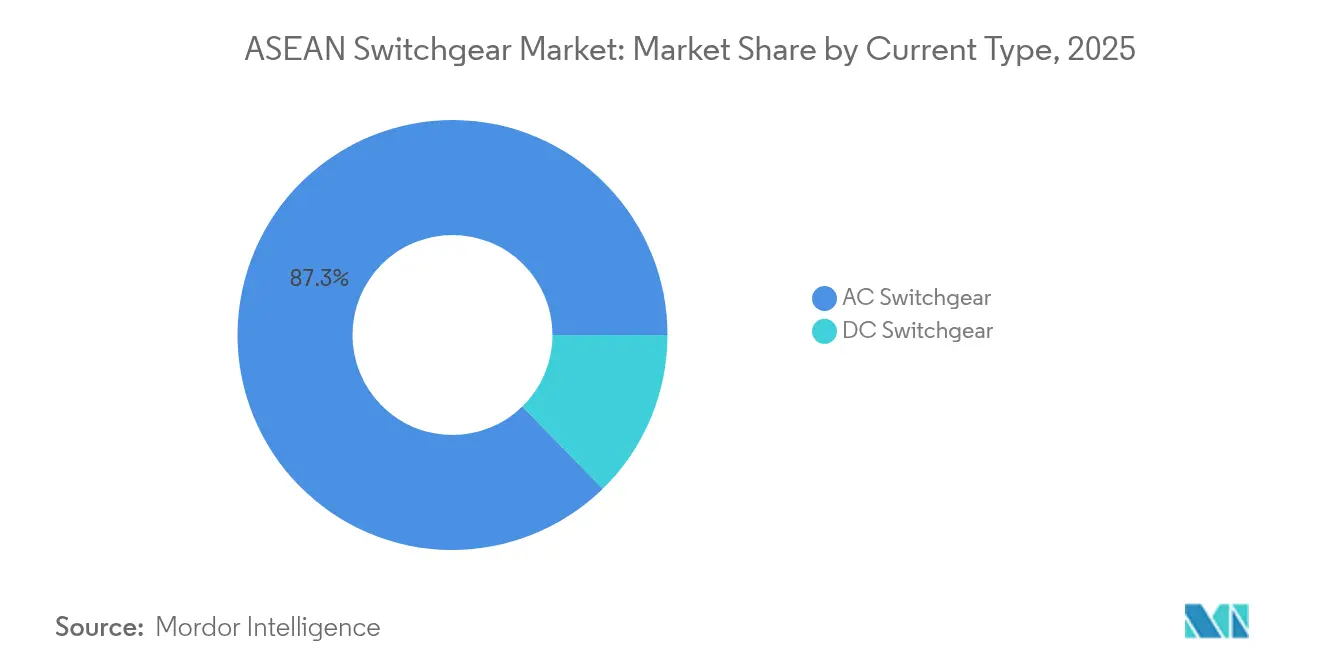
- By current type, AC equipment accounted for 87.32% of the ASEAN switchgear market size in 2025; DC variants are poised to climb at an 8.42% CAGR during 2026-2031.
- By 2025, indoor configurations commanded 80.74% of sales, whereas outdoor systems are expected to expand at a 10.21% CAGR through 2031.
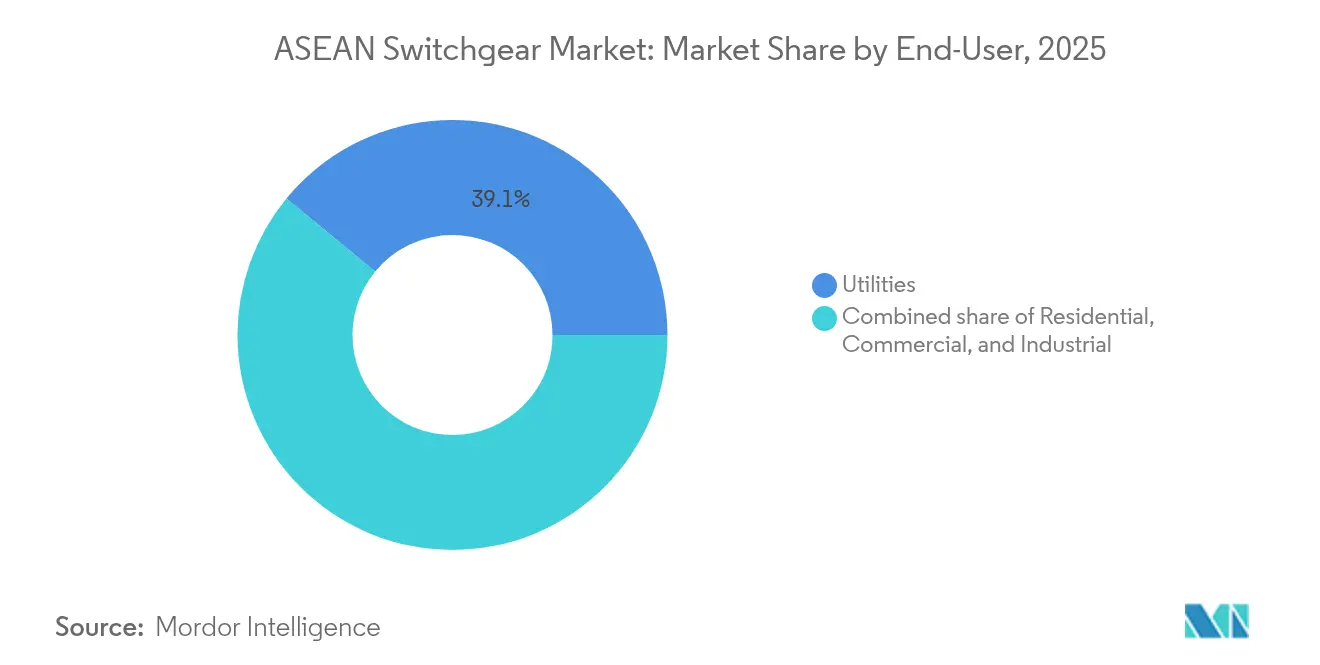
- By end-user, utilities captured 39.05% of 2025 revenues and are projected to grow at an 8.16% CAGR to 2031, driven by USD 764 billion in regional grid investments.
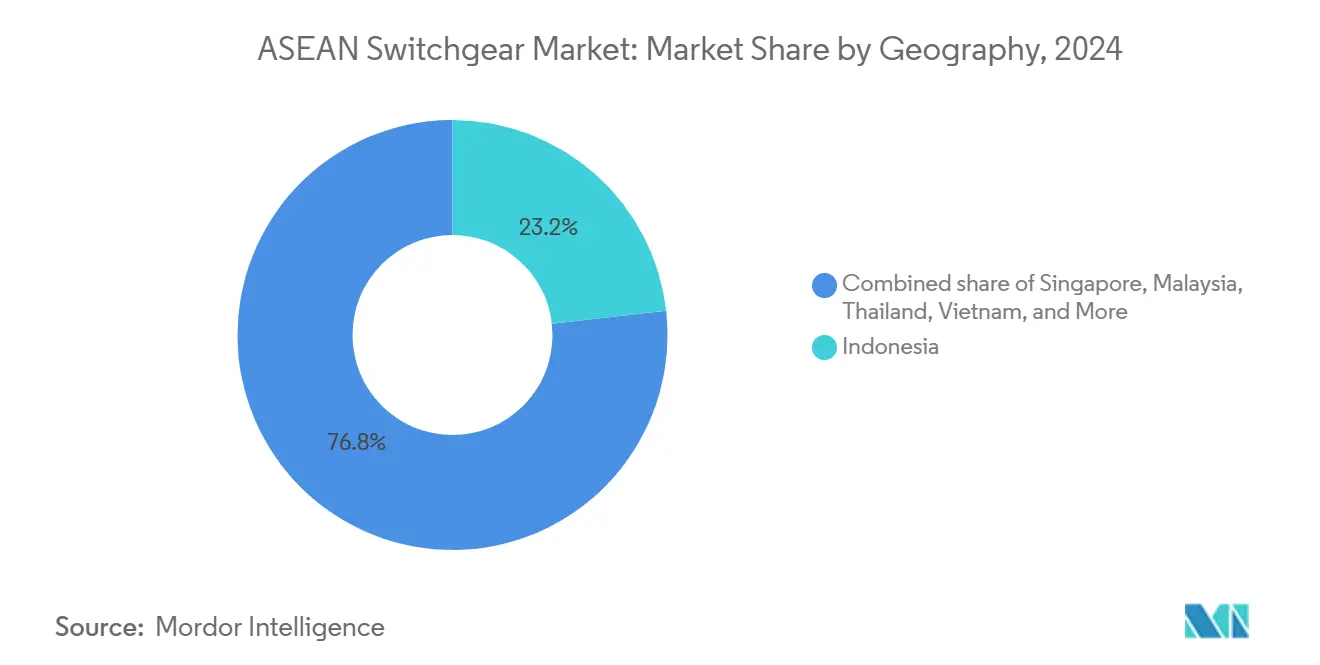
- By geography, Indonesia commanded a 22.85% revenue share in 2025, while Malaysia is forecasted to register the fastest CAGR of 8.12% from 2025 to 2031.
Note: Market size and forecast figures in this report are generated using Mordor Intelligence’s proprietary estimation framework, updated with the latest available data and insights as of 2026.
Market Trends and Insights
Drivers Impact Analysis of ASEAN Switchgear Market*
| Driver | (~) % Impact on CAGR Forecast | Geographic Relevance | Impact Timeline |
|---|---|---|---|
| Rapid grid-modernisation & ASEAN Power Grid projects | 2.10% | Indonesia, Malaysia, Thailand core with spillover to Vietnam, Philippines | Medium term (2-4 years) |
| Surging data-centre & AI load densification | 1.80% | Singapore, Malaysia, Indonesia primary with expansion to Thailand | Short term (≤ 2 years) |
| Industrial electrification & urban rail expansion | 1.20% | Indonesia, Vietnam, Thailand manufacturing hubs with urban centers | Medium term (2-4 years) |
| Localised manufacturing of MV/HV switchgear in Indonesia & Vietnam | 0.90% | Indonesia, Vietnam with supply chain effects across ASEAN | Long term (≥ 4 years) |
| Singapore-led SF₆-free procurement mandates | 0.80% | Singapore leading, Malaysia and Thailand following | Medium term (2-4 years) |
| Sub-sea HVDC interconnectors driving extra-high-voltage demand | 0.60% | Singapore-Malaysia-Vietnam corridor with regional grid integration | Long term (≥ 4 years) |
| Source: Mordor Intelligence | |||
Rapid Grid-Modernization & ASEAN Power Grid Projects
More than USD 764 billion is earmarked for cross-border transmission upgrades, with USD 50 billion already funded for near-term builds that specify 132-500 kV switchgear platforms. Governments are favoring digital control, IEC 61850 compliance, and remote diagnostics to enhance resilience following recent climate-related blackouts. National programs, such as Malaysia’s RM 43 billion (USD 9.7 billion) grid overhaul, embed cybersecurity and condition-monitoring clauses in tenders. Standardization across member states simplifies spares management and enables competitive bidding at scale. Manufacturers offering modular GIS and hybrid switchgear with built-in automation are positioned to capture multi-country frame contracts. Local utilities couple these rollouts with workforce-training grants that accelerate knowledge transfer and shorten commissioning cycles.
Surging Data-Center & AI Load Densification
Data-center capacity exceeding 1,000 MW in Singapore, Malaysia, and Indonesia drives demand for dual-feed, 99.99% availability switchgear designed for 30-50 kW rack densities.[1] AI training clusters impose higher harmonic distortion, compelling buyers to specify low-impedance busbars and active filtering. Hyperscalers favor modular, plug-and-play line-ups that can be installed during live operations, cutting outage windows to less than four milliseconds. Edge-computing nodes expanding across urban cores create incremental orders for compact 4-15 kV units with integrated metering. Suppliers differentiate through digital twins that model load scenarios and predict remaining useful life, helping operators meet stringent service-level agreements.
Industrial Electrification & Urban Rail Expansion
The electrification of automotive, electronics, and food-processing plants in Indonesia, Vietnam, and Thailand is increasing medium-voltage demand, as factories replace fossil-fuel boilers with electric alternatives at an annual adoption rate of over 25%.[2] Bangkok’s and Jakarta’s rail extensions require 25 kV traction power systems with regenerative-braking-optimized switchgear capable of managing rapid load reversals. Manufacturers integrate SCADA gateways, enabling transit agencies to overlay predictive maintenance across rolling stock and substations. ISO 50001 energy-efficiency mandates encourage factories to deploy switchgear with embedded power-quality meters that feed energy-management dashboards. Combined, these trends prompt OEMs to bundle software analytics with hardware, thereby monetizing their after-sales digital services.
Localised Manufacturing of MV/HV Switchgear in Indonesia & Vietnam
Indonesia’s 40% local-content rule encourages global players, such as ABB and Siemens, to add assembly lines that reduce import duties by up to 15%.[3] Vietnam’s tax holidays and industrial-park incentives reduce lead times from 20 to 12 weeks for standard product sets. Domestic production reduces freight costs, creates seismic-resistant designs tailored to the region, and enhances the availability of spare parts. Technology-transfer partnerships enhance indigenous engineering skills, while cost savings of 15-20% compared to imports enable competitive bids on budget-constrained projects. Localization also supports faster customization for tropical climates, including anti-corrosion coatings and high-humidity insulation clearances.
Restraints Impact Analysis of ASEAN Switchgear Market*
| Restraint | (~) % Impact on CAGR Forecast | Geographic Relevance | Impact Timeline |
|---|---|---|---|
| Up-front capex & long OEM lead-times | -1.50% | Global ASEAN impact with acute effects in Philippines, Myanmar | Short term (≤ 2 years) |
| Copper & aluminium price volatility | -1.10% | Indonesia, Vietnam manufacturing centers with cost pass-through effects | Short term (≤ 2 years) |
| FIT-policy reversals delaying utility budgets | -0.70% | Vietnam primary impact with spillover concerns in Thailand, Philippines | Medium term (2-4 years) |
| Indonesia local-content rules complicating foreign supply | -0.40% | Indonesia focused with supply chain effects across ASEAN | Medium term (2-4 years) |
| Source: Mordor Intelligence | |||
Up-Front Capex & Long OEM Lead-Times
Specialized 245-500 kV switchgear now ships in 16-24 months, stretching project schedules and inflating interest during construction. Hardware can account for 25% of substation budgets, forcing smaller utilities to stagger installations and accept sub-optimal load flows. Semiconductor shortages limit the availability of digital relays and sensors, further extending delivery windows. Developers increasingly break projects into phases to spread payments, yet this fragmentation of commissioning raises lifecycle costs. Concentrated manufacturing capacity among a few global vendors magnifies the impact of any factory disruption on regional rollout plans.
Copper & Aluminium Price Volatility
Aluminium moved from USD 2,419 per tonne in 2024 to USD 2,635 in 2025, lifting conductor costs that represent up to 35% of a medium-voltage switchgear bill of materials.[4] Spot copper trades near USD 9,560 per tonne and exhibits high daily volatility, prompting OEMs to revise their quotes quarterly and pass the risk to buyers. Regional makers lack hedging scale, leading to frequent repricing that challenges project feasibility for public-sector owners with fixed budgets. End-users delay awards when prices spike, resulting in lumpy demand and underutilized factory capacity.
*Our forecasts treat driver/restraint impacts as directional, not additive. The impact forecasts reflect baseline growth, mix effects, and variable interactions.
ASEAN Switchgear Market Segment Analysis
By Voltage:
High-Voltage Momentum Within Low-Voltage LeadershipLow-voltage assemblies accounted for 40.42% of 2025 revenue, underscoring their widespread use in buildings, factories, and residential complexes that operate at voltages below 1 kV. High-voltage solutions, however, are growing at a 9.35% CAGR as utilities build 275-500 kV corridors for renewable integration. The ASEAN switchgear market size for high-voltage units is expected to exceed USD 6.33 billion by 2031, driven by the expansion of cross-border grid links and offshore wind tie-ins. Medium-voltage gear remains essential for data-center campuses and industrial parks, balancing power from primary feeders down to facility loads. Suppliers position compact GIS options for urban substations where land is scarce, while air-insulated configurations dominate rural transmission yards owing to cost advantages. In Singapore, hyperscale operators opt for redundant 480V lineups with smart metering to comply with stringent uptime requirements. Conversely, Indonesia’s Super Grid program specifies 500 kV dead-tank breakers for long-haul transmission, elevating demand for extra-high-voltage switchgear. Regional planners increasingly bundle low-voltage feeders with battery-storage interfaces, creating hybrid procurement packages that favor vendors offering broad portfolios.
Manufacturers deploy digital twins to predict insulation aging under tropical humidity, enhancing reliability at both extremes of the voltage spectrum. The ASEAN switchgear market share for low-voltage products will compress marginally as high-voltage investments increase, yet absolute low-voltage volumes will continue to rise alongside construction activity. Suppliers that can tier pricing across voltage classes while maintaining firmware compatibility are likely to gain from enterprise-wide rollouts by multinational customers.

By Insulation:
Sustainability Shifts Design PreferencesAir-insulated technology held a 70.95% revenue share in 2025 due to its low acquisition cost and maintenance familiarity. Yet regulations targeting SF₆ emissions elevate demand for gas- and vacuum-based hybrids, driving a 15.48% CAGR for alternative systems through 2031. Singapore’s public-sector procurement now mandates SF₆-free mediums for new substation builds, encouraging regional utilities to pilot similar standards. Compact GIS addresses land-scarcity issues in urban nodes, reducing footprint by up to 90% compared to AIS. Manufacturers tout a vacuum-interrupter lifetime of 30,000 operations, which lowers the total cost of ownership despite higher upfront pricing. Hybrid solutions enable phased conversions: existing AIS bays receive vacuum interrupters while retaining primary busbars, easing capital budgeting. The ASEAN switchgear market size related to SF₆-free technology could reach USD 3.18 billion by 2031 if current policies extend to all member states.
Equipment specifiers weigh thermal performance under ambient temperatures exceeding 35°C, compelling OEMs to upgrade their heat-dissipation designs. Corrosion-resistant housings, silicone rubber bushings, and anti-condensation heaters become standard options. Vendors that provide environmental declarations and recycling programs earn points in tender evaluations. Over time, life-cycle assessment metrics may become as influential as acquisition costs when utilities compare bids for projects.
By Current Type:
DC Uptick Signals Grid EvolutionAC architectures dominate, accounting for 87.32% of 2025 deployments, underscoring the entrenched legacy infrastructure. Direct-current equipment nonetheless grows at an 8.42% CAGR, driven by HVDC submarine cables, such as the 1 GW Singapore–Malaysia link, and the rising adoption of 380 V DC buses in data centers. The ASEAN switchgear market size for DC solutions is forecast to surpass USD 1.49 billion by 2031 as more offshore policy-driven efforts for renewable penetration and microgrid resilience indicate a gradual yet persistent shift, and projects prefer HVDC export lines to slash reactive-power losses. In colocation campuses, operators adopt DC distribution at the rack level to eliminate conversion stages, trimming energy loss by 5-8%. Manufacturers respond with solid-state DC breakers that feature sub-millisecond interruption and arc-free operation, thereby enhancing safety in confined spaces.
Hybrid nodes emerge where AC grid interfaces hand off to DC microgrids, which power servers and battery storage. Standards bodies accelerate work on interoperability guidelines, driving vendor certification programs. AC incumbency still anchors bulk-power transfer within mainland networks, but policy-driven efforts for renewable penetration and microgrid resilience indicate a gradual yet persistent shift toward DC platforms across select applications.
By Installation:
Outdoor Builds Surge on Utility SpendingIndoor installations retained an 80.74% share in 2025, reflecting legacy placement inside plant rooms and commercial switchboards. Outdoor variants, however, are climbing at a 10.21% CAGR as utilities expand transmission corridors through difficult terrain. GIS housed in prefabricated e-houses offers plug-and-play yard installs, reducing civil works schedules by 25%. Solar farms and onshore wind arrays adopt weather-sealed cubicles with IP55 ratings and UV-resistant coatings. Seismic-grade anchoring gains attention in the Philippines and parts of Indonesia, prompting OEMs to test cabinets to IEEE 693 high-performance levels. Extended warranty packages and remote condition monitoring help offset the harsher duty cycle of outdoor gear. By 2031, the ASEAN switchgear market share for outdoor systems is expected to reach 24.6% as renewable energy penetration deepens.
Urban utilities still favor indoor AIS or GIS due to aesthetic and noise constraints; however, modular skid solutions enable faster replacements in aging substations. Designers integrate fire-suppression and arc-flash-detection cameras to meet city safety ordinances. Building owners appreciate that indoor switchboards with withdrawable drawers cut mean-time-to-repair to less than 30 minutes, preserving facility uptime.
By End-User:
Utilities Drive Scale and InnovationUtilities captured 39.05% of 2025 turnover and are projected to grow at 8.16% CAGR, reflecting USD 764 billion in announced grid spending across the bloc. They specify digital relays, SF₆-free interruptors, and cyber-secure communication links as default tender requirements. Industrial buyers come second, driven by automation and electrification, which increase demand for medium-voltage panels. Automotive manufacturers in Thailand and Vietnam retrofit their factories with energy-management-ready switchgear to meet corporate carbon reduction targets. Commercial buildings pioneer low-voltage switchboards linked to building-management systems, while residential developers deploy arc-fault detection to enhance safety in high-rise apartments.
Utilities also influence technology roadmaps by hosting pilot projects for solid-state breakers and peer-to-peer energy-trading nodes. Their buying power shapes standardization, pushing vendors to maintain multi-country certification lists. Conversely, fragmented industrial demand provides local fabricators with room to compete on price, especially when projects prioritize cost over advanced analytics.
Geography Analysis
Indonesia and Malaysia Switchgear Market
Indonesia led with 22.85% revenue in 2025, driven by its 47,758-circuit-km Super Grid plan and buoyant manufacturing output. Local-content mandates of 40% drive joint ventures that shorten lead times and cut import tariffs. The government’s electrification targets for outer islands necessitate modular outdoor switchgear that can withstand salt-spray resistance and be remotely monitored over VSAT links. Malaysia exhibits the highest growth trajectory at 8.12% CAGR, driven by Tenaga Nasional Berhad’s RM 43 billion modernization program and a flourishing data center predictive analytics pipeline valued at USD 5 billion. Projects often pair 132 kV GIS bays with 22 kV ring-main units to accommodate mixed-use urban developments.
APAC Switchgear Market
Singapore commands a premium niche focused on high-reliability applications, with utilities and colocation providers adopting SF₆-free equipment and predictive analytics service contracts. Thailand’s rail and industrial policies elevate medium-voltage uptake, while Vietnam’s renewable push drives both low- and high-voltage requisitions, albeit tempered by FIT revisions that introduce procurement delays. The Philippines pursues rural electrification, though fiscal constraints slow bulk orders, and Myanmar faces sanction-related supply hurdles that channel purchases toward Chinese vendors.
ASEAN Switchgear Market
Regional integration through the ASEAN Power Grid increases demand for standardized 275-500 kV interconnection equipment across member states. Currency fluctuations influence tender timing, with buyers advancing purchases when local units strengthen against the USD. Localized production in Indonesia and Vietnam provides hedges against exchange-rate risk, thereby improving the competitiveness of domestically assembled switchgear across neighboring markets.
Regulatory Landscape
ASEAN-level coordination is tightening technical requirements for cross-border power trade under the ASEAN Power Grid (APG). The November 2024 Memorandum of Understanding on the APG asks member countries to study, assess, and review legal frameworks for cross-border construction, operation, and maintenance, creating a formal basis for interconnection-driven high-voltage switchgear specifications and certification pathways.
On the technical side, the ASEAN Centre for Energy (ACE) is driving work under the ASEAN Interconnection Masterplan Study (AIMS) III Phase 3 to harmonize grid codes and define Minimum Operational Technical Standards and minimum technical standards for interconnections. The 2025-2030 roadmap emphasizes sub-regional guidelines and the technical foundations for interconnections, with a stated transition path toward a regional grid code by 2040. This increases the importance of interoperable, standards-compliant switchgear across national utilities and system operators.
Competitive Landscape
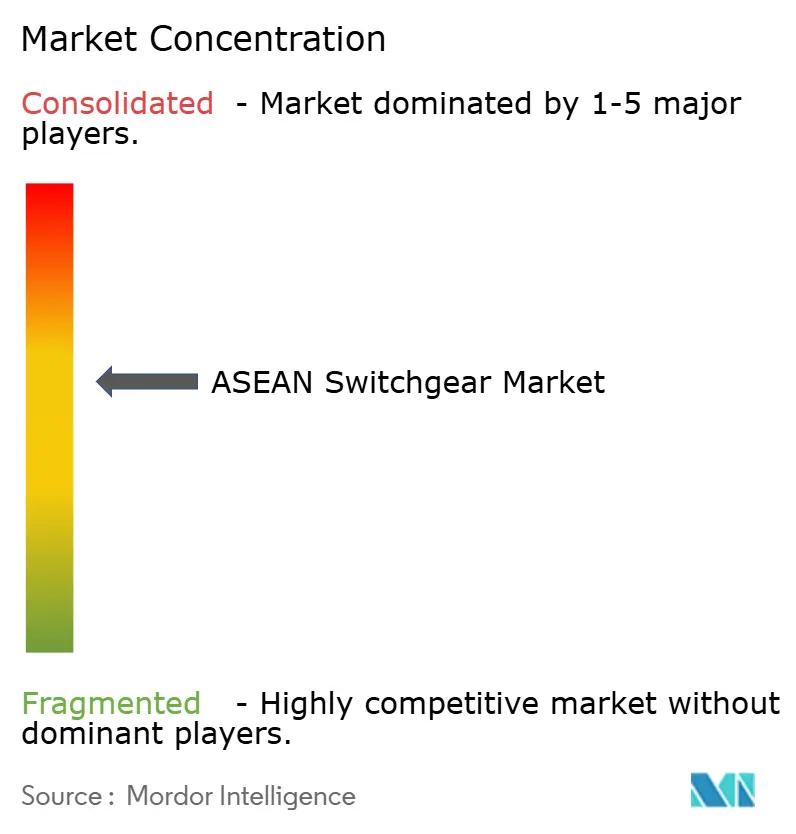
Competition is moderately fragmented, with the top five international companies, Schneider Electric, ABB, Siemens, Hitachi Energy, and Eaton, collectively controlling roughly 45% of the 2024 ASEAN revenues. They leverage global R&D and digital-service stacks to defend premium segments. Regional players, such as Pekat Group, EPE Power, and Lucy Electric, gain market share by targeting price-sensitive projects with shorter delivery promises. Pekat’s USD 15.2 million acquisition of EPE Power’s Malaysian switchgear business exemplifies a regional consolidation trend that enhances localized engineering and post-sales support. Joint ventures, such as Siemens-Lilama in Vietnam, facilitate technology transfer and sidestep import duties, thereby eroding the multinationals’ cost advantage.
Product differentiation pivots on environmental credentials and embedded analytics. Schneider’s SF₆-free line, ABB’s eco-GIS, and Siemens’ Sensformer-ready modules address sustainability clauses in tenders. Meanwhile, Indonesian assemblers offer tailor-made AIS solutions optimized for tropical humidity at 10-15% lower prices. Service capabilities become a battleground; Lucy Electric’s Jakarta hub cuts spare-part lead time to 48 hours, enhancing its bids for utility O&M contracts. Vendors increasingly bundle multi-year condition-based maintenance as a subscription, improving revenue predictability and deepening customer lock-in.
Digital ecosystems widen competitive moats. Hitachi Energy’s Lumada Asset Performance combines IoT sensors and AI analytics, enabling predictive failure alerts that can reduce unplanned outages by 20%. Smaller firms partner with cloud platforms to offer lite versions of similar dashboards. Procurement committees now score bids based on software openness and cybersecurity audits, rewarding suppliers who are prepared for IEC 62443 compliance.
ASEAN Switchgear Industry Leaders
-
ABB Ltd
-
Siemens AG
-
Mitsubishi Electric Corporation
-
Schneider Electric SE
-
Hitachi Energy Ltd.
- *Disclaimer: Major Players sorted in no particular order
ASEAN Switchgear Market Companies Covered in this Report
- Schneider Electric SE
- ABB Ltd.
- Siemens AG
- Hitachi Energy Ltd.
- Mitsubishi Electric Corp.
- Eaton Corp. plc
- Toshiba Energy Systems & Solutions
- HD Hyundai Electric
- Fuji Electric Co. Ltd.
- CG Power & Industrial Solutions
- Hyosung Heavy Industries
- Lucy Electric
- Larsen & Toubro (L&T)
- Nissin Electric Co.
- Powell Industries
- EPE Power (Malaysia)
- G&W Electric
- Chint Group
- S&C Electric Company
- Tavrida Electric
Market Opportunities and Future Outlook
Multilateral power trade and cross-border interconnection programs are creating whitespace for standardized high-voltage platforms, protection and control integration, and interconnection-ready substation packages across ASEAN. A concrete financing signal came in April 2026, when the Asian Development Bank (ADB) launched a USD 25 million multi-partner fund to support early-stage cross-border interconnections and grid infrastructure for the ASEAN Power Grid. This approach ties procurement to interconnection requirements and accelerates tender activity for 132-500 kV-class switchgear and substation automation.
Harmonization of grid codes and minimum operational technical standards under AIMS III Phase 3, coordinated by ACE, also supports vendor demand for repeatable designs that can be certified across multiple jurisdictions, along with IEC 61850-ready digital bays for remote operations. The policy stack is reinforced by the ASEAN Plan of Action for Energy Cooperation (APAEC) 2026-2030 focus on multilateral power trade, and by the 2024 approval of the World Bank Accelerating Sustainable Energy Transition Multi-Phase Programmatic Approach (ASET-MPA) with USD 2.5 billion to scale renewable energy and regional power trade. Together, these measures support demand for grid-strengthening switchgear, outdoor transmission yard assemblies, and interconnector-related DC-rated equipment where applicable.
Recent Industry Developments in ASEAN Switchgear Market
- June 2026: Schneider Electric launched MCSeT medium-voltage switchgear in Malaysia at the Energy Transition Conference 2026, featuring native digital sensing and predictive analytics. The SF6-free digital MV switchgear deployment in Malaysia supports wider regional adoption of digital-switchgear and expands the local engineering footprint for data-center and utility projects.
- May 2026: ABB Ltd introduced UniSec SPLN, a medium-voltage AIS switchgear adapted for Indonesia's SPLN standards, featuring >25% local content. The Indonesia MV AIS solution aligns with local content requirements and strengthens ABB's competitive position while reinforcing local manufacturing and supply-chain localization.
- April 2026: Schneider Electric completed Factory Acceptance Test FAT for the first GM AirSet SF6-free medium-voltage switchgear for implementation in Singapore. The SF6-free MV switchgear deployment in Singapore validates regional rollout and expands Schneider Electric's regional footprint.
ASEAN Switchgear Market Report Scope and Research Methodology
Market Definition and Coverage
For this study, the market is defined as revenue earned from switchgear products sold and installed across ASEAN to control, protect, and isolate electrical equipment in power networks.
Scope exclusions: Excludes transformers, cables, protection relays sold as standalone items, and EPC-only construction value that is not tied to switchgear product revenue.
Segments Covered in This Report
- By Voltage
- Low Voltage
- Medium Voltage
- High Voltage
- By Insulation
- Gas Insulated Switchgear (GIS)
- Air Insulated Switchgear (AIS)
- Others
- By Current Type
- AC Switchgear
- DC Switchgear
- By Installation
- Indoor
- Outdoor
- By End-User
- Utilities
- Residential
- Commercial
- Industrial
- By Geography
- Singapore
- Malaysia
- Indonesia
- Thailand
- Vietnam
- Philippines
- Myanmar
- Rest of ASEAN Countries
Data Sources, Market Sizing, and Validation
Desk Research
Desk research started with mapping power demand and grid buildout across ASEAN, then tying those program needs to equipment requirements for transmission and distribution. Public and official sources were used to anchor the basic demand pool and timing, such as ASEAN Centre for Energy publications, national energy ministries and regulators, utility annual reports, World Bank indicators, and IEA electricity statistics (where available by country).
To tighten the revenue model, we reviewed trade and procurement signals, including customs import-export statistics, public tenders, and published tariff or grid investment plans. Company filings, investor presentations, and reputable press were used to sanity check product mix shifts, pricing direction, and backlog commentary. A paid subscription for company financials and a shipment-level trade database were used selectively to validate a few missing data points. These desk sources are not exhaustive, and other public documents and databases were also referenced for validation and clarification.
Primary Interviews and Surveys
Primary work was used to test what desk sources cannot show clearly, especially how quickly projects translate into orders, and how pricing differs by voltage class and installation setting. We interviewed and surveyed a mix of OEM-side, channel, utility, and industrial buyer respondents across key ASEAN countries, so assumptions on replacement cycles, tender win patterns, and GIS versus AIS adoption could be cross-checked and adjusted.
Distribution of primary research fieldwork respondents
| Company type | Respondent position |
|---|---|
| Top tier: 32% | CXOs: 16% |
| Mid tier: 52% | Functional/Unit leaders: 33% |
| Smaller Players: 16% | Managers: 51% |
Market-Sizing & Forecasting
Sizing begins with a top-down build where grid investment and capacity additions, by country and voltage level, are reconstructed into likely switchgear demand pools, which are then converted into revenue using typical price bands. To keep it grounded, we corroborate outputs with selective bottom-up checks, such as supplier and channel roll-ups, sampled project bill-of-material splits, and ASP versus volume approximations for a few well covered applications.
Key inputs used in the model include T&D capex plans and commissioning timelines, renewable interconnection activity, urban load growth that pushes indoor GIS demand, replacement and refurbishment cycles for aging substations, and import intensity for switchgear assemblies in each country. Where price points were not directly observable, ranges were taken from interviews and public tenders, and then normalized to a consistent currency timing for the base year.
Forecasts were built using scenario analysis that links project pipeline conversion and policy driven grid upgrades to volume growth, and then layers expected ASP movement based on materials, localization, and product mix. When a segment had thin visibility in a specific country, we applied proxy ratios from a similar ASEAN market and re-validated those ratios with primary experts before finalizing.
Data Validation & Update Cycle
Outputs were validated through triangulation across independent signals, including grid capex totals, substation additions, import-export trends, and reported utility procurement activity. Any large variances were flagged for review, followed by a second pass where assumptions on voltage mix, project delays, and pricing bands were revisited and, where needed, interviewees were re-contacted to explain the gap.
Before sign-off, the full model is reviewed in steps by another analyst to check formulas, year alignment, and country aggregation logic, and then it is compared against historical growth patterns to spot anomalies. The report is refreshed annually, and interim updates are made when material events occur, such as policy changes, major tender cycles, or sharp currency moves, followed by a final pre-delivery check so clients receive the most current view.
Mordor Intelligence's Asean Switchgear Market Size Compared With Other Published Estimates
Published market numbers for ASEAN switchgear can vary because different studies do not always count the same revenue streams, years, or country baskets, and some also blend equipment with services and construction value. We keep the sizing traceable by staying close to observable demand drivers and by checking totals against project activity and trade signals.
EPC project value and commissioning services often get mixed into some estimates, which can lift totals above a product-revenue view, and voltage boundaries can also change the counted pool when high voltage transmission gear is treated as part of a broader transmission equipment bucket. Installed-base assumptions can shift results if replacement cycles are set too aggressively, and currency conversion timing can create extra spread in a multi-country region. Battery energy storage switchgear that is packaged inside turnkey BESS containers sits outside Mordor Intelligence's scope, which is one practical reason some broader electrical balance-of-plant totals look larger.
Benchmark comparison
| Source | Market Size | Gaps in Research Methodology |
|---|---|---|
| Mordor Intelligence | USD 12.28 B (2025) | |
| Regional Consultancy A | USD 13.84 B (2026) | Uses a later base year and appears to apply a wider revenue capture that can include EPC-linked electrical package value and a faster pipeline conversion assumption, which lifts the first forecast year total. |
| Industry Publisher B | USD 146.50 B (2025) | Likely bundles multiple electrical equipment categories into one ASEAN power distribution figure, which can pull in non-switchgear items and double count project package value versus a product-only switchgear definition. |
The spread across the three figures mainly points to category definition and what gets counted around a switchgear sale, not just growth expectations. When scope is kept to switchgear product revenues and the model is tied back to grid investment timing, trade flow direction, and realistic replacement cycles, the resulting number is easier to reconcile and repeat year over year.
Key Questions Answered in the Report
What is the 2026 value of the ASEAN switchgear market?
It stands at USD 13.19 billion, up from USD 12.28 billion in 2025 due to ongoing grid-upgrade programs.
Which voltage class is growing fastest?
High-voltage equipment is expanding at a 9.35% CAGR on the back of cross-border transmission projects.
Why are SF?-free switchgear solutions gaining traction?
National mandates, led by Singapore, aim to curtail greenhouse-gas emissions, pushing utilities toward vacuum and gas-mixture insulation.
How do local-content rules influence purchasing decisions in Indonesia?
A 40% domestic value-add requirement encourages OEMs to assemble locally, lowering import tariffs and shortening lead times.
What is driving DC switchgear demand?
HVDC interconnectors and data-center adoption of 380 V DC buses are propelling an 8.42% CAGR for DC-rated equipment.
Which end-user segment leads spending?
Utilities remain the largest and fastest-growing buyers, fueled by USD 764 billion in planned network investments.