
ASEAN Metal Forming Equipment Market Size and Share
Market Overview
| Study Period | 2020 - 2031 |
|---|---|
| Forecast Data Period | 2026 - 2031 |
| Base Year Market Size (2025) | USD 0.63 Billion |
| Market Size (2026) | USD 0.66 Billion |
| Market Size (2031) | USD 0.83 Billion |
| Growth Rate (2026 - 2031) | 4.53 % |
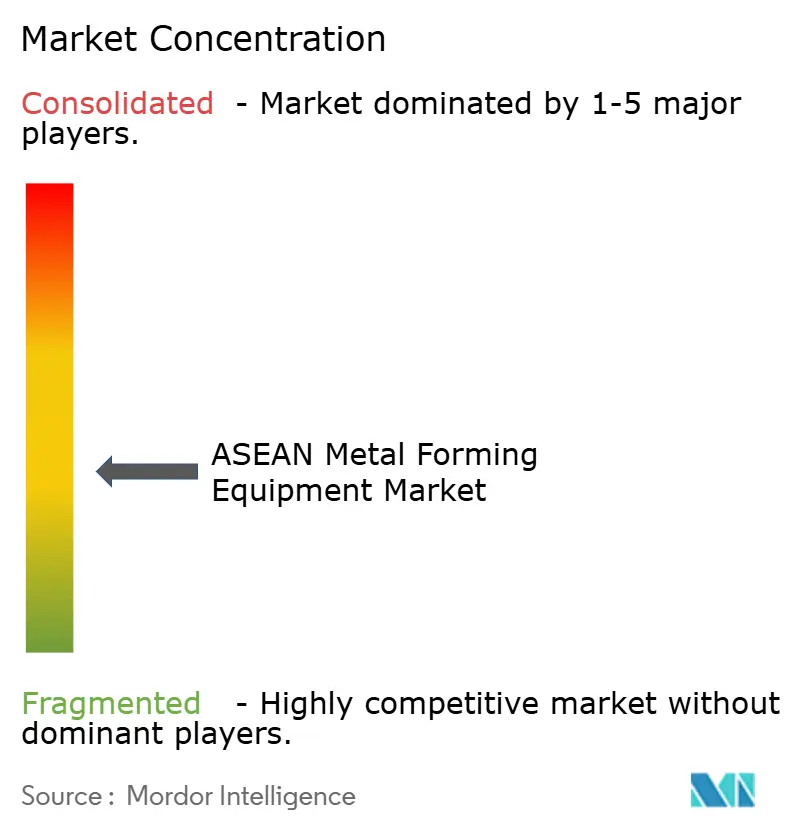
| Market Concentration | Medium |
Major Players *Disclaimer: Major Players sorted in no particular order Image © Mordor Intelligence. Reuse requires attribution under CC BY 4.0. | |
ASEAN Metal Forming Equipment Market Analysis by Mordor Intelligence
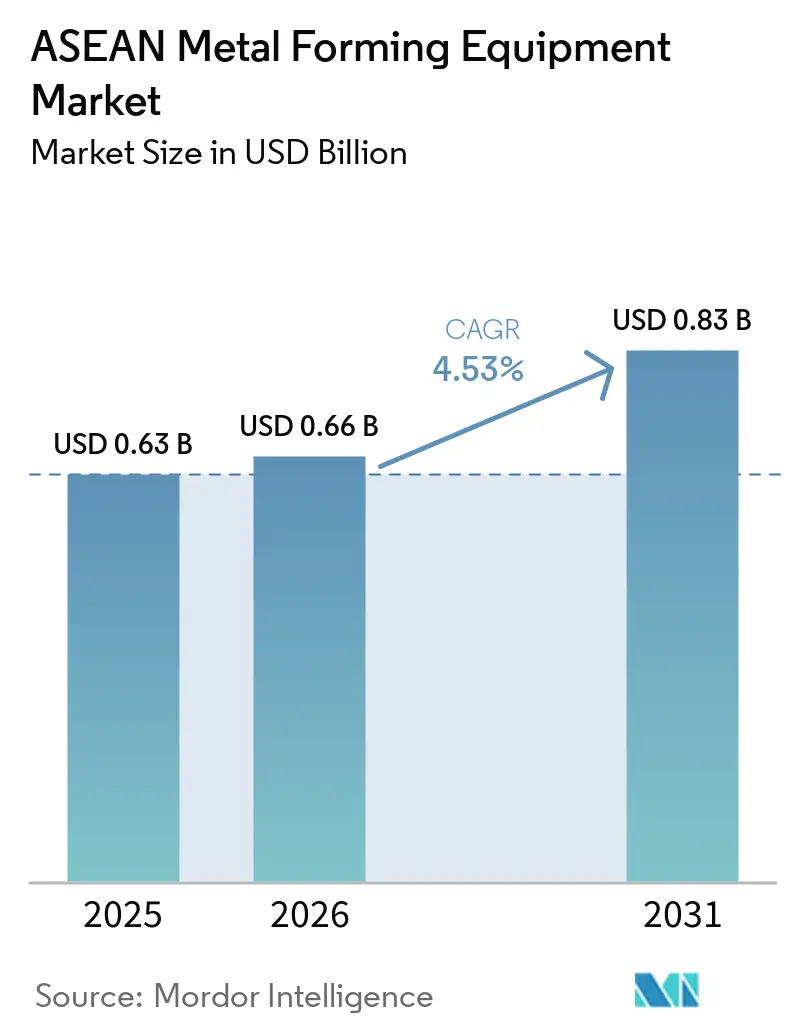
The ASEAN metal forming equipment market size was USD 0.63 billion in 2025 and is estimated to grow from USD 0.66 billion in 2026 to reach USD 0.83 billion by 2031, at a CAGR of 4.53% during the forecast period (2026-2031).
Manufacturing investment moving into Southeast Asia is expanding demand for new press shops, stamping lines, and precision forging cells. The shift is visible in automotive, electronics, semiconductor, and battery-related production, which need different forming capabilities and more consistent output. Manufacturers are also upgrading installed lines with servo controls and automation rather than replacing every machine. This approach can support work with advanced high-strength steel and aluminum while limiting disruption at operating plants. Demand remains exposed to financing limits, imported-equipment costs, automotive production cycles, and a limited supply of tool-and-die and CNC specialists.
Key Report Takeaways
- By equipment type, press machines held 46.8% of the ASEAN metal forming equipment market share in 2025, while servo presses are forecast to expand at a 6.21% CAGR through 2031.
- By forming process, stamping and punching held 39.6% of the ASEAN metal forming equipment market size in 2025, while hydroforming is forecast to expand at a 5.72% CAGR through 2031.
- By material formed, stainless steel accounted for 62.4% of the ASEAN metal forming equipment market share in 2025, while titanium and high-performance alloys are forecast to expand at a 6.18% CAGR through 2031.
- By end-use industry, automotive and transportation held 34.7% of the ASEAN metal forming equipment market size in 2025, while aerospace and defense are projected to advance at a 5.86% CAGR through 2031.
- By geography, Thailand captured 28.6% of the ASEAN metal forming equipment market share in 2025, while Vietnam is forecast to expand at a 6.14% CAGR through 2031.
Note: Market size and forecast figures in this report are generated using Mordor Intelligence’s proprietary estimation framework, updated with the latest available data and insights as of January 2026.
ASEAN Metal Forming Equipment Market Trends and Insights
Drivers Impact Analysis*
| Driver | (~) % Impact on CAGR Forecast | Geographic Relevance | Impact Timeline |
|---|---|---|---|
| China Plus One Manufacturing Diversification and FDI | +1.2% | Thailand, Vietnam, Malaysia, Indonesia | Medium term (2-4 years) |
| EV and Hybrid Vehicle Component Localization | +0.9% | Thailand, Vietnam, Indonesia | Long term (≥ 4 years) |
| Electronics and Semiconductor Capacity Expansion | +0.7% | Malaysia, Singapore, Vietnam | Medium term (2-4 years) |
| Automation to Offset Skilled-Labor Constraints | +0.5% | ASEAN-wide | Short term (≤ 2 years) |
| Demand for High-Speed, High-Precision Forming | +0.4% | Thailand, Malaysia, Singapore | Medium term (2-4 years) |
| Regional Service and Export Hub Development | +0.3% | Thailand, Singapore, Malaysia | Long term (≥ 4 years) |
| Source: Mordor Intelligence | |||
China Plus One Manufacturing Diversification and FDI
Manufacturing investment moving from China continues to create new equipment demand across the ASEAN metal forming equipment market. UNCTAD reported that ASEAN manufacturing FDI rose nearly 150% to USD 44 billion in the latest reporting period.[1]United Nations Conference on Trade and Development, “ASEAN Investment Report 2025,” UN Trade and Development, unctad.org. New industrial sites normally need press shops, stamping lines, and forging cells before production can begin. Malaysia, Vietnam, Thailand, and Indonesia have attracted different manufacturing activities, including automotive, electronics, semiconductor, and EV-related projects. This mix spreads equipment demand across several production activities instead of tying it to one customer sector. It also gives suppliers an opportunity to match machine specifications with country-level production needs and localized service requirements.
EV and Hybrid Vehicle Component Localization
EV and hybrid production is creating demand for locally formed battery enclosures, motor housings, and structural body parts in the ASEAN metal forming equipment market. Thailand’s EV3.0 and EV3.5 programs require eligible manufacturers to pair imported vehicle volumes with domestic production. That requirement extends to local stamping and forming suppliers as vehicle producers build regional component capability. Thailand approved EEC Phase 2 in March 2026, committing USD 15 billion over 5 years, with EV and battery manufacturing receiving the largest allocation. High-tonnage servo presses, hydroforming equipment, and aluminum deep-draw systems are relevant because EV components need programmable force and close dimensional control. The program pipeline supports investment in both new equipment and upgrades to existing automotive lines.
Electronics and Semiconductor Capacity Expansion
Electronics and semiconductor investment is widening the addressable application base for the ASEAN metal forming equipment market. The effect is direct through equipment and facility components, and indirect through the precision manufacturing firms that support new semiconductor sites. MIDA stated that X-FAB announced a MYR 3 billion (USD 0.74 billion) expansion in Sarawak during September 2025, increasing monthly wafer capacity from 30,000 to 40,000 units.[2]Malaysian Investment Development Authority, “X-FAB’s RM3-Billion State-of-the-Art Expansion in Sarawak Strengthens Malaysia’s Position as Global Semiconductor Hub,” Malaysian Investment Development Authority, mida.gov.my. Semiconductor operations need precision-formed lead frames, heat-sink housings, carrier components, and tooling fixtures. These applications support demand for fine blanking and progressive-die equipment in Malaysia, Singapore, and Vietnam. Equipment suppliers that can provide high-speed repeatability and local technical support are better placed to serve these specialized applications.
Automation to Offset Skilled-Labor Constraints
Workforce shortages are encouraging factories to consider automation-ready equipment in the ASEAN metal forming equipment market. The ASEAN Secretariat identified skills gaps and rising labor costs as factors affecting inbound manufacturing investment decisions in the region.[3]ASEAN Secretariat, “Understanding the Digital Drivers of Inbound Investment in ASEAN’s Manufacturing and Services Industries,” ASEAN Secretariat, asean.org. Servo presses with adaptive controls, automated coil feeds, and die-protection systems can reduce dependence on scarce experienced operators. These functions can improve repeatability and equipment availability when plant teams have limited technical depth. They can also reduce rework and scrap, which changes how buyers assess equipment cost over its operating life. Demand for high-speed precision systems and regional service hubs follows the same need for stable production and shorter technical response times.
Restraints Impact Analysis*
| Restraint | (~) % Impact on CAGR Forecast | Geographic Relevance | Impact Timeline |
|---|---|---|---|
| High Capital Cost and Extended Payback Periods | -1% | ASEAN-wide, most acute in Indonesia and the Philippines | Short term (≤ 2 years) |
| Import Dependence and Equipment-Logistics Exposure | -0.7% | Thailand, Vietnam, Indonesia | Medium term (2-4 years) |
| Volatile Automotive and Construction Cycles | -0.5% | Thailand, Indonesia, Malaysia | Short term (≤ 2 years) |
| Limited Local Tool-and-Die and Controls Talent | -0.3% | ASEAN-wide, most acute in Vietnam and the Philippines | Long term (≥ 4 years) |
| Source: Mordor Intelligence | |||
High Capital Cost and Extended Payback Periods
Advanced servo presses, CNC hydraulic press brakes, and precision forging lines require sizable upfront commitments for the region’s smaller fabricators. Credit access and collateral requirements remain material barriers for manufacturing SMEs in Southeast Asia. Loan terms of 3 to 5 years may not align with the longer payback periods associated with specialized forming systems. Smaller firms also face higher real estate and utility pressure when large greenfield projects compete for industrial capacity. Machinery duty exemptions can lower costs for eligible large projects, but they do not remove conventional financing constraints for many mid-sized shops. This leaves OEM-linked suppliers better able to upgrade while independent firms continue using equipment beyond preferred replacement periods.
Import Dependence and Equipment-Logistics Exposure
Buyers in the ASEAN metal forming equipment market remain dependent on equipment imported from Japan, Germany, China, Taiwan, and South Korea. This dependence exposes procurement budgets to exchange-rate movements, tariff treatment, shipping conditions, and long lead times. The OECD identified industrial equipment import reliance as a continuing vulnerability for manufacturing upgrading in Southeast Asia.[4]Organisation for Economic Co-operation and Development, “Supply Chains in Southeast Asia,” OECD Emerging Markets Forum Background Note, oecd.org. High-precision servo drives, press controls, and fabricated press frames have limited local production capacity. Regional policy has also focused more on finished-goods manufacturing than on capital equipment and tooling ecosystems. Automotive and construction cycles, together with shortages of tooling and controls talent, can further delay replacement decisions when equipment demand weakens or commissioning capacity is limited.
*Our forecasts treat driver/restraint impacts as directional, not additive. The impact forecasts reflect baseline growth, mix effects, and variable interactions.
Segment Analysis
By Equipment Type: Press Machines Support Core Production Requirements
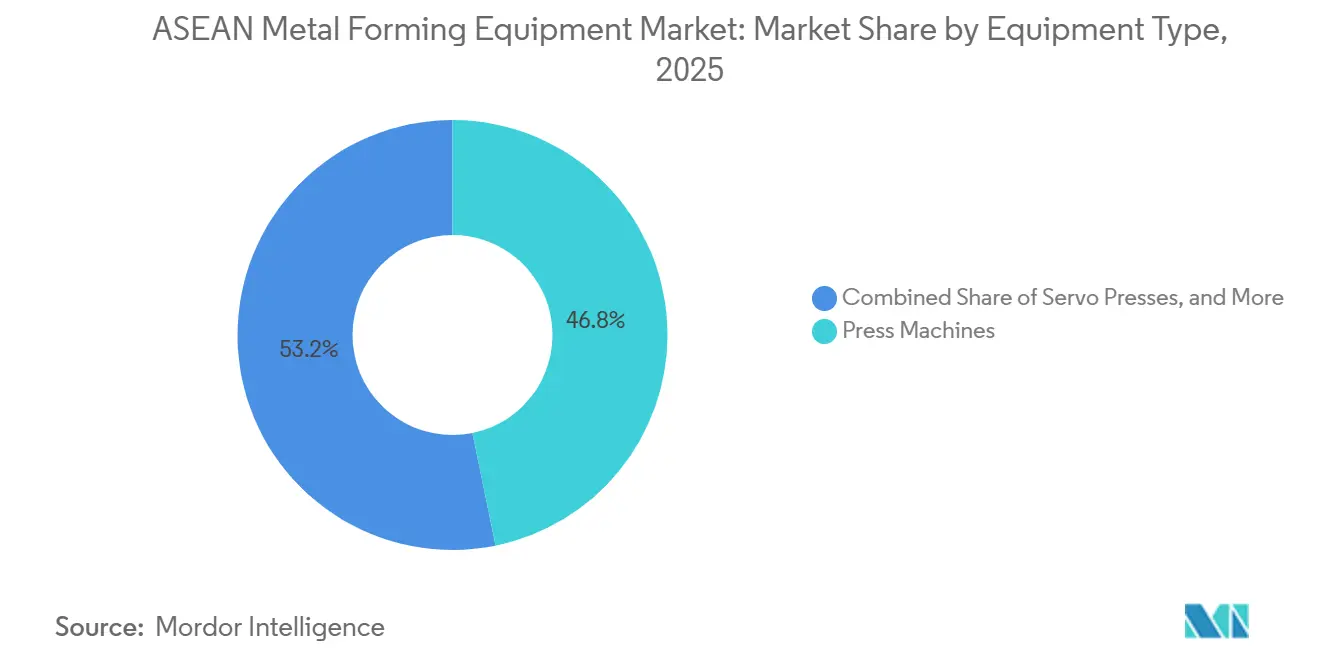
Press machines accounted for 46.8% of the ASEAN metal forming equipment market size in 2025. They support blanking, progressive stamping, and transfer-press work for automotive bodies, electronics chassis, and general fabrication. Programmable stroke profiles can reduce springback in advanced high-strength steel and aluminum components. That capability suits vehicle localization programs and electronics quality requirements. Mechanical presses retain a substantial installed base in Thailand and Indonesia because older automotive tooling was designed for standard stroke parameters. Tightening tolerance requirements are encouraging replacement with servo and CNC-controlled systems. Hydraulic presses remain important for forging, pre-forming, deep drawing, and hydroforming work. Their programmable force control is valuable where forming conditions matter more than the higher cycle rates of mechanical presses.
Servo presses are the fastest-growing technology variant within the equipment category, with a 6.21% CAGR forecast through 2031. Press brakes and bending machines form the second-largest equipment subcategory. Vietnamese and Malaysian fabricators are increasingly considering servo-electric variants for lower operating costs and simpler maintenance than hydraulic systems. Forging equipment is gaining relevance as defense programs seek more domestic structural component production. Hydroforming equipment and extrusion presses have smaller installed bases, but EV battery cases and lightweight structural parts support their stronger growth outlook. The ASEAN metal forming equipment industry also needs wire, tube, and profile-forming systems for specialized applications. AIDA introduced its BEX Series for fuel-cell bipolar plate separators in 2024, with capacities from 8,000 kN to 16,000 kN. The product shows how suppliers are adapting their equipment portfolios for hydrogen and electrified vehicle subsystems. These applications place greater value on process control and component consistency than on standard high-volume forming alone.


By Forming Process: Hydroforming Gains from EV Lightweighting Requirements
Stamping and punching held 39.6% of the ASEAN metal forming equipment market share in 2025. Its cost efficiency at scale and fit with progressive-die automation make it central to ASEAN automotive, electronics, and appliance production. EV programs use hydroformed members for battery enclosures, roof rails, and control-arm subframes. The process forms complex shapes with fewer secondary welds. This can improve structural integrity and reduce part counts in suitable applications. Deep drawing remains relevant for food equipment, medical devices, and semiconductor tooling. These applications benefit from the region’s stainless-steel processing requirements.
Hydroforming is the fastest-growing process, with a 5.72% CAGR forecast through 2031. Bending supports broad demand from fabrication, HVAC, and electronics-rack production. CNC press brakes are replacing manual folding machines in Vietnam and Indonesia as labor cost advantages narrow and export quality requirements rise. Hot forging and precision cold forging are gaining attention in automotive powertrain components and defense hardware. Regional suppliers are seeking to produce parts that were previously purchased from Japan, China, and Europe. Rolling and roll forming serve infrastructure, renewable-energy installations, structural steel, and solar mounting systems in Indonesia and Malaysia. Extrusion remains smaller than the dominant processes, but aluminum vehicle chassis components and heat-sink profiles are supporting further adoption. Process selection in the ASEAN metal forming equipment market, therefore, follows both end-product geometry and the required quality level. It also reflects the availability of experienced operators, dies, and local service support.
By Material Formed: Stainless Steel Aligns with Precision Manufacturing Needs
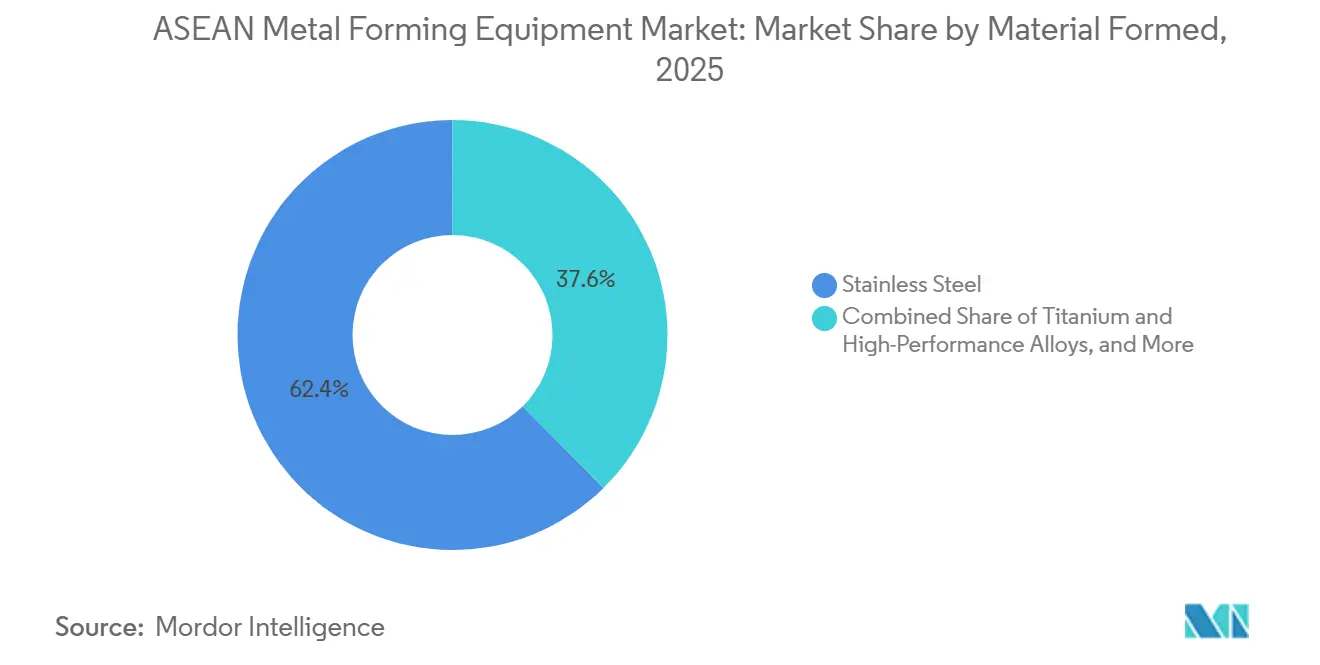
Stainless steel represented 62.4% of the ASEAN metal forming equipment market size in 2025. This concentration reflects electronics, semiconductor packaging, medical devices, and food-equipment activity. These applications require corrosion resistance, controlled surfaces, and hygiene compliance. Singapore and Malaysia have the highest stainless-forming intensity in the region. Clean-room standards and food-safety needs require equipment that can process austenitic and duplex grades without surface contamination. Carbon and low-alloy steel remained the largest material by tonnage processed. Automotive structural stampings, construction fasteners, and general fabrication support this position in Thailand, Indonesia, and Vietnam. Material choice directly affects press settings, die performance, and the required level of process control.
Titanium and high-performance alloys are the fastest-growing material category, with a 6.18% CAGR forecast through 2031. Aerospace parts, medical implants, and semiconductor process equipment support their use in Singapore and Malaysia. Aluminum and aluminum alloys also benefit from EV lightweighting and use in enclosures, battery housings, and heat-management components. Accurate aluminum forming needs tighter pressure control than conventional steel stamping. Servo-hydraulic equipment can therefore sustain premium pricing where aluminum specifications require closer control. Copper and copper alloys retain steady use in electronic connectors, busbars, and power-distribution hardware. The ASEAN metal forming equipment industry benefits when premium equipment suppliers can handle specialized alloys. These applications distinguish precision equipment makers from lower-cost competitors focused on standard hydraulic presses.
By End-Use Industry: Automotive Retains Volume While Aerospace and Defense Grow Faster
Automotive and transportation held 34.7% of end-use equipment demand in 2025. Established assembly operations in Thailand, Indonesia, and Malaysia support continuing stamping and forging requirements. The shift toward EV platforms is increasing pressure in existing press shops. Advanced high-strength steel stampings and aluminum battery enclosures need different force profiles, stroke control, and die-change practices than older vehicle programs. Domestic defense production plans are increasing the need for precision sheet forming, forging, and tube bending. These activities bring forming capability into regional defense supply chains that previously sourced more finished components abroad. Airbus stated that the Royal Thai Navy acquired two C295 aircraft in an enhanced transport configuration during May 2026.
Aerospace and defense are the fastest-growing end-use categories, with a 5.86% CAGR forecast through 2031. Electrical and electronics is the second-fastest-growing end-use area. Semiconductor investments in Malaysia, Singapore, and Vietnam require lead frames, tooling fixtures, and rack components made to close tolerances. Industrial machinery and capital equipment add demand as domestic machine-building activity develops around regional OEM and Tier 1 programs. Construction and infrastructure support roll forming and plate rolling in Indonesia, Malaysia, and the Philippines. Renewable-energy projects also support the fabrication of structural steel and solar mounting systems. Consumer appliances help maintain high-volume stamping demand in Indonesia and Vietnam. Medical and precision manufacturing support micro-forming and press-brake requirements in Singapore and Malaysia. This mix helps the ASEAN metal forming equipment market avoid complete reliance on a single end-use vertical. It also gives equipment makers opportunities to balance high-volume applications with specialized, higher-value work.
Geography Analysis
Thailand held a 28.6% national share in 2025, supported by automotive and electronics activity in the Eastern Economic Corridor. The EEC reported near-full industrial-estate utilization in September 2026 as electronics, automotive, and biochemical manufacturers continued to expand their production footprints. Thailand sustains ICE-related stamping capacity while adding servo press and hydroforming lines for EV programs, creating a parallel investment cycle. EEC Phase 2 received approval in March 2026, committing USD 15 billion over 5 years, with EV and battery manufacturing receiving the largest allocation. Its aerospace maintenance base can also create demand for precision sheet-metal and structural-forming work.
Vietnam is the ASEAN metal forming equipment market’s fastest-growing national geography, with a 6.14% CAGR forecast through 2031. Electronics investment, automotive localization, and steel investment are expanding their equipment base. The OECD identified Vietnam as a major recipient of relocated electronics and automotive activity, which needs press brakes, stamping lines, and welding-integrated forming cells. Malaysia and Singapore support the region’s highest-precision applications. MIDA reported that X-FAB’s RM 3 billion Sarawak expansion added semiconductor capacity and strengthened Malaysia’s role in the global semiconductor supply chain. These electronics clusters create demand for precision-formed components and technical service capabilities.
Indonesia supports hydraulic-press and forging demand in West and East Java supplier clusters, while Malaysia’s aerospace manufacturing base creates specialized requirements. Spirit AeroSystems disclosed the sale of its Subang, Malaysia, facility to CTRM for USD 95.2 million in August 2025. The Philippines is developing its equipment base through electronics and automotive wire-harness activity in Laguna and Cavite. Singapore remains focused on high-value precision forming and medical-device stamping, while Cambodia, Myanmar, Laos, and Brunei have early-stage demand for basic hydraulic presses and CNC press brakes.
Competitive Landscape
The ASEAN metal forming equipment market is moderately fragmented. Japanese suppliers, including AIDA Engineering, AMADA, Komatsu Industries, and Mitsubishi Heavy Industries, hold premium automotive and electronics positions through application engineering, lifecycle service, and tooling support. European specialists, including ANDRITZ Schuler, TRUMPF, LVD, Bystronic, Salvagnini, and Prima Industrie, compete through digitally integrated technology and precision performance. Chinese suppliers such as JIER Machine-Tool Group, Yangli Group, and Accurl are growing in mid-range hydraulic presses and CNC press brakes through price positioning and regional service networks. This range of suppliers gives buyers options across different price points and performance requirements.
ANDRITZ Schuler launched its HFA fineblanking press series with Feintool in January 2026, using servo-controlled hydraulic pump drives presented as improving energy efficiency and stroke rates. The move strengthens its offering for precision automotive and electronics work. TRUMPF expanded its Malaysian technical center presence in May 2025 for regional semiconductor customers. AMADA is committed to at least JPY 150 billion (USD 0.96 billion) in growth investments through 2030, covering capital expenditures, acquisitions, research and development, and advanced-forming activities. AIDA’s DPH Series for rectangular storage battery cases shows how specialized product development addresses EV component programs.
Affordable servo retrofits, local spare-parts networks, die maintenance, and battery-case equipment are potential openings for suppliers. Regional integrators can pair Chinese press hardware with Japanese or European CNC controls for suitable noncritical applications. The sale of the Spirit AeroSystems Malaysia facility to CTRM points to a more localized aerospace manufacturing base that can attract suppliers already serving aerospace customers.
ASEAN Metal Forming Equipment Industry Leaders
AIDA Engineering Ltd.
AMADA CO., LTD.
ANDRITZ Schuler Group
TRUMPF SE + Co. KG
Komatsu Industries (Thailand) Co., Ltd.
- *Disclaimer: Major Players sorted in no particular order

Recent Industry Developments
- March 2026: The Thai government approved the second phase of the Eastern Economic Corridor program, committing USD 15 billion over five years, with the largest single allocation targeting EV and battery manufacturing. The approval guarantees a sustained pipeline of press shop and forming equipment capex across Thailand's EEC industrial estates through at least 2031, per the Eastern Economic Corridor Office.
- January 2026: ANDRITZ Schuler launched the new HFA fineblanking press series in cooperation with Feintool, featuring servo-controlled hydraulic pump drives that deliver a double-digit percentage improvement in energy efficiency while increasing stroke rates. The machines are supplied directly from ANDRITZ Schuler as turnkey fineblanking lines, expanding the company's precision forming portfolio applicable to ASEAN electronics and automotive fine-blanking customers.
- September 2025: ANDRITZ Schuler showcased its newly developed ring roller system at its Erfurt facility, designed for rings up to 2,000 mm in diameter and 400 mm in height, with commissioning at a railway wheel manufacturer in Kazakhstan scheduled for spring 2026, demonstrating large-format roll-forming capability applicable to ASEAN infrastructure and energy sector programs.
- May 2025: TRUMPF Electronics opened a regional technical center in Malaysia, coinciding with its debut at SEMICON SEA 2025 in Singapore. The facility covers semiconductor customer service requests from Vietnam and Thailand in addition to Malaysia, strengthening TRUMPF's Southeast Asian infrastructure in precision electronics applications that require advanced forming-adjacent metalworking capability.


ASEAN Metal Forming Equipment Market Report Scope
| Press Machines | Mechanical Presses |
| Hydraulic Presses | |
| Servo Presses | |
| Other General-Purpose Presses | |
| Press Brakes and Bending Machines | Hydraulic Press Brakes |
| Servo / Electric Press Brakes | |
| Mechanical Press Brakes | |
| Other Bending Machines | |
| Forging Equipment | Forging Presses |
| Forging Hammers | |
| Upsetting and Heading Machines | |
| Other Forging Equipment | |
| Roll Forming and Plate/Profile Rolling Equipment | Roll Forming Machines |
| Plate Rolling Machines | |
| Section and Profile Rolling Machines | |
| Other Secondary Rolling/Forming Equipment | |
| Wire, Tube and Profile Forming Equipment | Wire and Bar Drawing/Forming Equipment |
| Tube Forming and Bending Equipment | |
| Profile Forming Equipment | |
| Extrusion Presses | |
| Hydroforming Equipment | |
| Other Metal Forming Equipment |
| Stamping and Punching |
| Deep Drawing |
| Bending |
| Forging |
| Rolling and Roll Forming |
| Extrusion |
| Hydroforming |
| Other Forming Processes |
| Carbon and Low-Alloy Steel |
| Stainless Steel |
| Aluminum and Aluminum Alloys |
| Copper and Copper Alloys |
| Titanium, Nickel and Other Non-Ferrous Metals |
| Other Materials |
| Automotive and Transportation |
| Aerospace and Defense |
| Industrial Machinery and Capital Equipment |
| Metal Products and Fabrication |
| Electrical and Electronics |
| Construction and Infrastructure |
| Energy and Power |
| Consumer Appliances and Durable Goods |
| Medical and Precision Manufacturing |
| Other End-Use Industries |
| Thailand |
| Vietnam |
| Indonesia |
| Malaysia |
| Philippines |
| Singapore |
| Rest of ASEAN |
| By Equipment Type | Press Machines | Mechanical Presses |
| Hydraulic Presses | ||
| Servo Presses | ||
| Other General-Purpose Presses | ||
| Press Brakes and Bending Machines | Hydraulic Press Brakes | |
| Servo / Electric Press Brakes | ||
| Mechanical Press Brakes | ||
| Other Bending Machines | ||
| Forging Equipment | Forging Presses | |
| Forging Hammers | ||
| Upsetting and Heading Machines | ||
| Other Forging Equipment | ||
| Roll Forming and Plate/Profile Rolling Equipment | Roll Forming Machines | |
| Plate Rolling Machines | ||
| Section and Profile Rolling Machines | ||
| Other Secondary Rolling/Forming Equipment | ||
| Wire, Tube and Profile Forming Equipment | Wire and Bar Drawing/Forming Equipment | |
| Tube Forming and Bending Equipment | ||
| Profile Forming Equipment | ||
| Extrusion Presses | ||
| Hydroforming Equipment | ||
| Other Metal Forming Equipment | ||
| By Forming Process | Stamping and Punching | |
| Deep Drawing | ||
| Bending | ||
| Forging | ||
| Rolling and Roll Forming | ||
| Extrusion | ||
| Hydroforming | ||
| Other Forming Processes | ||
| By Material Formed | Carbon and Low-Alloy Steel | |
| Stainless Steel | ||
| Aluminum and Aluminum Alloys | ||
| Copper and Copper Alloys | ||
| Titanium, Nickel and Other Non-Ferrous Metals | ||
| Other Materials | ||
| By End-Use Industry | Automotive and Transportation | |
| Aerospace and Defense | ||
| Industrial Machinery and Capital Equipment | ||
| Metal Products and Fabrication | ||
| Electrical and Electronics | ||
| Construction and Infrastructure | ||
| Energy and Power | ||
| Consumer Appliances and Durable Goods | ||
| Medical and Precision Manufacturing | ||
| Other End-Use Industries | ||
| By Geography | Thailand | |
| Vietnam | ||
| Indonesia | ||
| Malaysia | ||
| Philippines | ||
| Singapore | ||
| Rest of ASEAN | ||


Key Questions Answered in the Report
What is the projected growth rate for ASEAN metal forming equipment?
The ASEAN metal forming equipment market is projected to grow at a 4.53% CAGR from 2026 to 2031, reaching USD 0.83 billion.
Which equipment category leads regional demand?
Press machines led demand with 46.8% share in 2025 because they support automotive, electronics, and general fabrication production.
Which forming process is growing fastest in Southeast Asia?
Hydroforming is projected to grow at a 5.7% CAGR through 2031, supported by EV battery enclosures and lightweight structural components.
Why is Thailand important for equipment suppliers?
Thailand held 28.6% share in 2025 and combines established automotive capacity with EV, battery, electronics, and aerospace-related demand.
Which end-use area has the strongest growth outlook?
Aerospace and defense is forecast to expand at a 5.9% CAGR through 2031, supported by domestic defense and aerospace capability needs.
What limits equipment upgrades among smaller fabricators?
High initial costs, limited credit access, imported-equipment exposure, and shortages of technical talent can delay purchase and replacement decisions.
Page last updated on:





