
Artisan Bakery Market Size and Share
Market Overview
| Study Period | 2022 - 2032 |
|---|---|
| Market Size (2027) | USD 57.14 Billion |
| Market Size (2032) | USD 77.67 Billion |
| Growth Rate (2027 - 2032) | 5.71 % |
| Fastest Growing Market | Asia-Pacific |
| Largest Market | Europe |
| Market Concentration | Low |
Major Players *Disclaimer: Major Players sorted in no particular order Image © Mordor Intelligence. Reuse requires attribution under CC BY 4.0. | |
Artisan Bakery Market Analysis by Mordor Intelligence
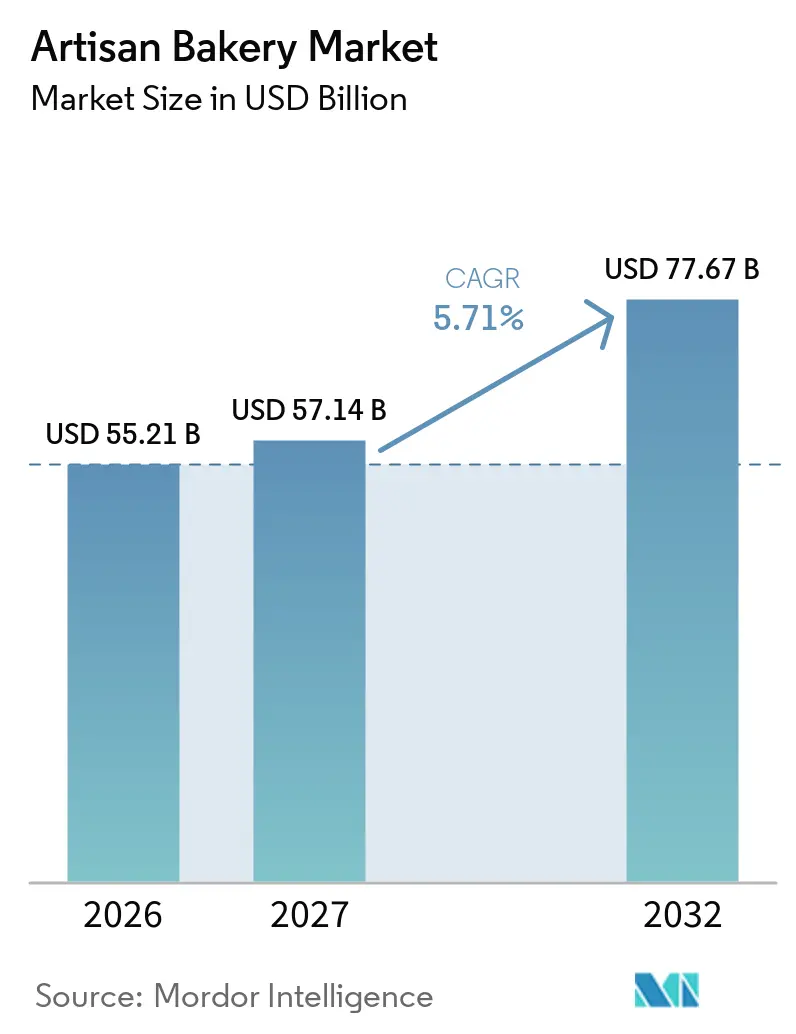
The artisan bakery market was valued at USD 55.21 billion in 2026 and is estimated to grow from USD 57.14 billion in 2027 to USD 77.67 billion by 2032, at a CAGR of 5.71% during the forecast period from 2027 to 2032. Growth is supported by demand for fresh products, recognizable ingredients, and breads with local or cultural identities. Europe remains the largest regional market, while Asia-Pacific offers strong growth opportunities as urban consumers adopt Western-style bread formats. The market remains fragmented, with companies likely to scale through acquisitions, franchising, and supply chain investments.
Key Report Takeaways
- By product type, bread and rolls held 47.11% share in 2026, while sourdough bread recorded the fastest rise at 7.40% CAGR through 2032.
- By ingredient and claim, conventional accounted for a 76.21% share in 2026, while natural/organic recorded the fastest rise at a 8.20% CAGR through 2032.
- By packaging format, retail-packaged fresh held 51.21% share in 2026, while frozen and par-baked recorded the fastest rise at a 7.30% CAGR through 2032.
- By end user, retail and household consumers accounted for 54.23% share in 2026, while hotels, catering and events recorded the fastest rise at a 7.40% CAGR through 2032.
- By geography, Europe held 32.22% share in 2026, while Asia-Pacific recorded the fastest rise at a 6.80% CAGR through 2032.
Note: Market numbers in this report are based on Mordor Intelligence's proprietary estimation framework, which combines nine months of actuals with Q4 projections for base year 2026.
Global Artisan Bakery Market Trends and Insights
Drivers Impact Analysis*
| Driver | (~) % Impact on CAGR Forecast | Geographic Relevance | Impact Timeline |
|---|---|---|---|
| Growing Consumer Interest in Premium Ingredients and Distinctive Bakery Flavors | +1.2% | Global, strongest in North America and Western Europe | Short term (≤ 2 years) |
| Increasing Popularity of Artisan Bread and Experiential Bakery Offerings | +1.0% | North America, Europe, Asia-Pacific urban centers | Medium term (2-4 years) |
| Rising Demand for Diverse Flavors, International Bakery Styles, and Seasonal Offerings | +0.9% | Global, concentrated in Tier-1 cities across North America, Europe, and Asia-Pacific | Medium term (2-4 years) |
| Growing Consumer Demand for Freshly Baked and Small-Batch Products | +0.7% | Global, high intensity in Asia-Pacific and the Middle East | Medium term (2-4 years) |
| Increasing demand for customized cakes and made-to-order bakery products | +0.8% | North America, Northern and Western Europe, and Asia-Pacific urban clusters | Long term (≥ 4 years) |
| Rising demand for organic, whole-grain and dietary-specific bakery products | +0.5% | South and Southeast Asia, the Middle East, and Latin America | Long term (≥ 4 years) |
| Source: Mordor Intelligence | |||
Growing Consumer Interest in Premium Ingredients and Distinctive Bakery Flavors
Growing consumer interest in distinctive flavors, ingredient transparency, and whole-grain products is encouraging bakeries to diversify their product offerings. For instance, in June 2025, according to the Oldways Whole Grains Council's Whole Grain Consumer Insights Survey, consumers chose whole-grain options for bread, rolls, and buns 42% of the time. Additionally, 77% of surveyed U.S. consumers wanted product packaging to display whole-grain content, up from 70% in 2021. Furthermore, 84% of respondents trusted the Whole Grain Stamp, underscoring the importance of ingredient transparency in purchasing decisions [1].
Increasing Popularity of Artisan Bread and Experiential Bakery Offerings
Increasing consumer interest in artisan bread, sourdough, and distinctive bakery products is creating opportunities for artisan bakeries to expand their product offerings and enhance the customer experience. For instance, in August 2026, according to the Grain Foods Foundation’s Consumer Perspectives on Bread research, conducted by Ipsos among 1,043 U.S. adults, sourdough registered the highest net consumption gain among all bread types over the previous year. It was also the preferred bread for the “ideal sandwich,” selected by 20% of respondents. The study identified an “Artisan Advocate” consumer group driven by interest in gut health and premium experiences [2].
Rising Demand for Diverse Flavors, International Bakery Styles, and Seasonal Offerings
Consumer interest in diverse bakery products and seasonal flavors is prompting bakeries to expand their portfolios beyond traditional offerings. For instance, in 2026, according to consumer research by the American Bakers Association, 71% of consumers prefer pastries in seasonal flavors, while 90% consider baked goods a fun part of celebrations [3]. These findings create opportunities for bakeries to attract consumers through limited-time products and occasion-based offerings. Artisan bakeries can capitalize on this demand by introducing internationally inspired breads and pastries, such as focaccia, ciabatta, flatbreads, and specialty sweet breads, as well as seasonal flavors and celebration-themed products.
Growing Consumer Demand for Freshly Baked and Small-Batch Products
Freshly baked, handcrafted, small-batch products enable artisan bakeries to differentiate themselves from mass-produced packaged bread by offering superior quality, freshness, and distinctive presentation. By emphasizing traditional baking methods, specialty recipes, and personalized customer experiences, artisan bakeries can strengthen their product identity and attract consumers seeking alternatives to standardized bakery products. Visible preparation areas, thoughtfully arranged displays, and a diverse selection of breads and pastries further enhance the in-store experience. These factors enable artisan bakeries to compete through product differentiation and perceived value rather than price alone, supporting premium pricing, repeat purchases, and sustained growth, even in mature bread markets.
Restraints Impact Analysis*
| Restraint | (~) % Impact on CAGR Forecast | Geographic Relevance | Impact Timeline |
|---|---|---|---|
| Shortage of Skilled Bakers and Employee Retention Challenges | -0.7% | Global, most acute in Europe and North America | Short term (≤ 2 years) |
| Volatility in Flour, Energy, and Specialty Ingredient Costs | -0.6% | Global, high exposure in Europe and South America | Medium term (2-4 years) |
| Short Shelf Life, Product Waste, and Distribution Constraints | -0.4% | North America, Asia-Pacific, and Middle East and Africa emerging markets | Medium term (2-4 years) |
| High Prices and Consumer Affordability Challenges | -0.5% | South America, Middle East and Africa, and lower-income Asia-Pacific segments | Long term (≥ 4 years) |
| Source: Mordor Intelligence | |||
Shortage of Skilled Bakers and Employee Retention Challenges
Skilled labor shortages and employee retention challenges can constrain artisan bakeries’ ability to extend operating hours, expand product portfolios, and increase wholesale production. Traditional baking requires hands-on expertise in dough preparation, fermentation, shaping, and baking, making experienced workers essential for maintaining consistent product quality. Smaller bakeries may face additional challenges in competing with larger food manufacturers for skilled employees due to limited training resources and career advancement opportunities. High workloads and demanding schedules can further reduce employee satisfaction and retention.
Volatility in Flour, Energy, and Specialty Ingredient Costs
Rising costs of flour, butter, sugar, energy, and specialty ingredients place significant pressure on the operating margins of artisan bakeries. Compared with large-scale manufacturers, smaller bakeries often have limited purchasing power and fewer opportunities to secure favorable supplier contracts or absorb sudden cost increases. Fluctuations in ingredient prices and utility expenses raise production costs, making it challenging for operators to maintain product quality while offering competitive prices. These pressures may compel bakeries to adjust product prices, optimize ingredient use, reduce waste, and improve production efficiency.
*Our forecasts treat driver/restraint impacts as directional, not additive. The impact forecasts reflect baseline growth, mix effects, and variable interactions.
Segment Analysis
By Product Type: Daily Bread Retains the Largest Base as Sourdough Expands
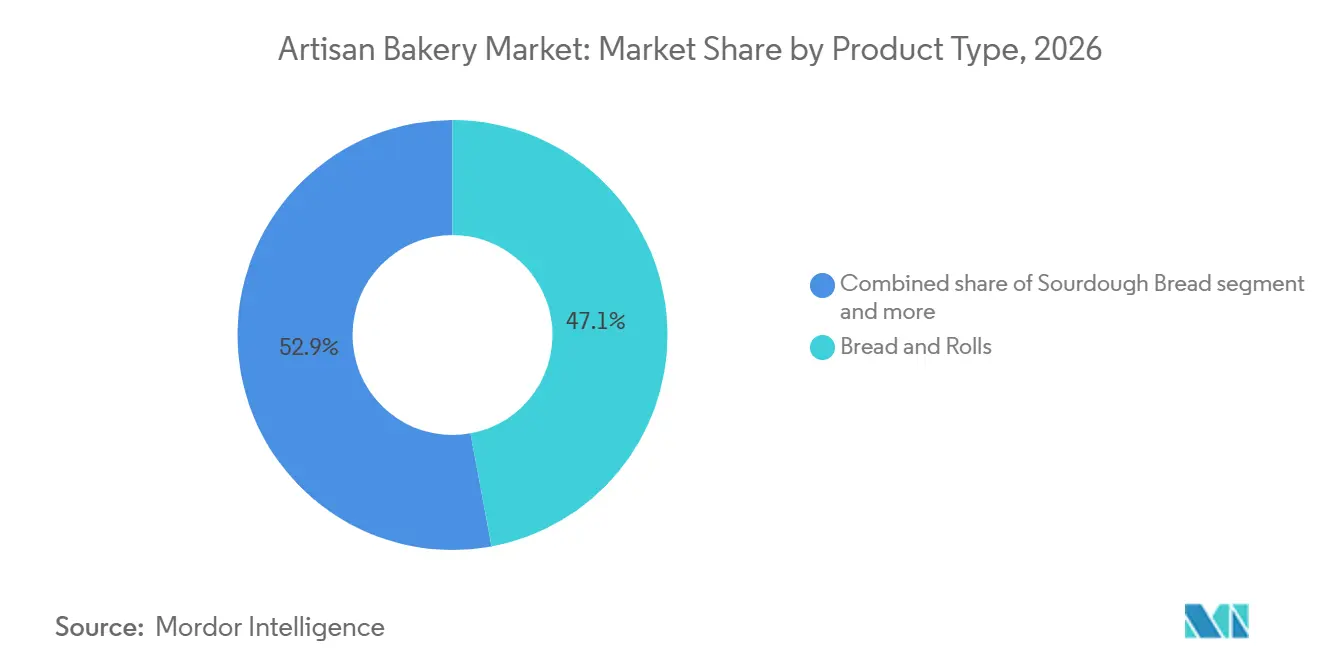
Bread and rolls accounted for 47.11% of the artisan bakery market in 2026, reflecting their role as everyday bakery staples across major regions. Regular household consumption, broad availability, and suitability for breakfast, sandwiches, and meal accompaniments drive demand for this segment. Consumers can choose from a wide range of formats, including loaves, buns, baguettes, and specialty rolls, which cater to varying taste preferences and consumption occasions. Artisan bakeries can leverage a core range of fresh bread and rolls to generate consistent sales while differentiating their offerings through traditional baking methods, high-quality ingredients, freshness, and distinctive textures.
Sourdough bread is projected to grow at a CAGR of 7.40% through 2032. Traditional fermentation methods, distinctive flavor and texture, and premium positioning drive this growth. Increasing consumer interest in naturally fermented, artisanal bread has expanded sourdough consumption beyond specialty bakeries to a broader household consumer base. Consumers increasingly value sourdough for its perceived quality, authentic production methods, and versatile use across everyday meals and premium food occasions. Artisan bakers can capitalize on this trend by incorporating sourdough loaves and variations into their core bread offerings, including flavored, seeded, and whole-grain options, to attract consumers seeking distinctive, higher-value bakery products.

By Ingredient and Claim: Conventional Products Lead While Organic Products Grow Faster
Conventional products accounted for 76.21% of the artisan bakery market in 2026, driven by sustained consumer demand for familiar, accessible, and affordable bakery products. Their widespread availability across bakery outlets and retail channels, established recipes, and suitability for everyday bread purchases support their leading position. Artisan bakeries maintain a strong customer base through conventional breads, rolls, and pastries that cater to both regular household consumption and diverse consumer preferences. They further differentiate these offerings through freshness, craftsmanship, ingredient quality, and product variety.
Natural and organic is projected to grow at a 8.20% CAGR through 2032, making it the fastest-growing formulation segment in the artisan bakery market. This growth reflects growing consumer interest in transparent ingredient sourcing, organic certification, clean-label products, and offerings that align with specific dietary preferences, such as natural ingredients and fewer artificial additives. Consumers are increasingly seeking breads and pastries that provide perceived health, quality, and sustainability benefits while serving as alternatives to conventional bakery products. Artisan bakeries can capitalize on this trend by expanding their offerings of naturally formulated and, where applicable, certified organic breads and pastries.
By Packaging Format: Fresh Retail Leads as Frozen and Par-Baked Gain Foodservice Use
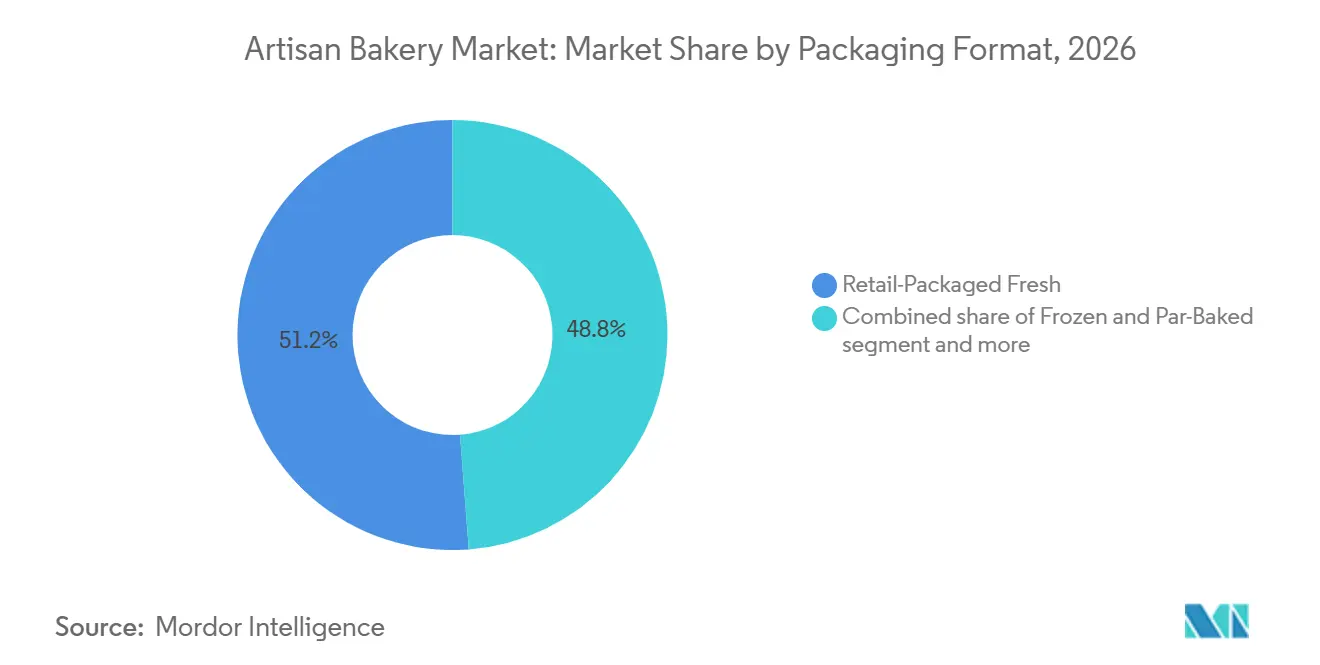
Retail-packaged fresh products accounted for 51.21% of the artisan bakery market in 2026, highlighting the importance of freshness and immediate product availability in consumer purchasing decisions. Consumers often associate artisan bakery products with freshly prepared batches, distinctive textures, and the quality associated with shorter production cycles. Retail-packaged fresh offerings enable bakeries to provide breads, rolls, pastries, and other baked goods for convenient everyday consumption while maintaining their freshly made appeal. By ensuring consistent quality, attractive packaging, and regular product availability, artisan bakeries can strengthen retail sales and build customer loyalty.
Frozen and par-baked products are projected to grow at a 7.30% CAGR through 2032, driven by their suitability for foodservice operations and production planning. These formats enable bakeries, cafés, hotels, and restaurants to store products and complete the baking or finishing process closer to serving time, helping them manage demand fluctuations and maintain product availability. They also support standardized preparation across multiple outlets while reducing the need to prepare every item entirely from scratch at each location. For artisan bakery suppliers, frozen and par-baked formats offer opportunities to serve commercial customers seeking operational flexibility, consistent product quality, and efficient inventory management.
By End User: Household Purchases Lead While Hotels and Events Grow Faster
Retail and household consumers are expected to account for 54.23% of the artisan bakery market in 2026, reflecting the importance of bread and other baked goods in everyday household purchases and visits to neighborhood bakeries. Regular consumption of bread, rolls, pastries, and other bakery products drives demand across routine shopping occasions. Local bakeries can encourage repeat purchases by offering fresh products, consistent quality, and a diverse selection that meets everyday consumer needs. This segment represents a broad customer base, particularly for bakeries that depend on neighborhood foot traffic and frequent purchases.
Hotels, catering, and events are projected to grow at a 7.40% CAGR through 2032, making this the fastest-growing end-use segment. Growth is driven by opportunities to incorporate premium and specialty bakery products into hotel dining, catering services, celebrations, and event menus. These customers can place higher-volume orders than individual retail buyers, generating demand for products tailored to specific occasions and service requirements. For artisan bakeries, serving hospitality and event customers can diversify sales channels, expand their reach beyond walk-in retail shoppers, and create opportunities to supply distinctive breads, pastries, and desserts.
Geography Analysis
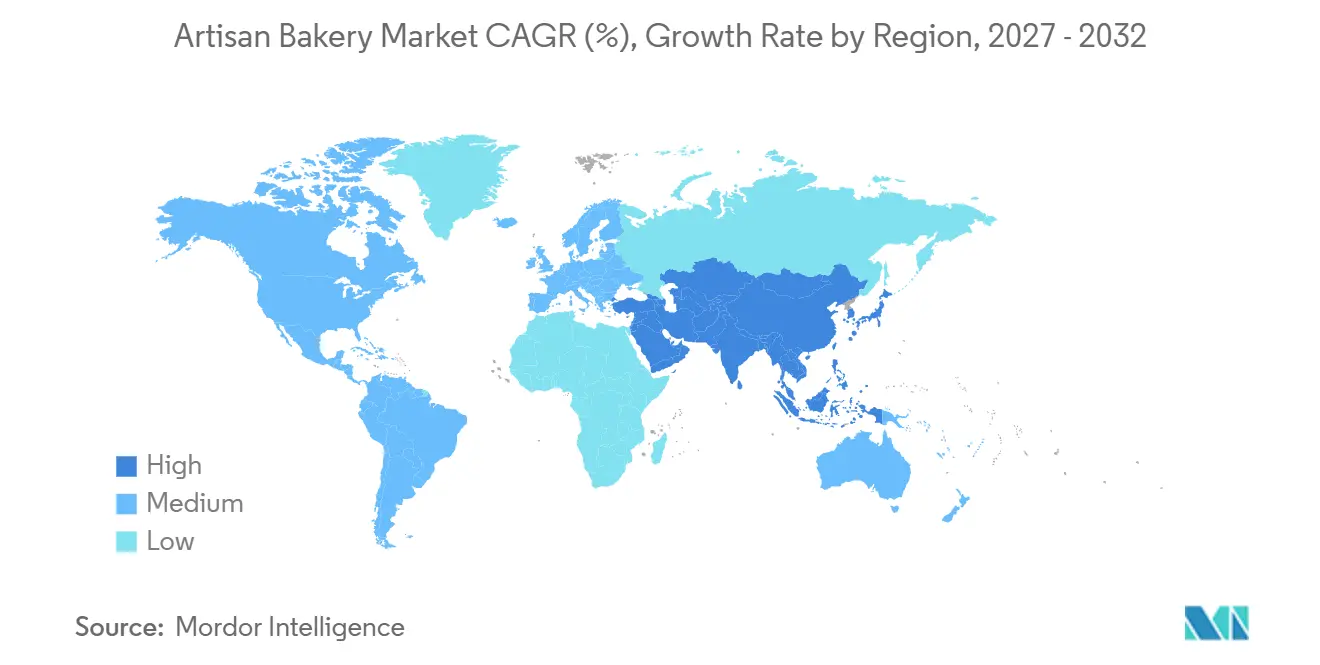
Europe is projected to account for 32.22% of the artisan bakery market in 2026. Europe’s artisan bakery market is supported by well-established baking traditions, extensive bakery networks, and mature ingredient supply chains. France has a strong tradition of artisanal boulangeries and baguette production, while Germany benefits from a broad network of bakeries. Spain also has an established bakery and pastry industry. These markets are supported by longstanding craft practices, consumer familiarity with traditional baked goods, and developed production and distribution networks.
Asia-Pacific is projected to register a CAGR of 6.80% through 2032. Expanding bakery retail networks, evolving urban lifestyles, and shifting consumer preferences support growth in the Asia-Pacific artisan bakery market. China’s bakery sector presents opportunities to increase bread consumption and diversify product offerings, while India’s growing preference for healthier bakery products encourages innovation in formulations and ingredients. Across the region, demand for diverse bread varieties, pastries, and premium baked goods enables artisan bakeries to expand their product portfolios and reach new consumer segments.
North America’s artisan bakery market benefits from a well-established retail bakery sector and strong consumer interest in premium breads, whole-grain ingredients, and organic products. In South America and the Middle East and Africa, opportunities vary based on local consumer preferences, retail development, and foodservice demand. The expansion of hospitality and catering services is creating opportunities for premium breads, pastries, and other specialty baked goods. Frozen and par-baked products also provide foodservice operators with greater preparation flexibility and consistent product availability. Across these regions, retail development and rising demand from commercial foodservice customers are enabling artisan bakery suppliers to expand their reach.
Competitive Landscape
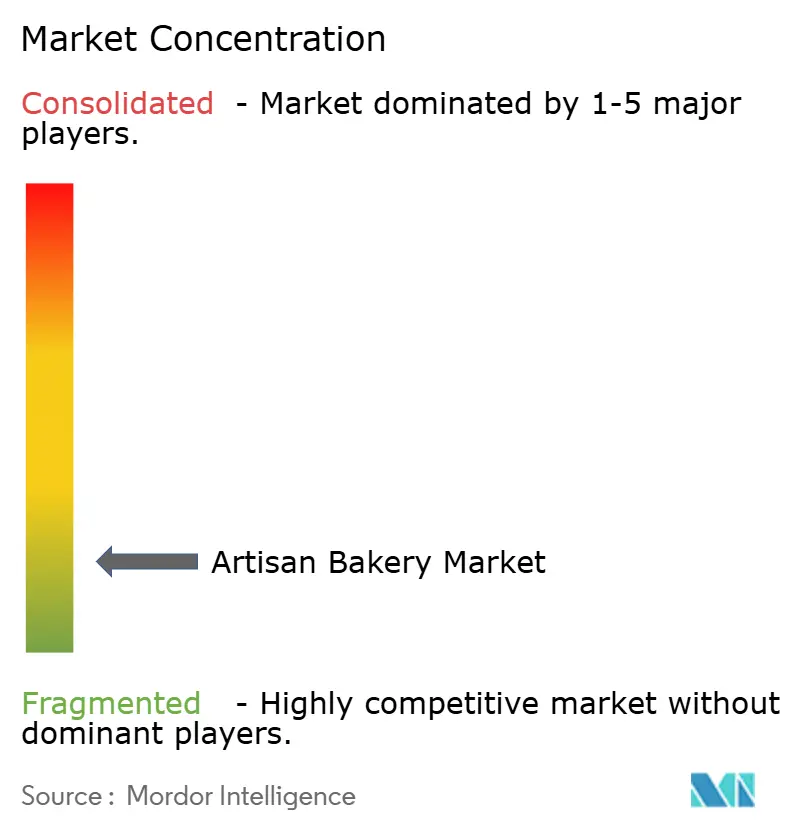
The artisan bakery market is fragmented, with no single company setting category-wide pricing or channel terms. The market includes large bakery groups with artisan-positioned businesses, regional specialty networks, and independent local bakeries. ARYZTA, Lantmännen Unibake, and Grupo Bimbo, through Aspire Bakeries, have the capacity to serve large customers. Groupe HOLDER’s PAUL network, SPC Group’s Paris Baguette, and Groupe LE DUFF operate premium formats with well-established consumer brands. Independent operators remain important because they often maintain stronger local identities and direct customer relationships.
Brioche Pasquier is set to acquire Anthony & Sons Bakery in March 2026, adding a U.S. producer of European-style breads and rolls to its portfolio. This transaction highlights how established bakery groups are pursuing production capacity and established customer access in the United States. It also underscores the growing importance of foodservice supply as a route to scale. Larger platforms can leverage such acquisitions to align product development, manufacturing, and distribution. Independent bakeries remain important in markets where customer preferences are shaped by neighborhood trust and local product knowledge.
Smaller brands can still compete by pairing credible craft products with disciplined expansion. The draft identifies Sourdough Sophia in the United Kingdom and Breaders in Italy as examples of firms using funding to increase capacity and store networks. Ingredient traceability, organic claims, and distinctive regional recipes may be harder for large operators to present credibly at a local level. At the same time, compliance requirements can place more pressure on small bakeries that have limited procurement resources. The Artisan Bakery Market is likely to stay fragmented because regional tastes and local trust remain important. However, acquisitions, franchising, and shared production networks will give better-capitalized companies a clearer path to growth.
Artisan Bakery Industry Leaders
-
Grupo Bimbo, S.A.B. de C.V.
-
ARYZTA AG
-
Lantmännen Unibake (Lantmännen)
-
Flowers Foods, Inc.
-
Rich Products Corporation (Rich’s)
- *Disclaimer: Major Players sorted in no particular order
Recent Industry Developments
- January 2026: OXXO introduced Ditsch artisan bakery products at its central El Paso store, including savory pretzel sticks, buttery croissants, Nutella pretzels, and personal-sized pizza snacks. The store bakes these products in-house and serves them hot and fresh.
- March 2026: Le Creuset launched the Signature Oval Bread Oven, an enameled cast-iron baking vessel designed for sourdough, bâtards, sandwich breads, and other elongated artisan loaves. Its oval shape, domed lid, and heat-distributing construction promote crust development and even browning.
- October 2025: Izzio Artisan Bakery introduced six certified organic and Non-GMO Project Verified varieties of Artisan Sandwich Bread, such as Sourdough, Classic White, Whole Wheat, Ancient Grains, Sprouted Seeds, and Lucky 7 Multigrain. The breads use living sourdough cultures and slow fermentation and contain no seed oils or vital wheat gluten.
Global Artisan Bakery Market Report Scope
Artisan bakery products are baked goods made using traditional methods and high-quality ingredients. The global artisan bakery market is segmented by product type, ingredients, claims, packaging format, end users, and geography. The market includes product types such as bread and rolls, sourdough bread, baguettes and boules, ciabatta, focaccia, and flatbreads. The ingredient and claim segment includes conventional and natural/organic products. Packaging formats include retail-packaged fresh, frozen, and par-baked products, as well as bulk, foodservice, and other types. End users include retail and household consumers, restaurants and cafés, hotels, catering and events, and institutional and workplace foodservice. The market covers North America, Europe, Asia-Pacific, South America, and the Middle East and Africa, including key countries within each region. The report provides market size estimates and forecasts by value (USD).
| Bread and Rolls |
| Sourdough Bread |
| Baguettes and Boules |
| Ciabatta, Focaccia and Flatbreads |
| Others |
| Conventional |
| Natural/Organic |
| Retail-Packaged Fresh |
| Frozen and Par-Baked |
| Bulk and Foodservice Packaging |
| Others |
| Retail and Household Consumers |
| Restaurants and Cafés |
| Hotels, Catering and Events |
| Institutional and Workplace Foodservice |
| North America | United States |
| Canada | |
| Mexico | |
| Rest of North America | |
| Europe | Germany |
| United Kingdom | |
| Italy | |
| France | |
| Spain | |
| Netherlands | |
| Poland | |
| Belgium | |
| Sweden | |
| Rest of Europe | |
| Asia-Pacific | India |
| Japan | |
| Australia | |
| China | |
| Indonesia | |
| South Korea | |
| Thailand | |
| Singapore | |
| Rest of Asia-Pacific | |
| South America | Brazil |
| Argentina | |
| Colombia | |
| Chile | |
| Peru | |
| Rest of South America | |
| Middle East and Africa | South Africa |
| Saudi Arabia | |
| United Arab Emirates | |
| Nigeria | |
| Egypt | |
| Morocco | |
| Turkey | |
| Rest of Middle East and Africa |
| By Product Type | Bread and Rolls | |
| Sourdough Bread | ||
| Baguettes and Boules | ||
| Ciabatta, Focaccia and Flatbreads | ||
| Others | ||
| By Ingredient and Claim | Conventional | |
| Natural/Organic | ||
| By Packaging Format | Retail-Packaged Fresh | |
| Frozen and Par-Baked | ||
| Bulk and Foodservice Packaging | ||
| Others | ||
| By End User | Retail and Household Consumers | |
| Restaurants and Cafés | ||
| Hotels, Catering and Events | ||
| Institutional and Workplace Foodservice | ||
| By Geography | North America | United States |
| Canada | ||
| Mexico | ||
| Rest of North America | ||
| Europe | Germany | |
| United Kingdom | ||
| Italy | ||
| France | ||
| Spain | ||
| Netherlands | ||
| Poland | ||
| Belgium | ||
| Sweden | ||
| Rest of Europe | ||
| Asia-Pacific | India | |
| Japan | ||
| Australia | ||
| China | ||
| Indonesia | ||
| South Korea | ||
| Thailand | ||
| Singapore | ||
| Rest of Asia-Pacific | ||
| South America | Brazil | |
| Argentina | ||
| Colombia | ||
| Chile | ||
| Peru | ||
| Rest of South America | ||
| Middle East and Africa | South Africa | |
| Saudi Arabia | ||
| United Arab Emirates | ||
| Nigeria | ||
| Egypt | ||
| Morocco | ||
| Turkey | ||
| Rest of Middle East and Africa | ||
Key Questions Answered in the Report
What is the projected value of the artisan bakery market by 2032?
The artisan bakery market is forecast to reach USD 77.67 billion by 2032, rising from USD 57.14 billion in 2027 at a 5.71% CAGR. This outlook reflects sustained demand for fresh, premium, and distinctive bakery products. It also reflects the sector’s ability to serve household, retail, café, hotel, and catering demand through different product formats.
Which product type leads artisan bakery sales?
Bread and rolls lead with a 47.11% share in 2026. The artisan bakery market remains anchored in this everyday category across regions, stores, and household shopping occasions. These products provide a regular purchase base, while specialty bread formats give operators a way to extend choice without moving away from familiar eating habits.
Which region offers the strongest growth potential for artisan bakeries?
Asia-Pacific is forecast to grow at a 6.80% CAGR through 2032, supported by urbanization, a growing bakery outlet base, and rising foodservice demand.
Why are organic and whole-grain bakery products growing?
Shoppers increasingly look for clear ingredient and certification information. Natural/organic products in the artisan bakery market are forecast to grow at an 8.20% CAGR through 2032, supported by rising interest in trusted claims.