
Artificial Iris Market Size and Share
Market Overview
| Study Period | 2020 - 2031 |
|---|---|
| Market Size (2026) | USD 24.65 Million |
| Market Size (2031) | USD 38.71 Million |
| Growth Rate (2026 - 2031) | 9.45 % |
| Fastest Growing Market | Asia-Pacific |
| Largest Market | North America |
| Market Concentration | High |
Major Players *Disclaimer: Major Players sorted in no particular order Image © Mordor Intelligence. Reuse requires attribution under CC BY 4.0. | |
Artificial Iris Market Analysis by Mordor Intelligence
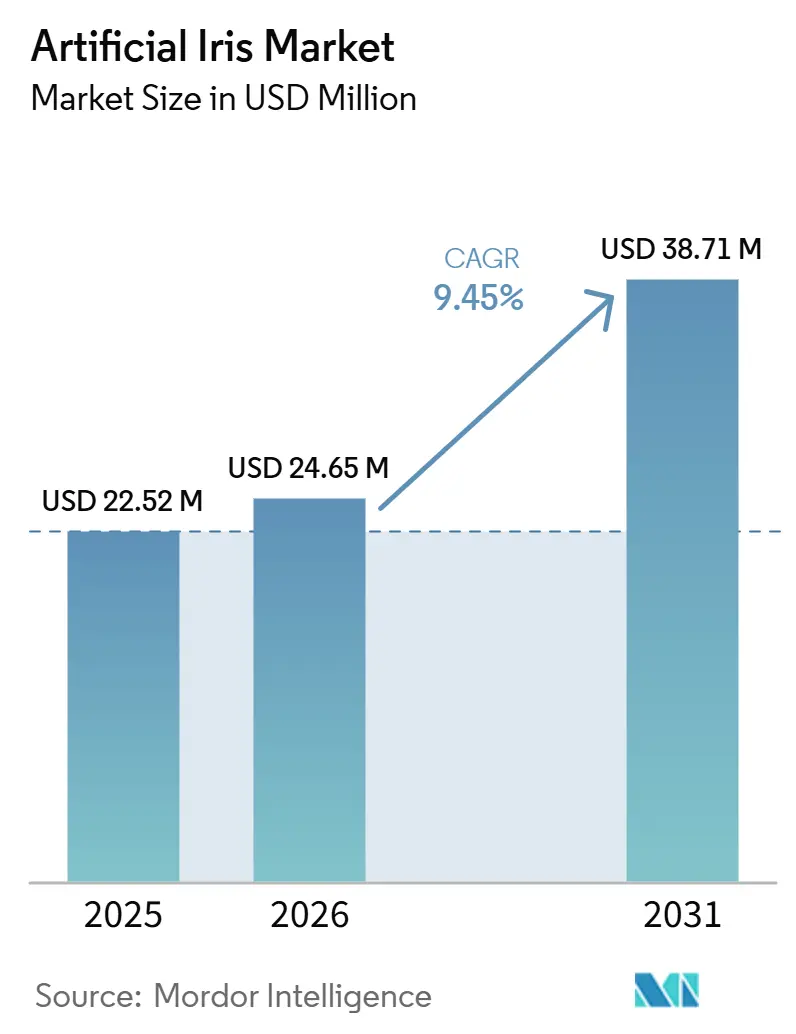
The Artificial Iris Market size is expected to grow from USD 22.52 million in 2025 to USD 24.65 million in 2026 and is forecast to reach USD 38.71 million by 2031 at 9.45% CAGR over 2026-2031.
The artificial iris market is supported by broader clinical recognition of congenital, traumatic, and surgery-related iris defects. Hospital ophthalmology units are increasingly procuring reconstructive devices that restore both visual function and appearance. Custom device platforms are making patient-specific treatment more accessible within specialist care pathways. Cataract, glaucoma, and penetrating keratoplasty procedures can damage iris tissue and create a secondary pool of patients for the artificial iris market. Standardized clinical guidance and improved specialist training are likely to reduce variation in how centers assess and manage eligible patients.
Key Report Takeaways
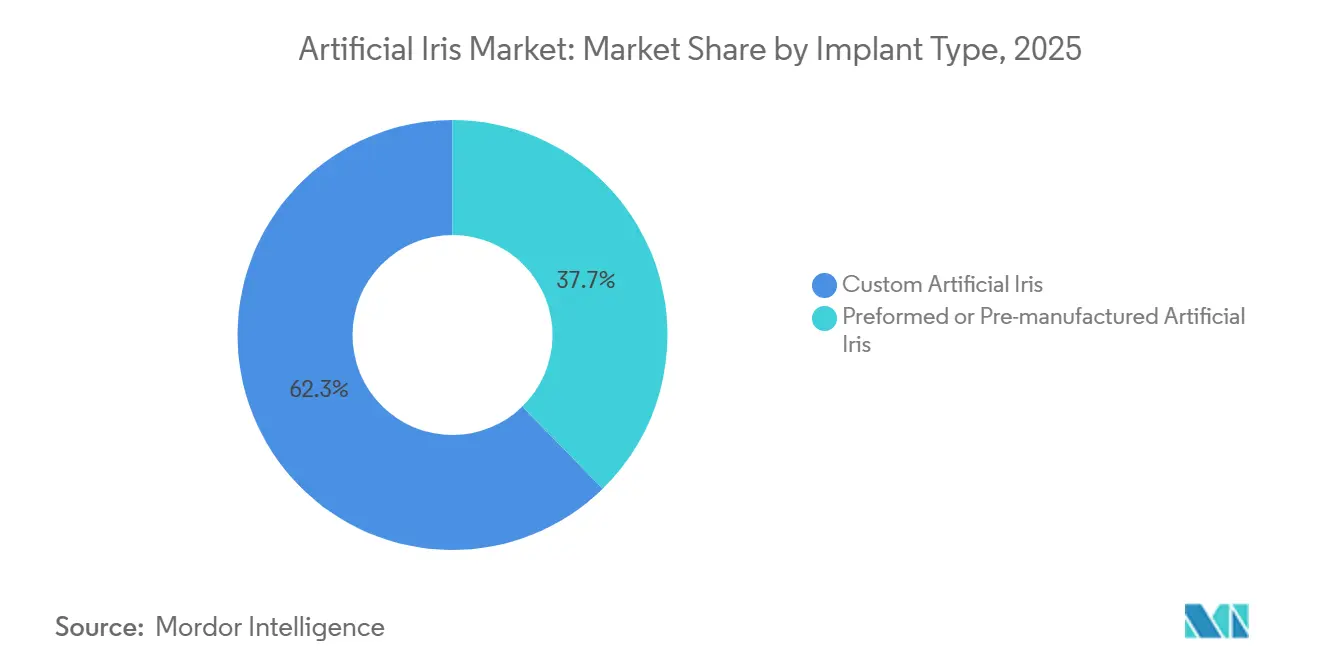
- By implant type, custom artificial iris devices held 62.31% of global revenue in 2025, and are expected to have 11.58% CAGR through 2031.
- By application, congenital aniridia accounted for 44.24% of the artificial iris market size in 2025, while cosmetic correction is forecast to grow at a CAGR of 12.22% through 2031.
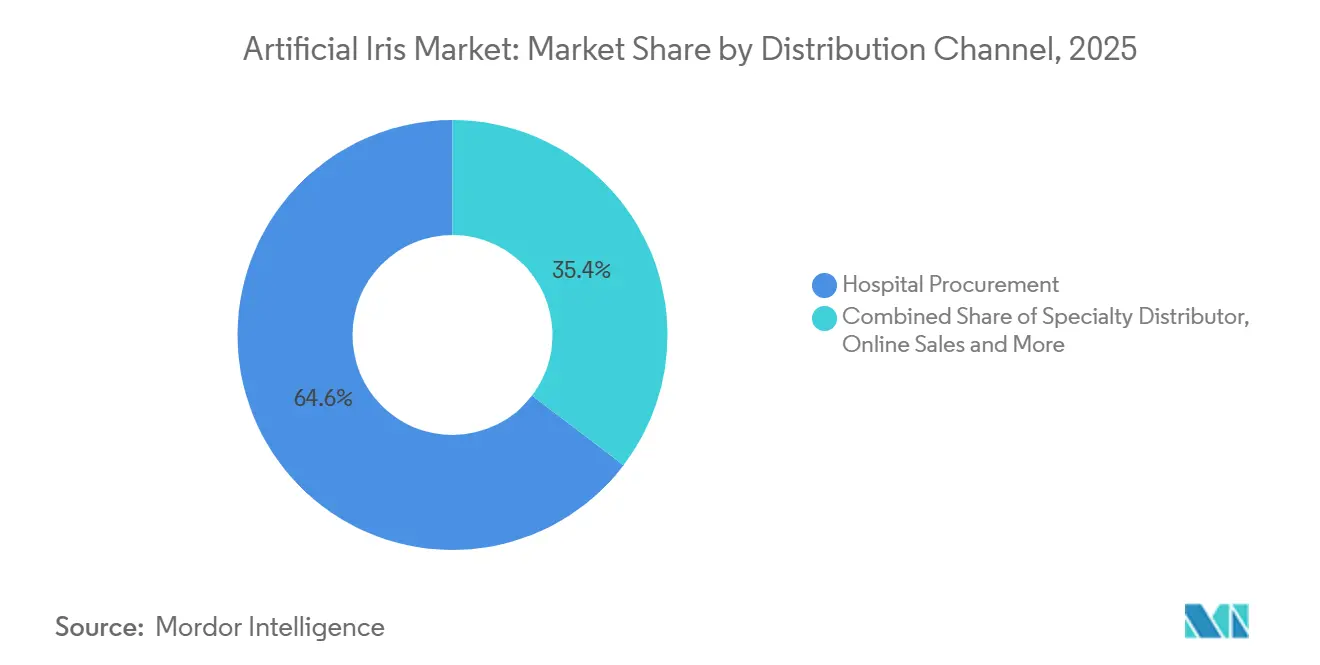
- By distribution channel, Hospital Supply Stores held 64.65% of revenue in 2025, while online sales channels are forecast to grow at a CAGR of 12.95% through 2031.
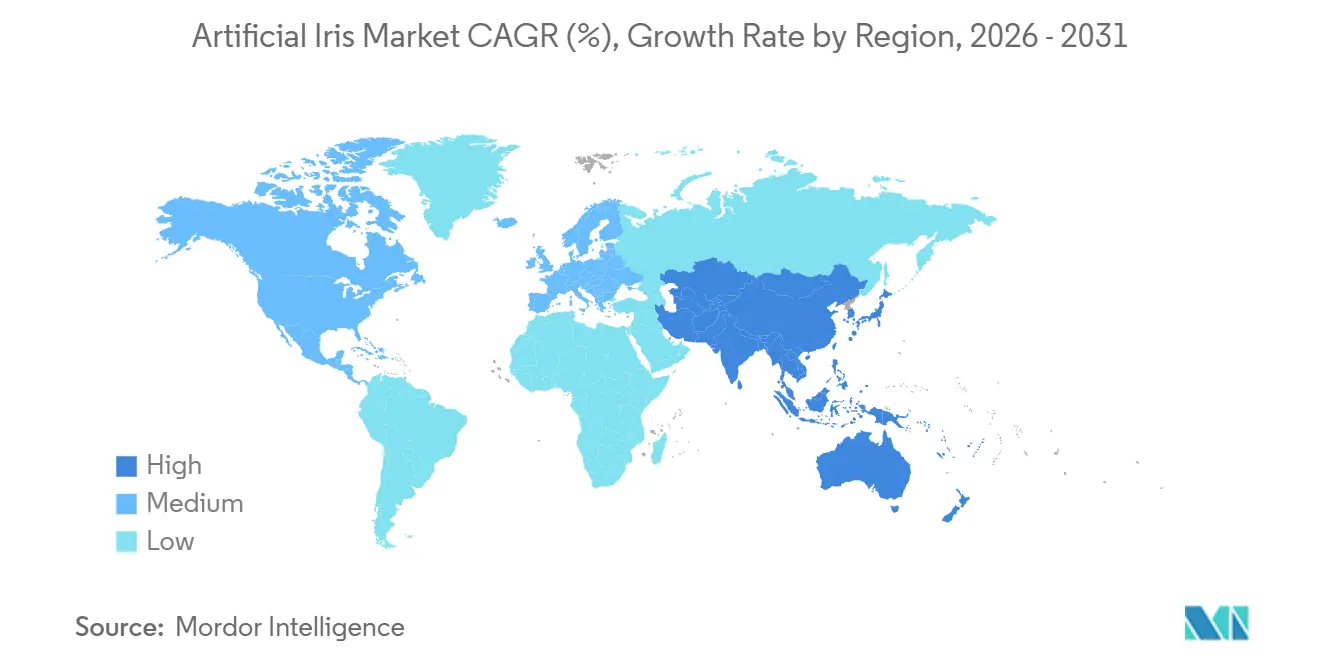
- By geography, North America held 38.61% of global revenue in 2025, while Asia-Pacific is forecast to grow at a CAGR of 11.25% through 2031.
Note: Market size and forecast figures in this report are generated using Mordor Intelligence’s proprietary estimation framework, updated with the latest available data and insights as of January 2026.
Market Trends and Insights
Drivers Impact Analysis of Artificial Iris Market*
| Driver | (~) % Impact on CAGR Forecast | Geographic Relevance | Impact Timeline |
|---|---|---|---|
| Increasing Prevalence of Congenital Aniridia and Traumatic Iris Defects | +2.1% | Global | Long term (≥ 4 years) |
| FDA and CE-Mark Access Expanding Clinical Adoption | +1.8% | North America & Europe | Medium term (2-4 years) |
| Preference for Foldable, Minimally Invasive Reconstruction | +1.2% | Global | Medium term (2-4 years) |
| Rising Demand for Aesthetic and Functional Restoration | +1.0% | North America, Europe & APAC | Medium term (2-4 years) |
| Digital Color-Matching and Distributed Custom Manufacturing | +0.7% | Global | Short term (≤ 2 years) |
| Integration of Iris Implants With Image-Guided Surgical Planning | +0.5% | North America & Europe | Long term (≥ 4 years) |
| Source: Mordor Intelligence | |||
Increasing Prevalence of Congenital Aniridia and Traumatic Iris Defects
Congenital aniridia affects an estimated 1 in 40,000 to 1 in 100,000 births globally. More than 50% of affected patients develop secondary glaucoma, while lens opacities occur in 50% to 90% of cases. Nystagmus can accompany up to 95% of cases, and aniridia-associated keratopathy affects 70% to 80% of patients. The combination of these conditions means that many patients require repeated assessment rather than a single device-focused visit. Hospitals must assess corneal health, glaucoma risk, residual iris tissue, lens status, and the expected method of fixation before reconstruction. These clinical needs make coordinated care across anterior-segment, glaucoma, corneal, and low-vision services important. The artificial iris market also serves patients with iris damage after cataract extraction, glaucoma drainage device placement, or penetrating keratoplasty, even when they are not included in congenital prevalence records. Such damage can emerge during treatment for another serious eye condition and may only become apparent after the primary procedure. A 2025 Chinese clinical series was mainly composed of patients with traumatic causes, which supports the importance of this non-congenital pathway.
FDA and CE-Mark Access Expanding Clinical Adoption
The Category I CPT code 66683 became effective on January 1, 2025, replacing the earlier Category III codes 0616T through 0618T for iris prosthesis procedures[1]American Academy of Ophthalmology, “New for 2025 CPT Codes 92137 for OCTA and 66683 for Iris Prosthesis,” EyeNet, aao.org. The coding change gives clinicians a clearer framework for documenting medically indicated implantation. It separates medically necessary reconstruction from coding arrangements commonly associated with emerging procedures. The change can improve administrative consistency for eligible procedures, although payer policies still vary across plans and patient groups. Some commercial plans continued to consider the device investigational during 2025, which can delay treatment authorization. Documentation of functional symptoms, prior treatment, iris loss, and the intended reconstructive purpose remains important in those reviews. HumanOptics maintained the ARTIFICIALIRIS platform's CE-mark availability through Medical Device Regulation certification in 2025. This regulatory continuity supports supply access in European care settings and raises the evidence and compliance requirements for potential competitors in the artificial iris market.
Preference for Foldable, Minimally Invasive Reconstruction
Foldable silicone iris prostheses can be implanted through incisions as small as 2.5 mm with an injector. This approach avoids the larger openings generally needed for rigid PMMA-based devices. It also gives surgeons a practical option when minimizing wound size is important in an already compromised eye. A 2025 clinical study reported a reduction in mean photophobia scores from 8.50 to 4.50 after minimal-incision artificial iris implantation, with no intraoperative complications in the study group. Smaller incisions can reduce corneal trauma, postoperative astigmatism, and recovery time. The technique can be especially relevant for patients who have prior corneal surgery or concurrent anterior-segment pathology. The 2026 expert consensus recommended the FIBER FREE model for capsular-bag placement and the WITH FIBER variant for cases requiring suture fixation. Those model-specific recommendations give surgeons a clearer basis for selecting a device before entering the operating room. These procedural distinctions can help surgeons incorporate artificial iris reconstruction into complex cases that also require scleral-fixated intraocular lenses.
Digital Color-Matching and Distributed Custom Manufacturing
Digital photography-based color matching allows manufacturers to reproduce iris color variation and heterochromatic patterns from a patient photograph. The process changes customization from an individual craft activity into a more structured clinical and manufacturing workflow. It also gives surgeons a visual reference that can be reviewed with patients before device production begins. Custom production typically requires 4 to 8 weeks, which can limit use in urgent cases. HumanOptics introduced ARTIFICIALIRIS SELECT in 2026 with 9 predefined multicolor combinations across BROWN, BLUE, and GREEN options in LIGHT, MEDIUM, and DARK gradations. The stock offering can remove the custom production delay for eligible patients. It may be particularly useful for trauma centers, pediatric units, and facilities that face difficult device logistics. HumanOptics reported that 70% of patients experienced meaningful improvement in light sensitivity and glare, while 70% were satisfied or very satisfied with aesthetic outcomes. As stock options gain wider acceptance, device manufacturers in the artificial iris market will need to establish when custom color fidelity produces a meaningful clinical or patient-reported advantage.
Restraints Impact Analysis of Artificial Iris Market*
| Restraint | (~) % Impact on CAGR Forecast | Geographic Relevance | Impact Timeline |
|---|---|---|---|
| High Implant and Procedure Cost With Inconsistent Reimbursement | -1.5% | Global | Medium term (2-4 years) |
| Complex Implantation and Surgeon Learning Curve | -1.2% | APAC & Rest of World | Medium term (2-4 years) |
| Limited Longitudinal Evidence for New Materials and Hybrid Devices | -0.8% | Global | Long term (≥ 4 years) |
| Anatomical Variability Increases Sizing, Centration, and Revision Risk | -0.6% | Global | Long term (≥ 4 years) |
| Source: Mordor Intelligence | |||
High Implant and Procedure Cost With Inconsistent Reimbursement
The cost of an iris prosthesis alone typically exceeds USD 1,000. Full treatment costs also include facility use, surgeon time, anesthesia, and postoperative monitoring. Patients may also face the cost of managing glaucoma, corneal disease, or lens complications that affect the same eye. This cost structure places treatment outside the affordable range for many patients in uninsured or under-reimbursed settings. Commercial plans often require prior authorization, and incomplete clinical documentation can delay access. These delays can be particularly difficult when photophobia, glare, or visual disturbance affects daily activities. North America and Western Europe have structured reimbursement pathways, but they do not provide consistent coverage in every case. In Southeast Asia, Latin America, and the Middle East, out-of-pocket payment can limit the artificial iris market to higher-income patients who can access tertiary private care.
Complex Implantation and Surgeon Learning Curve
Artificial iris implantation requires surgeons to choose among capsular-bag, ciliary-sulcus, and scleral-suture fixation approaches. The procedure also requires accurate sizing, centration of the pupil aperture on the visual axis, and management of other ocular conditions. Many eyes have concurrent glaucoma drainage devices, corneal grafts, or scleral-fixated intraocular lenses. These features make preoperative imaging, device planning, and intraoperative judgment central to a safe reconstruction. The 2026 expert consensus requires formal training and certification before surgeons perform the procedure and recommends rehearsal before clinical cases. A retrospective series of cosmetic iris implant explantations reported elevated intraocular pressure or glaucomatous neuropathy in 90% of patients, and no patient achieved complete surgical success by year 3 after glaucoma drainage device implantation. This evidence reinforces the need for careful case selection and trained surgical teams. Limited access to such training in South Asia, Southeast Asia, and Sub-Saharan Africa confines procedures to a small number of tertiary referral centers and restricts artificial iris market expansion.
*Our forecasts treat driver/restraint impacts as directional, not additive. The impact forecasts reflect baseline growth, mix effects, and variable interactions.
Artificial Iris Market Segment Analysis
By Implant Type:
Custom Configurations Define Clinical and Commercial DifferentiationCustom artificial iris devices held 62.31% of artificial iris market share in 2025. This position reflects the need to address unique iris morphology, partial residual tissue, irregular pupil anatomy, and individualized color patterns in medically indicated reconstruction. It also reflects the importance of restoring a functional pupil aperture when glare and light sensitivity affect a patient's daily visual comfort. Customized devices are made from pigmented, medical-grade, foldable silicone and can reproduce detailed color variation and heterochromatic patterns. They allow the surgeon to select an implant intended to work with the remaining anatomy rather than using a generic visual design. This selection can be especially important where iris loss is incomplete, asymmetric, or combined with lens and corneal disease. The 2026 consensus supported patient-matched design for elective reconstruction and set out 6 evidence-based recommendations for device selection, assessment, and follow-up.
Preformed devices represented a smaller portion of the artificial iris market in 2025. Their importance is growing because urgent, traumatic, and pediatric cases may not permit a 4 to 8 week custom manufacturing period. ARTIFICIALIRIS SELECT provides 9 stock colors for immediate dispatch in eligible cases, offering a defined option for cases where time and access matter. Custom devices remain relevant for elective reconstructions where close color matching, residual iris configuration, and patient expectations require greater individualization. The longer planning period is more practical when the surgeon can defer implantation until the eye has stabilized after earlier treatment. Stock and custom configurations therefore serve different clinical situations rather than simply presenting lower- and higher-priced alternatives.


By Application:
Congenital Aniridia as the Anchor, Cosmetic Correction as the Growth FrontierCongenital aniridia accounted for 44.24% of the artificial iris market size in 2025. The segment is the clinical and regulatory reference point for medically indicated iris reconstruction. More than 50% of patients develop secondary glaucoma, while aniridia-associated keratopathy affects 70% to 80% and lens opacities occur in 50% to 90%. These patients may require care across several years, multiple ophthalmic specialties, changing disease severity, and carefully timed reconstructive decisions. Their clinical course can be complicated when glaucoma, corneal surface disease, lens opacity, and visual rehabilitation needs occur together. The systemic profile can add further planning needs, as a registry of 337 patients found systemic disease in 46% of cases, including obesity in 8.6%, thyroid disease in 8.3%, and hypertension in 7.7%.
Cosmetic correction is forecast to record a CAGR of 12.22% through 2031. Interest in elective eye-color change is increasing in East Asian markets and through wider cosmetic awareness, but the treatment path differs fundamentally from medical reconstruction. No cosmetic iris implant has FDA clearance or a CE mark. The American Academy of Ophthalmology warned against cosmetic iris implants in 2024 because of glaucoma, cataract, and corneal decompensation risks, and one clinical series cited glaucoma in 40% of cosmetic implant eyes. Traumatic and surgical defects represent the largest annual clinical case volume, but historical epidemiological records have not always captured these patients as a distinct population. A 2026 study of 15 aphakic-aniridia patients reported improved corrected distance visual acuity in 87% of cases after use of the REPER intraocular lens with artificial iris[2]Asaf Achiron et al., “Reper Intraocular Lens with Artificial Iris: Presentation and Outcomes in Patients with Significant Iris Defects and Aphakia,” Indian Journal of Ophthalmology, doi.org.
By Distribution Channel:
Hospital Supply Stores Anchors Volume as Digital Ordering Gains GroundHospital Supply Stores held 64.65% of revenue in 2025. The procedure requires sterile operating rooms, microsurgical instruments, anesthesia support, and multidisciplinary perioperative teams. Academic medical centers and high-volume ophthalmic hospitals are, therefore, central purchasing points for the artificial iris market. Formal surgeon certification further strengthens the hospital setting as the primary implantation location. Hospitals can coordinate the extended care needed by patients with glaucoma, corneal disease, complex lens conditions, or a history of prior eye surgery. They also provide a setting where surgeons can combine iris reconstruction with other anterior-segment procedures when clinically appropriate.
Online sales channels are forecast to grow at a CAGR of 12.95% through 2031. Digital ordering can simplify ordering, inventory planning, and distributor communication for specialist devices while preserving product traceability. Corza Medical launched a customer portal for eye-care professionals in November 2025, reflecting the use of digital procurement tools in ophthalmic device distribution[3]Corza Medical, “Corza Medical Launches Customer Portal to Enhance the Digital Ordering Experience for Eye Care Professionals,” Corza Medical, corza.com. Specialty distributors remain important where centralized hospital procurement is fragmented, because they can support ordering, delivery, clinical coordination, and communication between the manufacturer and surgical team. Their role is especially relevant for low-volume centers that may not keep a dedicated inventory of specialized iris devices. Direct manufacturer-to-clinic supply remains smaller but helps reach specialist practices outside major hospital systems.

Geography Analysis
North America Artificial Iris Market
North America held 38.61% of global revenue in 2025. The United States supports this position through the FDA-cleared CUSTOMFLEX ARTIFICIALIRIS and a network of high-volume ophthalmology centers that can manage complex anterior-segment reconstruction. The 2025 Category I CPT code for iris prosthesis implantation gave physicians a clearer coding pathway for eligible procedures. VEO Ophthalmics provides a specialist distribution channel in the United States and supports access to surgeons and hospital customers. Canada relies on case-by-case coverage decisions through provincial health authorities, while Mexico remains largely a private-pay setting centered on tertiary urban care.
Europe Artificial Iris Market
Europe is the second-largest regional area of the artificial iris market. Germany, the United Kingdom, and France have high concentrations of specialist anterior-segment centers with the surgical equipment and referral patterns needed for these cases. HumanOptics secured Medical Device Regulation certification in 2025, maintaining ARTIFICIALIRIS availability across European Union member states. The Homburg Aniridia Registry in Germany included 337 patients and has provided genetic and systemic clinical evidence used in care planning. Spain, Italy, the Netherlands, Turkey, and Poland show growing or early adoption as training in foldable iris prostheses reaches more surgical centers and referral networks.
APAC, LATAM and MEA Artificial Iris Market
Asia-Pacific is forecast to grow at a CAGR of 11.25% through 2031. China is supported by the first peer-reviewed clinical assessment in a Chinese patient population, published in August 2025, which reported significant reductions in photophobia and appearance-defect scores. The findings provide a local clinical reference for surgical teams, training organizations, and payers considering the procedure. Japan has aging demographics and a dense network of ISO-certified ophthalmic surgical centers, while India has substantial demand linked to ocular trauma but faces cost and specialist-capacity constraints. India’s opportunity is concentrated in metropolitan private hospitals where advanced anterior-segment expertise is available. Latin America, the Middle East, and Africa are smaller opportunities where uptake will depend on distributor coverage, referral-level ophthalmology centers, and the ability to support complex follow-up care.

Competitive Landscape
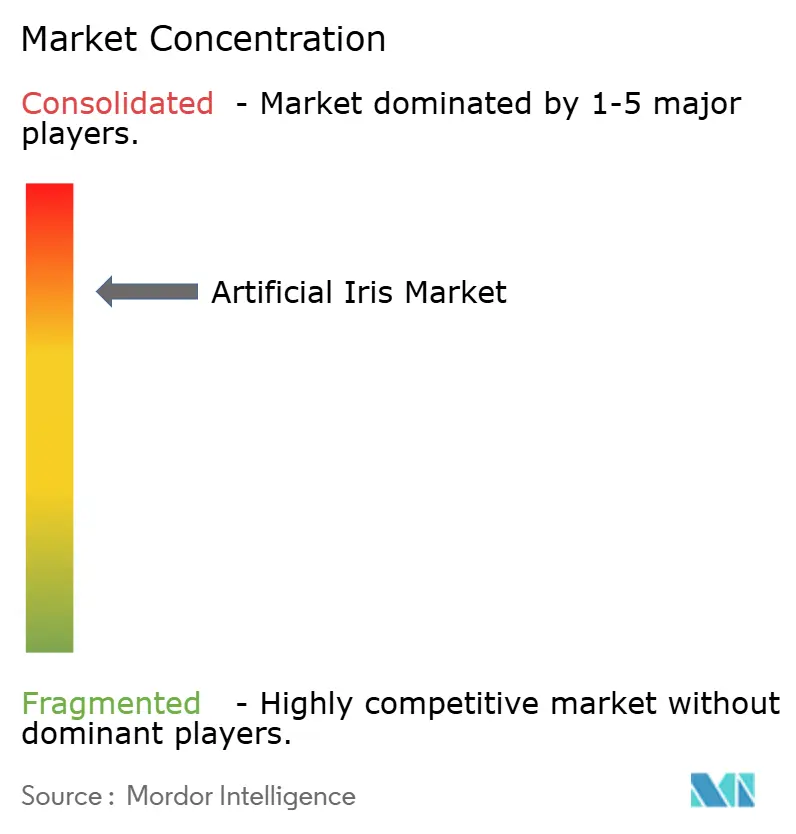
The artificial iris market is highly concentrated, with HumanOptics Holding AG holding the strongest regulatory position. The company has FDA and CE-mark access for its ARTIFICIALIRIS platform and maintained Medical Device Regulation certification in 2025. More than 7,500 patients have received HumanOptics ARTIFICIALIRIS implants worldwide. Building comparable regulatory approval, clinical evidence, and specialist support requires substantial time and investment. A new entrant must also demonstrate product performance in complex eyes and provide training that gives surgeons confidence in device selection and implantation. Reimbursement evidence and surgeon training also reinforce the position of suppliers with established clinical support.
Morcher GmbH serves a distinct need with its black diaphragm intraocular lens for combined iris and lens replacement in aphakic patients. An 11-year outcomes series published in 2024 reported long-term stability for the Morcher scleral-sutured aniridia intraocular lens. REPER-NN LTD addresses a more price-sensitive segment in Eastern Europe and the Middle East with its acrylic iris-intraocular lens hybrid, and its 2026 patient series reported improved corrected distance visual acuity in 87% of 15 aphakic-aniridia patients. These suppliers address different clinical configurations, but HumanOptics remains the reference supplier in the artificial iris market for custom, foldable devices. The presence of alternative iris-lens designs broadens the clinical options for aphakic patients without removing the need for customized reconstruction in other cases.
Rapid-access stock products remain an opportunity for trauma centers that cannot wait 4 to 8 weeks for custom manufacturing, while pediatric-focused designs remain limited for patients below the current 6-year threshold. These gaps affect the timing of care because trauma and pediatric cases may require a device pathway that fits a more urgent clinical decision. South and Southeast Asia have limited dedicated manufacturer distribution, which creates room for local commercial partnerships. The 2026 launch of ARTIFICIALIRIS SELECT provides a direct example of a supplier addressing speed of access with a stocked option. A 2025 study evaluated an augmented-reality surgical headset integrated with intraoperative optical coherence tomography for ophthalmic surgery, and compatibility with surgical guidance systems could become a product consideration in complex anterior-segment procedures.
Artificial Iris Industry Leaders
HumanOptics Holding AG
REPER-NN LTD
Morcher GmbH
Ophtec BV
- *Disclaimer: Major Players sorted in no particular order
Artificial Iris Market Companies Covered in this Report
- HumanOptics Holding AG
- REPER-NN LTD
- Morcher
- Ophtec BV

Recent Industry Developments in Artificial Iris Market
- February 2026: The American Journal of Ophthalmology published a case series that showed how HumanOptics iris implants, used alongside secondary scleral-fixated IOLs, helped manage anatomically complex anterior-segment cases and strengthened the evidence base for multimodal reconstruction procedures.
- October 2025: Colombia marked a significant milestone in its medical history by successfully completing its first artificial iris implant procedure. The surgery took place at Clínica Oftalmológica de Antioquia in Medellín, where a team restored vision in an 80-year-old foreign patient who had lived with severe visual impairment for months.


Global Artificial Iris Market Report Scope
As per the scope of the report, an artificial iris is a synthetic device or implant designed to replicate the function and appearance of a natural iris, the colored part of the eye. It is typically used to improve vision or cosmetic appearance in individuals with iris damage, abnormalities, or conditions such as aniridia.
The artificial iris market is segmented by implant type, including custom artificial iris and preformed or pre-manufactured artificial iris; application, including congenital aniridia, traumatic iris defects, surgical iris defects, cosmetic correction, and other applications; distribution channel, including hospital supply stores, specialty distributors, online sales, and other distribution channels; and geography, including North America, Europe, Asia-Pacific, and Rest of the World. For each segment, the market size and forecast are provided in terms of value (USD).
| Custom Artificial Iris |
| Preformed or Pre-manufactured Artificial Iris |
| Congenital Aniridia |
| Traumatic Iris Defects |
| Surgical Iris Defects |
| Cosmetic Correction |
| Other Applications |
| Hospital Supply Stores |
| Specialty Distributor |
| Online Sales |
| Other Distribution Channels |
| North America | United States |
| Canada | |
| Mexico | |
| Europe | Germany |
| United Kingdom | |
| France | |
| Italy | |
| Spain | |
| Rest of Europe | |
| Asia-Pacific | China |
| Japan | |
| India | |
| Australia | |
| South Korea | |
| Rest of Asia-Pacific | |
| Rest of the World |
| By Implant Type | Custom Artificial Iris | |
| Preformed or Pre-manufactured Artificial Iris | ||
| By Application | Congenital Aniridia | |
| Traumatic Iris Defects | ||
| Surgical Iris Defects | ||
| Cosmetic Correction | ||
| Other Applications | ||
| By Distribution Channel | Hospital Supply Stores | |
| Specialty Distributor | ||
| Online Sales | ||
| Other Distribution Channels | ||
| By Geography | North America | United States |
| Canada | ||
| Mexico | ||
| Europe | Germany | |
| United Kingdom | ||
| France | ||
| Italy | ||
| Spain | ||
| Rest of Europe | ||
| Asia-Pacific | China | |
| Japan | ||
| India | ||
| Australia | ||
| South Korea | ||
| Rest of Asia-Pacific | ||
| Rest of the World | ||


Key Questions Answered in the Report
What is the outlook for artificial iris devices through 2031?
The sector is projected to increase from USD 24.65 million in 2026 to USD 38.71 million by 2031, at a CAGR of 9.45%.
Which implant type leads artificial iris procedures?
Custom artificial iris devices led with 62.31% of revenue in 2025.
Which application is expected to grow fastest?
Cosmetic correction is forecast to grow at a CAGR of 12.22% through 2031.
Which region has the largest share of artificial iris procedures?
North America held 38.61% in 2025, supported by the United States regulatory pathway and specialist ophthalmology infrastructure.
Page last updated on:





