
Argentina Soil Monitoring Market Size and Share
Market Overview
| Study Period | 2021 - 2031 |
|---|---|
| Forecast Data Period | 2026 - 2031 |
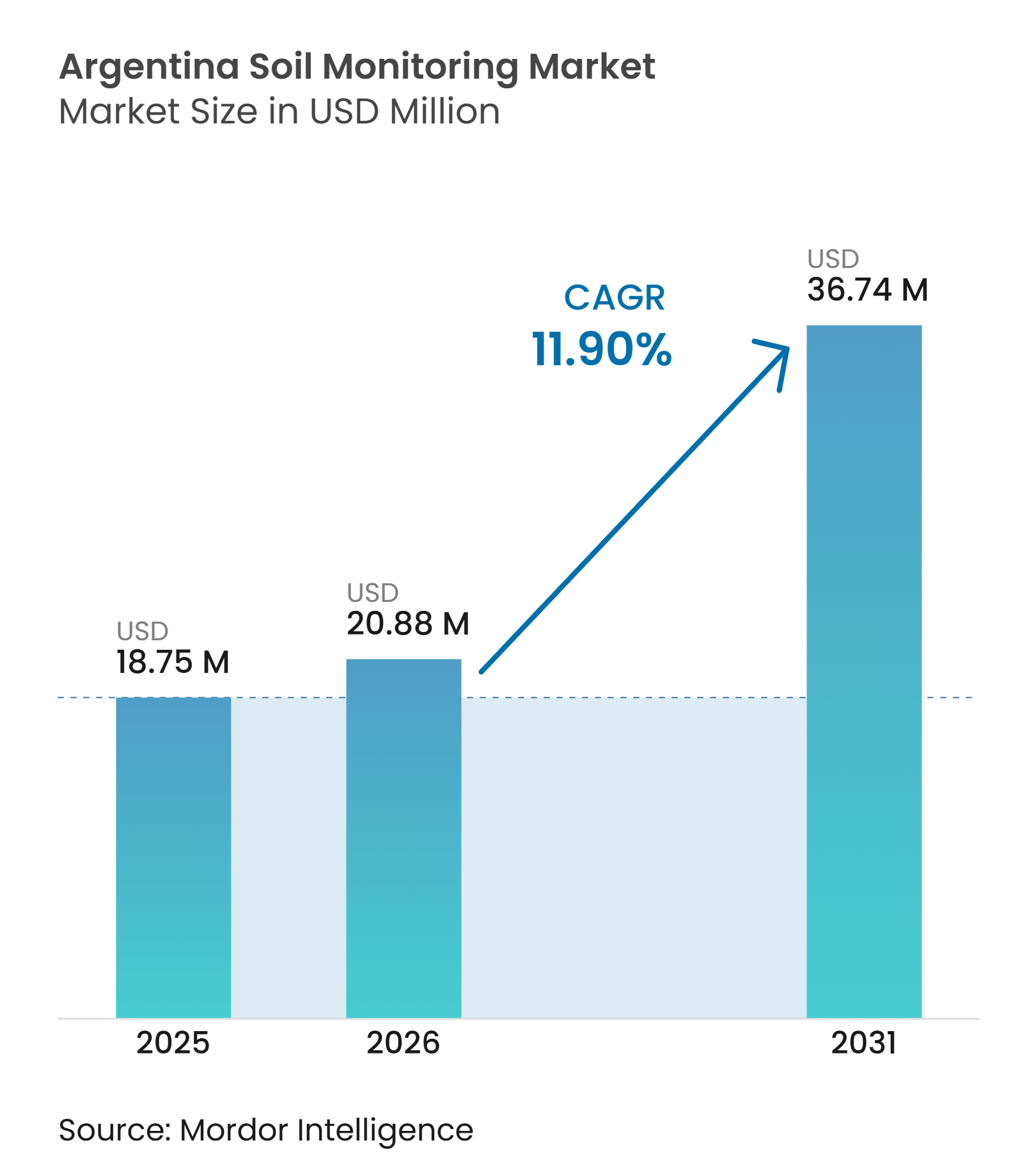
| Base Year Market Size (2025) | USD 18.75 Million |
| Market Size (2026) | USD 20.88 Million |
| Market Size (2031) | USD 36.74 Million |
| Growth Rate (2026 - 2031) | 11.90 % |
| Market Concentration | Low |
Major Players *Disclaimer: Major Players sorted in no particular order Image © Mordor Intelligence. Reuse requires attribution under CC BY 4.0. | |
Argentina Soil Monitoring Market Analysis by Mordor Intelligence
The Argentina soil monitoring market size was valued at USD 18.75 million in 2025 and is forecast to grow from USD 20.88 million in 2026 to reach USD 36.74 million by 2031, at a CAGR of 11.90% during the forecast period (2026-2031). The market covers hardware, software, services, installation, calibration, and monitoring subscriptions used across the country's distinct agricultural production conditions and farm business models. Agriculture remains important to Argentina's economy, giving farm operators a strong incentive to protect yield and manage inputs carefully. Growth reflects varying needs across broadacre grain farms, irrigated vineyards, and specialty crop systems. Suppliers are moving beyond device sales by linking field measurements with irrigation, fertilizer, and crop management decisions. The commercial opportunity is strongest where reliable local service, calibration, and data interpretation accompany the technology.
Key Report Takeaways
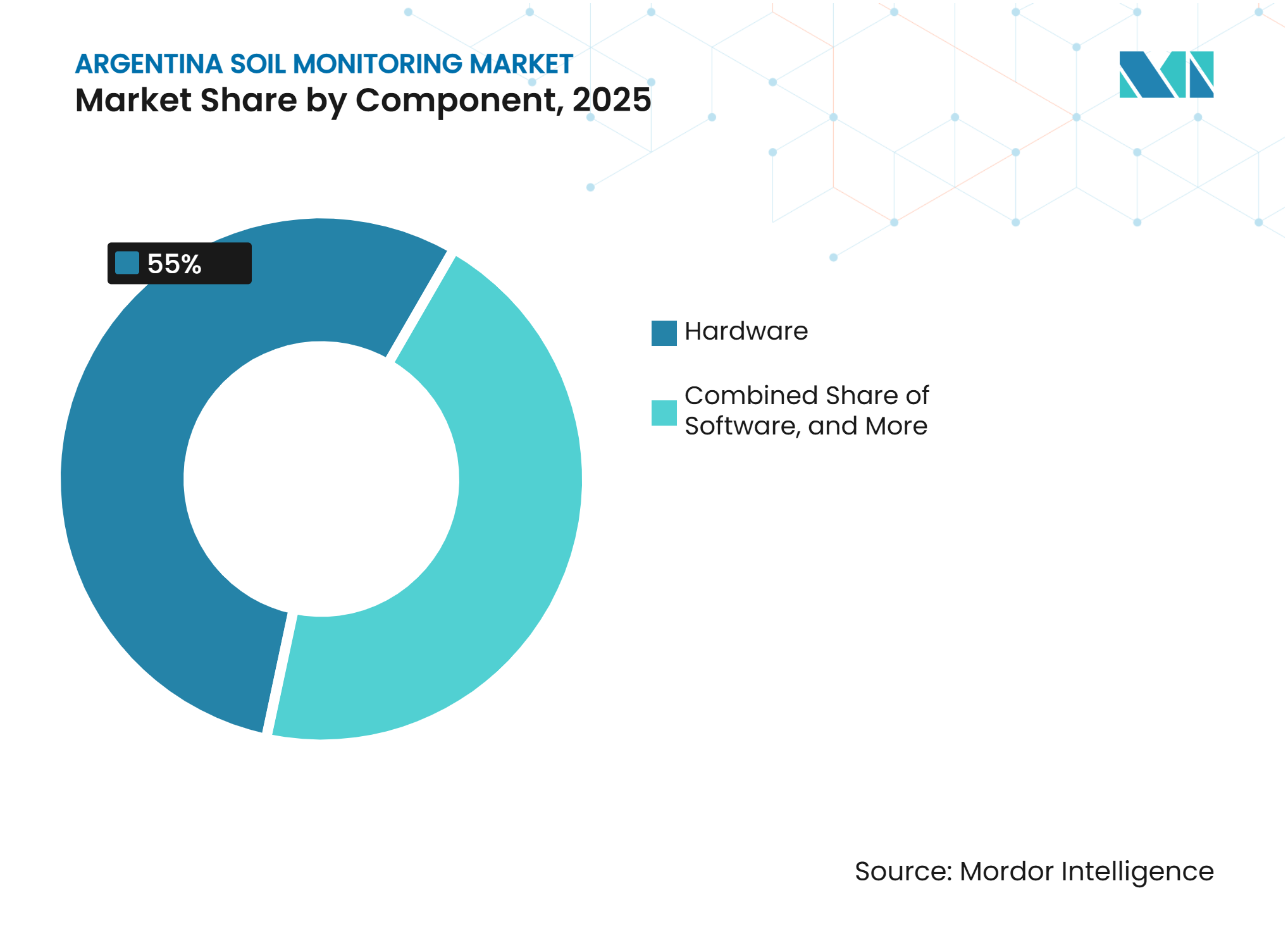
- By component, hardware accounted for a 55% of the Argentina soil monitoring market share in 2025, whereas software is forecast to grow at a CAGR of 15.8% from 2026 to 2031.
- By product type, in-situ sensors accounted for 48% of the Argentina soil monitoring market size in 2025, while remote sensing platforms are forecast to grow at a CAGR of 16.1% from 2026 to 2031.
- By connectivity technology, wireless accounted for a 70% share in 2025 and is forecast to grow at a CAGR of 17.8% from 2026 to 2031.
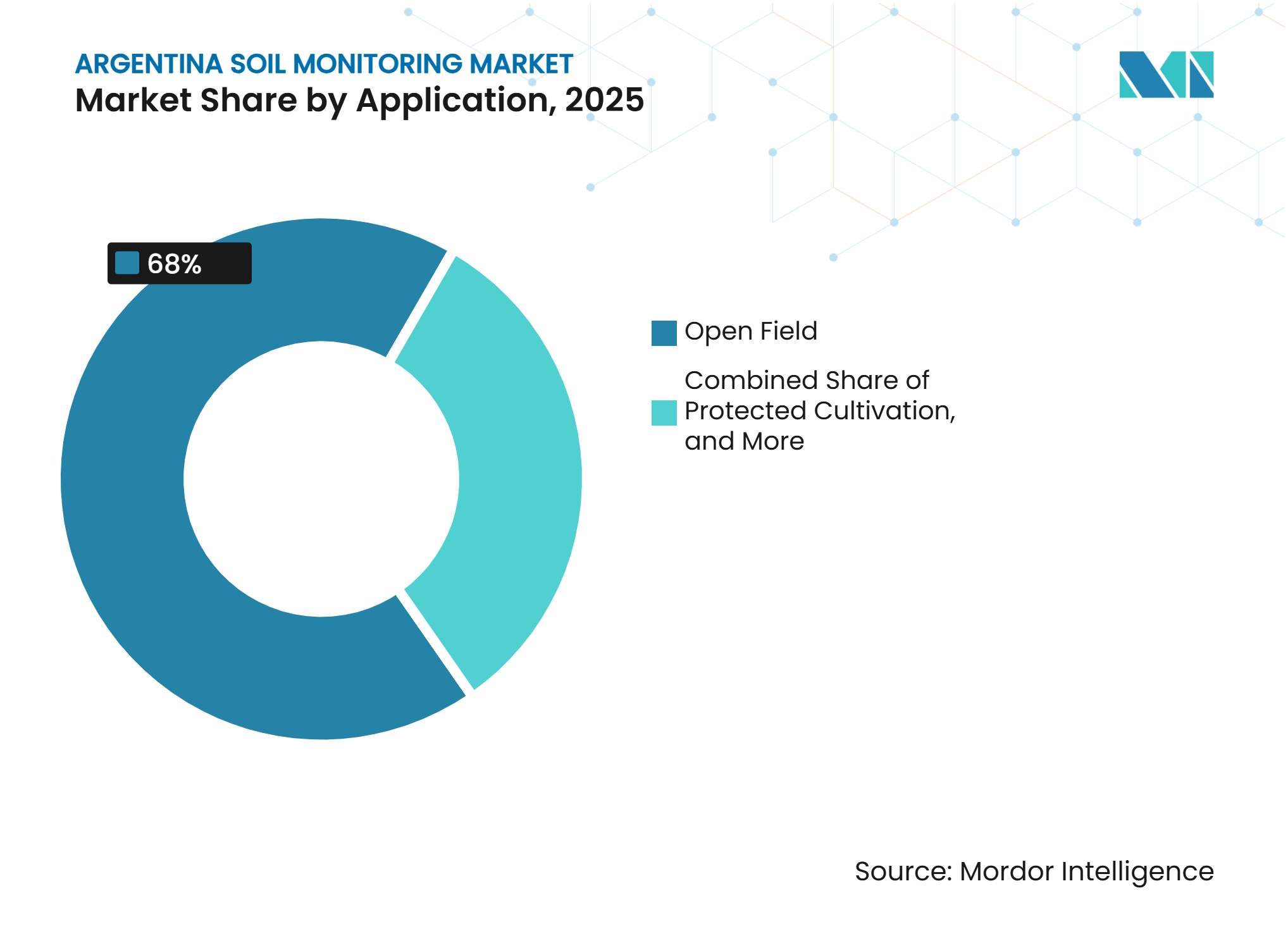
- By application, open-field applications accounted for a 68% share in 2025, while protected cultivation is forecast to grow at a CAGR of 13.2% from 2026 to 2031.
- By end user, large commercial farms accounted for a 54% share in 2025, while research institutes and universities are forecast to grow at a CAGR of 13.6% from 2026 to 2031.
Note: Market size and forecast figures in this report are generated using Mordor Intelligence’s proprietary estimation framework, updated with the latest available data and insights as of January 2026.
Market Trends and Insights
Drivers Impact Analysis of Argentina Soil Monitoring Market*
| Driver | (~) % Impact on CAGR Forecast | Geographic Relevance | Impact Timeline |
|---|---|---|---|
| Precision Irrigation and Water-Use Optimization | +2.5% | Argentina-wide, with greatest intensity in Cuyo, Mendoza, and irrigated Pampas areas | Medium term (2-4 years) |
| Nutrient Depletion and Variable-Rate Input Management | +1.8% | Buenos Aires, Córdoba, and Santa Fe | Medium term (2-4 years) |
| Expansion of Connected Farm Management Platforms | +1.6% | National, with early activity in the Rosario AgTech corridor | Long term (≥ 4 years) |
| Pampas Farm Scale and Field-Variability Economics | +1.5% | Buenos Aires, Córdoba, and Entre Ríos | Short term (≤ 2 years) |
| Climate-Volatility Monitoring for Drought and Irregular Rainfall | +2% | Argentina-wide, especially Buenos Aires and Córdoba | Short term (≤ 2 years) |
| Cooperative Procurement and Shared Services Deployment Modes | +0.9% | Buenos Aires, Santa Fe, and Entre Ríos | Medium term (2-4 years) |
| Source: Mordor Intelligence | |||
Precision Irrigation and Water-Use Optimization
Soil moisture and water-potential sensors are becoming part of irrigation management in Argentina. These tools help farms adjust irrigation by field and management zone instead of relying on fixed schedules. CropX reported that sensor-managed fields used 3.2 acre-feet of water versus 5.0 acre-feet under traditional management, while net profit increased by USD 43 per acre [1]. The World Bank’s GIRSAR program supports water infrastructure investments, including sensor-based gate controls in the Río Negro Valley and southern Córdoba [2]. Vineyard operators in Mendoza also require dependable moisture and electrical conductivity data to support drip irrigation and fruit quality. These conditions support demand for systems that connect soil readings with daily water decisions in the Argentina soil monitoring market.
Nutrient Depletion and Variable-Rate Input Management
Continuous soybean and corn production has increased attention on phosphorus and sulfur management across the Pampas. Soil monitoring can reveal field variation that periodic testing may not capture in time for operational decisions. The Argentina soil monitoring market benefits when farms use measurements to direct fertilizer spending toward areas with the greatest need. Instituto Nacional de Tecnología Agropecuaria (INTA) demonstrated the use of electrical conductivity sensors to characterize productive environments and support management-zone decisions. That field-level approach makes sensor data more useful when combined with agronomy support and machinery capable of variable-rate application. It also gives providers a role in both the measurement process and the practical use of results.
Expansion of Connected Farm Management Platforms
Connected farm platforms bring soil information together with weather, machinery, and satellite data. The resulting workflow makes the sensor one input within a broader farm management system. The Argentina soil monitoring market is supported by platforms that turn continuous readings into irrigation alerts, field maps, and management records. LoRaWAN is used in smart agriculture because it can connect low-power devices over long distances, including through satellite-backed extensions in remote areas [3]. This model can reduce the practical difficulty of managing several separate data systems on a single farm. It may also strengthen customer retention when the platform becomes part of recurring farm decisions.
Pampas Farm Scale and Field-Variability Economics
Commercial farms often operate fields large enough to justify sensor nodes, gateways, and recurring analytics subscriptions. The Argentina soil monitoring market, therefore, has a clear early-adopter base among broadacre operators. INTA has documented how electrical conductivity sensing can identify soil texture contrasts and support more specific management of productive environments. These differences can affect seeding, irrigation, and fertilizer choices across a single farm. Large operators can capture more value from those decisions when service providers support installation and calibration across extensive acreage.
Restraints Impact Analysis of Argentina Soil Monitoring Market*
| Restraint | (~) % Impact on CAGR Forecast | Geographic Relevance | Impact Timeline |
|---|---|---|---|
| Foreign-Exchange Controls and Import Lead Times | -1.8% | National, with the greatest effect on Buenos Aires hardware importers | Short term (≤ 2 years) |
| Rural Connectivity Gaps and Power Availability | -1.3% | Patagonia, Northern Agricultural Region, and remote Pampas areas | Medium term (2-4 years) |
| Calibration Drift in Saline and Heterogeneous Soils | -1% | Cuyo irrigation districts, Pampas Deprimida, and Santiago del Estero | Long term (≥ 4 years) |
| Uncertain Payback for Small Farms and Low-Value Crops | -0.9% | Northern Argentina, Patagonia, and marginal dryland Pampas areas | Long term (≥ 4 years) |
| Source: Mordor Intelligence | |||
Foreign-Exchange Controls and Import Lead Times
Most sensor hardware used in Argentina is imported, exposing the Argentina soil monitoring market to exchange-rate fluctuations and import procedures. Argentina removed payment timelines and capital controls in April 2025, reducing some transaction friction for importers. However, equipment distributors still manage currency exposure when carrying inventory and pricing multi-year service agreements. This can increase the final cost of devices, replacement parts, and installation, and may make farms hesitant to commit to systems when the expected payback period is unclear. Providers with local stock, predictable servicing, and transparent payment terms are better positioned to manage this constraint.
Rural Connectivity Gaps and Power Availability
Remote agricultural areas do not always have dependable cellular coverage, power, or fiber connections. These gaps are most relevant in Patagonia, Northern Argentina, and distant Pampas locations. The Argentina soil monitoring market depends on communications systems capable of operating under these conditions. LoRaWAN and satellite extensions can support remote smart agriculture deployments without continuous terrestrial coverage. However, solar-powered nodes, satellite links, and local data storage can increase initial installation costs. Wider adoption will require reliable solutions that reduce field maintenance requirements and function across mixed-connectivity environments.
*Our forecasts treat driver/restraint impacts as directional, not additive. The impact forecasts reflect baseline growth, mix effects, and variable interactions.
Argentina Soil Monitoring Market Segment Analysis
By Component:
Hardware Leads While Software Records the Fastest GrowthHardware accounted for 55% of the Argentina soil monitoring market size in 2025. This position reflects initial investment in sensor nodes, gateways, data loggers, and field connectivity equipment. Hardware remains necessary as it produces the readings used by farm managers and advisers. Installation, calibration, and maintenance services are also important within an import-led supply model, helping distributors maintain direct customer relationships after the original equipment sale.
Software is forecast to grow at a 15.8% CAGR from 2026 to 2031, the fastest rate in this segment. Cloud platforms can convert field readings into alerts, records, and variable-rate recommendations, supporting recurring subscriptions rather than one-time license sales. The Argentina soil monitoring market is likely to favor providers that combine reliable devices with usable software and practical agronomy support. Vendors without analytics offerings may face greater pressure as data platforms become more central to farm operations.



By Product Type:
In-Situ Sensors Lead While Remote Sensing Platforms Record the Fastest GrowthIn-situ sensors accounted for 48% share in the Argentina soil monitoring market in 2025. This position reflects demand for continuous measurements of root-zone moisture, temperature, and electrical conductivity. These devices are useful where farms require direct readings from multiple soil depths. Time-domain reflectometry probes remain relevant for water-content measurement, while capacitance devices support multi-depth profiling at a commercial farm scale. Portable probes and test kits also support technicians assessing fields before a permanent system is installed.
Remote sensing platforms are forecast to grow at a 16.1% CAGR from 2026 to 2031. Satellite and unmanned aerial vehicle data can extend visibility across fields where dense ground-sensor coverage is not practical. This approach works best when remote observations are verified against ground-level readings. The Argentina soil monitoring market can use these data layers as complementary sources rather than as a replacement for in-situ networks. Cooperative and field-service programs can use portable equipment to build familiarity before proposing a fixed monitoring contract.
By Connectivity Technology:
Wireless Leads and Records the Fastest GrowthWireless accounted for 70% of the Argentina soil monitoring market share in 2025. This category includes LPWAN, cellular, and satellite connections. Its dominant position reflects the cost and operational difficulty of installing wired networks across large, dispersed agricultural fields. Wireless systems can connect sensor nodes and gateways while reducing cable-related maintenance. The LoRa Alliance identified LoRaWAN as a smart agriculture connectivity option, including for satellite-backed coverage in remote fields.
Wireless is also forecast to grow at a 17.8% CAGR from 2026 to 2031, reflecting the need for data transfer where wired deployment is not economically viable. Soil CRC selected Sentek Technologies as a commercialization partner for the BILBY below-ground transmission unit in May 2026. The unit is designed to send probe data to above-ground receivers without surface wires. Wired systems retain a role in protected cultivation and research stations where installation conditions are controlled and precision requirements are high.
By Application:
Open Field Leads While Protected Cultivation Records the Fastest GrowthOpen field applications accounted for 68% of the Argentina soil monitoring market size in 2025. Broadacre grain and oilseed production gives this application the largest base of monitored hectares. A large Pampas farm can generate substantial demand for sensors even where spending per hectare is modest. Soil variability across these farms supports measurement at multiple field locations. Forestry represents a smaller but stable application in plantation areas where moisture management supports eucalyptus and pine production.
Protected cultivation is forecast to grow at a 13.2% CAGR from 2026 to 2031. Greenhouse and tunnel systems require more intensive measurement of water and nutrient conditions than most open fields. Northern horticultural zones and Mendoza specialty production provide relevant use cases. The Argentina soil monitoring market can generate higher revenue per hectare in these settings due to greater sensor density and service requirements. Documented soil and nutrient management can also support export-oriented fresh-produce operations.

By End User:
Large Commercial Farms Lead While Research Institutes and Universities Record the Fastest GrowthLarge commercial farms accounted for 54% of Argentina soil monitoring market share in 2025. Their scale can justify investment in multi-parameter systems and ongoing analytics services. These operations often have sufficient spatial variation to benefit from management-zone decisions and are well positioned to work with distributors that provide installation, calibration, and maintenance. This makes large farms an important initial customer group for the Argentina soil monitoring market.
Research institutes and universities are forecast to grow at a 13.6% CAGR from 2026 to 2031. Their demand is linked to sensor-equipped field plots, monitoring networks, and data-sharing work with commercial platforms. Smallholder and cooperative farms may also gain access through shared procurement and advisory support. Government bodies and development programs can generate additional demand through demonstration and extension installations.
Geography Analysis
The Pampas is the largest demand center for the Argentina soil monitoring market. Its broadacre production across Buenos Aires, Córdoba, Santa Fe, Entre Ríos, and La Pampa supports the greatest concentration of large commercial farms. These farms can deploy systems over extensive fields and use the data in fertilizer, seeding, and irrigation decisions. Scientific research published in the Agronomy Journal in 2025 linked soil-moisture conditions in the Argentine Pampas more closely to maize yields than precipitation-only measures. This strengthens the case for continuous soil measurements in the region.
Mendoza and the wider Cuyo corridor have high monitoring intensity per hectare because vineyards and irrigated horticulture require close water management. The World Bank reported sensor-based gate control modernization in Río Negro and related water investments in southern Córdoba during 2026. Irrigated operators need information that can improve timing and support water-use decisions. The region also has local agronomy and service capabilities that can make ongoing calibration more practical. Export-linked quality requirements give operators an additional reason to document growing conditions.
Northern Argentina includes specialty crops such as citrus, tobacco, sugar cane, tropical fruit, and protected horticulture. The area has lower penetration than the Pampas because farms are smaller and connectivity conditions can be more difficult. Diverse crops also require application-specific calibration and advisory support. The Argentina soil monitoring market has room to grow as export-oriented growers need documented soil-management practices, although adoption depends on affordable service and dependable communications.
Competitive Landscape
Market Concentration
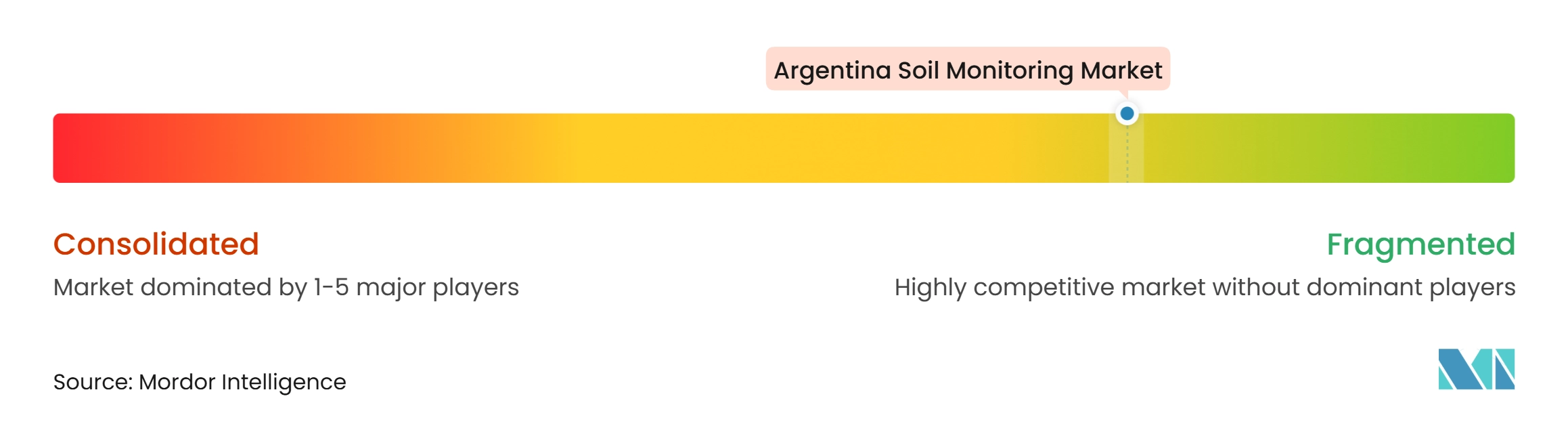
The Argentina soil monitoring market is fragmented, with established international players and local providers competing across sensor technology, software capabilities, distribution networks, and field support. METER Group, Pessl Instruments, Sentek Technologies, Stevens Water Monitoring Systems, and Spectrum Technologies are among the key companies operating in the market. Local integrators, additional vendors, and other local suppliers and distributors also contribute to the competitive landscape. This structure makes distributor relationships, field service, and calibration capability important competitive factors.
International brands commonly use local distributors because import requirements, currency exposure, and field support create a need for local commercial relationships. Some suppliers bundle hardware with calibration and maintenance services to protect customer relationships after installation. Other suppliers focus on software platforms that combine device readings with weather, machinery, and satellite information. METER Group released the SOLYX 14 in February 2026, positioning the product for more consistent volumetric water-content measurements across different soil types. CropX launched its Apex multi-depth soil sensor in April 2026 for continuous water-content, temperature, and salinity measurements within its digital agronomy platform.
Affordable modular systems for farms with 100 to 500 hectares remain an important commercial opportunity. These farms often need a clearly defined service package that covers sensing, connectivity, analytics, and advisory support. Local providers with soil-specific calibration expertise can compete where standard factory settings do not match saline or variable Argentine soils. Satellite analytics can also complement ground networks where permanent sensor installation is difficult.
Argentina Soil Monitoring Industry Leaders
-
METER Group, Inc.
-
Pessl Instruments GmbH
-
Sentek Technologies
-
Stevens Water Monitoring Systems, Inc.
-
Spectrum Technologies, Inc. (Transcat, Inc.)
- *Disclaimer: Major Players sorted in no particular order
Argentina Soil Monitoring Market Companies Covered in this Report
- METER Group, Inc.
- Pessl Instruments GmbH
- Sentek Technologies
- Stevens Water Monitoring Systems, Inc.
- Spectrum Technologies, Inc. (Transcat, Inc.)
- Irrometer Company, Inc.
- Acclima, Inc.
- Delta-T Devices Ltd.
- Campbell Scientific, Inc.
- CropX Inc.
- Soil Scout Oy
- EOS Data Analytics
- Championsys
- VEGGA
- Plantae
Recent Industry Developments in Argentina Soil Monitoring Market
- May 2026: Sentek Technologies partnered with the Soil CRC to commercialize BILBY®, a below-ground wireless data transmission unit that transmits soil moisture sensor data from buried probes to above-ground receivers over distances of up to 1,000 meters. The technology eliminates the need for surface wiring and enables permanent soil monitoring in agricultural applications.
- April 2026: CropX Technologies launched the Apex multi-depth soil sensor, providing continuous volumetric water content, temperature, and salinity measurements at 4-inch intervals across 12", 24", and 36" configurations, integrated with the CropX digital agronomy platform for automated irrigation and fertility analytics.
- February 2026: METER Group released the SOLYX 14 soil moisture sensor with CDX technology, delivering consistent volumetric water content across a wider range of soil types with reduced sensitivity to salinity and temperature variation, directly addressing the calibration-drift limitation that has historically constrained sensor trust in Argentina's saline and heterogeneous soil environments.
Argentina Soil Monitoring Market Report Scope
Soil monitoring refers to the use of technologies and solutions to measure and analyze soil parameters, including moisture, temperature, pH, salinity, and nutrient levels, to support informed agricultural and land management decisions.
The Argentina Soil Monitoring Market is Segmented by Component (Hardware, Software, and Services), by Product Type (In-Situ Sensors, Remote Sensing Platforms, and Portable Probes and Test Kits), by Connectivity (Wired and Wireless), by Application (Open Field, Protected Cultivation, and Forestry), and by End User (Large Commercial Farms, Smallholder and Cooperative Farms, Research Institutes and Universities, and Government and NGOs). The Market Forecasts are Provided in Terms of Value (USD).
Segmentation Overview
| Hardware |
| Software |
| Services |
| In-Situ Sensors |
| Remote Sensing Platforms |
| Portable Probes and Test Kits |
| Wired |
| Wireless (LPWAN, Cellular, Satellite) |
| Open Field |
| Protected Cultivation |
| Forestry |
| Large Commercial Farms |
| Smallholder and Cooperative Farms |
| Research Institutes and Universities |
| Government and NGOs |
| By Component | Hardware |
| Software | |
| Services | |
| By Product Type | In-Situ Sensors |
| Remote Sensing Platforms | |
| Portable Probes and Test Kits | |
| By Connectivity Technology | Wired |
| Wireless (LPWAN, Cellular, Satellite) | |
| By Application | Open Field |
| Protected Cultivation | |
| Forestry | |
| By End User | Large Commercial Farms |
| Smallholder and Cooperative Farms | |
| Research Institutes and Universities | |
| Government and NGOs |
Key Questions Answered in the Report
What is the Argentina soil monitoring market size?
The Argentina soil monitoring market size was valued at USD 18.75 million in 2025 and is forecast to grow from USD 20.88 million in 2026 to reach USD 36.74 million by 2031, at a CAGR of 11.90% during the forecast period (2026-2031).
Which component is growing fastest in Argentina?
Software is forecast to grow at a 15.8% CAGR from 2026 to 2031 as farms adopt data platforms and recurring analytics subscriptions.
Why does wireless connectivity lead soil monitoring deployments?
Wireless accounted for 70% of the share in 2025 because it is better suited to Argentina’s large and dispersed agricultural fields.
Which application has the largest deployment base?
Open field applications accounted for 68% of revenue in 2025, supported by broadacre grain and oilseed production.
What limits adoption among smaller farms?
Upfront system cost, unclear payback, limited connectivity, and the need for advisory support can delay adoption.