
Aluminum Slugs Market Size and Share
Market Overview
| Study Period | 2022 - 2032 |
|---|---|
| Market Size (2027) | USD 4.84 Billion |
| Market Size (2032) | USD 6.41 Billion |
| Growth Rate (2027 - 2032) | 5.78 % |
| Fastest Growing Market | Asia-Pacific |
| Largest Market | Asia-Pacific |
| Market Concentration | Low |
Major Players *Disclaimer: Major Players sorted in no particular order Image © Mordor Intelligence. Reuse requires attribution under CC BY 4.0. | |
Aluminum Slugs Market Analysis by Mordor Intelligence
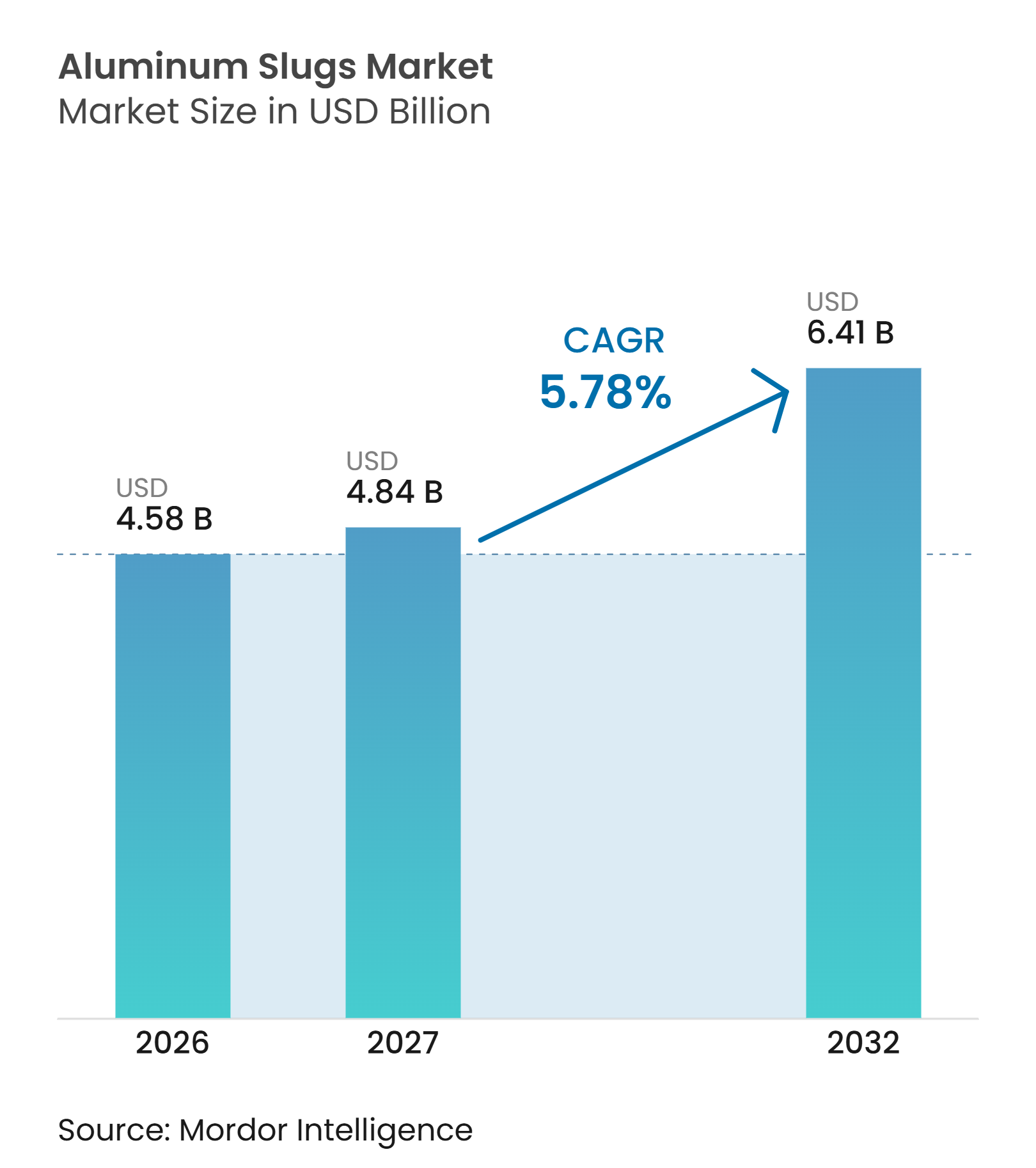
The aluminum slugs market size was valued at USD 4.58 billion in 2026 and is estimated to grow from USD 4.84 billion in 2027 to USD 6.41 billion by 2032, at a CAGR of 5.78% during the forecast period (2027-2032). The aluminum slugs market is influenced by demand for recyclable metal packaging and converters’ requirements for reliable extrusion blanks. The European Union Packaging and Packaging Waste Regulation requires that packaging placed on the EU market be recyclable and sets targets for aluminum recycling, thereby supporting the use of aluminum formats in procurement decisions. Extended producer responsibility requirements increase the costs of packaging options that are difficult to recycle, thereby favoring materials with established recovery systems. Producers use recycled feedstock, expand surface-treatment capabilities, and develop technical alloys. Capacity closures in Europe increase the importance of reliable supply. The aluminum slugs market depends on the balance between packaging demand, adoption of technical components, energy costs, and manufacturers’ ability to meet stringent quality specifications.
Key Report Takeaways
- By shape, Round held 49.34% of the aluminum slugs market share in 2026, while Rectangular is forecast to expand at a 6.54% CAGR through 2032.
- By application, Aerosols accounted for 31.67% of the aluminum slugs market share in 2026 and are projected to grow at a 7.13% CAGR through 2032.
- By end-user industry, Food and Beverages held 29.45% of the aluminum slugs market share in 2026, while Automotive is forecast to expand at a CAGR of 7.39% through 2032.
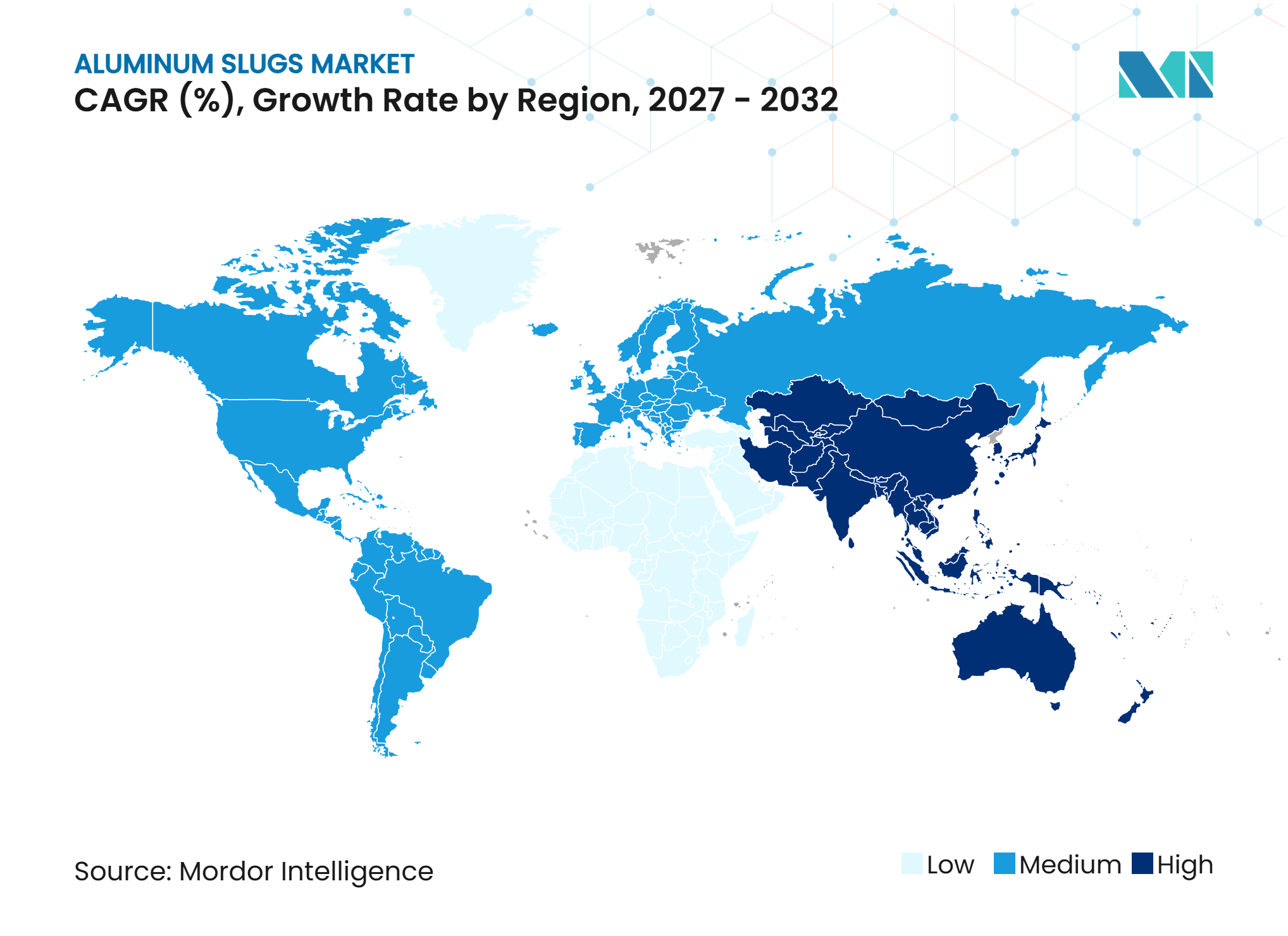
- By geography, Asia-Pacific accounted for 44.23% of the aluminum slugs market share in 2026 and is forecast to advance at a 7.21% CAGR through 2032.
Note: Market numbers in this report are based on Mordor Intelligence's proprietary estimation framework, which combines nine months of actuals with Q4 projections for base year 2026.
Market Trends and Insights
Drivers Impact Analysis of Aluminum Slugs Market*
| Drivers | (~) % Impact on CAGR Forecast | Geographic Relevance | Impact Timeline |
|---|---|---|---|
| Rising Demand for Recyclable and Lightweight Metal Packaging | +1.4% | Global | Medium term (2-4 years) |
| Growth in Pharmaceutical and Personal-Care Barrier Packaging | +1.0% | Europe, APAC, North America | Medium term (2-4 years) |
| Expansion of Technical Slugs for Automotive, Electrical and Battery Components | +1.2% | APAC, Europe, North America | Long term (≥ 4 years) |
| Increasing Use of Recycled and Low-Carbon Aluminum Feedstock | +0.8% | EU, Japan, APAC core | Medium term (2-4 years) |
| Customer-Specific Surface Treatments and Alloy Development | +0.6% | EU, North America | Long term (≥ 4 years) |
| Source: Mordor Intelligence | |||
Rising Demand for Recyclable and Lightweight Metal Packaging
EU Regulation 2025/40 took effect on February 11, 2025, and its general application began on August 12, 2026. The regulation requires packaging placed on the EU market to be recyclable and sets aluminum recycling targets of 50% by the end of 2025 and 60% by 2030. These requirements establish recyclability as a product-design criterion rather than a voluntary packaging feature. Aluminum slug formats support brands shifting away from packaging structures that are difficult to recycle. The aluminum slugs market also gains support because regulations allow producer responsibility fees to be adjusted based on recycled content. Metal Packaging Europe’s guidance identifies aluminum packaging as compatible with established recycling routes, supporting material selection by converters.
Growth in Pharmaceutical and Personal-Care Barrier Packaging
Pharmaceutical metered-dose inhalers and nasal spray systems use aluminum monobloc canisters because these applications require sterility, dimensional consistency, and propellant compatibility. The transition from hydrofluoroalkane (HFA) propellants with higher global warming potential to hydrofluoroolefin (HFO) systems requires manufacturers to qualify new can specifications for the intended application. This requirement supports demand for consistent aluminum extrusion inputs in the aluminum slugs market. India’s aluminum aerosol shipments reached an estimated 650 million units in 2024, supported by deodorants, hair sprays, and pharmaceutical inhalers. The same assessment reported that thinner-walled impact-extruded cans reduced metal input per unit by 15%, enabling converters to improve material efficiency. Pharmaceutical-grade orders also require stricter controls on cleanliness, dimensions, and documentation than general personal care requirements do.
Expansion of Technical Slugs for Automotive, Electrical and Battery Components
Vehicle electrification is expanding the use of aluminum slugs beyond packaging applications into engineered components. Battery housings, motor shells, thermal-management plates, and charging-system components can use specialized 3003- and 6061-alloy blanks. These products require traceable alloy chemistry, tight dimensional tolerances, and clean surfaces, making supplier qualification more demanding. Hindalco commissioned its Chakan EV component facility in April 2025, with an investment of INR 500 crore (USD 60 million) and capacity to produce 80,000 battery enclosures annually. The facility has a planned expansion path to 160,000 units and supplied 10,000 enclosures to Mahindra[1]. This investment expands the aluminum slugs market beyond conventional packaging demand.
Increasing Use of Recycled and Low-Carbon Aluminum Feedstock
According to Novelis, recycled aluminum requires 95% less energy than primary aluminum production. This difference affects purchasing decisions as energy costs and carbon requirements influence procurement in Europe and other developed manufacturing regions. Novelis reported an average recycled content of 63% across its flat-rolled products in fiscal 2025 and set a recycled-content target of 75% by 2030. The company also reported a 10% reduction in carbon dioxide equivalent (CO₂e) intensity during the year. The aluminum slugs market can benefit from a deeper secondary aluminum supply base, which reduces exposure to fluctuations in primary ingot prices. Aluminum Stewardship Initiative certification also supports market access for suppliers serving regulated and brand-sensitive applications.
Restraints Impact Analysis of Aluminum Slugs Market*
| Restraints | (~) % Impact on CAGR Forecast | Geographic Relevance | Impact Timeline |
|---|---|---|---|
| Aluminum Price and Energy-Cost Volatility | -1.2% | Europe, North America, Global | Short term (≤ 2 years) |
| Capital Intensity of Strip-Casting, Rolling and Punching Lines | -0.9% | Global, early gains in emerging markets | Long term (≥ 4 years) |
| Qualification Risk from Alloy, Surface and Cleanliness Specifications | -0.7% | EU, Japan, South Korea, North America | Medium term (2-4 years) |
| Source: Mordor Intelligence | |||
Aluminum Price and Energy-Cost Volatility
Aluminum and energy costs can fluctuate rapidly when disruptions affect bauxite, alumina, or power supplies. This volatility challenges slug producers operating under annual supply agreements with fixed conversion margins. A USD 200-300 per tonne price movement within a quarter can materially affect operating profit when hedging remains incomplete. Impol reported a 7% increase in aluminum prices in 2024 and cited weaker downstream demand and margin pressure in its 2025 annual report[2]. The company also reported production below plan and average prices nearly 20% lower than in the comparable prior-year period during early 2025. Energy-intensive operations remain particularly exposed in Europe, where power costs affect the competitiveness of every stage of production, from casting to annealing.
Capital Intensity of Strip-Casting, Rolling and Punching Lines
A fully integrated production line comprising strip casting, cold rolling, precision punching, annealing, and surface treatment requires an investment of EUR 30 million to EUR 80 million to achieve meaningful scale. These investments involve long payback periods and require confidence in stable demand over 8-12 years. High capital requirements restrict the number of new suppliers entering the aluminum slugs market. TALUM is investing EUR 40 million to increase its capacity to 80,000 tons by 2027, underscoring the scale of investment required for a major expansion. This investment also highlights the challenges of rapidly adding reliable capacity for specialty grades. New facilities may require two to three years to qualify customers, making short-term supply shortages difficult to address.
*Our forecasts treat driver/restraint impacts as directional, not additive. The impact forecasts reflect baseline growth, mix effects, and variable interactions.
Aluminum Slugs Market Segment Analysis
By Shape:
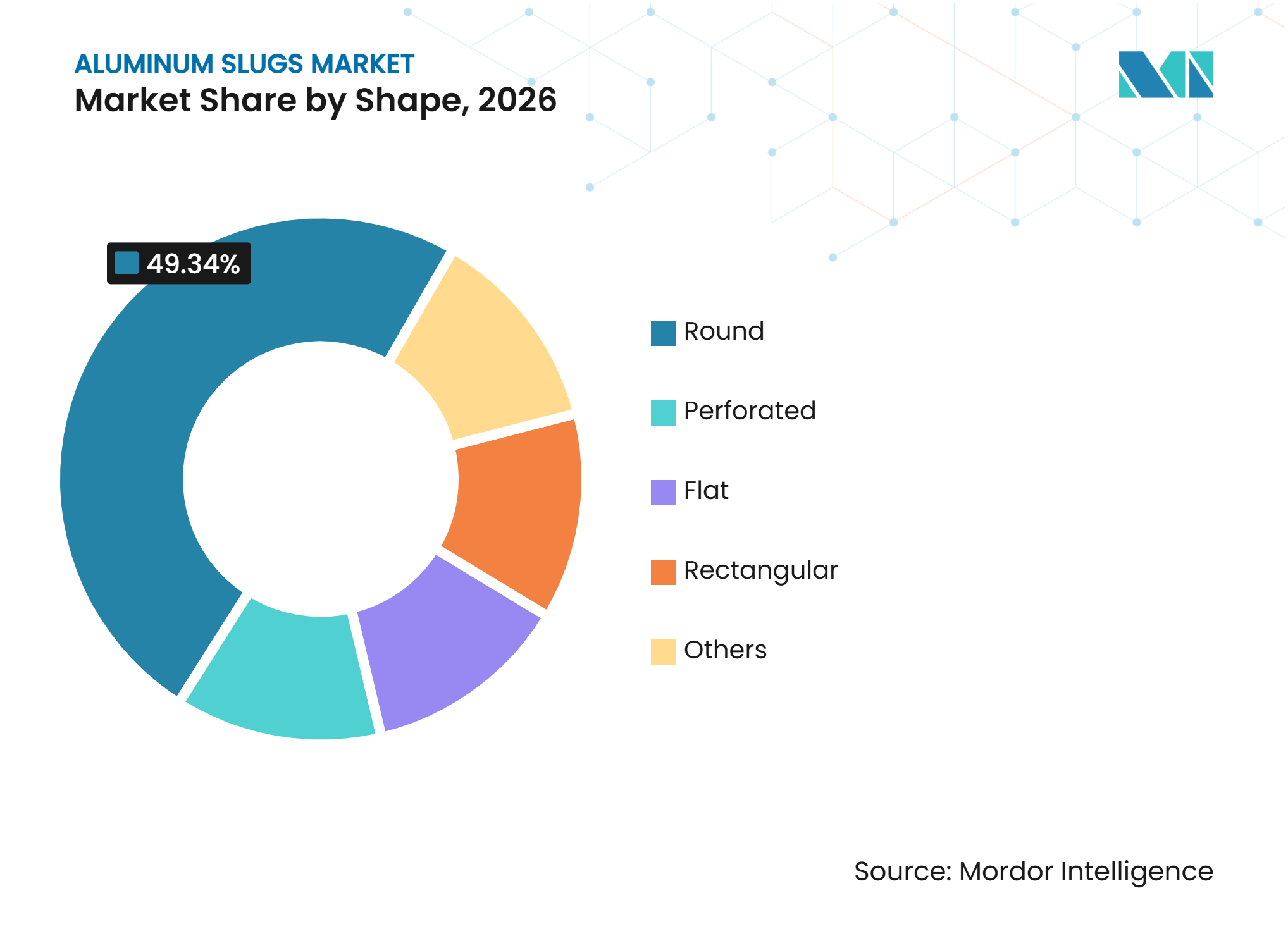
Round Slugs Support Large-Scale Packaging ProductionRound slugs accounted for 49.34% of the aluminum slug market in 2026. Their position reflects their widespread use in collapsible tubes and monobloc aerosol containers, which remain key products manufactured through impact extrusion. Round blanks are compatible with a broad range of presses and reduce tooling changeovers on continuous production lines. Alucon produced 41,306 tons of slugs at its Sriracha facility in 2025 for aerosol and tube applications. This production model favors standardized shapes that can serve multiple converter programs. Consequently, round products support the aluminum slugs industry's large-scale packaging base.
Rectangular slugs are forecast to grow at a CAGR of 6.54% through 2032. Their applications include electrical condenser housings, automotive sensor covers, and thermal-management components, in which functional requirements determine component geometry. Flat slugs are used in select aerosol closure systems that require stringent thickness control. Perforated slugs are used in tube manufacturing applications in which the blank forms an internal cavity. Other shapes include oval, domed, and conical formats for cosmetics and specialized industrial applications. This broader range of geometries enables suppliers to address applications with less standardized manufacturing requirements.



By Application:
Aerosols Combine Scale with Fast GrowthAerosols accounted for 31.67% of the aluminum slugs market in 2026 and are forecast to grow at a 7.13% CAGR through 2032. Premiumization in personal care and the increasing use of aluminum canisters in pharmaceutical delivery systems support this growth. Ball Corporation confirmed in its 2025 Form 10-K that it manufactures extruded aluminum aerosol containers and aluminum slugs. The company reported net sales of USD 13.16 billion and recycled aluminum content of 74% across its global beverage packaging operations. This disclosure highlights the operational link between aluminum packaging systems and upstream blank supply. Aerosol demand provides the aluminum slugs market with demand at scale and access to quality-sensitive customer programs.
Collapsible tubes remain relevant for pharmaceutical ointments, dental products, and adhesives. Pharmaceutical tubes require more stringent controls than cosmetic tubes, even when both use 1050 or 1070 alloy. Bottles and monobloc containers serve as alternatives to polyethylene terephthalate (PET) packaging for spirits and prestige beauty products. Technical components represent an emerging application for specialized alloys in automotive and electrical systems. This application mix enables producers to balance long-running packaging programs with smaller, higher-specification orders. This balance is particularly relevant as packaging demand remains steady while technical applications expand more rapidly.
By End-User Industry:
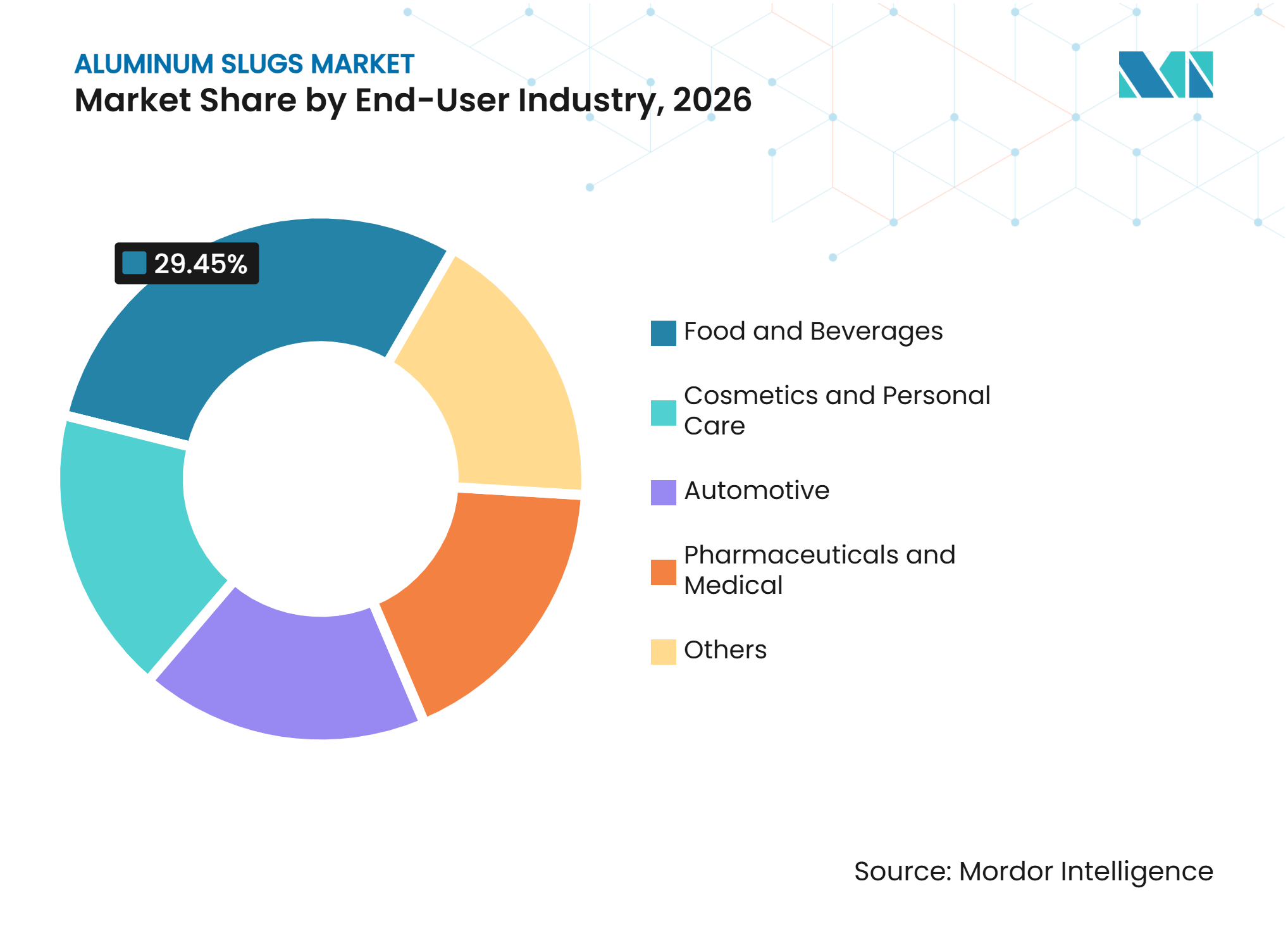
Food and Beverages Lead While Automotive Grows FastestFood and beverages accounted for a 29.45% share of the aluminum slugs market in 2026. The segment uses aluminum in packaging for edible oils, dairy products, infant formula, and food tubes, where protection against oxidation and contamination is required. Aluminum's recyclability also aligns with producer-responsibility and deposit-return systems across EU member states and Asian markets. These policy frameworks encourage the use of packaging materials that can be incorporated into established collection and recycling streams. Food and beverage demand provides the aluminum slugs market with a broad, recurring end-user base while linking material performance to compliance requirements for packaged consumer products.
Automotive applications are forecast to grow at a CAGR of 7.39% through 2032. Electric vehicle (EV) battery housings, motor shells, and thermal-management plates require specialized 3003 and 6061 aluminum products rather than packaging-grade materials. Hindalco delivered 10,000 battery enclosures to Mahindra from its Chakan facility in April 2025. The facility is designed to produce 80,000 units annually, with plans to scale capacity to 160,000 units. Pharmaceutical and medical applications require strict dimensional control and documentation, while cosmetics and personal care applications support aerosol demand. Other end-user applications include condenser housings, fire extinguisher cylinders, and precision industrial components.

Geography Analysis
Asia-Pacific
Asia-Pacific accounted for 44.23% of the aluminum slugs market in 2026 and is forecast to expand at a CAGR of 7.21% through 2032. China serves as a production hub, with Fuchuan Metal Technology operating 11 high-precision punching machines and maintaining more than 400 tooling gauges for customers across multiple countries. Haomei Aluminum supplies 1050, 1070, and 6061 aluminum products from Zhengzhou for packaging and industrial applications. Thailand provides integrated production capacity through Alucon, which produced 41,306 tons of slugs in 2025 and reported revenue of THB 6,909 million. India supports demand growth through personal-care aerosols and pharmaceutical packaging. Japan and South Korea support demand for pharmaceutical-grade monobloc products, where compliance and quality requirements influence supplier selection. The region combines manufacturing capacity with demand for technical alloys, making product qualification a competitive factor.
Europe
Europe has an established, specification-intensive production base. TALUM produced more than 60,000 tons of slugs in 2025 and is investing EUR 40 million to increase its capacity to 80,000 tons by 2027. This investment reflects demand from packaging and specialized aluminum applications. Aluman, Neuman Aluminum, and Aluminum-Werke Wutöschingen provide regional capacity and maintain customer relationships. European customers increasingly assess recycled content, traceability, and responsible sourcing when selecting suppliers. TALUM’s Aluminum Stewardship Initiative (ASI) Performance Standard certification supports these requirements. In July 2025, Neuman Aluminum converted heat-treatment furnaces at its Marktl plant from gas to electricity, a change expected to reduce annual CO₂ emissions by 311 tons. These investments indicate that decarbonization and quality compliance influence capacity decisions in Europe.
North America, South America, Middle East, and Africa
North America is an established consumption region, where aerosol and personal-care applications generate demand. Ball reported shipments of 111.9 billion units of aluminum packaging worldwide in 2025 and produces aluminum slugs for aerosol container operations. Mexico links North American aerosol converters with regional supply chains. In South America, demand is supported by personal care, food packaging, and organized retail, particularly in Brazil. Envases del Plata serves regional customers with aluminum packaging formats, including aerosol cans, foil conversion, and trays. The Middle East and Africa remain smaller consumption regions; however, pharmaceutical investments in Saudi Arabia and South Africa are driving demand for primary packaging inputs.
Competitive Landscape
Market Concentration
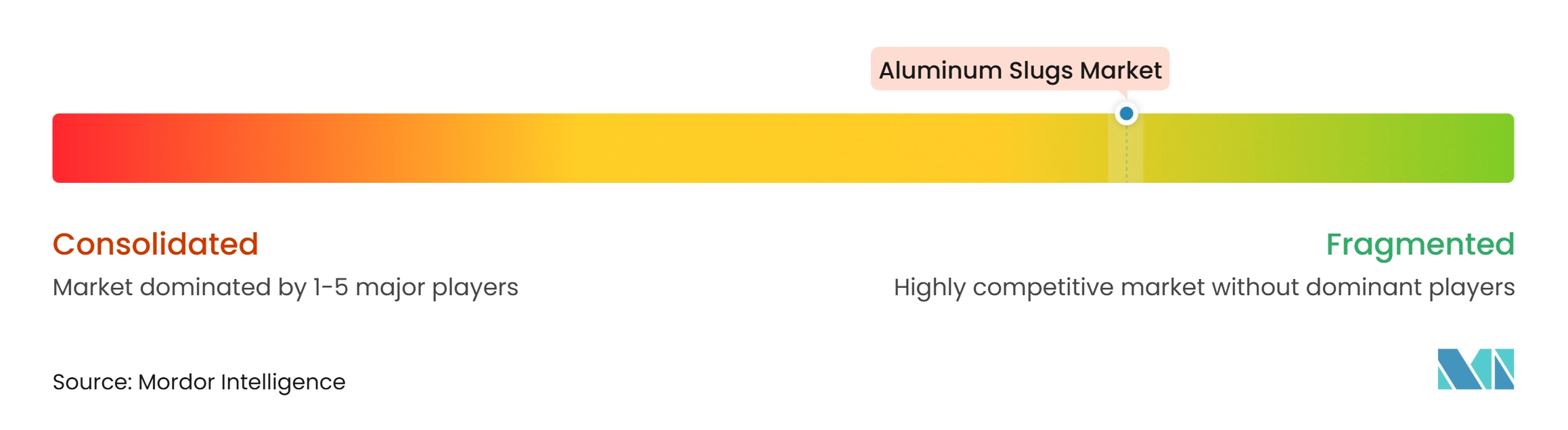
The aluminum slugs market is fragmented. TALUM produced more than 60,000 tons in 2025 and invested EUR 40 million to expand its capacity to 80,000 tons by 2027. Its production capabilities include surface treatment and a higher proportion of recycled material. TALUM also holds Aluminum Stewardship Initiative (ASI) Performance Standard certification, which aligns with customer procurement requirements for responsible sourcing. Aluman, Neuman Aluminum, Aluminum-Werke Wutöschingen, and Thai producers such as Alucon supply specialized and regional applications. Chinese companies, including Fuchuan Metal Technology and HaoMei Aluminum, compete on cost and tooling range, while product qualification remains necessary in regulated applications.
Competition is influenced by recycled content, technical alloy capabilities, and documentation. Novelis reported 63% recycled content in fiscal 2025, making secondary aluminum availability a benchmark across the value chain. Ball reported 74% recycled aluminum content across its global beverage packaging operations in 2025, reflecting customer focus on material circularity. Neuman Aluminum’s lightweight alloy development with Tubex demonstrates how material engineering can reduce aluminum use in downstream packaging applications. Hindalco’s Chakan facility applies aluminum expertise to electric vehicle (EV) battery enclosures. These developments create opportunities for suppliers that meet technical requirements beyond conventional packaging-grade products.
Pharmaceutical-grade qualification differentiates producers with clean manufacturing controls and traceability systems. Automotive applications involve lengthy approval cycles, which limit supplier substitution for companies without established customer records. ASI Performance Standard certification serves as a commercial indicator for European procurement teams. Producers with integrated casting, rolling, punching, and finishing operations can control quality across multiple production stages. Smaller companies can compete in regional or specialized product categories but face substantial investment requirements when targeting high-output customers. The aluminum slugs market remains price competitive, while qualification, recycled feedstock availability, and technical support are also key competitive factors.
Aluminum Slugs Industry Leaders
-
Ball Corporation
-
Envases
-
Alucon Public Company Limited
-
TALUM
-
Aluminium Rheinfelden Semis GmbH
- *Disclaimer: Major Players sorted in no particular order
Aluminum Slugs Market Companies Covered in this Report
- Alucon Public Company Limited
- Aluman S.A.
- Aluminium Rheinfelden Semis GmbH
- Aluminium-Werke Wutöschingen AG & Co. KG
- Ball Corporation
- Constellium
- Envases
- Fried. v. Neuman Gesellschaft m.b.H.
- Fuchuan Metal Technology Co.,Ltd.
- HaoMei Aluminum
- Hindalco Industries Limited
- Impol
- Norsk Hydro ASA
- Novelis
- TALUM
Recent Industry Developments in Aluminum Slugs Market
- July 2026: Aluminum Rheinfelden Alloys GmbH and Aluminum Rheinfelden Semis GmbH filed for insolvency under self-administration with the Amtsgericht Lörrach on July 16, 2026. Both entities permanently discontinued production for economic reasons. The closure removed approximately 31,000 tons of annual European aluminum slug capacity, affecting converters that used Rheinfelden’s round, rectangular, and flat slugs.
- April 2025: Hindalco Industries commissioned an EV component manufacturing facility in Chakan, Pune, India, with an investment of INR 500 crore (approximately USD 60 million). The facility supplied 10,000 aluminum battery enclosures to Mahindra for the BE 6e and XEV 9e electric SUVs. It has an annual capacity of 80,000 units, with plans to expand to 160,000 units. The enclosures reduce weight by up to 40% compared with steel equivalents and use aluminum slug-derived components in the EV value chain.
Global Aluminum Slugs Market Report Scope
Aluminum slugs are high-purity, solid aluminum discs or custom-shaped forms used as input materials in impact extrusion and deep-drawing operations to manufacture aluminum components.
The aluminum slugs market is segmented by shape, application, end-user industry, and geography. By shape, the market is segmented into round, flat, rectangular, perforated, and others. By application, the market is segmented into tubes, aerosols, bottles and monobloc containers, technical parts, and others. By end-user industry, the market is segmented into food and beverages, pharmaceuticals and medical, cosmetics and personal care, automotive, and others. The report also covers market sizes and forecasts for aluminum slugs across 15 countries in major regions. The market sizes and forecasts are provided in terms of value (USD).
Segmentation Overview
| Round |
| Flat |
| Rectangular |
| Perforated |
| Others |
| Tubes |
| Aerosols |
| Bottles and Monobloc Containers |
| Technical Parts |
| Others |
| Food and Beverages |
| Pharmaceuticals and Medical |
| Cosmetics and Personal Care |
| Automotive |
| Others |
| Asia-Pacific | China |
| India | |
| Japan | |
| South Korea | |
| ASEAN Countries | |
| Rest of Asia-Pacific | |
| North America | United States |
| Canada | |
| Mexico | |
| Europe | Germany |
| United Kingdom | |
| France | |
| Italy | |
| NORDIC Countries | |
| Rest of Europe | |
| South America | Brazil |
| Argentina | |
| Rest of South America | |
| Middle East and Africa | Saudi Arabia |
| South Africa | |
| Rest of Middle East and Africa |
| By Shape | Round | |
| Flat | ||
| Rectangular | ||
| Perforated | ||
| Others | ||
| By Application | Tubes | |
| Aerosols | ||
| Bottles and Monobloc Containers | ||
| Technical Parts | ||
| Others | ||
| By End-User Industry | Food and Beverages | |
| Pharmaceuticals and Medical | ||
| Cosmetics and Personal Care | ||
| Automotive | ||
| Others | ||
| By Geography | Asia-Pacific | China |
| India | ||
| Japan | ||
| South Korea | ||
| ASEAN Countries | ||
| Rest of Asia-Pacific | ||
| North America | United States | |
| Canada | ||
| Mexico | ||
| Europe | Germany | |
| United Kingdom | ||
| France | ||
| Italy | ||
| NORDIC Countries | ||
| Rest of Europe | ||
| South America | Brazil | |
| Argentina | ||
| Rest of South America | ||
| Middle East and Africa | Saudi Arabia | |
| South Africa | ||
| Rest of Middle East and Africa | ||
Key Questions Answered in the Report
What is current market size of Aluminum Slugs Market?
The aluminum slugs market size was valued at USD 4.58 billion in 2026 and is estimated to grow from USD 4.84 billion in 2027 to USD 6.41 billion by 2032, at a CAGR of 5.78% during the forecast period (2027-2032).
Why are recycled aluminum inputs important?
Recycled aluminum requires 95% less energy than primary production, while customers increasingly assess recycled content and responsible sourcing. A deeper secondary aluminum supply base can also reduce producers' exposure to primary ingot price movements. Certification and traceability can support access to customers that place a higher value on responsible sourcing.
What end-user sector is growing fastest?
Automotive is forecast to grow at a 7.39% CAGR through 2032 as electric vehicle (EV) components require specialized aluminum alloys and qualified supply. Battery housings, motor shells, and thermal-management parts need traceability, close tolerances, and controlled surfaces. These requirements create a different supply profile from commodity-grade packaging products.
Which region leads the aluminum slugs sector?
Asia-Pacific held a 44.23% share in 2026 and is forecast to grow at a 7.21% CAGR through 2032. The region combines China’s production capacity, Thailand’s integrated output, and India's growing demand for aerosols and pharmaceuticals. Japan and South Korea also contribute demand for pharmaceutical-grade products with higher quality requirements. The regional supply base also supports packaging and industrial customers across export markets.