
Aluminum Curtain Wall Market Size and Share
Market Overview
| Study Period | 2021 - 2031 |
|---|---|
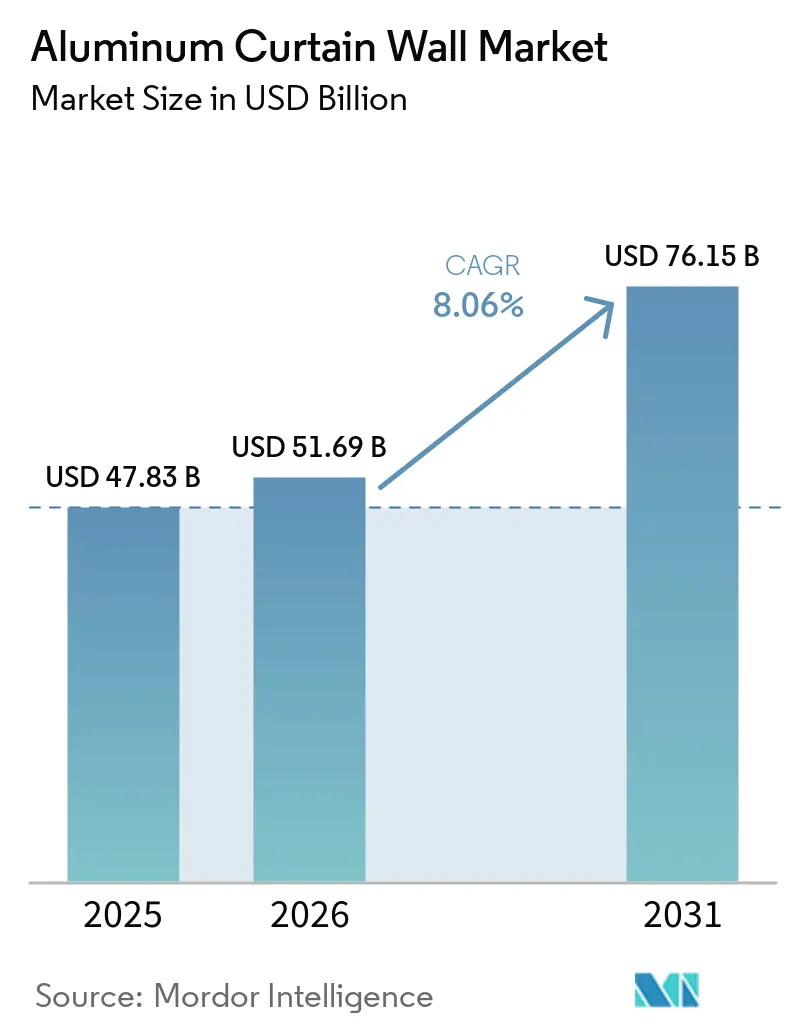
| Market Size (2026) | USD 51.69 Billion |
| Market Size (2031) | USD 76.15 Billion |
| Growth Rate (2026 - 2031) | 8.06 % |
| Fastest Growing Market | Asia-Pacific |
| Largest Market | Asia-Pacific |
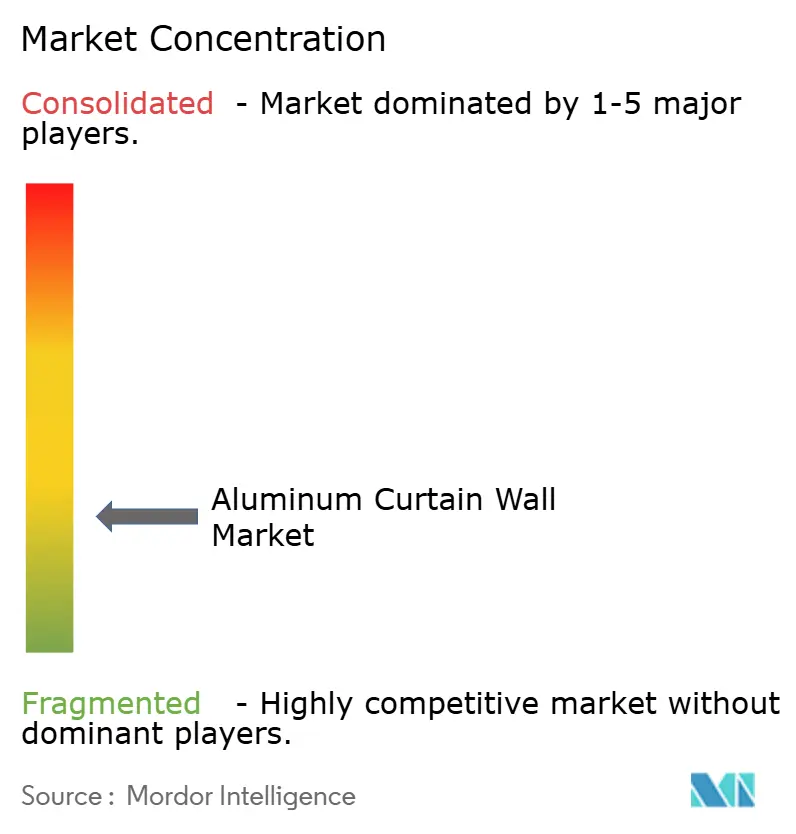
| Market Concentration | Low |
Major Players *Disclaimer: Major Players sorted in no particular order Image © Mordor Intelligence. Reuse requires attribution under CC BY 4.0. | |
Aluminum Curtain Wall Market Analysis by Mordor Intelligence
The Aluminum Curtain Wall Market size was valued at USD 47.83 billion in 2025 and is estimated to grow from USD 51.69 billion in 2026 to reach USD 76.15 billion by 2031, at a CAGR of 8.06% during the forecast period (2026-2031). The aluminum curtain wall market is supported by tighter building energy rules, green-building requirements, and continued construction of tall commercial and mixed-use buildings. Developers also favor factory-built façade systems because they reduce work at the site and make schedules more predictable. In mature regions, replacement activity is becoming as important as new construction because aging building envelopes must meet stronger energy requirements. Suppliers are responding with systems that combine improved thermal performance, testing support, and easier installation. The aluminum curtain wall market also faces higher material costs and shortages of qualified installers, which make procurement timing and project planning more important.
Key Report Takeaways
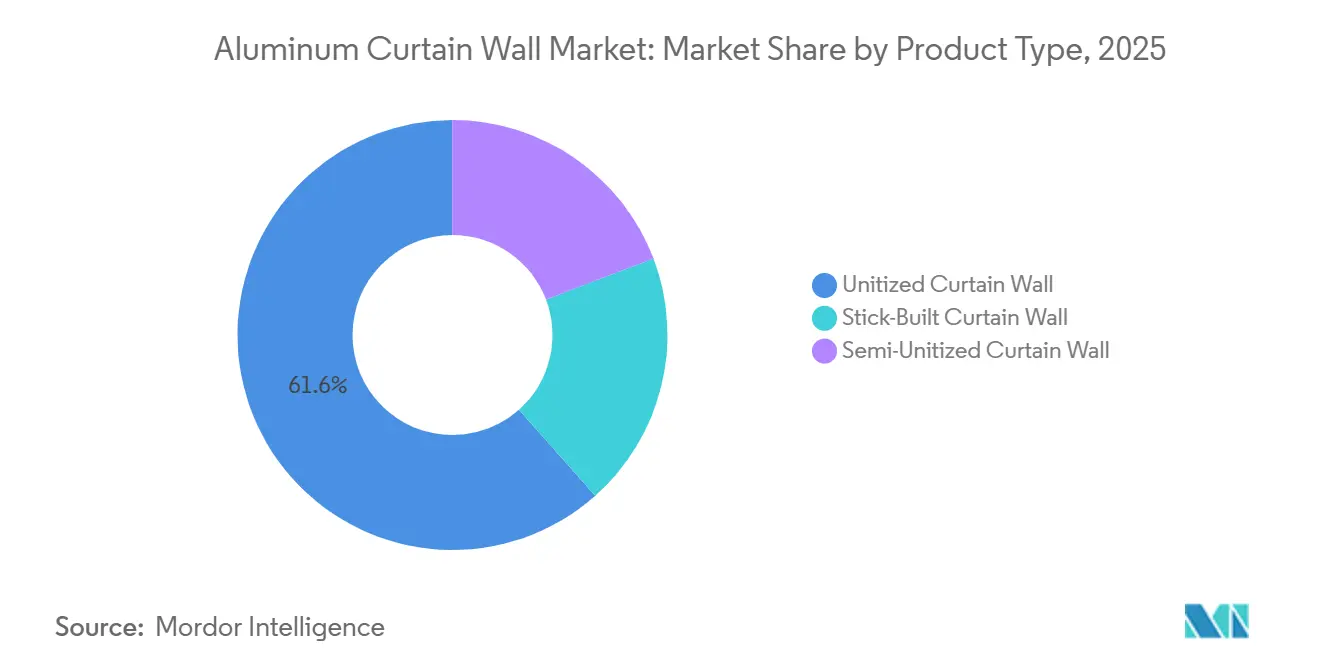
- By product type, unitized curtain wall held 61.56% of the aluminum curtain wall market share in 2025 and is projected to advance at an 8.85% CAGR through 2031.
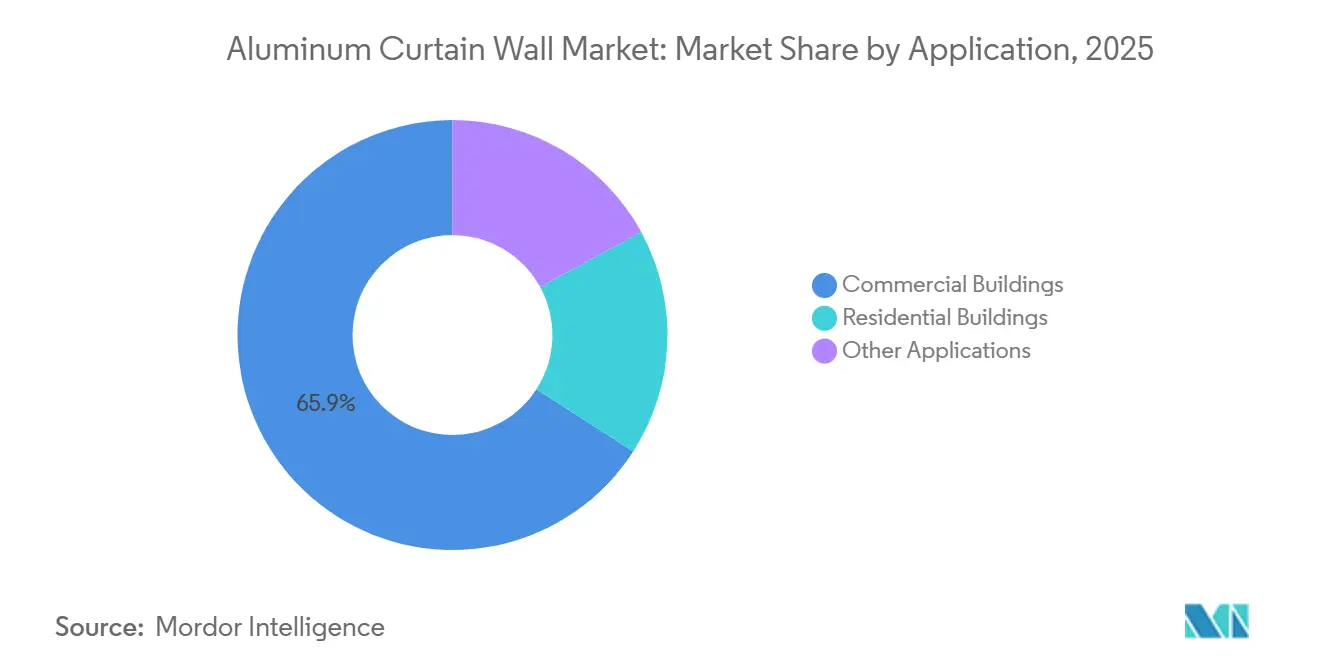
- By application, commercial buildings held 65.89% of the aluminum curtain wall market share in 2025, while residential buildings are projected to advance at a 9.14% CAGR through 2031.
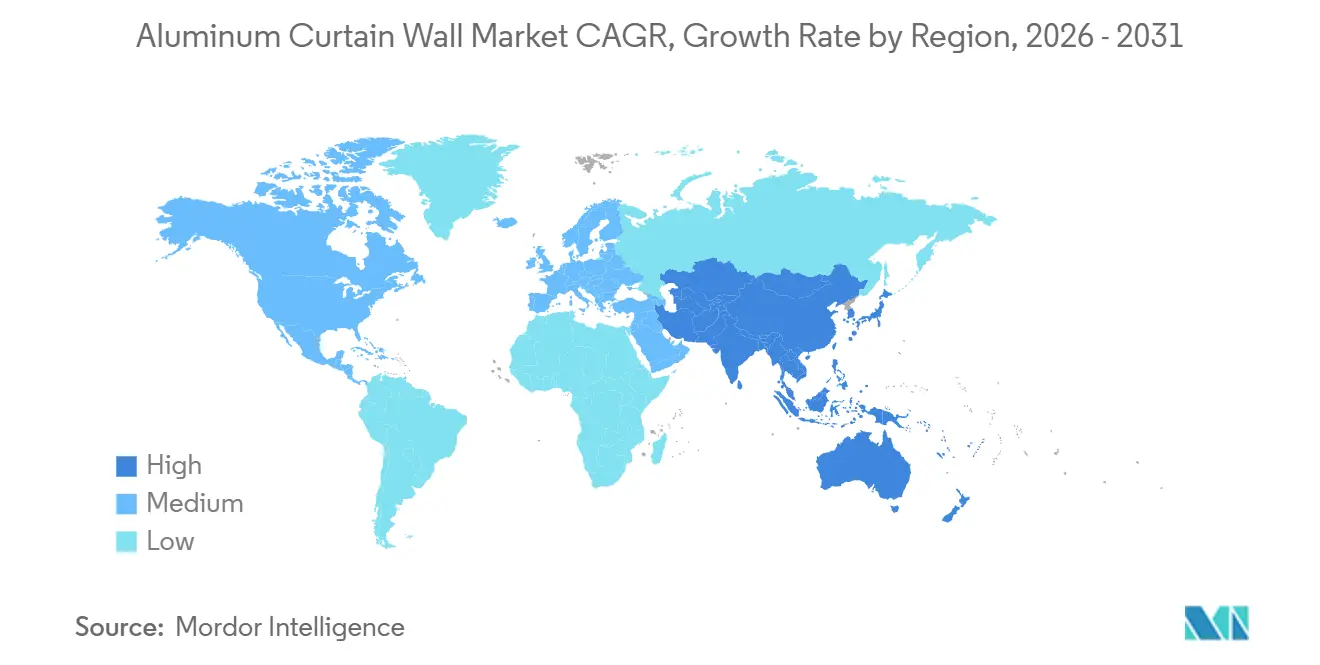
- By geography, Asia-Pacific held 44.05% of the aluminum curtain wall market share in 2025 and is projected to advance at an 8.62% CAGR through 2031.
Note: Market size and forecast figures in this report are generated using Mordor Intelligence’s proprietary estimation framework, updated with the latest available data and insights as of January 2026.
Market Trends and Insights
Drivers Impact Analysis of Aluminum Curtain Wall Market*
| Driver | (~) % Impact on CAGR Forecast | Geographic Relevance | Impact Timeline |
|---|---|---|---|
| Energy-Efficient Building Codes and Green-Building Certifications | +2.5% | Global; concentrated in North America, Europe, and high-income Asia-Pacific markets | Medium term (2-4 years) |
| High-Rise Commercial and Mixed-Use Construction | +2.0% | APAC core (China, India, Southeast Asia), spillover to Middle East and Africa | Short term (≤ 2 years) |
| Factory-Prefabricated Façade Adoption | +1.5% | Global | Short to medium term (≤ 4 years) |
| Façade Retrofit and Building-Energy Renovation Demand | +1.2% | Europe (France, Germany, UK, NORDIC Countries); North America | Medium term (2-4 years) |
| Design Digitization and Automated Façade Fabrication | +0.8% | Global; early gains in Europe and high-income Asia-Pacific markets | Long term (≥ 4 years) |
| Source: Mordor Intelligence | |||
Energy-Efficient Building Codes and Green-Building Certifications
The U.S. Green Building Council launched Leadership in Energy and Environmental Design (LEED) v5 in 2025 and separated energy-efficiency credits from whole-building carbon accounting. This change made it easier for high-performance curtain wall specifications to contribute to energy credits without requiring complex whole-building energy simulations. California's 2025 Building Energy Efficiency Standards set a maximum curtain wall assembly U-factor of 0.280 for nonresidential retrofits, limiting lower-performing substitutions in qualifying projects.[1]California Energy Commission, “2025 Building Energy Efficiency Standards,” California Energy Commission, energy.ca.gov. France's RE2020 requirements also increased the need for project-specific environmental documentation for aluminum curtain walls. These requirements make certified thermal performance and reliable product data more important in the aluminum curtain wall market, particularly where architects must show compliance during specification. They also shift attention from the initial system price toward whether a product can meet the documented performance requirement without late redesign. For suppliers, this makes certification records and technical support part of the basic project offer rather than an optional service.
High-Rise Commercial and Mixed-Use Construction
Buildings taller than 200 meters commonly use unitized aluminum curtain wall systems because installation speed and worker safety become more difficult at greater heights. The aluminum curtain wall market, therefore, benefits when developers plan supertall, office, mixed-use, and airport projects in dense urban areas. India’s Ude Desh ka Aam Naagrik (UDAN) airport expansion program targeted 50 cities by 2030, while commercial development in Hyderabad, Bengaluru, and Chennai added to demand for large façade packages. China also continued to set demanding specifications for major commercial assets, as shown by Tencent Binhai Tower, which used fluorocarbon-coated aluminum composite panels across two interconnected towers. Faster delivery of custom aluminum extrusions from Asia-Pacific suppliers can also influence sourcing decisions for projects in North America and Europe. The effect is strongest where a project needs custom profiles and cannot absorb a long production lead time. This gives fabrication capacity and delivery reliability a direct role in the aluminum curtain wall market.
Factory-Prefabricated Façade Adoption
Factory-prefabricated unitized systems reduced on-site installation time by 40%-50% compared with conventional stick-built methods. This reduction shortened scaffolding periods and helped contractors manage critical construction schedules in dense urban projects. Factory assembly also enabled testing for air, water, and thermal performance before units left the plant. A shortage of skilled glazing workers increased the value of moving more work into controlled manufacturing environments. The aluminum curtain wall market increasingly rewards fabricators that can manage design, testing, and Building Information Modeling (BIM) integration alongside factory production. These capabilities help a contractor resolve details before panels reach the site in the aluminum curtain wall market. They also reduce the risk that field changes will interrupt installation after delivery has begun.
Façade Retrofit and Building-Energy Renovation Demand
Older European commercial buildings often have curtain wall systems with Ucw values of 3.2-6.0 W/(m²·K), while current retrofit specifications seek Ucw values of 1.6 W/(m²·K) or below. Improving these systems can reduce total building energy consumption by 15%-25%, which supports renovation activity where incentives are available. France’s BAT-EN-113 incentive scheme supported the replacement of commercial curtain walls with insulated glazing. TECHNAL showed in 2025 that retaining the original aluminum substructure while replacing frames and glazing reduced cost by 20% and shortened installation from 8 months to 5 months at the La Providence office project in Levallois-Perret. This approach reduced the Ucw value from 3.2 to 1.2 W/(m²·K) and made renovation more practical for occupied commercial buildings. It allowed building owners to improve envelope performance without removing the primary aluminum structure. That distinction matters where tenants remain in the building and a full façade replacement would create greater disruption.
Restraints Impact Analysis of Aluminum Curtain Wall Market*
| Restraint | (~) % Impact on CAGR Forecast | Geographic Relevance | Impact Timeline |
|---|---|---|---|
| High Installation, Testing, and Maintenance Costs | -1.8% | Global; most acute in North America and Europe | Short to medium term (≤ 4 years) |
| Skilled Façade Engineering and Installation Labor Shortages | -1.3% | North America & Europe | Short term (≤ 2 years) |
| Project-Specific Fire, Seismic, Wind, and Acoustic Certification | -0.7% | Global; concentrated in high-seismic zones (Japan, US West Coast) and fire-code-sensitive markets (UK, EU, Middle East) | Medium term (2-4 years) |
| Source: Mordor Intelligence | |||
High Installation, Testing, and Maintenance Costs
Installation represented 35%-45% of the total aluminum curtain wall project cost, even when prefabrication moved some labor into factories. New systems also required testing against American Society for Testing and Materials (ASTM) E283, E330, and E331 standards for air infiltration, water resistance, and structural performance. The June 2025 rise in aluminum prices shortened price-hold windows to 30 days or fewer and increased uncertainty for fixed-price contracts. Complex building forms and multiple climate requirements can lead project teams to substitute glazing or thermal components to protect initial budgets. These conditions limit project feasibility for some mid-scale commercial projects and add pressure to the aluminum curtain wall market. Contractors must therefore balance performance, cost, and the period for which they can hold a quotation. The pressure is particularly significant in the aluminum curtain wall market when project schedules extend beyond the available material-price commitment.
Skilled Façade Engineering and Installation Labor Shortages
The U.S. Department of Energy documented shortages of installers familiar with high-performance curtain wall systems in code-leading locations, including Massachusetts, Washington State, and British Columbia. The gap between system requirements and available installation skills can increase project cost and encourage value engineering. Construction and manufacturing sectors also depended heavily on foreign-born workers to address domestic skill gaps. Schüco International responded in 2026 by expanding installation training through the Schüco Partner Academy in the United Kingdom. The shortage remains most serious in locations where curtain wall performance rules are most demanding. Training can help increase installer capability, but it does not immediately add experienced teams to active projects. As a result, suppliers with technical training and installation support can be better positioned for projects with demanding specifications.
*Our forecasts treat driver/restraint impacts as directional, not additive. The impact forecasts reflect baseline growth, mix effects, and variable interactions.
Aluminum Curtain Wall Market Segment Analysis
By Product Type:
Prefabrication Premium Widens Unitized Curtain Wall LeadUnitized curtain wall held a 61.56% share in 2025 and is projected to advance at an 8.85% CAGR through 2031. Its position reflected strong use in high-rise projects, where factory-built panels reduced installation time and reduced dependence on scaffolding. Buildings taller than 200 meters used unitized systems in more than 70% of façade applications because field installation was harder to manage at those heights. The systems also supported the air, water, and thermal performance expectations that project teams increasingly require. Kawneer Company, Inc. introduced the 2500 UT PLUS Enhanced Thermal Option in April 2026, which achieved U-factors as low as 0.25 with 1-inch insulating glass while retaining shop-assembly efficiency.
Stick-built curtain wall remained relevant for low-to-mid-rise projects and building envelopes with complex shapes. These projects may not have enough repeated panel design to justify the setup needed for full unitized production. Semi-unitized curtain wall offered partial factory quality control while maintaining more flexibility during field installation. This format was useful where façade elevations needed adjustment during construction in the aluminum curtain wall market. As BIM tools automate panel detailing, more complex projects may become suitable for factory-built systems, supporting broader adoption of unitized solutions in the aluminum curtain wall industry. Stick-built and semi-unitized curtain walls still provide options where site conditions or design changes need greater flexibility. The choice among the formats, therefore, depends on project height, repetition, geometry, labor conditions, and required performance.



By Application:
Commercial Building Holds Ground, Residential Buildings Gain MomentumCommercial buildings held a 65.89% share in 2025. Office towers, mixed-use developments, data centers, healthcare facilities, and institutional buildings continued to require high-performance façade systems. Activity in data centers, healthcare, and education supported demand even where office development had weakened. Permasteelisa Group was appointed in 2025 to design and install the unitized curtain wall system for Northeastern University’s Alfond Center in Portland, Maine. The 142,684 sq ft façade included structural glass fin walls, shaped metal panels, and granite sunshades, with installation scheduled through January 2028.
Residential buildings are projected to advance at a 9.14% CAGR through 2031. Premium high-rise residential developers in India, Vietnam, and Southeast Asia increasingly use glass-aluminum façades that were previously more common in commercial towers. Alumil deployed a unitized glazing system at Sunteck Pinnacle in Mumbai during 2026. The system used triple-barrier sealing, Ethylene propylene diene monomer (EPDM) gaskets, and custom wind-load management for local humidity and wind conditions. Other applications, including transport hubs, sports facilities, and public infrastructure, continued to add demand through active airport and civic development programs in the Gulf and Southeast Asia. These projects often have large public-facing elevations and technical performance needs that support curtain wall use. Their demand base also adds diversity to the aluminum curtain wall market beyond commercial and residential buildings.
Geography Analysis
APAC Aluminum Curtain Wall Market
Asia-Pacific held a 44.05% share in 2025 and is projected to advance at an 8.62% CAGR through 2031. China supported regional demand through commercial mixed-use and supertall projects, while its integrated aluminum supply chain supported domestic use and exports. India added demand through airport development, information technology corridors in Hyderabad, Bengaluru, and Chennai, and premium residential buildings in Mumbai. Japan and South Korea required technically certified systems for wind and seismic performance. YKK AP Inc. began operating the N-CueB testing facility in January 2026 following a JPY 2.2 billion investment (approximately USD 14.7 million), and the facility supports wind-pressure testing and seismic-displacement testing[2]YKK AP Inc., “YKK AP Begins Operation of ‘N-CueB,’ a Large-Scale Curtain Wall Testing Building at the Namerikawa Plant,” YKK AP Inc., ykkapglobal.com. The Association of Southeast Asian Nations (ASEAN) cities, including Bangkok, Jakarta, and Kuala Lumpur, added demand for skyscraper-class projects with fire-rated façade systems. This broad regional construction base supported demand across commercial, transport, and residential applications. It also enabled Asia-Pacific to combine demand from large national markets with demand from multiple developing urban centers in the aluminum curtain wall market.
North America Aluminum Curtain Wall Market
North America’s demand is centered on code-driven upgrades and retrofit investment. Stronger U-factor requirements increased the need for high-performance systems and affected product selection in code-leading states. Oldcastle BuildingEnvelope launched the Reliance-TC SS in June 2026 with U-factors as low as 0.19 using thin triple-insulated glass units (IGUs) without increasing system depth. Kawneer Company, Inc. also improved the thermal option for its 2500 UT Unitwall System during 2026. Canada’s Quebec and Ontario markets supported demand across office, medical, and institutional projects, while the International Energy Conservation Code (IECC) and American Society of Heating, Refrigerating and Air-Conditioning Engineers (ASHRAE) 90.1 influenced thermal specifications across the region. In this environment, a system’s U-factor and test record can be decisive during selection. Suppliers are consequently directing product development toward thermal gains that do not add depth or disrupt fabrication.
EMEA and South America Aluminum Curtain Wall Market
Europe remained a major center for sustainability rules and building-envelope renovation in the aluminum curtain wall market. France’s RE2020 regulation, Décret Tertiaire, and BAT-EN-113 incentive scheme supported the replacement of commercial curtain walls with insulated glazing. Germany’s Bundesförderung für effiziente Gebäude program offered up to 15% of eligible investment costs for façade renovations achieving a Uw below 0.9 W/(m²·K). Nordic countries required very strong thermal performance, which supported demand for triple-glazed aluminum systems. Reynaers Aluminium introduced SlimWall 35 in March 2026, with a U-value as low as 0.8 W/(m²·K) and both Passive House and Cradle-to-Cradle certifications. South America, the Middle East, and Africa added demand through commercial, infrastructure, and high-specification projects, while Permasteelisa Group established a manufacturing joint venture in Dubai for regional façade work. These regions differ in their local manufacturing depth and price sensitivity, but major projects can still require advanced façade systems. Regional production capacity can improve access to customized systems and reduce delivery constraints for those projects.

Competitive Landscape
The aluminum curtain wall market is highly fragmented. Permasteelisa Group and Kawneer Company, Inc. compete across specification, fabrication, and installation for complex commercial projects. Oldcastle BuildingEnvelope supplies glazing and framing products in North America through its glass, metal, and hardware platform. Reynaers Aluminium, Schüco International, Alumil, Aluprof S.A., GUTMANN, and HUECK System GmbH & Co. KG compete through thermal performance, certification depth, and BIM tools. RAICO Bautechnik GmbH, Jansen AG, Metal Yapi Sistemleri Tic. A.Ş., Ponzio, and ALUTECH compete through local distribution and customization capabilities. TECHNAL also focuses on renovation solutions that preserve existing aluminum structures while improving thermal performance. The competitive set in the aluminum curtain wall market, therefore, includes companies that address full new-build façade packages and companies that focus on targeted replacement work.
Companies in the aluminum curtain wall market increasingly use product performance to secure specifications before a project reaches the procurement stage. Oldcastle BuildingEnvelope launched Reliance-TC SS in June 2026 to address stringent thermal requirements without increasing system depth. Kawneer Company, Inc. launched the MetroView 4-SSG Window Wall in May 2026 for mid-to-high-rise multifamily, office, and institutional applications. YKK AP Inc. also invested in N-CueB to accelerate performance approval for systems used in high-wind and seismic conditions. These actions address different parts of the same competitive requirement. Product improvements address code thresholds, while testing capacity helps customers validate systems for demanding building conditions
European specialists also focused on certification, retrofit suitability, and improved product documentation. TECHNAL developed a renovation method that retained the original aluminum substructure while updating frames and glazing, reducing both cost and installation time for an occupied office building. Schüco International and LIXIL deepened their partnership in Japan during 2025 to expand highly insulated aluminum building products for commercial construction. Permasteelisa Group created a joint venture with ALBADDAD Capital in 2026 to establish façade production capacity in Jebel Ali, Dubai, with planned expansion into Saudi Arabia. These moves show that suppliers are balancing regional manufacturing capacity with product performance and approval support. The approach reflects the need to serve local project schedules while meeting increasingly demanding energy and safety requirements. It also favors suppliers that can provide technical evidence early in the specification process.
Aluminum Curtain Wall Industry Leaders
Kawneer Company, Inc.
Schüco International
Oldcastle BuildingEnvelope
Permasteelisa Group
YKK AP Inc.
- *Disclaimer: Major Players sorted in no particular order
Aluminum Curtain Wall Market Companies Covered in this Report
- Alumil
- Aluprof S.A.
- ALUTECH
- GUTMANN
- HUECK System GmbH & Co. KG
- Jansen AG
- Kawneer Company, Inc.
- Metal Yapi Sistemleri Tic. A.Ş.
- Oldcastle BuildingEnvelope
- Permasteelisa Group
- Ponzio
- RAICO Bautechnik GmbH
- Reynaers Aluminium
- Schüco International
- TECHNAL
- YKK AP Inc.

Recent Industry Developments in Aluminum Curtain Wall Market
- June 2026: Oldcastle BuildingEnvelope launched the Reliance-TC SS Thermal Control Screw Spline curtain wall system, achieving U-factors as low as 0.19 while accommodating thin triple IGUs without increasing overall system depth. The launch strengthened the adoption of high-performance aluminum curtain wall systems for energy-efficient commercial buildings across North America.
- May 2026: Kawneer Company, Inc. unveiled the MetroView 4-SSG Window Wall, a unitized system combining structural silicone glazing, high acoustic performance, and advanced thermal efficiency for mid- to high-rise multifamily, office, and institutional buildings. The product expanded aluminum façade solutions for slab-to-slab applications across new construction and retrofit projects.


Global Aluminum Curtain Wall Market Report Scope
Aluminum curtain walls are non-load-bearing building envelope systems that use aluminum framing to create exterior façades while protecting interiors from weather and environmental exposure. They provide a combination of structural flexibility, design versatility, daylight access, and resistance to corrosion, making them suitable for modern building exteriors.
The Aluminum Curtain Wall Market is segmented by product type, application, and geography. By product type, the market is segmented into unitized curtain wall, stick-built curtain wall, and semi-unitized curtain wall. By application, the market is segmented into commercial buildings, residential buildings, and other applications. The report also covers the market size and forecasts for aluminum curtain walls in 15 countries across major regions. For each segment, the market sizing and forecasts have been done on the basis of value (USD).
| Unitized Curtain Wall |
| Stick-Built Curtain Wall |
| Semi-Unitized Curtain Wall |
| Commercial Buildings |
| Residential Buildings |
| Other Applications |
| Asia-Pacific | China |
| India | |
| Japan | |
| South Korea | |
| ASEAN Countries | |
| Rest of Asia-Pacific | |
| North America | United States |
| Canada | |
| Mexico | |
| Europe | Germany |
| United Kingdom | |
| France | |
| Italy | |
| NORDIC Countries | |
| Rest of Europe | |
| South America | Brazil |
| Argentina | |
| Rest of South America | |
| Middle East and Africa | Saudi Arabia |
| South Africa | |
| Rest of Middle East and Africa |
| By Product Type | Unitized Curtain Wall | |
| Stick-Built Curtain Wall | ||
| Semi-Unitized Curtain Wall | ||
| By Application | Commercial Buildings | |
| Residential Buildings | ||
| Other Applications | ||
| By Geography | Asia-Pacific | China |
| India | ||
| Japan | ||
| South Korea | ||
| ASEAN Countries | ||
| Rest of Asia-Pacific | ||
| North America | United States | |
| Canada | ||
| Mexico | ||
| Europe | Germany | |
| United Kingdom | ||
| France | ||
| Italy | ||
| NORDIC Countries | ||
| Rest of Europe | ||
| South America | Brazil | |
| Argentina | ||
| Rest of South America | ||
| Middle East and Africa | Saudi Arabia | |
| South Africa | ||
| Rest of Middle East and Africa | ||


Key Questions Answered in the Report
What is the size of the aluminum curtain wall market?
The aluminum curtain wall market stands at USD 51.69 billion in 2026 and is projected to reach USD 76.15 billion by 2031.
What is driving demand for aluminum curtain wall?
Tighter energy codes, green-building requirements, high-rise construction, prefabrication, and retrofit demand support adoption.
Which product type leads the aluminum curtain wall demand?
Unitized curtain wall held a 61.56% share in 2025 and is projected to advance at an 8.85% CAGR through 2031.
Which application is projected to grow fastest through 2031?
Residential buildings are projected to advance at a 9.14% CAGR through 2031 as premium high-rise developments use commercial-grade façade systems.
Page last updated on:





