
Size and Share of Alternate Fuel and Raw Materials (AFR) Market For Power Generation Industry
Market Overview
| Study Period | 2021 - 2031 |
|---|---|
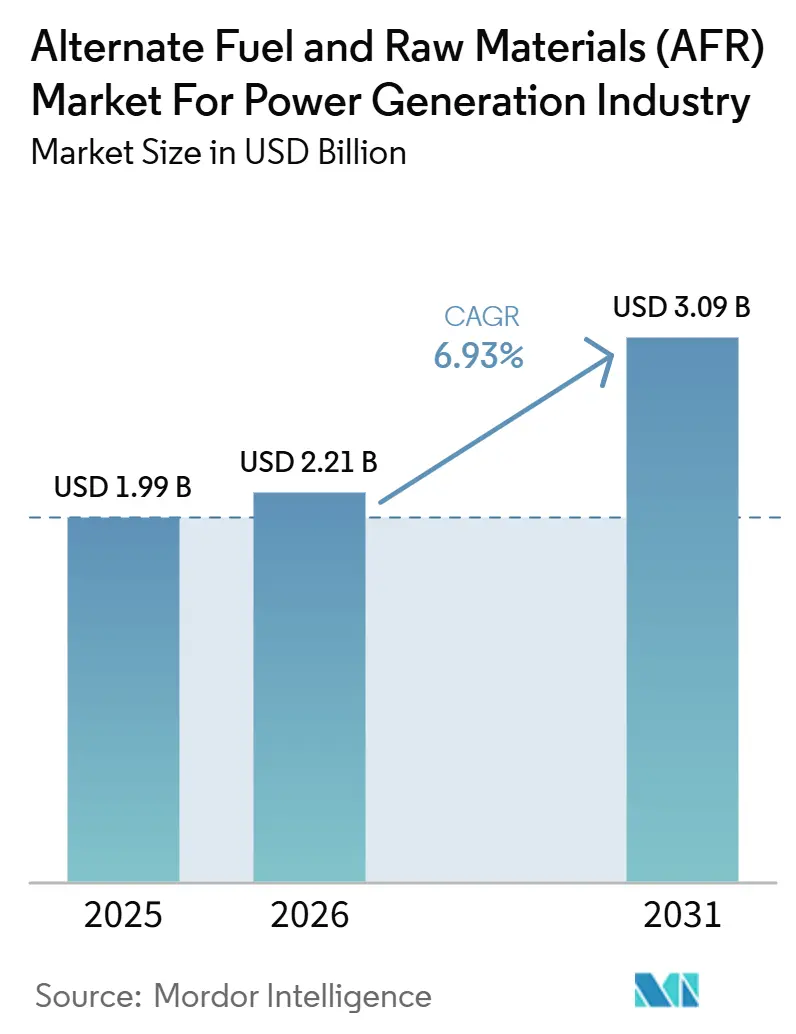
| Market Size (2026) | USD 2.21 Billion |
| Market Size (2031) | USD 3.09 Billion |
| Growth Rate (2026 - 2031) | 6.93 % |
| Fastest Growing Market | Asia-Pacific |
| Largest Market | Europe |
| Market Concentration | Medium |
Major Players *Disclaimer: Major Players sorted in no particular order Image © Mordor Intelligence. Reuse requires attribution under CC BY 4.0. | |
Analysis of Alternate Fuel and Raw Materials (AFR) Market For Power Generation Industry by Mordor Intelligence
The Alternate Fuel and Raw Materials Market For Power Generation Industry size is projected to be USD 1.99 billion in 2025, USD 2.21 billion in 2026, and reach USD 3.09 billion by 2031, at a CAGR of 6.93% from 2026 to 2031. The alternate fuel and raw materials for power generation market is supported by the need for dependable low-carbon power, landfill diversion rules, and industrial fuel substitution. It is also shaped by a gradual move from informal sourcing toward longer contracts for qualified fuels and industrial residues. Power producers and cement plants are placing more value on fuel consistency, traceability, and biogenic content because these qualities affect operating performance and compliance costs. Waste-to-energy facilities continue to provide electricity and heat, while co-firing creates an additional route for biomass and waste-derived fuels in coal-dependent systems. The alternate fuel and raw materials for power generation market, therefore, favors operators that can secure feedstock, process it to a consistent standard, and match it with nearby demand.
Key Report Takeaways
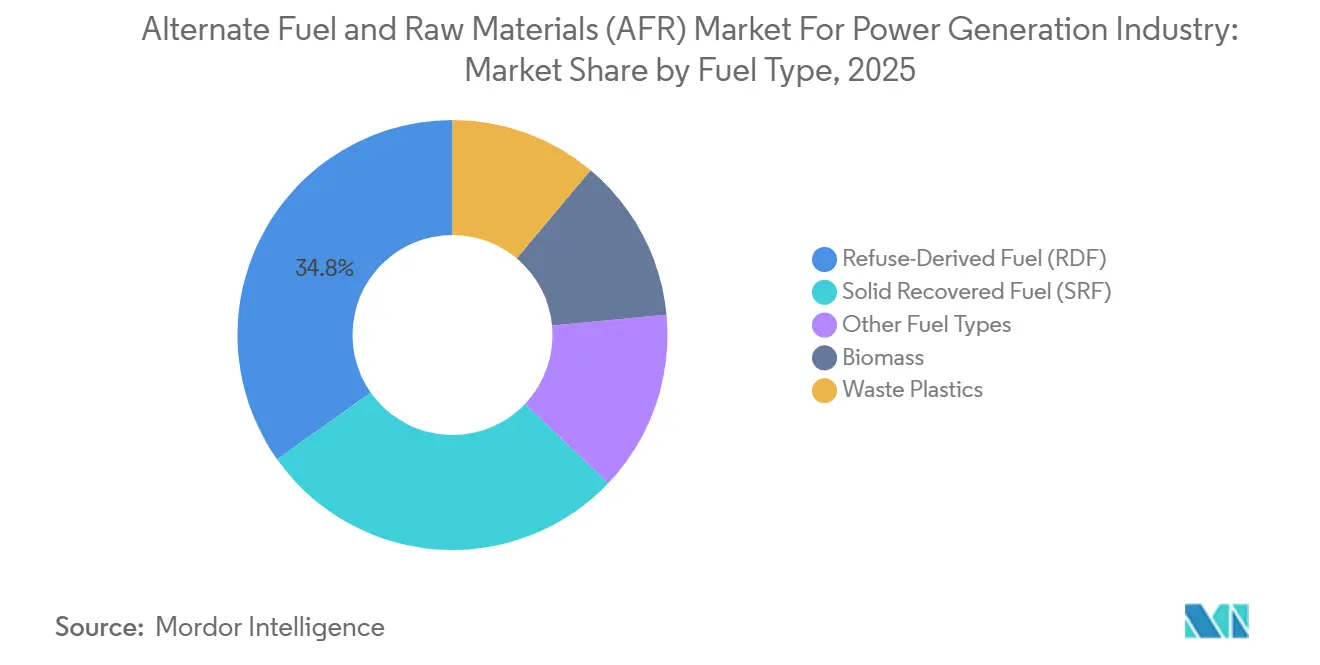
- By fuel type, refuse-derived fuel held 34.8% of the alternate fuel and raw materials for power generation market share in 2025, while solid recovered fuel is forecast to grow at an 8.4% CAGR through 2031.
- By raw material type, fly ash accounted for 46.3% of the alternate fuel and raw materials for power generation market size in 2025, while steel slag is forecast to grow at at an 7.3% CAGR through 2031.
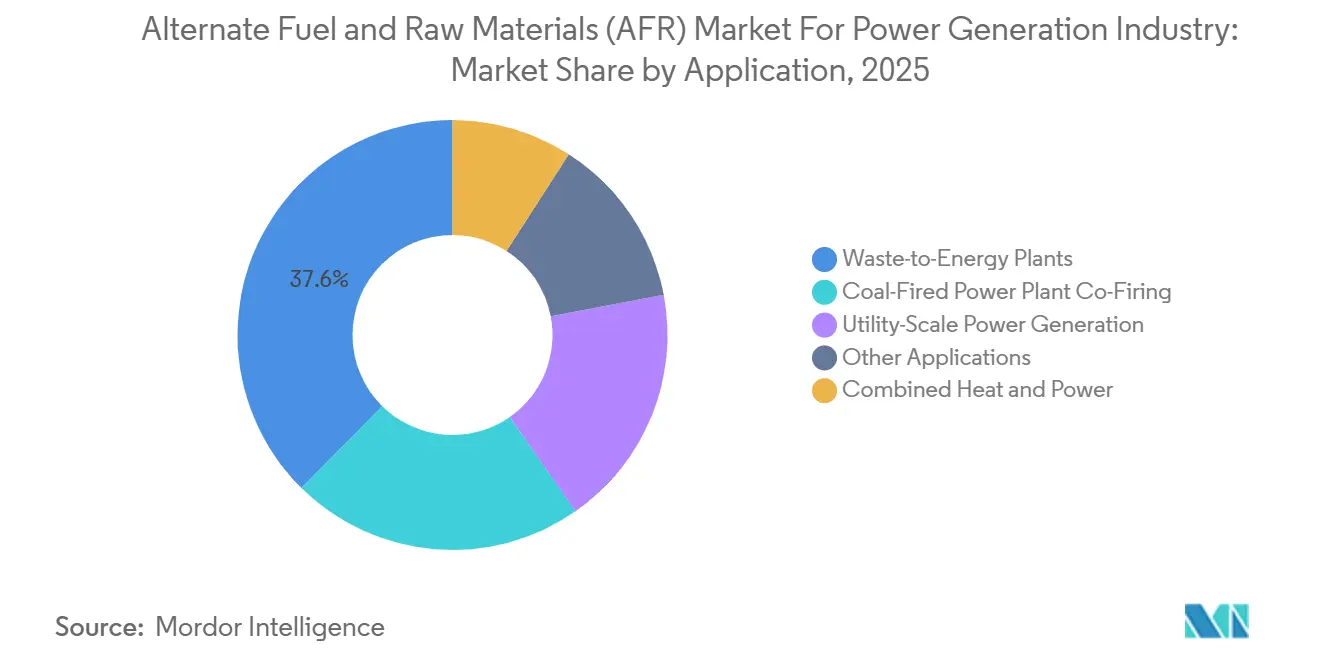
- By application, waste-to-energy plants held 37.6% of the alternate fuel and raw materials for power generation market share in 2025, while coal-fired power plant co-firing is expected to advance at a 9.2% CAGR through 2031.
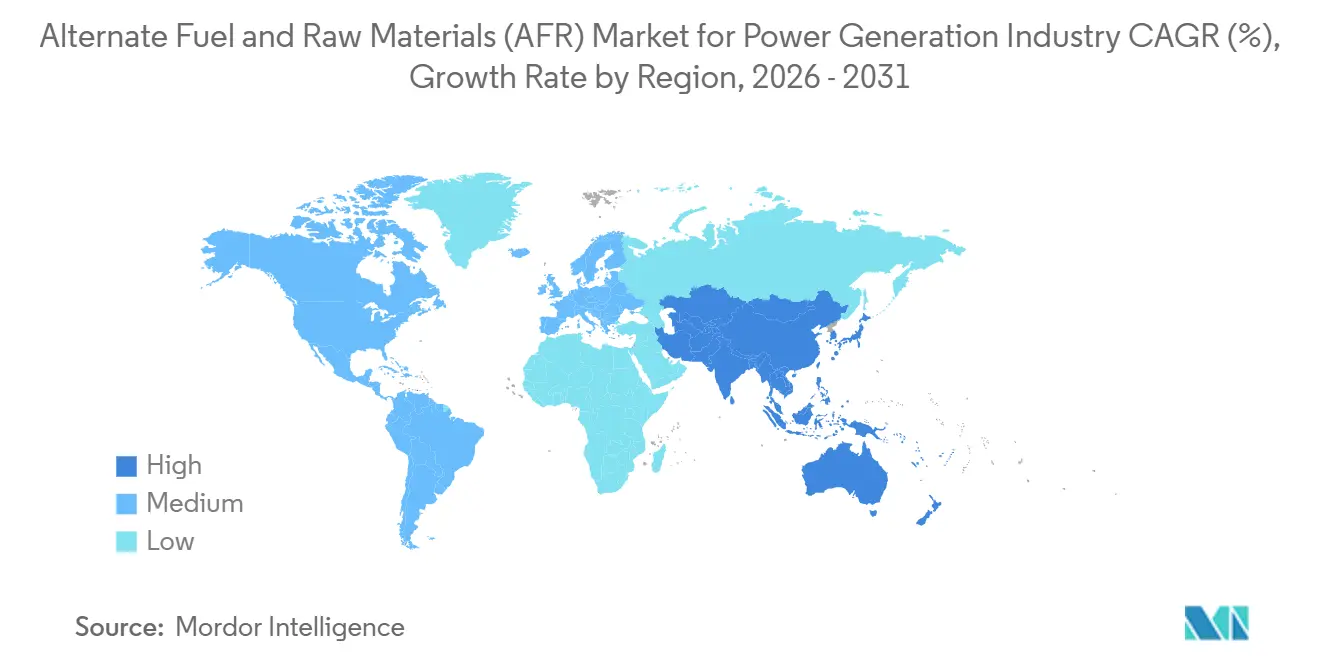
- By geography, Europe held 39.5% revenue share in 2025, while Asia-Pacific is forecast to expand at an 8.8% CAGR through 2031.
Note: Market size and forecast figures in this report are generated using Mordor Intelligence’s proprietary estimation framework, updated with the latest available data and insights as of January 2026.
Market Trends and Insights
Drivers Impact Analysis of Alternate Fuel and Raw Materials (AFR) Market For Power Generation Industry*
| Driver | (~) % Impact on CAGR Forecast | Geographic Relevance | Impact Timeline |
|---|---|---|---|
| Dispatchable Low-Carbon Power Demand | +2.1% | Global | Medium term (2-4 years) |
| Landfill Diversion and Circular-Economy Mandates | +1.8% | EU core, spill-over to APAC and MEA | Short term (≤ 2 years) |
| Industrial Coal and Petcoke Substitution | +1.5% | APAC and EU | Medium term (2-4 years) |
| Biogas and Biomethane Integration with Existing Gas Infrastructure | +0.7% | EU and North America | Long term (≥ 4 years) |
| Quality-Assured AFR Procurement Platforms | +0.4% | Global | Medium term (2-4 years) |
| Carbon-Negative Power and Biogenic Carbon Monetization | +0.3% | EU and North America | Long term (≥ 4 years) |
| Source: Mordor Intelligence | |||
Dispatchable Low-Carbon Power Demand
Wind and solar growth have increased the need for power assets that can produce electricity when intermittent sources are unavailable. Waste-to-energy plants can supply base-load electricity and useful heat, which gives the alternate fuel and raw materials for power generation market a role alongside renewable generation. EEW Energy from Waste and enercity started work in 2025 to raise usable heat output at Hannover-Lahe from 50 MW to 85 MW through a steam turbine bypass. [1]EEW Energy from Waste, “EEW Increases Heat Potential in Hannover-Lahe to Provide More District Heating for enercity,” EEW Energy from Waste, eew-energyfromwaste.com Germany’s solar generation moved into 2nd place in the national power mix in 2025, ahead of natural gas, which increased the case for thermal plants to improve their operating flexibility. [2]Agora Energiewende, “Die Energiewende in Deutschland: Stand der Dinge 2025,” Agora Energiewende, agora-energiewende.de EEW’s 15 MWh battery storage installation at Premnitz in 2026 shows how a thermal waste plant can add grid services to its existing energy role. These capabilities can improve the value of long-term energy contracts because operators can respond to grid conditions as well as supply energy.
Landfill Diversion and Circular-Economy Mandates
The EU Landfill Directive requires member states to reduce municipal waste going to landfill to 10% by 2035. It also restricts the landfilling of waste suitable for recycling or energy recovery from 2030, which supports demand for organized waste treatment. These rules make disposal alternatives more important for municipalities and support long-term arrangements for waste-derived fuels in the alternate fuel and raw materials for power generation market. France revised energy-efficiency requirements for solid recovered fuel production and co-incineration installations in December 2025, adding plant-level performance conditions that encourage higher-quality fuel preparation. In markets with landfill restrictions, facilities must manage recoverable waste through recycling or energy recovery, which supports predictable feedstock flows but also increases the importance of permit-ready capacity. Quality-assured procurement platforms can further support these flows by linking fuel quality, calorific value, and delivery terms in a common transaction process.
Industrial Coal and Petcoke Substitution
Coal and petcoke substitution is expanding the use of biomass, RDF, and SRF in power generation and industrial heat. India issued a biomass and municipal solid waste co-firing policy in November 2025 that required a 5% biomass pellet blend at coal-based thermal plants outside Delhi-NCR from the financial year 2025-26. [3]Ministry of Power, “Policy Update: Co-Firing MSW Charcoal in Coal Power Plants,” Down To Earth, downtoearth.org.in Plants in Delhi-NCR were also required to co-fire an additional 2% of torrefied municipal solid waste charcoal under the policy. Erex and Vinacomin Power agreed in 2025 to explore commercial biomass co-firing at Na Duong and Cao Ngan after tests reached 20% wood-chip blending and 30% wood-pellet blending, respectively. [4]Erex Co. Ltd., “Signed an MOU with Vinacomin Power Holdings of Vietnam to Explore the Commercialization of Biomass Co-Firing,” Erex Co. Ltd., erex.co.jp Wider deployment still depends on boiler changes and fuel-handling systems, so RDF retains a cost advantage where plants cannot support dedicated biomass infrastructure. The alternate fuel and raw materials for power generation market benefits when fuel standards allow industrial users to replace fossil inputs without undermining stable operations.
Carbon-Negative Power and Biogenic Carbon Monetization
Biogenic carbon content is becoming more important for facilities that seek to link waste processing with carbon removal. Suppliers that can measure the biogenic share of fuel can support more reliable carbon-accounting processes. This makes composition a commercial issue as well as an operating requirement. Fuels with higher biogenic fractions can offer a different emissions profile from streams that contain more fossil-derived material. Biogas and biomethane from organic waste can also fit existing gas networks, particularly where district heating systems offer a stable local buyer. The alternate fuel and raw materials for power generation market can therefore benefit from fuels that meet both energy specifications and verifiable carbon-accounting requirements.
Restraints Impact Analysis of Alternate Fuel and Raw Materials (AFR) Market For Power Generation Industry*
| Restraint | (~) % Impact on CAGR Forecast | Geographic Relevance | Impact Timeline |
|---|---|---|---|
| Feedstock Quality and Moisture Variability | -1.20% | Global | Short term (≤ 2 years) |
| High Logistics Cost and Limited Economical Haul Distance | -0.90% | Global, most acute in APAC & South America | Medium term (2–4 years) |
| Competing Uses for Sustainable Biomass Residues | -0.50% | EU & APAC | Medium term (2–4 years) |
| Permitting, Community Acceptance and Emissions Retrofit Risk | -0.40% | Global | Long term (≥ 4 years) |
| Source: Mordor Intelligence | |||
Feedstock Quality and Moisture Variability
Feedstock quality and moisture variability remain a direct operating constraint for fuel producers and receiving facilities. Municipal waste in tropical and subtropical areas can contain 50% to 60% moisture by weight during monsoon periods, reducing the calorific value of RDF. A 2024 study found that manufacturing efficiency at SRF production and use facilities averaged 69.5%, with results varying according to the combustible content in incoming waste. These differences affect calorific value and emissions performance, and they can lead to penalties under quality-band contracts. Competing uses for sustainable biomass residues can further limit access to consistent material, especially where pellet, heat, or agricultural uses offer stronger returns. Operators need screening, sorting, and contracts tied to measured quality if the alternate fuel and raw materials for power generation market is to avoid margin pressure from inconsistent input streams.
High Logistics Cost and Limited Economical Haul Distance
AFR supply is regional because transportation costs can overwhelm the value of lower-density materials. RDF generally has a limited economical road haul distance, and supply-demand mismatches can remain even when national volumes appear balanced. High-moisture biomass is especially difficult to move in areas with weak roads or limited pre-processing capacity. Pelletization can improve transport economics but adds capital and operating costs that are difficult for smaller producers to absorb. SRF has higher calorific density and lower moisture content, which can support longer-distance movement and cross-border trade. Permitting delays, community acceptance issues, and the need for emissions retrofits can extend project timelines, reinforcing the advantage of facilities that are close to feedstock and have established operating approvals.
*Our forecasts treat driver/restraint impacts as directional, not additive. The impact forecasts reflect baseline growth, mix effects, and variable interactions.
Alternate Fuel and Raw Materials (AFR) Market For Power Generation Industry Segment Analysis
By Fuel Type:
SRF Quality Premium Reshapes Co-firing EconomicsRefuse-derived fuel held 34.8% of the alternate fuel and raw materials for power generation market share in 2025. Its position reflects established co-processing agreements at cement kilns and utility boilers across Europe and Asia. RDF remains useful where operators need a lower-cost substitute for fossil fuels and have equipment designed for mixed-quality material. Solid recovered fuel is the fastest-growing fuel sub-segment, with an 8.4% CAGR from 2026 to 2031. The higher-specification fuel complies with EN ISO 21640 and can support tighter energy offtake and carbon-compliance requirements.
A 2025 review in ACS Energy & Fuels found that SRF-derived syngas from gasification can support combined heat and power generation and hydrogen-based fuel production. This creates options beyond traditional combustion co-firing for suppliers that can provide consistent material. Biomass remains important in Southeast Asia and South America, where rice husks, wood chips, and palm kernel shells can provide available feedstocks. Waste plastics have high calorific value, but their use depends on rules for non-recyclable fractions because circular economy policies give priority to mechanical recycling. Biomethane and biogas are also developing where organic waste can be linked with local gas and district heating systems.



By Raw Material Type:
Fly Ash Leads as Slag Valorization Gains Commercial ScaleFly ash accounted for 46.3% of the alternate fuel and raw materials for power generation market size in 2025. Its position is supported by long-standing use in concrete as a supplementary cementitious material with known pozzolanic properties. Steel slag is the fastest-growing raw material segment, with a 7.3% CAGR through 2031. Steelmakers face pressure to improve co-product returns as carbon costs rise and landfill access becomes more limited. Blast furnace slag and foundry sand retain more specialized roles in blended cement and foundry-heavy industrial areas.
A 2025 Scientific Reports study found that a blend of fly ash, blast furnace slag, and steel slag improved composite strength by 16.2% over a reference cement while using 45% industrial waste by mass. This supports the technical case for blended industrial residues in construction applications linked to power and industrial sites. Coal plant retirements could reduce fly ash availability in Europe after 2030. Steel slag may partly offset this shortfall where suitable processing and quality controls are available. Material quality, local standards, and transport distance will determine which residue is practical for each end use.
By Application:
Co-firing Growth Rewrites the AFR Demand HierarchyWaste-to-energy plants held 37.6% of the alternate fuel and raw materials for power generation market size in 2025. Their role is strongest where electricity generation can be paired with district heating and where landfill restrictions create reliable waste flows. Coal-fired power plant co-firing is the fastest-growing application, with a 9.2% CAGR through 2031. This growth is tied to policy-led fuel switching in Asia-Pacific rather than new coal capacity. EEW commissioned Unit 3 at MHKW Rothensee in April 2025 after a EUR 220 million investment, raising annual waste-processing capacity to 1 million metric tons.
Utility-scale power generation remains important in areas with long-term biomass power purchase agreements. Combined heat and power applications are established in industrial parks and urban district energy networks, especially in Scandinavia and Germany. Other applications include industrial boilers in food manufacturing and pulp processing, where economics depend on proximity to feedstock. Co-firing can accept a wider quality range of waste-derived fuels than some dedicated plants as residual waste declines. Plants still need fuel-handling changes to raise blend levels safely and consistently.
Geography Analysis
Europe and North America Alternate Fuel and Raw Materials (AFR) Market for Power Generation Industry
Europe accounted for 39.5% of the alternate fuel and raw materials for power generation market share in 2025. The region has a mature asset base where modernization, heat recovery, and fuel quality management are more important than broad new capacity additions. The EU landfill framework creates a clear policy basis for diverting recoverable waste from disposal. France’s 2025 SRF requirements show how national rules can move quality standards into plant-level operating conditions. North America combines concession-led waste-to-energy operations with growing interest in SRF at cement and pulp and paper facilities.
APAC Alternate Fuel and Raw Materials (AFR) Market for Power Generation Industry
Asia-Pacific is forecast to grow at an 8.8% CAGR through 2031, making it the fastest-growing regional part of the alternate fuel and raw materials for power generation market. India’s 2025 policy created mandatory biomass pellet demand across coal-based thermal power plants outside Delhi-NCR. The policy also introduced a municipal solid waste charcoal requirement for plants in Delhi-NCR. Vietnam’s co-firing activity shows that high blending levels can be achieved, although equipment and fuel-handling changes remain necessary for wider use. The pace of adoption depends on infrastructure as much as policy.
South America and MEA Alternate Fuel and Raw Materials (AFR) Market for Power Generation Industry
South America and Middle East and Africa have smaller, less mature positions within the alternate fuel and raw materials for power generation market. Brazil’s RDF gasification work indicates that local project data can support commercial models suited to regional waste streams. Gulf countries are incorporating waste-to-energy within circular economy programs, and centralized waste control can aid feedstock aggregation. Progress depends on whether public projects can move to bankable independent power producer structures.

Competitive Landscape
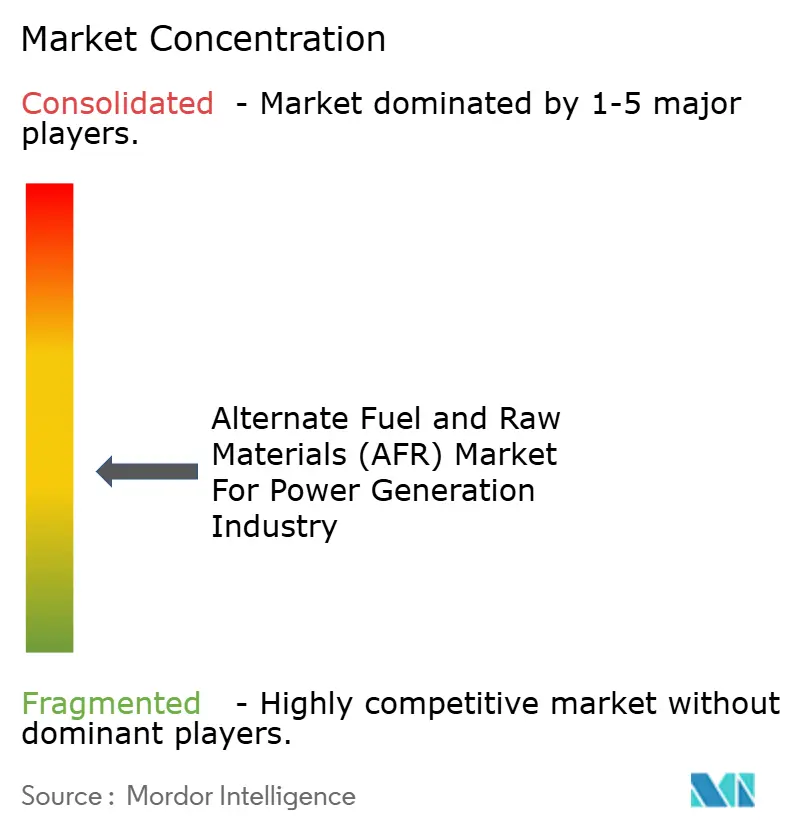
The alternate fuel and raw materials for power generation market is moderately fragmented and includes integrated waste and energy operators, specialized fuel suppliers, and technology-focused firms. SUEZ, Veolia, EEW, PreZero, and REMONDIS have broad positions because they combine waste collection, fuel processing, and waste-to-energy operations. This model gives them control over incoming materials and allows them to balance gate-fee revenue with fuel production economics. Veolia stated in its 2025 universal registration document that the Suez integration chapter had closed successfully, while its waste division reported 1.4% organic growth. Competitive differentiation is increasingly based on quality assurance, carbon tracking, and dependable supply contracts.
SUEZ started operations at the Calce waste treatment facility in France in June 2026 under a 12-year public service delegation, including SRF preparation for the adjacent energy-from-waste plant. In March 2026, SUEZ secured a 10-year contract to operate the Valserhône energy-from-waste plant and committed to enhanced non-ferrous metal recovery and environmental performance. EEW installed a 15 MWh battery storage system at Premnitz in 2026, adding flexibility to a thermal waste asset. These actions show investment in fuel preparation, resource recovery, and flexible energy capability. They also raise the importance of operating data and emissions monitoring.
Smaller companies compete through specialization rather than large physical networks. Cross-border matching of RDF and SRF can connect material surpluses with users that need higher-quality fuel. Technology providers can also compete through flue-gas cleaning, biogenic content measurement, and plant throughput improvements. The market remains moderately concentrated because integrated companies have advantages, while specialized firms can serve local or cross-border niches.
Leaders of Alternate Fuel and Raw Materials (AFR) Market For Power Generation Industry
Veolia Environnement S.A.
SUEZ S.A.
Geocycle SA
A2A S.p.A.
Biffa Limited
- *Disclaimer: Major Players sorted in no particular order
Alternate Fuel and Raw Materials (AFR) Market For Power Generation Industry Companies Covered in this Report
- A2A S.p.A.
- Andusia Recovered Fuels Limited
- Averda International Limited
- Biffa Limited
- Blue Phoenix Group B.V.
- Covanta Holding Corporation
- Ecoserv
- EEW Energy from Waste GmbH
- Enva Group Limited
- FCC Servicios Medio Ambiente Holding, S.A.U.
- Geminor AS
- Geocycle SA
- Indaver NV
- PreZero International GmbH
- REMONDIS SE & Co. KG
- Renewi plc
- SARIA SE & Co. KG
- SUEZ S.A.
- Veolia Environnement S.A.
- Waste Management, Inc.

Recent Industry Developments in Alternate Fuel and Raw Materials (AFR) Market For Power Generation Industry
- May 2026: SUEZ was awarded a GBP 396 million contract by Milton Keynes City Council to operate the Waste Recovery Park for 10 years. The plant processes 133,000 metric tons of non-recyclable waste each year and generates power for 10% of city homes. Operations begin in October 2026.
- March 2026: SUEZ secured a 10-year contract from SIVALOR to operate the Valserhône energy-from-waste plant in France, committing to convert the facility into a resource recovery benchmark with enhanced non-ferrous metal recovery and expanded environmental performance targets.
- January 2026: SUEZ commenced operations at the EUR 420 million Calce waste treatment facility under a 12-year public service delegation contract with Sydetom66, including a new SRF preparation center producing high-calorific fuel for the adjacent energy-from-waste plant.
- November 2025: India’s Ministry of Power issued a biomass and municipal solid waste co-firing policy that mandated a 5% biomass pellet blend at coal-based thermal plants from financial year 2025-26.


Scope of Report on Alternate Fuel and Raw Materials (AFR) Market For Power Generation Industry
The Alternate Fuel and Raw Materials (AFR) Market for Power Generation refers to the ecosystem of suppliers, processors, technology providers, and power producers involved in converting and utilizing waste-derived fuels and recoverable materials as substitutes for coal, natural gas, fuel oil, and virgin raw materials in thermal power generation and combined heat and power (CHP) plants.
The Alternative Fuel and Raw Material (AFR) market for power generation industry is segmented by fuel type, raw material type, application, and geography. By fuel type, the market is segmented into refuse-derived fuel (RDF), solid recovered fuel (SRF), biomass, waste plastics, and other fuel types. By raw material type, the market is segmented into fly ash, blast furnace (BF) slag, foundry sand, steel slag, and other raw materials. By application, the market is segmented into utility-scale power generation, waste-to-energy plants, coal-fired power plant co-firing, combined heat and power, and other applications. The report also covers the market size and forecasts for the global alternative fuel and raw material (afr) market for power generation across 26 countries in key regions. For each segment, the market sizing and forecasts have been provided on the basis of value (USD).
| Refuse-Derived Fuel (RDF) |
| Solid Recovered Fuel (SRF) |
| Biomass |
| Waste Plastics |
| Other Fuel Types |
| Fly Ash |
| Blast Furnace Slag |
| Foundry Sand |
| Steel Slag |
| Other Raw Material Types |
| Utility-Scale Power Generation |
| Waste-to-Energy Plants |
| Coal-Fired Power Plant Co-Firing |
| Combined Heat and Power |
| Other Applications |
| North America | United States |
| Canada | |
| Mexico | |
| Europe | Germany |
| France | |
| Italy | |
| Spain | |
| United Kingdom | |
| Poland | |
| Russia | |
| Rest of Europe | |
| Asia-Pacific | China |
| India | |
| Japan | |
| South Korea | |
| Australia | |
| Indonesia | |
| Vietnam | |
| Thailand | |
| Rest of Asia-Pacific | |
| South America | Brazil |
| Argentina | |
| Chile | |
| Rest of South America | |
| Middle East and Africa | Saudi Arabia |
| United Arab Emirates | |
| Egypt | |
| South Africa | |
| Morocco | |
| Rest of Middle East and Africa |
| By Fuel Type | Refuse-Derived Fuel (RDF) | |
| Solid Recovered Fuel (SRF) | ||
| Biomass | ||
| Waste Plastics | ||
| Other Fuel Types | ||
| By Raw Material Type | Fly Ash | |
| Blast Furnace Slag | ||
| Foundry Sand | ||
| Steel Slag | ||
| Other Raw Material Types | ||
| By Application | Utility-Scale Power Generation | |
| Waste-to-Energy Plants | ||
| Coal-Fired Power Plant Co-Firing | ||
| Combined Heat and Power | ||
| Other Applications | ||
| By Geography | North America | United States |
| Canada | ||
| Mexico | ||
| Europe | Germany | |
| France | ||
| Italy | ||
| Spain | ||
| United Kingdom | ||
| Poland | ||
| Russia | ||
| Rest of Europe | ||
| Asia-Pacific | China | |
| India | ||
| Japan | ||
| South Korea | ||
| Australia | ||
| Indonesia | ||
| Vietnam | ||
| Thailand | ||
| Rest of Asia-Pacific | ||
| South America | Brazil | |
| Argentina | ||
| Chile | ||
| Rest of South America | ||
| Middle East and Africa | Saudi Arabia | |
| United Arab Emirates | ||
| Egypt | ||
| South Africa | ||
| Morocco | ||
| Rest of Middle East and Africa | ||


Key Questions Answered in the Report
What is the size of the alternate fuel and raw materials (AFR) market for power generation?
The alternate fuel and raw materials (AFR) market for power generation stands at USD 2.21 billion in 2026 and is projected to reach USD 3.09 billion by 2031.
Which fuel type has the largest position in alternate fuel and raw materials for power generation?
RDF led fuel types with 34.8% share in 2025, while SRF is the fastest-growing fuel sub-segment at an 8.4% CAGR through 2031.
Why is SRF gaining importance for power and industrial users?
SRF follows EN ISO 21640 requirements and can support more consistent energy performance, traceability, and carbon-compliance processes. Its higher quality can help suppliers access more demanding energy offtake arrangements.
Which application is growing fastest through 2031?
Coal-fired power plant co-firing is the fastest-growing application, with a projected 9.2% CAGR. The growth reflects policy-led fuel switching in Asia-Pacific, where existing coal plants can become an outlet for qualifying biomass and waste-derived fuels.
Which region leads alternate fuel and raw materials for power generation?
Europe led with 39.5% share in 2025 because of established waste-to-energy assets, landfill diversion rules, and industrial processing demand. Asia-Pacific is forecast to post the fastest growth at an 8.8% CAGR through 2031.
What are the main challenges for fuel suppliers and power plants?
Material moisture, inconsistent quality, transport costs, competing biomass uses, permitting, and retrofit needs can limit project economics and fuel adoption. These limits are most acute when local collection, pre-processing, and logistics systems are still developing and when plants cannot accept broader fuel specifications or invest in needed equipment.
Page last updated on:





