
Size and Share of Alternate Fuel and Raw Materials (AFR) Market For Oil and Gas Industry
Market Overview
| Study Period | 2021 - 2031 |
|---|---|
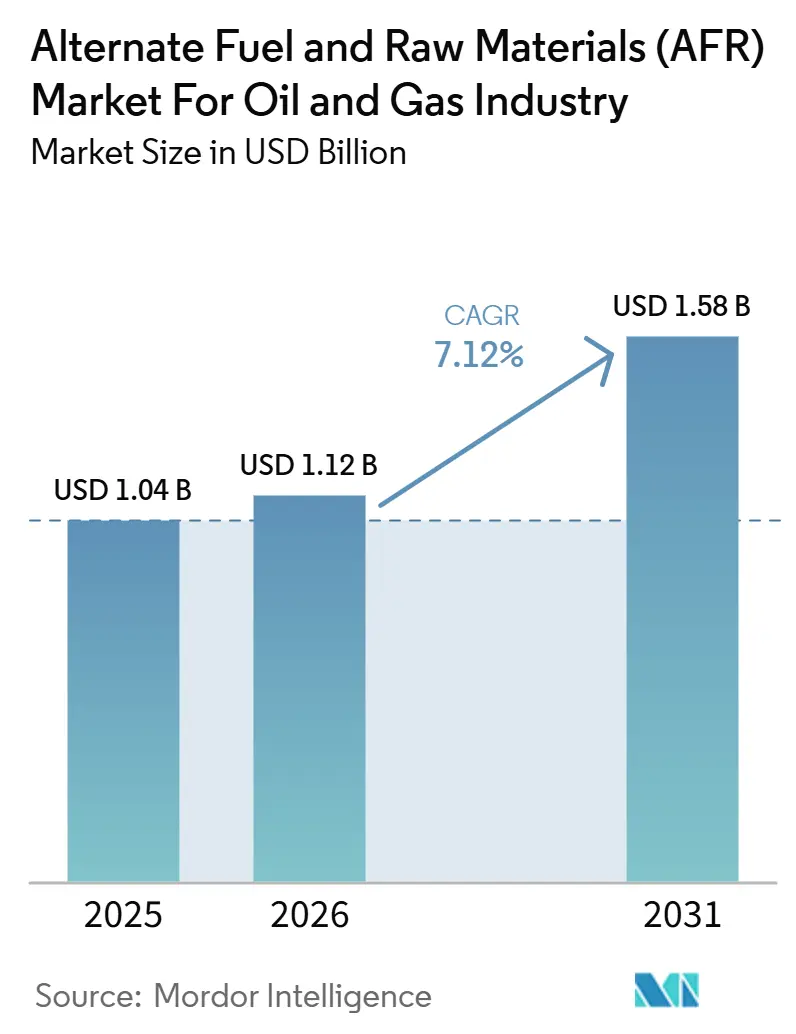
| Market Size (2026) | USD 1.12 Billion |
| Market Size (2031) | USD 1.58 Billion |
| Growth Rate (2026 - 2031) | 7.12 % |
| Fastest Growing Market | Asia-Pacific |
| Largest Market | Europe |
| Market Concentration | Medium |
Major Players *Disclaimer: Major Players sorted in no particular order Image © Mordor Intelligence. Reuse requires attribution under CC BY 4.0. | |
Analysis of Alternate Fuel and Raw Materials (AFR) Market For Oil and Gas Industry by Mordor Intelligence
The Alternate Fuel and Raw Materials Market For Oil & Gas Industry size is projected to expand from USD 1.04 billion in 2025 and USD 1.12 billion in 2026 to USD 1.58 billion by 2031, at a CAGR of 7.12% between 2026 and 2031. Growth in the alternate fuel and raw materials (AFR) market for oil and gas is supported by larger volumes of drilling waste, tighter disposal rules, and rising use of alternative feedstocks by refiners. These conditions shift waste handling from a disposal activity toward recovery of useful fuel and material inputs, especially where recovered oils can be directed to existing industrial systems. Certified processors can benefit as operators need documented waste movements, reliable product quality, and a clear record that supports environmental reporting and customer audits. On-site recovery is becoming more relevant where offshore transport and central treatment create high costs, longer handling periods, and limited access to qualified facilities. Competition centers on hazardous-waste processing capacity, testing, blending, and recovery technologies.
Key Report Takeaways
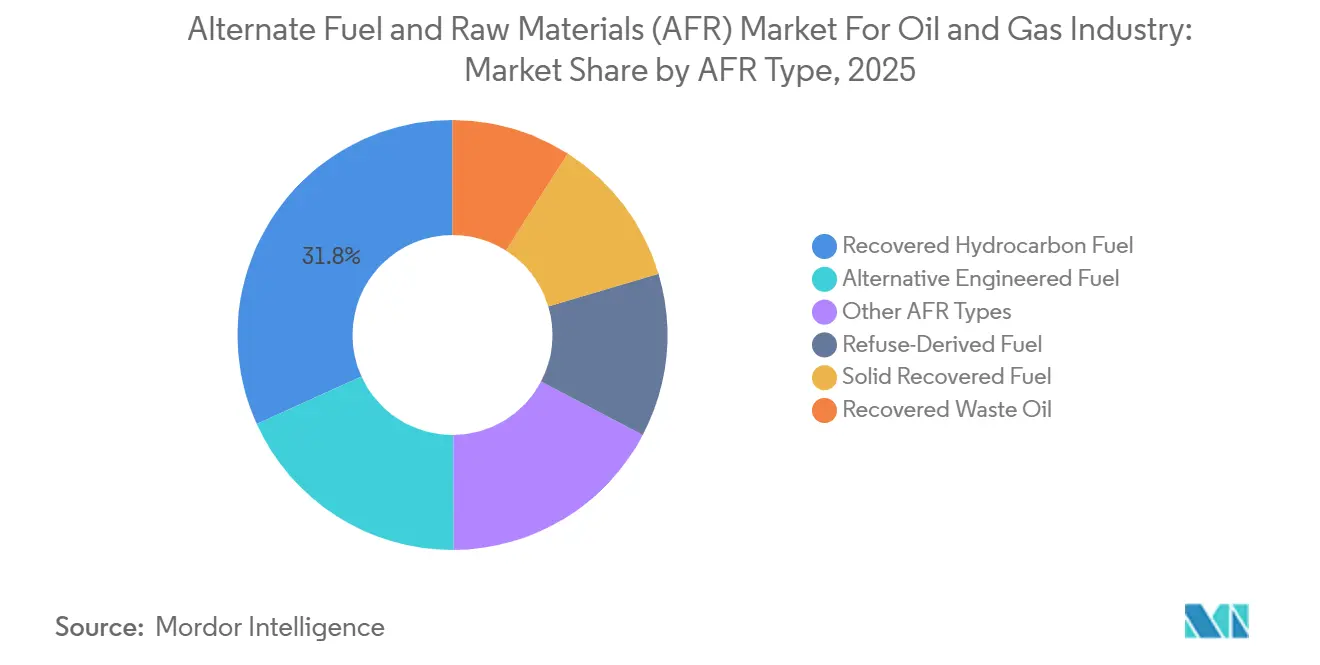
- By AFR type, Recovered Hydrocarbon Fuel held 31.8% of the alternate fuel and raw materials (AFR) market for oil and gas market share in 2025, while Alternative Engineered Fuel is forecast to grow at a 7.9% CAGR through 2031.
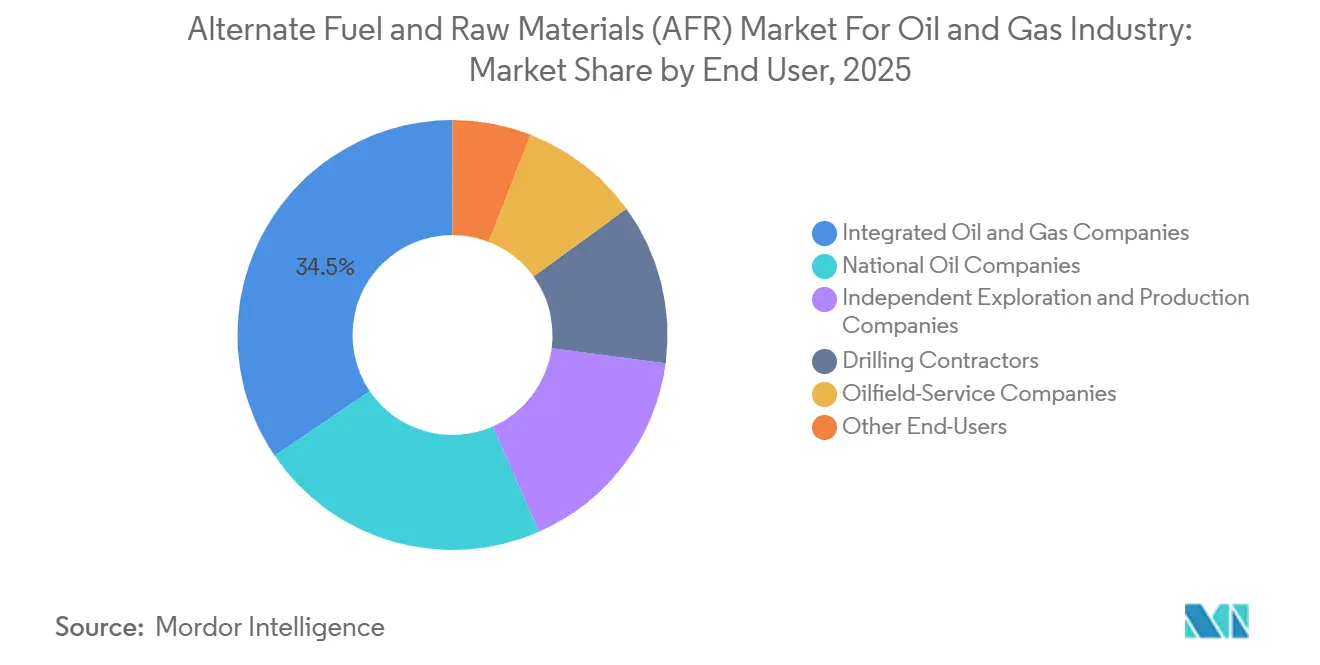
- By end user, Integrated Oil and Gas Companies held 34.5% of the alternate fuel and raw materials (AFR) market for oil and gas market share in 2025, while National Oil Companies are forecast to grow at an 8.2% CAGR through 2031.
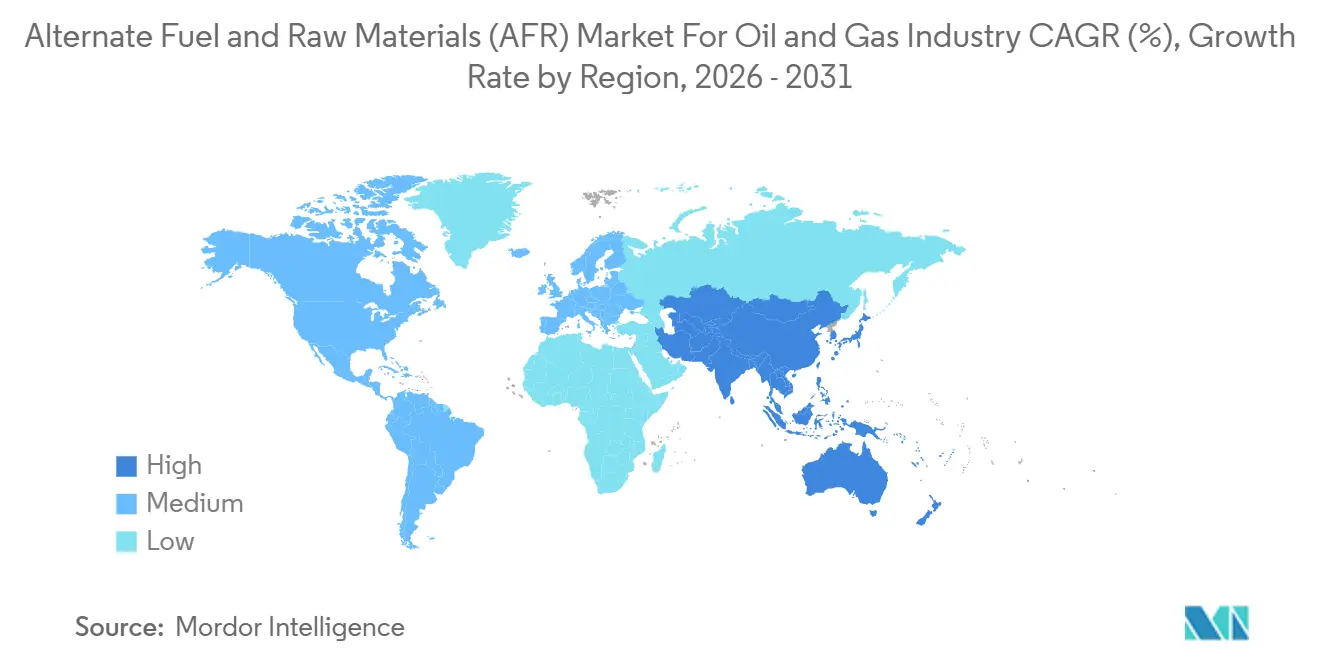
- By geography, Europe held 37.6% of the alternate fuel and raw materials (AFR) market for oil and gas market share in 2025, while Asia-Pacific is forecast to grow at an 8.8% CAGR through 2031.
Note: Market size and forecast figures in this report are generated using Mordor Intelligence’s proprietary estimation framework, updated with the latest available data and insights as of January 2026.
Insights and Trends of Alternate Fuel and Raw Materials (AFR) Market For Oil and Gas Industry
Drivers Impact Analysis*
| Driver | (~) % Impact on CAGR Forecast | Geographic Relevance | Impact Timeline |
|---|---|---|---|
| Growing Drilling and Production Waste | +1.50% | Global, concentrated in North America, the Middle East, and Asia-Pacific upstream basins | Short term (≤ 2 years) |
| Stricter Disposal and Zero-Discharge Rules | +1.20% | European Union, North Sea, and North America, with effects in Southeast Asian offshore areas | Medium term (2-4 years) |
| Hydrocarbon Recovery From Oil-Based Drilling Waste | +1.30% | Global, with priority in Latin America, Asia-Pacific, and West African deepwater operations | Medium term (2-4 years) |
| Refinery Decarbonization and Alternative Feedstocks | +1.10% | Europe and South America, with early activity in the Middle East | Long term (≥ 4 years) |
| Carbon Accounting and Circular Economy Targets | +0.80% | North America, Europe, and NOC-led markets in the Middle East and Asia | Long term (≥ 4 years) |
| AFR Recovery With Digital Waste Tracking | +0.50% | United Kingdom, core European Union markets, Canada, and selected U.S. states | Medium term (2-4 years) |
| Source: Mordor Intelligence | |||
Growing Volumes of Drilling and Production Waste
Oil-based cuttings commonly contain 15-25% oil and 60-80% solids, so they combine a disposal challenge with recoverable hydrocarbons. A study of waste oil-based drilling mud from China’s Yanchang Oilfield achieved 95.6% oil recovery through chemical demulsification and mechanical dehydration. The reported operating cost was USD 8.1 per cubic meter, below the USD 9.1 per cubic meter benchmark cited for conventional pyrolysis. As drilling activity expands in Asia-Pacific and Latin America, waste volumes can outpace centralized disposal capacity. The alternate fuel and raw materials (AFR) market for oil and gas, therefore, has a stronger case for recovery systems that are considered during field planning. On-site pre-processing can reduce the amount of waste that must be transported to a certified facility.
Recovery of Hydrocarbons From Oil-Based Drilling Waste
Hydrocarbon recovery is increasingly treated as a source of usable fuel and raw material rather than only a remediation step. A U.S. patent granted in November 2025 describes a system that separates solids, water, and multiple hydrocarbon fractions from drilling waste in a self-sustaining process. The system is intended to reduce atmospheric gas emissions while creating inputs for alternative fuel or petrochemical uses. [1]U.S. Patent and Trademark Office, “System for Coprocessing Oil Drilling Waste,” Patent Gazette, patentsgazette.uspto.gov. Field-scale treatment systems and active intellectual property indicate that recovery methods are moving beyond small demonstrations. This gives drilling contractors and independent producers more options for handling oil-based mud before it leaves the site, rather than treating transport as the only practical response. The alternate fuel and raw materials (AFR) market for oil and gas benefits when recovered base oil can meet a consistent specification for industrial use.
Stricter Waste-Disposal and Zero-Discharge Requirements
The revised Industrial Emissions Directive expanded environmental management requirements for affected industrial installations and required member states to transpose the directive by July 1, 2026. The directive addresses waste, resource use, and energy efficiency alongside emissions controls. [2]European Parliament and Council, “Directive (EU) 2024/1785 Amending Directive 2010/75/EU on Industrial Emissions,” Official Journal of the European Union, eur-lex.europa.eu. These requirements strengthen demand for processors that can document compliant treatment and offtake. Digital records can make informal disposal routes less viable because waste movements are easier to verify. This favors providers that combine collection, testing, chain-of-custody records, and established industrial offtake relationships within one service model. The alternate fuel and raw materials (AFR) market for oil and gas can consequently become more concentrated around certified processing networks.
Refinery Decarbonization and Alternative Feedstock Adoption
Refinery investment in renewable fuels broadens demand for qualified alternative feedstocks. Petrobras approved a USD 1.2 billion investment decision for a biorefinery project at the RPBC refinery in Cubatão in June 2026. The project is intended to produce 15,000 barrels per day of renewable diesel and bio-jet fuel by 2030 under Brazil’s Future Fuel Law. [3]Petróleo Brasileiro S.A., “Form 6-K: Final Investment Decision for RPBC Biorefining Project,” U.S. Securities and Exchange Commission, sec.gov. National oil companies can use these investments to connect waste recovery with wider circular-economy programs. The alternate fuel and raw materials (AFR) market for oil and gas gains relevance when refinery operators seek reliable material streams rather than isolated waste services. This also raises the value of processors that can provide traceable, consistent feedstock quality and meet the operating requirements of refinery and industrial customers.
Restraints Impact Analysis*
| Restraint | (~) % Impact on CAGR Forecast | Geographic Relevance | Impact Timeline |
|---|---|---|---|
| Hazardous-Component Variability in Oil and Gas Waste | -0.80% | Global, with the highest variability in Gulf of Mexico, North Sea, and Southeast Asian offshore basins | Medium term (2-4 years) |
| Complex Classification and Permitting Requirements | -0.70% | European Union, North America, and Southeast Asia | Medium term (2-4 years) |
| High Costs for Remote and Offshore Treatment | -0.90% | Offshore basins globally, especially West Africa, the South Atlantic, and Southeast Asian archipelagos | Long term (≥ 4 years) |
| Limited Qualified AFR Offtake Facilities | -0.60% | Emerging markets in Latin America, Africa, South Asia, and Southeast Asia | Long term (≥ 4 years) |
| Source: Mordor Intelligence | |||
High Treatment Costs for Remote and Offshore Operations
Remote and offshore operations face higher treatment costs than land-based sites because waste must often be transported to certified facilities. Marine logistics, handling, and compliance requirements raise the cost of centralized processing. A Society of Petroleum Engineers paper reported base-oil recovery of 60-81% from spent drilling fluids using heat and pressure without chemical additives. [4]Society of Petroleum Engineers, “Energy-Efficient and Cost-Effective Recovery and Recycling of Spent Drilling Fluids Through a Novel Thermochemical Destabilization Process,” SPE Paper 228201, onepetro.org. The method remains in commercial scale-up, so many operators still depend on thermal desorption and shipment. A 2026 study estimated USD 170,000 of capital investment for a modular system that processes 2,000 cubic meters per well. The alternate fuel and raw materials (AFR) market for oil and gas, therefore, is divided between established basins that can support on-site equipment and frontier areas that retain costly shore-based logistics.
Hazardous-Component Variability in Oil and Gas Waste
Oil and gas waste can contain polyaromatic hydrocarbons, barite, heavy metals, and synthetic drilling-fluid additives. The composition also changes due to well design, formation, and basin, which requires testing of each incoming batch. The Global Cement and Concrete Association states that waste used in co-processing must meet chemical suitability requirements, including controls on volatile heavy metals such as mercury, thallium, and cadmium. Sampling, testing, and rejection can increase processing costs, delay delivery to offtake customers, and limit the volume that can be blended into a consistent product. Classification can also differ across jurisdictions, adding permitting requirements for material transferred between terminals. These factors make compliance capabilities important in the alternate fuel and raw materials (AFR) market for oil and gas.
*Our forecasts treat driver/restraint impacts as directional, not additive. The impact forecasts reflect baseline growth, mix effects, and variable interactions.
Segment Analysis
By AFR Type: Recovered Hydrocarbon Fuel Leads While Engineered Fuels Gain Momentum
Recovered Hydrocarbon Fuel held 31.8% of the alternate fuel and raw materials (AFR) market for oil and gas market size in 2025. Its energy density and compatibility with cement kilns, refinery heaters, and industrial burners reduce the need for offtake customers to alter existing equipment. This compatibility supports use in operations that need a dependable fuel specification. Large volumes of base oil and synthetic drilling fluid residues from North American and North Sea operations also support established collection and upgrading networks. These networks allow recovered material to reach fuel-grade quality before it is supplied to end users.
Alternative Engineered Fuel is forecast to expand at a 7.9% CAGR from 2026 to 2031. Blending and pre-processing improvements allow mixed oil and gas waste fractions to be formulated into more consistent fuels. This increases the usable share of material that was previously rejected because its heating value was inconsistent. Refuse-Derived Fuel remains a secondary option where nonhazardous industrial waste is collected alongside oil field operational waste. Solid Recovered Fuel remains relevant in Europe, where non-landfill routes are encouraged, and China’s GB/T 35170-2024 standard has supported cement-kiln co-processing since February 2025. A study of SRF and RDF composition found that material classified under UNI EN 15359 can produce lower sulfur dioxide footprints than conventional fossil fuels. Recovered Waste Oil is used in industrial heating and lower-specification blendstock applications, while recovered synthetic fluids and spent process chemicals remain smaller, specialized volumes.



By End User: Integrated Majors Dominate Volume While NOCs Accelerate Fastest
Integrated Oil and Gas Companies commanded 34.5% of the alternate fuel and raw materials (AFR) market for oil and gas market size in 2025. Their scale of upstream operations produces substantial waste volumes and supports internal environmental services teams that can manage procurement, documentation, and regulatory requirements. Many also operate refinery assets, which can create internal offtake routes for recovered hydrocarbon fuel. Directing recovered material to boilers or existing hydrotreating units can shorten the value chain. Public commitments on emissions and resource use also make measurable waste-to-fuel outcomes more relevant than disposal alone.
National Oil Companies are projected to grow at an 8.2% CAGR through 2031. State-owned producers in the Middle East, Africa, and Asia are using recovery programs to support circular-economy objectives and reduce disposal spending. Their refinery investments may increase demand for traceable alternative feedstocks. The alternate fuel and raw materials (AFR) market for oil and gas can therefore benefit from procurement models that connect upstream waste handling with refinery operations. Independent exploration and production companies form a fragmented demand base and often rely on oilfield-service providers for waste management. Drilling contractors and oilfield-service companies act as collection and logistics intermediaries, and formal waste-service clauses in drilling contracts can channel more demand to specialist processors.
Geography Analysis
Europe held 37.6% of the alternate fuel and raw materials (AFR) market for oil and gas market share in 2025. The region has a dense network of co-processing facilities and a regulatory framework that favors waste-derived fuels over landfill routes. Germany, the Netherlands, Belgium, France, and the United Kingdom have important industrial offtake infrastructure. The revised Industrial Emissions Directive increases the emphasis on emission limits and environmental management at industrial installations. This can raise the compliance burden on waste generators while requiring higher quality standards from AFR producers.
Asia-Pacific is forecast to advance at an 8.8% CAGR from 2026 to 2031. Upstream additions in Indonesia, Vietnam, India, and China are increasing drilling-waste volumes faster than local compliant disposal capacity. China’s GB/T 35170-2024 standard expanded the basis for using preprocessed combustible material in cement-kiln co-processing from February 2025. This regulatory base is important because cement kilns provide a potential outlet for qualifying materials, particularly when local processing networks can meet required technical specifications. South Korea and Japan also contribute demand through strict waste-oil reprocessing rules and high-specification industrial heating-fuel requirements.
North America is the second-largest regional position, supported by waste volumes from the Permian Basin, Gulf of Mexico, and Canadian oil sands. Compliance under U.S. waste and effluent rules supports demand for approved oil field waste processing. South America is developing through Brazil’s Future Fuel Law and Petrobras’s USD 1.2 billion RPBC investment, which targets renewable fuels by 2030. The Middle East and Africa include national oil company programs that treat waste recovery as both a compliance and resource-security issue. The alternate fuel and raw materials (AFR) market for oil and gas in these regions is shaped by the availability of qualified processing sites near upstream operations.

Competitive Landscape
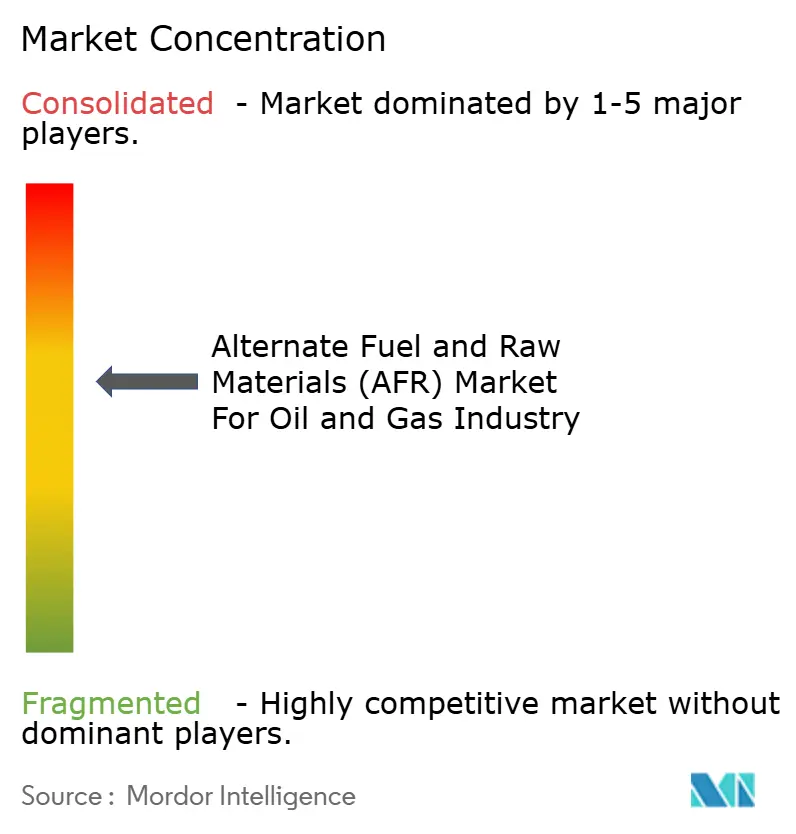
The alternate fuel and raw materials (AFR) market for oil and gas is moderately consolidated in processing and logistics. Five to 6 large environmental services and waste management groups hold significant certified hazardous waste capacity, while regional specialists compete on location, technical capability, or particular waste streams. Leading providers seek control of collection, laboratory testing, blending, and industrial offtake. Veolia completed its acquisition of Clean Earth in 2026 for USD 3.04 billion. The transaction doubled Veolia’s U.S. hazardous-waste footprint and raised its total U.S. revenue to USD 6.3 billion.
Clean Harbors reported that its Safety-Kleen Sustainability Solutions revenue rose 41% year over year in the second quarter of 2026, while adjusted EBITDA rose 143%. The company also disclosed a 10-year disposal contract valued at USD 600 million for incineration waste and complex wastewater. These moves show how scale, disposal capacity, and long-term contracts can reinforce market positions by making certified treatment capacity available to customers with complex waste streams. N+P Group, Geocycle, REMONDIS, Renewi, Tradebe, and Indaver focus on vertical integration of testing and blending capabilities. Consistent calorific quality is important for industrial customers who require a reliable fuel input.
Technology-focused specialists create competition through recovery systems for defined waste types and treatment methods. The November 2025 U.S. patent for co-processing oil drilling waste reflects activity in this area. Modular recovery equipment for remote and offshore sites remains an opening because standardized commercial systems are limited. The Basel Convention and GCCA frameworks provide reference points for sound co-processing and fuel-quality governance. Larger groups can manage hazardous-grade certification more easily, which may strengthen their position where permitting requirements are complex. The alternate fuel and raw materials (AFR) market for oil and gas remains open to smaller firms that can offer specialized recovery performance close to waste-generation sites and respond to conditions that do not suit centralized processing.
Leaders of Alternate Fuel and Raw Materials (AFR) Market For Oil and Gas Industry
Veolia Environnement S.A.
SUEZ S.A.
Remondis SE & Co. KG
Biffa Limited
Renewi plc
- *Disclaimer: Major Players sorted in no particular order

Recent Industry Developments
- July 2026: Clean Harbors disclosed a 10-year disposal contract, estimated at USD 600 million over its life, covering incineration waste and complex wastewater volumes with a U.S. manufacturer expanding domestic operations. The contract is scheduled to commence in Q4 2026 and reach full capacity by 2030, representing a significant long-term revenue lock-in for the company’s Environmental Services segment.
- June 2026: Petrobras approved the Final Investment Decision for a USD 1.2 billion biorefinery at its Presidente Bernardes Refinery in Cubatão, Brazil, with capacity to produce 15,000 barrels per day of bio-jet fuel and renewable diesel. Startup is scheduled for 2030, aligning with Brazil’s Future Fuel Law and CORSIA aviation fuel mandates, representing one of the largest alternative feedstock commitments by a national oil company.
- May 2026: Repsol commenced large-scale production at its second dedicated renewable fuels facility at the Puertollano Industrial Complex, producing 100% renewable diesel from used cooking oil and agri-food residues, with a capacity to generate 200,000 metric tons of renewable diesel per year. The facility also produces sustainable aviation fuel from organic waste and uses renewable hydrogen produced from biogas, further reducing the carbon dioxide footprint of the diesel produced by up to 98% compared with mineral-based fuel.
- March 2026: TotalEnergies started up France’s first chemical plastic recycling plant at the Grandpuits zero-petroleum platform in Seine-et-Marne, with a capacity of 15,000 metric tons per year. The facility converts non-mechanically-recyclable plastics into a synthetic pyrolysis oil that substitutes fossil feedstock in petrochemical production.


Scope of Report on Alternate Fuel and Raw Materials (AFR) Market For Oil and Gas Industry
The Alternate Fuel and Raw Materials (AFR) Market for the Oil & Gas Industry covers the production, processing, supply, and utilization of alternative fuels and secondary raw materials. These materials are derived from waste, industrial by-products, biomass, and recycled materials, and are used to reduce the consumption of conventional fossil fuels and virgin raw materials in oil and gas operations and associated energy infrastructure.
The Alternate Fuel and Raw Materials (AFR) for Oil and Gas Market is segmented by AFR type, end user, and geography. By AFR type, the market is segmented into recovered hydrocarbon fuel, alternative engineered fuel, refuse-derived fuel (RDF), solid recovered fuel (SRF), recovered waste oil, and other AFR types. By end user, the market is segmented into integrated oil and gas companies, national oil companies (NOCs), independent exploration and production (E&P) companies, drilling contractors, oilfield-service companies, and other end users. Geographically, the market is segmented across 26 countries in major regions. For each segment, the market sizing and forecasts have been provided on the basis of value (USD).
| Recovered Hydrocarbon Fuel |
| Alternative Engineered Fuel |
| Refuse-Derived Fuel |
| Solid Recovered Fuel |
| Recovered Waste Oil |
| Other AFR Types |
| Integrated Oil and Gas Companies |
| National Oil Companies |
| Independent Exploration and Production Companies |
| Drilling Contractors |
| Oilfield-Service Companies |
| Other End-Users |
| North America | United States |
| Canada | |
| Mexico | |
| Europe | Germany |
| France | |
| Italy | |
| Spain | |
| United Kingdom | |
| Poland | |
| Russia | |
| Rest of Europe | |
| Asia-Pacific | China |
| India | |
| Japan | |
| South Korea | |
| Australia | |
| Indonesia | |
| Vietnam | |
| Thailand | |
| Rest of Asia-Pacific | |
| South America | Brazil |
| Argentina | |
| Chile | |
| Rest of South America | |
| Middle East and Africa | Saudi Arabia |
| United Arab Emirates | |
| Egypt | |
| South Africa | |
| Morocco | |
| Rest of Middle East and Africa |
| By AFR Type | Recovered Hydrocarbon Fuel | |
| Alternative Engineered Fuel | ||
| Refuse-Derived Fuel | ||
| Solid Recovered Fuel | ||
| Recovered Waste Oil | ||
| Other AFR Types | ||
| By End User | Integrated Oil and Gas Companies | |
| National Oil Companies | ||
| Independent Exploration and Production Companies | ||
| Drilling Contractors | ||
| Oilfield-Service Companies | ||
| Other End-Users | ||
| By Geography | North America | United States |
| Canada | ||
| Mexico | ||
| Europe | Germany | |
| France | ||
| Italy | ||
| Spain | ||
| United Kingdom | ||
| Poland | ||
| Russia | ||
| Rest of Europe | ||
| Asia-Pacific | China | |
| India | ||
| Japan | ||
| South Korea | ||
| Australia | ||
| Indonesia | ||
| Vietnam | ||
| Thailand | ||
| Rest of Asia-Pacific | ||
| South America | Brazil | |
| Argentina | ||
| Chile | ||
| Rest of South America | ||
| Middle East and Africa | Saudi Arabia | |
| United Arab Emirates | ||
| Egypt | ||
| South Africa | ||
| Morocco | ||
| Rest of Middle East and Africa | ||


Key Questions Answered in the Report
What is the size of the alternate fuel and raw materials (AFR) market for oil and gas Industry?
The alternate fuel and raw materials (AFR) market for oil and gas Industry stands at USD 1.12 billion in 2026 and is projected to reach USD 1.58 billion by 2031.
Which AFR type leads oil and gas applications?
Recovered Hydrocarbon Fuel led with a 31.8% share in 2025 because it is compatible with existing cement kilns, refinery heaters, and industrial burners. Its established upgrading routes also support its role in the alternate fuel and raw materials (AFR) market for oil and gas. The fuel can enter conventional industrial systems without major changes to the customer’s existing combustion equipment.
Which end user is expanding fastest?
National Oil Companies are forecast to grow at an 8.2% CAGR through 2031 as they expand resource-recovery programs. Their upstream assets and refinery investments can link waste handling to reliable demand for traceable feedstocks in the alternate fuel and raw materials (AFR) market for oil and gas. This structure can reduce the distance between waste generation, treatment, and final use.
Which region is growing fastest?
Asia-Pacific is forecast to grow at an 8.8% CAGR through 2031, supported by upstream activity and tighter disposal needs. China’s cement-kiln co-processing standard adds an important potential offtake route as local processing capacity develops. This can support qualifying fuels when cement producers need alternative thermal inputs that meet applicable specifications.
How concentrated is the supplier base?
Processing and logistics are moderately consolidated because a limited group controls substantial certified hazardous-waste capacity. Regional and technology-focused providers still compete through site proximity, modular recovery methods, and specialist handling of complex drilling-waste streams. Their position is strongest when local waste chemistry or transport conditions limit the value of a centralized service model.
Page last updated on:





