
Alternate Fuel and Raw Materials (AFR) Market Size and Share
Market Overview
| Study Period | 2021 - 2031 |
|---|---|
| Market Size (2026) | USD 18.33 Billion |
| Market Size (2031) | USD 25.45 Billion |
| Growth Rate (2026 - 2031) | 6.78 % |
| Fastest Growing Market | Asia-Pacific |
| Largest Market | Europe |
| Market Concentration | Medium |
Major Players *Disclaimer: Major Players sorted in no particular order Image © Mordor Intelligence. Reuse requires attribution under CC BY 4.0. | |
Alternate Fuel and Raw Materials (AFR) Market Analysis by Mordor Intelligence
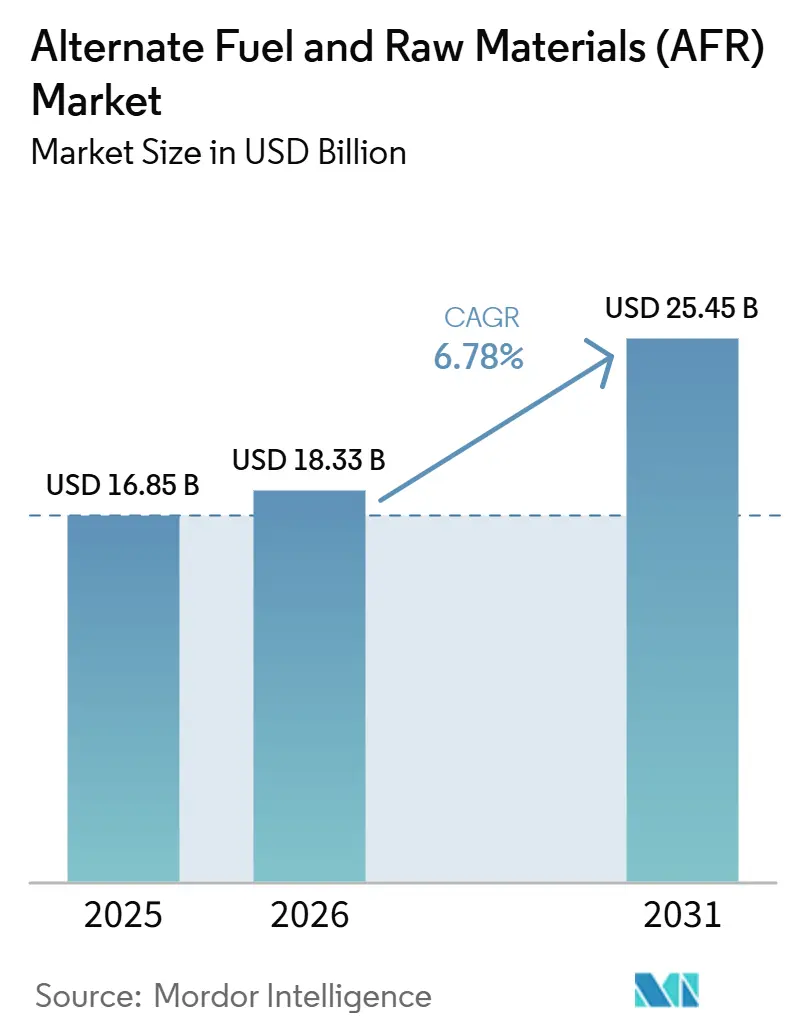
The Alternate Fuel and Raw Materials Market size is expected to grow from USD 16.85 billion in 2025 to USD 18.33 billion in 2026 and is forecast to reach USD 25.45 billion by 2031 at 6.78% CAGR over 2026-2031. Decarbonization requirements in cement production and tighter landfill restrictions are supporting demand for recovered fuels and substitute raw materials. Producers are also seeking stable fuel costs and long-term access to waste streams as coal and petcoke prices remain volatile. The alternative fuel and raw material market is increasingly shaped by the quality of incoming materials, because kiln operators need predictable calorific value and lower contaminant levels. Europe provides the most developed operating model, while Asia-Pacific offers the strongest growth opportunity as cement capacity and waste-processing systems expand. Companies with collection, pre-processing, quality control, and cement-industry partnerships are better placed to secure supply contracts and manage regulatory changes.
Key Report Takeaways
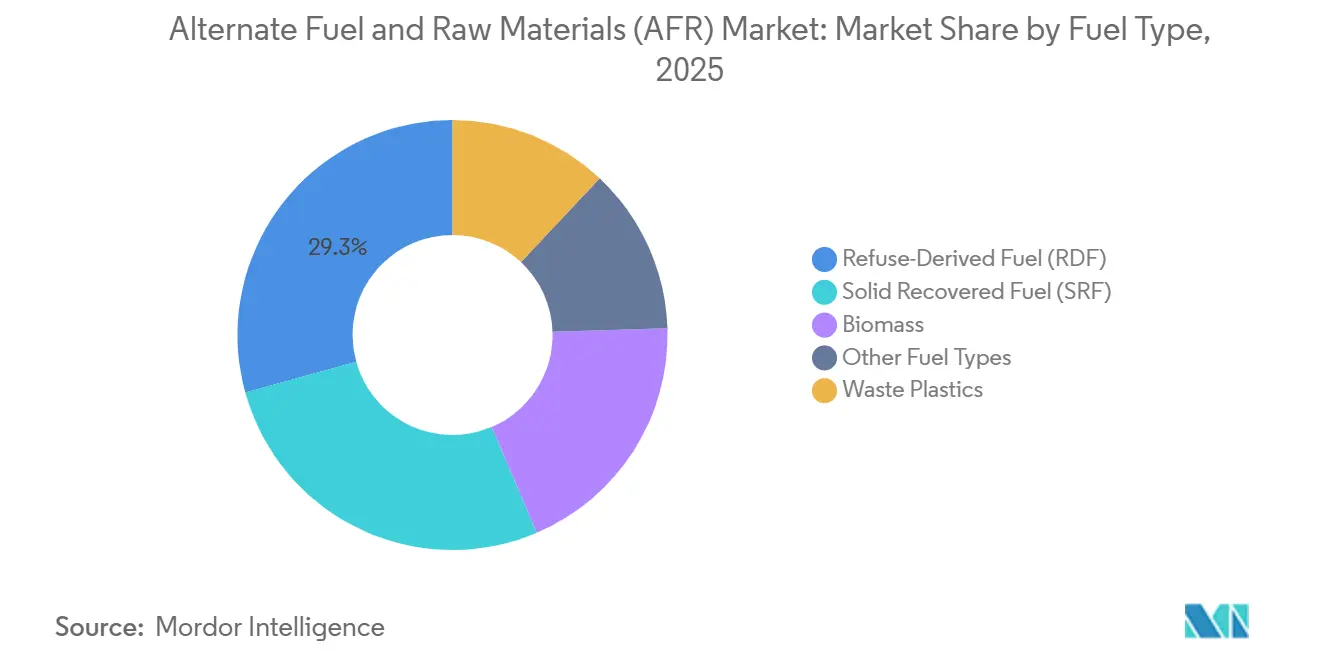
- By fuel type, RDF led with 29.3% of the alternative fuel and raw material market share in 2025, while SRF is forecast to grow at an 8.5% CAGR through 2031.
- By raw material type, fly ash held 39.7% of the alternative fuel and raw material market share in 2025, while steel slag is projected to advance at a 7.2% CAGR through 2031.
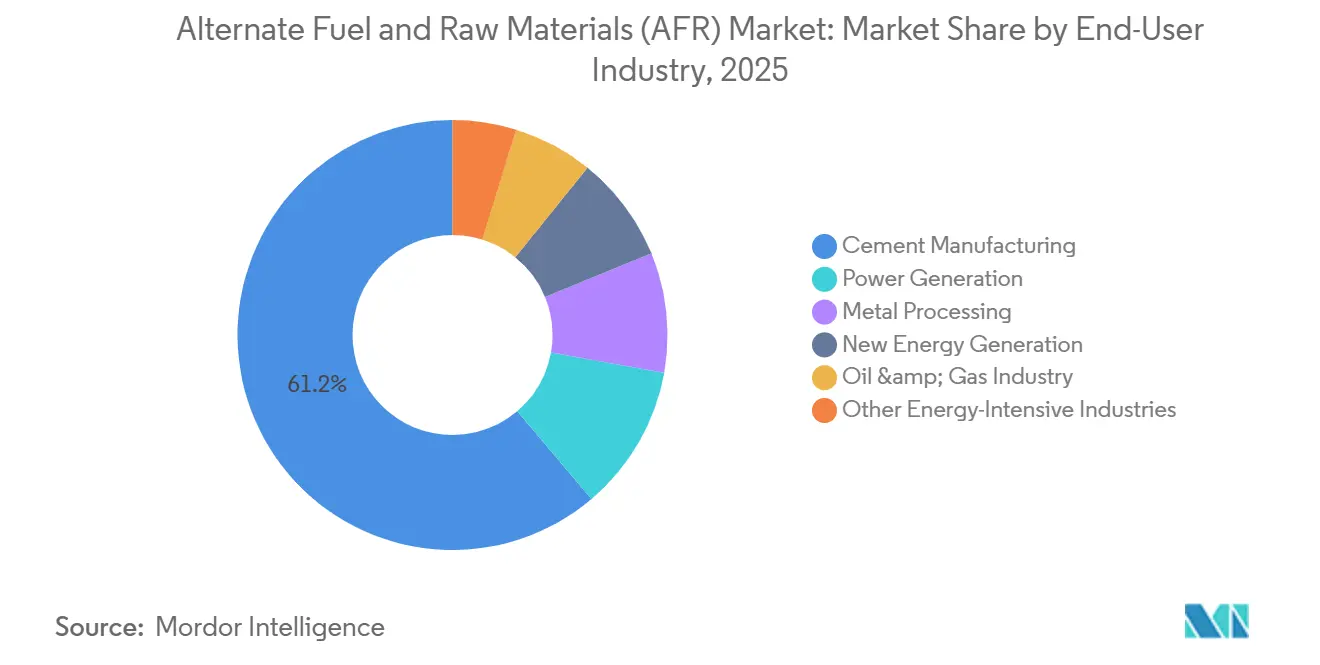
- By end-user industry, cement manufacturing accounted for 61.2% of demand in 2025, while New Energy Generation is expected to record a 9.8% CAGR through 2031.
- By geography, Europe held 41.3% of the alternative fuel and raw material market in 2025, while Asia-Pacific is forecast to expand at an 8.7% CAGR through 2031.
Note: Market size and forecast figures in this report are generated using Mordor Intelligence’s proprietary estimation framework, updated with the latest available data and insights as of January 2026.
Global Alternate Fuel and Raw Materials (AFR) Market Trends and Insights
Drivers Impact Analysis*
| Driver | (~) % Impact on CAGR Forecast | Geographic Relevance | Impact Timeline |
|---|---|---|---|
| Rising Decarbonization Targets in Cement Manufacturing | +2.20% | Global, most pronounced in Europe and South Asia | Medium term (2-4 years) |
| Landfill Diversion and Circular Economy Mandates | +1.60% | EU core, spill-over to ASEAN and South America | Medium term (2-4 years) |
| Fossil Fuel Price Volatility and Energy Security Concerns | +1.00% | Global, particularly acute in EU and emerging Asia | Short term (≤ 2 years) |
| Emerging-Market Cement Capacity and Waste Infrastructure Build-Out | +1.40% | Asia-Pacific, Middle East, and Africa | Long term (≥ 4 years) |
| Digital Feedstock Characterization and Combustion Optimization | +0.70% | Global, early deployment in Europe and China | Long term (≥ 4 years) |
| Carbon Capture-Compatible Kiln Retrofits Increasing AFR Compatibility | +0.60% | Europe and North America | Long term (≥ 4 years) |
| Source: Mordor Intelligence | |||
Rising Decarbonization Targets in Cement Manufacturing
Cement producers are using recovered fuels because thermal substitution can reduce fossil fuel use without replacing existing kiln systems. Germany’s cement sector raised its alternative-fuel use from 7% in 1990 to 77% in 2024 and has set a 90% target for 2045 [1]Institut der deutschen Wirtschaft, “Zementindustrie: Mit Neuer Technologie Für Mehr Klimaschutz,” Institut der deutschen Wirtschaft, iwd.de.. Austria’s cement plants reached an 87.7% thermal substitution rate in 2024, using waste plastics, used tires, old oils, solvents, and paper-fiber residues [2]Verband der österreichischen Zementindustrie, “Sauerstoff in der Zementherstellung: Wenn Luft im Drehrohrofen Zum Effizienzproblem Wird,” Verband der österreichischen Zementindustrie, industriemagazin.at.. France’s sector achieved 55% fossil-fuel substitution in 2024, compared with 52% in 2023, and its industry association is targeting 80% by 2030. The alternative fuel and raw material market benefits when these targets move from voluntary commitments into plant-level procurement and capital programs. A peer-reviewed review found that 20% RDF thermal substitution can reduce global warming potential by 3.3% to 4.2%, giving operators a measurable environmental basis for fuel switching.
Landfill Diversion and Circular Economy Mandates
Landfill diversion policies are enlarging the pool of residual materials that can be processed into industrial fuel. The European Union’s landfill policy includes a 10% municipal-landfill target by 2035, increasing pressure to find alternatives for non-recyclable waste. An EU study found that SRF and RDF use in energy-intensive industries could reach 2 to 3 times current levels under suitable market conditions. The same study reported that cement and lime plants can substitute up to 85% of solid fossil fuels when fuel quality and volumes remain consistent. This puts greater value on sorting, drying, and contamination control across the alternative fuel and raw material market. It also creates pressure between energy recovery operators and cement kilns for high-calorific residual materials.
Fossil Fuel Price Volatility and Energy Security Concerns
Fossil fuel price changes encourage cement companies to seek supply arrangements that provide more stable energy costs. Long-term recovered-fuel contracts can combine tipping-fee income, defined fuel specifications, and predictable volumes. This can lower a cement producer’s exposure to coal and petcoke price movements. The benefit is strongest where carbon costs or fuel-import risks add to conventional energy expenses. The alternative fuel and raw material market, therefore, depends on commercial arrangements as much as on environmental policy. Municipal partnerships are becoming important because they can link waste collection, pre-processing, and kiln supply under longer operating agreements.
Emerging-Market Cement Capacity and Waste Infrastructure Build-Out
New cement capacity in India, Vietnam, Indonesia, and African markets can support further demand for alternative fuels. Plants designed with higher fuel flexibility can use more recovered material once local preparation systems become available. India’s waste stream is large, but moisture and inert content can limit direct use in cement kilns. This makes shredding, drying, sorting, and storage capacity central to the alternative fuel and raw material market in emerging economies. Commercial plants need a reliable link between municipal waste collection and kiln-ready fuel. The opportunity is greatest where new cement assets and waste-processing investments are developed together.
Restraints Impact Analysis*
| Restraint | (~) % Impact on CAGR Forecast | Geographic Relevance | Impact Timeline |
|---|---|---|---|
| Inconsistent Waste Quality and Supply Reliability | -1.80% | Global, most severe in South and Southeast Asia | Medium term (2-4 years) |
| High Pre-Processing, Storage and Kiln Retrofit Capital Requirements | -2.00% | Global, disproportionate in emerging markets | Long term (≥ 4 years) |
| Competing Waste-Valorization Routes and Residual-Waste Scarcity | -1.20% | EU core, particularly Germany, Netherlands, and UK | Medium term (2-4 years) |
| Local Permitting, Emissions and Social-License Constraints | -0.90% | Europe, India, and South America | Medium term (2-4 years) |
| Source: Mordor Intelligence | |||
Inconsistent Waste Quality and Supply Reliability
Irregular material composition remains a major operational risk for kiln operators and fuel suppliers. Municipal waste in India often contains 40% to 50% moisture and high levels of sand, glass, and stone. These materials can damage equipment and require more extensive pre-processing before they can replace coal. In Europe, tighter quality specifications are increasing processing costs and favoring operators with established testing systems. The alternative fuel and raw material market can face local shortages when cement plants depend on imported or poorly sorted fuel. Cross-border shipments also remain exposed to national waste-management rules, which can disrupt established supply routes.
High Pre-Processing, Storage and Kiln Retrofit Capital Requirements
High substitution rates require investment in waste handling, storage, dosing equipment, monitoring, and clinker-quality management. Vicat’s Airvault cement plant modernization exceeded EUR 350 million, equivalent to USD 379 million, and enabled the plant to operate with up to 90% alternative fuels while preparing for carbon capture [3]Vicat, “The New Kiln at the Airvault Cement Plant in Deux-Sèvres Is Now Operational,” Vicat, batipole.com.. SRF also requires sorting, shredding, drying, and ongoing quality checks to meet the standards expected by cement plants. Smaller collectors and mid-sized manufacturers may lack the capital needed for this infrastructure. As a result, investment barriers can strengthen the position of established integrated suppliers in the alternative fuel and raw material market. Competing waste-valorization routes and local permitting requirements can add further uncertainty to project returns.
*Our forecasts treat driver/restraint impacts as directional, not additive. The impact forecasts reflect baseline growth, mix effects, and variable interactions.
Segment Analysis
By Fuel Type: SRF Gaining Share as Kiln Quality Specifications Rise
RDF held 29.3% of the alternative fuel and raw material market share in 2025, supported by established co-processing systems in Europe, India, and Southeast Asia. SRF is projected to expand at an 8.5% CAGR between 2026 and 2031 as kiln operators place greater weight on fuel consistency. SRF can offer tighter control over calorific value, chlorine, and mercury than mixed RDF. These characteristics support compliance with EN 15359 and more demanding emissions requirements. Higher-quality fuel can also reduce operational disruption at cement plants.
Biomass remains important in kiln main burners because wood residues, agricultural by-products, and processed pellets can lower reliance on fossil fuels. Turboden installed a 1.8 MW biochar-based power-generation project using organic waste, showing that biomass conversion can also support electricity production [4]Turboden, “Turboden Installed 1.8 MW Biochar-Based Power Generation Project Using ORC Technology,” Turboden, turboden.com.. Waste plastics are used as high-calorific precalciner fuel in many European kilns. The European waste hierarchy limits the use of clean plastic fractions for energy recovery because recycling receives priority. This directs fuel suppliers toward more detailed separation of mixed waste streams. ANDRITZ commissioned a commercial Steam-Ex pellet facility in Malaysia during 2026, using oil palm residues to produce advanced solid biofuels for industrial applications.



By Raw Material Type: Fly Ash Anchors Demand, Steel Slag Accelerates on Steelmaking Shifts
Fly ash accounted for 39.7% of the alternative fuel and raw material market share in 2025 because it is widely used as a supplementary cementitious material. It can replace part of the clinker content in cement and reduce carbon intensity per metric ton of output. Blast furnace slag remains important where integrated steelmaking industries are established. Germany, South Korea, Japan, and parts of South America have strong potential for these material flows. Foundry sand also provides silica-rich material for cement raw meals.
Steel slag is expected to grow at a 7.2% CAGR from 2026 to 2031 as steelmaking shifts toward electric arc furnaces. Research published in 2026 found that ultrafine steel slag and fly ash can improve steel passivation in ternary cements. Another 2026 study documented modification routes for BOF and EAF slag that can produce clinker-substitute minerals. Widespread use still depends on qualification under EN 197-1 and comparable ASTM requirements. This creates a time gap between research results and broad commercial adoption. Suppliers that complete qualification early could have an advantage as demand for certified substitute materials grows.
By End-User Industry: Cement Anchors Demand as New Energy Generation Opens Growth Channels
Cement manufacturing commanded 61.2% of end-user demand in 2025 because kilns require large volumes of thermal energy and can use a wide range of recovered materials. High kiln temperatures support complete combustion under controlled operating conditions. Cement plants also have well-developed co-processing rules in several major markets. Power generation and metal processing provide important secondary outlets for alternative fuels and substitute materials. Oil and gas applications remain smaller, although some industrial waste streams can be managed through regulated co-processing routes.
New Energy Generation is forecast to grow at a 9.8% CAGR through 2031, making it the fastest-growing end-user segment. This group includes biomass-to-energy plants, waste-gasification facilities, and hybrid biochar-power systems. These facilities use processed waste streams as primary inputs rather than supplemental kiln fuels. Wildfire Energy received Queensland government funding in 2026 for the Bulwer Island Biofuels Hub, which is planned to generate up to 1.4 MW of electricity in its first phase. Such projects require consistent upstream sorting and processing capacity. Their expansion can broaden demand beyond the cement-focused base of the alternative fuel and raw material market.
Geography Analysis
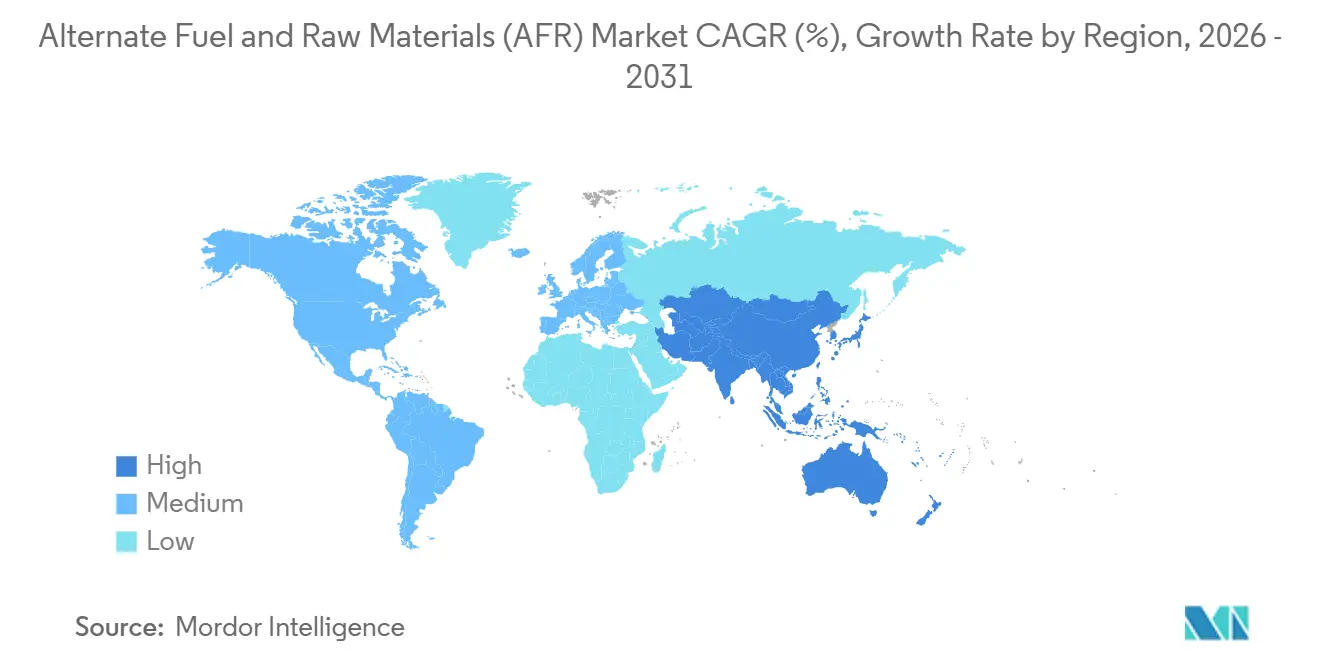
Europe held 41.3% of the alternative fuel and raw material market in 2025 because it has mature co-processing systems, landfill restrictions, and long-standing waste directives. Germany’s cement sector used 77% alternative fuels in 2024 and is targeting 90% by 2045. France reached a 55% fossil-fuel substitution rate in 2024 and has a sector target of 80% by 2030 AFOCO. Italy and Spain offer further near-term volume potential as more regional fuel-processing capacity is developed. Poland and other Central and Eastern European countries also represent the next phase of infrastructure investment. Holcim Germany achieved an 81.2% thermal substitution rate in 2024, setting a high operational reference point for regional producers.
Asia-Pacific is expected to expand at an 8.7% CAGR from 2026 to 2031, the fastest pace among regions in the alternative fuel and raw material market. India and China are central to this outlook because both need larger waste-processing systems alongside cement capacity. India’s large municipal waste stream can support higher fuel use once moisture, contamination, and collection gaps are addressed. China is also investing in pre-processing technology that can increase the use of prepared fuels in cement kilns. Vietnam, Thailand, and Indonesia are important markets for new cement capacity and related waste-management investment. Japan, South Korea, and Australia provide stable demand from more mature industrial systems.
North America, South America, and the Middle East and Africa remain less developed but offer specific growth routes. In North America, state and provincial regulatory differences continue to limit co-processing compared with Europe. Biomass and renewable-gas projects remain relevant for managing organic and landfill-derived material. In South America, integrated waste and cement operators can expand capacity by building regional supply networks. The Middle East and Africa are earlier in the development cycle because waste rules and pre-processing systems are still evolving. The alternative fuel and raw material market in these regions depends on stronger links among municipalities, industrial waste generators, and cement plants.

Competitive Landscape
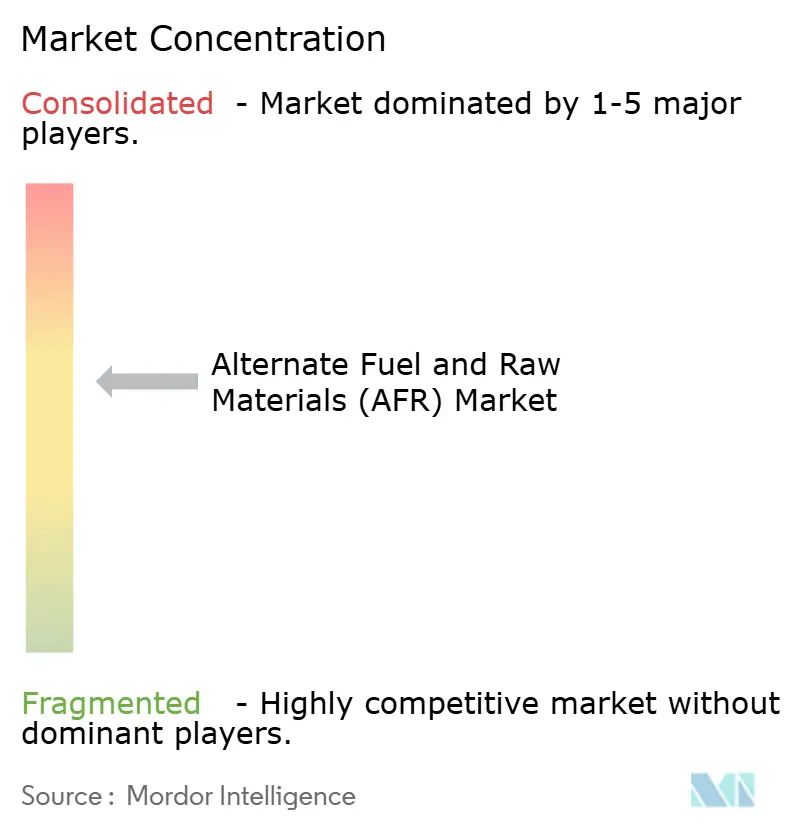
The alternative fuel and raw material market is moderately fragmented. Geocycle SA, Veolia Environnement S.A., and REMONDIS SE & Co. KG form a leading group because they combine waste collection, pre-processing, and industrial delivery capabilities. PreZero International GmbH, Renewi plc, Indaver NV, EEW Energy from Waste GmbH, and Ragn-Sells AB compete through regional coverage, fuel quality, and cement-producer contracts. Market participants are moving toward stronger control of feedstock quality and traceability. This favors companies that can test materials and maintain steady specifications across large supply networks
REMONDIS announced a minority investment in Saubermacher Dienstleistungs AG in January 2026, extending its presence in Austria and widening its access to municipal and commercial waste streams. Other suppliers are adding capacity for more consistent SRF production and closer cement-plant partnerships. Vicat modernized Airvault to support up to 90% alternative-fuel use and future carbon-capture deployment. These moves show that scale, higher fuel quality, and cement-plant integration are important competitive factors. Digital monitoring is also becoming more relevant because it can reduce variability in fuel handling and combustion.
Open opportunities remain in lower-capital solutions for mid-sized cement plants, digital fuel-verification systems, and facilities designed for wet or inert-heavy waste streams. These areas are particularly relevant in South and Southeast Asia, where waste availability does not always translate into kiln-ready fuel. The leading companies are likely to be those that can build local collection partnerships while meeting recognized quality standards. The alternative fuel and raw material industry is therefore moving toward a more integrated model rather than a simple waste-disposal service.
Alternate Fuel and Raw Materials (AFR) Industry Leaders
Geocycle SA
Veolia Environnement S.A.
SUEZ S.A.
Renewi plc
Biffa Limited
- *Disclaimer: Major Players sorted in no particular order

Recent Industry Developments
- July 2026: Wildfire Energy secured Queensland government funding for the Bulwer Island Biofuels Hub in Australia, a first-of-kind waste-to-biofuels commercial reference plant producing bio-syngas and up to 1.4 MW of electricity in Phase 1, with bio-methanol and sustainable aviation fuel planned for future phases.
- June 2026: Paprec and Vicat's ALTèreNATIVE joint venture at Martigues, France, commenced operations, producing 50,000 metric tons per year of CSR from non-recyclable waste with a EUR 15.4 million investment, equivalent to USD 16.7 million. The facility avoids an estimated 48,000 metric tons of CO2 annually by substituting coal with high-calorific CSR at local cement plants.
- June 2026: ANDRITZ commissioned the world's first commercial-scale Steam-Ex pellet plant with Rainbow Pellet Group in Malaysia, converting oil palm residues into advanced solid biofuels suitable for direct coal replacement in industrial kilns, opening a new agricultural waste-to-AFR pathway in Southeast Asia.
- March 2026: Geocycle commissioned a new mineral-waste treatment and recovery platform at Lafarge France's Martres-Tolosane cement plant in Haute-Garonne, scheduled for full operation in summer 2026. The platform processes mineral wool, biomass ash, fly ash, and impacted soils, converting materials previously destined for class 1 or 2 landfills into mineral raw material substitutes for cement production.


Global Alternate Fuel and Raw Materials (AFR) Market Report Scope
Alternate Fuel and Raw Materials (AFR) refers to waste-derived or non-conventional materials used as substitutes for traditional fossil fuels and virgin raw materials in industrial processes, particularly in energy-intensive industries such as cement manufacturing, lime production, steel, and power generation. AFR enables industries to recover both the energy content and material value of waste that would otherwise be landfilled or incinerated without resource recovery.
The Alternative Fuel and Raw Material (AFR) market is segmented by fuel type, raw material type, end-user industry, and geography. By fuel type, the market is segmented into refuse-derived fuel (RDF), solid recovered fuel (SRF), biomass, waste plastics, and other fuel types. By raw material type, the market is segmented into fly ash, blast furnace (bf) slag, foundry sand, steel slag, and other raw materials. By end-user industry, the market is segmented into cement, power generation, metal processing, new energy, oil & gas, and other end-user industries. The report also covers the market size and forecasts for the global alternative fuel and raw material (afr) market across 26 countries in key regions. For each segment, the market sizing and forecasts have been provided on the basis of value (USD).
| Refuse-Derived Fuel (RDF) |
| Solid Recovered Fuel (SRF) |
| Biomass |
| Waste Plastics |
| Other Fuel Types |
| Fly Ash |
| Blast Furnace Slag |
| Foundry Sand |
| Steel Slag |
| Other Raw Material Types |
| Cement Manufacturing |
| Power Generation |
| Metal Processing |
| New Energy Generation |
| Oil & Gas Industry |
| Other Energy-Intensive Industries |
| North America | United States |
| Canada | |
| Mexico | |
| Europe | Germany |
| France | |
| Italy | |
| Spain | |
| United Kingdom | |
| Poland | |
| Russia | |
| Rest of Europe | |
| Asia-Pacific | China |
| India | |
| Japan | |
| South Korea | |
| Australia | |
| Indonesia | |
| Vietnam | |
| Thailand | |
| Rest of Asia-Pacific | |
| South America | Brazil |
| Argentina | |
| Chile | |
| Rest of South America | |
| Middle East and Africa | Saudi Arabia |
| United Arab Emirates | |
| Egypt | |
| South Africa | |
| Morocco | |
| Rest of Middle East and Africa |
| By Fuel Type | Refuse-Derived Fuel (RDF) | |
| Solid Recovered Fuel (SRF) | ||
| Biomass | ||
| Waste Plastics | ||
| Other Fuel Types | ||
| By Raw Material Type | Fly Ash | |
| Blast Furnace Slag | ||
| Foundry Sand | ||
| Steel Slag | ||
| Other Raw Material Types | ||
| By End-User Industry | Cement Manufacturing | |
| Power Generation | ||
| Metal Processing | ||
| New Energy Generation | ||
| Oil & Gas Industry | ||
| Other Energy-Intensive Industries | ||
| By Geography | North America | United States |
| Canada | ||
| Mexico | ||
| Europe | Germany | |
| France | ||
| Italy | ||
| Spain | ||
| United Kingdom | ||
| Poland | ||
| Russia | ||
| Rest of Europe | ||
| Asia-Pacific | China | |
| India | ||
| Japan | ||
| South Korea | ||
| Australia | ||
| Indonesia | ||
| Vietnam | ||
| Thailand | ||
| Rest of Asia-Pacific | ||
| South America | Brazil | |
| Argentina | ||
| Chile | ||
| Rest of South America | ||
| Middle East and Africa | Saudi Arabia | |
| United Arab Emirates | ||
| Egypt | ||
| South Africa | ||
| Morocco | ||
| Rest of Middle East and Africa | ||


Key Questions Answered in the Report
What is driving demand for alternative fuels and raw materials?
Cement decarbonization targets, landfill diversion rules, and the need for more stable industrial energy costs are supporting demand. These factors encourage waste suppliers and manufacturers to build longer-term material supply arrangements.
What is the size of the alternative fuel and raw material market?
The alternative fuel and raw material market is valued at USD 18.33 billion in 2026 and is forecast to reach USD 25.45 billion by 2031 at a 6.78% CAGR. Growth depends on expanding pre-processing capacity and industrial demand for recovered materials.
Which fuel type leads demand?
RDF led fuel demand with 29.3% share in 2025, while SRF is expected to grow fastest at an 8.5% CAGR through 2031. SRF growth reflects demand for more predictable quality in cement and other industrial applications.
Why is SRF growing faster than RDF?
SRF offers more consistent fuel quality and supports kiln compliance with tighter emissions and material-quality requirements. Its use requires more sorting, drying, and testing, which can raise entry barriers for smaller suppliers.
Which end-user segment is growing fastest?
New Energy Generation is forecast to grow at a 9.8% CAGR through 2031 as biomass, gasification, and biochar-power projects expand. These facilities increase demand for reliable processed feedstocks beyond cement kiln applications.
Which region offers the strongest growth outlook?
Asia-Pacific is projected to grow at an 8.7% CAGR through 2031 as waste-processing systems and cement capacity expand. India, China, Vietnam, Indonesia, and other developing markets need stronger links between waste collection and industrial users.
Page last updated on:


 Your data is secure and never sold or shared.


