
Almond Flour Market Size and Share
Market Overview
| Study Period | 2022 - 2032 |
|---|---|
| Market Size (2027) | USD 1.82 Billion |
| Market Size (2032) | USD 2.58 Billion |
| Growth Rate (2027 - 2032) | 7.22 % |
| Fastest Growing Market | Asia-Pacific |
| Largest Market | North America |
| Market Concentration | Low |
Major Players *Disclaimer: Major Players sorted in no particular order Image © Mordor Intelligence. Reuse requires attribution under CC BY 4.0. | |
Almond Flour Market Analysis by Mordor Intelligence
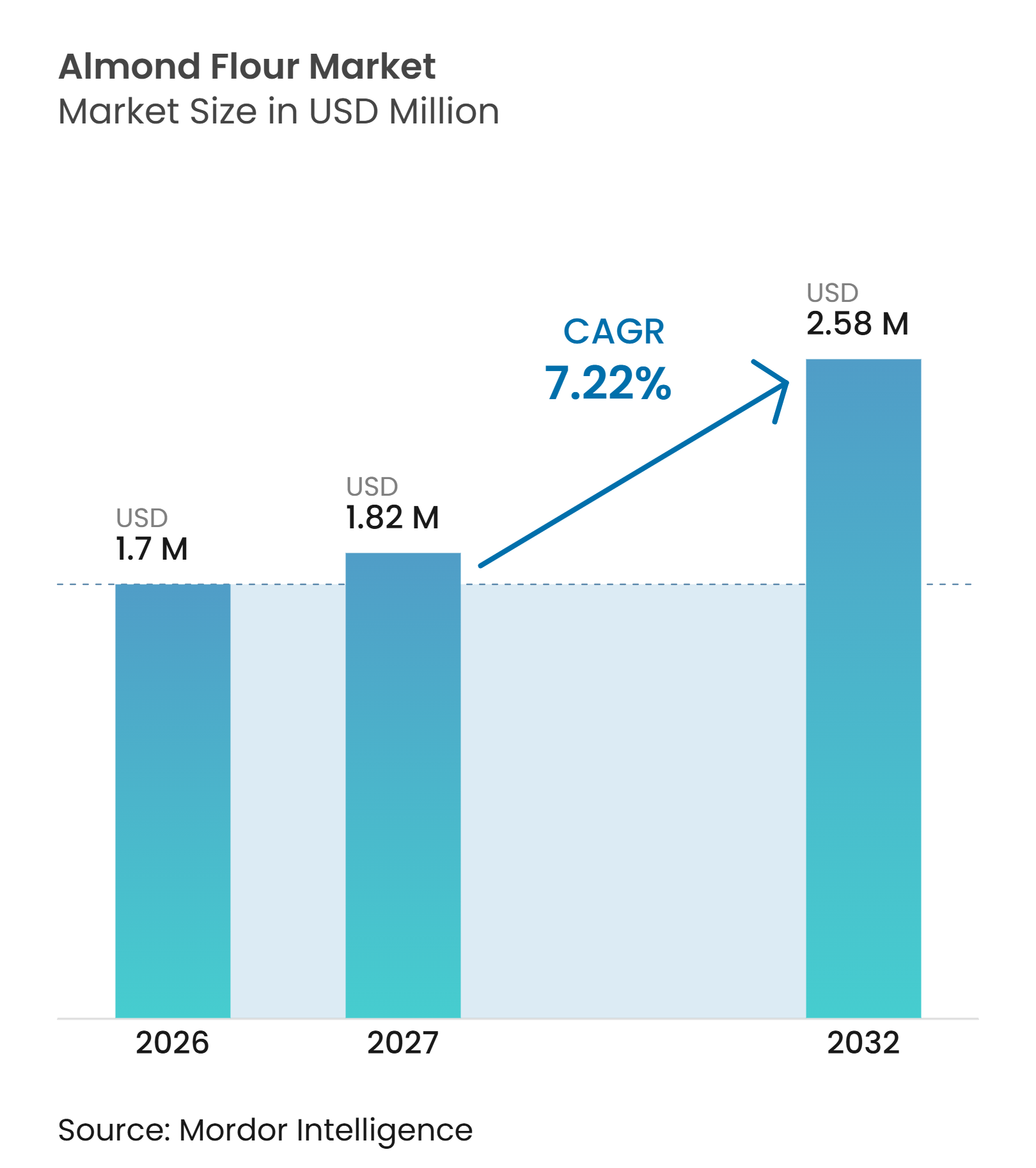
The almond flour market size was valued at USD 1.70 billion in 2026 and is estimated to grow from USD 1.82 billion in 2027 to reach USD 2.58 billion by 2032, at a CAGR of 7.22% during the forecast period (2027–2032). Demand now reaches beyond consumers managing celiac disease because gluten-free, ketogenic, and paleo eating patterns have widened the customer base. Almonds appear in more than 9,000 new product launches each year, and the Almond Board of California identifies them as the leading nut ingredient in global new product development. This places the almond flour market at the meeting point of dietary requirements and demand for simple ingredient lists. Manufacturers are responding by improving texture, reducing additive use, and strengthening traceability. Supply costs and compliance needs remain material limits on expansion, especially where consumers are highly price sensitive.
Key Report Takeaways
- By product type, Blanched Almond Flour held a 61.23% share of the almond flour market in 2026, while Natural Almond Flour is projected to grow at a 7.80% CAGR through 2032.
-
By nature, Organic Almond Flour accounted for 59.72% of revenue in 2026 and is forecast to expand at a 9.22% CAGR through 2032.
-
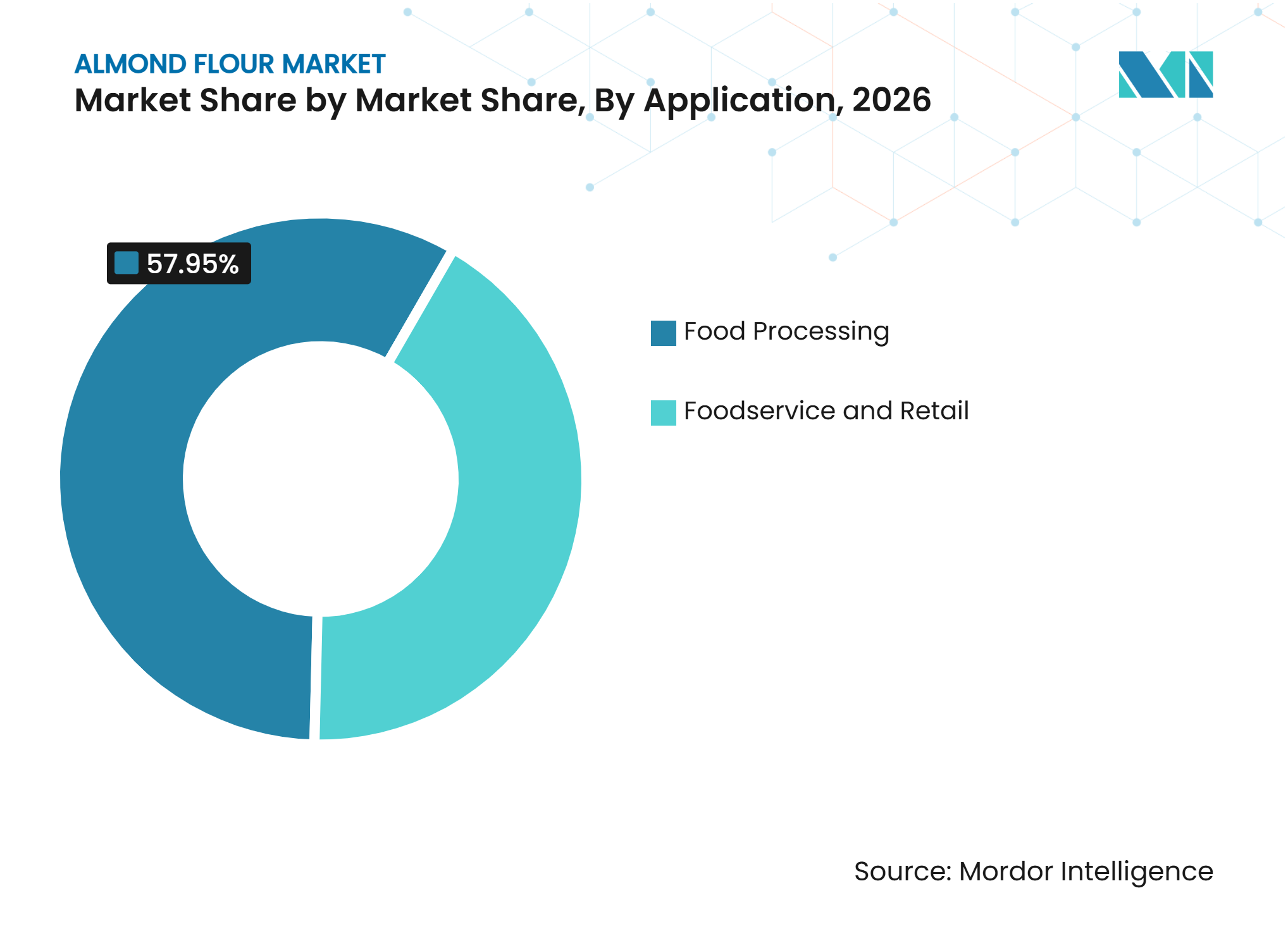
By application, Food Processing use represented 57.95% of revenue in 2026, while Retail is expected to advance at an 8.43% CAGR through 2032.
-
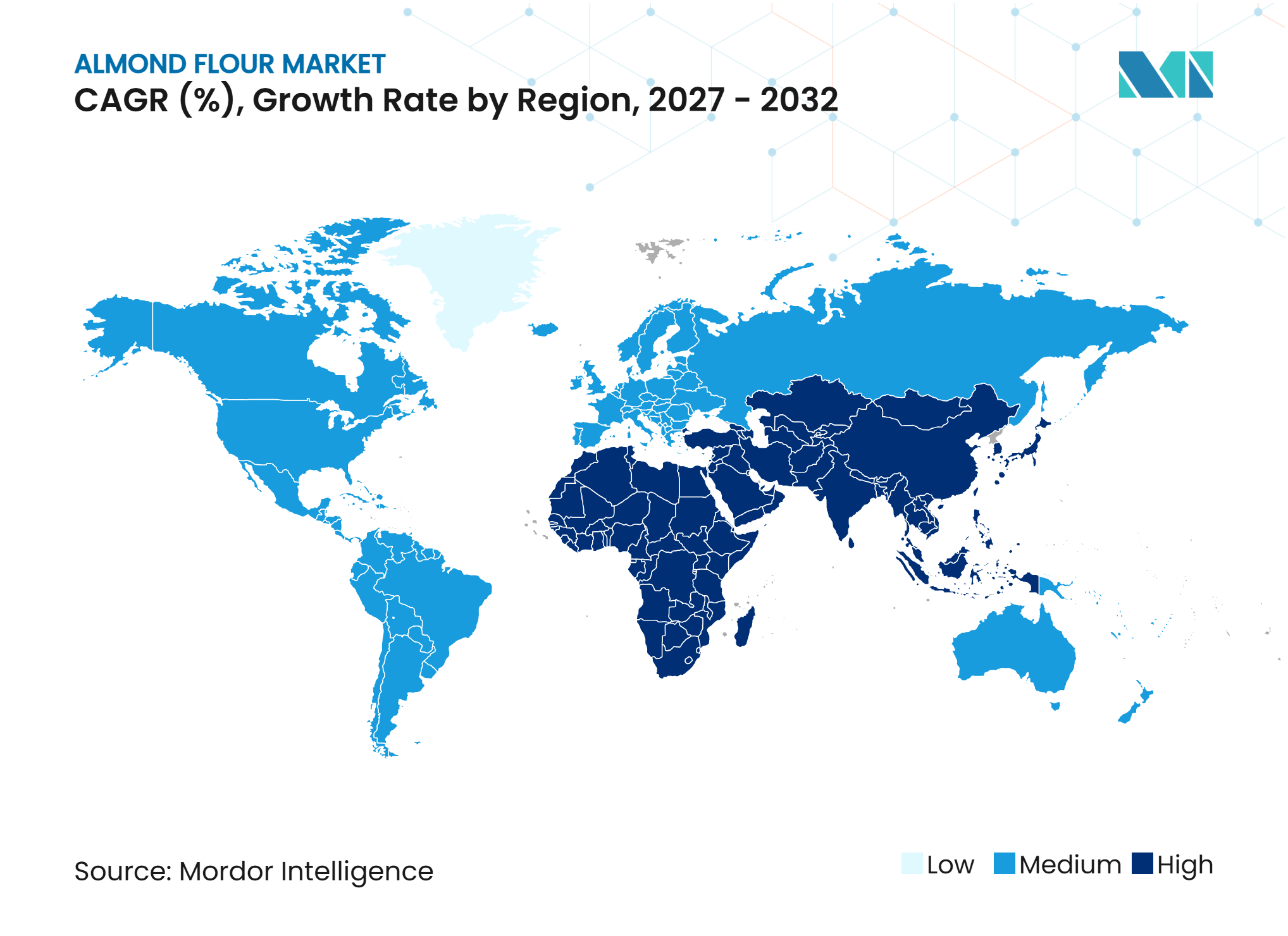
By geography, North America held 38.45% of revenue in 2026, while Asia-Pacific is forecast to grow at a 9.29% CAGR through 2032.
Note: Market numbers in this report are based on Mordor Intelligence's proprietary estimation framework, which combines nine months of actuals with Q4 projections for base year 2026.
Market Trends and Insights
Drivers Impact Analysis of Almond Flour Market*
| Driver | (~) % Impact on CAGR Forecast | Geographic Relevance | Impact Timeline |
|---|---|---|---|
| Preference for gluten-free, grain-free, and low-carbohydrate diets | +2.1% | Global, strongest in North America and Western Europe | Short term (≤ 2 years) |
| Applications beyond conventional baking | +1.1% | Global, with growing dairy-alternative and snack use in Asia-Pacific | Medium term (2-4 years) |
| Demand for clean-label and nutritionally enriched ingredients | +1.0% | North America, Europe, and Australia | Medium term (2-4 years) |
| Industrial adoption in bakery and confectionery | +1.4% | Global, with core demand in North America and Europe | Medium term (2-4 years) |
| Milling technology and particle-size customization | +0.7% | North American and European industrial processors | Long term (≥ 4 years) |
| Reformulation of staple foods for lower-glycemic positioning | +0.8% | North America, Europe, and urban Asia-Pacific markets | Medium term (2-4 years) |
| Source: Mordor Intelligence | |||
Growing Consumer Preference for Gluten-Free, Grain-Free, and Low-Carbohydrate Diets
Gluten-free flour demand has expanded from a clinical need into a broader lifestyle choice, increasing the potential audience for the almond flour market. Ardent Mills research cited by the Celiac Disease Foundation found that 94% of gluten-free eating occasions in the United States reflect lifestyle choices rather than a medical diagnosis[1]. Taste, texture, and value therefore matter as much as dietary suitability when consumers choose these products. The almond flour market must meet those everyday expectations if dietary interest is to translate into repeat purchases. The Food and Drug Adminstration (FDA) requires foods labeled gluten-free to contain fewer than 20 parts per million of gluten under 21 CFR 101.91[2]. Almond flour naturally meets the ingredient-side requirement, which can reduce reformulation needs compared with some grain-based substitutes. Producers still need effective controls for cross-contact and clear labeling to maintain consumer confidence.
Diversification of Almond Flour Applications Beyond Conventional Baking
The almond flour market is gaining applications where its fat profile and fine texture support moisture retention, emulsification, and protein enrichment. Formulators use it in dairy alternatives, plant-based protein bars, meat and fish coatings, and confectionery fillings. This widens the range of development work undertaken by almond flour market customers. Alfrus identified almond flour as a fast-growing confectionery ingredient format, supported by premium chocolate applications that use nut flour for texture and simple ingredient positioning. This use broadens demand beyond standard bakery mixes and pastry applications. RE-NUT is commercializing in-shell almond flour made from almond milk byproduct streams, with a higher-fiber proposition and lower raw-material cost. Such processing may create a different cost and supply model if it moves beyond early-stage production.
Rising Demand for Clean-Label and Nutritionally Enriched Food Ingredients
The almond flour market benefits from a product profile that can be communicated with a short ingredient list. Almond flour contains ground almonds without the multiple inputs found in many specialty flour blends. A 2025 Journal of Dairy Science study reported that consumers ranked all-natural ingredients, recognizable ingredients, and organic certification among the leading clean-label attributes[3]. This preference increases the value of simple formulations for packaged food manufacturers. Consumers also look for products that combine gluten-free status with protein, lower carbohydrate content, or other nutritional benefits. Almond flour contains more than 21% protein by weight, supporting that broader product proposition.
Increasing Industrial Adoption of Almond Flour in Bakery and Confectionery Manufacturing
Industrial buyers are increasing their use of almond flour in products where texture and ingredient declarations influence purchase decisions. This gives the almond flour market a route into large-volume manufacturing programs rather than only retail packs. In the United States and Europe, 50% of almond volume enters manufactured food products as an ingredient, according to the Almond Board of California. Blue Diamond Growers expanded its California almond flour facility in February 2025 to support commercial bakery and packaged food demand. The ingredient can help retain moisture and emulsify formulations, reducing the need for some synthetic emulsifiers and stabilizers. This matters as European food companies respond to the Farm to Fork agenda and reassess additive use. The commercial case rests on premium product pricing as well as potential savings from simpler formulations.
Restraints Impact Analysis of Almond Flour Market*
| Restraint | (~) % Impact on CAGR Forecast | Geographic Relevance | Impact Timeline |
|---|---|---|---|
| Higher Cost Than Wheat and Commodity Alternative Flours | -1.4% | Global, particularly price-sensitive Asia-Pacific and South American markets | Short term (≤ 2 years) |
| Almond Allergy, Cross-Contact, and Gluten-Free Certification Complexity | -0.6% | North America and Europe | Medium term (2-4 years) |
| California Supply Concentration and Water Stress Exposure | -0.9% | Global supply chain, particularly North American and European processors | Long term (≥ 4 years) |
| Oxidation, Shelf Life, and Storage Requirements | -0.4% | Asia-Pacific and Middle East and Africa | Medium term (2-4 years) |
| Source: Mordor Intelligence | |||
Higher Cost Compared With Wheat and Commodity Alternative Flours
The relatively high cost of almond flour production remains a key restraint on its penetration into price-sensitive household, bakery, and foodservice applications. Unlike conventional wheat flour, almond flour requires substantial raw almond input, as well as additional processing steps such as blanching, skin removal (where applicable), grinding, and precision sifting to achieve the desired particle size and consistency. These requirements increase production costs and limit manufacturers' ability to offer almond flour at price points comparable to conventional flour alternatives. According to UC Davis, California almond orchard operating costs increased by approximately 27%–40% over the preceding five years, driven by rising water, labor, and agricultural input expenses. Such cost pressures can translate into higher almond procurement prices and sustain elevated finished-product prices, even when commodity almond prices decline.
Almond Allergy, Cross-Contact, and Gluten-Free Certification Complexity
Almonds remain among the tree nuts that require disclosure under the FDA’s updated food allergen labeling guidance. These obligations influence how suppliers participate in the almond flour market. Producers also need to meet the FDA gluten-free threshold of fewer than 20 parts per million when making that claim. Meeting both requirements calls for segregated lines, batch testing, allergen management, and cross-contact controls. Voluntary certification can add further cost, particularly for smaller suppliers. The National Celiac Association explains that certified products are assessed against standards beyond the basic federal definition. Larger processors with dedicated controlled facilities are better placed to support industrial customers seeking certified material.
*Our forecasts treat driver/restraint impacts as directional, not additive. The impact forecasts reflect baseline growth, mix effects, and variable interactions.
Almond Flour Market Segment Analysis
By Product Type:
Blanched Flour Leads, Natural Variants AccelerateBlanched almond flour held a 61.23% share of the almond flour market in 2026, supported by its performance in precision bakery and confectionery uses. Removing the skin produces a lighter flour with a more uniform particle profile and lower tannin content. These properties are important in macarons, fine pastry fillings, and coatings where appearance and mild flavor influence product acceptance. Industrial buyers and premium foodservice operators have historically specified blanched flour for these applications. That established use creates a durable base for blanched products within the almond flour industry.
Natural almond flour is projected to grow at a 7.80% CAGR through 2032. It uses whole, unpeeled almonds and can offer a lower raw-material cost for formulators. Improved air classification can produce tighter particle cutoffs, narrowing the texture difference from blanched products. Treehouse California Almonds markets blended natural and blanched flour options that let processors balance cost, color, and flavor. These blended products indicate that substitution is not the only route to growth for natural flour. They also give manufacturers more flexibility when setting quality specifications.


By Nature:
Organic Almond Flour Commands a Growing Price PremiumOrganic almond flour represented 59.72% of nature-based revenue in 2026, . The segment leads both on current revenue and forecast growth within the nature classification. Retailers are expanding better-for-you private-label ranges that require certified organic ingredients. Consumers who already pay a premium for almond flour can also place value on verified organic provenance. This supports a distinct shelf position for organic offerings.
The Organic almond flour segment is forecast to advance at a 9.22% CAGR through 2032. Conventional almond flour remains relevant for industrial and foodservice customers where organic certification is not a purchasing requirement. Cost control is often more important for these large-volume uses. United States Department of Agriculture (USDA) National Organic Program requirements require certified production and segregated handling, which can make entry more difficult. Those requirements can also support product differentiation where customers value documented origin and handling controls.
By Application:
Food Processing Scale Meets Retail’s Digital SurgeFood processing applications accounted for 57.95% of revenue in 2026, reflecting demand from bakery, confectionery, dairy, soups, and sauces. The segment uses large-volume ingredient contracts for products that replace wheat flour or conventional starches. Macarons, protein-enriched baked goods, premium biscuits, and grain-free snack bars are key use cases. These categories favor consistent ingredient performance and dependable supply. Foodservice also contributes through café chains and artisanal bakeries that use almond-based crusts and pastry fillings.
Retail is projected to expand at an 8.4% CAGR through 2032, the fastest rate among application channels. Online retail is an important part of this demand because recipe content helps home bakers discover almond flour. King Arthur Baking Company is one of the top-selling branded flour company as digital engagement can help a flour brand build recognition before a consumer purchases from a grocery or specialty retailer. This supports a multi-channel route to retail growth in the almond flour industry.

Geography Analysis
North America: The Structural Anchor of Global Demand
North America held 38.45% of revenue in the almond flour market in 2026. California produces close to 80% of the global almond supply, providing the region with a strong ingredient base and mature retail infrastructure. The United States also combines high pantry penetration with major processors such as Blue Diamond Growers. Canada follows similar premium grocery consumption patterns, while Mexico is developing demand in urban specialty retail. FDA gluten-free labeling rules provide a compliance framework that supports consistent claims for products sold in the United States. Trade measures affecting United States agricultural exports in 2025 disrupted some established channels and encouraged sourcing diversification toward Australian almonds in affected markets. Furthermore, established health-food retail networks, strong consumer awareness of alternative flours, and continued product innovation across gluten-free bakery and low-carbohydrate food categories are reinforcing North America's position as a leading regional market.
Asia-Pacific: India and Southeast Asia Accelerate the Regional Growth Engine
Asia-Pacific is forecast to grow at a 9.29% CAGR through 2032, the fastest regional rate in the almond flour market. India’s almond consumption is supported by urban incomes, a young population, and use in sweets, protein snacks, granola bars, and bakery products. United States almond exports to India grew after retaliatory tariffs were removed in 2023. Japan retains a high-value pastry segment where almond powder is an established confectionery ingredient. Additionally, growing awareness of gluten-free diets, low-carbohydrate alternatives, and protein-rich ingredients is encouraging food manufacturers to incorporate almond flour into premium bakery, confectionery, and health-oriented product formulations. Expanding modern retail infrastructure and rising availability of imported and locally processed almond flour are further improving product accessibility across emerging Asia-Pacific markets, supporting sustained regional demand through 2032.
Other Regions: Import-Led Demand Takes Different Forms
Spain is both an almond producer and a processing gateway for European food manufacturers. The European Union’s Farm to Fork agenda encourages manufacturers to reconsider additive use in bakery products. Regulation EU 1169/2011 requires tree nut disclosure across the food supply chain, which standardizes an important labeling obligation. Brazil and Argentina show growing urban interest in premium baking ingredients, although distribution outside major cities remains limited. Saudi Arabia and the United Arab Emirates are emerging consumption centers because of higher-income urban customers and expanded premium food retail. Calmond Valley formed distribution partnerships in the United Arab Emirates, Saudi Arabia, and Egypt in June 2025.
Competitive Landscape
Market Concentration
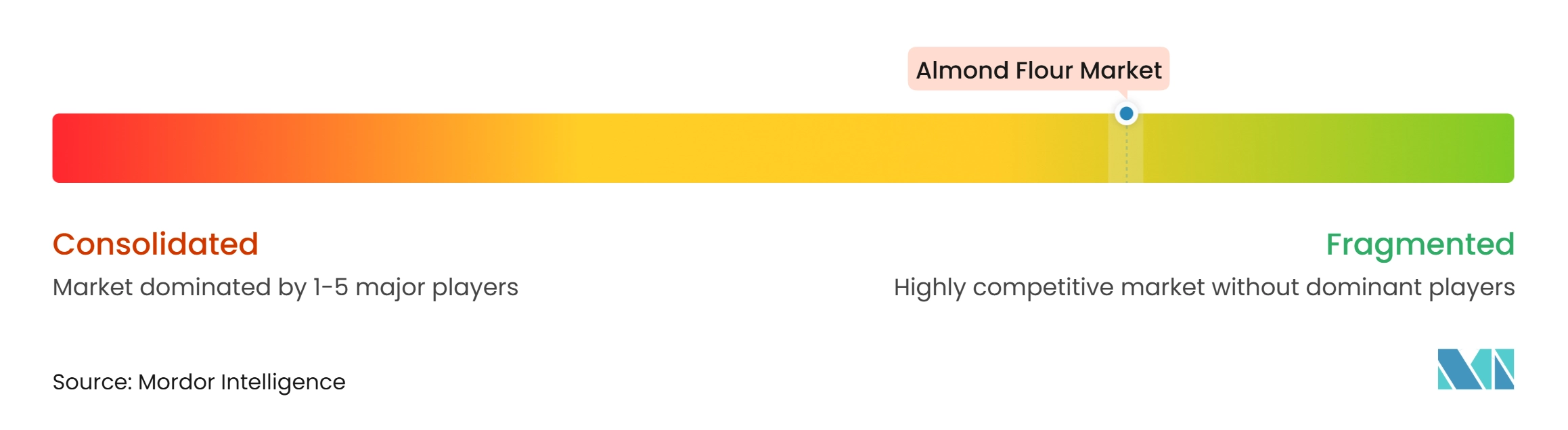
The almond flour market reflects a fragmented structure in which no single supplier controls global pricing or supply terms. Blue Diamond Growers, Treehouse California Almonds, and Olam Group Limited have notable influence over industrial ingredient availability because of their processing scale and supply connections. Their positions show the importance of access to almonds, milling capacity, and consistent quality controls. Competition also extends to branded retail products, where digital engagement and simple ingredient claims influence shelf performance. The almond flour market is therefore shaped by both upstream integration and downstream brand investment.
Bob’s Red Mill reformulated its gluten-free 1-to-1 baking flour in August 2026, with an improved formula for taste and texture. The product is manufactured in the company’s dedicated 100% gluten-free facility and is subject to batch testing as per company claims. This move addresses consumer expectations and supports compliance with gluten-free product requirements. These actions show that product performance and documented operating practices are both relevant to supplier differentiation.
King Arthur Baking Company opened a combined retail and baking school location in Alexandria, Virginia, in July 2026. The company also introduced 5 new product mixes in April 2026, including gluten-free options. Precision milling is another competitive area because customers need defined particle sizes for industrial applications. Hosokawa Alpine introduced the Alpine Dual Mill ADM classifier mill in September 2025, capable of d97 fineness below 7 µm. Suppliers able to combine certified organic materials, allergen controls, fine particle grading, and verified sourcing are positioned to compete for demanding industrial contracts.
Almond Flour Industry Leaders
-
Blue Diamond Growers
-
Bob's Red Mill Natural Foods, Inc.
-
King Arthur Baking Company
-
Treehouse California Almonds, LLC
-
Anthony's Goods
- *Disclaimer: Major Players sorted in no particular order
Almond Flour Market Companies Covered in this Report
- Bob's Red Mill Natural Foods, Inc.
- King Arthur Baking Company
- Treehouse California Almonds, LLC
- Anthony's Goods
- NOW Health Group, Inc.
- Honeyville, Inc.
- Barney Butter
- Hodgson Mill
- Woodland Foods
- WellBees
- Nature's Eats
- Terrasoul Superfoods
- Oh! Nuts
- Mandelin, Inc.
- Borges Agricultural and Industrial Nuts, SA
- Olam Group Limited
- Royal Nut Company
- Damiano S.p.A.
- Harris Woolf California Almonds
- Puramate India Pvt. Ltd.
Recent Industry Developments in Almond Flour Market
- June 2026: Nonpareil Gold launched Organic Defatted Almond Flour, a specialized almond flour product made by removing most of the naturally occurring oil from almonds before grinding them into a fine powder. The company uses premium Nonpareil almonds sourced from Northern California. The almonds are gently cold-pressed to extract almond oil, while the remaining almond cake is milled into fine flour.
- June 2025: Calmond Valley established a distribution partnerships in the United States, Saudi Arabia, and Egypt, marking a formal entry into 3 key Middle Eastern almond import markets and signaling the region's growing appetite for California-origin premium almond ingredients.
- February 2025: Blue Diamond Growers expanded its California almond flour production facility to strengthen supply capacity for commercial bakery manufacturers and packaged food brands responding to rising global demand for gluten-free and plant-based flour applications.
Global Almond Flour Market Report Scope
Almond flour refers to a finely ground flour produced from almonds, which may be prepared using blanched almonds (with the skin removed) or natural almonds (with the skin retained). It is widely used as an ingredient in bakery, confectionery, snacks, gluten-free foods, and other food products as a wheat flour alternative. The Almond Flour Market is segmented by product type, nature, application, and geography. Based on product type, the market is segmented into blanched almond flour and natural almond flour. Based on nature, the market is segmented into conventional almond flour and organic almond flour. Based on application, the market is segmented into food processing, foodservice, and retail. Based on geography, the market is segmented into North America, Europe, Asia-Pacific, South America, Middle East and Africa. For each segment, market sizing and forecasts are provided in terms of value (USD billion).
Segmentation Overview
| Blanched Almond Flour |
| Natural Almond Flour |
| Conventional Almond Flour |
| Organic Almond Flour |
| Food Processing | Bakery |
| Confectionery | |
| Dairy | |
| Soups, and Sauces | |
| Other Food Processing Applications | |
| Foodservice | |
| Retail | Offline Retail Stores |
| Online Retail Stores |
| North America | United States |
| Canada | |
| Mexico | |
| Rest of North America | |
| Europe | Germany |
| United Kingdom | |
| France | |
| Italy | |
| Spain | |
| Netherlands | |
| Rest of Europe | |
| Asia-Pacific | China |
| Japan | |
| India | |
| South Korea | |
| Australia | |
| Rest of Asia-Pacific | |
| South America | Brazil |
| Argentina | |
| Rest of South America | |
| Middle East and Africa | Saudi Arabia |
| South Africa | |
| Turkey | |
| Rest of Middle East and Africa |
| By Product Type | Blanched Almond Flour | |
| Natural Almond Flour | ||
| By Nature | Conventional Almond Flour | |
| Organic Almond Flour | ||
| By Application | Food Processing | Bakery |
| Confectionery | ||
| Dairy | ||
| Soups, and Sauces | ||
| Other Food Processing Applications | ||
| Foodservice | ||
| Retail | Offline Retail Stores | |
| Online Retail Stores | ||
| By Geography | North America | United States |
| Canada | ||
| Mexico | ||
| Rest of North America | ||
| Europe | Germany | |
| United Kingdom | ||
| France | ||
| Italy | ||
| Spain | ||
| Netherlands | ||
| Rest of Europe | ||
| Asia-Pacific | China | |
| Japan | ||
| India | ||
| South Korea | ||
| Australia | ||
| Rest of Asia-Pacific | ||
| South America | Brazil | |
| Argentina | ||
| Rest of South America | ||
| Middle East and Africa | Saudi Arabia | |
| South Africa | ||
| Turkey | ||
| Rest of Middle East and Africa | ||
Key Questions Answered in the Report
What is the projected value of the almond flour market by 2032?
The almond flour market is projected to reach USD 2.58 billion by 2032, from USD 1.70 billion in 2026, at a 7.22% CAGR.
What is driving demand for almond flour?
Demand is supported by gluten-free, grain-free, low-carbohydrate, clean-label, and protein-oriented food preferences, as well as broader industrial use.
Which almond flour product type leads sales?
Blanched almond flour leads product type revenue with a 61.23% share in 2026 because its light color, uniform particle profile, and mild flavor support premium bakery and confectionery applications.
Which nature category is growing fastest?
Organic almond flour is projected to grow at a 9.22% CAGR through 2032 and also held 59.72% of nature-based revenue in 2026.