
Agentic AI Professional Services Market Size and Share
Market Overview
| Study Period | 2020 - 2031 |
|---|---|
| Market Size (2026) | USD 3.36 Billion |
| Market Size (2031) | USD 12.24 Billion |
| Growth Rate (2026 - 2031) | 29.51 % |
| Fastest Growing Market | Asia-Pacific |
| Largest Market | North America |
| Market Concentration | Medium |
Major Players *Disclaimer: Major Players sorted in no particular order Image © Mordor Intelligence. Reuse requires attribution under CC BY 4.0. | |
Agentic AI Professional Services Market Analysis by Mordor Intelligence
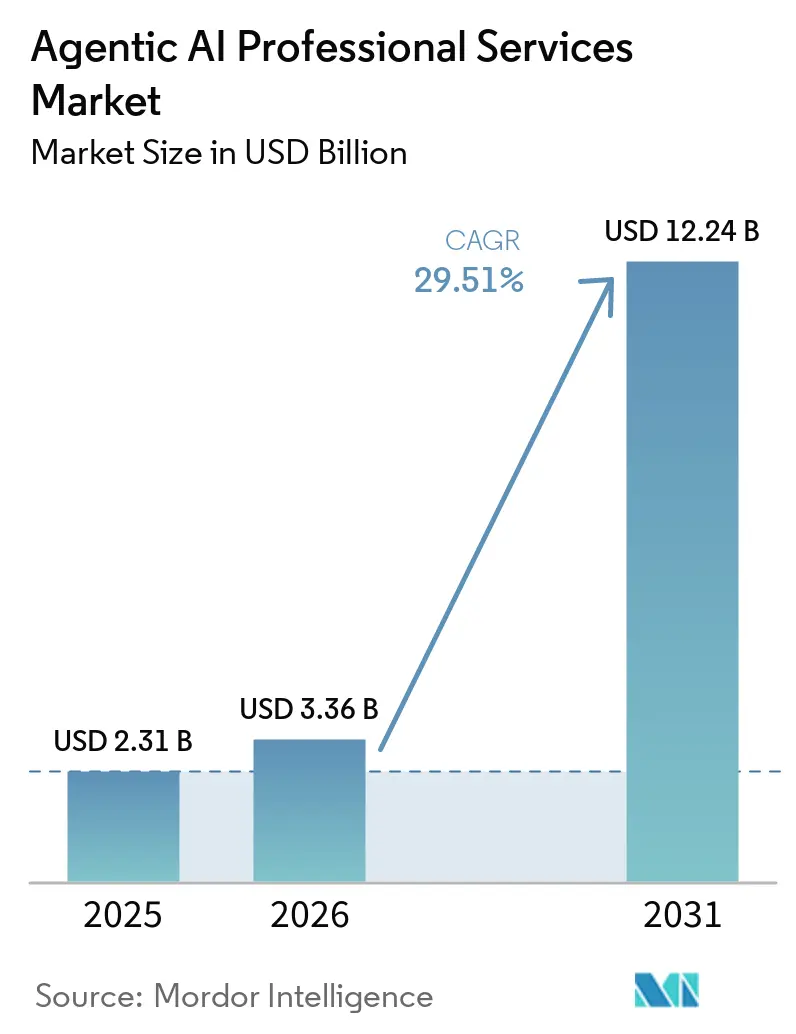
The agentic AI professional services market size is projected to expand from USD 2.30 billion in 2025 to USD 3.36 billion in 2026, and to USD 12.24 billion by 2031, registering a CAGR of 29.51% between 2026 and 2031. The agentic AI professional services market is growing as organizations move beyond tools that assist individual tasks toward systems that can plan and execute connected workflows. This shift raises the need for readiness assessments, workflow design, enterprise data integration, and governance work before deployment, because each connected decision can affect operational ownership, customer experience, and regulatory accountability. Enterprises are also placing greater weight on systems that commit to a workflow result rather than merely generate a response, which changes the scope of implementation services. The competitive setting favors providers that can combine industry knowledge with platform engineering, security controls, ongoing management, and an ability to adapt services as agent behavior and enterprise data change. The main opportunity is in turning pilots into durable operating models, although privacy exposure and weak value measurement can delay larger programs. Providers that coordinate strategy, architecture, integration, security, and operations can reduce the handoffs that often slow a client’s movement from a promising use case to a controlled production workflow.
Key Report Takeaways
- By service type, Advisory and Readiness Assessment held 44.81% of the agentic AI professional services market share in 2025, while Strategy, Roadmap, and Use-Case Prioritization is forecast to grow at a 30.71% CAGR through 2031.
- By deployment, Cloud held a 71.12% share in 2025 and is forecast to expand at a 29.91% CAGR through 2031, leading the agentic AI professional services market by deployment architecture in the agentic AI professional services market.
- By organization size, Large Enterprises held 68.08% of the agentic AI professional services market share in 2025, while Small and Medium-Sized Enterprises are forecast to grow at a 29.89% CAGR through 2031 in the agentic AI professional services market.
- By end-user industry, Banking, Financial Services, and Insurance held 24.39% of revenue in 2025, while Healthcare and Life Sciences are forecast to grow at a 30.68% CAGR through 2031.
- By geography, North America held 33.76% of revenue in 2025, while Asia-Pacific is forecast to expand at a 30.47% CAGR through 2031.
Note: Market size and forecast figures in this report are generated using Mordor Intelligence’s proprietary estimation framework, updated with the latest available data and insights as of January 2026.
Global Agentic AI Professional Services Market Trends and Insights
Drivers Impact Analysis*
| Driver | (~) % Impact on CAGR Forecast | Geographic Relevance | Impact Timeline |
|---|---|---|---|
| Enterprise Shift From Copilots to Autonomous Workflows | +5.2% | Global | Short term (≤ 2 years) |
| Rising Demand for Build-Deploy-Run Agentic Services | +4.7% | North America and Europe, with early Asia-Pacific gains | Short term (≤ 2 years) |
| Cross-System Integration and Context Engineering Needs | +4.1% | Global | Medium term (2-4 years) |
| Outcome-Based AI Transformation Budgets | +3.8% | North America and Asia-Pacific core, with spillover to the Middle East and Africa | Medium term (2-4 years) |
| Agentic AI Adoption in High-Value Regulated Workflows | +3.2% | North America and Europe, with early Asia-Pacific adoption | Medium term (2-4 years) |
| Standardization of Model Context Protocol and Agent-to-Agent Interoperability | +2.6% | Global | Long term (≥ 4 years) |
| Source: Mordor Intelligence | |||
Enterprise Shift From Copilots to Autonomous Workflows
Organizations are shifting from assistive tools to autonomous workflow systems, thereby expanding the agentic AI professional services market beyond prompt design and interface integration. An April 2026 projection indicated that more than 50% of enterprises would abandon assistive AI platforms in favor of systems committed to workflow outcomes by 2028. These deployments require process redesign, identity architecture, and controls that record how decisions are made and escalated, particularly when several agents coordinate actions across customer, finance, and internal operations. Anthropic reported that 57% of organizations use agents in multistage workflows, and 81% plan to move into complex cross-functional use cases during 2026.[1] The agentic AI professional services market, therefore, benefits from work that connects accountability, audit trails, and human review to each workflow rather than to an isolated application. Providers with proven governance methods can use this change to move from limited pilot assistance into broader transformation engagements.
Rising Demand for Build-Deploy-Run Agentic Services
The agentic AI professional services market is increasingly organized around build, deployment, and ongoing operational management rather than a single implementation project. Providers are being asked to develop use cases, put them into production, and manage exceptions, drift, human escalation, and compliance reporting after launch. This structure makes system performance and workflow outcomes more important than time-and-materials staffing, since clients expect a provider to remain accountable for system behavior after the initial configuration is complete. Amazon Web Services committed USD 1 billion to its Forward Deployed Engineering organization in 2026 to place engineers with customers and speed development and deployment of agentic solutions. The investment supports a delivery model in which certified engineering capabilities and continuous management can matter as much as initial build capacity. It also signals that client demand is shifting toward teams that can work closely with operating units rather than handing over a completed system for internal support.
Cross-System Integration and Context Engineering Needs
The agentic AI professional services market depends on connecting agents to enterprise resource planning, customer relationship management, IT service management, internal databases, and external application programming interfaces. Multi-agent systems need reliable access rules and a current business context across these systems to act safely, including clear boundaries on what information they can retrieve, modify, or pass to another tool. Context engineering encompasses the knowledge structures, retrieval processes, and memory designs that help an agent use proprietary information correctly, reducing the risk that a capable system arrives at the wrong answer due to incomplete or outdated enterprise material. Anthropic identified integration challenges as the leading barrier to enterprise-scale deployment for 46% of respondents, followed by data quality requirements for 42%. This creates demand for providers with both integration experience and the ability to maintain the data foundations used by production agents. The work becomes more valuable as clients add systems, workflows, and agent roles that must continue to operate with a consistent business context.
Outcome-Based AI Transformation Budgets
AI spending is moving from experimental budgets toward operational programs with defined responsibilities and expected business results. The agentic AI professional services market gains when buyers require a clear deployment path and measurable outcomes before approving broader use. Difficulty in scaling pilots has increased the value of repeatable deployment methods, governance models, and industry-specific agent libraries, which allow providers to apply lessons from earlier programs without treating each new engagement as a wholly separate technical exercise. Enterprise buyers also increasingly favor pricing linked to outputs in business process outsourcing and customer experience work, rather than hours alone, because a defined operational result is easier for senior sponsors to evaluate than an open-ended technical workstream. This approach can align provider incentives with workflow performance, while requiring providers to demonstrate credible measurement and operating discipline. It also makes implementation design more important, since the terms of an outcome-based engagement depend on a process that can be observed and evaluated.
Restraints Impact Analysis*
| Restraint | (~) % Impact on CAGR Forecast | Geographic Relevance | Impact Timeline |
|---|---|---|---|
| Data Privacy, Security, and Privileged-Access Exposure | -2.8% | Global, with higher exposure in Europe and regulated Asia-Pacific markets | Short term (≤ 2 years) |
| Unclear Return on Investment Beyond Pilots | -2.3% | Global | Medium term (2-4 years) |
| Reliability, Evaluation, and Auditability Gaps | -1.7% | North America and Europe | Medium term (2-4 years) |
| Legacy Integration Complexity and Change-Management Friction | -1.4% | Asia-Pacific and South America | Long term (≥ 4 years) |
| Source: Mordor Intelligence | |||
Data Privacy, Security, and Privileged-Access Exposure
Data privacy and security concerns can slow growth in the agentic AI professional services market because agents may access financial, health, customer, and operational information across multiple systems. Microsoft stated in July 2026 that many organizations are deploying agentic capabilities faster than their identity and authorization models are evolving, creating risks when agents lack managed identities and least-privilege access controls.[2] A poorly configured permission or prompt injection can affect more than 1 connected system when an agent has broad access to tools. The EU AI Act, the General Data Protection Regulation, and the California Consumer Privacy Act create compliance duties when agents process personal, financial, or health data, making documentation, access controls, and appropriate human oversight part of the implementation scope. Singapore’s Infocomm Media Development Authority published its Model AI Governance Framework for Agentic AI in 2025, including guidance on privilege escalation, agent identity management, and human oversight. These requirements extend demand for zero-trust designs, identity controls, and security integration, but may discourage buyers with limited resources, especially where legacy systems cannot yet provide the granular permissions that an autonomous workflow requires.
Unclear Return on Investment Beyond Pilots
Unclear return on investment can hold back the agentic AI professional services market after early pilot work is complete. Buyers need measures that account for changing enterprise context, exceptions, and ongoing tuning, rather than treating an agent as static software. Without credible value measurement, organizations can postpone the next wave of transformation spending even when the initial pilot was technically successful, because business leaders must compare the expected benefit against the ongoing costs of data, engineering, monitoring, and change management. The resulting hesitation supports demand for outcome attribution tools and centers of excellence that report auditable results during defined contract periods. Providers that can link a workflow to a measurable business outcome are better placed to reduce this constraint, particularly when they can show how an agent improves a specific process without compromising quality, controls, or employee accountability. This favors firms that define baseline performance, intervention points, and review measures before the pilot becomes a broader production program.
*Our forecasts treat driver/restraint impacts as directional, not additive. The impact forecasts reflect baseline growth, mix effects, and variable interactions.
Segment Analysis
By Service Type: Advisory Services Anchor Initial Enterprise Spending
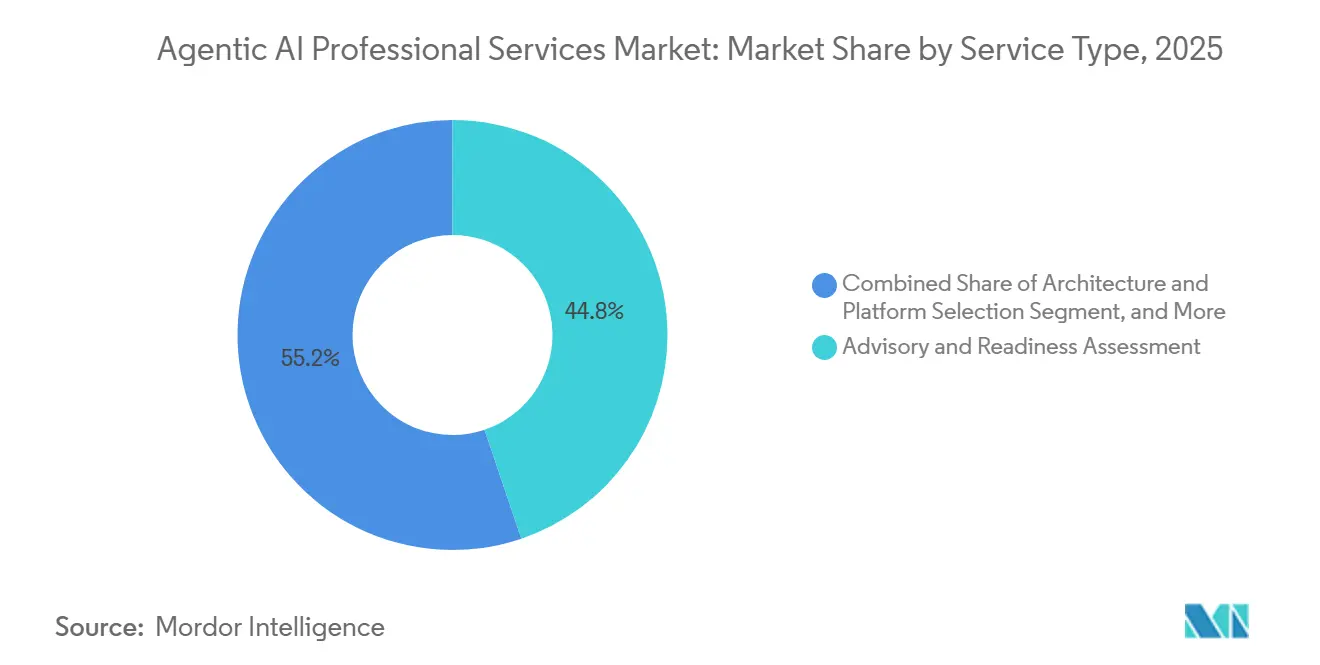
Advisory and Readiness Assessment accounted for 44.81% of the agentic AI professional services market size in 2025. Enterprises often start with a diagnosis before committing engineering budgets because framework choices, vendor architecture, and operating models can shape several years of deployment. This work addresses which workflows should be automated, how agent decisions should be governed, and how people remain accountable for results. Advisory services remain relevant after early market entry because these questions combine technology, organizational change, and risk management, and because early architectural decisions can determine whether later workflows remain manageable as more agents and data sources are added.
Strategy, Roadmap, and Use-Case Prioritization is forecast to expand at a 30.71% CAGR from 2026 to 2031. Organizations that completed readiness work are moving toward multistep roadmaps with return-on-investment milestones and board-level accountability. Architecture selection, custom agent development, workflow engineering, and integration work form the next stage as buyers move from strategy into implementation. Managed agentic services and continuous optimization are also emerging beyond conventional project delivery, broadening the service mix within the agentic AI professional services market and reflecting that deployed agents require monitoring as business rules, source data, and edge cases change.

By Deployment: Cloud Architecture Leads and Widens Its Lead
Cloud deployments accounted for 71.12% in 2025 and are forecast to grow at a 29.91% CAGR from 2026 to 2031. Cloud services support elastic computing, managed foundation-model interfaces, agent runtimes, tool libraries, interoperability gateways, and observability capabilities. The model can help a client obtain new capabilities without building and operating each component alone, although the provider must still configure access, data handling, and oversight for the client’s specific environment. These features are important when many agents require dynamic resources and coordinated access to enterprise tools, because the supporting platform must manage model services, tool connections, permissions, and monitoring without disrupting the automated business process. The agentic AI professional services market thus draws material delivery work from cloud-based architecture, configuration, and lifecycle management.
On-premises deployment retains a role in financial services, defense, and healthcare, where data sovereignty, latency, and auditability requirements are important. Such organizations may require clear data-residency controls under rules such as the EU AI Act, as well as evidence that the system can be reviewed, monitored, and governed in accordance with their established risk-management procedures. IBM announced Enterprise Advantage on Amazon Web Services in May 2026 with a structured 90-day deployment program for production-ready agentic workflows on Amazon Bedrock AgentCore.[3] The offering combines lifecycle management, governance controls, and observability in a cloud environment, indicating that the control gap between cloud and on-premises options is narrowing.
By Organization Size: Large Enterprises Set the Pace as SMEs Narrow the Gap
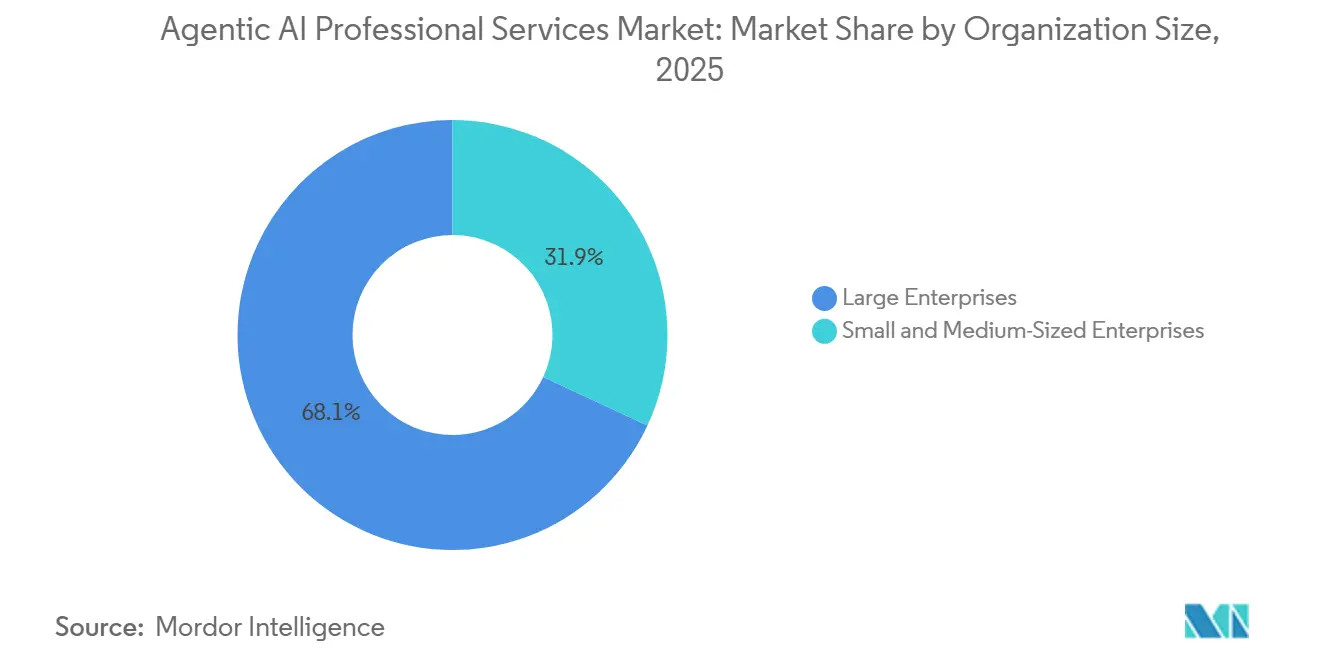
Large Enterprises held 68.08% of the agentic AI professional services market share in 2025. They have more systems to connect, larger transformation budgets, and dedicated AI centers of excellence that can support multistep deployment, giving them the capacity to test agents, involve business owners, and establish governance before extending use to sensitive processes. Anthropic found that large enterprises led small and medium-sized businesses in production deployment of coding agents, at 91% compared with 83%. They also reported greater intent to address complex use cases during 2026.
Small and Medium-Sized Enterprises are forecast to grow at a 29.89% CAGR from 2026 to 2031. Cloud platforms and pre-built workflow libraries lower the engineering requirement for smaller organizations that cannot fund extensive custom architecture. This allows a service provider to begin with a defined process and a limited set of integrations, then broaden the scope when the organization has established operational confidence and a workable governance approach. AI-native providers also offer shorter fixed-outcome pilots that better fit mid-market budget cycles than long enterprise transformation programs. Employee resistance and training needs are a stronger concern for smaller businesses, so the service requirement includes change management and enablement alongside technical delivery, with providers needing to make the workflow understandable for teams that will supervise, correct, and use the new system.
By End-User Industry: Healthcare and Life Sciences Has the Fastest Growth Rate
Banking, Financial Services, and Insurance held 24.39% of agentic AI professional services revenue in 2025. The sector uses agents in know-your-customer onboarding, loan origination, fraud detection, reconciliation, and compliance reporting. Regulated workflows create a need for controlled deployment, clear audit records, and security-focused integration, because a flawed action in a customer, lending, fraud, or compliance process can create material operational and regulatory consequences. These needs make financial services an early and sustained source of work for the agentic AI professional services industry.
Healthcare and Life Sciences are forecast to expand at a 30.68% CAGR from 2026 to 2031. McKinsey’s September 2025 review of 270 life-sciences workflows found that 75% to 85% contained tasks that agents could enhance or automate. Peer-reviewed research published in npj Digital Medicine in July 2026 documented multi-agent frameworks with validated clinical accuracy across diagnostics, management, and care-adjacent work. Information technology and telecommunications, manufacturing, and retail and e-commerce provide additional demand through infrastructure automation, supply chain and quality control work, inventory management, and customer experience workflows, extending the agentic AI professional services market beyond its early concentration in financial services and health-related use cases.
Geography Analysis
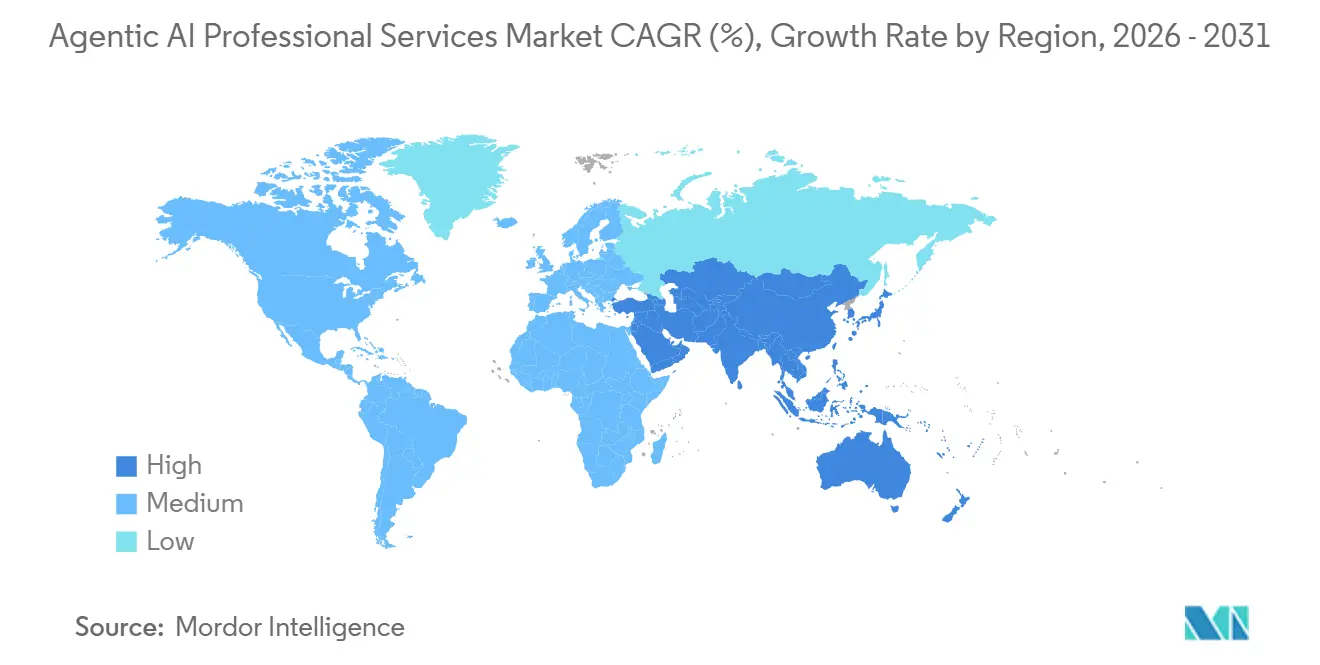
North America held 33.76% of the agentic AI professional services market share in 2025. The region combines high enterprise AI budgets, major cloud providers, global consulting firms, and specialist providers, giving clients access to both large transformation teams and focused firms that can address specific workflows or technology environments. Financial services and healthcare organizations support major transformation programs because their workflows require controlled automation. Canada drives demand through the adoption of financial services and an AI research ecosystem that supplies specialized talent. Mexico has attracted nearshore delivery-center expansion for cost-effective agentic engineering capacity.
South America remains at an earlier stage, although Brazilian enterprises are moving agentic pilots into full production, and Argentina contributes technology talent for Spanish-language engineering work. Europe requires extensive work on audit, documentation, governance, and risk management because high-risk systems face EU AI Act conformity obligations, which makes compliance preparation an active part of system design rather than a task completed after a deployment decision. These requirements can lengthen engagements and raise the minimum scope for deployments in financial services, healthcare, and critical infrastructure. Germany’s Mittelstand firms began commissioning agentic readiness assessments in 2025, which signals a developing mid-market adoption path. Asia-Pacific is forecast to grow at a 30.47% CAGR from 2026 to 2031, the highest regional rate in the agentic AI professional services market.
India has a large focus on agentic AI, while Japan has reported strong operational efficiency gains in governance-led deployment environments. These markets illustrate different adoption paths, with one driven by widespread future interest and technical talent, and the other showing how careful governance can support measurable process improvement in a more deliberate deployment model. India’s 2026 AIdea of India report found that 48.6% of organizations named agentic AI as a primary future focus. The Middle East is supported by sovereign AI programs in Saudi Arabia and the United Arab Emirates that target public services, energy, and financial services. Africa remains in the advisory and assessment phase, with fintech innovation in Nigeria and banking demand in South Africa creating early use cases for fraud detection, customer onboarding, and mobile financial services.
Competitive Landscape
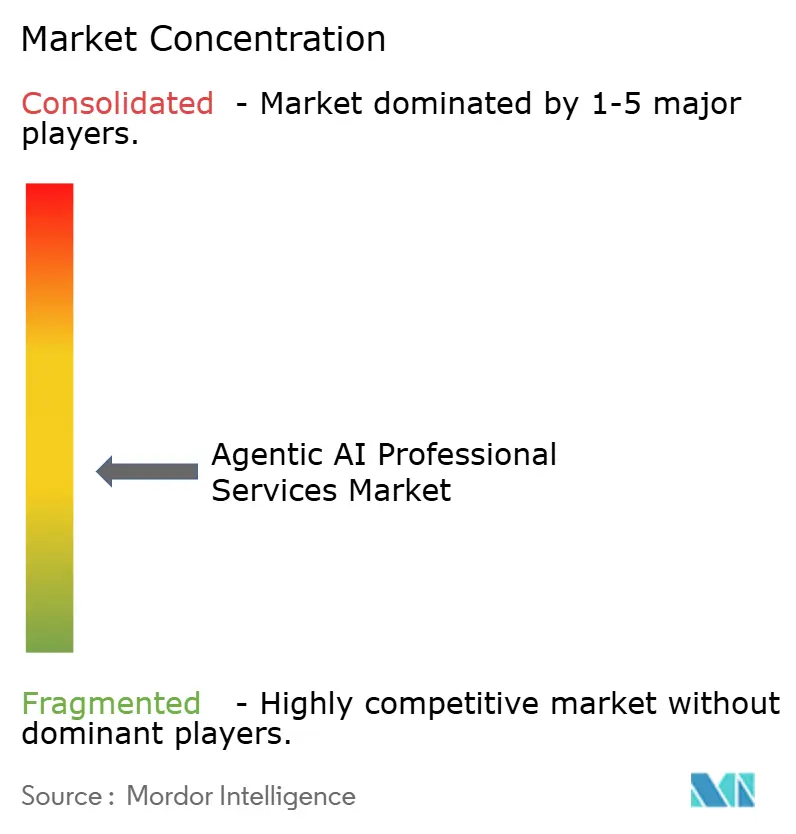
The agentic AI professional services market is moderately fragmented. Global consulting providers have brand strength from cloud partnerships, proprietary platforms, and agent libraries, while AI-native specialists compete through speed, domain knowledge, and flexible engagement structures that can make a narrowly defined deployment easier for a buyer to approve. IBM’s Enterprise Advantage combines an MCP gateway, context tools, lifecycle management, and full-stack observability in a 90-day deployment approach. This platform approach can reduce client risk and compress the time available for firms that rely only on staffing.
Accenture and Google Cloud launched the Gemini Enterprise Acceleration Program in April 2026, combining AI-skilled engineers with pre-built industry-specific agents in Google Cloud Marketplace. Deloitte established a dedicated Google Cloud Agentic Transformation Practice in April 2026, with more than 1,000 pre-built industry-specific agents connected through the Agent-to-Agent Protocol. Accenture also released the AI Refinery distiller agentic framework and software development kits in June 2025. These moves combine platform assets, technical standards, and engineering capacity, allowing providers to position their services around reusable components while still adapting a workflow to a client’s data, governance, and operating requirements. They increase the qualification bar for production deployments.
Specialist providers retain openings in clinical workflow automation, defense-oriented systems, and mid-market enterprise resource planning integration. Their narrower expertise can be more useful where a general platform library is not yet mature. Outcome-committed, sprint-based projects can also reduce uncertainty for buyers before a larger program begins. Providers that retain client-specific context and develop orchestration layers may build a stronger renewal position than firms selling general consulting capacity. The competitive picture, therefore, combines scale advantages with clear openings for specialist delivery models, especially where a provider can demonstrate a credible result in a tightly defined, regulated, clinical, operational, or mid-market environment. Across the agentic AI professional services market, a provider’s ability to work with existing systems, explain controls, and remain responsible after launch is likely to carry as much weight as the breadth of its agent library.
Agentic AI Professional Services Industry Leaders
-
Sigmoid, Inc.
-
Digevo SpA
-
Altan Technologies, Inc.
-
PX42 Consulting, Inc
-
Metacto, Inc.
- *Disclaimer: Major Players sorted in no particular order
Recent Industry Developments
- July 2026: Cognizant launched its EMEA AI Unit, a dedicated organization in London combining advisory, engineering, and delivery capabilities to help enterprises across Europe, the Middle East, and Africa transition from AI pilots to production-scale agentic workflows, structured across Foundation, Accelerate, and Transform service tiers, with documented client work in pharmaceutical multi-agent drug-discovery pipelines and retail agentic supply-chain operations.
- July 2026: The Model Context Protocol community, operating under the Agentic AI Foundation, released the MCP 2026-07-28 specification, transitioning the protocol to a stateless core architecture, hardening authorization alignment with OAuth 2.0 and OpenID Connect, and introducing a formal extensions framework.
- July 2026: UniCredit, Accenture, and IBM announced a long-term strategic collaboration to build a next-generation banking technology platform across UniCredit's 13 European markets, with Accenture acquiring from IBM the majority stake in the joint venture managing a significant portion of UniCredit's technology infrastructure.
- May 2026: IBM Consulting announced the general availability of IBM Enterprise Advantage on AWS, a 90-day structured deployment program that takes enterprises from initial assessment to production-ready agentic workflows natively on Amazon Bedrock AgentCore.
Global Agentic AI Professional Services Market Report Scope
The Agentic AI Professional Services Market represents the annual revenue generated from professional services that help organizations assess, design, develop, integrate, deploy, and operationalize agentic artificial intelligence (AI) systems capable of autonomously or semi-autonomously performing tasks, making decisions, coordinating workflows, interacting with enterprise systems, and executing multi-step processes based on defined objectives.
The Agentic AI Professional Services Market Report is Segmented by Service Type (Advisory and Readiness Assessment, Strategy, Roadmap, and Use-Case Prioritization, Architecture and Platform Selection, Custom Agent Development and Workflow Engineering, Integration, Data, and Context Engineering, and Other Service Types), Deployment (Cloud and On-Premises), Organization Size (Large Enterprises and Small and Medium-Sized Enterprises), End-User Industry (Banking, Financial Services, and Insurance, Healthcare and Life Sciences, Retail and E-Commerce, Information Technology and Telecommunications, Manufacturing and Industrial, and Other End-User Industries), and Geography (North America, South America, Europe, Asia-Pacific, Middle East, and Africa). The Market Forecasts are Provided in Terms of Value (USD)
| Advisory and Readiness Assessment |
| Strategy, Roadmap, and Use-Case Prioritization |
| Architecture and Platform Selection |
| Custom Agent Development and Workflow Engineering |
| Integration, Data, and Context Engineering |
| Other Service Types |
| On-Premises |
| Cloud |
| Large Enterprises |
| Small and Medium-Sized Enterprises |
| Banking, Financial Services, and Insurance |
| Healthcare and Life Sciences |
| Retail and E-Commerce |
| Information Technology and Telecommunications |
| Manufacturing and Industrial |
| Other End-User Industries |
| North America | United States |
| Canada | |
| Mexico | |
| South America | Brazil |
| Argentina | |
| Rest of South America | |
| Europe | United Kingdom |
| Germany | |
| France | |
| Russia | |
| Rest of Europe | |
| Asia-Pacific | China |
| India | |
| Japan | |
| Australia | |
| Rest of Asia-Pacific | |
| Middle East | Saudi Arabia |
| United Arab Emirates | |
| Turkey | |
| Rest of Middle East | |
| Africa | South Africa |
| Nigeria | |
| Rest of Africa |
| By Service Type | Advisory and Readiness Assessment | |
| Strategy, Roadmap, and Use-Case Prioritization | ||
| Architecture and Platform Selection | ||
| Custom Agent Development and Workflow Engineering | ||
| Integration, Data, and Context Engineering | ||
| Other Service Types | ||
| By Deployment | On-Premises | |
| Cloud | ||
| By Organization Size | Large Enterprises | |
| Small and Medium-Sized Enterprises | ||
| By End-User Industry | Banking, Financial Services, and Insurance | |
| Healthcare and Life Sciences | ||
| Retail and E-Commerce | ||
| Information Technology and Telecommunications | ||
| Manufacturing and Industrial | ||
| Other End-User Industries | ||
| By Geography | North America | United States |
| Canada | ||
| Mexico | ||
| South America | Brazil | |
| Argentina | ||
| Rest of South America | ||
| Europe | United Kingdom | |
| Germany | ||
| France | ||
| Russia | ||
| Rest of Europe | ||
| Asia-Pacific | China | |
| India | ||
| Japan | ||
| Australia | ||
| Rest of Asia-Pacific | ||
| Middle East | Saudi Arabia | |
| United Arab Emirates | ||
| Turkey | ||
| Rest of Middle East | ||
| Africa | South Africa | |
| Nigeria | ||
| Rest of Africa | ||
Key Questions Answered in the Report
How large is the agentic AI professional services market?
The market is valued at USD 3.36 billion in 2026 and is forecast to reach USD 12.24 billion by 2031 at a 29.51% CAGR.
What is driving demand for agentic AI professional services?
Organizations need help redesigning workflows, integrating enterprise systems, building governance controls, and running agents after deployment.
Which service type holds the largest share?
Advisory and Readiness Assessment held 44.81% of revenue in 2025 because enterprises typically assess governance, architecture, and workflow priorities before implementation.
Which deployment model is growing fastest?
Cloud deployment is forecast to grow at a 29.91% CAGR from 2026 to 2031 because it provides elastic computing and managed agent platform capabilities.
Which end-user sector has the strongest growth outlook?
Healthcare and Life Sciences is forecast to grow at a 30.68% CAGR through 2031 as clinical and operational workflows adopt agentic capabilities.
What can limit enterprise adoption of agentic systems?
Data privacy, identity controls, privileged access, and unclear return-on-investment measures can delay movement from pilots to scaled production systems.