
Agentic AI Consulting Services Market Size and Share
Market Overview
| Study Period | 2020 - 2031 |
|---|---|
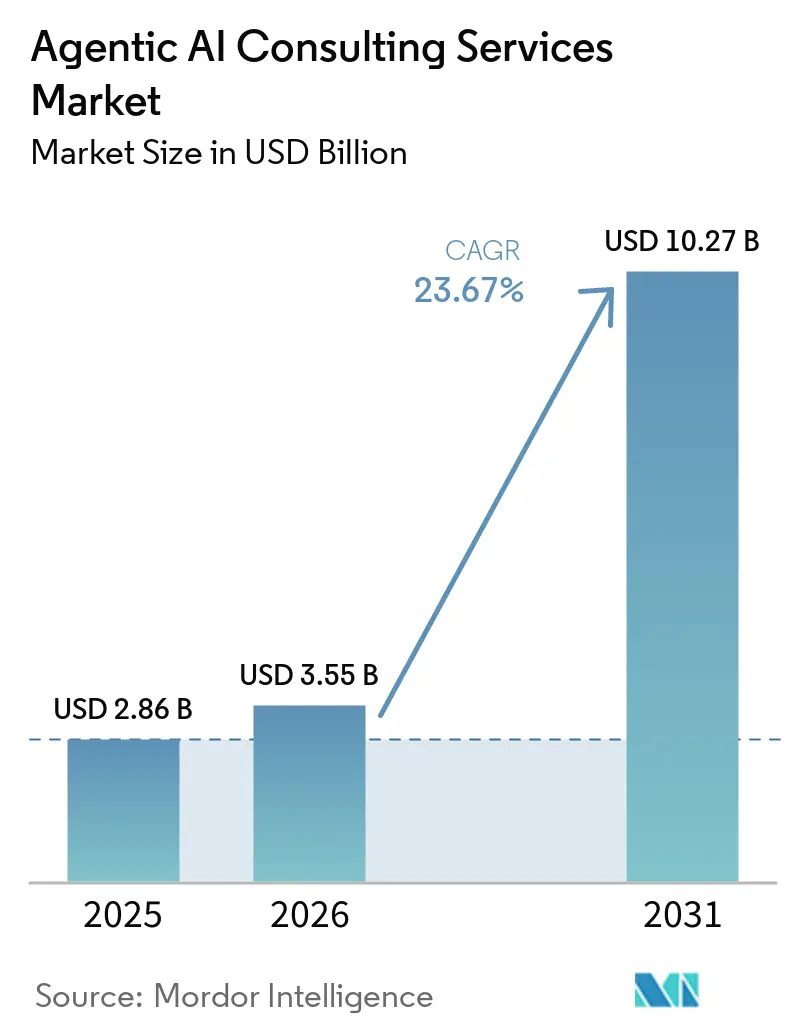
| Market Size (2026) | USD 3.55 Billion |
| Market Size (2031) | USD 10.27 Billion |
| Growth Rate (2026 - 2031) | 23.67 % |
| Fastest Growing Market | Asia-Pacific |
| Largest Market | North America |
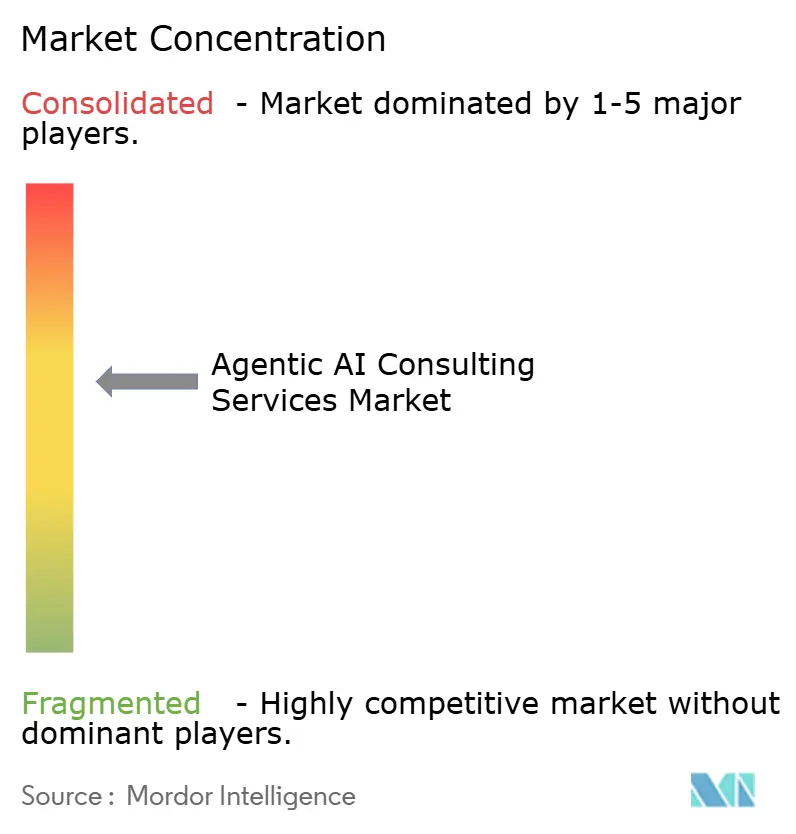
| Market Concentration | Medium |
Major Players *Disclaimer: Major Players sorted in no particular order Image © Mordor Intelligence. Reuse requires attribution under CC BY 4.0. | |
Agentic AI Consulting Services Market Analysis by Mordor Intelligence
The Agentic AI Consulting Services Market size was valued at USD 2.86 billion in 2025 and estimated to grow from USD 3.55 billion in 2026 to reach USD 10.27 billion by 2031, at a CAGR of 23.67% during the forecast period (2026-2031). The Agentic AI Consulting Services Market is growing as enterprises move from limited generative AI trials to workflows that can complete linked tasks with defined controls. These programs require support with strategy, system design, integration, testing, and governance. Demand is strongest where companies need to connect agents with core business systems and establish clear accountability for automated actions. Cloud environments remain central because they provide managed tools for model access, data retrieval, monitoring, and orchestration. Regulatory obligations also create consulting work, although they can extend approval and deployment cycles, especially in regulated sectors.
Key Report Takeaways
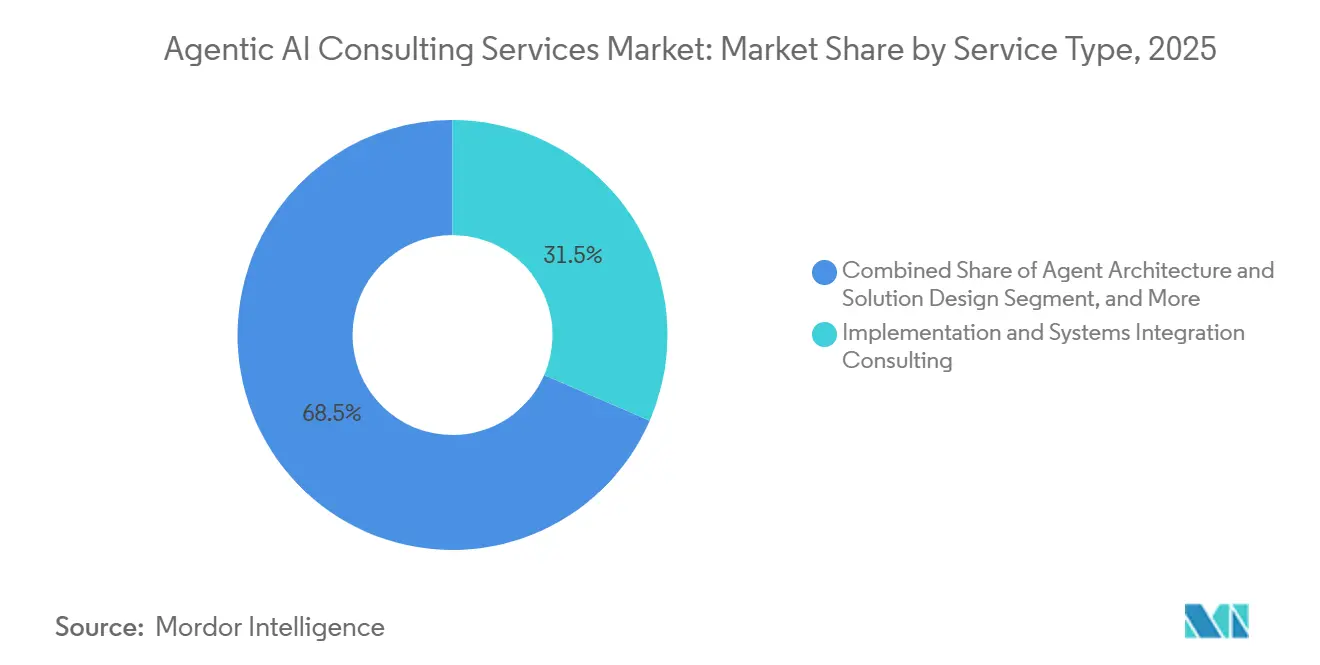
- By service type, implementation and systems integration consulting held 31.53% of the Agentic AI Consulting Services Market share in 2025, while agent architecture and solution design is forecast to grow at a 24.13% CAGR through 2031.
- By deployment, cloud deployment accounted for 64.28% of the Agentic AI Consulting Services Market size in 2025 and is forecast to expand at a 24.44% CAGR through 2031.
- By organization size, large enterprises held 72.38% of the agentic AI consulting services market in 2025, while small and medium-sized enterprises are projected to grow at a 24.06% CAGR through 2031.
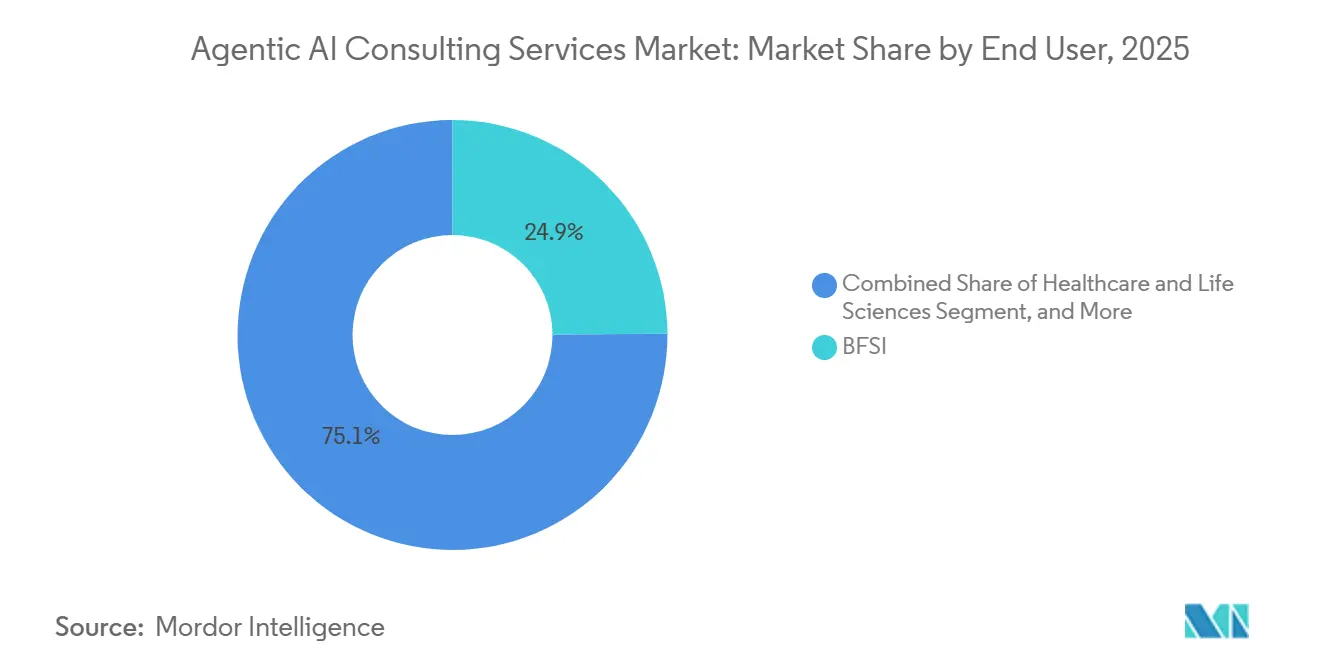
- By end user, banking, financial services, and insurance accounted for 24.91% of revenue in 2025, while healthcare and life sciences are forecast to grow at a 24.58% CAGR through 2031.
- By application, autonomous process automation held 28.11% revenue share in 2025 and is forecast to grow at a 24.78% CAGR through 2031.
- By geography, North America held 38.73% revenue share in 2025, while Asia-Pacific is forecast to grow at a 24.61% CAGR through 2031.
Note: Market size and forecast figures in this report are generated using Mordor Intelligence’s proprietary estimation framework, updated with the latest available data and insights as of January 2026.
Market Trends and Insights
Drivers Impact Analysis of Agentic AI Consulting Services Market*
| Driver | (~) % Impact on CAGR Forecast | Geographic Relevance | Impact Timeline |
|---|---|---|---|
| Autonomous Workflow Transformation | +4.5% | Global, led by North America and Asia-Pacific | Short term (≤ 2 years) |
| Complex Multi-Agent Deployments | +3.2% | Global, concentrated in North America and Europe | Medium term (2-4 years) |
| AI Governance and Sovereign AI Readiness | +2.8% | Global, strongest in the EU, Middle East, India, and Southeast Asia | Medium term (2-4 years) |
| Regulated-Industry Agentic Use Cases | +2.1% | Global, strongest in North American BFSI and healthcare and European BFSI and government | Medium term (2-4 years) |
| Specialized Engineering and Change Talent Shortage | +1.8% | Global, most severe in North America and Western Europe | Short term (≤ 2 years) |
| Outcome-Based Transformation Programs | +1.4% | North America and Europe | Long term (≥ 4 years) |
| Source: Mordor Intelligence | |||
Enterprise Demand for Autonomous Workflow Transformation
The Agentic AI Consulting Services Market benefits when enterprises commit funding to autonomous workflows rather than isolated demonstrations. Organizations need help defining which activities can be automated, what approvals remain with people, and how results should be measured. This need extends from early planning to production support, as workflows often span finance, operations, service, and compliance teams. Client interest is also shifting toward commercial models tied to operating outcomes rather than consultant time. That shift favors providers that can set clear delivery milestones and maintain control standards throughout deployment.
Rising Complexity of Multi-Agent Enterprise Deployments
The Agentic AI Consulting Services Market is supported by the difficulty of moving from a single agent to coordinated systems that interact with business applications. These systems need reliable data access, task routing, memory controls, observation tools, and procedures for exceptions. Legacy systems and uneven data quality can slow implementation even when the target use case is well defined. Human review remains important when an agent supports material decisions or actions. IBM and SAP expanded their collaboration in 2026 to enable interactions between IBM Consulting Advantage agents and SAP Joule agents, highlighting the technical coordination required for cross-platform deployments.[1]
Growing Need for AI Governance and Sovereign AI Readiness
The Agentic AI Consulting Services Market is gaining work from organizations that need governance structures before agents can be used at scale. The EU AI Act includes requirements related to risk management, documentation, transparency, and human oversight for certain AI systems. These obligations increase the importance of data controls, testing records, and clear responsibility for agent decisions.[2] Sovereign AI requirements add further design work where clients need local data handling, localized computing, or controlled model access. Public-sector buyers also need governance processes that match procurement and accountability expectations. Consulting firms with reusable governance methods can address these needs more consistently than firms that begin each engagement from scratch.[3]
Expansion of Agentic AI Use Cases Across Regulated Industries
The Agentic AI Consulting Services Market is expanding in sectors where processes are documented, data is structured, and audit trails are mandatory. Banking, healthcare, government, and energy organizations can apply agents to defined workflows while retaining review controls. OCBC launched HELIOS in July 2026 for wealth-management client onboarding across Singapore, Hong Kong, and Dubai. Santander and Mastercard completed a live end-to-end payment executed by an AI agent in March 2026 within a regulated banking framework. Such examples show why clients need consulting support that covers technical design, compliance documentation, and operational controls. They also widen the set of use cases considered suitable for supervised automation.
Restraints Impact Analysis of Agentic AI Consulting Services Market*
| Restraint | (~) % Impact on CAGR Forecast | Geographic Relevance | Impact Timeline |
|---|---|---|---|
| Unclear Return on Investment for High-Autonomy Workflows | -2.1% | Global, most acute in North America and Europe | Short term (≤ 2 years) |
| Fragmented Agent Interoperability and Evaluation Standards | -1.4% | Global | Medium term (2-4 years) |
| Rising Compute, Inference, and AgentOps Costs | -1.2% | Global, concentrated in markets with limited cloud infrastructure | Medium term (2-4 years) |
| Accountability Gaps in Autonomous Decision-Making | -0.9% | Global, heightened in GDPR-regulated EU markets and Asia-Pacific | Long term (≥ 4 years) |
| Source: Mordor Intelligence | |||
Unclear Return on Investment for High-Autonomy Workflows
The Agentic AI Consulting Services Market may see slower buying decisions when clients cannot connect agent deployments to measurable operational outcomes. A proof of concept may show technical capability without proving that it improves a full business process. Integration work, data remediation, and governance review can also delay the point at which returns become visible. Finance leaders may therefore prefer phased engagements with defined milestones instead of broad transformation contracts. Providers that bring validated use cases and transparent performance measures are better placed to convert pilots into production programs.
Fragmented Agent Interoperability and Evaluation Standards
Variations across agent frameworks, communication methods, and evaluation tools constrain the Agentic AI Consulting Services Market. Clients using several technology providers may need custom interfaces and testing methods before agents can work together reliably. This can increase delivery effort and make it harder to compare performance across systems. The Linux Foundation has established the Agentic AI Foundation to support open development and governance around agent-related projects. Broader adoption of shared standards could reduce technical friction, although the current lack of common methods continues to create consulting demand.
*Our forecasts treat driver/restraint impacts as directional, not additive. The impact forecasts reflect baseline growth, mix effects, and variable interactions.
Agentic AI Consulting Services Market Segment Analysis
By Service Type:
Implementation Services Lead as Architecture Design AcceleratesImplementation and systems integration consulting held 31.53% of the agentic AI consulting services market in 2025. The segment leads because organizations must connect agents to enterprise resource planning, customer relationship management, service management, and operational platforms. These projects require data pipelines, application interfaces, access controls, and process testing. The work often continues after launch because business rules and source systems change. Implementation teams also need to document failure paths and escalation procedures. Agent architecture and solution design are projected to grow at a 24.13% CAGR through 2031. Its growth reflects demand for decisions on agent roles, task routing, memory management, tool access, and human oversight.
Strategy and readiness consulting remain important at the start of an enterprise program. It helps clients prioritize use cases, identify operating risks, and set decision rights before technical work begins. Data, cloud, and infrastructure consulting support the systems that give agents reliable access to company information. Those systems can include retrieval workflows, data governance controls, and monitoring tools. The Agentic AI Consulting Services Market also includes emerging needs such as AgentOps, agent evaluation design, and model risk management. IBM introduced Context Studio and Process Studio in May 2026 to help clients ground agents in organizational data and turn operating procedures into agent-ready workflows. These capabilities show why architecture and integration work must proceed together. Providers that combine business process knowledge with technical delivery can address a larger share of the work.

By Deployment:
Cloud Infrastructure Anchors Enterprise Agent DeploymentsCloud deployment accounted for 64.28% of the agentic AI consulting services market in 2025. It leads because cloud services provide managed model access, data storage, monitoring, and computing capacity. Consultants can focus on workflow configuration and enterprise integration instead of building each infrastructure layer. Cloud platforms also make it easier to update models and observability tools as a program develops. This approach can support faster deployment for use cases with clear data and control requirements. Cloud deployment is projected to grow at a 24.44% CAGR through 2031. The pattern shows that enterprises are using managed services to reduce operational burden in production agent programs.
On-premises deployment remains relevant for organizations with strict data-residency, security, or audit requirements. Financial institutions, government agencies, and defense-related users may need greater control over inference, data handling, and decision records. The EU AI Act reinforces the need for documentation and oversight in relevant high-risk AI applications. These conditions can increase the scope and duration of deployment consulting. Accenture and Google Cloud launched the Gemini Enterprise Acceleration Program in April 2026 with sovereign-deployment-ready agents. This indicates that sovereign and controlled deployment models are becoming a defined service area. The two deployment approaches will continue to coexist because client requirements differ by risk profile and geography.[4]
By Organization Size:
Large Enterprises Anchor Revenue as SMEs AccelerateLarge enterprises held 72.38% of the Agentic AI Consulting Services Market share in 2025. Their position reflects larger technology budgets and the complexity of coordinating agents across business units, regions, and systems. These organizations often have more repeatable processes that justify the need for dedicated integration and governance teams. They also need broader change-management support when autonomous workflows affect established operating roles. Large clients remain central to revenue because their programs can include strategy, infrastructure, integration, and ongoing control work. Small and medium-sized enterprises are forecast to grow at a 24.06% CAGR through 2031. Their growth is linked to packaged platforms and repeatable consulting offerings that lower the technical barrier to adoption.
Smaller organizations usually seek defined outcomes, controlled scope, and a clear path to value. They are less likely to fund broad customization before a use case is proven. This favors service providers that offer standard implementation patterns and fixed deliverables. Microsoft reported in December 2025 that Cognizant, Infosys, TCS, and Wipro were deploying more than 200,000 Copilot licenses collectively. Wider access to established platforms can make agent capabilities more reachable for midmarket clients. Consulting providers still need to adapt delivery models because SMEs often have fewer internal data and governance resources. The Agentic AI Consulting Services Market, therefore, supports both high-touch enterprise engagements and more standardized midmarket offerings.
By End User:
BFSI Anchors Demand, Healthcare Drives the Fastest GrowthBFSI accounted for 24.91% of the Agentic AI Consulting Services Market in 2025. The sector combines high-value automation opportunities with clear process controls and formal audit obligations. Common consulting needs include reconciliation, fraud review, client onboarding, compliance reporting, and controlled client interactions. Financial institutions also require clear records of how an agent accessed information and reached an outcome. Santander and Mastercard completed a regulated live payment executed by an AI agent in March 2026. The example supports demand for consulting that connects automation with risk and compliance controls. Citi also introduced Citi Sky in 2026 as an AI-powered member of its wealth team using Google Cloud and Google DeepMind technologies.
Healthcare and life sciences are projected to grow at a 24.58% CAGR through 2031. Organizations in this segment need to improve administrative workflows while protecting sensitive information and maintaining oversight. Potential consulting work includes prior authorization, care coordination, policy review, and adverse-event monitoring. AWS documented 2026 deployments with Cohere Health and Bluesight that use Amazon Bedrock AgentCore for healthcare workflows. Manufacturing, telecommunications, retail, government, automotive, and energy users have different needs but share a requirement for reliable process integration. Manufacturing can use agents for supply-chain exceptions, while government users can apply them to controlled compliance workflows. Energy and utilities can use them for predictive maintenance. The Agentic AI Consulting Services Market, therefore, depends on service providers that can adapt controls and operating models to each sector.
By Application:
Autonomous Process Automation Anchors the Enterprise Agentic AgendaAutonomous process automation held 28.11% of the agentic AI consulting services market in 2025 and is projected to grow at a 24.78% CAGR through 2031. The application focuses on reducing manual steps in end-to-end processes by defining rules, information sources, and approvals. It can cover document handling, compliance checks, service operations, and internal workflow coordination. The value proposition is strongest when a client can measure changes in cycle time, quality, cost, or workload. Consulting support is needed to select the right process, connect it to source systems, and determine when human review is required. This segment remains important because many enterprises view workflow automation as the practical path from AI experimentation to operational change.
Predictive analytics and decision support require careful data preparation and validation before outputs can shape business actions. Intelligent virtual assistants and customer experience programs need integration with customer data, service rules, and escalation pathways. RPA integration and process orchestration create a bridge between established automation tools and agent-based workflows. UiPath launched AI-powered orchestration on Salesforce AgentExchange in April 2026 to connect RPA orchestration with agent-driven Salesforce workflows. Software development and testing is another emerging applications because agents can support repetitive development activities under review. Cybersecurity operations require particularly strong controls because automated actions can affect critical systems. The Agentic AI Consulting Services Market is therefore shaped by the ability to apply one technical foundation across distinct operational applications.
Geography Analysis
North America Agentic AI Consulting Services Market
North America held 38.73% of the agentic AI consulting services market in 2025. The region benefits from a large base of enterprises with mature technology programs and access to major consulting and platform providers. Client work is increasingly focused on moving defined agent use cases from trials into production operations. Google announced a USD 750 million commitment in April 2026 to support partner agentic AI development with Accenture, Deloitte, McKinsey, and BCG. This strengthens the role of large partner ecosystems in the region. North American engagements are likely to combine platform implementation with workflow redesign and governance support.
APAC Agentic AI Consulting Services Market
Asia-Pacific is projected to grow at a 24.61% CAGR through 2031. The region combines rapid enterprise adoption with government interest in locally controlled AI infrastructure. Microsoft reported in April 2025 that 53% of Asia-Pacific leaders were using agents to automate entire workstreams and that 74% were highly familiar with AI agents. India and Singapore are important early markets for consulting work as enterprises and public institutions prioritize agent-enabled operations. Japan shows a more cautious pattern, supporting demand for human-in-the-loop designs. India-based IT services firms also have a broad platform deployment base through their Microsoft partnerships.
EMEA and South America Agentic AI Consulting Services Market
Europe has significant demand from Germany, the United Kingdom, and France, particularly in regulated sectors. The EU AI Act is fully applicable as of August 2, 2026, and introduces compliance requirements for relevant systems. This creates opportunities in governance consulting while also lengthening implementation timelines. Santander’s regulated AI-agent payment in Europe provides an early operational example for financial services firms. South America is developing from a smaller base, with Brazil’s financial sector offering a potential entry point for automation services. The Middle East is focused on sovereign AI infrastructure and strategy work, especially in the United Arab Emirates and Saudi Arabia. Africa remains at an earlier stage because limitations in skills and infrastructure can delay wider adoption.
Competitive Landscape
The Agentic AI Consulting Services Market includes large professional services firms, management consultancies, and IT services companies competing for enterprise transformation programs. Competition centers on delivery capability, platform relationships, reusable agent libraries, governance methods, and commercial models tied to operating results. Deloitte announced a Google Cloud Agentic Transformation Practice in April 2026, featuring prebuilt industry agents and plans to scale up Gemini Enterprise licenses. The approach combines a large delivery workforce with standard assets to reduce the time required to begin a client project. IBM introduced Enterprise Advantage and expanded IBM Consulting Advantage in May 2026, with a focus on hybrid AI, sovereign AI, and client-controlled governance. These moves show that leading providers are competing on control and integration as well as agent functionality.
Capgemini agreed to acquire WNS for USD 3.3 billion in July 2025 and described the transaction as a move to expand agentic AI-powered intelligent operations. It also invested in the OpenAI Deployment Company in May 2026. This combination links consulting strategy with managed operational delivery. Accenture and Google Cloud launched their Gemini Enterprise Acceleration Program in April 2026, featuring thousands of AI-skilled engineers and pre-built, sovereign-deployment-ready agents. Large firms can use such alliances to access platforms, training, and repeatable delivery tools. Their scale can be an advantage where clients need a program that spans several countries and business functions.
Mid-size IT services firms and specialist consultancies compete by building focused vertical playbooks and offering lower-complexity delivery models. They can be relevant to clients who want a defined workflow outcome rather than a broad enterprise program. HCL Technologies invested USD 150 million in Sarvam AI to support the deployment of locally trained AI models that require data localization. Governance alignment with frameworks such as the NIST AI Risk Management Framework and ISO/IEC 42001 can be an important differentiator in regulated work. The Agentic AI Consulting Services Market remains competitive because technology platforms evolve quickly, and client requirements vary widely. No verified combined share for the leading firms was provided, so a numeric concentration score cannot be assigned under the stated scoring method. The competitive environment is best described as moderately concentrated in large enterprise mandates and diverse across specialized service providers.
Agentic AI Consulting Services Industry Leaders
-
Accenture plc
-
International Business Machines Corporation
-
Deloitte Touche Tohmatsu Limited
-
Capgemini SE
-
PricewaterhouseCoopers International Limited
- *Disclaimer: Major Players sorted in no particular order
Agentic AI Consulting Services Market Companies Covered in this Report
- Accenture plc
- International Business Machines Corporation
- Deloitte Touche Tohmatsu Limited
- PricewaterhouseCoopers International Limited
- Ernst & Young Global Limited
- McKinsey & Company, Inc.
- Boston Consulting Group, Inc.
- Bain & Company, Inc.
- Capgemini SE
- KPMG International Cooperative
- Tata Consultancy Services Limited
- Cognizant Technology Solutions Corporation
- Wipro Limited
- HCL Technologies Limited
- NTT DATA Corporation
- Avanade Inc.
- ServiceNow, Inc.
- Salesforce, Inc.
- UiPath, Inc.
- EPAM Systems, Inc.
Recent Industry Developments in Agentic AI Consulting Services Market
- July 2026: OCBC launched HELIOS, its agentic AI platform for wealth-management client onboarding, cutting account-opening time from the industry median of approximately 6 weeks to 15 business days across Singapore, Hong Kong, and Dubai. The rollout was executed within stringent risk-management and compliance standards under OCBC's Next Frontier strategy.
- May 2026: Capgemini invested in the OpenAI Deployment Company, reinforcing its Frontier Alliance partnership and positioning itself at the center of enterprise agentic AI deployment globally as organizations transition from experimentation to scaled implementation.
- May 2026: IBM Consulting unveiled Enterprise Advantage and expanded IBM Consulting Advantage at Think 2026, introducing Context Studio for agent grounding in organizational data and Process Studio for converting legacy standard operating procedures into agent-ready workflows. IBM and SAP simultaneously expanded their A2A interoperability collaboration.
- April 2026: Accenture and Google Cloud launched the Gemini Enterprise Acceleration Program, deploying thousands of AI-skilled engineers alongside hundreds of pre-built, sovereign-deployment-ready industry agents available on Google Cloud Marketplace.
Global Agentic AI Consulting Services Market Report Scope
The Agentic AI Consulting Services Market refers to specialized advisory, architectural, implementation, and managed services designed to help organizations strategy, deploy, and optimize autonomous AI agents. These services enable enterprises to integrate goal-directed, decision-making AI systems securely into their workflows while ensuring regulatory compliance, infrastructure scalability, and workforce alignment.
The Agentic AI Consulting Services Market Report is segmented by Service Type (Strategy and Readiness Consulting, Agent Architecture and Solution Design, Data, Cloud, and Infrastructure Consulting, Implementation and Systems Integration Consulting, Governance, Risk, and Compliance Consulting, Change Management and Workforce Enablement, AgentOps Optimization and Managed Services, and Other Service Types), Deployment (Cloud Deployment and On-Premises Deployment), Organization Size (Large Enterprises and Small and Medium-Sized Enterprises), End User (Banking, Financial Services, and Insurance, Healthcare and Life Sciences, Information Technology and Telecommunications, Retail and E-Commerce, Government and Public Sector, Automotive, Energy and Utilities, Logistics and Transportation, Media and Entertainment, Education, Real Estate, and Other End Users), Application (Predictive Analytics and Decision Support, Customer Experience and Contact Center Transformation, RPA Integration and Process Orchestration, Software Development and Testing, Cybersecurity Operations, Finance and Accounting Operations, Supply Chain and Procurement, Human Resources and Workforce Operations, Regulatory Compliance and Risk Management, and Other Applications), and Geography (North America, South America, Europe, Asia-Pacific, Middle East, and Africa). The Market Forecasts are Provided in Terms of Value (USD).
Segmentation Overview
| Strategy and Readiness Consulting |
| Agent Architecture and Solution Design |
| Data, Cloud, and Infrastructure Consulting |
| Implementation and Systems Integration Consulting |
| Governance, Risk, and Compliance Consulting |
| Change Management and Workforce Enablement |
| AgentOps Optimization and Managed Services |
| Other Service Type |
| Cloud Deployment |
| On-Premises Deployment |
| Large Enterprises |
| Small and Medium-Sized Enterprises |
| BFSI |
| Healthcare and Life Sciences |
| Information Technology and Telecommunications |
| Retail and E-Commerce |
| Government and Public Sector |
| Automotive |
| Energy and Utilities |
| Logistics and Transportation |
| Media and Entertainment |
| Education |
| Real Estate |
| Other End Users |
| Predictive Analytics and Decision Support |
| Customer Experience and Contact Center Transformation |
| RPA Integration and Process Orchestration |
| Software Development and Testing |
| Cybersecurity Operations |
| Finance and Accounting Operations |
| Supply Chain and Procurement |
| Human Resources and Workforce Operations |
| Regulatory Compliance and Risk Management |
| Other Applications |
| North America | United States |
| Canada | |
| Mexico | |
| South America | Brazil |
| Argentina | |
| Chile | |
| Rest of South America | |
| Europe | Germany |
| United Kingdom | |
| France | |
| Italy | |
| Spain | |
| Rest of Europe | |
| Asia-Pacific | China |
| Japan | |
| India | |
| South Korea | |
| Australia | |
| Rest of Asia-Pacific | |
| Middle East | United Arab Emirates |
| Saudi Arabia | |
| Qatar | |
| Rest of Middle East | |
| Africa | South Africa |
| Egypt | |
| Nigeria | |
| Rest of Africa |
| By Service Type | Strategy and Readiness Consulting | |
| Agent Architecture and Solution Design | ||
| Data, Cloud, and Infrastructure Consulting | ||
| Implementation and Systems Integration Consulting | ||
| Governance, Risk, and Compliance Consulting | ||
| Change Management and Workforce Enablement | ||
| AgentOps Optimization and Managed Services | ||
| Other Service Type | ||
| By Deployment | Cloud Deployment | |
| On-Premises Deployment | ||
| By Organization Size | Large Enterprises | |
| Small and Medium-Sized Enterprises | ||
| By End User | BFSI | |
| Healthcare and Life Sciences | ||
| Information Technology and Telecommunications | ||
| Retail and E-Commerce | ||
| Government and Public Sector | ||
| Automotive | ||
| Energy and Utilities | ||
| Logistics and Transportation | ||
| Media and Entertainment | ||
| Education | ||
| Real Estate | ||
| Other End Users | ||
| By Application | Predictive Analytics and Decision Support | |
| Customer Experience and Contact Center Transformation | ||
| RPA Integration and Process Orchestration | ||
| Software Development and Testing | ||
| Cybersecurity Operations | ||
| Finance and Accounting Operations | ||
| Supply Chain and Procurement | ||
| Human Resources and Workforce Operations | ||
| Regulatory Compliance and Risk Management | ||
| Other Applications | ||
| By Geography | North America | United States |
| Canada | ||
| Mexico | ||
| South America | Brazil | |
| Argentina | ||
| Chile | ||
| Rest of South America | ||
| Europe | Germany | |
| United Kingdom | ||
| France | ||
| Italy | ||
| Spain | ||
| Rest of Europe | ||
| Asia-Pacific | China | |
| Japan | ||
| India | ||
| South Korea | ||
| Australia | ||
| Rest of Asia-Pacific | ||
| Middle East | United Arab Emirates | |
| Saudi Arabia | ||
| Qatar | ||
| Rest of Middle East | ||
| Africa | South Africa | |
| Egypt | ||
| Nigeria | ||
| Rest of Africa | ||
Key Questions Answered in the Report
What is the projected growth rate for agentic AI consulting services?
The Agentic AI Consulting Services Market is projected to grow at a 23.67% CAGR from 2026 to 2031, reaching USD 10.27 billion in 2031. Growth depends on enterprise demand for workflow redesign, systems integration, and governance support as clients move defined use cases into production.
Which service type leads demand for agentic AI consulting?
Implementation and systems integration consulting led with 31.53% share in 2025 because enterprises need agents connected to core systems. The work includes interfaces, data controls, application access, testing, and procedures for exceptions after launch.
Why is cloud deployment important for enterprise agent programs?
Cloud deployment held 64.28% share in 2025 because it provides managed model, data, monitoring, and orchestration services. It allows consulting teams to focus on workflow design and integration, although on-premises designs remain important for clients with strict control needs.
Which end-user sector is growing fastest for agentic AI services?
Healthcare and life sciences is projected to grow at a 24.58% CAGR through 2031 as organizations pursue controlled administrative and clinical workflows. Consulting engagements must pair technical implementation with privacy safeguards, oversight processes, and clear records of operational decisions.
Which region is expected to grow fastest through 2031?
Asia-Pacific is projected to grow at a 24.61% CAGR as enterprises and governments invest in agent adoption and sovereign AI capabilities. The region includes fast-moving markets such as India and Singapore, while Japans preference for human review supports governance-focused program designs.
What limits enterprise adoption of autonomous AI workflows?
Unclear return on investment, fragmented interoperability standards, operating costs, and accountability gaps can delay large-scale deployment. Clients can reduce these barriers by selecting defined use cases, setting delivery milestones, measuring outcomes, and retaining human decision rights where actions have material consequences.