
AI Agent Testing and Validation Market Size and Share
Market Overview
| Study Period | 2020 - 2031 |
|---|---|
| Market Size (2026) | USD 1.01 Billion |
| Market Size (2031) | USD 2.58 Billion |
| Growth Rate (2026 - 2031) | 20.58 % |
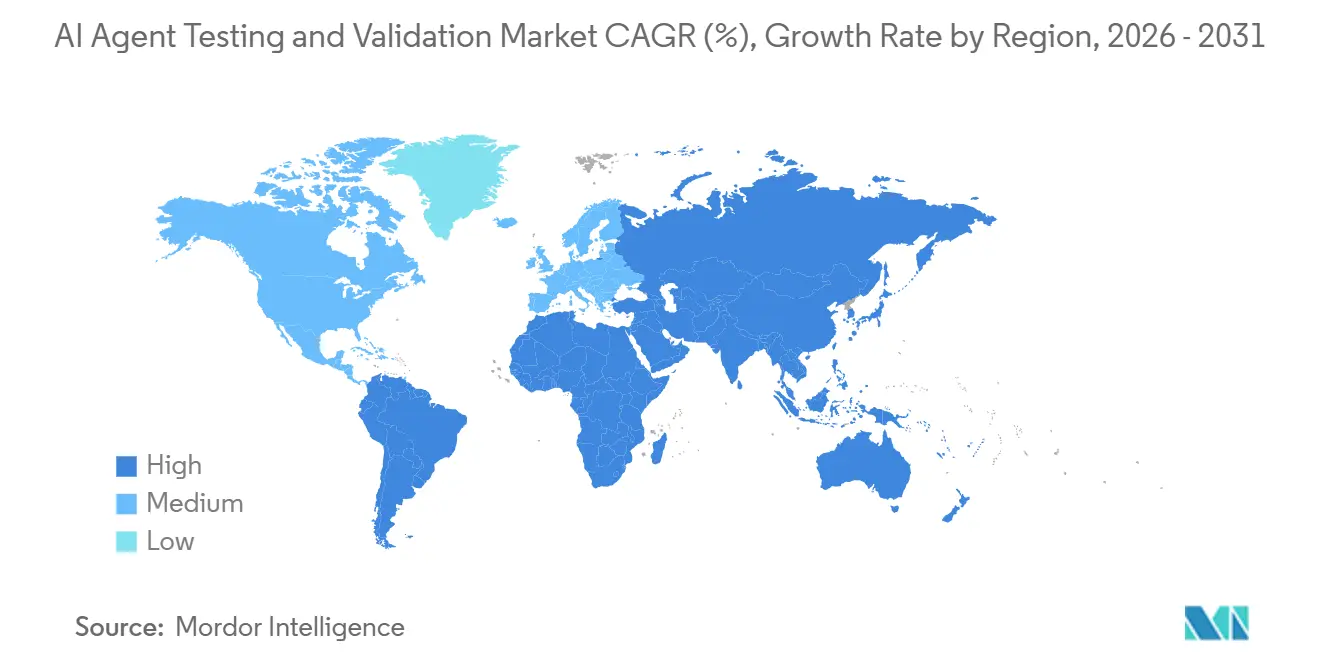
| Fastest Growing Market | Asia-Pacific |
| Largest Market | North America |
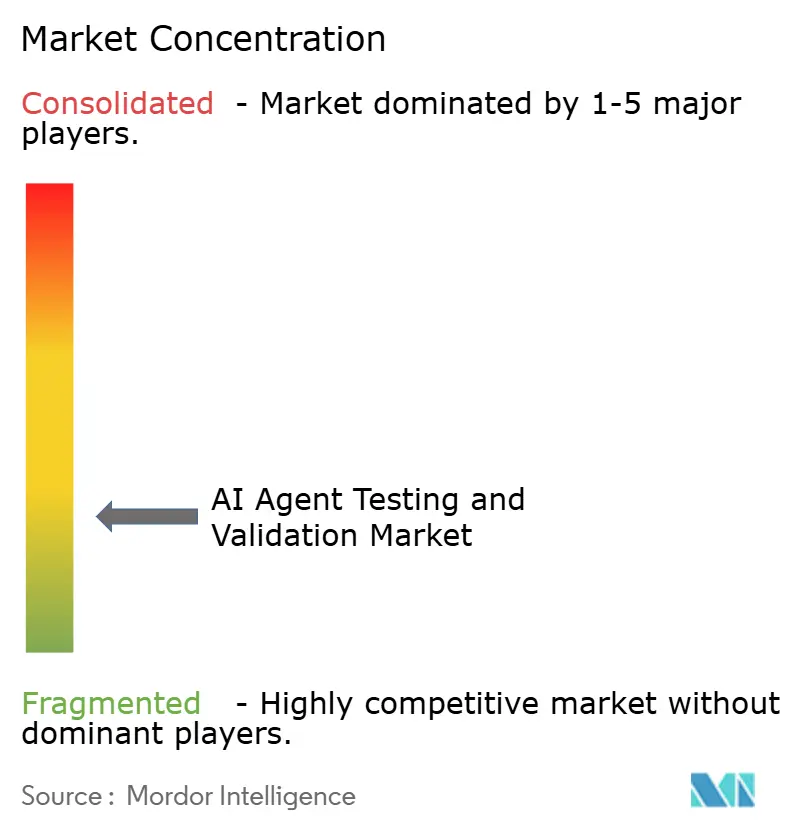
| Market Concentration | Low |
Major Players *Disclaimer: Major Players sorted in no particular order Image © Mordor Intelligence. Reuse requires attribution under CC BY 4.0. | |
AI Agent Testing and Validation Market Analysis by Mordor Intelligence
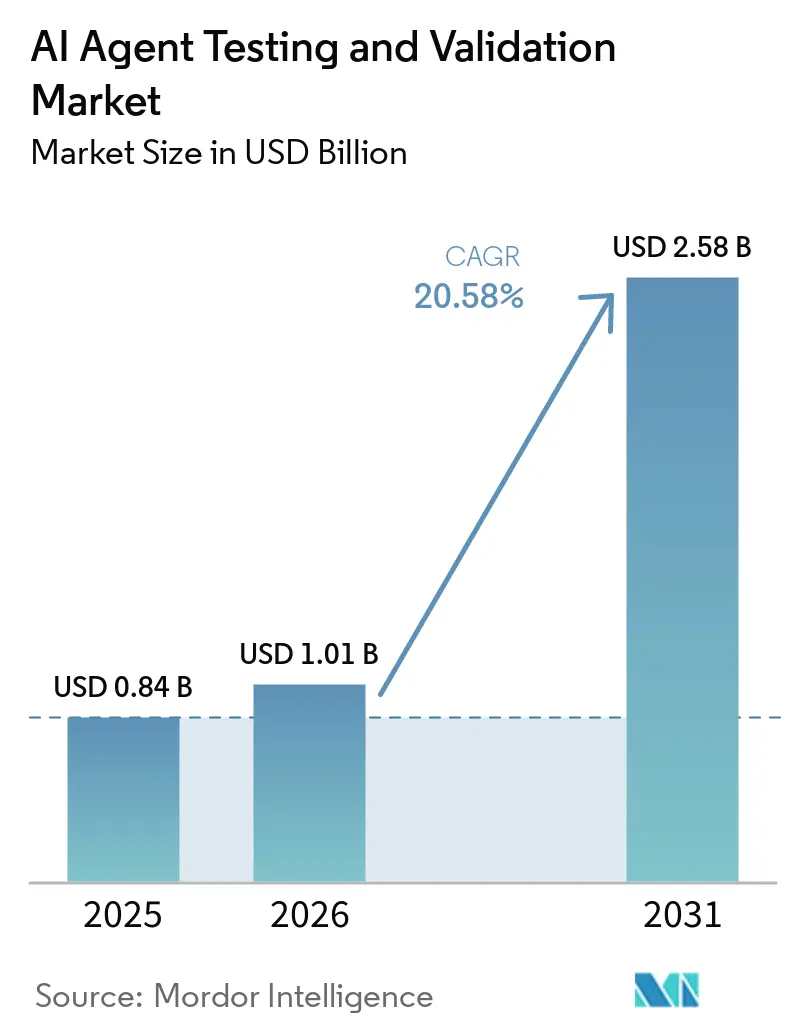
The AI Agent Testing and Validation Market size was valued at USD 0.84 billion in 2025 and is estimated to grow from USD 1.01 billion in 2026 to reach USD 2.58 billion by 2031, at a CAGR of 20.58% during the forecast period (2026-2031). Growth reflects the move from deterministic software toward agents that reason, call tools, and complete multi-step tasks. Those systems require validation of outputs, tool sequences, and intermediate states, as well as resilience to adversarial inputs. Enterprise mandates are widening deployment plans, although organizational readiness remains limited. IBM reported that 80% of surveyed CIOs and CTOs faced CEO-led AI transformation mandates, while 11% were fully ready for the anticipated scale of deployment. The AI Agent Testing and Validation Market, therefore, benefits from a gap between deployment ambition and the ability to verify production behavior.
Key Report Takeaways
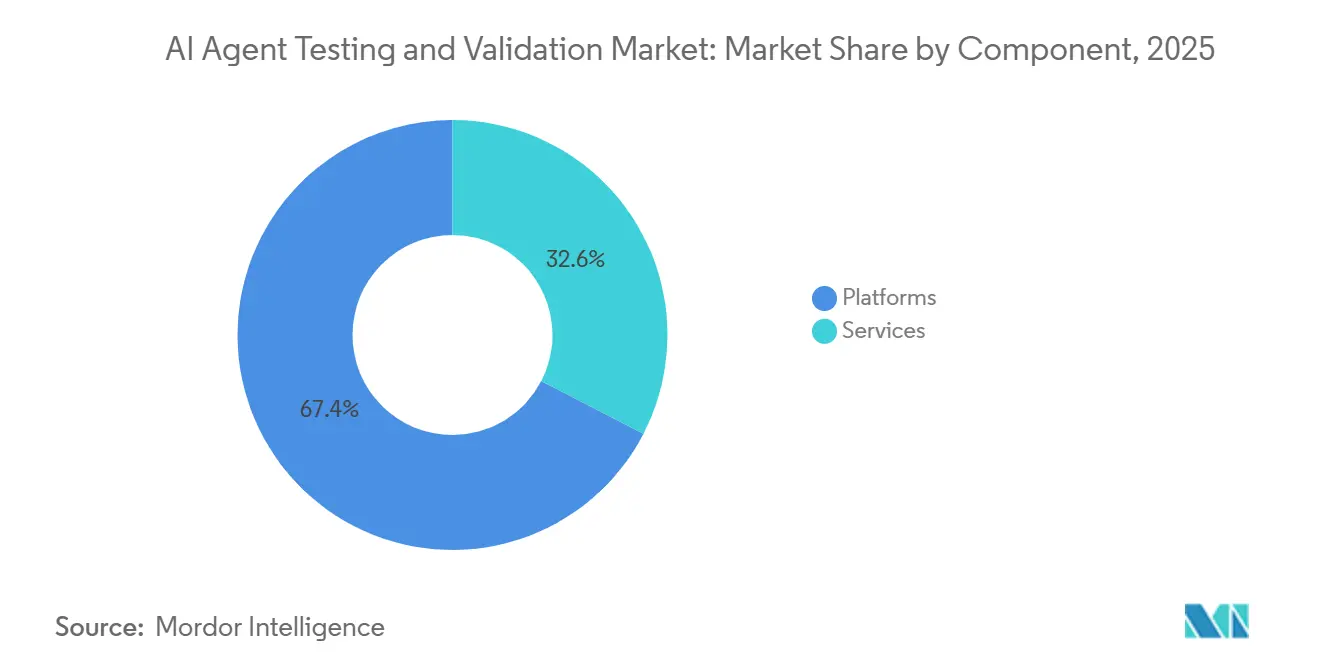
- By component, platforms held 67.41% of the AI Agent Testing and Validation Market share in 2025, while services are forecast to grow at a 21.37% CAGR through 2031.
- By testing type, functional and task-completion testing held 34.29% of the AI Agent Testing and Validation Market share in 2025, while safety, security, and adversarial testing is forecast to grow at a 20.88% CAGR through 2031.
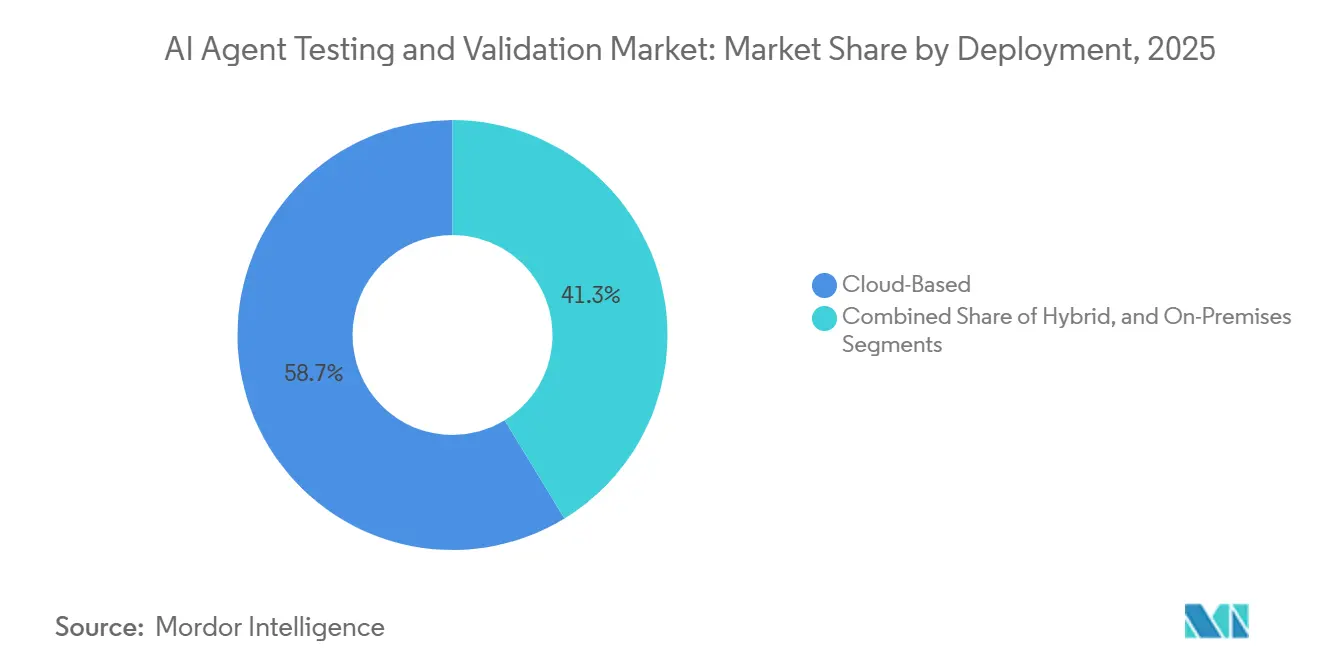
- By deployment, cloud-based deployment held 58.73% of revenue in 2025 and is forecast to grow at a 20.96% CAGR through 2031.
- By end user, technology companies and AI-native startups held 29.33% of revenue in 2025, while BFSI is forecast to grow at a 20.87% CAGR through 2031.
- By geography, North America held 40.43% of global revenue in 2025, while Asia-Pacific is forecast to grow at a 20.91% CAGR through 2031.
Note: Market size and forecast figures in this report are generated using Mordor Intelligence’s proprietary estimation framework, updated with the latest available data and insights as of January 2026.
Market Trends and Insights
Drivers Impact Analysis of AI Agent Testing and Validation Market*
| Driver | (~) % Impact on CAGR Forecast | Geographic Relevance | Impact Timeline |
|---|---|---|---|
| Proliferation of Autonomous and Multi-Agent Workflows | +5.2% | Global, with North America and Asia-Pacific as primary centers | Short term (≤ 2 years) |
| Continuous Evaluation in AI Software Delivery Pipelines | +4.3% | Global, with the highest concentration in North America and Europe | Short term (≤ 2 years) |
| Regulatory Demand for Explainable and Auditable AI Assurance | +3.8% | Europe, North America, and Asia-Pacific | Medium term (2-4 years) |
| Procurement Evidence Requirements for Third-Party Agents | +2.9% | Global, led by enterprise-dense North America and Europe | Medium term (2-4 years) |
| Synthetic User Simulation for Rare-Event Coverage | +2.1% | Global, with higher adoption in North America and Asia-Pacific | Medium term (2-4 years) |
| Evidence-Based Validation of Agent Tool and State Transitions | +1.8% | Global, with early gains in North America | Long term (≥ 4 years) |
| Source: Mordor Intelligence | |||
Proliferation of Autonomous and Multi-Agent Workflows
Enterprises are deploying multi-agent systems in which planning, retrieval, and execution agents coordinate through shared memory and external tools. This design increases the number of paths that must be examined before a workflow can be approved. An error from one agent can move through later steps before it becomes visible to an employee or customer. Patronus AI’s TRAIL benchmark contains 148 human-annotated traces, 841 discrete errors, and more than 20 agentic error categories. The benchmark found joint accuracy below 12% for frontier models tasked with localizing errors in complex traces. The AI Agent Testing and Validation Market is driven by this broader testing burden, as evaluation capacity can constrain enterprise rollout plans.
Continuous Evaluation in AI Software Delivery Pipelines
AI evaluation is becoming part of normal software delivery rather than a task completed only before launch. Changes to prompts, models, or tool definitions can alter agent behavior without changing the intended business process. Running evaluation suites on code changes can identify regressions before they reach production users. LangSmith Engine monitors production traces, groups repeated failures, identifies root causes, and proposes fixes. Datadog described an evaluation process that reruns labeled test sets when new models become available to identify improvements and regressions. In the AI Agent Testing and Validation Market, integration with delivery workflows can matter as much as the evaluation method because it shortens the time between a detected failure and a corrective test.
Regulatory Demand for Explainable and Auditable AI Assurance
Regulatory frameworks are making traceable evidence a practical requirement for many AI agent deployments. The European Commission states that Article 50 transparency obligations under the EU AI Act applied from August 2, 2026. The obligations cover systems that interact directly with people and, where relevant, require clear information about their artificial nature.[1] Japan’s AI Safety Institute updated its safety evaluation guide in July 2026 to cover the spread of AI agent systems. Germany’s BSI published AICRIV Finanz criteria for testing AI systems used in financial services. These requirements strengthen demand for versioned test records, linked scores, and documented coverage in the AI Agent Testing and Validation Market.[2]
Procurement Evidence Requirements for Third-Party Agents
Enterprise buyers are increasingly asking vendors to demonstrate that third-party agents have been tested before being introduced into important workflows. Documentation can include benchmark results, adversarial test results, monitoring commitments, and version records. This requirement affects organizations, buying agents, and the vendors that supply them. Langfuse outlined deployment gates for financial services that automate evidence collection, including test results, review sign-offs, and version records. The framework addresses documentation that would otherwise require manual effort across technical and governance teams. The AI Agent Testing and Validation Market is seeing increased demand on both sides because buyers need independent assessment and providers need proof to support procurement approval.[3]
Restraints Impact Analysis of AI Agent Testing and Validation Market*
| Restraint | (~) % Impact on CAGR Forecast | Geographic Relevance | Impact Timeline |
|---|---|---|---|
| Probabilistic Test Flakiness and Reproducibility Limits | -2.1% | Global | Short term (≤ 2 years) |
| Shortage of AI-First Quality Engineering Talent | -1.4% | Global, most acute in Europe and emerging Asia-Pacific markets | Medium term (2-4 years) |
| High Compute and Data Costs for High-Fidelity Simulation | -0.9% | Global, with a disproportionate effect on SMEs and emerging-market buyers | Medium term (2-4 years) |
| Fragmented Standards Across Agent Frameworks and Protocols | -0.7% | Global | Long term (≥ 4 years) |
| Source: Mordor Intelligence | |||
Probabilistic Test Flakiness and Reproducibility Limits
Large language models can produce different outputs when they receive the same input in separate runs. This makes it harder to separate genuine improvement from ordinary variation. Sierra’s tau-bench introduced the pass^k reliability measure to show how success rates decline as agents must repeatedly complete the same task. Teams may need many trials for each test case before the results are reliable enough for a production decision. That need increases computing use and can extend validation cycles. A review of 257 papers found that runtime evidence maintenance, temporal validity, and open-ended multi-agent assurance remained less developed than behavioral evaluation. These limits can slow adoption in the AI Agent Testing and Validation Market, where regulated users need consistent evidence for every release.
Shortage of AI-First Quality Engineering Talent
Evaluation teams need expertise in non-deterministic model behavior, trajectory scoring, judge calibration, and reliability measurement. This combination remains uncommon in many enterprise quality engineering organizations. The issue is not only the number of available practitioners, but also the narrow range of skills needed to create, maintain, and interpret agent evaluation suites. Organizations can buy testing platforms, but they still need people who can construct appropriate test sets, review exceptions, and interpret results in the context of each workflow. Human review remains particularly relevant when an automated judge cannot provide a sufficiently dependable evaluation in a high-stakes case. The shortage can limit the pace at which buyers in the AI Agent Testing and Validation Market use advanced evaluation functions.
*Our forecasts treat driver/restraint impacts as directional, not additive. The impact forecasts reflect baseline growth, mix effects, and variable interactions.
AI Agent Testing and Validation Market Segment Analysis
By Component:
Platforms Remain the Primary Buying ModelPlatforms accounted for 67.41% of the AI Agent Testing and Validation Market in 2025. The lead reflected enterprise preference for a single environment that supports offline evaluation, production monitoring, and regression testing. A unified system can reduce the effort needed to connect separate tools and reconcile their results. LangChain reported 12x year-over-year growth in commercial monthly trace volume for LangSmith, while 35% of Fortune 500 companies used LangChain services. These results show why integrated trace and evaluation functions matter to organizations operating agents at scale. Platforms also suit technology-forward buyers with internal AI engineering teams who want direct control over testing workflows.
Services are projected to grow at a 21.37% CAGR from 2026 to 2031 within the AI Agent Testing and Validation Market. Buyers use services when they need help with test harnesses, golden datasets, or calibration of automated judges. This is particularly relevant for regulated organizations that need an independent and defensible review. Platform revenue can scale with seats or usage, while services revenue usually remains tied to projects and specialist labor. Arize AX introduced functions for agent experiment comparison and root cause analysis of failures in 2026. Vendors are lowering the expertise needed to use platforms, while services remain valuable when evaluation design requires specialist judgment.
By Testing Type:
Safety Testing Gains Importance Alongside Functional TestingFunctional and task-completion testing accounted for 34.29% of the AI Agent Testing and Validation Market size in 2025. It remains the baseline test layer for agents that complete clear tasks such as filing forms, retrieving information, or executing a database query. These tests help teams confirm whether a workflow produces the expected result under defined conditions. They do not always reveal whether an agent used an unauthorized tool, relied on outdated context, or deviated from its assigned role. Research on multi-agent financial systems identified risks involving temporal staleness, role drift, and unauthorized tool use.[4] Functional testing therefore remains necessary, but it is being supplemented by methods that review the full trajectory of an agent.
Safety, security, and adversarial testing is forecast to grow at a 20.88% CAGR through 2031 in the AI Agent Testing and Validation Market. Automated red-teaming is moving into operational delivery processes as enterprises deploy agents in sensitive settings. Microsoft Research found that responsible AI harms were widespread and difficult to measure across more than 100 generative AI products. The work also showed that automation can expand risk coverage beyond what manual exercises can review. Performance, cost, and latency testing is also relevant for high-frequency workflows where computing cost and response time affect operating outcomes. Fairness, bias, compliance, regression, drift, and tool-use testing are gaining importance as agent configurations and underlying models change.
By Deployment:
Cloud-Based Systems Provide Scale for EvaluationCloud-based deployment held 58.73% of revenue in 2025. It is forecast to grow at a 20.96% CAGR through 2031. Cloud infrastructure supports large volumes of simulations and adversarial tests that can run in parallel. That capacity is important when teams need to evaluate many paths across an agent workflow. Cast AI found average GPU utilization near 5% across more than 23,000 clusters, indicating the cost challenge of dedicated capacity for intermittent AI workloads. Elastic environments can therefore fit evaluation workloads that rise sharply around releases and model updates.
On-premises deployment remains relevant where data residency rules, air-gap requirements, or proprietary models prevent cloud testing. Defense, sovereign banking, and healthcare organizations can require evaluation of protected production data. Hybrid deployment combines cloud scale for general test suites with local systems for sensitive data and live production validation. This approach can preserve local controls without losing access to wider regression capacity. Article 10 of the EU AI Act includes data governance requirements for training, validation, and test datasets used by high-risk systems. The AI Agent Testing and Validation Market will therefore require cloud providers to offer environments that preserve auditability and data safeguards.

By End User:
Technology Buyers Lead While BFSI Expands FastestTechnology companies and AI-native startups held 29.33% of revenue in 2025. These organizations build and operate agents as part of their commercial products, making evaluation a core operating requirement. Their teams can create rapid feedback loops between agent development and testing results. That feedback raises platform use as models, prompts, tools, and workflows change. It also allows suppliers to sell trace monitoring, test management, and production evaluation in a connected offering. Technology buyers are likely to remain early adopters because they have direct exposure to failures in agent performance.
BFSI is forecast to expand at a 20.87% CAGR from 2026 to 2031 in the AI Agent Testing and Validation Market. Financial institutions face transaction risk, audit requirements, and strict expectations around policy compliance. MAS published the SAFR framework in July 2026 to support policy-bound execution, real-time validation, auditability, and interoperability for financial AI agents. BSI’s AICRIV Finanz catalog also provides operational criteria for AI systems used in financial services. The TELLER benchmark reported 38% execution accuracy for the leading model in complex financial workflows across 1,033 instances and 5 banking scenarios. Healthcare, retail, telecommunications, manufacturing, government, and defense also require evaluation as agents make consequential decisions and operate within operational processes.
Geography Analysis
North America AI Agent Testing and Validation Market
North America held 40.43% of global revenue in 2025, supported by its concentration of frontier AI labs, enterprise software vendors, evaluation startups, and early enterprise adopters. LangChain, Braintrust, Arize AI, Patronus AI, Galileo Technologies, Scale AI, and Datadog operate from North American headquarters, which helps platform methods and enterprise practices circulate quickly among developers and buyers. Canada’s AI safety research community contributes evaluation methods with commercial relevance, while Mexico is beginning to add demand as its technology sector adopts cloud-based tools. Large cloud developer ecosystems also shape regional uptake, as Amazon Web Services, Google, and Microsoft embed evaluation capabilities into broader development environments. This can bring evaluation functions to cloud-native teams that may not purchase a dedicated platform, while existing cloud contracts can make initial adoption less complex.
Europe AI Agent Testing and Validation Market
Europe is expanding from a smaller base, with Germany, the United Kingdom, and France leading enterprise adoption. Article 50 transparency obligations became applicable in August 2026, while high-risk AI system requirements have a later implementation schedule. The AI Agent Testing and Validation Market size in Europe is supported by the need for records that demonstrate compliance over time, including versioned tests, documented coverage, and trace-linked results. The regulatory sequence creates a multi-year build-out cycle because enterprises need to establish test processes before agent deployments become more widespread in customer-facing and consequential uses. Buyers will also need to align those processes with data governance expectations for high-risk systems and with their own internal risk controls.
APAC, South America and MEA AI Agent Testing and Validation Market
Asia-Pacific is projected to grow at a 20.91% CAGR through 2031 in the AI Agent Testing and Validation Market, as Japan, South Korea, India, China, and Australia implement governance approaches that increase the need for documented agent validation. In July 2026, Japan’s AI Safety Institute updated its guide to include AI agent system considerations, and Singapore’s SAFR framework provides a testing reference point for financial AI agents. South America remains earlier in adoption, with Brazil leading cloud-first enterprise use and Argentina adding emerging demand. The United Arab Emirates and Saudi Arabia are generating government-led demand through national digital programs, while African procurement remains concentrated among multinational enterprises in South Africa and Nigeria.
Competitive Landscape
The AI Agent Testing and Validation Market is fragmented, with more than 20 identifiable vendors across specialized evaluation providers, observability platforms that have expanded into AI workloads, and cloud provider toolkits. Braintrust, Arize AI, Patronus AI, HoneyHive, Galileo Technologies, Langfuse, Openlayer, Deepchecks, Agenta, and Maxim AI compete as specialized providers with differing evaluation depth, trace fidelity, judge calibration, and human-review workflow capabilities. Datadog, Weights and Biases, and Scale AI bring enterprise-grade contracts and data infrastructure that can help buyers connect evaluation findings to live production performance. Cloud providers compete mainly on the convenience of integration with existing developer environments rather than on standalone evaluation methods. This supplier mix gives buyers options, but it also makes workflow compatibility, evidence quality, and integration depth important selection factors.
Microsoft Research developed Agent-Pex to extract explicit and implicit behavioral rules from prompts and traces, then verify compliance across production spans. If productized, this method could narrow the methodological advantage held by some specialist providers by making behavioral specifications reusable across large volumes of agent activity. LangChain’s LangSmith Engine monitors traces, clusters recurring failures, diagnoses probable causes, and proposes fixes, while Arize AX introduced agent experiment comparisons across tool use, retrieval quality, latency, trajectories, and evaluation results. These moves connect evaluation with remediation and system-wide experiment management, rather than treating testing as an isolated release gate. Suppliers, therefore, need to make technical evidence understandable to engineering teams and governance functions that use it for deployment decisions.
Interoperable traces, continuous red-teaming, and human review of difficult cases are important areas of competition. OpenTelemetry and the Model Context Protocol can support testing across varied agent frameworks and tools, while automated red-teaming can make adversarial assessment a recurring control rather than an occasional exercise. Human review remains necessary when automated judges lack sufficient calibration for high-stakes decisions, and regulatory documentation favors platforms that provide versioned datasets, trace-linked scores, and coverage records. The AI Agent Testing and Validation Market remains open to specialists, but broader platforms can use established cloud relationships and observability data to extend their reach.
AI Agent Testing and Validation Industry Leaders
-
LangChain Inc.
-
Datadog, Inc.
-
Arize AI, Inc.
-
Braintrust Data, Inc.
-
Amazon Web Services, Inc.
- *Disclaimer: Major Players sorted in no particular order
AI Agent Testing and Validation Market Companies Covered in this Report
- LangChain Inc.
- Braintrust Data, Inc.
- Arize AI, Inc.
- Patronus AI, Inc.
- Openlayer, Inc.
- Datadog, Inc.
- HoneyHive AI, Inc.
- Deepchecks Technologies Ltd.
- Galileo Technologies, Inc.
- Agenta Technologies, Inc.
- Maxim AI, Inc.
- Langfuse GmbH
- Monte Carlo Data, Inc.
- Fiddler Labs, Inc.
- WhyLabs, Inc.
- Truera, Inc.
- Weights & Biases, Inc.
- Scale AI, Inc.
- Tricentis GmbH
- Amazon Web Services, Inc.
- Google LLC
- Microsoft Corporation
- International Business Machines Corporation
- Anthropic PBC
Recent Industry Developments in AI Agent Testing and Validation Market
- August 2026: The European Union's enforcement powers under the EU AI Act became fully effective on August 2, 2026, requiring providers and deployers of AI systems, including AI agents interacting with natural persons, to comply with transparency obligations under Article 50. This regulatory milestone is expected to trigger mandatory testing investment across enterprise deployments in EU member states as organizations seek defensible compliance documentation, converting regulatory timelines into procurement cycles.
- July 2026: The Monetary Authority of Singapore, alongside leading financial institutions and FinTechs, published the "Safeguards for Agentic Finance at Runtime" (SAFR) white paper under its BuildFin.ai initiative. SAFR proposes an industry-developed framework for policy-bound execution, real-time validation, auditability, and interoperability for financial AI agents, directly mandating validation infrastructure from financial institutions deploying autonomous agents at transactional speed.
- July 2026: Arize AI launched new capabilities for its Arize AX platform at the Observe 2026 annual conference. The release introduced agent experiment functionality enabling full-harness comparisons across runs, covering tool use, retrieval quality, latency, trajectories, and evaluation results, moving agent testing beyond prompt-level evaluation to complete system-level regression validation.
- June 2026: LangChain launched LangSmith Engine at the Interrupt 2026 conference, alongside the general availability of LangSmith Sandboxes. LangSmith Engine monitors production traces, clusters recurring agent failures into named issues, diagnoses root causes, and proposes fixes automatically, closing the evaluation-to-improvement loop and reducing remediation cycle time from days to hours for teams with high-volume agent deployments.
Global AI Agent Testing and Validation Market Report Scope
The AI agent testing and validation market comprises platforms and services that evaluate the functionality, safety, and reliability of autonomous AI agents before deployment. This includes testing for task completion, tool-use workflows, adversarial attacks, performance latency, and algorithmic bias or drift. Deployed across cloud, hybrid, or on-premises models, these solutions help technology companies, financial institutions, and other enterprises ensure their AI agents operate securely, fairly, and as intended in real-world environments.
The AI Agent Testing and Validation Market Report is Segmented by Component (Platforms and Services), Testing Type (Functional and Task-Completion Testing, Tool-Use and Workflow Testing, Safety, Security, and Adversarial Testing, Performance, Cost, and Latency Testing, Fairness, Bias, and Compliance Testing, Regression and Drift Testing, and Other Testing Type), Deployment Model (Cloud-Based, Hybrid, and On-Premises), End User (Technology Companies and AI-Native Startups, Banking, Financial Services, and Insurance, Healthcare and Life Sciences, Retail and E-commerce, IT and Telecommunications, Manufacturing, Automotive, and Logistics, Government and Defense, and Other End Users), and Geography (North America, South America, Europe, Asia-Pacific, Middle East, and Africa). The Market Forecasts are Provided in Terms of Value (USD).
Segmentation Overview
| Platforms |
| Services |
| Functional and Task-Completion Testing |
| Tool-Use and Workflow Testing |
| Safety, Security, and Adversarial Testing |
| Performance, Cost, and Latency Testing |
| Fairness, Bias, and Compliance Testing |
| Regression and Drift Testing |
| Other Testing Type |
| Cloud-Based |
| Hybrid |
| On-Premises |
| Technology Companies and AI-Native Startups |
| Banking, Financial Services, and Insurance |
| Healthcare and Life Sciences |
| Retail and E-commerce |
| IT and Telecommunications |
| Manufacturing, Automotive, and Logistics |
| Government and Defense |
| Other End Users |
| North America | United States |
| Canada | |
| Mexico | |
| South America | Brazil |
| Argentina | |
| Chile | |
| Rest of South America | |
| Europe | Germany |
| United Kingdom | |
| France | |
| Italy | |
| Spain | |
| Rest of Europe | |
| Asia-Pacific | China |
| Japan | |
| India | |
| South Korea | |
| Australia | |
| Rest of Asia-Pacific | |
| Middle East | United Arab Emirates |
| Saudi Arabia | |
| Qatar | |
| Rest of Middle East | |
| Africa | South Africa |
| Egypt | |
| Nigeria | |
| Rest of Africa |
| By Component | Platforms | |
| Services | ||
| By Testing Type | Functional and Task-Completion Testing | |
| Tool-Use and Workflow Testing | ||
| Safety, Security, and Adversarial Testing | ||
| Performance, Cost, and Latency Testing | ||
| Fairness, Bias, and Compliance Testing | ||
| Regression and Drift Testing | ||
| Other Testing Type | ||
| By Deployment Model | Cloud-Based | |
| Hybrid | ||
| On-Premises | ||
| By End User | Technology Companies and AI-Native Startups | |
| Banking, Financial Services, and Insurance | ||
| Healthcare and Life Sciences | ||
| Retail and E-commerce | ||
| IT and Telecommunications | ||
| Manufacturing, Automotive, and Logistics | ||
| Government and Defense | ||
| Other End Users | ||
| By Geography | North America | United States |
| Canada | ||
| Mexico | ||
| South America | Brazil | |
| Argentina | ||
| Chile | ||
| Rest of South America | ||
| Europe | Germany | |
| United Kingdom | ||
| France | ||
| Italy | ||
| Spain | ||
| Rest of Europe | ||
| Asia-Pacific | China | |
| Japan | ||
| India | ||
| South Korea | ||
| Australia | ||
| Rest of Asia-Pacific | ||
| Middle East | United Arab Emirates | |
| Saudi Arabia | ||
| Qatar | ||
| Rest of Middle East | ||
| Africa | South Africa | |
| Egypt | ||
| Nigeria | ||
| Rest of Africa | ||
Key Questions Answered in the Report
How large is the AI Agent Testing and Validation Market?
The market is estimated at USD 1.01 billion in 2026 and is forecast to reach USD 2.58 billion by 2031 at a 20.58% CAGR.
What is driving demand for AI agent testing and validation?
Demand is supported by multi-agent workflows, recurring evaluation in software delivery, regulatory documentation, and buyer requests for pre-deployment evidence.
Which component leads spending on agent evaluation?
Platforms led with 67.41% share in 2025 because organizations seek connected evaluation, monitoring, and regression testing functions across the agent lifecycle.
Which deployment model is growing fastest for agent testing?
Cloud-based deployment led with 58.73% share in 2025 and is forecast to grow at a 20.96% CAGR through 2031, supported by its ability to run parallel simulations.
Why does BFSI need specialized agent validation?
Financial services require policy controls, real-time validation, auditability, and evidence for higher-risk workflows under emerging agent governance expectations.
Which region is expanding fastest for AI agent validation?
Asia-Pacific is forecast to grow at a 20.91% CAGR through 2031 as regional governance approaches raise evidence requirements for agent systems. The AI Agent Testing and Validation Market benefits as enterprises translate these requirements into repeatable testing and documentation processes.