
Africa 5G Infrastructure Market Size and Share
Market Overview
| Study Period | 2020 - 2031 |
|---|---|
| Forecast Data Period | 2026 - 2031 |
| Base Year Market Size (2025) | USD 4.86 Billion |
| Market Size (2026) | USD 5.34 Billion |
| Market Size (2031) | USD 9.16 Billion |
| Growth Rate (2026 - 2031) | 11.40 % |
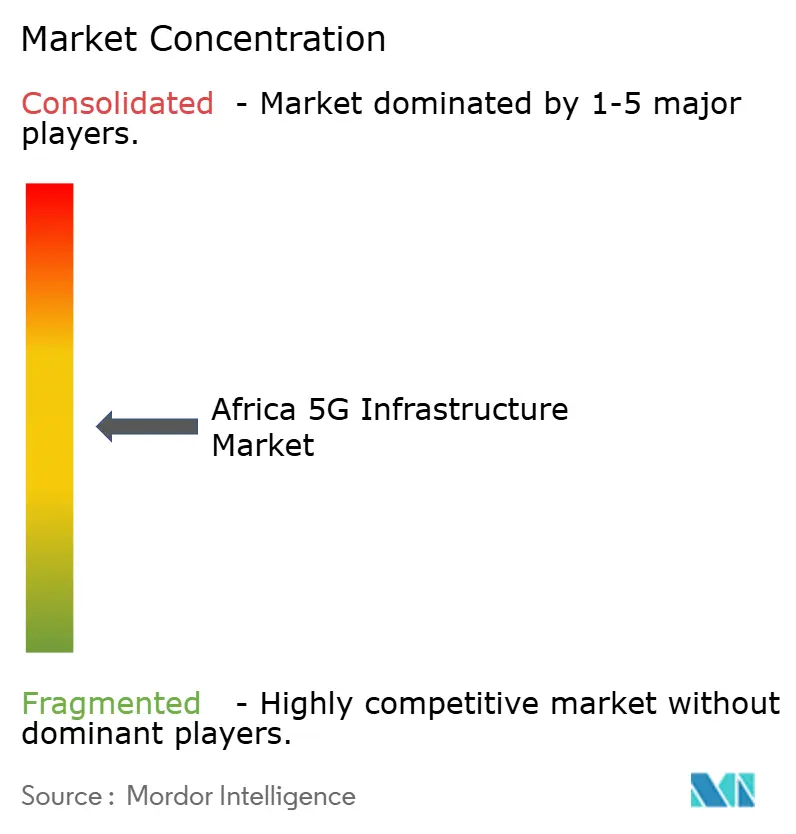
| Market Concentration | Medium |
Major Players *Disclaimer: Major Players sorted in no particular order Image © Mordor Intelligence. Reuse requires attribution under CC BY 4.0. | |
Africa 5G Infrastructure Market Analysis by Mordor Intelligence
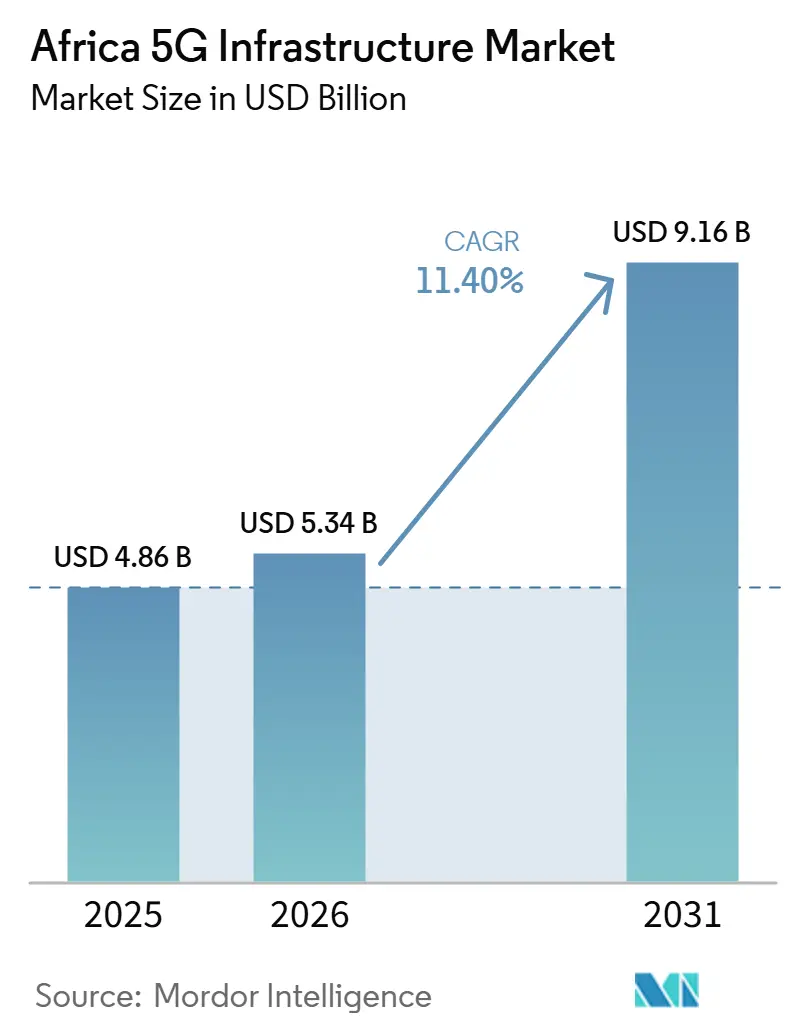
The Africa 5G Infrastructure Market size was valued at USD 4.86 billion in 2025 and is estimated to grow from USD 5.34 billion in 2026 to reach USD 9.16 billion by 2031, at a CAGR of 11.40% during the forecast period (2026-2031). The Africa 5G infrastructure market is moving from maintaining 4G networks to expanding 5G coverage, adopting cloud-native core networks, and providing enterprise connectivity services. Sub-Saharan Africa is expected to add substantial 5G subscriptions, which should extend equipment demand beyond city coverage into industrial sites and rural broadband. This demand also places greater emphasis on transport and xHaul capacity, rather than on radio site density. Vendors are competing on radio networks, core platforms, energy use, and private-network capabilities, while operators increasingly combine procurement with infrastructure investment. High capital needs, fragmented spectrum rules, and diesel-related energy costs can delay deployment and weaken project returns.
Key Report Takeaways
- By communication infrastructure, 5G radio access network (RAN) held 62.42% of revenue share in the Africa 5G infrastructure market in 2025, while the core network (cloud-native 5G core) is projected to expand at a 14.34% CAGR through 2031.
- By spectrum band, mid-band (1-6 GHz) held 59.89% of revenue share in the Africa 5G infrastructure market in 2025, while high-band/mmWave (above 24 GHz) is projected to expand at a 16.11% CAGR through 2031.
- By network architecture, non-standalone architecture held 55.12% of revenue share in the Africa 5G infrastructure market in 2025, while standalone architecture is projected to expand at an 18.85% CAGR through 2031.
- By core network technology, network function virtualization held 39.10% of revenue share in the Africa 5G infrastructure market in 2025, while network slicing is projected to expand at a 12.43% CAGR through 2031.
- By end-user vertical, consumer electronics accounted for 51.78% of revenue share in the Africa 5G infrastructure market in 2025, while industrial manufacturing is projected to expand at a 18.30% CAGR through 2031.
- By country, South Africa held 23.68% of revenue share in the Africa 5G infrastructure market in 2025, while Nigeria is projected to expand at a 12.33% CAGR through 2031.
Note: Market size and forecast figures in this report are generated using Mordor Intelligence’s proprietary estimation framework, updated with the latest available data and insights as of January 2026.
Market Trends and Insights
Drivers Impact Analysis of Africa 5G Infrastructure Market*
| Driver | (~) % Impact on CAGR Forecast | Geographic Relevance | Impact Timeline |
|---|---|---|---|
| Mobile Data Traffic Surge and 5G Coverage Gaps | +3.2% | Global, most acute in Sub-Saharan Africa and North Africa | Medium term (2-4 years) |
| Digital Economy Programs and Spectrum Release | +2.4% | North Africa, Morocco and Egypt, West Africa, Nigeria and Ghana, East Africa, Kenya | Short term (≤ 2 years) |
| Fixed Wireless Access for Broadband Expansion | +1.8% | South Africa, North Africa, and East Africa | Medium term (2-4 years) |
| Private 5G Demand in Mining, Ports, and Industrial Sites | +1.4% | South Africa mining belt, West Africa ports, and North Africa industrial zones | Medium term (2-4 years) |
| Microwave and Millimeter-Wave Backhaul Modernization | +0.9% | Sub-Saharan Africa, East Africa, and Central Africa | Long term (≥ 4 years) |
| AI-RAN, Automation, and Energy-Efficient Operations | +0.7% | Global, led by South Africa and North Africa | Long term (≥ 4 years) |
| Source: Mordor Intelligence | |||
Mobile Data Traffic Surge and 5G Coverage Gaps
The Africa 5G infrastructure market is increasingly responding to pressure on existing 4G capacity rather than only to long-range technology plans. Average monthly data use per active smartphone in Sub-Saharan Africa was 5.3 GB in 2025 and is forecast to reach 12 GB by 2031. MTN Nigeria's capital expenditure reached NGN 757.4 billion (USD 527 million) in 2025, as data traffic rose 36%, underscoring how traffic pressure can increase network spending under difficult operating conditions. Only 53 operators in 29 African markets had launched commercial 5G by September 2025, leaving more than 25 markets facing capacity pressure on 4G networks.[1]GSMA, “5G in Africa 2025: Market Status, Trends and Outlook,” GSMA, gsma.com Operators that use 5G mainly to ease congestion may face shorter revenue recovery periods unless they also add enterprise and fixed wireless access services. The Africa 5G infrastructure market, therefore, depends on matching capacity investment with services that create additional revenue.
Government Digital Economy Programs and Spectrum Release Momentum
Spectrum policy is shaping the near-term pace of the Africa 5G infrastructure market by determining when operators can place equipment orders and begin commercial coverage. Egypt's National Telecommunications Regulatory Authority published its Mobile Spectrum Roadmap 2026-2030 in March 2026, adding 410 MHz across 3 bands with assignments extending through 2039.[2]National Telecommunications Regulatory Authority, “Mobile Spectrum Roadmap 2026-2030: Enabling the Future of Mobile Connectivity,” National Telecommunications Regulatory Authority, tra.gov.eg Ghana's National Communications Authority opened applications in July 2026 for 5G spectrum in the 700 MHz, 2.3 GHz, and 3 GHz bands on a competitive commercial basis. Morocco licensed Maroc Telecom, Orange, and inwi at the same time in November 2025, with coverage obligations of 45% of the population by 2026 and 85% by 2030 under Digital Morocco 2030. The strategy is supported by MAD 80 billion (USD 8 billion) through 2035. License obligations turn regulatory deadlines into capital expenditure commitments and give vendors clearer procurement schedules. The African Telecommunications Union recommends technology-neutral licensing and faster availability of mid-band and high-band spectrum to support this process.[3]African Telecommunications Union, “ATU-R Report 005-0: Report on 5G Preparedness and Relevant Use Cases in Africa,” African Telecommunications Union, atuuat.africa
Fixed Wireless Access as a Fast Path to Broadband Expansion
Fixed wireless access gives the Africa 5G infrastructure market a near-term broadband revenue stream from radio sites that also serve mobile users. By September 2025, 25 African operators had launched commercial 5G fixed wireless access services, and many offered it alongside mobile 5G. Nokia expects 5G to account for 35% of all fixed wireless access connections in the Middle East and Africa by 2030. This model is important where fiber-to-the-home deployment is costly or uneconomic. Vodacom Group spent ZAR 23.6 billion (USD 1.28 billion) in capital expenditure during FY2026 and added 6,160 5G sites, creating shared infrastructure for mobile broadband and home broadband. Fixed wireless access can support site-level revenue in peri-urban locations before enterprise demand develops. It can also free capital for coverage expansion in less densely populated areas.
Enterprise Demand for Private 5G in Mining, Ports, and Industrial Sites
Private networks are creating a separate procurement path for the Africa 5G infrastructure market in mining, port logistics, and industrial facilities. MTN South Africa, China Telecom, and Huawei announced a private 5G network for a manganese mining company in South Africa's Northern Cape in January 2025. The deployment supported vehicle tracking, unmanned truck operations, and worker monitoring. Inwi deployed Morocco's first private industrial 5G network at a 52-hectare factory site in the Oriental region in April 2026. Nokia and Sedna Africa announced a private mobile network for the Port of Beira in Mozambique in July 2025. These projects show that private-network demand can develop before national public 5G coverage is complete. Individually licensed private spectrum can also reduce reliance on national spectrum auction schedules for industrial projects.
Restraints Impact Analysis of Africa 5G Infrastructure Market*
| Restraint | (~) % Impact on CAGR Forecast | Geographic Relevance | Impact Timeline |
|---|---|---|---|
| High Capital Expenditure and Long Payback Cycles | -2.6% | Global, most acute in Sub-Saharan Africa | Long term (≥ 4 years) |
| Delayed Spectrum Assignment and Regulatory Fragmentation | -1.8% | West Africa, Central Africa, and parts of East Africa | Medium term (2-4 years) |
| Unreliable Grid Power and Diesel Backup Dependence | -1.5% | Sub-Saharan Africa, particularly Nigeria and the Democratic Republic of the Congo | Short term (≤ 2 years) |
| Foreign Exchange Constraints and Vendor Financing Pressure | -1.2% | Ethiopia, Angola, Zimbabwe, and frontier markets in West Africa | Short term (≤ 2 years) |
| Source: Mordor Intelligence | |||
High Capital Expenditure and Long Payback Cycles
High network density requirements and low average revenue per user create long recovery periods for the 5G infrastructure market in Africa. Mid-band and high-band deployments need more sites than 4G deployments, while average revenue per user in many African markets remains below USD 5 per month. Airtel Africa guided FY2026 capital expenditure at USD 725-750 million, up from USD 670 million in FY2025. Infrastructure equipment is generally purchased in USD, while operators earn revenue in local currencies, which increases exposure to foreign exchange movements. MTN Nigeria's planned USD 2.2 billion acquisition of IHS Towers showed the growing balance-sheet commitment required to control tower infrastructure. These funding conditions can leave operators dependent on development finance and commercial debt for large-scale network investment.
Delayed Spectrum Assignment and Regulatory Fragmentation
Delayed spectrum assignment constrains the Africa 5G infrastructure market because equipment cannot be fully used before commercial frequencies are available. By mid-2025, around 70% of African countries had not assigned dedicated 5G spectrum. Africa has 54 national regulators with different fee structures, licensing periods, and coverage conditions. Egypt raised USD 700 million through 3.5 GHz auctions in 2024, while Namibia charged USD 0.28-0.43 million for comparable bands in the same period. Operators that have prepared network equipment but lack spectrum face a risk that assets will remain unused. Niger's 2025 spectrum consultation, with implementation planned for 2027-2029, illustrates how regulatory planning can defer procurement in frontier markets. The Africa 5G infrastructure market must therefore manage separate regulatory schedules rather than a single continental rollout cycle.
*Our forecasts treat driver/restraint impacts as directional, not additive. The impact forecasts reflect baseline growth, mix effects, and variable interactions.
Africa 5G Infrastructure Market Segment Analysis
By Communication Infrastructure:
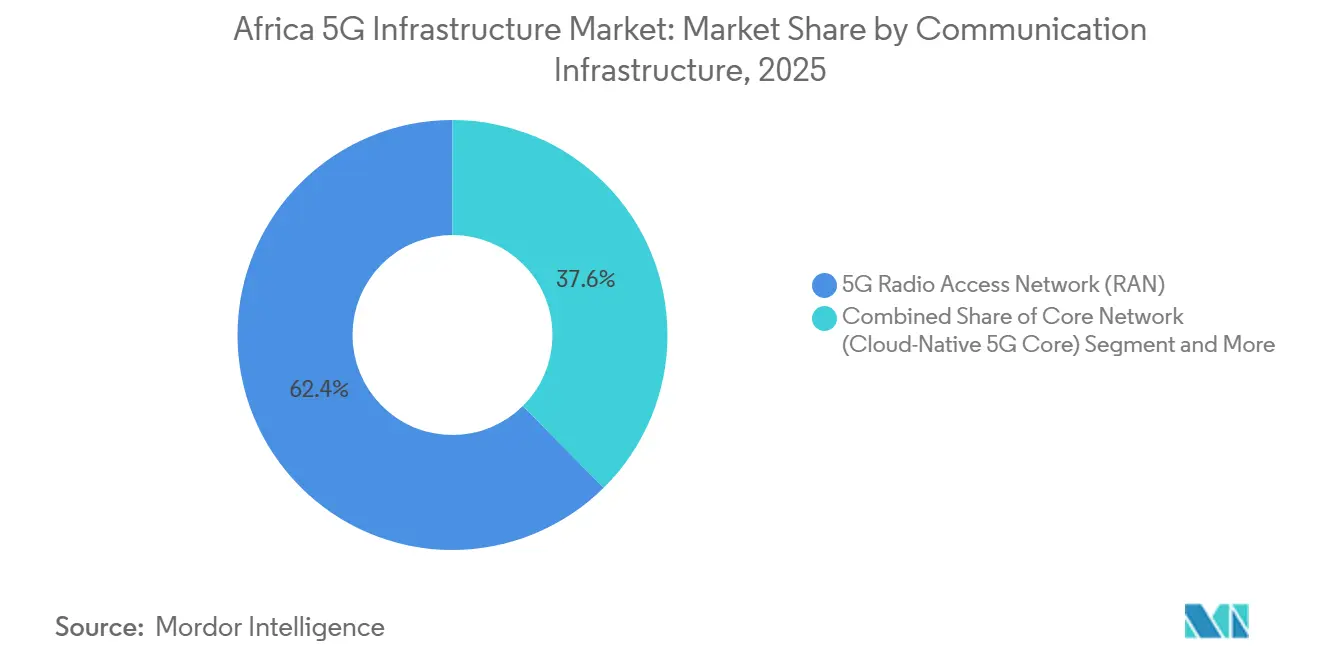
Radio Networks Lead While Core Investment RisesThe 5G radio access network segment accounted for 62.42% of total revenue in 2025, reflecting the priority operators placed on expanding air-interface coverage. Macro-site rollout activity centered on South Africa, Nigeria, Morocco, and Kenya. Mid-band spectrum supported many of these initial commercial deployments because it offers a practical balance between coverage and capacity. Transport and xHaul networks increasingly use microwave and millimeter-wave links where fiber is limited. The Africa 5G infrastructure market size for radio access equipment remains closely linked to site deployment and spectrum availability. Operators are also improving backhaul capacity because heavier traffic cannot be handled solely through radio upgrades. This makes radio, transport, and power systems interdependent parts of each rollout program. The radio layer will remain the largest immediate area of spending while coverage gaps remain significant.
Cloud-native 5G core is projected to expand at a 14.34% CAGR through 2031, making it the fastest-growing segment of communication infrastructure. The segment is supported by migration to containerized, microservices-based designs that enable network slicing and edge computing. MTN South Africa and Ericsson completed a 5G core modernization in 2025 using Ericsson Cloud Native Infrastructure Solution. Huawei deployed a cloud-native 5.5G core for Ethio Telecom, extending core modernization into East Africa. Core investment normally follows initial radio coverage, but it becomes essential when operators seek more advanced enterprise services. The Africa 5G infrastructure market will increasingly require cloud-native core platforms as operators move from non-standalone to standalone networks. This shift expands the addressable equipment base beyond radio hardware. It also increases demand for software integration and operational skills.



By Spectrum Band:
Mid-Band Supports Coverage While mmWave Serves Enterprise SitesMid-band spectrum from 1-6 GHz accounted for 59.89% of total revenue in 2025. It was the main commercial 5G spectrum range because it balances coverage with data throughput. The 3.5 GHz band was used for early commercial activations in Egypt, Morocco, Nigeria, South Africa, and Kenya. Common use of this band can simplify equipment procurement and vendor planning across national markets. Low-band spectrum is gaining importance for wider rural coverage. Nigeria's 2026-2030 Spectrum Roadmap prioritizes the 600 MHz band, while Ghana's July 2026 application process included the 700 MHz band. The Africa 5G infrastructure market depends on these lower frequencies, where distance and terrain make dense site deployment expensive. Mid-band will still anchor capacity-focused public networks in urban and suburban areas.
High-band/mmWave above 24 GHz is projected to expand at a 16.11% CAGR through 2031, the fastest rate among spectrum bands. Its main use is expected to be private networks at mines, ports, and factories rather than broad consumer mobile coverage. Rain South Africa and Huawei initiated a multi-thousand-site sub-1 GHz Massive MIMO 5G deployment in July 2026. The deployment used a low-frequency configuration, while mmWave remains relevant for locations requiring very high capacity and low latency. International spectrum frameworks provide a basis for mmWave licensing as African regulators update national frequency allocation plans. Equipment suppliers can serve both public-network and private-site demand by supporting several band combinations. The Africa 5G infrastructure market will use spectrum choice to differentiate rural coverage, urban capacity, and industrial connectivity. This creates separate investment cases rather than a single spectrum approach.
By Network Architecture:
Non-Standalone Coverage Precedes Standalone ServicesNon-standalone architecture held 55.12% of total revenue in 2025. Commercial launches commonly use 5G New Radio over existing 4G Evolved Packet Core systems. This approach reduced initial deployment complexity and limited early capital requirements. MTN South Africa reached 44% 5G population coverage by early 2025 and added 900 new 5G sites in 2024. The simpler non-standalone rollout model supported this expansion. Non-standalone networks provide the coverage base that operators can later improve with standalone capabilities. The Africa 5G infrastructure market continues to benefit from this staged approach because it reduces the need to replace all network elements at once. It also allows operators to build initial traffic and fixed wireless access revenues before major core investment.
Standalone architecture is projected to expand at an 18.85% CAGR through 2031, the highest rate among network architecture options. Mining, logistics, and public-safety users need consistent latency and service quality that non-standalone systems cannot fully provide. One Mobile completed West Africa's first 5G standalone network in Sierra Leone in 83 days in 2025. Standalone migration requires changes to both the radio and core networks, making it an important driver of future equipment demand. Network slicing and ultra-reliable low-latency services are central commercial uses for standalone systems. The Africa 5G infrastructure market is likely to see standalone investment rise as enterprise projects become more common. Operators can use standalone networks to offer managed services rather than relying solely on consumer data plans. This makes the upgrade relevant to revenue strategy as well as technical performance.
By Core Network Technology:
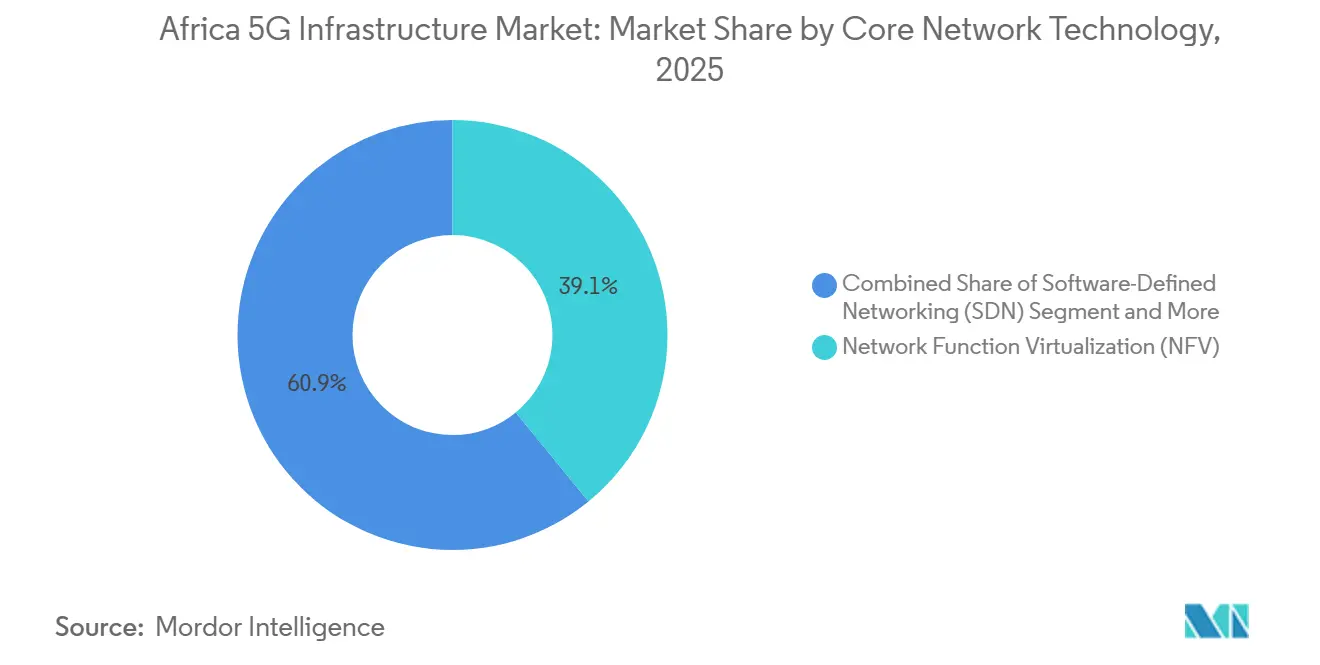
NFV Establishes the Base While Slicing Supports New ServicesNetwork function virtualization held 39.10% of total revenue in 2025. It provides a software-based foundation for cloud-native 5G cores in leading African markets. Software-defined networking can manage traffic through programmable controls, while multi-access edge computing moves processing closer to the user. These technologies can support time-sensitive tasks such as mine-site analysis and port automation. The combined network function virtualization, software-defined networking, and multi-access edge computing stack has become the basic design for major cloud-native core projects. This model reduces reliance on dedicated hardware and enables more flexible capacity expansion. The Africa 5G infrastructure market needs this foundation before operators can offer more specialized standalone services. It also allows vendors to compete through software integration rather than only through physical infrastructure.
Network slicing is projected to expand at a 12.43% CAGR through 2031, making it the fastest-growing core technology sub-segment. Operators in South Africa and Morocco with more mature standalone deployments have started offering dedicated network slices to enterprise customers. Dedicated slices can provide an agreed quality of service for applications that cannot tolerate variable performance. This service model can reduce dependence on traditional consumer average revenue per user. The 3GPP framework provides technical specifications for interoperable slicing services. Standards can give network operators and enterprise users more confidence in multiyear service arrangements. The Africa 5G infrastructure market can leverage network slicing to turn core modernization into a managed service offering. Its growth will depend on the pace of standalone deployment and on enterprise willingness to pay for assured performance.
By End-User Vertical:
Consumer Electronics Lead While Manufacturing Grows FastestConsumer electronics held 51.78% of total revenue in 2025. Smartphone-based mobile broadband and expanding fixed wireless access services supported this position. Lower-cost 5G smartphones are expected to widen adoption beyond early users as the decade progresses. Consumer services will continue to provide the traffic base that supports broad radio network deployment. Automotive and mobility, energy and utilities, and smart cities represent smaller but developing sources of managed connectivity demand. These verticals remain secondary to consumer services in current revenue contribution. The Africa 5G infrastructure market still depends on consumer electronics for the largest share of immediate service demand. This base can help operators use the same network assets for both household and business customers.
Industrial manufacturing is projected to expand at an 18.30% CAGR through 2031, the fastest rate among end-user verticals. Private 5G, autonomous equipment, and real-time operational analysis are supporting demand in extractive and process industries. Inwi deployed a private industrial 5G network at a 52-hectare factory site in Morocco in April 2026. Mining, renewable energy, logistics, and manufacturing facilities can use private connectivity for operational visibility and automation. Healthcare, public safety, defense, and smart cities are also developing through pilot projects in South Africa and East Africa. These applications can establish the evidence operators need before making broader capital commitments. The Africa 5G infrastructure market has an opportunity to move toward business services with higher value per connection. The transition will depend on reliable coverage, appropriate spectrum, and clear service terms for enterprise buyers.
Geography Analysis
South Africa 5G Infrastructure Market
South Africa accounted for 23.68% of Africa's 5G infrastructure revenue in 2025, supported by the continent's highest 5G deployment density and an active private network pipeline. Vodacom Group spent ZAR 23.6 billion (USD 1.28 billion) in capital expenditure during FY2026, a 16.5% year-on-year increase, and added 6,160 5G sites. MTN South Africa committed ZAR 480 million (USD 26 million) in May 2026 to improve 5G and 4G coverage in the Free State and Northern Cape. The company targeted 82% 5G coverage in the Free State and 75% in the Northern Cape by the end of 2026. Rain South Africa and Huawei initiated a multi-thousand-site sub-1 GHz Massive MIMO deployment in July 2026. South Africa's spectrum availability supports mid-band densification and private-network projects, giving it the continent's deepest single-country infrastructure base.
Nigeria 5G Infrastructure Market
Nigeria is projected to expand at a 12.33% CAGR through 2031, making it the fastest-growing country within the Africa 5G infrastructure market. MTN Nigeria completed a NGN 600 billion (USD 400 million) payment for 200 MHz of 3.5 GHz 5G spectrum in November 2025. Nigeria had 7.2 million 5G connections in early 2026, with 14% penetration against the Nigerian Communications Commission's 30% target. Airtel Nigeria more than doubled its active 5G sites in 2026 and targeted 25% site coverage in the 20 largest cities by year-end. Operators in Nigeria spend more than USD 350 million annually on diesel for tower sites, which encourages the adoption of solar-hybrid energy systems. The Nigeria Communications Commission's Spectrum Roadmap 2026-2030 sets out additional assignments that guide operator and vendor planning.
Broader Africa 5G Infrastructure Market
The rest of Africa includes Morocco and Egypt, where commercial 5G networks and spectrum plans are active, as well as frontier markets where launches remain further away. Morocco's 3 licensed operators began commercial 5G service simultaneously in November 2025 and must reach 85% population coverage by 2030. Digital Morocco 2030 is backed by MAD 80 billion (USD 8 billion) through 2035. Ghana opened competitive 5G spectrum applications in July 2026, while Mozambique began frequency allocation in April 2026. The Democratic Republic of the Congo signed a USD 1.5 billion agreement for 1,700 km of fiber optic infrastructure along the Congo River in June 2026. Kenya's Safaricom increased its 5G sites from 803 to 1,700 in 2025, covering 30% of the population. These differing stages of readiness will spread equipment procurement across several time periods.
Competitive Landscape
The Africa 5G infrastructure market is moderately concentrated in radio access and core networks, with Huawei, Ericsson, Nokia, and ZTE holding large shares of active network contracts. Huawei's position is supported by its work with Rain South Africa on sub-1 GHz Massive MIMO and with Inwi on a private industrial network in Morocco. Ericsson completed a cloud-native 5G core modernization with MTN South Africa in 2025, which provides a reference case for other operators. Nokia has focused on private networks and neutral-host infrastructure, including Ghana's NGIC shared backbone and the Port of Beira project. Mavenir, Airspan, and Parallel Wireless are gaining visibility in open radio access network pilots. Ghana's wholesale-first NGIC model uses open radio access interfaces and demonstrates an institutional approach to shared infrastructure. The Africa 5G infrastructure market combines vendor competition with strong operator influence because operators also fund, own, and operate parts of the infrastructure base.
MTN Group announced during its 2026 Capital Markets Day that it planned to expand fiber by 420,000 km under Ambition 2030. Vodacom reported USD 1.28 billion in FY2026 capital expenditure, while Airtel Africa guided FY2027 capital expenditure to USD 725-750 million. These operator commitments can reduce some third-party infrastructure opportunities while increasing interoperability requirements in procurement terms. Samsung has expanded its radio access presence in Africa, Ceragon Networks serves microwave backhaul needs, and Comba Telecom supplies distributed antenna systems in dense urban areas. Energy management, cloud-native core platforms for mid-sized operators, and solar-hybrid tower systems remain areas where specialists can compete. Suppliers must also meet the 3GPP Release 17 and Release 18 requirements, as well as national type-approval rules.
Competitive strategies increasingly combine hardware supply, software platforms, managed services, and financing support. Huawei's rain deployment illustrates competition around low-band coverage technology, while Ericsson's MTN South Africa modernization illustrates competition around cloud-native core capabilities. Nokia's role in private networks and shared infrastructure illustrates a strategy focused on enterprise and neutral-host opportunities. Operators prefer suppliers that can support 5G radio, transport, cloud core, and energy needs across several markets. This preference can favor established vendors with broad portfolios, even as open radio access networks create entry points for specialists. The Africa 5G infrastructure market remains open to smaller suppliers who can address clear problems, such as fiber-scarce backhaul or energy-efficient operations. No company-level market share data is available to support a numerical concentration measure based on the combined share of leading vendors.
Africa 5G Infrastructure Industry Leaders
Huawei Technologies Co., Ltd.
Telefonaktiebolaget LM Ericsson
Nokia Corporation
ZTE Corporation
Samsung Electronics Co., Ltd.
- *Disclaimer: Major Players sorted in no particular order
Africa 5G Infrastructure Market Companies Covered in this Report
- Huawei Technologies Co., Ltd.
- Telefonaktiebolaget LM Ericsson
- Nokia Corporation
- ZTE Corporation
- Samsung Electronics Co., Ltd.
- Cisco Systems, Inc.
- Mavenir Systems, Inc.
- Airspan Networks Holdings Inc.
- Parallel Wireless, Inc.
- NEC Corporation
- Fujitsu Limited
- CommScope Holding Company, Inc.
- Juniper Networks, Inc.
- Ceragon Networks Ltd.
- Comba Telecom Systems Holdings Ltd.
- MTN Group Limited
- Vodacom Group Limited
- Safaricom PLC

Recent Industry Developments in Africa 5G Infrastructure Market
- July 2026: Rain South Africa and Huawei initiated the deployment of a multi-thousand-site sub-1 GHz Massive MIMO 5G network across South Africa, described as a global first in that frequency-coverage configuration, targeting ubiquitous 5G connectivity through the advantages of low-band propagation.
- July 2026: Ghana's National Communications Authority opened a formal Request for Applications for 5G spectrum in the 700 MHz, 2.3 GHz, and 3 GHz bands on a competitive commercial basis, effective July 15, 2026, marking a shift from administrative to market-led spectrum allocation in West Africa.
- June 2026: The Democratic Republic of the Congo Ministry of Posts, Telecommunications, and Digital Economy signed a USD 1.5 billion memorandum of understanding with Genew Technologies for 1,700 km of fiber optic infrastructure along the Congo River, with the first phase involving more than USD 400 million in investment toward the country's national telecommunications backbone.


Africa 5G Infrastructure Market Report Scope
The Africa 5G infrastructure market generates revenue from 5G equipment, software licenses and subscriptions, integration, deployment, modernization, managed services, maintenance, and support for mobile operators and enterprises in manufacturing, automotive, healthcare, energy, smart cities, public safety, and consumer applications.
The Africa 5G infrastructure market report is segmented by communication infrastructure (5G radio access network (RAN), transport/xHaul (front-haul, mid-haul, back-haul), and core network (cloud-native 5G core)), spectrum band (low-band (less than 1 GHz), mid-band (1-6 GHz), and high-band / mmWave (above 24 GHz)), network architecture (non-standalone (NSA), and standalone (SA)), core network technology (software-defined networking (SDN), network function virtualization (NFV), multi-access edge computing (MEC), and network slicing), end-user vertical (consumer electronics, automotive and mobility, industrial manufacturing, healthcare and life sciences, energy and utilities, public safety and defense, smart cities and infrastructure, and other end-user verticals (retail, media, agriculture)), and country (South Africa, Nigeria, and Rest of Africa). The market forecasts are provided in terms of value (USD).
| 5G Radio Access Network (RAN) |
| Transport / xHaul (Front-, Mid-, Backhaul) |
| Core Network (Cloud-Native 5GC) |
| Low-Band (Less Than 1 GHz) |
| Mid-Band (1-6 GHz) |
| High-Band / mmWave (Above 24 GHz) |
| Non-Standalone (NSA) |
| Standalone (SA) |
| Software-Defined Networking (SDN) |
| Network Function Virtualization (NFV) |
| Multi-Access Edge Computing (MEC) |
| Network Slicing |
| Consumer Electronics |
| Automotive and Mobility |
| Industrial Manufacturing |
| Healthcare and Life Sciences |
| Energy and Utilities |
| Public Safety and Defense |
| Smart Cities and Infrastructure |
| Other End-User Verticals (Retail, Media, Agriculture) |
| South Africa |
| Nigeria |
| Rest of Africa |
| By Communication Infrastructure | 5G Radio Access Network (RAN) |
| Transport / xHaul (Front-, Mid-, Backhaul) | |
| Core Network (Cloud-Native 5GC) | |
| By Spectrum Band | Low-Band (Less Than 1 GHz) |
| Mid-Band (1-6 GHz) | |
| High-Band / mmWave (Above 24 GHz) | |
| By Network Architecture | Non-Standalone (NSA) |
| Standalone (SA) | |
| By Core Network Technology | Software-Defined Networking (SDN) |
| Network Function Virtualization (NFV) | |
| Multi-Access Edge Computing (MEC) | |
| Network Slicing | |
| By End-User Vertical | Consumer Electronics |
| Automotive and Mobility | |
| Industrial Manufacturing | |
| Healthcare and Life Sciences | |
| Energy and Utilities | |
| Public Safety and Defense | |
| Smart Cities and Infrastructure | |
| Other End-User Verticals (Retail, Media, Agriculture) | |
| By Country | South Africa |
| Nigeria | |
| Rest of Africa |


Key Questions Answered in the Report
What is the size of the Africa 5G infrastructure market?
The Africa 5G infrastructure market was USD 4.86 billion in 2025 and is estimated at USD 5.34 billion in 2026. It is forecast to reach USD 9.16 billion by 2031 at an 11.40% CAGR. These figures reflect planned spending on radio access, transport networks, cloud-native core platforms, and associated power systems.
What is driving 5G infrastructure spending across Africa?
Rising mobile data traffic, spectrum releases, fixed wireless access, and private-network demand in mining, ports, and industrial facilities are supporting investment. These needs extend equipment spending from urban radio coverage to transport, core, and power systems. They also encourage operators to pursue services that improve the financial case for new sites.
Which communication infrastructure segment leads Africa's 5G deployments?
5G radio access network led with a 62.42% share in 2025. Cloud-native 5G core is projected to grow faster, at a 14.34% CAGR through 2031, as operators seek enterprise-ready services. The difference reflects the present priority on coverage and the future need for advanced service delivery.
Why is standalone architecture important for African operators?
Standalone architecture is expected to support network slicing and consistent low-latency services for mining, logistics, and public-safety users. It is projected to grow at an 18.85% CAGR through 2031 and requires upgrades to both radio and core systems. The architecture can give operators a basis for managed enterprise offerings with specified service quality.
Which country is expected to grow fastest in African 5G infrastructure?
Nigeria is projected to expand at a 12.33% CAGR through 2031, supported by 3.5 GHz spectrum investment and planned 5G site expansion. Its 7.2 million early-2026 5G connections indicate room for further deployment. Site expansion in major cities and continued spectrum planning will influence the pace of infrastructure purchases.
What are the main barriers to 5G rollout in Africa?
Long capital recovery periods, delayed spectrum assignment, unreliable grid power, diesel dependence, and foreign exchange constraints can slow network deployment. These pressures make equipment financing and operating-cost control important to rollout plans. They can also lead operators to sequence coverage expansion and favor shared infrastructure where it is available.
Page last updated on:





