
Africa 5G Core Network Market Size and Share
Market Overview
| Study Period | 2020 - 2031 |
|---|---|
| Forecast Data Period | 2026 - 2031 |
| Base Year Market Size (2025) | USD 0.63 Billion |
| Market Size (2026) | USD 0.97 Billion |
| Market Size (2031) | USD 3.62 Billion |
| Growth Rate (2026 - 2031) | 30.13 % |
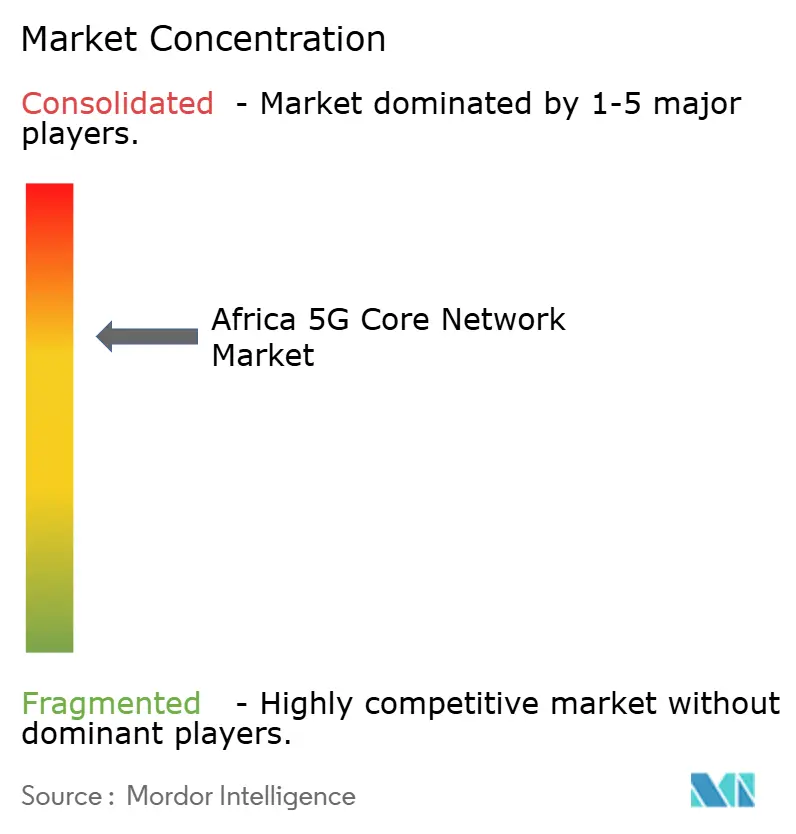
| Market Concentration | Medium |
Major Players *Disclaimer: Major Players sorted in no particular order Image © Mordor Intelligence. Reuse requires attribution under CC BY 4.0. | |
Africa 5G Core Network Market Analysis by Mordor Intelligence
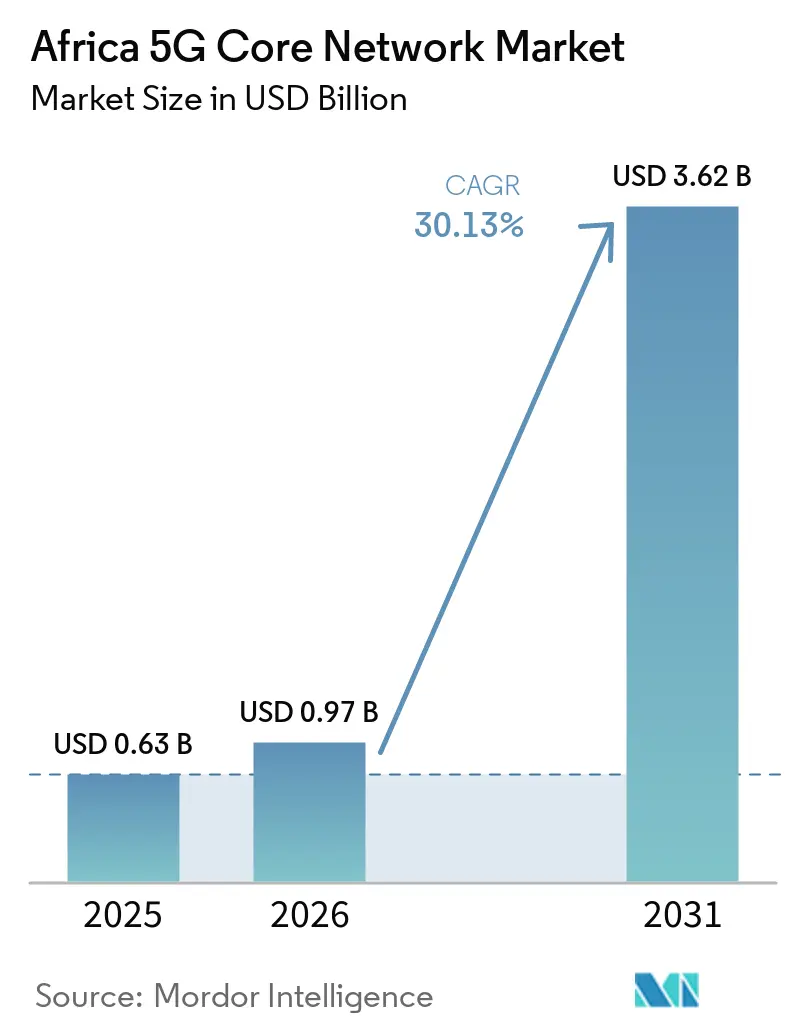
The Africa 5G core network market size was valued at USD 0.63 billion in 2025 and is estimated to expand from USD 0.97 billion in 2026 to USD 3.62 billion by 2031, at a CAGR of 30.13% during the forecast period (2026-2031). The Africa 5G core network market is shifting from early radio deployments to investments in standalone core platforms that support enterprise services. Commercial 5G launches have broadened the pool of operators requiring cloud-native packet core, automation, and policy management capabilities. Operators are also using dual-mode architectures to support 4G and 5G services on one platform while controlling the cost and disruption of a full standalone transition. Demand for private networks, network slicing, and low-latency services is creating a clearer revenue case for advanced core functions. Differences in spectrum access, fiber availability, data-center capacity, and financing conditions will continue to shape the pace of deployment across countries.
Key Report Takeaways
- By component, solutions held 58.91% of the Africa 5G core network market share in 2025, while services are projected to expand at a 34.11% CAGR through 2031.
- By deployment model, on-premises and dedicated deployments accounted for 49.99% of revenue in 2025, while hybrid and telco edge cloud deployments are projected to expand at a 32.19% CAGR through 2031.
- By end-user, telecom operators accounted for 71.51% of demand in 2025, while enterprises are projected to expand at a 34.98% CAGR through 2031 in the Africa 5G core network market.
- By network function, the User Plane Function held 22.33% of revenue in 2025, while the Network Exposure Function is projected to expand at a 33.98% CAGR through 2031 in the Africa 5G core network market.
- By geography, South Africa accounted for 47.88% of regional revenue in 2025 and is projected to expand at a 36.78% CAGR through 2031, supported by continued investment from leading operators.
Note: Market size and forecast figures in this report are generated using Mordor Intelligence’s proprietary estimation framework, updated with the latest available data and insights as of January 2026.
Market Trends and Insights
Drivers Impact Analysis of Africa 5G Core Network Market*
| DRIVER | (~) % IMPACT ON CAGR FORECAST | GEOGRAPHIC RELEVANCE | IMPACT TIMELINE |
|---|---|---|---|
| Accelerated 5G Standalone Core Deployments by Tier-1 Mobile Operators | +8.5% | South Africa, Nigeria, and Morocco, with spillover to Angola, Zimbabwe, and Ethiopia | Short term (≤2 years) |
| Rising Need for Network Slicing for Enterprise and Industrial Connectivity | +6.2% | South Africa, Nigeria, Morocco, and Algeria | Medium term (2–4 years) |
| Cloud-Native Core Migration to Reduce Long-Term Operating Costs | +5.8% | South Africa and Nigeria, with spillover across the Rest of Africa | Short term (≤2 years) |
| Demand for Low-Latency Public Safety and Smart City Connectivity | +4.9% | South Africa, Nigeria, Algeria, and Botswana | Medium term (2–4 years) |
| Spectrum Refarming and Core Modernization Programs | +3.7% | South Africa, Nigeria, Ghana, and Morocco | Short term (≤2 years) |
| Vendor-Led Financing and Managed Core Offerings | +2.8% | Rest of Africa, especially East, West, and Central Africa | Medium term (2–4 years) |
| Source: Mordor Intelligence | |||
Accelerated 5G Standalone Core Deployments by Tier-1 Mobile Operators
Tier-1 operators entered 2026 with 5G standalone commitments moving into active procurement and deployment programs. The Africa 5G core network market benefits when group-level operators apply common cloud platforms across several national businesses. MTN Group's MUNA framework supported cloud-native modernization programs in South Africa, Zimbabwe, Angola, and Uganda. Ericsson reported that MTN South Africa completed an automated in-service software upgrade on a live Packet Core Gateway while it handled 2.52 million active sessions and 40 Gbps of traffic in 2025.[1] That operational result shows why operators may favor an established core supplier when a platform carries a large live subscriber base. GSMA Intelligence recorded 61 operators offering commercial 5G services in 37 African markets by mid-2026, giving the Africa 5G core network market a wider base for later standalone upgrades.[2]
Rising Need for Network Slicing for Enterprise and Industrial Connectivity
Network slicing enables operators to assign defined network performance to a specific enterprise or public service. This capability depends on a standalone core deployment, making slicing demand closely tied to the timing of core modernization. GSMA Intelligence reported that 32 companies across Africa were procuring private-network equipment in early 2025, with activity concentrated in South Africa, Nigeria, Angola, and Ghana. Mining, manufacturing, logistics, and public safety users can require service levels that conventional consumer mobile offers cannot provide. Inwi deployed Morocco's first private industrial 5G network at the Nador West Med industrial hub in April 2026, in partnership with China Mobile International and Huawei, to support automation, real-time monitoring, Internet of Things applications, and remote sensing. These projects increase the value of the Network Exposure Function, as enterprise applications require secure access to specific network capabilities.
Cloud-Native Core Migration to Reduce Long-Term Operating Costs
Cloud-native cores allow operators to manage network functions as software components and add capacity with greater flexibility. The Africa 5G core network market, therefore, increasingly depends on cloud platforms, orchestration tools, and systems integration rather than on dedicated hardware alone. AMD found that 33% of surveyed communications service providers already ran most 5G core functions on cloud-native infrastructure in 2025, and another 30% targeted completion by the end of 2026.[3] MTN Group and Huawei signed a 2026 memorandum focused on Autonomous Networks Level 4, AI-driven operations, 5G fixed wireless access, and data monetization.[4] A cloud-native design can permit different vendors to provide separate functions, although shared orchestration and policy layers may still make supplier changes difficult. Initial core awards can therefore influence later spending on upgrades, support, and automation.
Demand for Low-Latency Public Safety and Smart City Connectivity
Public safety, municipal operations, and smart-city programs require responsive connectivity and dependable service controls. The Africa 5G core network market can benefit from these applications, as they require distributed user-plane functions and well-defined service policies. Dedicated deployments are especially relevant where government agencies and critical infrastructure users need auditable environments for sensitive data. Nigeria's communications regulator has outlined plans for private 5G in ports, airports, and industrial parks, alongside testing of advanced capabilities for emergency services and connected drones. Vodacom reported capital expenditure of ZAR 23.6 billion (USD 1.30 billion) in FY2026 and added 6,160 new 5G sites across the group.[5] The ongoing expansion of access networks provides operators with a larger infrastructure base for low-latency services when core platforms are ready.
Restraints Impact Analysis of Africa 5G Core Network Market*
| RESTRAINT | (~) % IMPACT ON CAGR FORECAST | GEOGRAPHIC RELEVANCE | IMPACT TIMELINE |
|---|---|---|---|
| High Network Modernization Cost and Long Payback Period | -5.2% | Pan-Africa, especially mid-tier operators outside South Africa | Long term (≥4 years) |
| Limited Fiber Backhaul and Data Center Readiness | -3.8% | Rest of Africa, especially secondary and tertiary cities in Central and West Africa | Long term (≥4 years) |
| Fragmented Regulatory and Licensing Environments | -2.9% | Rest of Africa, across national regulatory frameworks | Medium term (2–4 years) |
| Core Security and Sovereignty Concerns in Multi-Vendor Cloud Deployments | -2.1% | South Africa and Nigeria | Medium term (2–4 years) |
| Source: Mordor Intelligence | |||
High Network Modernization Cost and Long Payback Period
Core modernization requires substantial initial spending before operators can generate material new enterprise revenue. The challenge is most acute where average revenue per user is low, and 4G networks still meet much of the demand for mobile data. The Nigerian Communications Commission reported that industry investment exceeded USD 1 billion in 2025, while 5G accounted for 4.2% of mobile connections in March 2026. This gap can lengthen payback periods for a full standalone core, particularly where consumer adoption is concentrated in major cities. Managed core services can reduce the initial capital burden, but they require sufficient data center infrastructure and skilled operational support. Smaller operators may therefore retain existing core platforms until enterprise demand and radio coverage strengthen.
Limited Fiber Backhaul and Data Center Readiness
Cloud-native architectures require reliable, high-capacity links between distributed user-plane sites and centralized control functions. Limited fiber coverage and a lack of carrier-neutral data centers can restrict the practical use of telco edge cloud models outside leading markets. GSMA Intelligence stated that 16 African countries had completed 5G spectrum allocations by March 2026. Spectrum assignment is often an early step before operators commit to major core investments. SEACOM has expanded its focus on multi-terabit capacity and data-center connectivity in South Africa, Kenya, and Nigeria, showing the scale of supporting infrastructure that operators need. Hybrid models can provide a practical interim route, but they introduce network design and latency management requirements. These limits keep demand for advanced edge functions concentrated in a small number of countries.
*Our forecasts treat driver/restraint impacts as directional, not additive. The impact forecasts reflect baseline growth, mix effects, and variable interactions.
Africa 5G Core Network Market Segment Analysis
By Component:
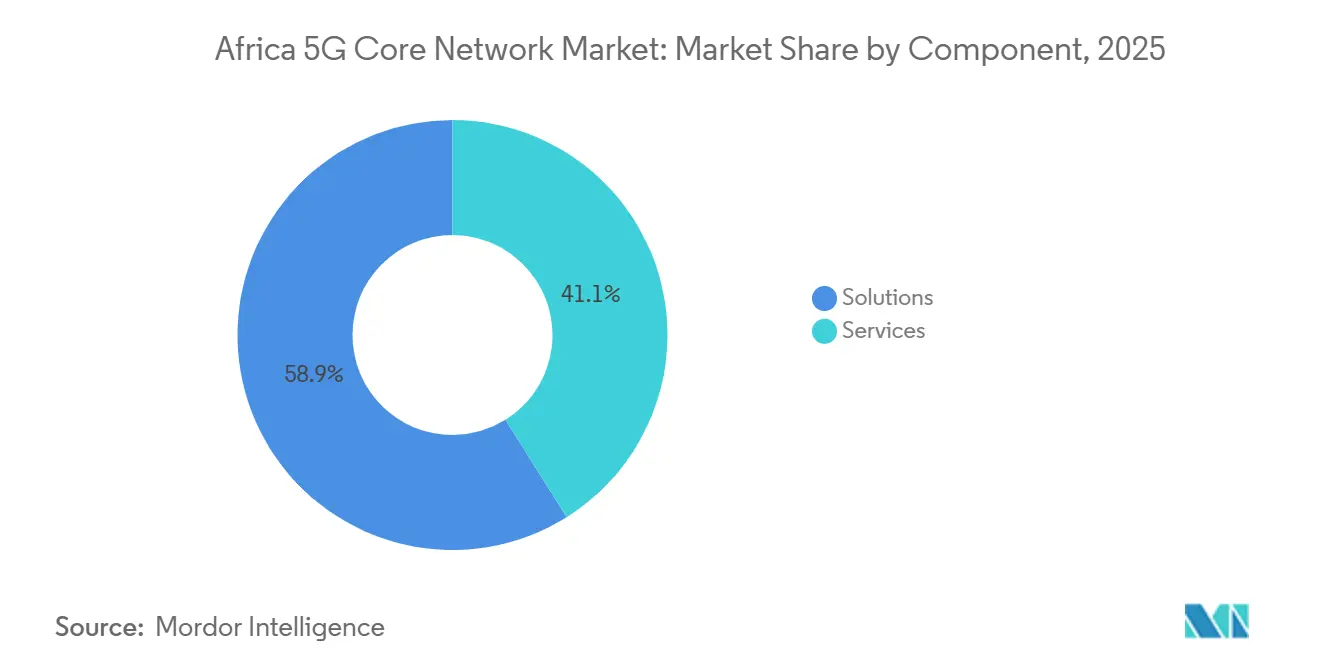
Solutions Anchor Revenue While Services Build Long-Term DemandSolutions are expected to account for 58.91% of Africa 5G core network market revenue in 2025. The segment includes packet-core software, network functions virtualization infrastructure, and orchestration and management platforms. These products represent a significant initial share of spending because operators must establish the core technical foundation for standalone 5G. Packet-core software includes essential access, session, and user-plane functions. The Africa 5G core network market relies on these functions to manage mobile sessions, route traffic, enforce subscriber policies, and ensure service quality. MTN South Africa is expected to deploy Ericsson’s cloud-native packet core and user-management functions on a cloud-native infrastructure platform in 2025. This deployment highlights the role of software platforms in multi-year operator modernization plans.
Services are projected to expand at a CAGR of 34.11% from 2026 to 2031. The category includes integration and deployment, consulting, advisory services, support, and maintenance. Demand for services increases when operators migrate subscriber data, policy controls, and legacy systems without disrupting live services. It also rises when operators integrate multiple vendors into a shared cloud environment. AMD reported that 39% of surveyed communications service providers expected to create combined telecom cloud teams for core and virtual radio access network operations. This operational convergence supports recurring integration and managed-service work. The Africa 5G core network industry may see systems integrators play a larger role where smaller operators lack internal cloud operations teams. Vendors with established local support capabilities may also benefit as upgrades progress beyond the initial deployment stage.
By Deployment Model:
Dedicated Systems Retain a Lead as Edge Cloud Use ExpandsOn-premises and dedicated systems are expected to account for 49.99% of revenue in the Africa 5G core network market in 2025. This position reflects security, sovereignty, and operational requirements among government-related and security-sensitive users. It also reflects the limited availability of large cloud regions in many countries. Dedicated systems give operators greater direct control over data handling, user-plane placement, and network operations. They can better support workloads that require data to remain within a defined jurisdiction. This deployment model also supports enterprises that require a separate and auditable core environment. These factors keep on-premise systems important even as public cloud options become more available.
Hybrid and telco edge cloud deployments are projected to expand at a CAGR of 32.19% from 2026 to 2031. Operators use these models to place user-plane processing closer to enterprise locations while retaining control-plane functions in centralized cloud environments. This approach can reduce application latency and backhaul traffic for local data flows. Intel, Nokia, and Dell Technologies are expected to present a low-footprint far-edge User Plane Function device at MWC 2026, offering 30% higher performance than the preceding solution. The device is designed for enterprise and industrial locations with limited space and infrastructure. The Africa 5G core network market will depend on greater availability of fiber and data centers for this model to expand beyond primary cities. The model offers a way to support fixed wireless access, private 5G, and industrial applications without placing every network function at the edge.
By End-User:
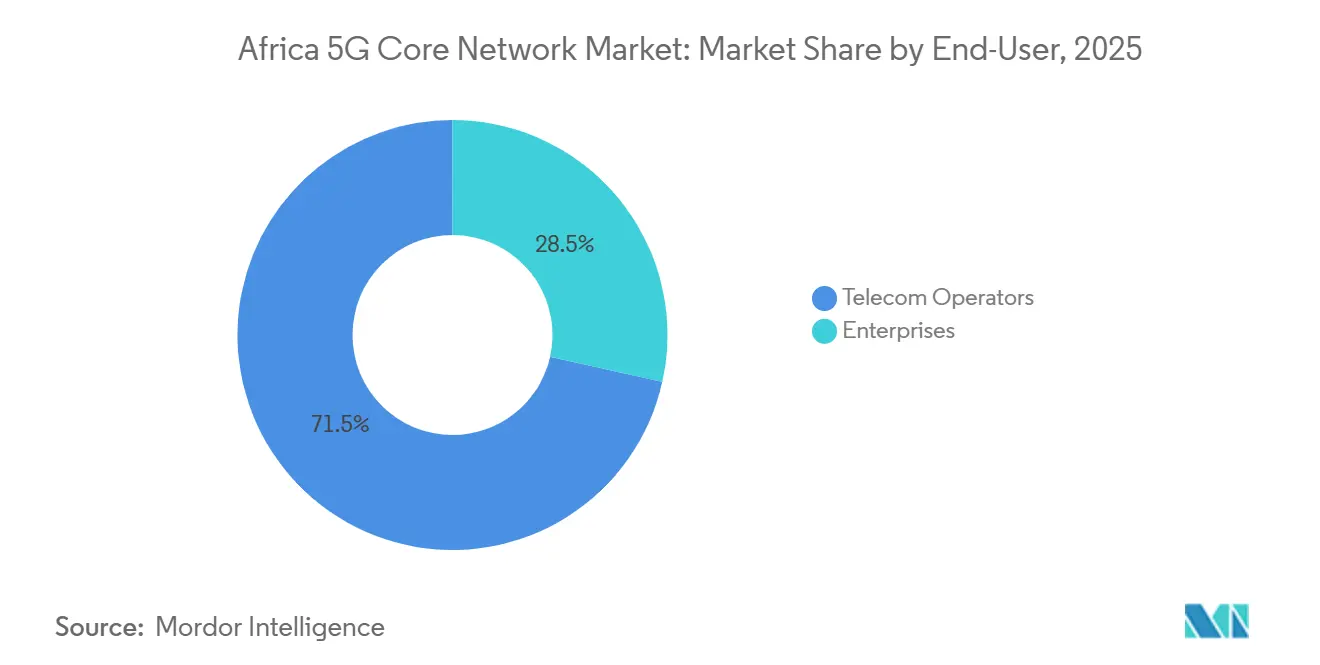
Operators Lead Current Demand While Enterprise Use BuildsTelecom operators are expected to account for 71.51% of Africa 5G core network demand in 2025. Licensed mobile operators are the first buyers because they own the public networks that require modernization. Large groups can coordinate investments across national operations and use common vendor frameworks. MTN Group’s multi-market cloud program and Vodacom’s FY2026 capital expenditure illustrate the financial scale of operator-led infrastructure investment. Operator demand includes core software, integration, capacity expansion, automation, and security controls. Smaller carriers in markets such as Zimbabwe, Angola, and Ethiopia can also use vendor-financed programs to begin modernization. This trend broadens the customer base beyond the largest regional operators.
Enterprises are projected to expand at a CAGR of 34.98% from 2026 to 2031. The category includes manufacturing, energy and utilities, transportation and logistics, public safety and emergency services, and municipalities. Private networks can support worker monitoring, vehicle tracking, industrial automation, and remote operations. GSMA Intelligence identified procurement activity across mining, manufacturing, ports, and logistics, where dedicated services can deliver measurable operational value. MTN South Africa has used a private 5G network at a manganese mine for worker monitoring, vehicle tracking, and autonomous trucks. The Africa 5G core network industry benefits from these projects because each deployment can combine core functions, integration, security, and ongoing operational support. Enterprise adoption will remain concentrated where industrial users have adequate digital infrastructure and clear requirements for dependable connectivity.
By Network Function:
User Plane Capacity Leads While API Exposure AdvancesThe User Plane Function is expected to account for 22.33% of network-function revenue in 2025. It manages mobile data flows and acts as the traffic anchor for user sessions. Operators need user-plane capacity in both centralized and distributed deployments. This makes it a core element of public mobile networks, private networks, and edge-based services. The function becomes more important when operators aim to reduce latency near enterprise locations. The Africa 5G core network market uses distributed User Plane Function placements to support local processing and reduce pressure on long-distance backhaul. Intel, Nokia, and Dell Technologies are expected to introduce a far-edge platform designed for this type of deployment in 2026.
The Network Exposure Function is projected to expand at a CAGR of 33.98% from 2026 to 2031 in the Africa 5G core network market. It gives approved external applications access to selected network capabilities, including service quality requests, location information, and edge triggers. The function supports the shift from basic connectivity to application-oriented services. Econet Wireless Zimbabwe is expected to agree with Ericsson in 2025 to add cloud-native 5G functions and the Cloud Core Exposure Server to its existing dual-mode core. The agreement is intended to support standalone 5G and third-party application partnerships. Other functions, such as the Network Slice Selection Function and Policy Control Function, can support commercial slice offerings. The Africa 5G core network market will see stronger demand for these tools when operators have enough enterprise customers willing to pay for application-level network services.
Geography Analysis
South Africa 5G Core Network Market
South Africa is expected to hold 47.88% of the Africa 5G core network market share in 2025 and is projected to expand at a 36.78% CAGR through 2031. The country benefits from more mature data center infrastructure, established operators, and a more developed spectrum environment than many of its regional peers. MTN South Africa is expected to complete its cloud-native packet core and user management deployment with Ericsson in 2025. The implementation includes the automated upgrade of a live Packet Core Gateway supporting 2.52 million active sessions and 40 Gbps of traffic. Vodacom is expected to add 6,160 new 5G sites across the group during FY2026 and report ZAR 23.6 billion (USD 1.30 billion) in capital expenditure. These programs are expected to sustain demand for capacity, automation, and core management platforms. South Africa also offers a reference environment for deployments that operators may later adapt in other African markets.
Nigeria 5G Core Network Market
Nigeria represents a major long-term opportunity due to its population, large economy, and rising need for enterprise connectivity. However, Nigeria’s 5G deployment cycle currently trails South Africa’s, as coverage and adoption remain uneven. The Nigerian Communications Commission is expected to report more than USD 1 billion in sector investment in 2025 and plans for further investment in 2026. Its 2026-2030 spectrum roadmap targets 5G coverage for 50% of the population and all state capitals. The roadmap also includes additional 3.5 GHz spectrum and future mmWave allocations. Each spectrum and coverage milestone could create a subsequent need for expanded core capacity. Oil and gas, financial technology, and transportation offer enterprise use cases for secure and service-assured connectivity.
Africa 5G Core Network Market
The Rest of Africa includes markets with varying levels of readiness, but it offers a broader future base for the Africa 5G core network market. Morocco is expected to launch commercial 5G in November 2025, while its operators are expected to develop plans to expand coverage during 2026 and beyond. Algeria is expected to license Mobilis, Ooredoo Algeria, and Djezzy for 5G in November 2025, creating a new base for core deployment. Ghana's Next Gen InfraCo is expected to activate a wholesale 4G and 5G platform in Accra, Kumasi, and Tamale in March 2026, with Nokia as its core technology partner. In Ethiopia, Ethio Telecom and ZTE are expected to finalize a 647-site network expansion agreement in March 2026. GSMA Intelligence also expects Safaricom to increase its 5G site count from 803 to 1,700 during 2025. These access-network investments create the conditions for later core modernization, although financing and backhaul constraints will vary by country.
Competitive Landscape
The Africa 5G core network market is moderately consolidated, dominated by a small group of established equipment suppliers. Ericsson, Nokia, Huawei, and ZTE hold many of the leading core transformation relationships. Ericsson has deployed dual-mode 5G core platforms with MTN South Africa, Orange Maroc, UNITEL Angola, Econet Wireless Zimbabwe, and Econet Telecom Lesotho. This geographic footprint positions Ericsson across both group-level operator programs and individual national deployments. Nokia provides the core technology for Ghana's Next Gen InfraCo wholesale platform. Huawei and ZTE compete through broad portfolios that combine radio, transport, and core equipment. Their financing arrangements can play an important role in markets where operators prioritize payment terms and bundled delivery.
Vendor strategies increasingly extend beyond core capacity to automation, cloud operations, and application enablement. MTN Group and Huawei have set a 2026 roadmap for AI-driven network evolution, 5G fixed wireless access, and data monetization. Ericsson’s automated live upgrade at MTN South Africa demonstrates its ability to reduce operational disruption during modernization. Nokia’s work with Ghana’s neutral-host platform provides another example of a core supplier supporting a wholesale network model. These strategic moves matter because operators need systems that can support both current 4G traffic and future standalone services. They also make vendor relationships harder to replace once operators deeply integrate automation, orchestration, and operational processes. The Africa 5G core network market is therefore likely to reward suppliers that can demonstrate reliability across a full modernization program.
Cloud-native challengers and infrastructure partners address areas where traditional vendors do not control every layer of the technology stack. Mavenir competes in cloud-native and application-focused software, while Dell Technologies and Hewlett-Packard Enterprise provide infrastructure for virtualized network functions. Amdocs and Tech Mahindra provide systems integration and business support capabilities in multi-vendor programs. Open architecture can appeal to cost-sensitive operators seeking greater flexibility in future supplier choices. However, open systems still require strong capabilities in integration, security, and lifecycle management. This environment creates opportunities for specialized software, integration, and edge-computing providers alongside established core suppliers.
Africa 5G Core Network Industry Leaders
-
Telefonaktiebolaget LM Ericsson (publ)
-
Nokia Corporation
-
Huawei Technologies Co., Ltd.
-
ZTE Corporation
-
Samsung Electronics Co., Ltd.
- *Disclaimer: Major Players sorted in no particular order
Africa 5G Core Network Market Companies Covered in this Report
- Telefonaktiebolaget LM Ericsson (publ)
- Nokia Corporation
- Huawei Technologies Co., Ltd.
- ZTE Corporation
- Cisco Systems, Inc.
- Mavenir Systems, Inc.
- Oracle Corporation
- Samsung Electronics Co., Ltd.
- Dell Technologies Inc.
- Hewlett Packard Enterprise Development LP
- NEC Corporation
- Juniper Networks, Inc.
- Amdocs Limited
- Wind River Systems, Inc.
- Parallel Wireless, Inc.
- Athonet S.r.l.
- Radisys Corporation
- Tech Mahindra Limited
Recent Industry Developments in Africa 5G Core Network Market
- July 2026: Ghana's National Communications Authority opened a competitive 5G spectrum auction for 11 lots carrying a combined minimum reserve value of USD 230 million across the 700 MHz, 2.3 GHz, and 3 GHz bands, ending Next Gen InfraCo's exclusive wholesale 5G rights.
- May 2026: Huawei's 5.5G core network platform went live at Ethio Telecom in Ethiopia, marking the first commercial deployment of a 5.5G core network in East Africa. The cloud-native, service-based architecture supports network slicing, edge computing, and 10 Gbps downlink speeds.
- April 2026: Inwi deployed Morocco's first private industrial 5G network at a 52-hectare factory in the Nador West Med industrial hub in partnership with China Mobile International and Huawei, targeting Industry 4.0 applications including automation, IoT, real-time monitoring, and remote sensing.
- March 2026: MTN Group and Huawei signed a 2026 Strategic Memorandum of Understanding at MWC Barcelona, targeting Autonomous Networks Level 4 as a shared evolution goal, with joint programs across AI-driven intelligent network evolution, 5G Fixed Wireless Access, and data monetization infrastructure across MTN's Africa footprint.
Africa 5G Core Network Market Report Scope
The Africa 5G Core Network Market Report is Segmented by Component (Solutions [Packet-Core Software. NFV Infrastructure, and Orchestration and Management], and Services [Integration and Deployment, Consulting and Advisory, Support and Maintenance]), Deployment Model (On-Premises/Dedicated, Public Cloud, and Hybrid and Telco Edge Cloud), End-User (Telecom Operators, and Enterprises [Manufacturing, Energy and Utilities, Transportation and Logistics, Public Safety and Emergency, and Smart Cities and Municipalities]), Network Function (Network Exposure Function, User Plane Function, Application Function, Unified Data Management, Session Management Function, Network Slice Selection Function, Policy Control Function, Network Repository Function, Authentication Server Function, and Access and Mobility Management), and Country (South Africa, Nigeria, and Rest of Africa). The Market Forecasts are Provided in Terms of Value (USD).
Segmentation Overview
| Solutions | Packet-Core Software |
| NFV Infrastructure | |
| Orchestration and Management | |
| Services | Integration and Deployment |
| Consulting and Advisory | |
| Support and Maintenance |
| On-Premise/Dedicated |
| Public Cloud |
| Hybrid and Telco Edge Cloud |
| Telecom Operators | |
| Enterprises | Manufacturing |
| Energy and Utilities | |
| Transportation and Logistics | |
| Public Safety and Emergency | |
| Smart Cities and Municipalities |
| Network Exposure Function (NEF) |
| User Plane Function (UPF) |
| Application Function (AF) |
| Unified Data Management (UDM) |
| Session Management Function (SMF) |
| Network Slice Selection Function (NSSF) |
| Policy Control Function (PCF) |
| Network Repository Function (NRF) |
| Authentication Server Function (AUSF) |
| Access and Mobility Management Function (AMF) |
| South Africa |
| Nigeria |
| Rest of Africa |
| By Component | Solutions | Packet-Core Software |
| NFV Infrastructure | ||
| Orchestration and Management | ||
| Services | Integration and Deployment | |
| Consulting and Advisory | ||
| Support and Maintenance | ||
| By Deployment Model | On-Premise/Dedicated | |
| Public Cloud | ||
| Hybrid and Telco Edge Cloud | ||
| By End-User | Telecom Operators | |
| Enterprises | Manufacturing | |
| Energy and Utilities | ||
| Transportation and Logistics | ||
| Public Safety and Emergency | ||
| Smart Cities and Municipalities | ||
| By Network Function | Network Exposure Function (NEF) | |
| User Plane Function (UPF) | ||
| Application Function (AF) | ||
| Unified Data Management (UDM) | ||
| Session Management Function (SMF) | ||
| Network Slice Selection Function (NSSF) | ||
| Policy Control Function (PCF) | ||
| Network Repository Function (NRF) | ||
| Authentication Server Function (AUSF) | ||
| Access and Mobility Management Function (AMF) | ||
| By Country | South Africa | |
| Nigeria | ||
| Rest of Africa | ||
Key Questions Answered in the Report
What is the Africa 5G core network market size?
The Africa 5G core network market size is estimated at USD 0.97 billion in 2026 and is forecast to reach USD 3.62 billion by 2031 at a 30.13% CAGR.
Which component leads Africa's 5G core network spending?
Solutions led with 58.91% of revenue in 2025 because operators must invest in packet-core software, network functions virtualization infrastructure, and orchestration platforms.
Which deployment model is expanding fastest?
Hybrid and telco edge cloud deployments are projected to expand at a 32.19% CAGR from 2026 to 2031.
Who are the main buyers of 5G core platforms in Africa?
Telecom operators accounted for 71.51% of demand in 2025, while enterprises are expected to become an important source of private-network demand.
Which country leads regional 5G core investment?
South Africa accounted for 47.88% of regional revenue in 2025, supported by established operators, data center capacity, and continued network investment.
Why is the Network Exposure Function important?
It enables approved external applications to access selected network capabilities and is projected to expand at a 33.98% CAGR through 2031.