
Advanced Reactor Fuel (HALEU & TRISO) Market Size and Share
Market Overview
| Study Period | 2022 - 2032 |
|---|---|
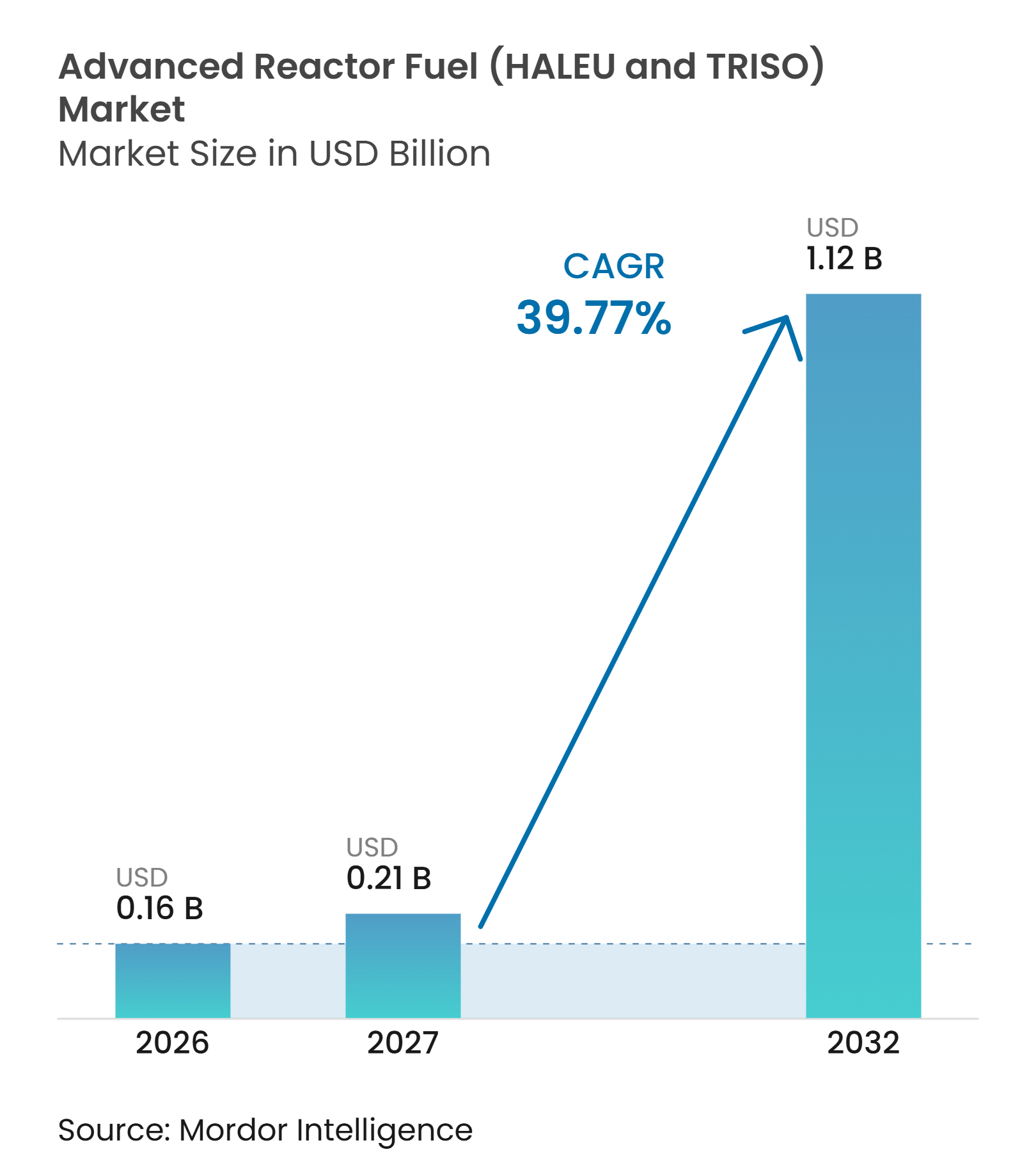
| Market Size (2027) | USD 0.21 Billion |
| Market Size (2032) | USD 1.12 Billion |
| Growth Rate (2027 - 2032) | 39.77 % |
| Fastest Growing Market | Asia-Pacific |
| Largest Market | North America |
| Market Concentration | High |
Major Players *Disclaimer: Major Players sorted in no particular order Image © Mordor Intelligence. Reuse requires attribution under CC BY 4.0. | |
Advanced Reactor Fuel (HALEU & TRISO) Market Analysis by Mordor Intelligence
The Advanced Reactor Fuel Market size was valued at USD 0.16 billion in 2026 and is estimated to grow from USD 0.21 billion in 2027 to reach USD 1.12 billion by 2032, at a CAGR of 39.77% during the forecast period (2027-2032). The Global Advanced Reactor Fuel (HALEU & TRISO) market begins from a limited commercial base, because Russia remains the only established commercial HALEU supplier at scale while Western capacity is still being developed. Government procurement, licensing milestones, and private investment are moving the sector from policy commitments toward physical enrichment and fabrication capacity. The United States, Europe, and China are building separate enrichment and fabrication pathways, with early output expected before 2030. The Global Advanced Reactor Fuel (HALEU & TRISO) market also faces a timing challenge because reactor schedules may advance faster than qualified fuel facilities. Developers are therefore likely to place supply agreements earlier, favoring suppliers that can demonstrate regulatory readiness.
Key Report Takeaways
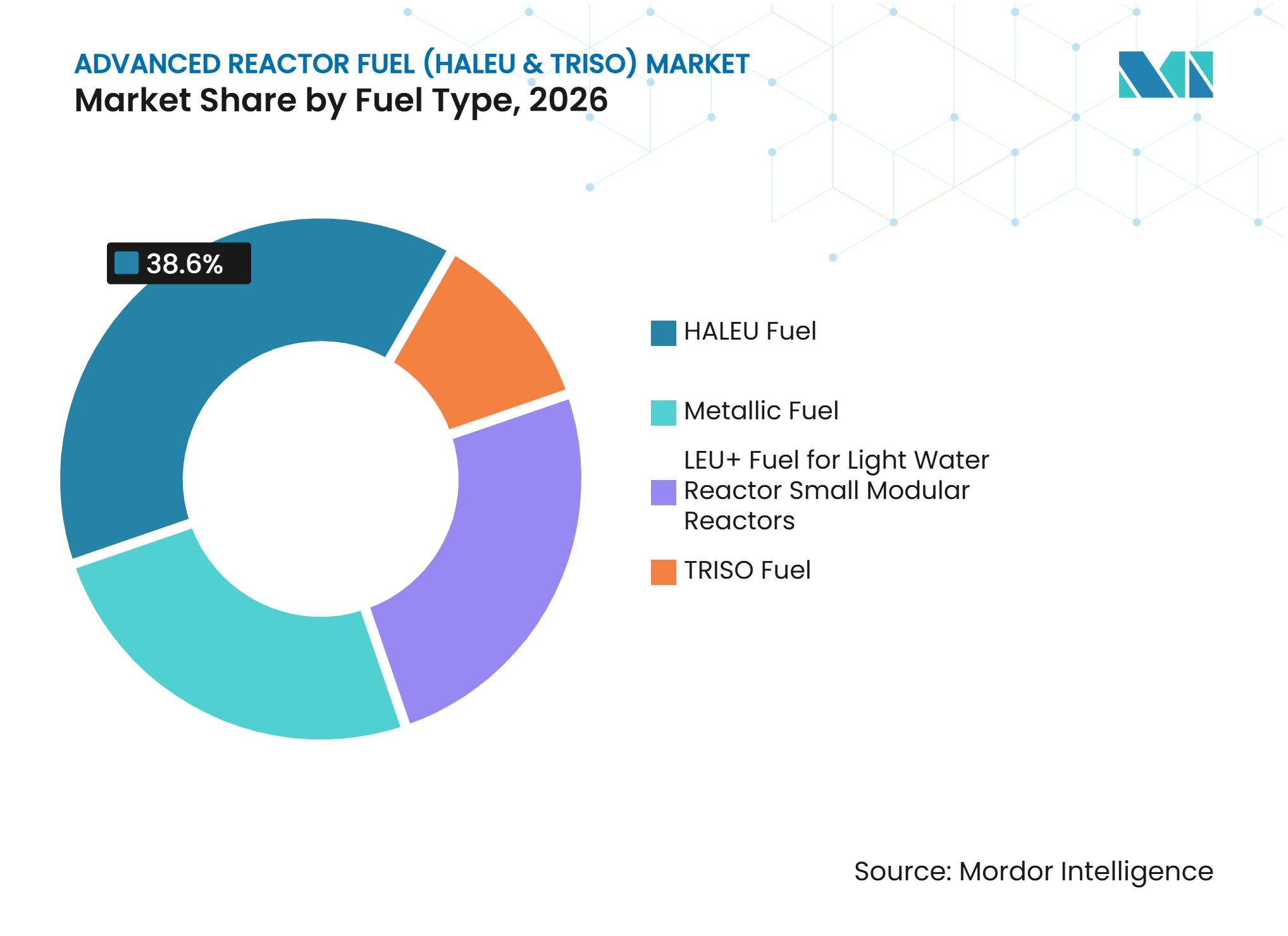
- By fuel type, HALEU Fuel held 38.6% of the Global Advanced Reactor Fuel (HALEU & TRISO) market share in 2026, while TRISO Fuel is forecast to grow at a 40.8% CAGR through 2032.
- By fabrication technology, HALEU Conversion and Enrichment held 29.3% of the Global Advanced Reactor Fuel (HALEU & TRISO) market size in 2026, while TRISO Particle Coating and Fabrication is forecast to grow at a 40.6% CAGR through 2032.
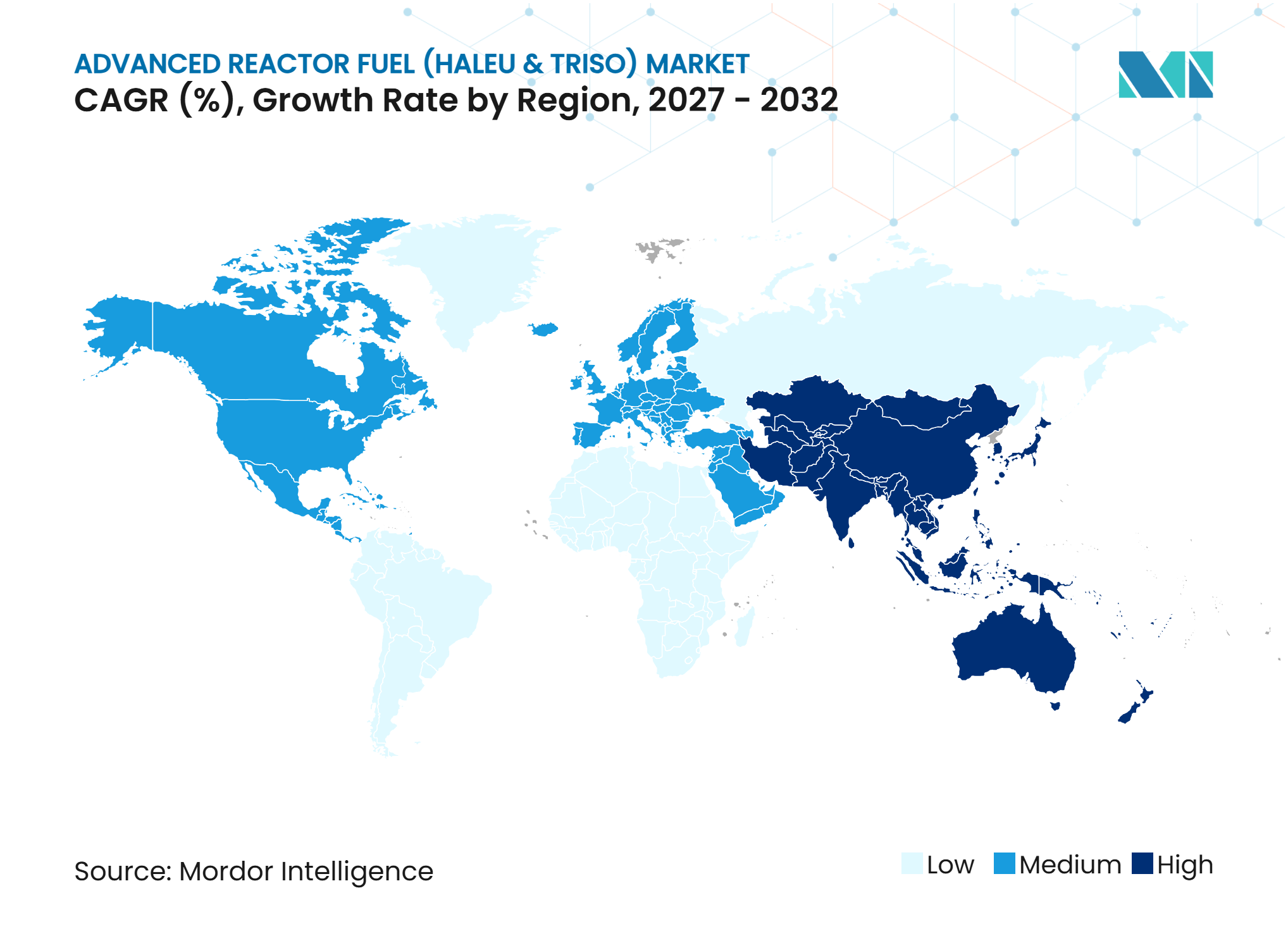
- By geography, North America held 54.7% revenue share in 2026, while Asia-Pacific is forecast to grow at a 40.2% CAGR through 2032.
Note: Market numbers in this report are based on Mordor Intelligence's proprietary estimation framework, which combines nine months of actuals with Q4 projections for base year 2026.
Market Trends and Insights
Drivers Impact Analysis of Advanced Reactor Fuel (HALEU & TRISO) Market*
| Driver | (~) % Impact on CAGR Forecast | Geographic Relevance | Impact Timeline |
|---|---|---|---|
| Rising Advanced Reactor and SMR Deployments | +12.0% | Global, led by North America and China | Medium term (2-4 years) |
| Government-Led HALEU Supply-Chain Localization | +10.5% | North America and Europe | Medium term (2-4 years) |
| Higher Power Density and Longer Fuel Cycles Enabled by HALEU | +6.5% | Global | Long term (≥ 4 years) |
| Commercialization of TRISO-Fueled Demonstration Reactors | +7.5% | North America, spillover to Europe and Asia-Pacific | Medium term (2-4 years) |
| Government and Defense Demand for Transportable Microreactors | +4.5% | North America, early gains in Asia-Pacific and the Middle East and Africa | Long term (≥ 4 years) |
| Hyperscale Data Center Demand for Firm Low-Carbon Power | +8.0% | North America and Europe, with Asia-Pacific demand | Short term (≤ 2 years) |
| Source: Mordor Intelligence | |||
Rising Advanced Reactor and Small Modular Reactor (SMR) Deployments Drive Primary Demand
The Global Advanced Reactor Fuel (HALEU & TRISO) market is supported by a growing group of small modular reactor designs that require higher enrichment fuel. The OECD Nuclear Energy Agency identified 127 SMR designs in its 2025 dashboard, including 30 designs requiring HALEU at 10% to 20% enrichment and 9 designs requiring HALEU at 5% to 10% enrichment.[1] Each reactor deployment creates a fuel requirement that can continue for decades and must be contracted years before operation. TerraPower’s 345 MWe Natrium reactor illustrates the supply issue because it requires metallic HALEU fuel without an approved commercial supplier in 2026. Fuel qualification has become part of a reactor developer’s ability to secure licensing and maintain its construction schedule. The Global Advanced Reactor Fuel (HALEU & TRISO) market consequently rewards early suppliers that can move from qualified material to dependable deliveries.
Government-Led HALEU Supply-Chain Localization Creates Bankable Revenue
The United States used the Defense Production Act for nuclear fuel in August 2025, which elevated fuel supply development into a national procurement priority.[2] The Department of Energy awarded USD 2.7 billion in task orders, with USD 900 million each for American Centrifuge Operating, General Matter, and Orano Federal Services.[3] These awards provide a multiyear revenue foundation for enrichment projects that require substantial upfront capital. The European Commission’s Euratom Safeguards Regulation took effect on July 6, 2025, requiring safeguards by design for novel installations and expanded electronic reporting.[4] The UK also provided USD 258.41 million (GBP 196 million) for Urenco’s Capenhurst facility, which targets up to 10 metric tons of HALEU output a year by 2031. These commitments are reducing the financing uncertainty that has delayed investment across the Global Advanced Reactor Fuel (HALEU & TRISO) market.
Higher Power Density and Longer Fuel Cycles Enabled by HALEU
HALEU can support higher fuel utilization and longer operating cycles for reactor designs that cannot rely on conventional low-enriched uranium. The Global Advanced Reactor Fuel (HALEU & TRISO) market is therefore linked to reactor programs seeking smaller systems with more usable output from a given fuel volume. Metallic fuels support fast reactor designs, while TRISO can retain fission products at high operating temperatures. These performance attributes are important for microreactors and remote applications where refueling intervals and fuel logistics affect project viability. Lightbridge began irradiation testing of enriched uranium-zirconium alloy samples at Idaho National Laboratory in November 2025, adding qualification data for another advanced fuel pathway. Longer qualification programs still limit the speed at which these benefits can move into commercial projects. The Global Advanced Reactor Fuel (HALEU & TRISO) market will depend on operators accepting new fuel forms after testing and regulatory review.
Commercialization of TRISO-Fueled Demonstration Reactors Validates the Fabrication Path
TRISO fuel has moved closer to commercial fabrication through several projects that entered new stages during 2025 and 2026. TRISO-X received a 40-year NRC Special Nuclear Material License in February 2026 for its TX-1 facility in Oak Ridge, Tennessee, where fabrication is targeted for early 2028. Standard Nuclear signed an agreement with the Department of Energy in December 2025 to scale TRISO production under DOE oversight. BWXT fabricated TRISO compacts that powered Antares Nuclear’s reactor to its first criticality in June 2026. Standard Nuclear and Framatome are targeting 2 metric tons of TRISO particle output annually through their joint venture. The presence of BWXT, TRISO-X, and Standard Nuclear-Framatome reduces the single-supplier risk that has constrained early offtake negotiations in the Global Advanced Reactor Fuel (HALEU & TRISO) market. Their progress provides a clearer fabrication path for developers using gas-cooled and microreactor designs.
Restraints Impact Analysis of Advanced Reactor Fuel (HALEU & TRISO) Market*
| Restraint | (~) % Impact on CAGR Forecast | Geographic Relevance | Impact Timeline |
|---|---|---|---|
| Limited Commercial HALEU Enrichment and Deconversion Capacity | -6.5% | Global, most acute in North America and Europe | Short term (≤ 2 years) |
| Long Qualification and Licensing Cycles for First-of-a-Kind Fuels | -4.5% | Global | Medium term (2-4 years) |
| Category-II Transport, Safeguards, and Criticality-Control Requirements | -3.0% | North America and Europe | Short term (≤ 2 years) |
| Chicken-and-Egg Economics Between Fuel Capacity and Reactor Offtake | -3.5% | Global | Medium term (2-4 years) |
| Source: Mordor Intelligence | |||
Limited Commercial HALEU Enrichment and Deconversion Capacity Caps Near-Term Supply
Commercial HALEU enrichment and deconversion capacity remains limited across Western supply chains. Centrus’s Piketon facility was the only Nuclear Regulatory Commission (NRC)-licensed HALEU enrichment facility in the United States and reached 900 kilograms of HALEU production by June 2025. That volume is not sufficient for a large commercial advanced-reactor fleet. Deconversion is also constrained because commercial Western facilities have not begun operating for HALEU as of late 2026. The Global Advanced Reactor Fuel (HALEU & TRISO) market remains exposed to a gap between enriched material and fabrication-ready fuel. Conditional Department of Energy (DOE) allocations can support projects, but they do not by themselves solve the delivery and processing steps needed before fuel loading. This limitation can place reactor licensing and commissioning schedules at risk.
Long Qualification and Licensing Cycles for First-of-a-Kind Fuels Extend Capital Exposure
HALEU and TRISO designs need fuel qualification data that does not yet exist for many operating conditions. X-energy began confirmatory irradiation testing of TRISO-X fuel pebbles at Idaho National Laboratory in November 2025. Testing must cover power levels, temperatures, and burnup before Nuclear Regulatory Commission (NRC) review can support commercial use. Similar qualification work is underway for metallic and uranium nitride fuel options. This process can extend for years because it requires irradiation, post-irradiation examination, and regulatory review. The Global Advanced Reactor Fuel (HALEU & TRISO) market may therefore favor conventional TRISO compacts in the near term, even when newer fuel concepts offer stronger operating performance. The extended timeline increases capital exposure for companies trying to introduce first-of-a-kind fuel forms.
*Our forecasts treat driver/restraint impacts as directional, not additive. The impact forecasts reflect baseline growth, mix effects, and variable interactions.
Advanced Reactor Fuel (HALEU & TRISO) Market Segment Analysis
By Fuel Type:
TRISO Growth Challenges HALEU’s Volume LeadHALEU Fuel held 38.6% of the Global Advanced Reactor Fuel (HALEU & TRISO) market in 2026 because it is the feedstock needed across sodium-cooled fast reactors, molten salt reactors, high-temperature gas-cooled reactors, and microreactors. The early share reflects the value of enrichment before broad downstream fabrication capacity has been established. TRISO Fuel is forecast to grow at a 40.8% CAGR through 2032 as several developers advance qualification and commercial production programs. BWXT, TRISO-X, and Standard Nuclear-Framatome are each advancing TRISO capacity between 2027 and 2028. Their combined progress gives reactor developers more options for arranging qualified fuel supply.
Metallic Fuel and Low-Enriched Uranium+ (LEU+) Fuel for light water reactor Small Modular Reactors (SMRs) remain smaller contributors through 2027, but both are relevant to specific reactor pathways. Framatome and TerraPower produced metallic uranium pucks at Framatome’s Richland facility in November 2025 for the Natrium supply chain. Lightbridge’s enriched uranium-zirconium alloy samples entered irradiation testing at Idaho National Laboratory in late 2025. These programs are building the data needed for broader deployment. The Global Advanced Reactor Fuel (HALEU & TRISO) industry will continue to require different fuel forms because reactor technologies have distinct operating conditions and design requirements.



By Fuel Fabrication Technology:
Enrichment Anchors the Value Chain, Coating Sets the Growth PaceHALEU Conversion and Enrichment held 29.3% of the Global Advanced Reactor Fuel (HALEU & TRISO) market in 2026, making it the largest fabrication technology segment. Enrichment is the first step in the advanced fuel cycle and captures material value before fabrication begins. Centrus’s single operating licensed facility in the United States created a concentration risk that Department of Energy (DOE) task orders to American Centrifuge Operating, Orano Federal Services, and General Matter aim to address. The activity reflects the importance of secure upstream supply before fabrication lines can run at scale. The Global Advanced Reactor Fuel (HALEU & TRISO) market depends on greater capacity from enrichment through deconversion if downstream output is to meet reactor schedules.
TRISO Particle Coating and Fabrication is forecast to grow at a 40.6% CAGR through 2032. BWXT installed a chemical vapor infiltration furnace at Lynchburg in July 2025 to produce uranium nitride TRISO in additively manufactured fuel forms. Fuel compact and pebble manufacturing serve different reactor designs, including compact-based gas-cooled reactors and pebble-based HTR systems. Tsinghua University reported in 2025 that the Erdos production line had delivered 1.5 million fuel balls for the Shidao Bay HTR-PM demonstration project. Metallic casting and advanced assembly manufacturing remain early-stage activities, although Global Nuclear Fuel-Americas and Argonne National Laboratory demonstrated electroreduction for producing fast-reactor fuel metal in 2025.
Geography Analysis
North America
North America accounted for 54.7% of the Global Advanced Reactor Fuel (HALEU & TRISO) market in 2026. The Department of Energy made conditional HALEU commitments to eight companies across two rounds in 2025, creating an initial group of projects with structured fuel arrangements. The Defense Production Act consortium announced in August 2025 also supports coordinated supply-chain planning. BWXT’s June 2026 TRISO fuel delivery for Antares Nuclear’s first criticality demonstrated an operating domestic route from HALEU processing to compact fabrication. Canada contributes through McMaster University’s irradiation work with Westinghouse and the Canadian Nuclear Safety Commission’s vendor design review process for eVinci.
Asia-Pacific
Asia-Pacific is forecast to grow at a 40.2% CAGR through 2032. China’s High Temperature Reactor Pebble-bed Module (HTR-PM) at Shidao Bay supports continuing use of commercially produced TRISO pebbles, and its associated commercial fuel line entered full commissioning by late 2025. China’s ACP100 Linglong One completed primary-circuit cold-state functional testing on October 16, 2025, with commercial operation targeted for 2026. Japan is reorganizing conventional fuel manufacturing at Nuclear Fuel Industries’ Kumatori site and expanded HALEU research infrastructure through the Kyoto University Critical Assembly conversion in December 2025.
Europe and Emerging Markets
Europe’s activity is centered on enrichment expansion and TRISO fabrication development rather than substantial starting-period revenue. Urenco’s Capenhurst project has government support and targets up to 10 metric tons of HALEU output a year by 2031. Framatome launched a TRISO pilot line in France in November 2025, while the Euratom safeguards framework remains a key compliance factor. South America and other markets remain in planning and regulatory engagement, while the IAEA has scheduled a 2026 international conference on fuel supply chains.
Competitive Landscape
Market Concentration
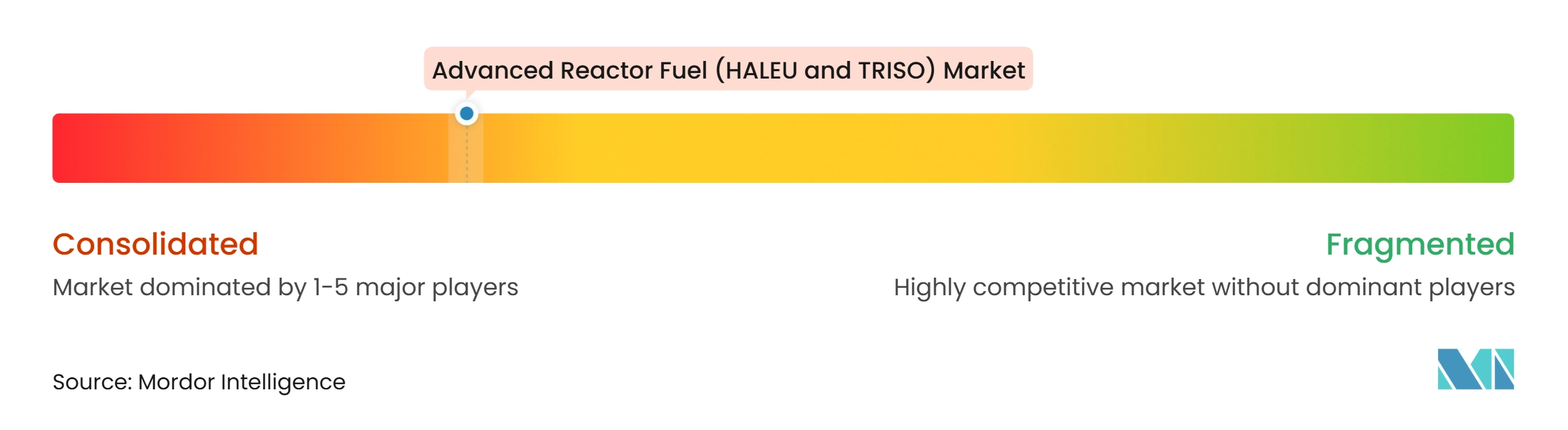
The Global Advanced Reactor Fuel (HALEU & TRISO) market is highly concentrated, with fewer than 5 entities able to produce certified HALEU or TRISO products at meaningful scale in late 2026. BWXT holds a strong position in qualified TRISO compacts through its existing Nuclear Regulatory Commission (NRC) license and Lynchburg production line. Centrus holds the only NRC license for commercial HALEU enrichment in the United States. The largest opportunity remains in deconversion and fuel-form conversion, where a commercial Western supplier has not yet achieved scale. Framatome is pursuing metallization, while Global Nuclear Fuel-Americas has demonstrated electroreduction with Argonne National Laboratory.
Competitive strategies separate integrated supply companies from specialist developers. Urenco continued its global capacity program in 2025, including the Almelo expansion and added U.S. cascades. Framatome and Standard Nuclear formed a joint venture in September 2025 to supply commercial quantities of TRISO particles. These steps are broadening prospective supply, although they have not yet removed near-term concentration.
The Global Advanced Reactor Fuel (HALEU & TRISO) market is also shaped by partnerships between reactor developers and fuel producers. Oklo, newcleo, and Blykalla announced a strategic partnership in October 2025 that included up to USD 2 billion in planned investment for advanced fuel infrastructure in the United States. These partnerships indicate that reactor developers are seeking fuel security before final deployment decisions. Nuclear Regulatory Commission (NRC) licensing and the Euratom safeguards regime favor companies with established regulatory relationships.
Advanced Reactor Fuel (HALEU & TRISO) Industry Leaders
-
BWX Technologies, Inc.
-
X-energy, LLC
-
Framatome Inc.
-
China National Nuclear Corporation
-
Centrus Energy Corp.
- *Disclaimer: Major Players sorted in no particular order
Advanced Reactor Fuel (HALEU & TRISO) Market Companies Covered in this Report
- BWX Technologies, Inc.
- Centrus Energy Corp.
- China National Nuclear Corporation
- China Nuclear Fuel Element Co., Ltd.
- Framatome Inc.
- General Matter, Inc.
- Global Laser Enrichment LLC
- Global Nuclear Fuel-Americas, LLC
- Joint Stock Company Techsnabexport (TENEX)
- Kairos Power, LLC
- Lightbridge Corporation
- Nuclear Fuel Industries, Ltd.
- Oklo Inc.
- Orano SA
- Standard Nuclear, Inc.
- TerraPower, LLC
- TRISO-X, LLC
- Urenco Limited
- Westinghouse Electric Company, LLC
- X-energy, LLC
Recent Industry Developments in Advanced Reactor Fuel (HALEU & TRISO) Market
- June 2026: BWX Technologies announced that its TRISO nuclear fuel powered Antares Nuclear Inc.'s reactor to first successful criticality under Executive Order 14301. BWXT processed HALEU feedstock from NNSA scrap material and fabricated the TRISO compacts at its Lynchburg facility, demonstrating a full domestic fuel production chain and reinforcing its position as the leading qualified TRISO supplier.
- February 2026: The US NRC granted TRISO-X, LLC, X-energy's fuel subsidiary, a 40-year Special Nuclear Material License for its TX-1 advanced fuel fabrication facility in Oak Ridge, Tennessee, three months ahead of schedule. Fuel fabrication at the first-of-a-kind Category-II facility, designed for 5 MTU or 700,000 TRISO pebbles per year, is expected to begin in early 2028.
- January 2026: Centrus Energy's subsidiary American Centrifuge Operating was selected for a USD 900 million task order to expand its Piketon, Ohio HALEU enrichment facility to commercial-scale production. The company targets 12 metric tons of HALEU per year sometime after 2030, with at least some HALEU production by end of decade.
- December 2025: Standard Nuclear executed an Other Transaction Agreement with the US DOE, enabling DOE-overseen scale-up of TRISO fuel manufacturing at its Oak Ridge campus. The agreement is the first of its kind under the Fuel Line Pilot Program and enables substantial increases in production throughput within existing facilities.
Global Advanced Reactor Fuel (HALEU & TRISO) Market Report Scope
HALEU (High-Assay Low-Enriched Uranium) is nuclear fuel enriched to contain between 5% and less than 20% uranium-235. TRISO (Tristructural Isotropic) fuel is a micro-particle fuel form that encapsulates uranium kernels within heat-resistant carbon and silicon carbide layers.
The advanced reactor fuel (HALEU & TRISO) market is segmented into fuel type, fuel fabrication technology, and geography. By fuel type, the market is divided into HALEU fuel, TRISO fuel, metallic fuel, and LEU+ Fuel for light water reactor small modular reactors. By fuel fabrication technology, the market is divided into HALEU conversion and enrichment, TRISO particle coating and fabrication, fuel compact manufacturing, fuel pebble manufacturing, metallic fuel casting and fabrication, and advanced fuel assembly manufacturing. The report also covers the market size and forecasts for the global advanced reactor fuel (HALEU & TRISO) market across 18 countries in key regions. For each segment, the market sizing and forecasts have been provided on the basis of value (USD).
Segmentation Overview
| HALEU Fuel |
| TRISO Fuel |
| Metallic Fuel |
| LEU+ Fuel for Light Water Reactor Small Modular Reactors |
| HALEU Conversion and Enrichment |
| TRISO Particle Coating and Fabrication |
| Fuel Compact Manufacturing |
| Fuel Pebble Manufacturing |
| Metallic Fuel Casting and Fabrication |
| Advanced Fuel Assembly Manufacturing |
| North America | United States |
| Canada | |
| Mexico | |
| Europe | United Kingdom |
| France | |
| Germany | |
| Russia | |
| Poland | |
| Rest of Europe | |
| Asia-Pacific | China |
| Japan | |
| South Korea | |
| India | |
| Australia | |
| Rest of Asia-Pacific | |
| South America | Brazil |
| Argentina | |
| Rest of South America | |
| Middle East and Africa | Saudi Arabia |
| United Arab Emirates | |
| South Africa | |
| Rest of Middle East and Africa |
| By Fuel Type | HALEU Fuel | |
| TRISO Fuel | ||
| Metallic Fuel | ||
| LEU+ Fuel for Light Water Reactor Small Modular Reactors | ||
| By Fuel Fabrication Technology | HALEU Conversion and Enrichment | |
| TRISO Particle Coating and Fabrication | ||
| Fuel Compact Manufacturing | ||
| Fuel Pebble Manufacturing | ||
| Metallic Fuel Casting and Fabrication | ||
| Advanced Fuel Assembly Manufacturing | ||
| By Geography | North America | United States |
| Canada | ||
| Mexico | ||
| Europe | United Kingdom | |
| France | ||
| Germany | ||
| Russia | ||
| Poland | ||
| Rest of Europe | ||
| Asia-Pacific | China | |
| Japan | ||
| South Korea | ||
| India | ||
| Australia | ||
| Rest of Asia-Pacific | ||
| South America | Brazil | |
| Argentina | ||
| Rest of South America | ||
| Middle East and Africa | Saudi Arabia | |
| United Arab Emirates | ||
| South Africa | ||
| Rest of Middle East and Africa | ||
Key Questions Answered in the Report
What is driving growth in advanced reactor fuel?
Advanced reactor and SMR deployments, government-backed enrichment capacity, and expanding TRISO fabrication are supporting growth. The forecast CAGR is 39.77% through 2032.
Why is HALEU important for advanced reactors?
HALEU is a required feedstock for many sodium-cooled, molten salt, gas-cooled, and microreactor designs. HALEU Fuel held 38.6% share in 2026.
Which fuel type is expected to grow fastest?
TRISO Fuel is forecast to grow at a 40.8% CAGR through 2032 as several fabrication lines move toward commercial production.
Which region leads advanced reactor fuel demand?
North America held 54.7% share in 2026, supported by DOE allocations, domestic enrichment activity, and advanced reactor development.
What is the primary supply constraint for HALEU?
Commercial enrichment and deconversion capacity remain limited, leaving a gap between enriched material availability and fuel-ready delivery.
How concentrated is the supplier base?
Fewer than 5 suppliers have demonstrated HALEU or TRISO production at meaningful scale, and established regulatory capabilities remain a major entry barrier.