
Acoustic Imaging For Predictive Maintenance Market Size and Share
Market Overview
| Study Period | 2020 - 2031 |
|---|---|
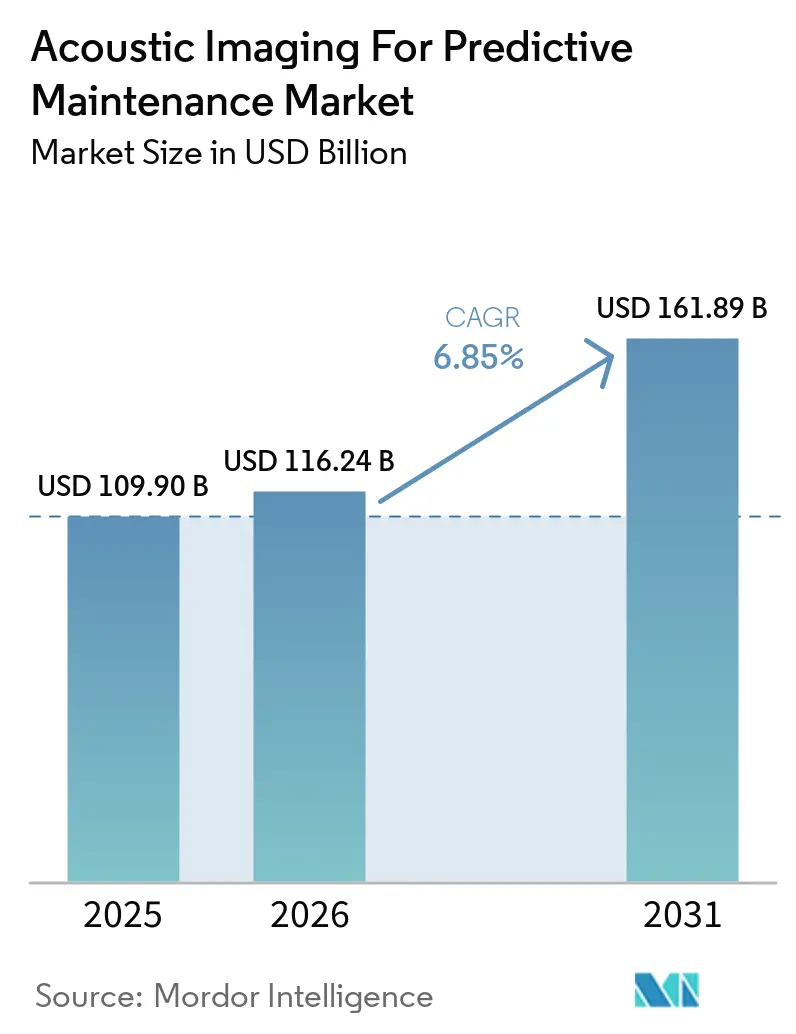
| Market Size (2026) | USD 116.24 Billion |
| Market Size (2031) | USD 161.89 Billion |
| Growth Rate (2026 - 2031) | 6.85 % |
| Fastest Growing Market | Asia-Pacific |
| Largest Market | North America |
| Market Concentration | Medium |
Major Players *Disclaimer: Major Players sorted in no particular order Image © Mordor Intelligence. Reuse requires attribution under CC BY 4.0. | |
Acoustic Imaging For Predictive Maintenance Market Analysis by Mordor Intelligence
The acoustic imaging for predictive maintenance market size is expected to increase from USD 109.90 million in 2025 to USD 116.24 million in 2026 and reach USD 161.89 million by 2031, expanding at a CAGR of 6.85% over 2026-2031. The acoustic imaging for predictive maintenance market is moving from periodic inspection toward continuous condition monitoring in facilities with costly and safety-critical assets. Buyers are placing more value on non-contact evidence that can support repair decisions, maintenance records, and insurance discussions. Lower microphone-array costs are widening access for mid-sized plants, while fixed systems still require significant investment in installation, software integration, and training. Suppliers are responding with mobile cameras, cloud reporting, AI-supported classification, and equipment that can operate with robots or drones. The acoustic imaging for predictive maintenance market also faces pressure from hardware price competition and inconsistent calibration practices that make multi-vendor programs more difficult.
Key Report Takeaways
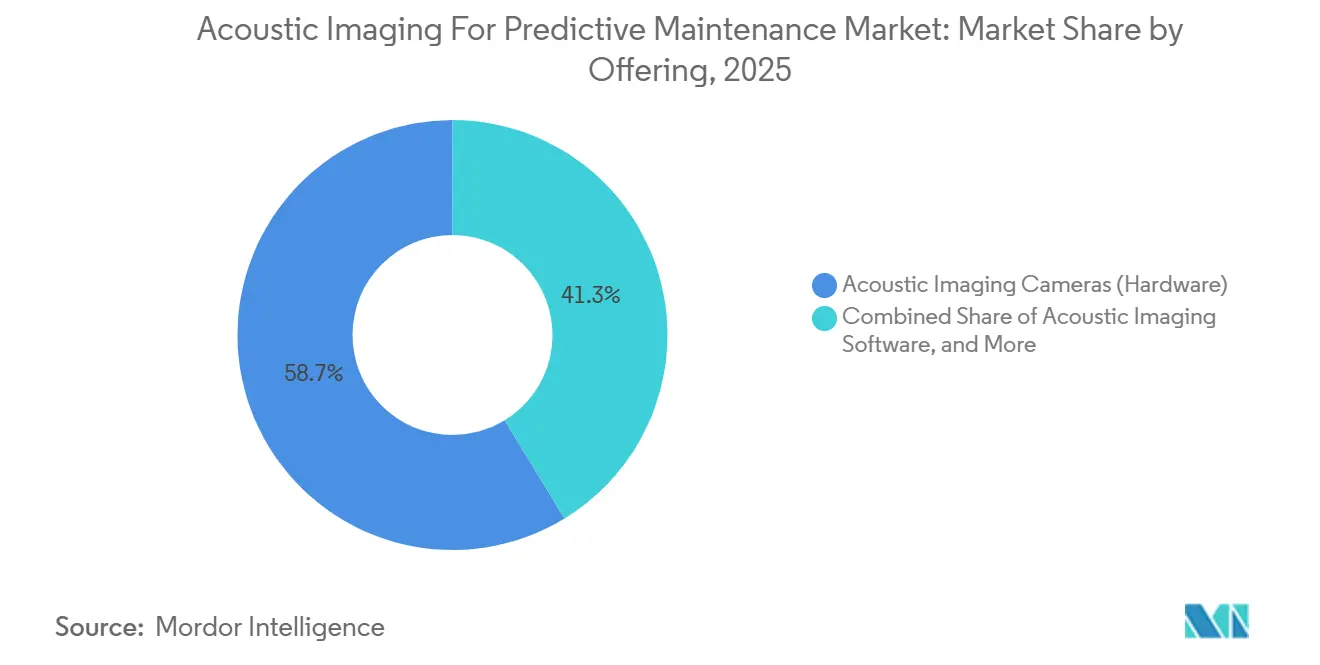
- By offering, acoustic imaging cameras held 58.73% of the acoustic imaging for predictive maintenance market share in 2025, while acoustic imaging software is projected to expand at a CAGR of 7.83% through 2031.
- By deployment platform, handheld and portable systems held 52.46% of global demand in 2025, while robot-integrated systems are projected to expand at a CAGR of 7.47% through 2031.
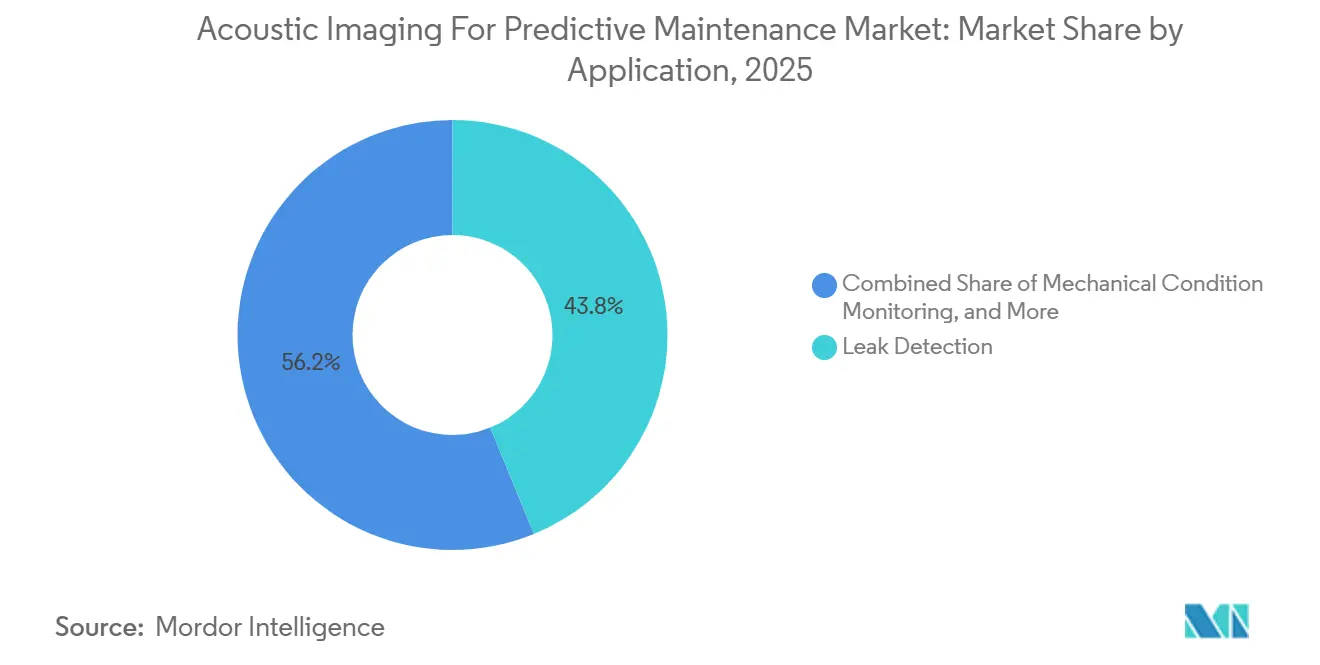
- By application, leak detection held 43.82% of global demand in 2025, while electrical fault detection is projected to expand at a CAGR of 7.76% through 2031.
- By end-user industry, smart manufacturing held 31.64% of global demand in 2025, while electronics and semiconductor is projected to expand at a CAGR of 7.68% through 2031.
- By geography, North America held 35.72% of global demand in 2025, while Asia-Pacific is projected to expand at a CAGR of 7.91% through 2031.
Note: Market size and forecast figures in this report are generated using Mordor Intelligence’s proprietary estimation framework, updated with the latest available data and insights as of January 2026.
Global Acoustic Imaging For Predictive Maintenance Market Trends and Insights
Drivers Impact Analysis*
| Driver | (~) % Impact on CAGR Forecast | Geographic Relevance | Impact Timeline |
|---|---|---|---|
| Rising Adoption of Condition-Based Maintenance | +1.8% | Global, with concentration in North America and Europe | Medium term (2-4 years) |
| Increasing Industrial Downtime Avoidance Requirements | +1.5% | Global, with highest intensity in smart manufacturing and oil and gas hubs | Short term (≤ 2 years) |
| Expansion of AI-Enabled Acoustic Monitoring | +1.2% | Global, with early leadership in North America and East Asia | Medium term (2-4 years) |
| Growth in Industrial Leak and Partial-Discharge Detection | +1.0% | North America, Europe, and Asia-Pacific, especially China, Japan, and South Korea | Medium term (2-4 years) |
| Edge-AI Integration With Legacy Maintenance Systems | +0.7% | North America and Europe, with spillover to Asia-Pacific | Long term (≥ 4 years) |
| Autonomous Robot and Drone Inspection Integration | +0.5% | Oil and gas hubs in the Middle East and North America, with early gains in Asia-Pacific | Long term (≥ 4 years) |
| Source: Mordor Intelligence | |||
Rising Adoption of Condition-Based Maintenance
Condition-based maintenance is becoming a central operating practice in asset-heavy facilities. The acoustic imaging for predictive maintenance market benefits because cameras convert sound patterns into visual findings that maintenance teams can investigate before a failure occurs. A 2025 scientific review found that sound-based monitoring can identify bearing degradation and valve leakage at early stages, supporting earlier and more precise fault classification than some conventional methods.[1] Earlier detection can give teams more time to plan repairs, order parts, and avoid unnecessary replacement of functioning equipment. Time-stamped images also create a record of asset condition that can strengthen inspection documentation. This is particularly useful where plants need repeatable evidence across shifts, sites, and maintenance contractors.
Increasing Industrial Downtime Avoidance Requirements
Avoiding downtime remains a direct reason for facilities to adopt acoustic imaging. The acoustic imaging for predictive maintenance market is supported by cameras that inspect pressurized and energized equipment without direct contact. UE Systems documented a 2025 paper-mill case in which ultrasound identified a hidden transformer defect and helped avoid nearly USD 1 million in production and replacement risk.[2] A 2026 ECNDT paper reported that acoustic cameras can inspect industrial equipment from a distance without stopping production. This characteristic makes the technology relevant to plants where access is limited or shutdown windows are rare. It also shifts procurement discussions toward operational continuity and risk control rather than a narrow comparison of instrument prices.
Expansion of AI-Enabled Acoustic Monitoring
AI is reducing the manual interpretation required after an acoustic inspection. The acoustic imaging for predictive maintenance market is therefore moving toward systems that can prioritize findings and connect them with maintenance workflows. Teledyne FLIR introduced its fixed Si2a PD system in 2026 with AI detection and classification for partial-discharge events, together with connection to the FLIR AssetLink ecosystem.[3] This type of capability can turn a periodic inspection into a continuous source of condition data. It also supports software subscriptions, fleet management, and recurring reporting services on an installed hardware base. The commercial value increasingly depends on how easily the camera output fits existing maintenance records and work-order processes.
Growth in Industrial Leak and Partial-Discharge Detection
Leak detection and electrical diagnostics provide the clearest operating cases for acoustic monitoring. The U.S. Department of Energy states that leaks can account for 20%-30% of the compressed-air energy used in industrial systems. The acoustic imaging for predictive maintenance market gains from the ability to scan large areas and locate leaks without placing technicians next to hazardous equipment. ECNDT documentation from 2026 described the use of acoustic cameras to identify compressed-air, nitrogen, carbon dioxide, ammonia, and oxygen leaks from safe distances. The same systems can support partial-discharge screening and mechanical checks, increasing their usefulness across a plant. Semiconductor facilities add a demanding use case because gas-distribution micro-leaks can affect production yield and require fast investigation.
Restraints Impact Analysis*
| Restraint | (~) % Impact on CAGR Forecast | Geographic Relevance | Impact Timeline |
|---|---|---|---|
| High Upfront Cost of Acoustic Imaging Systems | -1.5% | Global, with greatest friction in the Middle East and Africa and South America | Short term (≤ 2 years) |
| Limited Calibration and Interoperability Standards | -1.0% | Global, especially where multi-vendor deployments are required | Medium term (2-4 years) |
| Environmental Noise and False-Positive Risk | -0.7% | Industrial hubs with high ambient noise, including steel, mining, and heavy engineering | Short term (≤ 2 years) |
| Shortage of Acoustic Diagnostic Expertise | -0.5% | Emerging markets and mid-sized facilities globally | Long term (≥ 4 years) |
| Source: Mordor Intelligence | |||
High Upfront Cost of Acoustic Imaging Systems
High-end fixed systems remain difficult for smaller facilities to justify. The cost includes the camera, installation, cloud access, integration with supervisory control and maintenance software, and workforce training. FOTRIC launched the TD2e Kit in April 2026 at USD 999, which shows that handheld options have reached a more accessible price point. However, continuous fixed monitoring retains a higher cost structure and often requires a formal reliability program. The acoustic imaging for predictive maintenance market may therefore advance more slowly in facilities with tight maintenance budgets. Rental, subscription, and service models can reduce the initial barrier, but they depend on local financing and distribution capacity.
Limited Calibration and Interoperability Standards
The lack of common calibration practices limits confidence in results produced by different systems. The acoustic imaging for predictive maintenance market has no widely adopted field protocol that allows one vendor’s beamforming output to be directly compared with another’s. ISO 55000 provides an asset-management framework, while IEC 60270 addresses partial-discharge measurement, but neither creates a universal calibration method for predictive-maintenance acoustic imaging. Mixed camera fleets can consequently create extra work during audits, contractor handoffs, and platform integrations. This also limits the ability of smaller analytics providers to develop hardware-neutral applications. Better interoperability would make camera data easier to use as primary maintenance evidence rather than supporting information.
*Our forecasts treat driver/restraint impacts as directional, not additive. The impact forecasts reflect baseline growth, mix effects, and variable interactions.
Segment Analysis
By Offering: Hardware Holds Scale While Software Builds Value
Acoustic imaging cameras held 58.73% of the acoustic imaging for predictive maintenance market share in 2025, reflecting the need for a physical device at every inspection point. Hardware remains essential because software, reporting services, and managed inspection contracts all depend on an installed microphone array and camera. Facilities often begin with cameras, establish routes and response procedures, then broaden the program across additional assets and sites. This sequence keeps hardware important even as more entry-level mobile products reach the field. Hazardous-area certification, weather protection, mounting requirements, and access constraints also sustain demand for specialized camera systems.
Acoustic imaging software is projected to expand at a CAGR of 7.83% through 2031, as customers seek more value from existing devices. Software can add AI classification, cloud dashboards, energy-loss estimates, fleet oversight, and structured reporting without replacing the camera. Vendors are linking acoustic data with CMMS and enterprise asset-management systems, including SAP PM and IBM Maximo, so findings can move directly into maintenance records. Teledyne FLIR’s 2026 Si2a PD connected fixed monitoring with AssetLink and supported time-stamped digital maintenance records. Services remain relevant where sites lack diagnostic specialists or prefer inspection-as-a-service to owning equipment. In the acoustic imaging for predictive maintenance industry, this model can turn a hardware purchase into a longer relationship based on analysis, reporting, and workflow support.

By Deployment Platform: Portable Systems Lead While Autonomous Formats Advance
Handheld and portable systems held 52.46% of global deployment demand in 2025, making them the most common starting format for new users. Their lower initial cost and familiar walk-around method suit facilities that are testing acoustic inspection before committing to permanent monitoring. A portable device can move among compressed-air networks, motors, valves, utilities, and process equipment without requiring a fixed installation. Fluke introduced the ii01 acoustic camera for Android in September 2026 within its iSee Mobile Imaging Series, using a plug-and-play USB-C design. FOTRIC’s TD2e Kit offered a 64-microphone handheld option for compressed-air, gas, and vacuum leak work.
Robot-integrated systems are projected to expand at a CAGR of 7.47% through 2031, driven by inspection needs in hazardous, remote, and repetitive locations. These systems place acoustic monitoring on autonomous equipment that can collect data where routine technician access is difficult. Fixed-mount and online systems serve a related need at critical assets, where continuous observation is more useful than planned inspection rounds. The Si2a PD was designed for continuous partial-discharge monitoring of substations, switchgear, transformers, and gas-insulated systems. Drone-mounted systems remain the smallest platform, but they are relevant to overhead power assets, pipelines, and offshore facilities that are difficult to inspect from the ground.
By Application: Leak Detection Leads While Electrical Diagnostics Gain Ground
Leak detection held 43.82% of the acoustic imaging for predictive maintenance market share in 2025, supported by clear energy, safety, and production implications. Compressed-air and process-gas losses are familiar maintenance problems, making the application easier to justify than less established acoustic uses. Cameras can scan broad areas from safe distances and help teams prioritize repairs without direct contact with operating equipment. The Department of Energy identifies leaks as a material source of compressed-air system energy loss. Mechanical condition monitoring broadens the addressable use cases to bearings, gearboxes, steam traps, and structural screening.
Electrical fault detection is projected to expand at a CAGR of 7.76% through 2031, supported by utility investment and aging electrical infrastructure. The application is useful where operators must assess energized equipment without direct contact or production disruption. A 2026 IEEE Sensors Journal review found that acoustic sensing for partial-discharge detection in power cables can resist electromagnetic interference and support online monitoring designs. Continuous monitoring can capture intermittent discharge events that a periodic handheld inspection may not observe. Teledyne FLIR’s fixed system illustrates the focus on substations, transformers, switchgear, and gas-insulated systems.
By End-User Industry: Smart Manufacturing Anchors Demand While Semiconductors Accelerate
Smart manufacturing held 31.64% of global end-user demand in 2025, supported by the number of automated assets that require regular checks. Integrated plants use acoustic monitoring across robots, conveyors, servo presses, and compressed-air networks within industrial internet of things architectures. The installed base creates many points where non-contact monitoring can reduce exposure to operating equipment and limit manual checks. Automotive operations apply acoustic methods to battery enclosures, pneumatic circuits, stamping, welding, and assembly processes. Energy and power operators use cameras for partial-discharge surveillance, while oil and gas operators use them for fugitive-emissions monitoring in refinery and liquefied natural gas infrastructure.
Electronics and semiconductor is projected to expand at a CAGR of 7.68% through 2031, because fabrication operations have little tolerance for gas leaks or acoustic anomalies. CAE Systems reported that TSMC deployed more than 60 SoundCam Ultra 3 units in 2025 for gas-distribution leak and anomaly detection across its fabrication facilities. New fabrication capacity in the United States, Europe, Japan, and South Korea supports ongoing demand for specified monitoring systems. The acoustic imaging for predictive maintenance market has an opening in greenfield sites where monitoring can be included during construction rather than added to legacy operations. Aerospace, defense, chemicals, petrochemicals, mining, water infrastructure, marine operations, and construction also create specialized safety-critical demand.
Geography Analysis
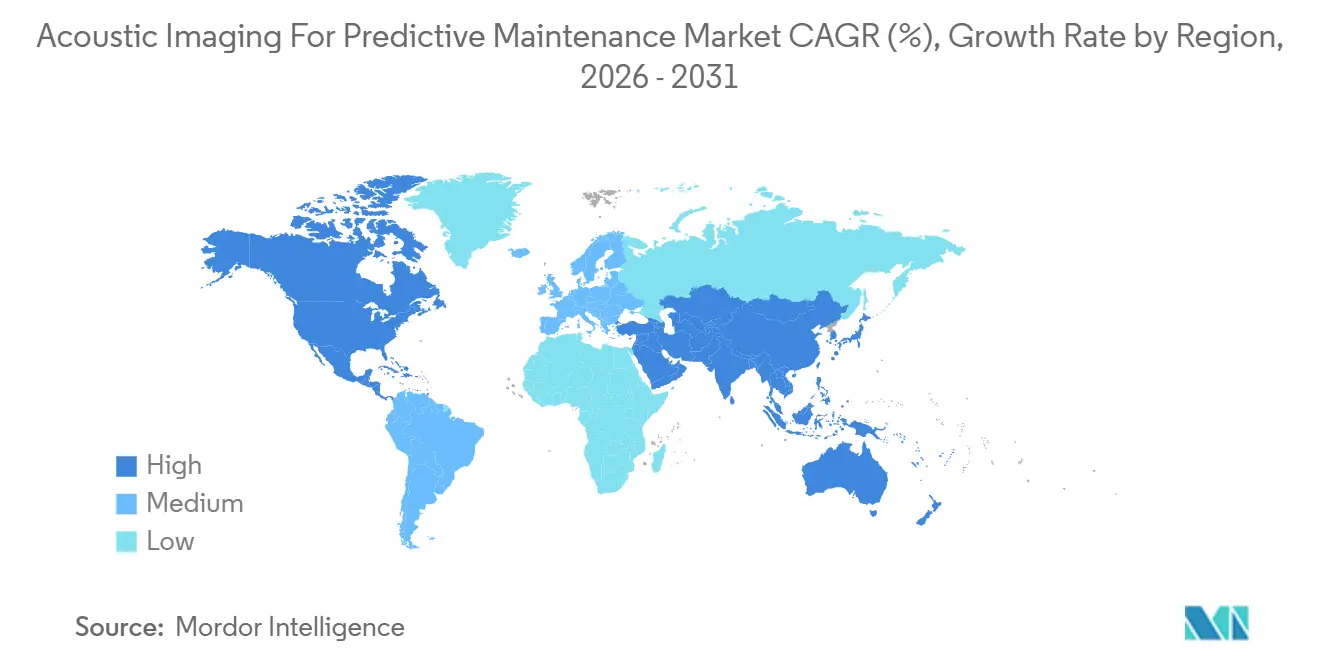
North America held 35.72% of the acoustic imaging for predictive maintenance market share in 2025, with the United States accounting for much of the region’s demand. Its extensive compressed-air networks, process-gas systems, high-voltage infrastructure, and petrochemical facilities require recurring reliability inspections. Industrial maintenance programs in manufacturing, power, public infrastructure, and energy create a broad base for acoustic camera adoption. Carahsoft and Distran announced a 2025 distribution partnership for passive ultrasound detection technology serving U.S. public-sector customers through specified procurement vehicles. Canada contributes demand through energy and heavy industry, while Mexico is developing as a secondary center through nearshoring-related automotive and manufacturing investment.
Europe remained the second-largest region in 2025, led by Germany, the United Kingdom, France, Italy, and Spain. Germany’s mechanical engineering and automotive supply chains support routine condition monitoring under Industry 4.0 programs. The European Union’s Methane Regulation, Regulation (EU) 2024/1787, creates compliance requirements that can support leak detection across parts of the energy supply chain. European utilities and chemical producers also value documentation-grade inspection evidence. France’s nuclear operations provide a specialized setting in which repeatability and formal inspection procedures are particularly important.
Asia-Pacific is projected to expand at a CAGR of 7.91% through 2031, based on industrial automation in China, precision manufacturing in Japan, semiconductor investment in South Korea, and ASEAN manufacturing activity. China is developing domestic acoustic-imaging capability for grid and pipeline inspection, including drone-oriented systems. Japan’s manufacturing sector is moving toward cloud-delivered condition monitoring tools that use sound data. The Middle East and Africa remains smaller, but energy modernization programs in Saudi Arabia and the United Arab Emirates support refinery, liquefied natural gas, and electrical-grid applications. South America is the least penetrated major region, with Brazil and Argentina providing the main opportunities in oil and gas and pulp-and-paper operations.
Competitive Landscape
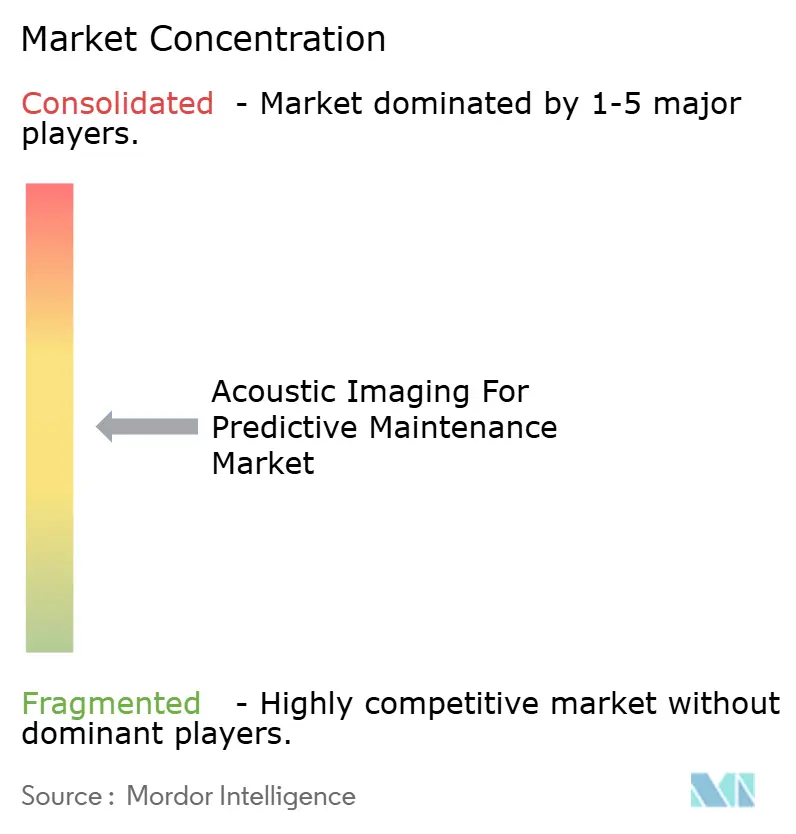
The acoustic imaging for predictive maintenance market is moderately fragmented, with diversified instrumentation vendors and specialized suppliers active in the same accounts. Teledyne FLIR, Fluke Corporation, and Hottinger Brüel and Kjær Sound and Vibration Measurement A/S have broad distribution capabilities and established relationships with industrial and utility customers. Distran, Sorama BV, SM Instruments, and gfai tech GmbH compete through focused applications, product design, and analytical methods. This structure gives larger suppliers scale while allowing specialists to respond quickly to particular inspection problems. Suppliers increasingly combine hardware with AI classification, cloud services, and workflow software, making practical usability an important competitive factor.
Fluke’s September 2026 ii01 launch illustrates a mobile-first approach to lower-cost access for maintenance teams. The Android-connected device is intended to broaden acoustic diagnostics without a dedicated instrument purchase. FOTRIC’s April 2026 TD2e Kit also targeted leak inspection with a USD 999 starting price, 64 microphones, and a field-ready design. These moves can direct sales toward technicians and mobile use cases, rather than only traditional instrument purchasers. They also increase price pressure on suppliers that depend on premium hardware margins.
Teledyne FLIR’s 2026 Si2a PD launch represents the competing fixed-monitoring strategy. The IP66-rated system was designed for 24/7 partial-discharge monitoring and includes AI detection, fault classification, and connection to AssetLink. Hazardous-area certification is another competitive factor because qualified equipment has fewer alternatives in explosive environments. Robotics integrators can influence purchasing when acoustic modules are built into inspection robots or robotic dogs. Platform links with maintenance systems can strengthen customer retention when equipment history and reporting become part of everyday operating workflows. The acoustic imaging for predictive maintenance market will remain competitive across camera performance, system integration, and the ease of using findings in a customer’s established maintenance process.
Acoustic Imaging For Predictive Maintenance Industry Leaders
-
Hottinger Brüel & Kjær Sound & Vibration Measurement A/S
-
Siemens Digital Industries Software
-
Teledyne FLIR LLC
-
Norsonic AS
-
gfai tech GmbH
- *Disclaimer: Major Players sorted in no particular order
Recent Industry Developments
- September 2026: Fluke Corporation launched the ii01 Acoustic Camera for Android, the inaugural product of the iSee Mobile Imaging Series, integrating SoundMap technology and high-precision MEMS sensors across a 2-48 kHz detection-frequency range. The plug-and-play USB-C mobile form factor extends professional acoustic diagnostics to a broader technician base by eliminating dedicated instrument investment, with applications spanning compressed-air leak detection and energy-waste identification across manufacturing and process facilities.
- September 2026: HIKMICRO completed one year since the launch the AI56L Acoustic Imager targeting automotive stamping, welding, and assembly-line environments, featuring ultra-sensitive gas-leak detection mode, a 4.3-inch LCD touchscreen, and real-time visualization for detecting compressed-air leaks in live high-speed production environments where traditional single-microphone tools require line stoppage.
- April 2026: FOTRIC launched the TD2e Kit Acoustic Imaging Camera at a starting price of USD 999, featuring 64 MEMS microphones, a 2-100 kHz frequency range, and a 60 m detection distance in an IP54-rated, 2 m drop-resistant field configuration. The kit targets compressed-air, gas, and vacuum leak detection for continuous multi-site industrial inspections and is positioned to displace traditional soapy-water testing and single-microphone handheld ultrasonic wand methods.
- April 2026: Distran Switzerland announced that its SonicView X received ATEX Zone 2 and IECEx certification, enabling direct deployment inside hazardous-area industrial facilities without zone-entry restrictions. The certification expands Distran's addressable market to include live upstream and downstream oil and gas processing areas where Zone 2 classification applies across significant portions of plant infrastructure.
Global Acoustic Imaging For Predictive Maintenance Market Report Scope
The Acoustic Imaging for Predictive Maintenance Market refers to the industry focused on the development, deployment, and utilization of acoustic imaging systems that detect, visualize, and analyze sound waves and ultrasonic emissions from industrial equipment and infrastructure to identify faults before failure occurs.
The Acoustic Imaging for Predictive Maintenance Market Report is Segmented by Offering (Acoustic Imaging Cameras (Hardware), Acoustic Imaging Software, and Acoustic Imaging Services), by Deployment Platform (Handheld and Portable Systems, Fixed-Mount and Online Systems, Robot-Integrated Systems, and Drone and UAV-Mounted Systems), by Application (Leak Detection, Electrical Fault Detection, Mechanical Condition Monitoring, and Other Acoustic Diagnostic Applications), by End-User Industry (Smart Manufacturing, Energy and Power, Oil and Gas, Automotive and Mobility, Aerospace and Defense, Electronics and Semiconductor, Chemicals and Petrochemicals, Mining and Heavy Engineering, Utilities and Water Infrastructure, Construction and Infrastructure, Marine and Shipbuilding, and Other End-User Industries), and by Geography (North America (United States, Canada, and Mexico), South America (Brazil, Argentina, and Rest of South America), Europe (Germany, United Kingdom, France, Italy, Spain, and Rest of Europe), Asia-Pacific (China, Japan, India, South Korea, ASEAN, and Rest of Asia-Pacific), and Middle East and Africa (Saudi Arabia, United Arab Emirates, Turkey, Rest of the Middle East, South Africa, Nigeria, and Rest of Africa)). The Market Forecasts are Provided in Terms of Value (USD).
| Acoustic Imaging Cameras (Hardware) |
| Acoustic Imaging Software |
| Acoustic Imaging Services |
| Handheld and Portable Systems |
| Fixed-Mount and Online Systems |
| Robot-Integrated Systems |
| Drone and UAV-Mounted Systems |
| Leak Detection |
| Electrical Fault Detection |
| Mechanical Condition Monitoring |
| Other Acoustic Diagnostic Applications |
| Smart Manufacturing |
| Energy and Power |
| Oil and Gas |
| Automotive and Mobility |
| Aerospace and Defense |
| Electronics and Semiconductor |
| Chemicals and Petrochemicals |
| Mining and Heavy Engineering |
| Utilities and Water Infrastructure |
| Construction and Infrastructure |
| Marine and Shipbuilding |
| Other End-User Industries |
| North America | United States | |
| Canada | ||
| Mexico | ||
| South America | Brazil | |
| Argentina | ||
| Rest of South America | ||
| Europe | Germany | |
| United Kingdom | ||
| France | ||
| Italy | ||
| Spain | ||
| Rest of Europe | ||
| Asia-Pacific | China | |
| Japan | ||
| India | ||
| South Korea | ||
| ASEAN | ||
| Rest of Asia-Pacific | ||
| Middle East and Africa | Middle East | Saudi Arabia |
| United Arab Emirates | ||
| Turkey | ||
| Rest of the Middle East | ||
| Africa | South Africa | |
| Nigeria | ||
| Rest of Africa | ||
| By Offering | Acoustic Imaging Cameras (Hardware) | ||
| Acoustic Imaging Software | |||
| Acoustic Imaging Services | |||
| By Deployment Platform | Handheld and Portable Systems | ||
| Fixed-Mount and Online Systems | |||
| Robot-Integrated Systems | |||
| Drone and UAV-Mounted Systems | |||
| By Application | Leak Detection | ||
| Electrical Fault Detection | |||
| Mechanical Condition Monitoring | |||
| Other Acoustic Diagnostic Applications | |||
| By End-User Industry | Smart Manufacturing | ||
| Energy and Power | |||
| Oil and Gas | |||
| Automotive and Mobility | |||
| Aerospace and Defense | |||
| Electronics and Semiconductor | |||
| Chemicals and Petrochemicals | |||
| Mining and Heavy Engineering | |||
| Utilities and Water Infrastructure | |||
| Construction and Infrastructure | |||
| Marine and Shipbuilding | |||
| Other End-User Industries | |||
| By Geography | North America | United States | |
| Canada | |||
| Mexico | |||
| South America | Brazil | ||
| Argentina | |||
| Rest of South America | |||
| Europe | Germany | ||
| United Kingdom | |||
| France | |||
| Italy | |||
| Spain | |||
| Rest of Europe | |||
| Asia-Pacific | China | ||
| Japan | |||
| India | |||
| South Korea | |||
| ASEAN | |||
| Rest of Asia-Pacific | |||
| Middle East and Africa | Middle East | Saudi Arabia | |
| United Arab Emirates | |||
| Turkey | |||
| Rest of the Middle East | |||
| Africa | South Africa | ||
| Nigeria | |||
| Rest of Africa | |||
Key Questions Answered in the Report
What is the acoustic imaging for predictive maintenance market size?
The acoustic imaging for predictive maintenance market size was USD 116.24 million in 2026 and is forecast to reach USD 161.89 million by 2031, at a CAGR of 6.85%. This outlook reflects broader use of non-contact condition monitoring in facilities with high-value equipment and limited shutdown windows.
What is driving adoption of acoustic imaging for predictive maintenance?
Condition-based maintenance, downtime avoidance, AI-enabled monitoring, leak detection, and partial-discharge checks are supporting adoption. The market is also supported by the need for visual, time-stamped evidence that can be incorporated into routine maintenance records.
Which offering leads demand for acoustic imaging systems?
Acoustic imaging cameras led demand with a 58.73% share in 2025, while software is projected to expand at a CAGR of 7.83% through 2031. The market combines deployed hardware with software that helps teams classify findings, organize reports, and link results with work orders.
Which application is expanding fastest for acoustic imaging?
Electrical fault detection is projected to expand at a CAGR of 7.76% through 2031, supported by utility and electrical infrastructure inspection needs. The market serves this application through non-contact checks that can be performed on energized equipment from a safer distance.
Which region leads demand for acoustic imaging systems?
North America held 35.72% of global demand in 2025, while Asia-Pacific is projected to expand at a CAGR of 7.91% through 2031. Regional demand is driven by heavy industry, process facilities, manufacturing, energy systems, and semiconductor operations.
What limits wider use of acoustic cameras in industrial facilities?
Upfront system cost, inconsistent calibration, environmental noise, false positives, and limited diagnostic expertise can slow adoption. The market also depends on local service capacity, training, financing options, and practical integration with established maintenance processes.