
AI-Enabled Software As A Medical Device (SaMD) Market Size and Share
Market Overview
| Study Period | 2020 - 2031 |
|---|---|
| Market Size (2026) | USD 11.33 Billion |
| Market Size (2031) | USD 31.18 Billion |
| Growth Rate (2026 - 2031) | 22.45 % |
| Fastest Growing Market | Asia-Pacific |
| Largest Market | North America |
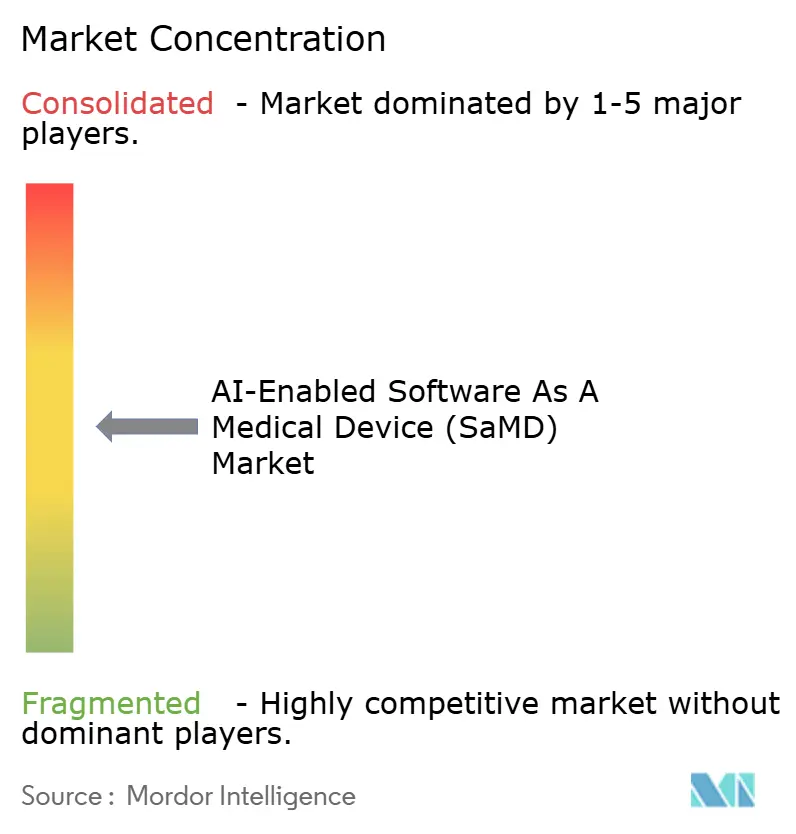
| Market Concentration | Medium |
Major Players *Disclaimer: Major Players sorted in no particular order Image © Mordor Intelligence. Reuse requires attribution under CC BY 4.0. | |
AI-Enabled Software As A Medical Device (SaMD) Market Analysis by Mordor Intelligence
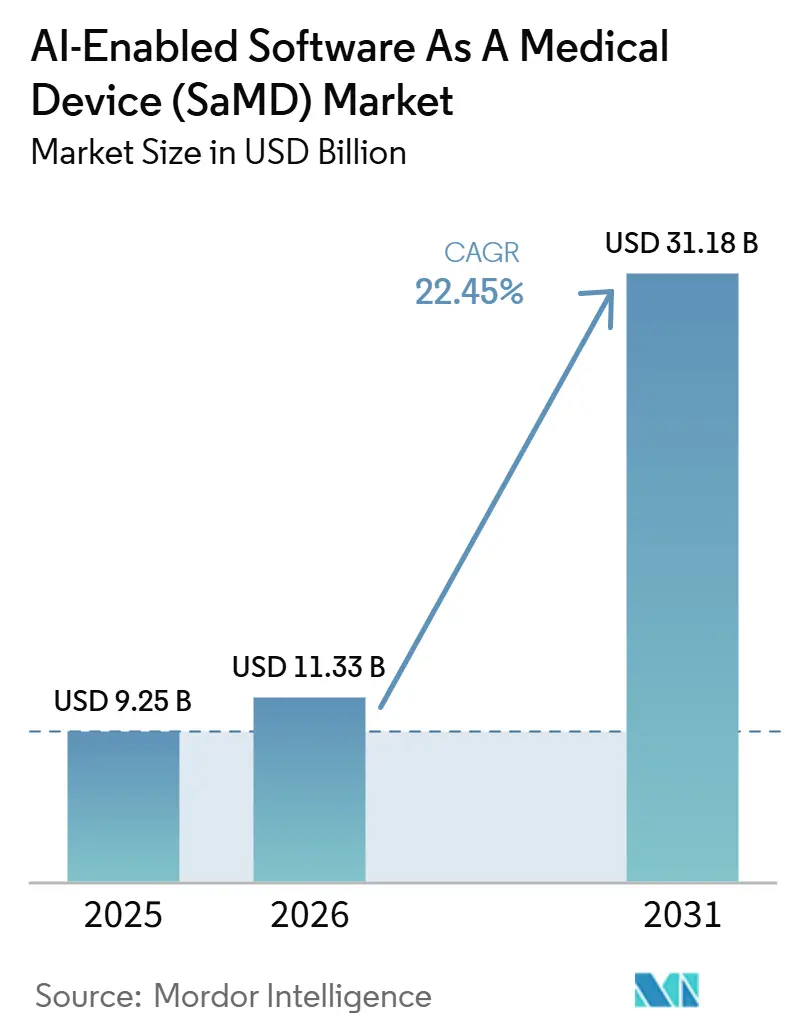
The AI-Enabled Software As A Medical Device Market size is expected to grow from USD 9.25 billion in 2025 to USD 11.33 billion in 2026 and is forecast to reach USD 31.18 billion by 2031 at 22.45% CAGR over 2026-2031.
The AI-enabled software as a medical device (SaMD) market is entering a more mature phase as regulatory expectations in the United States and Europe become easier for manufacturers and providers to navigate across multi-year product cycles. The FDA’s finalized Predetermined Change Control Plan framework is reducing friction in post-market algorithm improvements, enabling faster iteration and lowering the operational burden of keeping products current after launch. Demand remains strong as hospitals address rising diagnostic volumes and workforce shortages, making automation a practical operational need rather than a discretionary digital upgrade. More favorable payment discussions for triage, diagnosis, and chronic disease management are helping the market move products from pilot deployments into routine procurement and recurring operating budgets.
Key Report Takeaways
- By software type, diagnostic SaMD led with a 38.55% revenue share in 2025, while therapeutic SaMD is projected to expand at a 25.93% CAGR through 2031.
- By clinical specialty, radiology and imaging accounted for 42.22% of revenue in 2025, while pathology is forecast to grow at a 24.67% CAGR through 2031.
- By end user, hospitals held 46.66% of revenue in 2025, while home healthcare settings are projected to advance at a 26.35% CAGR through 2031.
- By deployment mode, cloud-based solutions represented 51.56% of revenue in 2025, while edge-enabled and hybrid deployment are expected to grow at a 23.78% CAGR through 2031.
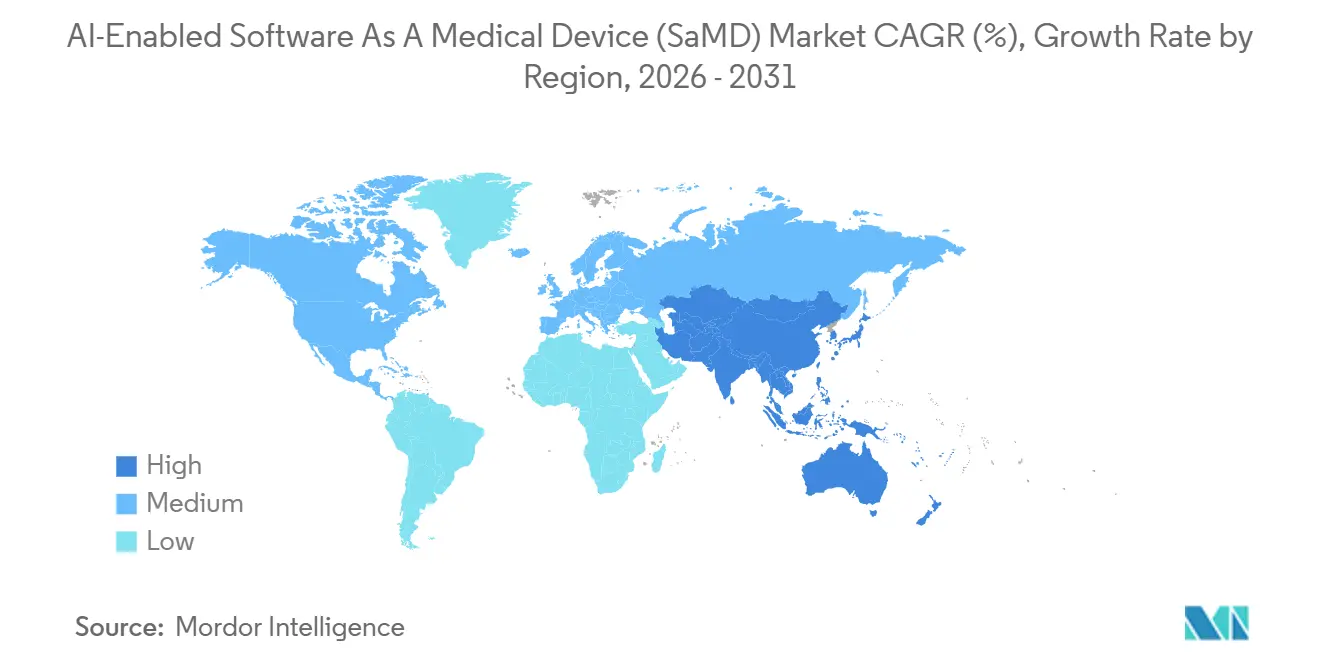
- By geography, North America held 41.56% of revenue in 2025, while Asia-Pacific is projected to grow at a 25.56% CAGR through 2031.
Note: Market size and forecast figures in this report are generated using Mordor Intelligence’s proprietary estimation framework, updated with the latest available data and insights as of January 2026.
Market Trends and Insights
Drivers Impact Analysis of AI-Enabled Software As A Medical Device (SaMD) Market*
| DRIVER | (~) % IMPACT ON CAGR FORECAST | GEOGRAPHIC RELEVANCE | IMPACT TIMELINE |
|---|---|---|---|
| Rising FDA and global regulatory clarity for AI-enabled SaMD | +3.2% | Global, with stronger near-term benefit in North America and Europe | Short term (≤ 2 years) |
| Hospital demand for diagnostic workflow automation | +2.8% | Global, with highest relevance in North America, Western Europe, and China | Medium term (2-4 years) |
| Expansion of evidence-generating real-world data and registry programs | +2.4% | North America and Europe, with growing spillover into leading Asia-Pacific centers | Medium term (2-4 years) |
| Higher reimbursement interest for AI-assisted triage and diagnosis | +2.1% | North America as the lead market, Europe as an emerging market, and Asia-Pacific at an early stage | Medium term (2-4 years) |
| AI-first SaMD designed for narrow clinical workflows | +1.9% | Global, with early commercial traction in North America and India | Long term (≥ 4 years) |
| Source: Mordor Intelligence | |||
Rising FDA and Global Regulatory Clarity for AI-Enabled SaMD
Regulatory clarity has long shaped commercialization in the AI-enabled software as a medical device (SaMD) market, and the 2025 to 2026 period marked a clear improvement. The FDA’s January 2025 draft guidance clarified submission expectations for locked and continuously learning algorithms across all three major marketing pathways. The February 2026 Quality Management System Regulation update aligned FDA requirements more closely with ISO 13485:2016, while the FDA’s PCCP framework, finalized in December 2024, enabled pre-authorized future algorithm changes.[1]U.S. Food and Drug Administration, “Predetermined Change Control Plans for Medical Devices: Guidance for Industry and Food and Drug Administration Staff,” FDA, fda.gov In Europe, MDCG 2025-6 clarified how AI Act obligations interact with MDR and IVDR quality systems, helping companies prepare unified compliance files.
Hospital Demand for Diagnostic Workflow Automation
Hospital demand remained a major driver for the AI-enabled software as a medical device (SaMD) market, as providers faced rising imaging and diagnostic workloads without proportional growth in specialist staffing. Workforce shortages were especially relevant in radiology and other data-heavy specialties where case volumes increased faster than expert capacity. Aidoc’s deployment across nearly 2,000 hospitals and its USD 150 million Series E financing in April 2026 showed stronger hospital interest in broad diagnostic augmentation platforms rather than isolated single-condition tools. This demand also supported AI integration into imaging systems and workflow infrastructure.
Expansion of Evidence-Generating Real-World Data and Registry Programs
The AI-enabled software as a medical device (SaMD) market gained support from real-world evidence programs, clinical registries, and EHR-linked data pipelines that improved algorithm performance and commercial credibility. Deployment data helped companies demonstrate performance across broader patient groups and real clinical settings. Tempus AI’s multicenter validation study for its AI-enabled ECG model, published in June 2026 across 31 clinical sites, showed the value of broad validation for payer engagement and clinical adoption.[2]U.S. Food and Drug Administration, “Artificial Intelligence-Enabled Device Software Functions: Lifecycle Management and Marketing Submission Recommendations,” FDA, fda.gov Qure.ai’s presence across 105+ countries and analysis of over 39 million patient scans highlighted the competitive value of dataset diversity.
Higher Reimbursement Interest for AI-Assisted Triage and Diagnosis
Reimbursement became a more meaningful growth support for the AI-enabled software as a medical device (SaMD) market, as commercial viability depended on clear payment pathways. The April 23, 2026 FDA and CMS announcement of the RAPID Coverage Pathway shortened the time from authorization to Medicare national coverage to two months for eligible Breakthrough Device products. CMS also moved toward a formal Software as a Medical Service payment structure under the proposed FY2027 outpatient rule, giving hospitals and billing teams a clearer model for AI diagnostic software. Clearer reimbursement reduced budget hesitation and encouraged vendors to build products with payment readiness from the start.
Restraints Impact Analysis of AI-Enabled Software As A Medical Device (SaMD) Market*
| RESTRAINT | (~) % IMPACT ON CAGR FORECAST | GEOGRAPHIC RELEVANCE | IMPACT TIMELINE |
|---|---|---|---|
| Clinical validation burden across diverse populations | -2.3% | Global, with highest relevance in multi-ethnic markets such as the United States, India, and Brazil | Short term (≤ 2 years) to Medium term (2-4 years) |
| Cybersecurity, data integrity, and model drift risks | -2.1% | Global, with sharper impact in markets that enforce data localization, including Europe, India, and China | Medium term (2-4 years) to Long term (≥ 4 years) |
| Liability ambiguity for AI-influenced clinical decisions | -1.8% | Global, with stronger pressure in high-litigation settings such as the United States and Europe | Medium term (2-4 years) |
| Integration friction with legacy PACS, EHR, and hospital systems | -1.5% | Global, with greater severity in smaller networks and lower-middle-income settings | Short term (≤ 2 years) to Medium term (2-4 years) |
| Source: Mordor Intelligence | |||
Clinical Validation Burden Across Diverse Populations
Clinical validation across diverse populations remains a key constraint in the AI-enabled software as a medical device (SaMD) market, as regulators and providers place greater emphasis on subgroup performance and data provenance. The FDA’s January 2025 draft guidance made it clear that future submissions would face closer scrutiny on demographic coverage and algorithm behavior across subpopulations. This increases the burden on developers, as studies must demonstrate reliable performance across patient groups that differ by age, ethnicity, disease burden, and equipment setting. For multi-indication products, this can extend evidence-building timelines by 12 to 18 months and increase the capital required before broad commercialization. Qure.ai’s wide deployment footprint demonstrates the value of a strong validation strategy, while highlighting the difficulty smaller vendors face in replicating this model at scale.
Cybersecurity, Data Integrity, and Model Drift Risks
Cybersecurity and data integrity risks remain structural constraints in the AI-enabled software as a medical device (SaMD) market, as AI systems can fail in less visible ways than conventional software. Model drift, adversarial sensitivity, and data pipeline failures can reduce diagnostic quality without causing obvious system breakdowns. This risk is particularly relevant in prediction-heavy use cases, such as sepsis detection and cardiac monitoring, where real-world data environments can shift quickly after deployment. The compliance burden also increases when continuous-learning products require broad data access, while privacy and localization rules restrict how organizations process or move identifiable patient information across systems.
*Our forecasts treat driver/restraint impacts as directional, not additive. The impact forecasts reflect baseline growth, mix effects, and variable interactions.
AI-Enabled Software As A Medical Device (SaMD) Market Segment Analysis
By Software Type:
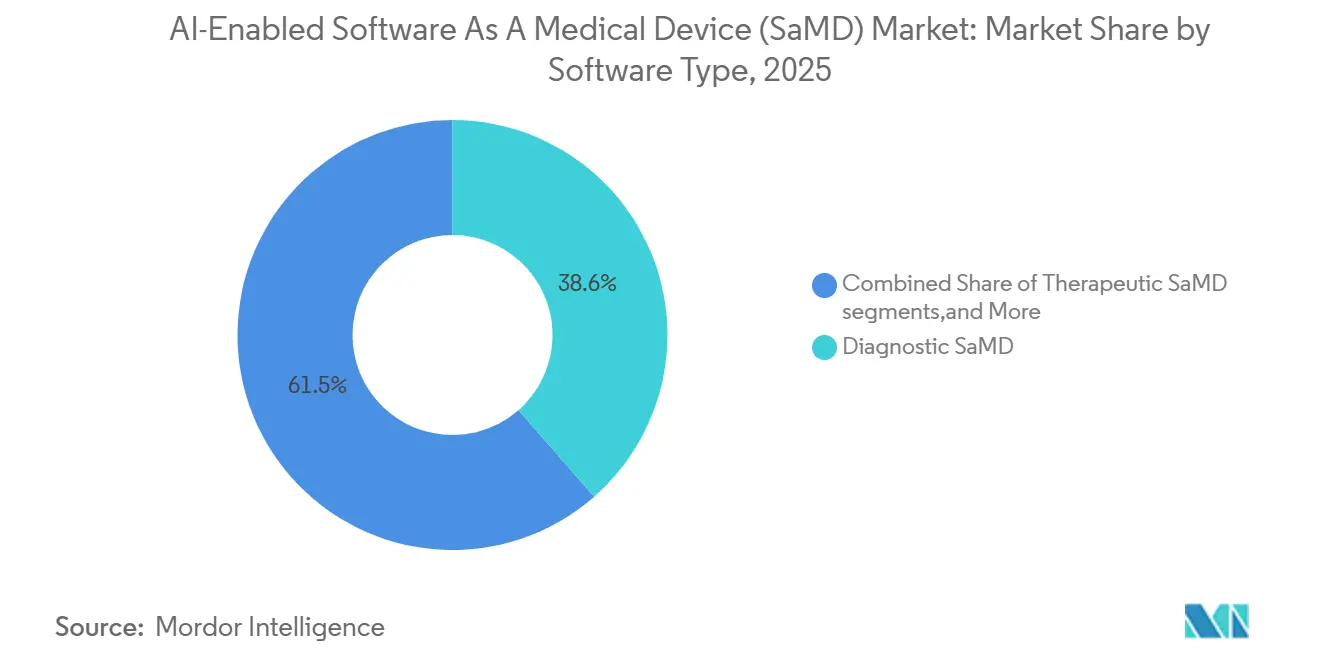
Therapeutic and Monitoring SaMD Narrow the Diagnostic LeadDiagnostic SaMD held 38.55% of the AI-enabled software as a medical device (SaMD) market share in 2025, supported by strong adoption in radiology, cardiology, and ophthalmology. Image-rich workflows, defined reference standards, high digital volumes, and clearer approval pathways helped the segment commercialize earlier than many treatment-focused workflows. Therapeutic SaMD was the fastest-growing software type, with this portion of the AI-enabled software as a medical device (SaMD) market size projected to expand at a 25.93% CAGR through 2031.
Digital therapeutics, adaptive neuromodulation, and treatment planning tools drove growth by influencing billable care pathways beyond diagnostic interpretation. Monitoring SaMD also gained scale as providers combined wearable inputs, longitudinal data, and EHR-linked risk models to identify patients earlier and manage them over time. The AI-enabled software as a medical device (SaMD) market shifted from software that mainly read or flagged cases toward solutions that supported treatment and follow-up decisions.



By Clinical Specialty:
Pathology Ascends Fastest in a Radiology-Anchored MarketRadiology and imaging commanded 42.22% of revenue in 2025, maintaining the largest specialty position in the AI-enabled software as a medical device (SaMD) market. The specialty benefited from high procedure volumes, established digital infrastructure, and a deep installed base of AI-enabled tools. Large imaging vendors strengthened this position by embedding software into device portfolios rather than offering AI only as a separate add-on.
GE HealthCare’s March 2026 FDA clearance for Photonova Spectra and Philips’ March 2026 FDA clearance for Verida Spectral CT showed how imaging refresh cycles became distribution channels for AI-enabled clinical workflows. Pathology was the fastest-growing specialty, with this segment of the AI-enabled software as a medical device (SaMD) market size projected to rise at a 24.67% CAGR through 2031. Wider whole-slide imaging use, stronger foundation models, and oncology workflows combining image, molecular, and clinical signals supported this momentum.
By End User:
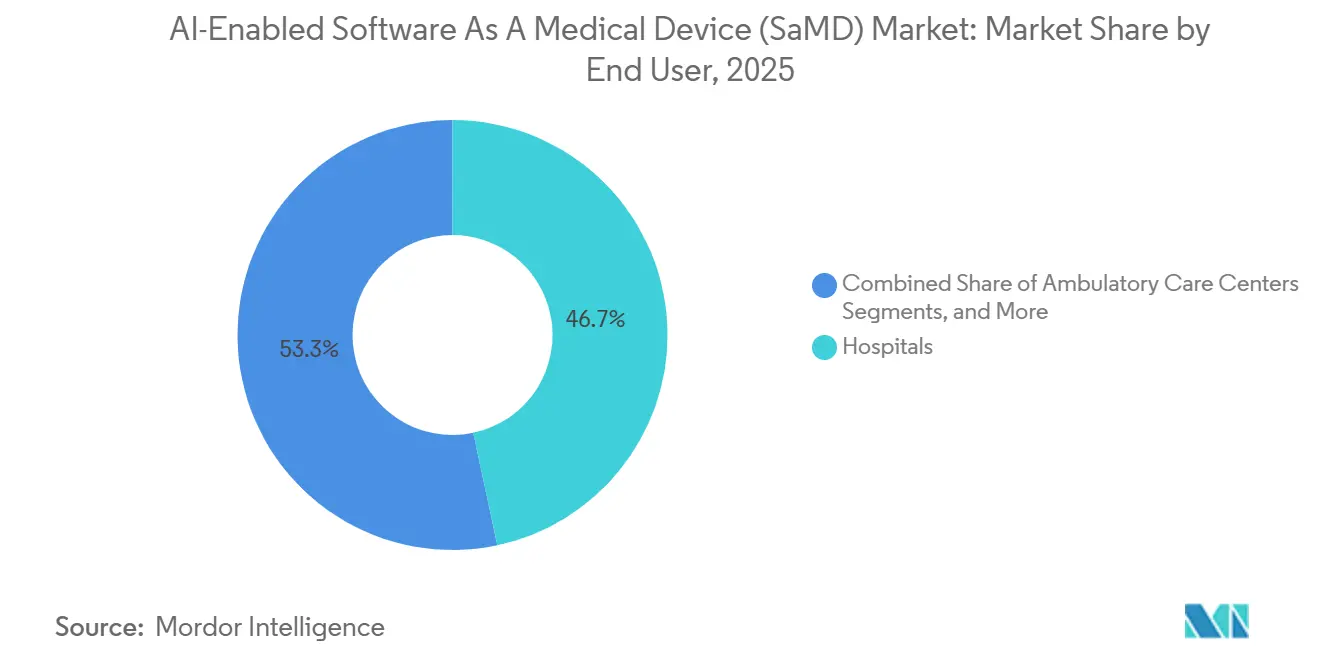
Hospital Depth Masks Home Care’s Structural RiseHospitals accounted for 46.66% of revenue in 2025, keeping them as the largest end-user group in the AI-enabled software as a medical device (SaMD) market. Hospitals integrated software across radiology, cardiology, emergency, and enterprise workflow systems at scale. Their lead reflected their role in managing high-acuity cases and imaging-heavy volumes, where early AI deployment was easier to justify.
Home healthcare settings were the fastest-growing end-user group, with this part of the AI-enabled software as a medical device (SaMD) market size projected to advance at a 26.35% CAGR through 2031. Wearable monitoring, software-driven chronic disease management, and payment frameworks supporting outcomes-based care in the home drove this growth. Withings Medical’s July 2026 launch under the CMS ACCESS Model reflected the shift from passive monitoring to reimbursed clinical service delivery.
By Deployment Mode:
Cloud Dominance Holds as Edge-Enabled Demand AcceleratesCloud-based deployment accounted for 51.56% of revenue in 2025, making it the largest deployment model in the AI-enabled software as a medical device (SaMD) market. Cloud deployment lowered upfront infrastructure costs, simplified centralized model updates, and aligned with subscription pricing structures. Providers could absorb these costs more easily through operating budgets than through large capital requests.
Edge-enabled and hybrid deployment was the fastest-growing model, with this part of the AI-enabled software as a medical device (SaMD) market size projected to grow at a 23.78% CAGR through 2031. Data sovereignty rules limiting external processing of identifiable health data and latency-sensitive use cases, such as stroke detection, intraoperative guidance, and ICU alerts, drove demand. The Tempus AI and Medtronic ALERT trial presented in March 2026 supported the value of workflow-embedded AI notifications in live clinical settings.
Geography Analysis
North America AI-Enabled Software As a Medical Device (SaMD) Market
North America held 41.56% of the AI-enabled software as a medical device (SaMD) market share in 2025, making it the most advanced commercial region. Strong hospital digitization, an active regulatory pathway, and a more accessible payment system for AI-enabled products supported its leadership. The RAPID Coverage Pathway, announced by CMS and the FDA in April 2026, improved commercialization conditions by narrowing the gap between authorization and Medicare national coverage for eligible Breakthrough Device products.
Europe AI-Enabled Software As a Medical Device (SaMD) Market
Europe is the second-largest regional bloc in the AI-enabled software as a medical device (SaMD) market. Its growth trajectory is being shaped by the interaction between the MDR, IVDR, and the AI Act, rather than by a single approval system. MDCG 2025-6 clarified how AI Act obligations mapped onto existing device quality processes, helping manufacturers create unified documentation packages and reduce duplicate compliance work. The May 2026 Digital Omnibus political agreement also gave manufacturers more preparation time for AI-embedded medical device obligations without changing the broader regulatory direction. Germany, the United Kingdom, and France remain the leading markets, while Italy, Spain, and other European countries are expanding as digitization programs and digital health funding increase the hospital base capable of deploying AI software.
APAC AI-Enabled Software As a Medical Device (SaMD) Market
Asia-Pacific is the fastest-growing regional segment in the AI-enabled software as a medical device (SaMD) market, with a projected CAGR of 25.56% through 2031. Diagnostic workforce shortages, expanding imaging infrastructure, and large, varied patient datasets are driving growth by supporting deployment and model development. India stood out as Qure.ai deployed across hundreds of public-sector sites, analyzed more than 39 million patient scans, and received a Gates Foundation grant in January 2026 to build AI-powered point-of-care ultrasound for low-resource environments. Japan’s 2026 Class II SaMD certification for Impakt Health’s remote monitoring platform showed broader regulatory acceptance.

Competitive Landscape
The competitive structure of the AI-enabled software as a medical device (SaMD) market is divided between large platform vendors with strong imaging and hospital integration capabilities and application-focused specialists competing at the clinical workflow level. Platform vendors benefit from installed equipment bases, enterprise service relationships, and software bundling in broader procurement contracts. These strengths give large vendors an advantage in imaging-heavy settings, while narrow use-case products continue to create opportunities for entrants with strong clinical evidence or specialty fit.
Strategic activity in the AI-enabled software as a medical device (SaMD) market is centered on three priorities: evidence generation, reimbursement readiness, and expansion beyond a single indication. Philips strengthened its imaging AI depth in 2026 through multiple FDA clearances across CT, cardiac MR, ultrasound, and image-guided procedures. Tempus AI’s August 2025 acquisition of Paige for USD 81.25 million added a large digital pathology slide base and a cleared foundation model. Aidoc’s April 2026 financing and June 2026 Breakthrough Device Designation showed how specialist vendors were moving from single-purpose tools into broader clinical platforms.
A meaningful white space remains in ambulatory and home settings within the AI-enabled software as a medical device (SaMD) market, as neither equipment-led vendors nor hospital-focused software companies fully dominate these workflows. Companies such as Withings Medical, Coredio, and the outpatient-facing parts of iRhythm’s strategy stand out despite operating outside the traditional imaging center of gravity. Vendors are raising switching costs by embedding products into enterprise workflow, analytics, and care coordination layers, making software part of operating infrastructure rather than a replaceable specialty application.
AI-Enabled Software As A Medical Device (SaMD) Industry Leaders
GE HealthCare Technologies Inc.
Koninklijke Philips N.V.
Medtronic plc
Siemens Healthineers AG
AliveCor, Inc.
- *Disclaimer: Major Players sorted in no particular order
AI-Enabled Software As A Medical Device (SaMD) Market Companies Covered in this Report
- Abbott Laboratories
- Aidoc Medical Ltd.
- AliveCor
- Boston Scientific
- Butterfly Network, Inc.
- Caption Health, Inc.
- Captis AI, Inc.
- Clinical Body Area Network, Inc.
- GE HealthCare Technologies Inc.
- HeartFlow, Inc.
- Intuitive Surgical, Inc.
- iRhythm Technologies
- Koninklijke Philips
- Medtronic
- Nanox Imaging
- Paige.AI, Inc.
- Qure.ai Technologies Private Limited
- Siemens Healthineers
- Tempus AI, Inc.
- Viz.ai, Inc.

Recent Industry Developments in AI-Enabled Software As A Medical Device (SaMD) Market
- July 2026: HeartFlow presented eight new datasets at SCCT 2026 in San Diego, covering over 36,000 patients and showing that its Plaque Analysis reclassified cardiovascular risk in more than 50% of symptomatic patients with zero coronary artery calcium.
- July 2025: iHealthScreen received FDA 510(k) clearance, K253704, for iPredict-DR, an AI-based SaMD for detecting more than mild diabetic retinopathy in previously undiagnosed adults with diabetes.
- June 2026: Aidoc received FDA Breakthrough Device Designation, Q260882, for First Read, an AI-based SaMD that analyzed chest radiographs and generated preliminary radiology report text across more than 100 pre-specified findings.
- June 2026: UpDoc received FDA clearance for the first SaMD with a patient-facing large language model and launched initial deployments across four major US health systems.
- June 2026: Tempus AI published a multi-center validation study in Heart Rhythm for its FDA-cleared AI-enabled ECG model, supporting one-year atrial fibrillation or flutter risk prediction across 31 clinical sites.
- May 2026: Myriad Genetics launched Prolaris + AI, combining a molecular biomarker score, clinical-pathological features, and AI-powered digital pathology to support active surveillance decisions in prostate cancer.


Global AI-Enabled Software As A Medical Device (SaMD) Market Report Scope
As per the scope of the report, AI-Enabled Software as a Medical Device (AI-SaMD) is standalone computer software that uses artificial intelligence to diagnose, treat, or prevent disease. It operates independently of physical medical hardware and runs on everyday devices like smartphones, computers, or hospital cloud servers.
The AI-enabled Software as a Medical Device (SaMD) market is segmented by software type, clinical specialty, end user, deployment mode, and geography. By software type, the market includes diagnostic SaMD, therapeutic SaMD, monitoring SaMD, clinical decision support SaMD, and workflow and administrative SaMD. By clinical specialty, the market is segmented into radiology and imaging, cardiology, neurology, pathology, ophthalmology, oncology, and others. By end user, the market is segmented into hospitals, ambulatory care centers, diagnostic laboratories, home healthcare settings, and specialty clinics. By deployment mode, the market is segmented into cloud-based, on-premises, and edge-enabled and hybrid. By geography, the market is analyzed across North America, Europe, Asia-Pacific, the Middle East and Africa, and South America. The report also covers the estimated market sizes and trends for 17 countries across major regions globally. The report offers the market sizes and forecasts in terms of value (USD) for the above segments.
| Diagnostic SaMD |
| Therapeutic SaMD |
| Monitoring SaMD |
| Clinical Decision Support SaMD |
| Workflow and Administrative SaMD |
| Radiology and Imaging |
| Cardiology |
| Neurology |
| Pathology |
| Ophthalmology |
| Oncology |
| Others |
| Hospitals |
| Ambulatory Care Centers |
| Diagnostic Laboratories |
| Home Healthcare Settings |
| Specialty Clinics |
| Cloud-Based |
| On-Premises |
| Edge-Enabled and Hybrid |
| North America | United States |
| Canada | |
| Mexico | |
| Europe | Germany |
| United Kingdom | |
| France | |
| Italy | |
| Spain | |
| Rest of Europe | |
| Asia-Pacific | China |
| India | |
| Japan | |
| Australia | |
| South Korea | |
| Rest of Asia-Pacific | |
| Middle East and Africa | GCC |
| South Africa | |
| Rest of Middle East and Africa | |
| South America | Brazil |
| Argentina | |
| Rest of South America |
| By Software Type | Diagnostic SaMD | |
| Therapeutic SaMD | ||
| Monitoring SaMD | ||
| Clinical Decision Support SaMD | ||
| Workflow and Administrative SaMD | ||
| By Clinical Specialty | Radiology and Imaging | |
| Cardiology | ||
| Neurology | ||
| Pathology | ||
| Ophthalmology | ||
| Oncology | ||
| Others | ||
| By End User | Hospitals | |
| Ambulatory Care Centers | ||
| Diagnostic Laboratories | ||
| Home Healthcare Settings | ||
| Specialty Clinics | ||
| By Deployment Mode | Cloud-Based | |
| On-Premises | ||
| Edge-Enabled and Hybrid | ||
| By Geography | North America | United States |
| Canada | ||
| Mexico | ||
| Europe | Germany | |
| United Kingdom | ||
| France | ||
| Italy | ||
| Spain | ||
| Rest of Europe | ||
| Asia-Pacific | China | |
| India | ||
| Japan | ||
| Australia | ||
| South Korea | ||
| Rest of Asia-Pacific | ||
| Middle East and Africa | GCC | |
| South Africa | ||
| Rest of Middle East and Africa | ||
| South America | Brazil | |
| Argentina | ||
| Rest of South America | ||


Key Questions Answered in the Report
What is the 2026 value of the AI-enabled software as a medical device (SaMD) market?
The AI-enabled software as a medical device (SaMD) market is valued at USD 11.33 billion in 2026 and is forecast to reach USD 31.18 billion by 2031 at a 22.45% CAGR.
Which software type is growing the fastest in AI-enabled SaMD?
Therapeutic SaMD is the fastest-growing software type, with a projected CAGR of 25.93% through 2031.
Which clinical specialty leads revenue in AI-enabled SaMD?
Radiology and imaging leads the field with a 42.22% revenue share in 2025, supported by established digital workflows and broad imaging integration.
Why are hospitals the largest buyers of AI-enabled SaMD solutions?
Hospitals held 46.66% of revenue in 2025 because they face high diagnostic volumes, staffing pressure, and a clear need to integrate AI into existing enterprise workflows.
Which region is expanding the fastest for AI-enabled SaMD adoption?
Asia-Pacific is the fastest-growing region, with a projected CAGR of 25.56% through 2031, driven by workforce shortages, imaging build-out, and large patient data pools.
What is the biggest barrier to wider adoption of AI-enabled SaMD tools?
Clinical validation across diverse populations remains one of the biggest barriers because vendors need stronger subgroup evidence, broader datasets, and reliable post-market performance.
Page last updated on:





