
Duty Free And Travel Retail Market Size and Share
Market Overview
| Study Period | 2021 - 2031 |
|---|---|
| Market Size (2026) | USD 102.51 Billion |
| Market Size (2031) | USD 156.15 Billion |
| Growth Rate (2026 - 2031) | 8.78 % |
| Fastest Growing Market | Middle East and Africa |
| Largest Market | Asia Pacific |
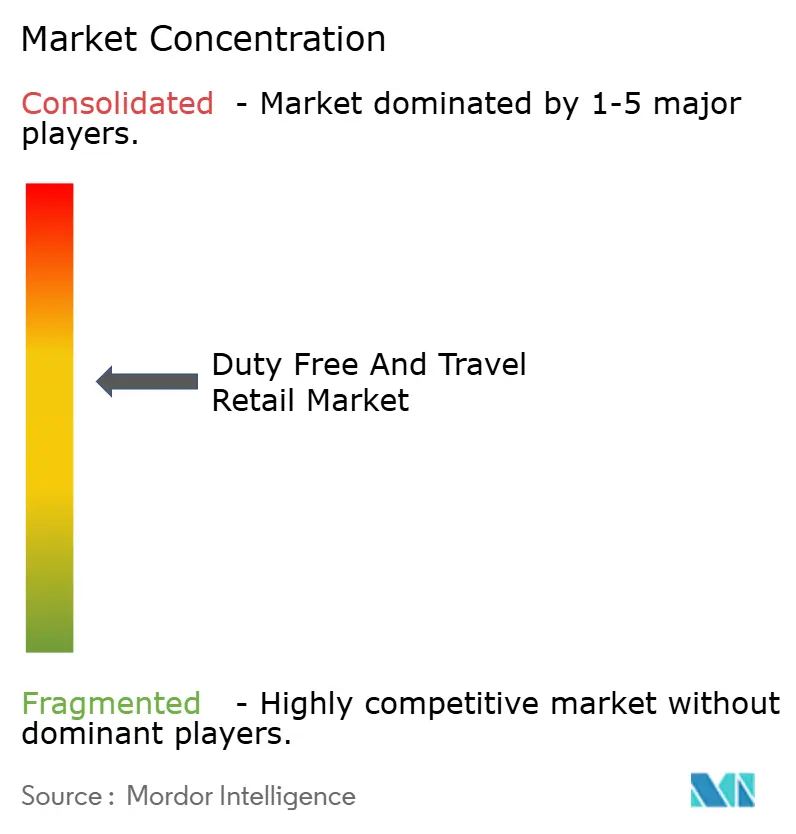
| Market Concentration | Medium |
Major Players *Disclaimer: Major Players sorted in no particular order Image © Mordor Intelligence. Reuse requires attribution under CC BY 4.0. | |
Duty Free And Travel Retail Market Analysis by Mordor Intelligence
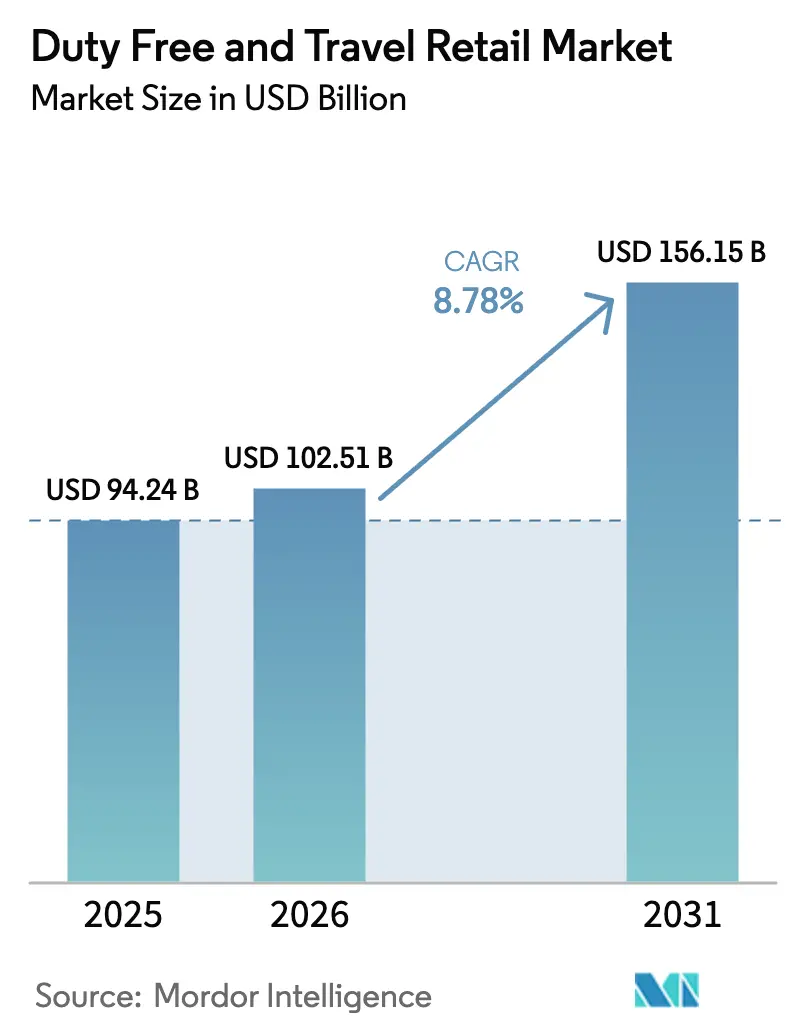
The Duty Free And Travel Retail Market size is projected to be USD 94.24 billion in 2025, USD 102.51 billion in 2026, and reach USD 156.15 billion by 2031, growing at a CAGR of 8.78% from 2026 to 2031.
The expansion outpaces the projected 2.9% global GDP growth for 2026, indicating resilient structural momentum for non-aeronautical retail across aviation, cruise, and cross-border nodes. International tourist arrivals topped 1.1 billion in the first nine months of 2025, up 5% year-over-year and 3% above pre-pandemic levels, which sustains high passenger volumes and improves conversion opportunities for core categories such as beauty and liquor. Airport operators are deepening the pivot toward non-aeronautical revenues, with evidence that Middle East hubs generate more than USD 16 in non-aeronautical income per passenger, well above the global average, underpinned by premium retail investments and strong transfer traffic[1]. Regulatory and commercial models are evolving, as dual-till and hybrid-till regimes spread and risk-sharing contracts sharpen alignment between operators and concessionaires for sustainable growth in the duty-free and travel retail market. Policy-led retail zones are a further tailwind, highlighted by the launch of island-wide special customs operations in Hainan in December 2025 that expanded zero-tariff coverage to most product lines and reinforced the island’s role as an offshore consumption hub.
Key Report Takeaways
- By product type, perfumes and cosmetics led with a 35.74% share in the duty-free and travel retail market in 2025; fashion and accessories are projected to expand at a 12.87% CAGR to 2031.
- By distribution channel, airport shops held 61.73% share of the duty-free and travel retail market in 2025, while e-commerce and omnichannel pre-order are forecast to grow at a 12.74% CAGR through 2031.
- By price range, premium and luxury captured 49.36% of the duty-free and travel retail market in 2025 and are expected to grow at a 7.76% CAGR to 2031.
- By consumer profile, leisure travellers accounted for 58.87% of the duty-free and travel retail market in 2025, while millennial and Gen Z leisure cohorts are projected to advance at a 10.87% CAGR through 2031.
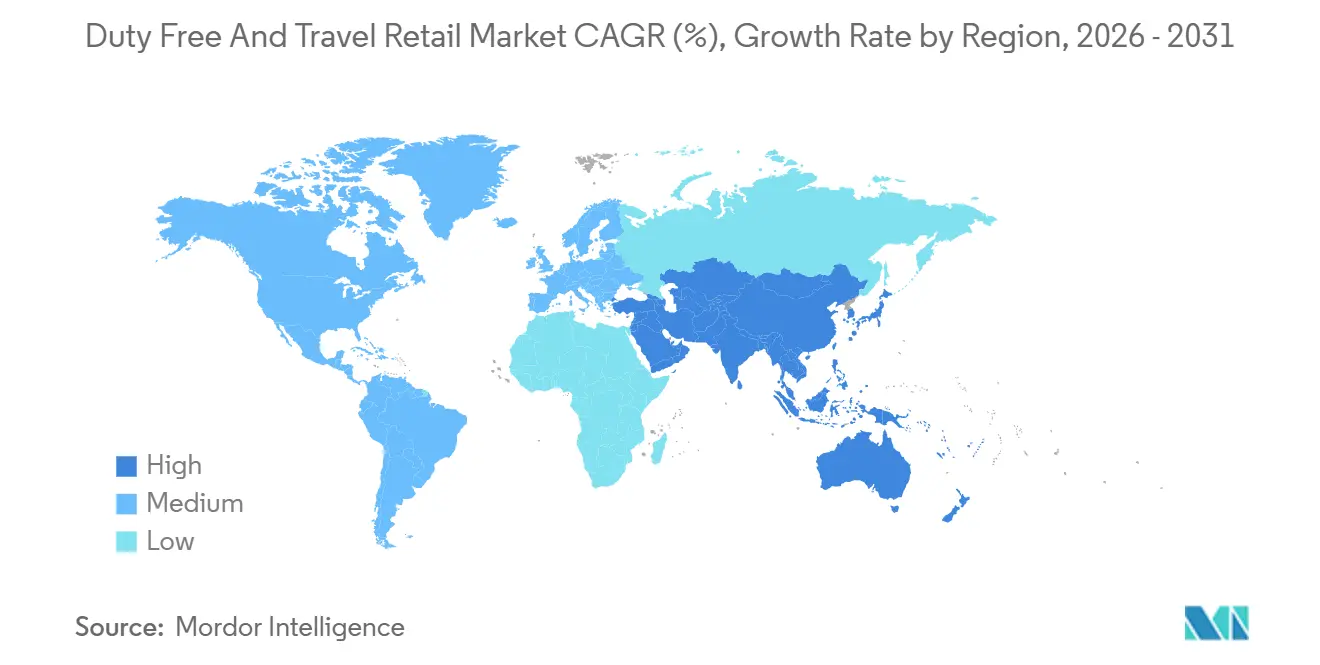
- By geography, Asia-Pacific led with 56.84% of the duty-free and travel retail market in 2025, and the Middle East is projected to record a 9.85% CAGR through 2031.
Note: Market size and forecast figures in this report are generated using Mordor Intelligence’s proprietary estimation framework, updated with the latest available data and insights as of January 2026.
Market Trends and Insights
Drivers Impact Analysis of Duty Free And Travel Retail Market*
| Driver | (~) % Impact on CAGR Forecast | Geographic Relevance | Impact Timeline |
|---|---|---|---|
| Expansion of offshore duty-free zones and free-trade islands is boosting shopper footfall | +1.8% | Global, with early gains in Hainan, Singapore, and pilot concepts discussed in parts of the GCC | Medium term (2-4 years) |
| Airport privatization and non-aeronautical revenue focus on expanding retail floor plates | +1.5% | North America, Europe, India, the Middle East | Medium term (2-4 years) |
| Recovery of long-haul leisure travel is reviving the fragrance and beauty category spend | +1.4% | Global, strongest in Asia-Pacific, Europe, the Middle East | Short term (≤ 2 years) |
| Rise of omnichannel pre-order and click-and-collect elevating conversion rates | +1.2% | Global core, spreading in Asia-Pacific and South America, early adoption in North America and Europe | Medium term (2-4 years) |
| Premiumization trend in duty-free liquor targeting millennial traveller segments | +1.0% | Middle East, Asia-Pacific, North America | Medium term (2-4 years) |
| Introduction of arrival-hall duty-free formats, unlocking incremental purchases | +0.9% | Middle East, Asia Pacific, and selective European adoption | Medium term (2-4 years) |
| Source: Mordor Intelligence | |||
Expansion of Offshore Duty-Free Zones and Free-Trade Islands Boosting Shopper Footfall
Hainan’s shift to island-wide special customs operations in December 2025 materially broadened zero-tariff eligibility and simplified logistics, which strengthens its role as a policy-driven retail destination and encourages luxury and premium brands to scale presence on the island. The move institutionalizes a durable value proposition for travellers and residents, supporting higher visit frequency and deeper baskets as more product categories become eligible under the free-trade framework[2]. Complementary rules on value-added processing pave the way for selective local finishing and assembly, which further integrates retail, logistics, and light manufacturing within a single consumption hub. The policy architecture signals to other tourism economies that calibrated tariff and customs settings can unlock incremental demand in the duty-free and travel retail market. As travel flows normalize, these free-trade retail models broaden category choice, price ladders, and promotional flexibility while maintaining regulatory guardrails. The ripple effect is a positive cycle where higher footfall attracts more brands and store investments, which in turn improve shopper experience and conversion in the duty-free and travel retail market.
Recovery of Long-Haul Leisure Travel Reviving Fragrance and Beauty Category Spend
International travel demand now exceeds pre-pandemic levels, with 1.1 billion arrivals in the first nine months of 2025 and a 5% year-on-year uplift, indicating sustained support for cross-border shopping propensity[3]. Long-haul routes linking Asia-Pacific, Europe, and the Middle East hubs are particularly supportive for categories like beauty and fashion that benefit from destination and transfer shopping patterns. Airports and operators have responded with refined category adjacencies and traveller segment targeting, including more localized assortments that align with origin markets and travel purpose. Several leading hubs reported strong 2025 retail months that coincided with peak travel waves, underscoring how recovered capacity and stable schedules translate into retail throughput in the duty-free and travel retail market. The net effect is renewed momentum for perfumes and cosmetics in airport retail, strengthened by a greater focus on high-conversion merchandising and targeted activations.
Premiumization Trend in Duty-Free Liquor Targeting Millennial Traveler Segments
Premium and super-premium spirits continue to gain space within airport assortments, reflecting trading-up behaviour among frequent international travellers and the appeal of exclusive travel retail editions. Operators are prioritizing high-margin, storytelling-led offerings, with in-store tasting and education that support mix upgrades and higher per-passenger yields. The strategy aligns with broader non-aeronautical revenue objectives, as premiumization improves gross profit per square foot even with steady penetration rates. Suppliers and operators report that curated exclusives and limited editions encourage pre-order and early trip planning, which increases conversion and reduces price-only comparisons in the duty-free and travel retail market. Hubs with larger luxury footprints and high transfer shares are well placed to scale these initiatives due to deeper exposure to long-haul demand and premium travellers. These dynamics sustain a favourable mix shift in wines and spirits across the forecast period.
Introduction of Arrival-Hall Duty-Free Formats Unlocking Incremental Purchases
Arrival shops capture demand from travellers who did not purchase at departure or onboard, including time-constrained passengers and those preferring to avoid carrying goods through security. Where regulations permit, these formats add capacity and reduce congestion in departures, while enabling assortments tuned to local allowances and traveller profiles. Operators emphasize simplified pickup flows, visible wayfinding, and quick-service counters to raise throughput and capitalize on short dwell windows. The commercial logic is to convert post-flight downtime into incremental spend that complements departures without cannibalization in the duty-free and travel retail market. Regulatory diversity across jurisdictions requires localized compliance and agile inventory planning, yet the model remains attractive for hubs seeking to lift non-aeronautical revenue share.
Restraints Impact Analysis of Duty Free And Travel Retail Market*
| Restraint | (~) % Impact on CAGR Forecast | Geographic Relevance | Impact Timeline |
|---|---|---|---|
| Progressive plain packaging and marketing curbs on tobacco products are shrinking margins | -1.3% | Global, notably Australia, the European Union, the United Kingdom, Saudi Arabia, the Middle East | Long term (≥ 4 years) |
| Currency volatility in emerging tourism economies is eroding the perceived price advantage | -0.9% | Emerging markets in South America, Asia-Pacific, and Africa | Short term (≤ 2 years) |
| Lengthening security and immigration wait times reduce passenger dwell time for shopping | -0.7% | North America, Europe, and the Asia-Pacific hubs with capacity constraints | Medium term (2-4 years) |
| Ingredient-specific regulatory bans are narrowing cosmetics and sunscreen assortments | -0.5% | European Union, the United Kingdom, North America, and parts of Asia | Medium term (2-4 years) |
| Source: Mordor Intelligence | |||
Progressive Plain-Packaging and Marketing Curbs on Tobacco Products Shrinking Margins
Regulatory momentum on tobacco control has strengthened worldwide under the WHO Framework Convention on Tobacco Control, which does not exempt duty-free channels from core measures like health warnings and marketing curbs. Packaging restrictions reduce brand-led differentiation at the point of sale and compress premium tiers, shifting price competition toward value formats and alternative nicotine products. WHO and regional health bodies report continued expansion of tobacco control coverage, raising compliance requirements for operators and suppliers in the duty-free and travel retail market. These measures also constrain promotional levers in-store, impacting category visibility and speed of new product introductions in regulated jurisdictions. Retailers are responding by focusing on compliant shopper communication, supply chain integrity, and careful allocation of shelf space across tobacco and non-tobacco alternatives. Over the long term, cumulative policy effects point to lower growth from traditional tobacco, encouraging a mix shift toward higher-margin categories in the duty-free and travel retail market.
Currency Volatility in Emerging Tourism Economies Eroding Perceived Price Advantage
Exchange rate movements can quickly alter perceived value for cross-border shoppers, especially for higher-ticket categories priced in hard currencies. Volatile currency episodes reduce purchasing power for outbound travellers from impacted economies and heighten sensitivity to promotional pricing and instalment options. Policy reports on foreign exchange dynamics among major trading partners emphasize the spillovers of monetary tightening and capital flows on currency stability, which feeds into consumer sentiment and discretionary spending patterns. Operator responses include flexible pricing windows, curated assortments by origin market, and enhanced acceptance of digital payment methods to lower friction at checkout. These measures aim to preserve conversion rates during volatility shocks and protect the growth trajectory of the duty-free and travel retail market.
*Our forecasts treat driver/restraint impacts as directional, not additive. The impact forecasts reflect baseline growth, mix effects, and variable interactions.
Duty Free And Travel Retail Market Segment Analysis
By Product Type:
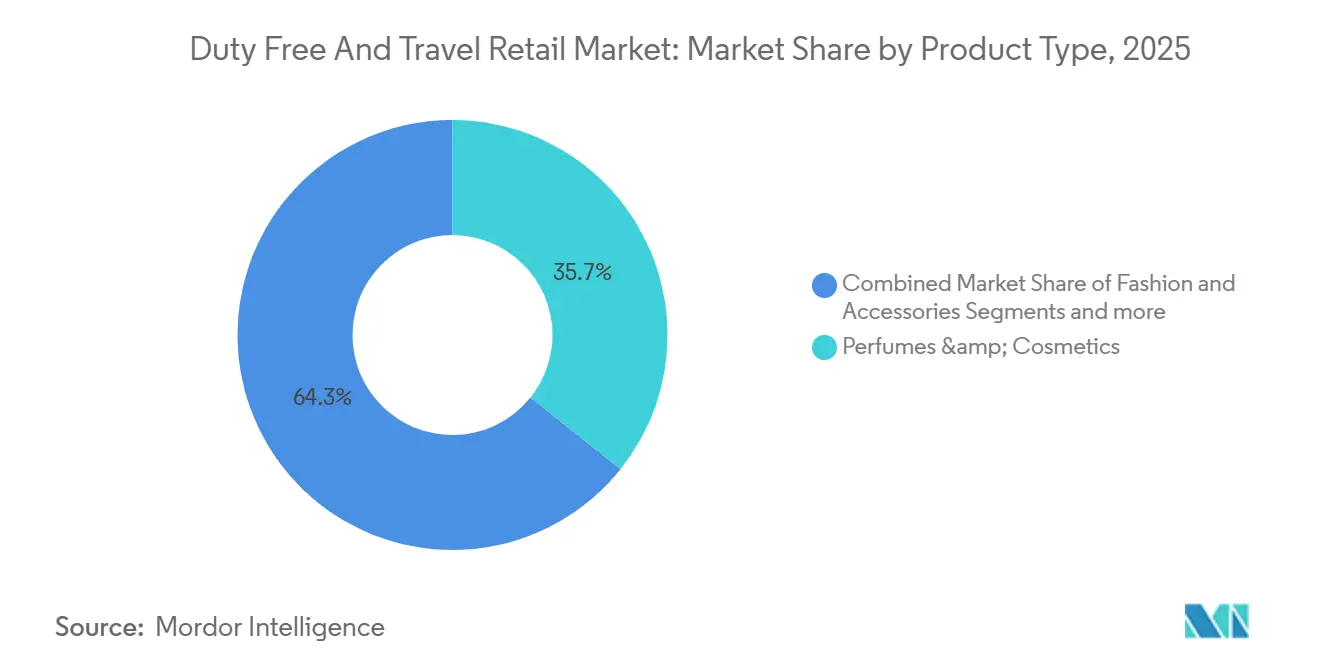
Luxury and Fashion Surge Amid Beauty ConsolidationPerfumes and cosmetics accounted for 35.74% of the duty free and travel retail market share in 2025, reflecting the category’s centrality to traffic-driven retail and the crossover appeal of prestige beauty among international travellers. The duty free and travel retail market is benefiting from the return of long-haul itineraries, which typically convert at higher rates in beauty, supported by brand activations and curated gifting assortments that fit travel occasions. Beauty operators continue to refine space planning and staff training to lift per-passenger yield while aligning stock depth to peaks in holiday travel. Adjacencies with fashion accessories and watches provide a pathway to multi-category baskets as hubs expand experiential zones. With core traffic drivers normalizing, the category mix in the duty free and travel retail market is anchored by beauty leadership and rising premiumization.
Fashion and accessories are the fastest-growing product group, set to expand at a 12.87% CAGR through 2031, supported by luxury-led concepts and curated assortments that include small leather goods, sunglasses, and selective pre-owned formats where permitted. Wines and spirits are capturing mix upgrades through storytelling-led promotions and exclusives that raise average selling price without sacrificing volume, a strategy reinforced by operator focus on non-aeronautical yield per square foot. Tobacco faces structural headwinds as regulatory controls broaden, which shifts emphasis toward compliant merchandising and careful space allocation while favouring growth in alternative categories. Confectionery and fine foods leverage sense-of-place and localized gifting, which sustain impulse conversion close to gates and in arrivals stores. Electronics and gadgets contribute steady traffic with device and accessory refresh cycles that align with travel timing in the duty free and travel retail market.

By Distribution Channel:
Omnichannel Platforms Reshape Traditional Airport DominanceAirport shops held 61.73% share of the duty free and travel retail market size in 2025, reflecting the central role of airside locations as the primary interface for international shoppers. The scale and visibility of airport stores allow operators to orchestrate category adjacencies, brand takeovers, and cross-promotions that lift conversion as dwell time stabilizes. Leading operators continue to invest in digital infrastructure and store automation that compress checkout times and unlock staff bandwidth for higher-touch selling. As traffic and schedules normalize, airports benefit from higher predictability in peaks, supporting better inventory planning and targeted promotions in the duty free and travel retail market. Meanwhile, curated arrivals concepts were permitted to add incremental capacity and convenience for inbound passengers.
E-commerce and omnichannel pre-order are the fastest-growing channels, advancing at a 12.74% CAGR through 2031 as digital journeys move upstream into trip planning and seat selection. Loyalty-driven personalization and real-time inventory visibility are key levers, as seen in programs that report higher average transaction values and repeat purchase behaviour among enrolled travellers. Airport-branded sites and partner platforms enable reserved pickup and upsell at collection points, improving conversion and reducing basket abandonment. Smart lockers and click-and-collect remove friction for time-sensitive passengers while creating new touchpoints for cross-selling. Onboard programs are incorporating pre-order integrations, but scale remains anchored in airport and omnichannel flows in the duty free and travel retail market.
By Price Range:
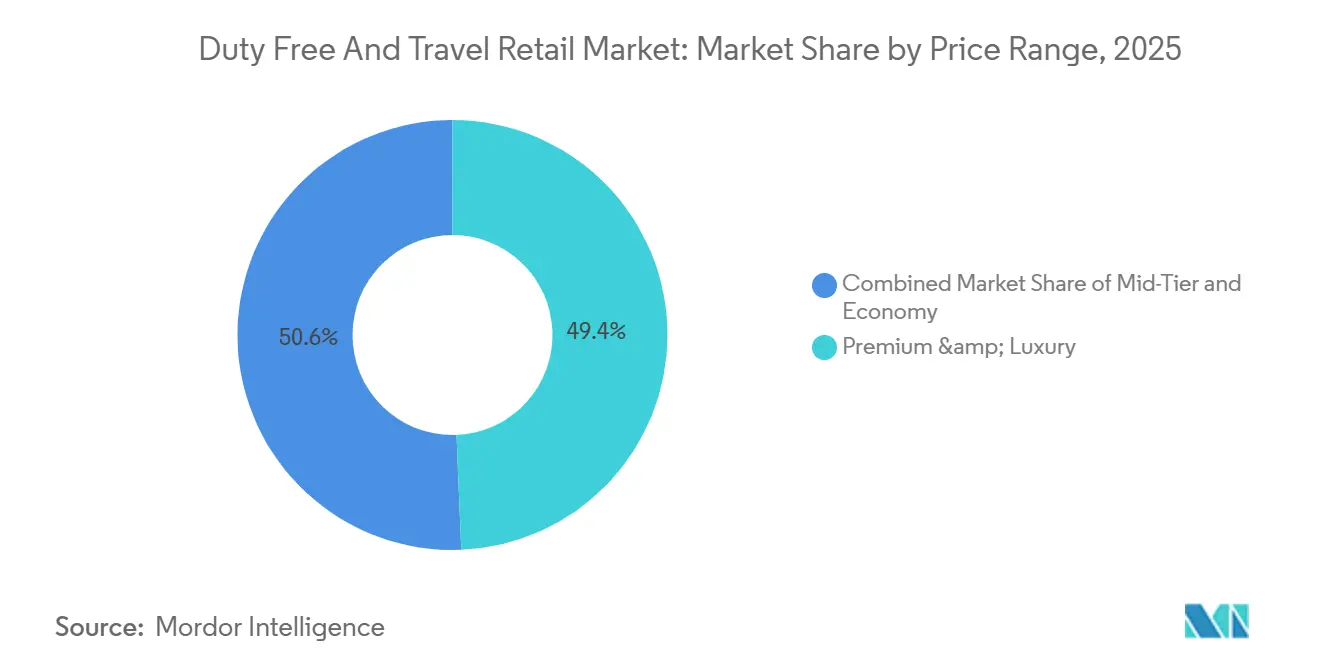
Premium Segment Dominates as Accessible Luxury Gains TractionThe premium and luxury segment captured 49.36% of duty free and travel retail market share in 2025 and is projected to grow at a 7.76% CAGR through 2031, supported by trading-up behaviour and more immersive brand storytelling at key hubs. Operators are recalibrating mix to emphasize premium skincare, niche fragrances, and higher-age-statement spirits, supported by exclusive editions that differentiate airport assortments. This premium tilt lifts per-square-foot margins even when penetration remains stable, amplifying the commercial contribution to airport non-aeronautical revenue. Accessible luxury strategies are expanding to capture aspirational shoppers who respond to entry-price hero products and limited-time offers. The combined effect is a balanced price ladder that supports both volume and value in the duty free and travel retail market.
Mid-tier lines supply dependable volume and respond well to bundle pricing and destination-led gifting, especially in confectionery and beauty sets. Economy price points remain essential for convenience and grab-and-go formats, and they reinforce footfall into multi-category areas near gates. Across tiers, brand-led experiences, sampling, and rapid checkout play a central role in raising conversion among time-poor passengers. Store design improvements, lighting, and digital screens aid navigation and improve basket composition across budgets. These tactics protect category health while premium-led strategies continue to drive the duty free and travel retail market.
By Consumer Profile:
Leisure Dominance Masks Millennial AccelerationLeisure travellers accounted for 58.87% of the duty free and travel retail market in 2025, reflecting the recovery of vacation itineraries and the strong appeal of duty-free gifting and self-treat purchases in cross-border journeys. International arrivals remain on an upward trajectory, which sustains spend opportunities tied to holiday timing and destination retail. Business travellers, while smaller in volume, contribute higher trip frequency and elite lounge access, which can funnel spend to luxury and premium categories. VFR and expat shoppers anchor stable gifting patterns aligned with cultural events and family milestones. These behavioural anchors help stabilize conversion across seasons in the duty free and travel retail market.
Millennial and Gen Z leisure cohorts are the fastest-growing subsegment, with the profile advancing at a 10.87% CAGR to 2031 on stronger digital engagement and appetite for premium experiences. Operators are leaning into loyalty, push notifications, and pre-order prompts to capture intent before departure, tailoring offers to route, language, and brand affinity. Personalization and quick fulfilment resonate with these cohorts, who often prioritize convenience and exclusivity in travel shopping. Senior travellers also contribute meaningfully where accessibility, service, and clear wayfinding are emphasized. The combined targeting raises participation across diverse profiles in the duty free and travel retail market.
Geography Analysis
APAC Duty Free and Travel Retail Market
Asia-Pacific captured 56.84% of the duty free and travel retail market size in 2025, supported by large aviation corridors and policy innovations that elevate offshore consumption. Hainan’s special customs regime is reinforcing the island’s position as an offshore shopping destination by expanding zero-tariff coverage and streamlining customs, which sustains shopper footfall and broadens category appeal. Regional hubs continue to invest in terminal enhancements and digital journeys, adding capacity and improving retail adjacency. As travel rebalances, Japan, Korea, and Southeast Asia corridors offer resilient demand for beauty, fashion, and luxury gifting. These pillars reinforce Asia-Pacific’s scale advantage in the duty free and travel retail market.
Middle East Duty Free and Travel Retail Market
The Middle East is the fastest-growing region with a projected 9.85% CAGR through 2031, buoyed by capacity expansions and luxury-led retail propositions at mega-hubs. Operators are focusing on high-margin categories, curated exclusives, and loyalty at scale to maximize spend from transfer-heavy traffic. Several airports have reported strong 2025 retail months aligned with robust long-haul flows, illustrating how consistent connectivity translates into retail throughput. Investments in store upgrades, wayfinding, and quick-service checkouts are designed to preserve conversion as security processes evolve. These factors add momentum to the duty free and travel retail market in the region.
Europe, the Americas and Africa Duty Free and Travel Retail Market
Europe and North America remain critical through their large hub networks and steady adoption of omnichannel pre-order that deepens engagement beyond the gate. Strategic concessions in leading European airports are increasing retail square footage and refreshing offer architecture, which supports improved yield per passenger. In North America, airport authorities and operators are aligning on digital-first store concepts and flexible layouts that support rapid category pivots as travel patterns shift. South America and Africa show rising contributions as concessions expand and store networks grow at primary gateways, aided by global operators’ entry and investment. These developments broaden the footprint and resilience of the duty free and travel retail market.
Regulatory Landscape
Duty-free and travel retail is governed by a patchwork of customs, VAT/excise, and consumer-product rules that vary by border format (airports, seaports, downtown/border stores) and by jurisdiction. In Asia, policy moves are expanding formal duty-free capacity and refining tax-refund administration: China authorized 41 new arrival duty-free shops at ports in January 2026 and later optimized departure tax refund measures in May 2026, followed by a nationwide transition to paperless departure tax refund documentation in July 2026. The changes raise the compliance bar for POS data capture, invoice integrity, and interface readiness between retailers and customs platforms.
In Europe and other mature travel markets, customs and public health frameworks continue to shape category economics and operating models. In March 2026, EU institutions reached an informal deal on reform of the Union Customs Code, including creation of a new EU Customs Authority (planned for Lille, France), reinforcing centralized, data-driven oversight for cross-border goods flows. Tobacco controls under the WHO Framework Convention on Tobacco Control continue to pressure duty-free tobacco merchandising globally, and the EU also advanced changes to low-value import treatment in 2026, requiring retailers and platforms with cross-border fulfillment to adapt import and duty calculation processes and related customer communications.
Value Chain Analysis
The value chain in duty-free and travel retail begins with brand owners and authorized distributors supplying travel retail-specific and domestic SKUs, including exclusives. Cross-border logistics then move product execution through bonded warehouses and in-terminal bonded stores. Airport and port authorities (and, in some cases, government duty-free licensing bodies) set concession frameworks and commercial terms, while travel retail operators run merchandising, staffing, digital pre-order, and in-store execution across airports, cruise and seaport, rail, and border or downtown nodes. Specialist logistics partners and consolidators support regulated movement and storage, including bonded warehousing, order consolidation, and multi-modal delivery into secure zones, with companies such as GEODIS and Duty Free Dynamics positioned around warehousing and distribution services for multi-airport networks.
Value creation concentrates in concession access and execution capabilities, including tendering and contract design (often with risk-sharing), category and space optimization, and omnichannel journeys that shift demand upstream in trip planning through reserve-and-collect and pre-order. Bottlenecks tend to cluster around demand volatility and compliance complexity, including excise and VAT handling, product traceability, and stock availability during peak waves. Operators and airports are tightening data-sharing and automation, using tools such as electronic shelf labels and centralized planning. Partnerships that integrate warehousing and last-meter delivery into terminals, for example GEODIS expansions supporting Lagardere Travel Retail at London Heathrow and Auckland, reflect a push to improve service levels under regulated constraints.
Competitive Landscape
The duty free and travel retail market remains moderately consolidated, featuring global leaders and specialized regional players that compete for multi-year concessions across airports, cruise, and cross-border locations. Avolta’s 2024 performance included 6.3% organic growth in core turnover, underpinned by a larger program of digital upgrades, loyalty expansion, and self-checkout deployments that improve conversion and labour productivity[4]. The company’s strategy emphasizes targeted bolt-on wins, disciplined capital allocation, and a data platform designed to sharpen assortment and pricing decisions at store level. Lagardère Travel Retail secured a 10-year contract to operate duty free at London Luton Airport starting in 2026, with a significant expansion in commercial space that will refresh category adjacencies and brand representation. Gebr. Heinemann reported a strong rebound in 2024 turnover and outlined store network expansions that build on partnerships across Europe, the Middle East, and Africa.
Operators are differentiating through loyalty depth, store automation, and supply chain agility that preserve availability under variable schedules. The largest players are accelerating omnichannel flows that bring pre-order upstream, offering product reservation, targeted promotions, and fast pickup with an aim to lift basket size and repeat rates. Infrastructure-led partners seek to optimize non-aeronautical revenue with design, signage, and dwell management that directs passengers into high-conversion zones. Strengthening collaboration between airports and concessionaires is visible in contracts that incorporate hybrid revenue-sharing mechanisms aligned to traffic scenarios in the duty free and travel retail market. These approaches spread risk and support investment in store fit-outs and digital integrations.
Strategic moves in 2025 favoured bids that combine duty free, specialty retail, and foodservice expertise to deliver integrated experiences aligned to airport brand and passenger mix. Companies highlighted targeted store redesigns, improved category adjacency, and more flexible merchandising to adapt to evolving regulations and traveller preferences. Data and analytics remain core to daily operations, from forecasting and inventory optimization to price elasticities and targeted offers by route and traveller cohort. As operators refine portfolio balance across airports, seaports, and border formats, multichannel capabilities will continue to distinguish leaders in the duty free and travel retail market. Competitive intensity should remain high given the weight of global tenders and the importance of long-term contracts.
Duty Free And Travel Retail Industry Leaders
-
Avolta AG (Dufry)
-
China Duty Free Group Co. Ltd.
-
Lagardère Travel Retail
-
DFS Group (LVMH)
-
Lotte Duty Free
- *Disclaimer: Major Players sorted in no particular order
Duty Free And Travel Retail Market Companies Covered in this Report
- Avolta AG (Dufry)
- China Duty Free Group Co. Ltd.
- Lagardère Travel Retail
- DFS Group (LVMH)
- Lotte Duty Free
- Dubai Duty Free
- Heinemann SE & Co. KG
- Qatar Duty Free
- King Power International (Thailand)
- Aer Rianta International
- 3Sixty Duty Free
- Flemingo International
- WHSmith Travel
- Shilla Duty Free
- Bahrain Duty Free
- Duty Free Americas
- Delhi Duty Free
- JR/Duty Free (Australia)
- Beirut Duty Free
- Nuance Group
- Mumbai Travel Retail
- London Heathrow – World Duty Free
- Alpha Airport Shopping
- Qatar Airways In-flight Retail
- ANA Trading Duty Free
Market Opportunities and Future Outlook
Whitespace is forming where policy expansion, new airport capacity, and omnichannel infrastructure intersect. China is a clear example of policy-led retail zone scale-up, with December 2025 island-wide special customs operations in Hainan broadening zero-tariff eligibility, and 2026 actions expanding arrival duty-free shop authorizations and shifting tax-refund processing toward paperless workflows. These changes create room for retailers and brands that can operationalize compliant data capture, integrate tax-refund processes, and tailor assortments for arrivals formats, particularly in high-throughput hubs where arrivals duty-free is permitted.
Concession wins and M&A are also reshaping where operators can add footprint and capability. Lagardere AWPL secured dual 10-year concessions totaling 3,100 sq m at Western Sydney International Airport in March 2026, and Avolta signed an agreement in June 2026 to acquire DFS Okinawa, marking entry into Japanese travel retail. Digital and fulfillment upgrades are moving from front-end pre-order into back-end automation, illustrated by Shinsegae Duty Free partnering with LG Electronics in March 2026 on AI-powered logistics and automated fulfillment. Together, these developments point to opportunities around hybrid formats (retail plus food and beverage), higher-speed fulfillment such as click-and-collect, lockers, and arrivals pickup, and data-led assortment and staffing models that help protect conversion as dwell-time pressures persist.
Recent Industry Developments in Duty Free And Travel Retail Market
- June 2026: Avolta entered an agreement to acquire 100% of DFS Okinawa, marking its entry into the Japanese travel retail market, with closing targeted for Q3 2026. The deal broadens Avolta's Asia-Pacific footprint and adds a Japan-based operating platform that can be used to scale brand partnerships and omnichannel execution across airports and other travel nodes.
- October 2025: Lagardere Travel Retail won a 10-year duty free concession at London Luton Airport starting in November 2026, including a substantial increase in retail space and a refreshed commercial proposition. The long-duration award strengthens Lagardere's position in a major UK gateway and signals ongoing airport emphasis on non-aeronautical revenue through upgraded retail environments.
- May 2024: Avolta reported 2024 organic growth in core turnover and highlighted an operating program focused on digital upgrades, loyalty expansion, and self-checkout deployments. The ongoing rollout supports higher conversion and labor productivity in airport shops, reinforcing omnichannel and automation as central levers in competitive tenders.
Duty Free And Travel Retail Market Report Scope and Research Methodology
Market Definition and Coverage
This market covers retail sales made to travelers in controlled travel environments where goods are sold as duty-free or travel retail, and the purchase is linked to a trip and proof of travel for export or transit.
Scope exclusions: Domestic duty-paid travel convenience retail and inflight catering services are excluded from the market totals.
Segments Covered in This Report
- By Product Type
- Perfumes & Cosmetics
- Wines & Spirits
- Fashion & Accessories
- Tobacco Products
- Confectionery & Fine Foods
- Electronics & Gadgets
- By Distribution Channel
- Airport Shops
- On-board Aircraft
- Seaport & Cruise Line Stores
- Border & Downtown Duty-Free
- Railway Stations
- E-commerce / Omnichannel Pre-order
- By Price Range
- Premium & Luxury
- Mid-tier
- Economy
- By Consumer Profile
- Leisure Travelers
- Business Travelers
- VFR & Expat Shoppers
- By Geography
- North America
- United States
- Canada
- Mexico
- South America
- Brazil
- Peru
- Chile
- Argentina
- Rest of South America
- Europe
- United Kingdom
- Germany
- France
- Spain
- Italy
- BENELUX (Belgium, Netherlands, Luxembourg)
- NORDICS (Denmark, Finland, Iceland, Norway, Sweden)
- Rest of Europe
- Asia-Pacific
- India
- China
- Japan
- Australia
- South Korea
- South-East Asia (Singapore, Malaysia, Thailand, Indonesia, Vietnam, Philippines)
- Rest of Asia-Pacific
- Middle East and Africa
- United Arab Emirates
- Saudi Arabia
- South Africa
- Nigeria
- Rest of Middle East and Africa
- North America
Data Sources, Market Sizing, and Validation
Desk Research
Desk research begins by mapping the travel and retail demand context, so the model is not driven by a single datapoint. We use public travel flows and capacity signals from sources such as IATA updates, ICAO datasets, UNWTO tourism indicators, and airport operator traffic releases, then align them with trade and price context using UN Comtrade and national statistics offices.
To keep the retail side grounded, we also review annual reports and investor presentations from listed travel retail operators and airport groups, plus trade association publications and reputable press coverage on passenger recovery and duty-free policy shifts. In parallel, a few paid subscriptions are used only where they add structure, such as company financials and intelligence, import and export shipment-level databases, and patent databases for packaging, authentication, and store tech signals. These are illustrative sources only, and many other public references were used to collect data, validate assumptions, and clarify unclear points.
Primary Interviews and Surveys
Primary discussions are used to convert passenger and travel indicators into realistic retail conversion and spend assumptions, and then to sanity-check category mix and channel mix. We speak with a mix of travel retailers, airport commercial teams, brand principals, distributors, and logistics partners across APAC, EMEA, and the Americas, so regional recovery patterns and route mix do not get averaged away.
Distribution of primary research fieldwork respondents
| Company type | Respondent position | Region |
|---|---|---|
| Top tier: 31% | CXOs: 16% | APAC: 47% |
| Mid tier: 50% | Functional/Unit leaders: 28% | EMEA: 35% |
| Smaller Players: 19% | Managers: 56% | Americas: 18% |
Market-Sizing & Forecasting
Sizing starts with a top-down build where passenger volumes, international share, and airport and border traffic are translated into an addressable traveler pool, then into spend using region-specific conversion rates and average ticket values gathered from interviews. After that demand pool is built, we corroborate it with selective bottom-up checks such as sampled sales-per-passenger ranges, retailer revenue splits where disclosed, and channel checks on airport versus downtown duty-free contribution.
Inputs used in the model include international passenger volumes, route and hub mix shifts, concession intensity at airports (space and tenanting direction), category mix changes in key baskets like beauty, alcohol, tobacco, and fashion, and FX and price inflation effects on average spend per trip. For forecasting, scenario analysis is applied around travel recovery pace, capacity additions, and policy changes that affect duty-free eligibility, and assumptions are tightened using consensus ranges from primary experts. Where bottom-up signals are missing for smaller channels, gaps are handled by applying conservative ranges tied to passenger throughput and observed sales-per-traveler benchmarks, which keeps totals reproducible.
Data Validation & Update Cycle
Outputs are checked against independent signals such as regional passenger recovery, airport commercial revenue direction, and reported retailer performance trends, then variances are investigated before sign-off. If a number moves sharply, the assumptions that drive it are revisited, and experts are re-contacted to confirm whether the change is real or model-driven.
Each report is refreshed annually, with interim updates when material events occur, such as major travel disruptions, policy changes on allowances, or step changes in international capacity. Before delivery, a final analyst pass is completed so clients get the latest view with consistent definitions and comparable year-on-year logic.
Mordor Intelligence's Duty Free and Travel Retail Market Sizing Compared With Other Published Estimates
Published numbers for duty-free and travel retail can look far apart, even when they are describing the same broad idea. The gaps typically come from what is counted as travel retail versus general retail, which channels are included, and whether the year's passenger mix and FX timing were refreshed.
Inflight catering services sit outside Mordor Intelligence's scope, which removes food and beverage service revenues that can appear in onboard retail tallies. Differences also show up when an estimate focuses only on airport duty-free, applies a single global spend-per-passenger assumption, or carries forward pre-shift category mix without re-validating conversion rates and ticket sizes by region.
Benchmark comparison
| Source | Market Size | Gaps in Research Methodology |
|---|---|---|
| Mordor Intelligence | USD 94.24 B (2025) | |
| Industry Data Portal A | USD 76.80 B (2025) | Often presented as global sales tracking and may treat travel retail more narrowly, with heavier reliance on reported sales snapshots and less explicit normalization for channel coverage beyond the most visible locations. |
| Trade Release B | USD 58.90 B (2024) | The figure is framed as duty-free only and anchored to a single year, which can undercount duty-paid travel retail formats and does not always explain how downtown, border, rail, and pre-order sales are handled. |
Taken together, the spread mainly reflects scope and channel coverage, not just growth expectations. When passenger-throughput signals are translated into a traveler demand pool and then checked using realistic conversion and spend ranges by region, the resulting total stays traceable to clear inputs and can be repeated in future refresh cycles.
Key Questions Answered in the Report
What is the duty free and travel retail market size and projected growth to 2031?
The duty free and travel retail market size is USD 102.51 billion in 2026 and is forecast to reach USD 156.15 billion by 2031 at an 8.78% CAGR, supported by resilient international travel and a higher non-aeronautical revenue focus.
Which product categories are leading and growing fastest in duty free and travel retail?
Perfumes and cosmetics led with 35.74% share in 2025, while fashion and accessories are the fastest-growing category with a 12.87% CAGR through 2031, aided by premium and curated assortments.
Which channels are gaining share in duty free and travel retail?
Airport shops remain the largest channel with 61.73% share in 2025, while e-commerce and omnichannel pre-order are the fastest-growing channels with a 12.74% CAGR as digital journeys expand.
Which regions drive the most value in duty free and travel retail?
Asia-Pacific accounted for 56.84% in 2025 due to large traffic corridors and policy-led retail zones, while the Middle East is the fastest-growing region with a 9.85% CAGR on capacity expansions and premium retail focus.
Which consumer profiles contribute most to duty free and travel retail demand?
Leisure travellers accounted for 58.87% in 2025, and millennial and Gen Z leisure cohorts are advancing at a 10.87% CAGR as omnichannel engagement and premium experiences lift conversion.
What are the key risks to duty free and travel retail growth through 2031?
The main risks are regulatory tightening in tobacco and beauty, currency volatility affecting perceived price advantage, and dwell-time pressure from security and immigration queues, which operators are addressing through design, digital, and operational initiatives.