
Fragrance and Perfume Market Size and Share
Fragrance and Perfume Market Analysis by Mordor Intelligence
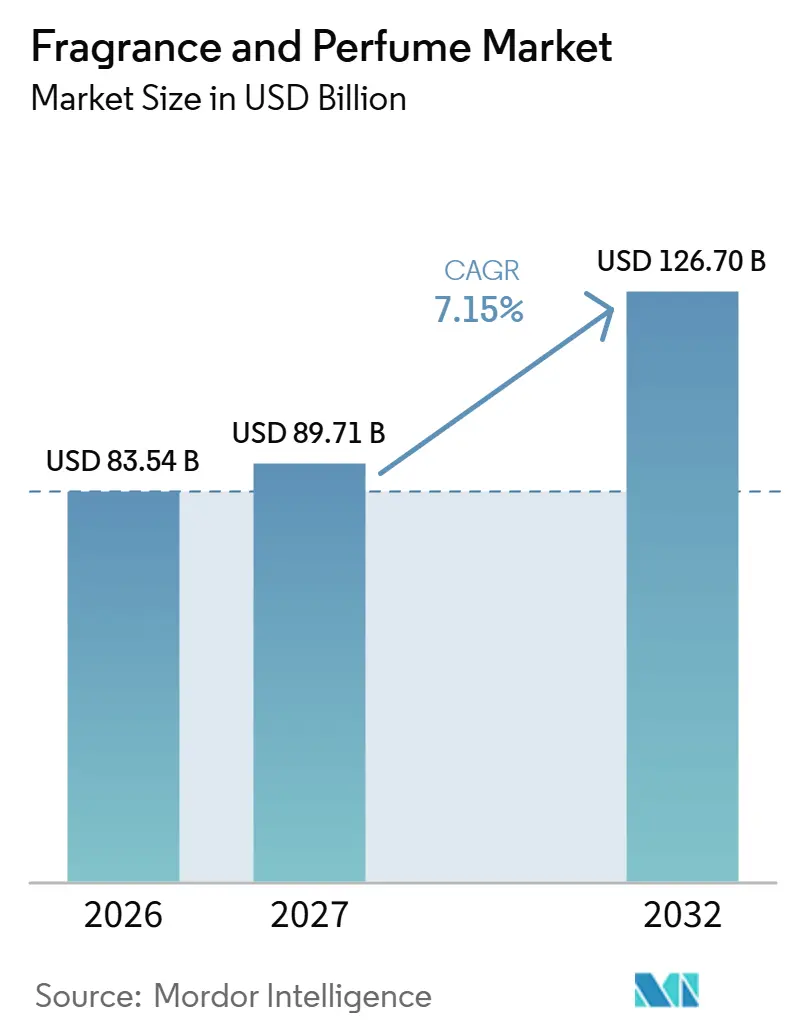
The Fragrance And Perfume Market size was valued at USD 83.54 billion in 2026 and is estimated to grow from USD 89.71 billion in 2027 to reach USD 126.70 billion by 2032, at a CAGR of 7.15% during the forecast period (2027-2032).
Luxury product renewal, niche awareness and social discovery create opportunities to expand fragrance demand. In the United States, digital discovery offers a route to introduce an eau de parfum before a buyer reaches the fragrance counter. Counterfeit and grey-market competition can divert spending from authorized distributors, while fragrance sensitivity constrains use and allergen labeling conditions access to EU retail. Houses expanding through acquisitions or licenses must develop finished perfumes and compliant labels together, turning additional brand rights into fragrances that retailers can offer to the buyers attracted by discovery.
Key Report Takeaways
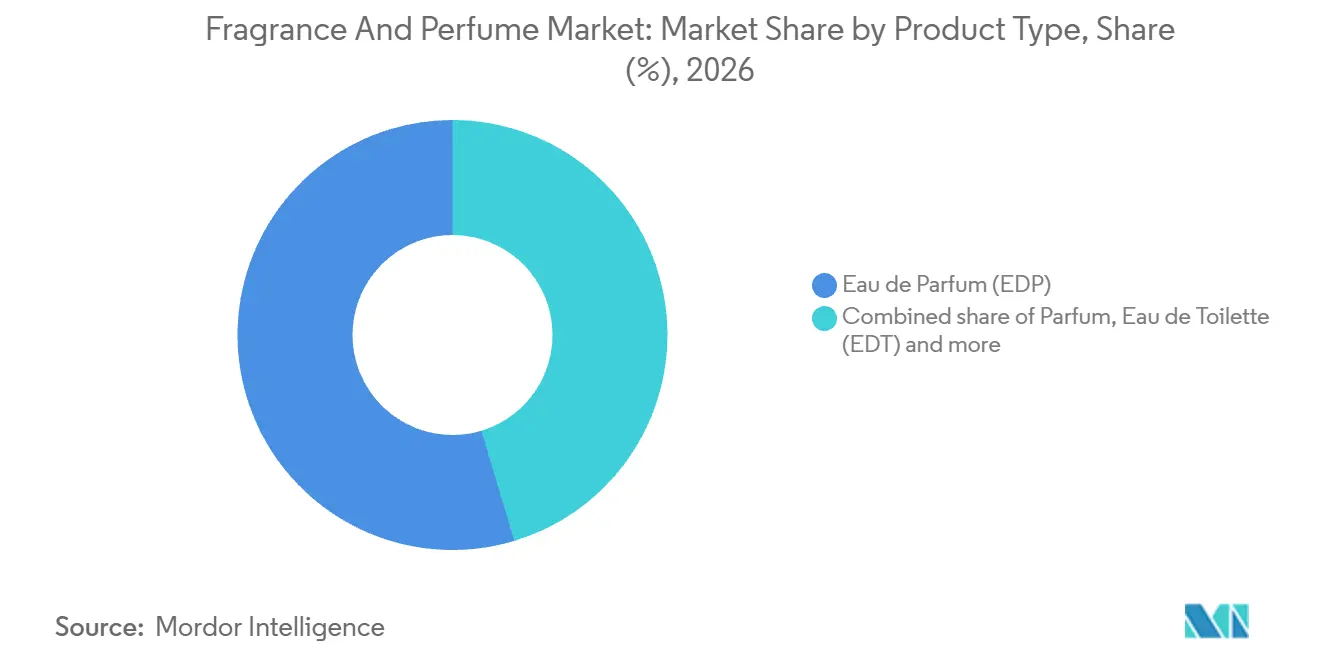
- By product type, eau de parfum (EDP) held a 54.65% fragrance and perfume market share in 2026, while parfum is forecast to be the fastest-growing segment with an 8.1% CAGR over 2027-2032.
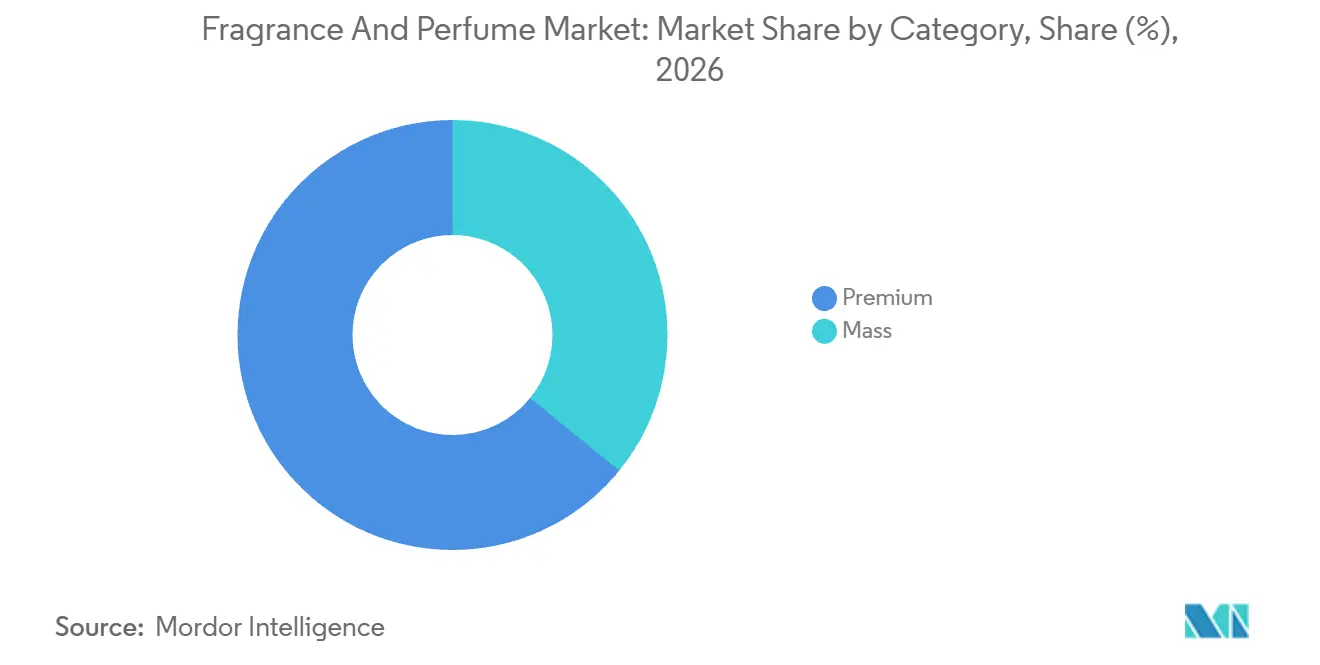
- The premium category accounted for a 64.13% share of the fragrance and perfume market size in 2026 and is projected to grow fastest, with an 8% CAGR over 2027-2032.
- Among end users, women led with a 55.79% share in 2026, while men are forecast to be the fastest-growing segment with an 8.6% CAGR over 2027-2032.
- Distribution through specialty stores represented 42.58% of sales in 2026, and online retail stores are expected to grow fastest with a 9% CAGR over 2027-2032.
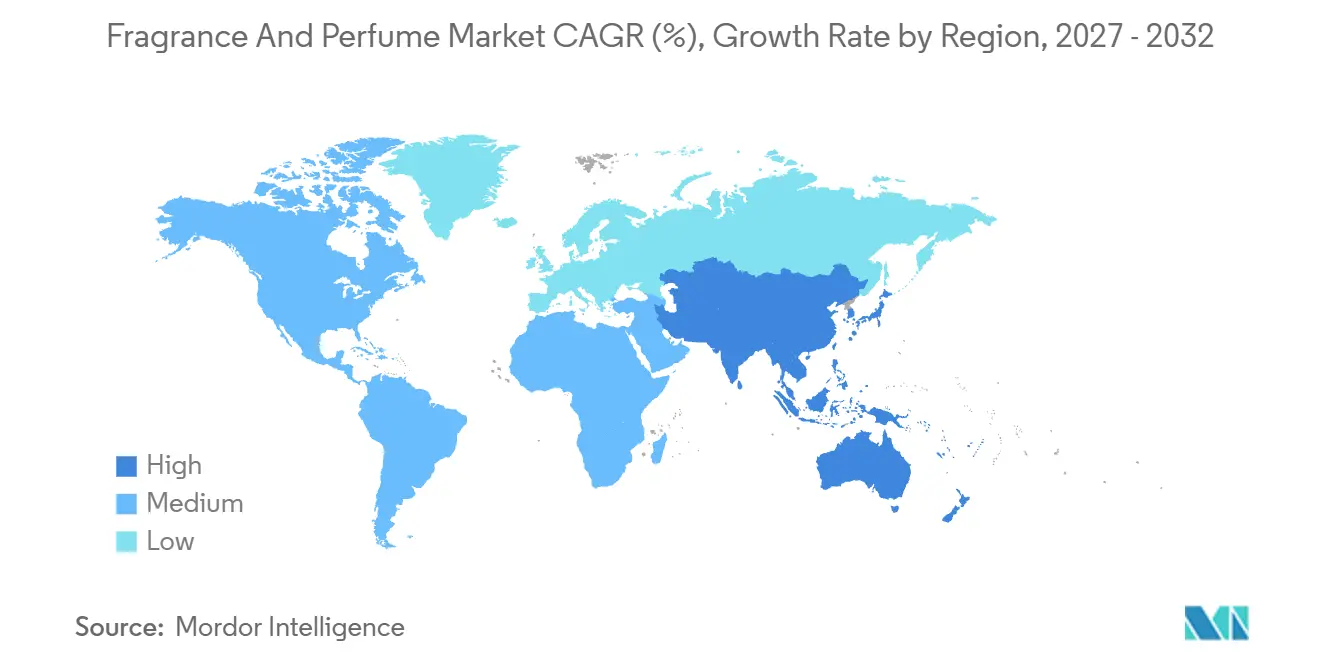
- Across geographies, North America held a 45.86% share in 2026, while Asia-Pacific is forecast to record the fastest growth with a 9.8% CAGR over 2027-2032.
Note: Market numbers in this report are based on Mordor Intelligence's proprietary estimation framework, which combines nine months of actuals with Q4 projections for base year 2026.
Market Trends and Insights
Drivers Impact Analysis of Fragrance and Perfume Market*
| Driver | (~) % Impact on CAGR Forecast | Geographic Relevance | Impact Timeline |
|---|---|---|---|
| Shift toward natural, clean-label, and sustainable fragrance formulations | +1.5% | North America, Europe and Asia-Pacific | Long term (≥ 4 years) |
| Growing demand for niche, artisanal, and bespoke fragrances | +1.8% | North America, Europe and Asia-Pacific | Medium term (2-4 years) |
| Social media influence and celebrity-led brand collaborations | +1.6% | North America, Europe and Asia-Pacific | Short term (≤ 2 years) |
| Premiumization and rising demand for luxury fragrance offerings | +2.1% | North America, Europe and Asia-Pacific | Short term (≤ 2 years) |
| Expansion of e-commerce and direct-to-consumer fragrance platforms | +1.2% | United States and Canada | Medium term (2-4 years) |
| Increasing focus on personal grooming, self-expression, and experiential consumption | +0.5% | The Kingdom of Thailand | Medium term (2-4 years) |
| Source: Mordor Intelligence | |||
Shift toward natural, clean-label, and sustainable fragrance formulations
A natural or clean-label fragrance relies on suppliers that can document where its raw materials come from. Givaudan, a fragrance and flavor supplier, reported that the responsibly sourced share of its natural raw-material portfolio spend rose from 85% in 2024 to 87% in 2025.[1] At the supplier level, that higher share can help brands substantiate sourcing claims when developing natural formulations. Where buyers value responsible sourcing, a substantiated claim can give them an additional reason to select a finished perfume. Givaudan's 2-percentage-point rise in responsibly sourced natural spend shows that such documentation is expanding at the supplier level, which is the upstream condition for brands to market natural formulations with a sourcing story.
Growing demand for niche, artisanal, and bespoke fragrances
In 2025, dsm-firmenich said rising awareness of niche brands was fueling fragrance demand and increasing consumption among younger generations, particularly Gen Z.[2] That mechanism gives smaller fragrance houses an opening to compete through a recognizable composition before achieving the name recognition of established designer labels. For retailers serving these buyers, a distinctive selection can therefore contribute to demand creation rather than merely redistribute purchases among familiar perfumes. The commercial challenge is to make the scent difference understandable without treating niche, artisanal production and bespoke formulation as interchangeable promises. For a niche house choosing retail partners, access to younger fragrance users fits this demand mechanism better than broad coverage that does little to build brand awareness.
Social media influence and celebrity-led brand collaborations
Digital discovery can put a perfume into consideration before a buyer encounters it at a fragrance counter. In its 2025 market discussion, dsm-firmenich identified social media platforms such as TikTok as a force fueling fragrance demand. In April 2026, Vogue reported that Orebella's Jasmine Blues parfum had week-one sales more than double those of previous releases, with Bella Hadid leading the brand as founder and chief creative officer. The commercial value depends on connecting that initial interest to a way of evaluating the fragrance, since awareness alone does not resolve the scent choice. Jasmine Blues, described in that report as the brand's most successful fragrance debut to date, shows that a founder-led house can raise first-week demand well above its earlier releases.
Premiumization and rising demand for luxury fragrance offerings
A luxury fragrance can increase the commercial value of a brand's perfume offer through a new scent proposition as well as its price position. CHANEL Limited, the Chanel group's parent, reported 2025 fragrance growth supported by CHANCE EAU SPLENDIDE. The company describes its fragrances as luxury products, and this was its first new women's fragrance in 8 years. That result gives a concrete example of product renewal supporting the fragrance business within a luxury group. For a perfume house, the opportunity is to give an established identity another reason to be considered while preserving a distinct place for the new scent. Chanel's new scent supported fragrance growth alongside new ranges such as BLEU DE CHANEL L'EXCLUSIF in 2025, showing launch renewal and range extension occurring together.
Restraints Impact Analysis of Fragrance and Perfume Market*
| Restraint | (~) % Impact on CAGR Forecast | Geographic Relevance | Impact Timeline |
|---|---|---|---|
| Rising penetration of counterfeit and grey-market fragrances | -0.7% | Hong Kong and Macau | Short term (≤ 2 years) |
| Heightened consumer concerns over synthetic and allergenic ingredients | -0.6% | North America, Europe and Asia-Pacific | Medium term (2-4 years) |
| Supply chain volatility impacting availability of key aroma chemicals and naturals | -0.4% | North America, Europe and Asia-Pacific | Long term (≥ 4 years) |
| Increasingly stringent ingredient safety, disclosure, and labeling regulations | -0.3% | The European Union | Short term (≤ 2 years) |
| Source: Mordor Intelligence | |||
Rising penetration of counterfeit and grey-market fragrances
Lower-priced parallel imports and counterfeits can constrain a fragrance distributor's ability to retain customers at its intended selling price. Eternal Beauty Holdings Limited's June 2025 prospectus described this risk as of June 10, 2025, for its multicategory distribution business in China, including Hong Kong and Macau. It warned that, if a significant number of customers chose lower-priced parallel imports or counterfeit products, its sales could suffer. That risk differs from competition between fragrance compositions because products bearing the brands it distributes may reach customers through a competing route. Even a successful brand launch could leave the authorized distributor with weaker sales if lower-priced competing routes capture the resulting customer interest.
Heightened consumer concerns over synthetic and allergenic ingredients
For buyers who experience fragrance sensitivity, avoiding exposure can take precedence over choosing a preferred scent. An international survey conducted in 2024-2025 studied self-described fragrance-sensitive people reached through targeted distribution. Its authors reported that avoiding perfume, other fragrances and volatile compounds was the only strategy that worked for all. A reformulated or reassuringly labeled perfume would still require exposure to the product category these respondents seek to avoid. For fragrance sellers, increasing assortment within a scented range cannot by itself remove this obstacle to reaching that particular group of potential users.
*Our forecasts treat driver/restraint impacts as directional, not additive. The impact forecasts reflect baseline growth, mix effects, and variable interactions.
Fragrance and Perfume Market Segment Analysis
By Product Type:
EDP Scale And Parfum DifferentiationEau de parfum (EDP) accounted for a 54.65% share of the fragrance and perfume market size in 2026. Circana reported that EDP value sales grew 15.8% in Spain's selective men's fragrance segment in 2025 versus 2024. This spending growth gives an EDP supplier a concrete reason to defend its presence in that selective channel, where the format attracted additional revenue. Circana added that the Spanish selective men's segment was shifting toward higher concentrations while eau de toilette sales kept declining, placing EDP on the growing side of that concentration shift.
Parfum is expected to be the fastest-growing segment, with an 8.1% CAGR over 2027-2032. In France's selective fragrance channel, sales of extrait and other high-concentration perfumes rose 18% in Q1 2025 versus Q1 2024. That grouped result supports a concentration-led selling opportunity in selective retail, where a parfum interpretation competes with other concentrated perfumes for spending. A producer choosing a parfum launch must make its particular composition worth selecting within that growing group, since concentration alone does not distinguish the product from the alternatives measured alongside it.



By Category:
Premium Growth Through Distinct FranchisesPremium fragrances represented a 64.13% fragrance and perfume market share in 2026 and are forecast to be the fastest-growing segment, with an 8% CAGR over 2027-2032. L'Oréal SA reported double-digit global fragrance growth within its Luxe division in the first half of 2026. For a diversified luxury operator, a growing fragrance business creates an expansion route that can be developed independently of its other beauty categories. That makes fragrance a candidate for dedicated growth investment within the luxury division, with resources tied to perfume demand rather than spread evenly across its beauty activities.
The Estée Lauder Companies Inc. reported 10% organic growth in fragrance net sales for the fiscal year ended June 30, 2026, driven primarily by double-digit growth from its Luxury Brands. Le Labo, TOM FORD and KILIAN PARIS led that growth, with the company reporting increases across brands and all geographic regions. This breadth provides several brand-specific routes to fragrance demand, making the premium offer less dependent on a single scent identity or national market.

By End User:
Established Franchises And Distinct UsesFragrances positioned for women accounted for 55.79% of sales in 2026, making women the largest end-user segment. In its half-year 2026 results, L'Oréal SA said Yves Saint Laurent Libre had become the world's number one women's fragrance. In Europe in 2025, L'Oréal said Libre, La Vie est Belle and Paradoxe held the top 3 positions in female fragrances. Challengers competing beside Libre must justify retail attention against a franchise already carrying a company-reported global leadership position.
Men's fragrances are projected to be the fastest-growing end-user segment, with an 8.6% CAGR over 2027-2032. Circana data showed U.S. men's fragrance sales grew 7% in dollars and 3% in units in the first half of 2026. Dollar sales outpacing units means that unit expansion alone cannot explain the revenue gain. In a survey conducted October 13-21, 2025, 55% of French men aged 18-25 said they wore perfume more often than 5 years earlier. For suppliers, the French frequency shift creates an opening for everyday-use propositions alongside the unit-sales expansion measured in the United States.
By Distribution Channel:
Store Discovery And Online ExecutionSpecialty stores held a 42.58% share in 2026, making them the largest distribution segment. At Sephora, fragrance ranked third by sales volume in 2025 and showed the strongest momentum among its beauty categories. LVMH linked that momentum to innovations and new applications, including mists and fragrance layering. A specialty assortment can therefore make it possible to compare scent identities alongside different ways of using fragrance within a personal routine. A specialty retailer can develop a broader fragrance basket by presenting mists and layering as additions to a routine, rather than substitutes for its existing perfume offer.
Online retail stores are forecast to be the fastest-growing segment, with a 9% CAGR over 2027-2032. In France, Interparfums reported 19% growth in its own online sales in 2025 versus 2024. At the end of 2025, the company generated 21% of its sales online. Interparfums' 21% online share compares with a 17% French market average, so its sales lean further toward the channel where French online sales rose 12% in 2025 while in-store sales fell more than 5%.
Geography Analysis
North America Fragrance And Perfume Market
North America accounted for a 45.86% share of the fragrance and perfume market size in 2026. The United States imported perfumes and toilet waters valued at USD 5.23 billion in 2025. In June 2026, Shoppers Drug Mart and L'Oréal Canada announced a multi-brand refill offer including Lancôme Idôle, Giorgio Armani Acqua di Giò and Prada Paradoxe at selected BeautyBOUTIQUE stores in 16 Canadian cities. The import value shows the scale of finished-fragrance supply entering the United States, and the Canadian refill launch shows a retailer adding a service around scents buyers have already chosen.
Asia-Pacific Fragrance And Perfume Market
Asia-Pacific is projected to be the fastest-growing region, with a 9.8% CAGR over 2027-2032. Puig Brands SA's multicategory Asia-Pacific net revenue rose 20.9% like-for-like in the first half of 2026. The company attributed that growth to robust performance across niche fragrances and continued strong consumer demand across the region, while also reporting strong makeup performance. For fragrance suppliers, this points to a commercial opening in serving niche portfolios within a broader beauty business. A supplier pursuing that opening needs niche franchises with their own regional demand, because the makeup performance Puig also reported is a separate source of the same revenue growth.
In Europe, Interparfums' Western European sales rose 5% in 2025, particularly in the United Kingdom and Spain. In South America, the company attributed a good 2025 to expanded Lacoste fragrance distribution and increased Coach fragrance business. In 2025, Arab News quoted Rasasi Perfumes head of marketing Talha Kalsekar describing fragrance as part of daily Gulf rituals, including welcoming guests and post-shower layering. Within the Middle East and Africa, Saudi Arabia's cosmetics guidance classifies qualifying body-perfuming products as cosmetics, subject to limits on medicinal ingredients, therapeutic claims, significant physiological effects and disease-treatment presentation. Additional retail reach does not change the Saudi cosmetic-claims boundary, so distribution expansion cannot substitute for a compliant perfume proposition.
Mordor Intelligence provides coverage of the fragrance and perfume market across other key regional markets, including Middle East, each with their regulatory frameworks and demand patterns.
Regulatory Framework and Outlook
This comparison assesses selected jurisdictions for small compliant manufacturers of finished personal perfumes, including producers eligible for an artisanal pathway. Market access can require manufacturing authorization, product documentation or notification, with duties assigned separately to manufacturers, facility operators and responsible persons. Distinguishing current obligations, scheduled standards and planned rulemaking establishes the preparation horizon for bringing a fragrance offer to each country.
Regulatory Table of Fragrance and Perfume Market
| Decision factor | United States | Germany | China | Brazil | Saudi Arabia |
|---|---|---|---|---|---|
| Primary authority | Food and Drug Administration (FDA) | Competent state and local cosmetics surveillance authorities | National Medical Products Administration (NMPA) and local drug-supervision departments | Anvisa | Saudi Food and Drug Authority |
| Key instruments or direction | 21 U.S.C. § 364c facility registration and product listing; fragrance-allergen disclosure proposal scheduled for November 2026 | Regulation (EC) No 1223/2009 safety assessment, product information file and notification; Regulation (EU) 2023/1545 covered-allergen labels | Manufacturing licensing, quality and traceability requirements; mandatory GB 7916-2026 effective January 1, 2028 | RDC 907/2024; artisanal RDC 1.045/2026 and IN 474/2026 | SFDA.CO/GSO 1943 safety requirements and applicable technical and ingredient controls |
| Commercial effect | Nonexempt facility owners or operators register and renew biennially; responsible persons list products and ingredients and update annually; qualifying small businesses have conditional exemptions | Covered-allergen placement restrictions applied from 31 July 2026; qualifying previously placed stock may remain available until 31 July 2028 | Licensed production requires quality and traceability systems; the revised safety baseline starts January 1, 2028 | Brazilian responsible company notifies ordinary perfume; qualifying artisanal registration and notification exemptions are scheduled 60 days after October 5, 2026, subject to specified rules | Body-perfuming cosmetics must meet safety requirements and applicable ingredient controls |
| Current policy attractiveness | Medium | Medium | Medium | High | Medium |
| Future direction of policy attractiveness | Hardening | Hardening | Hardening | Easing | No change |
| Source: Mordor Intelligence | |||||
The US Medium rating reflects recurring facility-registration and product-listing duties and conditional exemptions, while FDA's agenda schedules an allergen-disclosure proposal for November 2026. Germany's documentation burden and China's licensed-production requirements support Medium ratings, with Hardening tied to the July 2028 stock deadline and January 2028 safety transition, respectively. Brazil's simplified notification supports High attractiveness, and the published artisanal exemptions support Easing for qualifying producers while specified technical and safety conditions continue. Saudi Arabia's Medium rating and No change direction reflect its continuing cosmetics safety framework and maintained ingredient controls, with the 2025 prohibited-list addition treated as an existing duty.
Value Chain Stages
This value chain compares fragrance creation, finished-product manufacturing and the routes that bring a branded scent to its final buyer. Chanel opened a new fragrance manufacturing facility in France in February 2026.[3] That investment places production capability within the brand owner's operations, while the distinction between supplying a fragrance composition and selling a finished perfume creates separate sources of revenue and exposure to disruption.
Value Chain Analysis Table of Fragrance and Perfume Market
| Primary activity | Key participants | Value capture | Bottleneck | Resilience response |
|---|---|---|---|---|
| Fragrance creation and ingredient supply | Business-to-business fragrance creators and suppliers such as Givaudan | Fragrance composition and compound sales | Preserving the intended composition when inputs change | Qualify alternative ingredients against the intended scent |
| Finished-fragrance manufacturing | Brand manufacturers such as Puig Brands SA and Chanel | Sales of finished branded fragrances | Raw-material shortages can interrupt production | Link sourcing agreements to production sequencing |
| Distribution and final sale | Integrated brand sellers such as Puig Brands SA, using owned shops and brand e-commerce alongside third-party channels | Retail and direct online sales | Coordinating owned and third-party routes | Assign distinct channel offers and fulfillment responsibilities |
| Source: Mordor Intelligence | ||||
Across its business, Puig uses supplier assessments and long-term sourcing agreements, while identifying raw-material shortages as a risk that can stop production lines. This makes continuity of qualified inputs consequential even for a company that owns manufacturing capacity. The practical resilience advantage comes from preparing a usable input alternative before a shortage stops fragrance production, so brand-owned capacity can keep supporting finished-product sales.
Competitive Landscape
Market Concentration
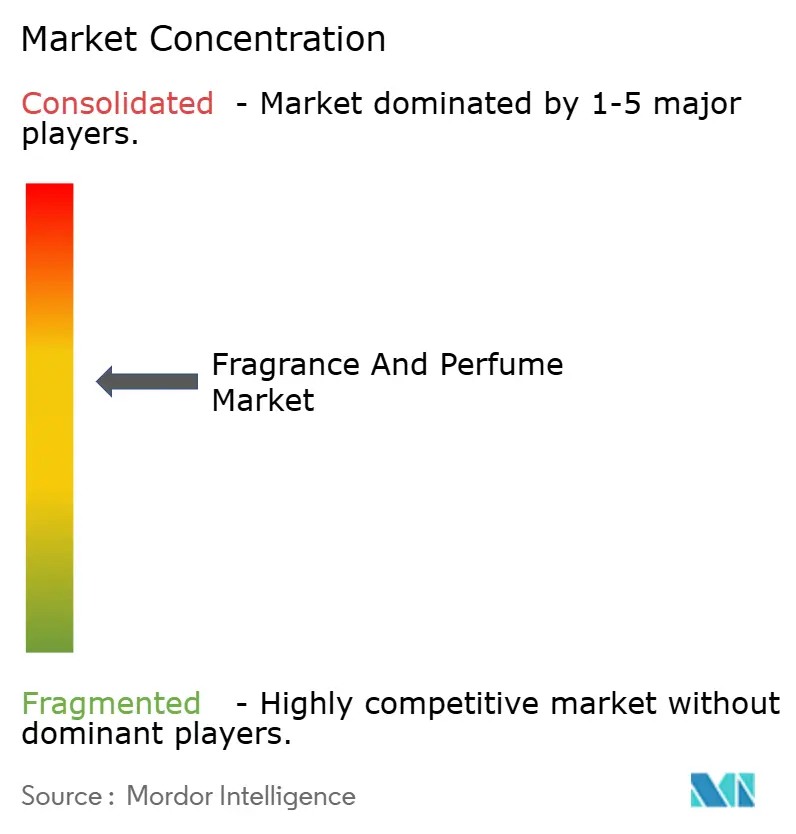
Competition is moderately consolidated around multi-brand beauty groups and established houses, including Coty Inc., Chanel SA, The Estée Lauder Companies Inc., L'Oréal SA and LVMH Moët Hennessy Louis Vuitton SE. Coty's Prestige division, which includes fragrance, cosmetics and skincare, recorded a 4% like-for-like net-revenue decline in the fiscal year ended June 30, 2026. That division generated USD 3.81 billion in net revenues, 66% of Coty's total sales. A fragrance specialist competes against these multicategory portfolios through individual franchises rather than group breadth, so franchise-level strength is the more direct gauge of perfume position.
On March 31, 2026, L'Oréal SA completed its acquisition of Kering Beauté, including the House of Creed, from Kering SA. The companies also signed 50-year exclusive licenses for the creation, development and distribution of fragrance and beauty products under Bottega Veneta and Balenciaga. Owning a fragrance house and licensing designer brands secure different commercial assets that can be managed within a shared luxury beauty portfolio. Retailers can gain a broader set of potential scent propositions through one commercial relationship, while challengers face the separate tasks of securing a product identity and a route to distribution.
Le Labo, owned by The Estée Lauder Companies Inc., added 90 points of distribution in fiscal 2025, including flagships in Beijing and Seoul and expansion in Brazil. Flagship stores can create physical opportunities to encounter a scent franchise, making access to the product a competitive asset alongside brand ownership. Newly placed EU cosmetics, including perfumes, require individual labeling of covered fragrance allergens above specified thresholds. For challengers entering EU retail, the barrier is combining a distinctive composition with product-specific ingredient documentation and an effective route to the shelf. A narrower initial EU range lets a challenger concentrate labeling work on fewer perfumes while building the retail presence needed to sell them.
Fragrance and Perfume Industry Leaders
-
Coty Inc.
-
Chanel SA
-
The Estée Lauder Companies Inc.
-
L'Oréal SA
-
LVMH Moët Hennessy Louis Vuitton SE
- *Disclaimer: Major Players sorted in no particular order
Fragrance and Perfume Market Companies Covered in this Report
- Chanel SA
- The Estée Lauder Companies Inc.
- LVMH Moët Hennessy Louis Vuitton SE
- Coty Inc.
- L'Oréal SA
- Puig Brands SA
- Shiseido Company Limited
- Natura Cosméticos S.A.
- Interparfums Inc.
- Hermès International SCA
- Revlon Group Holdings LLC
- Mary Kay Inc.
- Oriflame Holding AG
- Bath & Body Works Inc.
- Amorepacific Corporation
- Beiersdorf AG
- Ajmal Perfumes LLC
- Arabian Oud Co
- Swiss Arabian Perfume Group
- Kering SA
Key Opportunities for Market Participants
These opportunities compare new refill offers, additional delivery routes and compliant finished-fragrance supply. A refill offer reaches only the stores that carry it, so buyers' access depends on how far its rollout extends. That makes geographic coverage a distinct commercial decision when developing the service beyond its initial retail locations.
Market Opportunities Table of Fragrance and Perfume Market
| Opportunity | Why now | Buyer / lead segment | Recommended play | Main barrier | Likely beneficiaries |
|---|---|---|---|---|---|
| New perfume-refill offers in Canada | Multi-brand retail refill offer demonstrated in June 2026 | Canadian owners of refill-compatible fragrances | Develop refill services for eligible finished perfume lines | Matching the fragrance offer to eligible products and proving consumer uptake | Fragrance brands and retailers such as L'Oréal Canada and Shoppers Drug Mart |
| Additional online fragrance delivery routes | Sephora and Uber Eats introduced on-demand beauty delivery, including fragrance, from hundreds of stores in September 2025 | Perfume replenishment buyers in the United States and Canada | Extend finished-perfume availability through additional retail and delivery partnerships | Securing retail partners and validating delivery coverage | Fragrance retailers and delivery operators such as Sephora and Uber Technologies |
| Label-compliant perfume ranges for EU retail | Expanded labeling duty applied from 31 July 2026 for covered allergens above specified thresholds | Retailers sourcing newly placed finished perfumes | Offer product-specific compliant fragrance labels | Maintaining accurate ingredient-level labels across products | Compliant perfume manufacturers |
| Source: Mordor Intelligence | |||||
The central opening is to make replenishment of a familiar perfume easier through services designed around an existing fragrance choice. Shoppers Drug Mart has said customer response will inform whether the fountains reach additional stores, so the refill opening stays contingent on uptake in the 16 launch cities. The named fragrances already on the fountain are the first products to show whether refilling an already chosen scent draws uptake.
Recent Industry Developments in Fragrance and Perfume Market
- Oct 2026: Anvisa published rules on October 5 exempting qualifying artisanal alcohol-based perfumes in Brazil from registration or notification, subject to specified conditions. The changes were scheduled to take effect 60 days after publication.
- Aug 2026: Shiseido Company Limited introduced Max Mara Le Parfum on August 24 through selected retail partners in North America and Europe, the first fragrance developed under its long-term partnership with Max Mara.
- Jul 2026: Coty Inc. agreed to transition the Gucci Beauty license back to Kering SA for about USD 400 million. Coty described the business as a fragrance and beauty operation and was to continue operating it through at least June 30, 2027, with Kering able to request an extension.
Fragrance and Perfume Market Report Scope and Research Methodology
Market Definition and Coverage
The fragrance and perfume market measures annual spending on finished alcohol-based fine fragrances and body mists sold for personal scenting in the global market. It covers sales through retail and business-to-business channels.
Scope exclusions: Air-care products, including room sprays, neat essential oils, bulk aroma chemicals and natural fragrance ingredients, scented candles, and deodorants are excluded.
Segments Covered in This Report
- By Product Type
- Parfum
- Eau de Parfum (EDP)
- Eau de Toilette (EDT)
- Eau de Cologne (EDC)
- Other Product Types
- By Category
- Mass
- Premium
- By End User
- Men
- Women
- Unisex
- By Distribution Channel
- Supermarkets/Hypermarkets
- Specialty Stores
- Online Retail Stores
- Others Distribution Channels
- By Geography
- North America
- United States
- Canada
- Mexico
- Rest of North America
- Europe
- Germany
- United Kingdom
- France
- Spain
- Netherlands
- Italy
- Sweden
- Poland
- Belgium
- Rest of Europe
- Asia-Pacific
- China
- India
- Japan
- Australia
- South Korea
- Indonesia
- Thailand
- SIngapore
- Rest of Asia-Pacific
- South America
- Brazil
- Argentina
- Colombia
- Chile
- Peru
- Rest of South America
- Middle East and Africa
- United Arab Emirates
- South Africa
- Nigeria
- Saudi Arabia
- Egypt
- Morocco
- Turkey
- Rest of Middle East and Africa
- North America
Data Sources, Market Sizing, and Validation
Desk Research
Public research uses sources such as Cosmetics Europe's 2025 market performance data for category sales and exports, World Bank WITS trade tables based on UN Comtrade for perfume and toilet-water flows, the IFRA value-chain description to distinguish ingredients from finished consumer products, and the European Union Cosmetics Regulation for product and market-access context. Because trade codes and broad cosmetics totals represent supporting signals rather than the full defined market, analysts use them as boundary checks rather than direct measures.
Company filings, investor materials, retailer disclosures, and reputable business press can add reported fragrance sales, channel changes, launches, and price or product-mix context for cross-checks. The named sources are not exhaustive, and further sources inform collection, validation and clarification.
Primary Interviews and Surveys
Analysts would interview brand owners, fragrance manufacturers, distributors, specialty and online retailers, and category specialists, with executives and functional leads covering sales, product, channel, and regional conditions. A structured survey can check product, price-tier, end-user, channel, and regional direction, while interviews clarify the meaning of reported revenue and changes in route to market. When evidence is missing or inconsistent, analysts would record the gap, seek a second independent source or respondent, and triangulate reported sales with trade and channel signals before using an estimate.
Distribution of primary research fieldwork respondents
| Company type | Respondent position | Region |
|---|---|---|
| Top tier: 30% | CXOs: 20% | APAC: 38% |
| Mid tier: 45% | Functional/Unit leaders: 35% | EMEA: 32% |
| Smaller Players: 25% | Managers: 45% | Americas: 30% |
Market-Sizing & Forecasting
The global 2027 market would be estimated from a top-down pool of final-buyer spending on finished personal fragrances, then allocated across product type, mass and premium category, end-user positioning, retail channel, and geography using source-reported sales mix and channel or country evidence. Key indicators include fragrance and personal-care retail sales, HS 3303 import values and quantities, company-reported fragrance revenue, and channel and price-tier mix. Retail sales anchor the demand pool, customs flows check cross-border supply and country direction, company results indicate brand-level momentum, and channel or price mix helps distinguish demand growth from trading up.
For 2027-2032, a multivariate regression can relate historical market value to those indicators where comparable time series exist, with scenario analysis used when source coverage or market conditions make a single trend unreliable. Segment shares would follow reported category and regional splits, supplemented by consistent comparisons across company and channel evidence, and would be reconciled to the total. Analysts would selectively test the top-down result with sampled average selling price times estimated units or supplier and channel roll-ups, adjusting for resale so products are counted once. Where prices, units, or channel coverage are missing, they would bound the check with available public data and retain the top-down estimate as the anchor. Primary experts would review the direction and business meaning of forecast drivers at variable level, and unexplained differences would prompt further source checks or a documented range rather than an unsupported point adjustment.
Data Validation & Update Cycle
Retail, company, trade, and channel indicators would be triangulated so that independent signals support the same market direction and segment shares reconcile to the global total. Analysts would flag unusual year-to-year moves, source variances, and possible double counting for analyst review, then trace each anomaly to its definition, period, currency, or channel treatment before sign-off. When a material inconsistency remains, analysts would re-contact a relevant respondent or source owner. They would refresh the model annually, revisit it after material market events, and complete a fresh source and calculation review before delivery.
Mordor Intelligence's Fragrance and Perfume Market Size Versus Other Published Estimates
Published estimates can differ in the transactions and products they count and the inputs used to model demand. The fragrance and perfume market measures annual spending on finished alcohol-based fine fragrances and body mists sold for personal scenting in the global market.
Key Gap Drivers include the study's defined coverage and market-specific modeling choices. Primary experts would review the direction and business meaning of forecast drivers at variable level, and unexplained differences would prompt further source checks or a documented range rather than an unsupported point adjustment.
Benchmark comparison
| Source | Market Size | Gaps in Research Methodology |
|---|---|---|
| Mordor Intelligence | USD 89.71 B (2027) | |
| Global Consultancy A | USD 63.5 B (2026) | At its 2026 base, this estimate is 29.2% below this report's 2027 value of USD 89.71 B, 1 year later. Its one-year-earlier 2026 estimate lists parfum, eau de parfum, eau de toilette, eau de cologne, and eau fraiche, while this report also counts finished body mists and qualifying final business-to-business sales. |
| Global Consultancy B | USD 64.1 B (2026) | At its 2026 base, this estimate is 28.5% below this report's 2027 value of USD 89.71 B, 1 year later. Its one-year-earlier 2026 breakdown reports perfume concentrations and luxury or non-luxury tiers, while this report also counts finished body mists and qualifying final business-to-business sales. |
For Mordor Intelligence, retail, company, trade, and channel indicators would be triangulated so that independent signals support the same market direction and segment shares reconcile to the global total.
Key Questions Answered in the Report
What is the fragrance and perfume market size and growth outlook?
The market is expected to reach USD 89.71 billion in 2027 and USD 126.7 billion by 2032, with a 7.15% CAGR over 2027-2032.
What supports demand for personal fragrances?
Niche-fragrance awareness, luxury product renewal and digital discovery support demand. Premium fragrances held a 64.13% share in 2026.
Which perfume format has the largest share?
Eau de parfum held a 54.65% share in 2026. Parfum is forecast to grow fastest with an 8.1% CAGR over 2027-2032.
Which companies are major competitors in personal fragrance?
Major competitors include Coty Inc., Chanel SA, The Estée Lauder Companies Inc., L'Oréal SA and LVMH Moët Hennessy Louis Vuitton SE.
What can restrict fragrance distributors' sales?
As of June 10, 2025, Eternal Beauty Holdings Limited warned that lower-priced parallel imports or counterfeits could divert customers and hurt sales in its multicategory China distribution business, including Hong Kong and Macau.
Which region leads perfume sales, and where is growth fastest?
North America held a 45.86% share in 2026, while Asia-Pacific is forecast to grow fastest with a 9.8% CAGR over 2027-2032.