Flip over your protein bar, your overnight oats, or that smoothie bowl you paid too much for. If chia is on the label, there’s a better-than-even chance it was grown in one country: Paraguay. Not Central America, where chia was first cultivated. Not the US, where most of it gets eaten. Paraguay now supplies more than half of the world’s chia.
That works fine in a good year. The trouble is, Paraguay hasn’t had a clean one in a while. Weather has hit its chia crop three seasons in a row: a disappointing 2024 harvest, frost in 2025, and a 2026 crop that started dry, sent farmers back out to replant, and then lost about a quarter of its output at harvest.
You’d expect buyers to back off when prices jump. They didn’t. They kept buying and paid more. So for anyone who buys, sells, finances or advises on chia, the useful question isn’t “when will prices calm down?” It’s “why does one field, in one country, keep deciding what everyone pays?”
Executive Summary
The chia seeds shortage isn’t happening because the world can’t grow chia. It’s happening because the world grows most of it in one place and harvests it in one short winter window. As per Mordor Intelligence estimates, Paraguay accounted for about 59% of global chia seed production in 2025, and its weather has dented three crops in a row. Buyers absorbed the hit through price: in Q1 2026, Paraguay’s chia export volume rose 14% while export revenue rose 50%.
Mordor Intelligence sees a wet 2026/27 harvest as the base case, with El Niño likely, which puts quality, not just volume, under pressure. Paraguay has more than doubled its chia fields since 2022/23, but every new hectare sits under the same winter weather, and the structural fix, hardier crops and new growing regions, is at least four years out. The buyers, importers and brands that plan contracts, suppliers and quality checks around Paraguay’s winter will be in a much stronger position at the next shock than those who wait to see how each harvest turns out.
Why Chia Seed Supply Depends on One Country
Picture a city where every bakery buys its flour from one mill, and that mill sits on a flood plain. When the river rises, nobody calls it a flour shortage. Everyone knows it’s a mill problem. Chia seed supply works the same way, except most buyers don’t realize they’re all buying from the same mill.
As per Mordor Intelligence estimates, Paraguay chia production reached about 72,000 metric tons in 2025, around 59% of the global total. Europe takes 38% of Paraguay’s chia exports and North America 35%, according to the Paraguayan Chamber of Chia Exporters (Capachía). So whether your chia lands in Rotterdam or Los Angeles, there’s a good chance it came out of the same fields.
Those fields also run on one clock. In Paraguay, chia is a winter crop harvested in June and July, according to the Paraguayan Chamber of Sesame Exporters (Capexse), and farmers grow it between soybean seasons. One bad frost in that window, and most of the world’s supply for the year is on the line.
Other chia seed producing countries exist, but none comes close. Bolivia and Argentina together add about 30% of global production, and everyone else, from Mexico and Australia to India, Uganda, Kenya and Peru, shares what’s left:
Chia Seed Producing Countries by Share of Production
Share of Global Chia Production by Origin, 2025
| Origin | Planted Area (ha) | Est. Yield (MT/ha) | Est. Production (MT) | Share of Total |
| Paraguay | 180,000 | 0.40 | 72,000 |
~59%
|
| Bolivia | 40,000 | 0.50 | 20,000 |
~16%
|
| Argentina | 35,000 | 0.50 | 17,500 |
~14%
|
| Mexico | 9,000 | 0.40 | 3,600 |
~3%
|
| Australia | 4,000 | 0.80 | 3,200 |
~3%
|
| Others (India, Uganda, Kenya, Peru) | 15,000 | 0.39 | 5,850 |
~5%
|
| Total | 283,000 | — | ~122,150 | 100% |
Source: Mordor Intelligence
Diversification is starting, but slowly. Bolivia planted 22,635 hectares of chia in 2024, according to the Bolivian Information Agency (ABI), as cited in Mordor Intelligence’s South America Chia Seeds Market report. India’s chia push in Nagpur covered around 500 acres across 12 talukas, as reported in April 2026 by the district’s Agricultural Technology Management Agency and cited in Mordor Intelligence’s Chia Seeds Market report.
Three Chia Seed Harvests, Three Weather Hits
One bad chia seed harvest is bad luck. Here’s how the last three went:
- 2024: The harvest fell short of expected yields because of the weather, Capexse said, though higher prices softened the blow for farmers.
- 2025: Late-June frosts hit chia at a critical growth stage, causing losses in both volume and quality, according to Paraguay’s Union of Production Guilds (UGP). The country’s chia chamber expected production to fall.
- 2026: A dry start forced farmers to replant several plots. The June to July harvest then lost about 25% of the crop, came in at around 8% moisture, and left organic lots severely hit on quality. Total supply for the season was around 90,000 metric tons.
Now the part that should make any buyer sit up. Through all of that, Paraguay still shipped more chia, not less: 83,591 metric tons in the 2025/26 season, up 13.6% on the season before, according to Capachía. Nobody stopped buying. They just paid more.
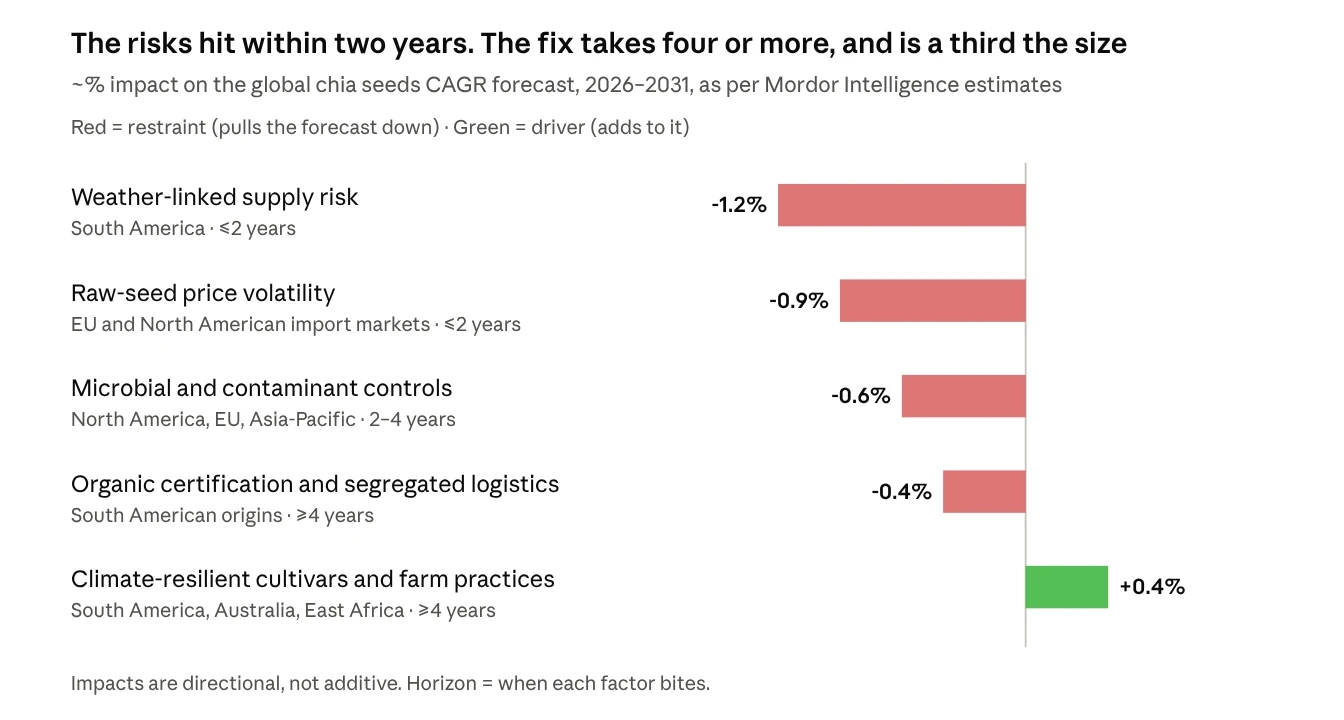
Chart: Mordor Intelligence, based on export data from the Paraguayan Chamber of Sesame Exporters (Capexse) · Region: Paraguay · Periods: Q1 2026 and January to July 2026 vs. the same periods of 2025
What the Shortage Did to Chia Seeds Wholesale Prices
The chia seed price increase shows up in the gap: revenue grew roughly three times faster than volume. That’s what it looks like when buyers can’t easily walk away from an ingredient. Capexse also noticed importers pulling purchases forward to cover the demand they expected. When buyers start stocking up early, they’ve stopped expecting things to get easier.
European chia seeds wholesale prices tell the same story. Conventional chia reached EUR 3,000 per metric ton in 2025 after frost damage in Paraguay and Bolivia, according to the Dutch Centre for the Promotion of Imports from developing countries (CBI), as cited in Mordor Intelligence’s Chia Seeds Market report. By September 2026, conventional chia in Dordrecht was priced at EUR 3.07–3.12 per kg, and organic chia at EUR 3.75–3.80 per kg.
Paraguay Chia Production: Bigger Fields, Same Weather
Here’s the bit that sounds like good news but isn’t. Paraguay’s chia fields grew from 101,697 hectares in 2022/23 to 261,699 hectares in 2025/26, up 157.3%, according to Capachía. More fields should mean more security. It doesn’t, not really.
Think of a homeowner in a flood zone who solves the flooding by buying the house next door. They own more, but they’re still living by the same river. Every new hectare in Paraguay sits under the same winter sky as the old ones.
The yields show the strain. Paraguayan chia has ranged from about 290 to 490 kg per hectare in recent seasons, against a target of 500 kg per hectare, and every recent season has fallen short. Mordor Intelligence’s production estimate puts Paraguay’s 2025 yield at about 0.40 metric tons per hectare on roughly 180,000 hectares; Capachía’s 261,699-hectare figure covers the 2025/26 campaign.
The longer-term fixes are real, just slow. Growers are trying staggered planting and more frost-tolerant varieties, according to Paraguay’s Ministry of Industry and Commerce, as cited in Mordor Intelligence’s Chia Seeds Market report. But look at how the risks and the fixes line up over time:
Chart: Mordor Intelligence · Data: Mordor Intelligence, Chia Seeds Market report, driver and restraint impact analysis (page updated September 11, 2026) · Scope: global, with regional relevance per factor · Forecast period: 2026–2031
The problem runs on a two-year clock. The fix runs on a four-year one, and it’s about a third the size. That gap is the repricing cycle buyers are living in right now.
Chia Seed Recalls Start One Step Up the Chain
A shortage isn’t only about how much chia you can get. It’s also about how good it is.
On January 23, 2026, Navitas Organics recalled select lots of its organic chia seeds over possible Salmonella contamination, according to the U.S. Food and Drug Administration (FDA). The packs had gone out nationwide through stores including Whole Foods Market and Target, and online through Amazon. Here’s the detail that matters for anyone sourcing chia: Navitas said it was acting as a precaution, after a recall started by its own chia supplier.
And Navitas wasn’t a one-off. It was one of three chia seed recalls across the US and Canada since 2024: Walmart’s Great Value brand in May 2024 (a Class 1 recall), Navitas in January 2026, and Left Coast Organics in Canada, also in January 2026. All three involved Salmonella, and all three were triggered at the supplier level.
The brand’s name is on the headline. The problem sits one step up the chain. If you sell chia under your own label, that’s your exposure too.
Bad weather makes this worse. Mordor Intelligence’s value chain analysis flags moisture control as critical for chia, because one quality downgrade can cascade into rejected lots and relabeling. The UGP reported quality losses, not just volume losses, after the 2025 frost, and organic lots were severely hit on quality in the 2026 harvest. As per Mordor Intelligence estimates, microbial and contaminant-control requirements will weigh on chia across North America, the European Union and Asia-Pacific over the next two to four years.
Three Ways the 2026/27 Chia Seed Harvest Could Play Out
Mordor Intelligence sees Scenario 2, a wet harvest, as the base case, with the US National Oceanic and Atmospheric Administration (NOAA) putting the probability of El Niño above 90%. A good plan should still hold up in all three.
| Scenario 1: Clean harvest | Scenario 2: Wet harvest (base case) | Scenario 3: Another frost | |
| What happens | Paraguay hits Capachía’s target of around 100,000 metric tons of exports by June 2027 | Volume holds up, but moisture and quality problems hit part of the crop |
A repeat of 2025: frost in the June to July window cuts volume and quality
|
| What changes for you | Prices ease into 2027, and cover bought at today’s prices looks expensive in hindsight | Total supply looks fine on paper, but organic and high-spec lots get tight |
Prices jump again, spot buyers pay the most, and over-committed suppliers struggle to deliver
|
| Your posture | Stage your cover in tranches rather than locking everything in at once | Write moisture and microbial specs into contracts, lot by lot |
Lock base cover before June, with a second origin already qualified
|
Source: Mordor Intelligence analysis. Capachía’s export target as reported in October 2026.
In the base case, Mordor Intelligence puts conventional chia at around EUR 2.90–3.10 per kg and organic chia at around EUR 3.60–3.80 per kg.
Planning Your 2027 Chia Contracts?
We benchmark your chia suppliers on cost, compliance and financial health, and trace your volume back to tier-2 and tier-3. You get an origin-level risk map and a supplier shortlist before you sign.
Talk to an analyst
What Each Group Should Do About the Chia Seeds Shortage
Chia passes through a lot of hands between a field in Paraguay and a supermarket shelf, and each pair of hands carries a different risk.
- Food and beverage manufacturers. Stop buying to the calendar and start buying to the crop. Paraguay’s harvest lands in June and July, and Capexse says early-year shipments mostly fill contracts signed the year before. Lock in your base volume before that window and keep a smaller share open. In September 2026, Capexse reported buyers holding back to see how the harvest develops. If the crop disappoints, the wait-and-see buyer pays spot.
- Importers, traders and distributors. A short crop tests your suppliers’ balance sheets as much as their fields. Ask how much of their volume is already sold, where the stock sits, and how they delivered on 2025 contracts. Then qualify a second origin, such as Bolivia, India, Kenya or Uganda, in a calm year. Rules at the destination take time too, from the EU’s Novel Food list to China’s customs registration for processing plants.
- Retailers and private-label brands. Three recalls in three years, all traced to suppliers, show that your label carries your supplier’s risk. Ask for a certificate of analysis on every lot, and for pathogen testing before shipment. Paraguay’s chia sector is planning a sterilization plant, so ask which of your suppliers will use it.
- Investors, advisors and analysts. Chia is a clean case study in what happens when one origin carries an entire category. When you look at a food, ingredient or supplement business that leans on chia, ask what share of its supply comes from one country, and when its contracts get signed. Mordor Intelligence’s value chain analysis also points to where margins are moving: toward processors that can prove consistent quality, lot by lot.
Where This Leaves You
For years, chia was treated as a simple ingredient: order it, receive it, use it. That only works when supply is spread out. Right now, most of the world’s chia depends on one country’s winter, and that winter has gone wrong three times running. The buyers who come out ahead won’t be the ones who guess the next harvest correctly. They’ll be the ones who set things up so a bad harvest costs them less.
What Could Change This
A clean 2026/27 harvest would ease prices for a while. Capachía expects Paraguay to export around 100,000 metric tons by June 2027, its biggest season yet. If that happens, cover bought at today’s prices will look pricey in hindsight. But a good year doesn’t change the setup: the same country, the same frost window, and more hectares exposed to it. The two things to watch are Paraguay’s weather through June and July 2027, and how fast other origins actually scale.
The Next Layer of Intelligence
Chia is a small ingredient with a big lesson- when one origin carries a category, the weather report becomes a pricing report. Mordor Intelligence’s new chia seeds research tracks production, trade flows and wholesale price trends by origin and destination, with regional editions for South America, Europe, North America, Asia-Pacific and Africa. So you have hard numbers to plan around before the next frost window opens.
Go Deeper
Explore our Chia Seeds Market report for a closer look at where chia is grown, where it’s shipped, and how weather, regulation and quality rules shape what buyers pay.