
Zero Waste Shampoo Market Size and Share
Market Overview
| Study Period | 2021 - 2031 |
|---|---|
| Market Size (2026) | USD 211.95 Million |
| Market Size (2031) | USD 293.52 Million |
| Growth Rate (2026 - 2031) | 6.73 % |
| Fastest Growing Market | Asia-Pacific |
| Largest Market | North America |
| Market Concentration | Medium |
Major Players *Disclaimer: Major Players sorted in no particular order Image © Mordor Intelligence. Reuse requires attribution under CC BY 4.0. | |
Zero Waste Shampoo Market Analysis by Mordor Intelligence
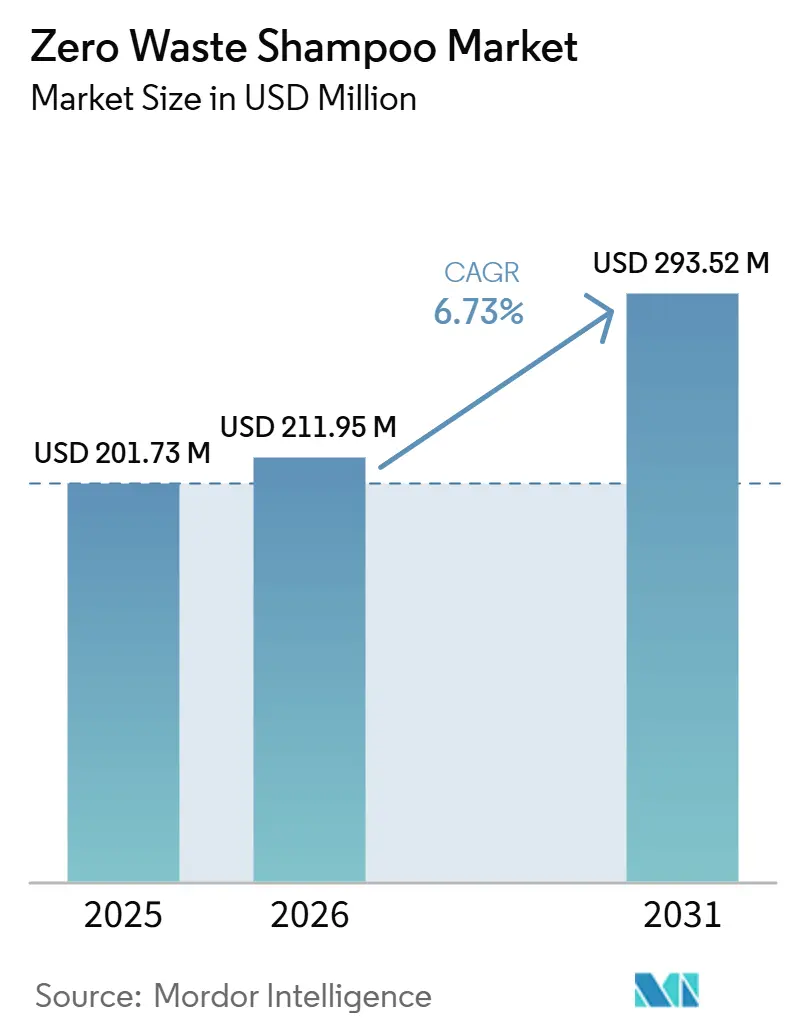
The zero waste shampoo market size was valued at USD 201.73 million in 2025 and is estimated to grow from USD 211.95 million in 2026 to reach USD 293.52 million by 2031, at a CAGR of 6.73% during the forecast period (2026-2031). The zero waste shampoo market is gaining support from packaging rules, wider retail placement, and products that reduce the need for single-use plastic packaging. The EU Packaging and Packaging Waste Regulation entered into force on February 11, 2025, and applies from August 12, 2026, giving brands a clearer reason to reduce packaging use in cosmetics and toiletries[1]Source: European Commission, “Packaging Waste,” European Commission, environment.ec.europa.eu. Mainstream retailers are also giving the zero waste shampoo market greater visibility, which moves purchase decisions beyond specialty stores and lets consumers compare solid, refillable, and bottled options during routine shopping trips. Larger companies are pairing bar formats with refill systems, while smaller brands continue to compete through product performance, ingredient transparency, direct online relationships, and product education that reduces uncertainty at first use. Price remains a constraint in lower-income regions, and the shift from liquid shampoo to solid formats still requires better consumer education, convenient access, and a convincing explanation of value over the life of the product.
Key Report Takeaways
- By product type, shampoo bars held 73.51% of the zero waste shampoo market share in 2025, while liquid shampoo is projected to grow at a 7.46% CAGR through 2031.
- By category, conventional products accounted for 88.62% of revenue in 2025, while organic variants are forecast to expand at an 8.11% CAGR through 2031.
- By price range, the mass tier captured 70.51% of revenue in 2025, while the premium tier is projected to grow at a 7.35% CAGR through 2031.
- By distribution channel, hypermarkets and supermarkets held 43.11% of revenue in 2025, while online retail stores are forecast to grow at a 7.91% CAGR through 2031.
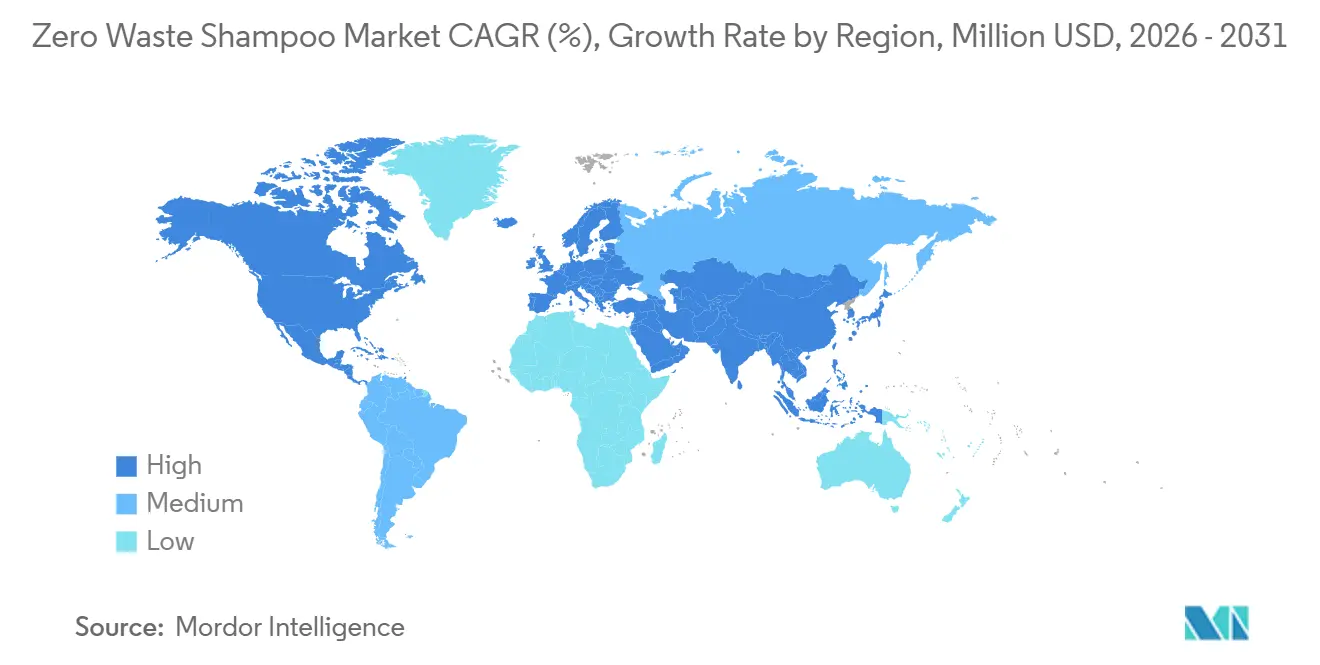
- By geography, North America held 41.9% of revenue in 2025, while Asia-Pacific is forecast to grow at a 7.98% CAGR through 2031.
Note: Market size and forecast figures in this report are generated using Mordor Intelligence’s proprietary estimation framework, updated with the latest available data and insights as of January 2026.
Market Trends and Insights
Drivers Impact Analysis of Zero Waste Shampoo Market*
| Driver | (~) % Impact on CAGR Forecast | Geographic Relevance | Impact Timeline |
|---|---|---|---|
| Rising consumer focus on plastic reduction | +1.4% | Global | Medium term (2–4 years) |
| Growing adoption of sustainable personal care | +1.2% | North America and Europe | Medium term (2–4 years) |
| Increasing demand for waterless beauty products | +0.9% | Global | Short term (≤ 2 years) |
| Expanding refill and reuse retail infrastructure | +0.8% | North America and Europe, emerging in the Asia-Pacific | Medium term (2–4 years) |
| Rising environmental awareness among younger consumers | +1.0% | Global | Long term (≥ 4 years) |
| Government initiatives reducing single-use plastic waste | +0.7% | Europe primary; North America; global regulatory ripple | Short term (≤ 2 years) |
| Source: Mordor Intelligence | |||
Rising consumer focus on plastic reduction
Plastic reduction has moved from an opt-in consumer preference to a baseline purchase criterion, particularly in markets where retail transparency mandates require brands to disclose packaging composition. A single conventional shampoo bottle contributes 30–40 grams of single-use plastic per unit; at a per-household consumption rate that can reach or exceed 10 bottles annually in high-income markets, personal care packaging represents a visible, easily substitutable source of household plastic waste. Brands that have reframed zero waste shampoo as a cost-per-wash proposition, rather than a sustainability sacrifice, have materially expanded their accessible market, especially as consumers calculate that one bar replaces two to three conventional 250ml bottles. The adoption of extended producer responsibility (EPR) frameworks across North America and Australia is reinforcing corporate incentives to reformulate packaging ahead of mandatory thresholds, compressing the timeline for competitor action and accelerating category-wide transition.
Growing adoption of sustainable personal care
Sustainable personal care has advanced from a fringe specialty category to a measurable revenue contributor within mainstream grocery and drugstore channels, driven by a consumer cohort that now treats environmental performance as a product prerequisite. Retailers across Germany, the Netherlands, and the United Kingdom integrated sustainable shampoo bars into standard personal care shelf sets by 2025, a merchandising signal that indicates category legitimacy rather than niche accommodation. The competitive implication is consequential: brands that previously distributed exclusively through specialty channels face increasing pressure from private-label extensions and multinational products in mainstream aisles. L'Oréal's 2026 #JoinTheRefillMovement campaign, which brought together 18 brands and 28 refillable products under a coordinated haircare and beauty refill strategy, supported by dedicated manufacturing at its Burgos, Spain facility, illustrates the scale at which corporate portfolios are realigning product and packaging roadmaps around this structural shift[2]Source: L'Oréal Groupe, “L'Oréal Calls on Consumers Around the World to #JoinTheRefillMovement in Its Biggest Ever Campaign for Refillable Beauty,” L'Oréal Groupe, loreal.com.
Increasing demand for waterless beauty products
Conventional liquid shampoos comprise up to 80% water by formulation weight, meaning a significant portion of production cost, packaging material, and distribution logistics is borne by an ingredient that consumers can source independently. Solid shampoo bars eliminate this embedded water cost, reducing packaging weight, transportation-related emissions, and retail shelf footprint simultaneously, a set of efficiencies that resonate with sustainability-focused brands and cost-conscious retailers alike. The waterless positioning is gaining particular traction in urban Asia-Pacific markets where municipal water stress is a lived reality for a growing proportion of the population. In these markets, cost-per-wash calculation often favors bars over full-bottle liquid alternatives, and online review aggregation has accelerated trial conversion by allowing consumers to evaluate real-world use experiences before format switching. The implication is that waterless format adoption is increasingly driven by functional rationality rather than purely by environmental identity, a more durable demand driver.
Expanding refill and reuse retail infrastructure
Refill and reuse infrastructure is transitioning from a grassroots retail experiment to a scalable distribution model, with direct implications for both zero waste shampoo brands and conventional category incumbents. Unilever has tested more than 50 reuse and refill models globally, operates more than 1,000 refill outlets for home care brands in Indonesia alone, and is participating in a Consumer Goods Forum city-wide reuse-refill initiative launching in Ottawa, Canada, in 2026, reflecting an institutional commitment to refill as a mainstream distribution channel rather than a pilot. L'Oréal's dedicated refill manufacturing at its Burgos facility for haircare products, backed by a EUR 100 million L'AcceleratOR program investing in next-generation packaging solutions, including seaweed-based packaging and recyclable paper bottles, points to manufacturing infrastructure investment translating into durable channel expansion. The common thread across these deployments is that refill infrastructure cost is increasingly shared across manufacturers, government bodies, and retail partners, lowering the adoption barrier below what individual brands could achieve independently.
Restraints Impact Analysis of Zero Waste Shampoo Market*
| Restraint | (~) % Impact on CAGR Forecast | Geographic Relevance | Impact Timeline |
|---|---|---|---|
| Higher product costs are reducing consumer affordability | -0.8% | South Asia, the Middle East and Africa, Latin America | Long term (≥ 4 years) |
| Limited retail availability across emerging markets | -0.5% | The Middle East and Africa, South America, rural Asia-Pacific | Long term (≥ 4 years) |
| Consumer resistance toward solid shampoo formats | -0.7% | Global; strongest in the Asia-Pacific and the Middle East and Africa | Medium term (2–4 years) |
| Performance concerns compared with liquid shampoos | -0.4% | Global; concentrated in mass and premium segments | Short term (≤ 2 years) |
| Source: Mordor Intelligence | |||
Higher product costs reducing consumer affordability
Price parity with conventional liquid shampoo remains one of the most persistent structural barriers to zero waste adoption in price-sensitive consumer cohorts, particularly across South Asia, the Middle East, and Latin America. A zero waste shampoo bar typically retails at USD 8–20 per unit, compared with USD 2–5 for mass-market liquid shampoos, even though lifecycle cost-per-wash frequently favours the bar across a full bottle equivalent. The challenge is that grocery purchasing decisions are made on displayed unit price, not lifecycle value, a cognitive pattern that disadvantages zero waste formats despite their economic equivalence over time. Addressing this barrier requires manufacturing scale and supply chain efficiencies that most specialist brands have not yet achieved, and that mainstream players are beginning to deploy through portfolio extension rather than standalone zero waste brands. In markets with acute disposable income constraints, the perception of zero waste shampoo as a premium indulgence rather than a practical household choice limits adoption to urban, aspirational consumer segments for the foreseeable forecast period.
Consumer resistance toward solid shampoo formats
Transitioning from liquid to solid shampoo formats requires a behavioral change that a segment of consumers resists beyond initial trial, particularly where product education at the point of sale is limited or absent. The learning curve involves adjusting application technique, managing bar storage to prevent excess moisture-related degradation between uses, and recalibrating lather expectations relative to the heavily marketed visual standards established by liquid shampoo advertising over decades. Consumer perception research consistently identifies lather volume, a sensory proxy for cleansing efficacy that has no direct correlation with actual performance, as a primary trigger for post-trial abandonment among first-time bar users, particularly for those with oily or fine hair. Brands investing in formulation improvements targeting lather enhancement and in targeted retail education programs have improved trial-to-repurchase conversion; however, the initial gap between trial and committed adoption continues to create above-average customer acquisition costs relative to conventional formats. As third-party testing organizations apply efficacy benchmarks to shampoo bars with growing rigor, transparent performance data is beginning to reduce this barrier over time.
*Our forecasts treat driver/restraint impacts as directional, not additive. The impact forecasts reflect baseline growth, mix effects, and variable interactions.
Zero Waste Shampoo Market Segment Analysis
By Product Type:
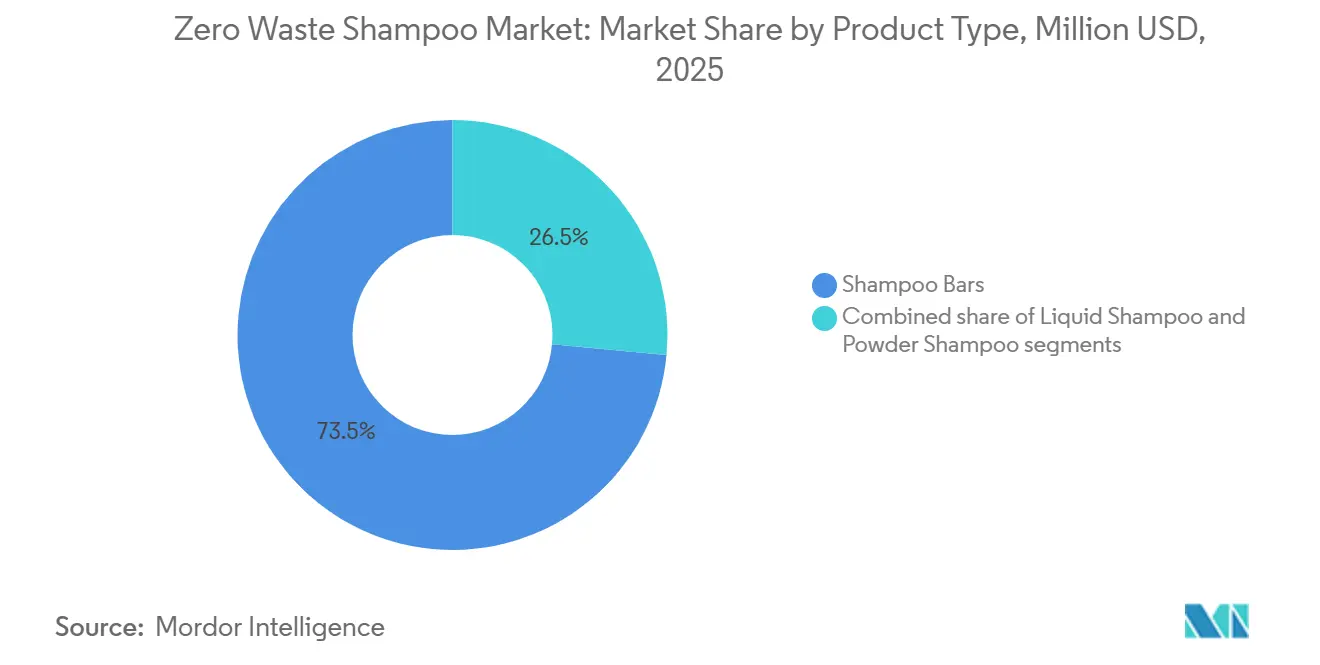
Bars Anchor the Category, Liquid Gains Through Format InnovationShampoo bars held a 73.51% revenue share in 2025, a position anchored by the format's complete plastic-free packaging profile, its concentrated formulation efficiency, and the category-defining presence of specialist brands that have focused on bar products since inception. The format's structural efficiency is not just environmental: one bar typically replaces two to three conventional 250ml bottles, giving brick-and-mortar retailers a revenue-per-shelf-meter argument for range expansion and giving e-commerce platforms a lower shipping cost per effective wash. Powder shampoo, while the smallest product segment, is attracting interest from brands targeting travel and on-the-go consumers, given its ultra-compact profile and zero-liquid carry-on compliance, with multiple 2025–2026 product introductions validating the format's early growth trajectory.
Liquid shampoo within the zero waste category, formulated in aluminum bottles, glass refillables, or compostable film pouches rather than conventional plastic, is the fastest-growing product type at a projected 7.46% CAGR through 2031. The growth dynamic here reflects a counter-intuitive insight: liquid formats, typically associated with non-zero-waste positioning, are gaining credibility within the zero waste category as brands commercialise packaging systems that deliver familiar application experiences without generating plastic waste. The compliance factor compounds this shift: COSMOS Organic certification, which covers both formulation and packaging criteria, has become a de facto credibility standard for liquid zero waste products seeking premium shelf placement in European natural and organic retail, accelerating investment in certified liquid-format portfolios.



By Category:
Conventional Commands Scale, Organic Accelerates on Formulation PremiumizationConventional zero waste shampoo retained an 88.62% revenue share in 2025, reflecting the market's current composition: the majority of zero waste shampoo products are sustainably packaged but not organically certified in formulation. This distinction matters strategically; the next phase of category development is likely to involve formulation premiumization alongside packaging innovation, a shift that disproportionately benefits organic sub-segment players and specialist brands. The implication for incumbent conventional-formulation brands is that packaging improvements alone are becoming insufficient as a differentiation lever; ingredient transparency is the next competitive frontier. Asia-Pacific, led by India and Japan, is a key growth corridor for organic certified zero waste shampoos, driven by aspirational demand for products combining Ayurvedic or traditional botanical ingredients with modern sustainable formulations.
Organic variants are growing at 8.11% CAGR through 2031, the fastest-growing sub-category, driven by a consumer cohort that treats ingredient transparency and organic certification as inseparable from packaging sustainability. USDA Organic and COSMOS Organic certifications are increasingly demanded by specialty retailers across Australia, Japan, and Singapore as pre-qualification criteria for listing, which has the effect of raising formulation quality and pricing expectations in those markets simultaneously. Compliance frameworks operated by organizations such as COSMOS-standard AISBL function as regulatory influence mechanisms, establishing minimum ingredient and packaging thresholds that consumer-facing organic claims must meet to remain credible. Brands without verifiable certification are finding that unsubstantiated natural positioning carries increasing reputational risk as category-savvy consumers grow more discerning.
By Price Range:
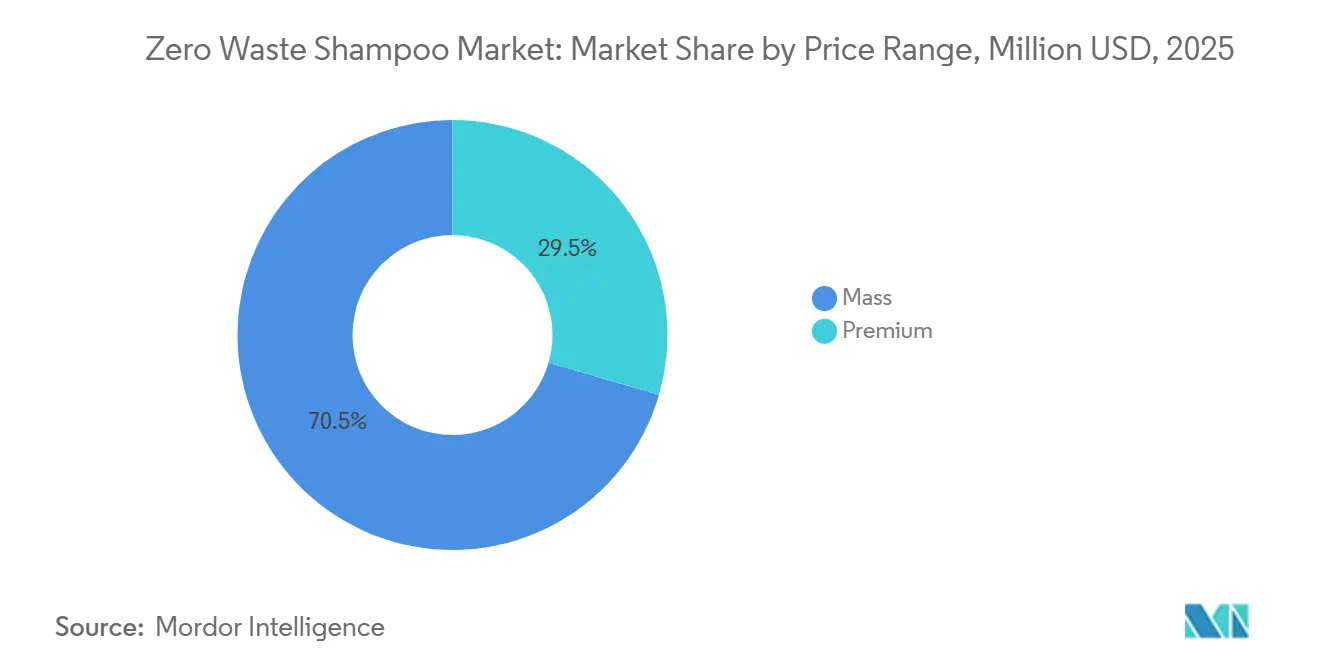
Mass Channels the Volume, Premium Defines the MarginThe mass price tier accounted for 70.51% of 2025 revenue, a share reflecting the category's successful penetration of mainstream grocery and drugstore channels where everyday hair care purchasing decisions are made on price, brand recognition, and availability. The mass segment has been the primary vector through which multinational players, extending existing shampoo brand equities into bar and refillable formats, have broadened the zero waste shampoo category beyond its specialist-brand origins. P&G's 2025 launch of Head & Shoulders BARE, which uses 45% less plastic than prior formulations through a mono-material packaging design to enhance recyclability, exemplifies how incumbents are adapting mass-market portfolios to capture this demand while maintaining scale economics. That mainstream expansion, while volume-positive, compresses average selling prices and creates margin pressure for specialist brands whose economic model assumes premium positioning.
Premium zero waste shampoo is the fastest-growing price tier, forecast at 7.35% CAGR through 2031, driven by consumers who view certified ingredient quality, artisanal provenance, and verifiable environmental credentials as worth a meaningful price premium. Premium brands are establishing new product quality benchmarks: Davines, which relaunched its Essential Haircare Collection in 2026 with an average natural-origin content of 93% and a biodegradability rating of 92%, has set a formulation-level performance standard that differentiates the category upward and compresses space for products making sustainability claims without substantiation[3]Source: Davines S.p.A., “Davines Essential Haircare Collection Relaunch,” Davines, davines.com. The premium segment also benefits from professional salon distribution, where stylist endorsement functions as a high-trust trial conversion mechanism that translates into durable retail repurchase.
By Distribution Channel:
Physical Channels Anchor Volume, Digital Channels Drive ConversionHypermarkets and supermarkets accounted for 43.11% of 2025 revenue, reflecting the category's successful transition from specialty retail into mainstream mass distribution. Retailers integrating sustainable shampoo bars into standard personal care shelf sets, merchandised by hair type and function alongside liquid alternatives, reduce the perceived format risk for new consumers and improve trial rates without requiring active consumer research. Specialty beauty stores retain a structurally important role as brand storytelling and education channels: they function as the conversion point where consumers move from format curiosity to committed adoption, before purchase behavior migrates to lower-cost mass channels. Other distribution channels, including professional salons and refill stations, represent an emerging and strategically underestimated route to market that established brands have been slower to scale than their distribution economics would warrant.
Online retail stores are the fastest-growing channel, projected at 7.91% CAGR through 2031, driven by direct-to-consumer brand models that bypass traditional retail gatekeeping, subscription replenishment mechanics that increase customer lifetime value, and the role of platform reviews in reducing format-unfamiliarity barriers at scale. The online channel is structurally advantageous for zero waste shampoo for operational reasons: packaging-light products ship more efficiently, lower return rates on familiar replenishment purchases reduce cost-to-serve, and social commerce on digital platforms creates a discovery-to-checkout path that compresses the sales funnel significantly versus physical retail. Brands without substantive digital commerce capabilities face a material competitive disadvantage in the fastest-growing acquisition channel across all geographies through the forecast period.
Geography Analysis
North America Zero Waste Shampoo Market
North America held 41.9% of 2025 revenue. The region developed an early consumer base for plastic-free personal care and has a broad specialty retail network. The United States includes digitally native brands such as HiBAR, Plaine Products, and EcoRoots that use social commerce and subscription models. Canada is also supporting regional demand through plastic-reduction policy alignment and a specialist brand base. Mexico remains an underpenetrated urban opportunity, although price sensitivity and limited distribution outside major cities constrain broader adoption, especially in cities outside the region's largest population and commercial centers.
EMEA and South America Zero Waste Shampoo Market
Europe was the second-largest regional segment in the supplied research draft. The United Kingdom, Germany, France, and Italy form the core of regional revenue. The United Kingdom has strong consumer familiarity with shampoo bars, supported by Lush's long history in packaging-free cosmetics. Germany has a strict packaging compliance setting through the LUCID Packaging Register. The EU Packaging and Packaging Waste Regulation applies from August 2026 and restricts single-use plastic for small cosmetic and toiletry products placed on the EU market. This rule supports a clearer case for refillable and packaging-light formats across member states. South America, the Middle East, and Africa remain early-stage regions where price, distribution, and consumer awareness limit adoption largely to premium urban buyers.
APAC Zero Waste Shampoo Market
Asia-Pacific is forecast to grow at an 8.0% CAGR through 2031, the fastest regional rate in the zero waste shampoo market. Japan offers an entry point for high-performance bars because consumers place a strong value on product quality. India is seeing greater interest in waterless formats among urban consumers, while e-commerce is improving access beyond major cities. China's cross-border e-commerce zones can shorten the route to shelf for international brands serving premium urban consumers. Australia, Singapore, and Japan give added weight to recognized certifications in premium natural retail. These conditions position the region for faster adoption, although affordability and consumer education will still shape the scale of adoption.

Competitive Landscape
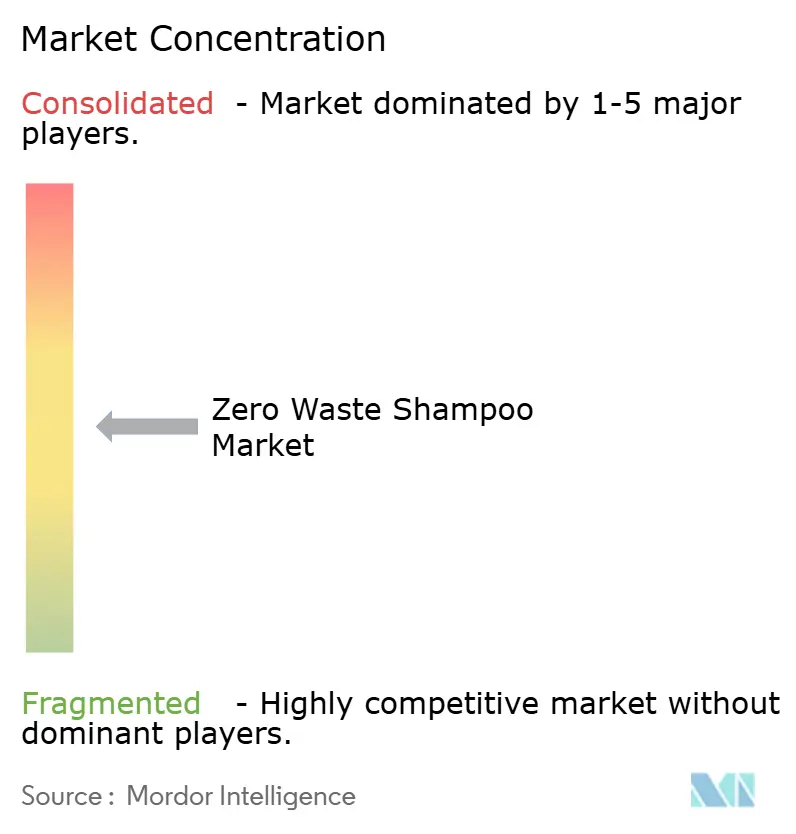
The zero waste shampoo market is moderately fragmented, with specialist independent brands operating beside multinational companies. L'ORÉAL, Unilever, and P&G can use large product portfolios, manufacturing resources, and retail relationships to expand refillable or lower-plastic formats. Lush, Ethique, HiBAR, and Davines compete through concentrated products, formulation positioning, direct consumer engagement, and salon or specialty channels. L'Oréal reported that its refillable options increased 3.7-fold between 2019 and 2025, and it has dedicated hair care refill manufacturing at Burgos. The company also launched the third #JoinTheRefillMovement campaign in June 2026 across 4 divisions, 18 brands, and 28 products. These actions show how larger companies are placing refill systems within broader product and packaging plans.
Unilever met its 25% recycled-plastic-in-packaging target in 2025 and reduced its virgin plastic footprint by 29% compared with 2019. It also set targets for a 30% reduction in virgin plastic by 2026 and a 40% reduction by 2028. P&G introduced Head & Shoulders BARE in 2025 with packaging that uses 45% less plastic than earlier bottle formats. These portfolio changes can make lower-plastic shampoo more visible in mass retail. They may also improve cost efficiency as large companies apply scale to packaging and distribution. In the zero waste shampoo market, smaller brands need to keep product performance and claims clear as large companies build stronger refill and packaging capabilities.
Specialist brands retain room to compete where consumers want clear product performance and credible environmental credentials. Lush launched a summer collection of solid shampoo bars in July 2025 with 100% post-consumer recycled packaging and vegan formulas, with each bar rated for up to 80 washes. Davines' 2026 collection relaunch gives premium buyers a cited formulation standard alongside sustainability positioning. Product development in powder formats, organic-certified bars, and salon-exclusive lines remains relevant for differentiated offerings. ISO 16128 and COSMOS certification can help separate verifiable claims from broad natural positioning. The zero waste shampoo market therefore remains competitive across both scale-based packaging investment and specialist product credibility.
Zero Waste Shampoo Industry Leaders
Lush Retail Ltd.
Ethique Beauty Ltd.
Unilever PLC
Henkel AG & Co. KGaA
HiBAR, Inc.
- *Disclaimer: Major Players sorted in no particular order
Zero Waste Shampoo Market Companies Covered in this Report
- Lush Retail Ltd.
- Ethique Beauty Ltd.
- L’Oréal S.A.
- The Procter & Gamble Company
- Unilever PLC
- Henkel AG & Co. KGaA
- HiBAR, Inc.
- Plaine Products LLC
- J.R. Liggett Ltd.
- Davines S.p.A.
- Kitsch LLC
- The Earthling Co.
- Viori, Inc.
- Beauty and the Bees
- Rocky Mountain Soap Company
- Oregon Soap Company
- Meow Meow Tweet, Inc.
- The Refill Shoppe, Inc.
- By Humankind, Inc.
- EcoRoots

Recent Industry Developments in Zero Waste Shampoo Market
- June 2026: L'Oréal Groupe launched the third edition of its #JoinTheRefillMovement campaign, the most comprehensive in the company's history, uniting 4 divisions, 18 brands, and 28 products across haircare, skincare, fragrance, and makeup; L'Oréal Professionnel introduced refill pouches for selected shampoo lines using 73% less plastic than conventional 500ml bottles, which reinforced the company's haircare refill strategy at manufacturing scale.
- March 2026: L'Oréal confirmed dedicated refill manufacturing capabilities at its Burgos, Spain facility for haircare products, reported that the number of refillable options offered by the Group had risen 3.7-fold between 2019 and 2025, and supported the initiative with EUR 100 million in L'AcceleratOR programme investment in next-generation packaging materials.
- October 2025: Garnier, a brand of L'Oréal S.A., upgraded European manufacturing facilities to double production capacity for its Ultra Doux solid shampoo bar range, signaled rising mass-market demand for waterless hair care alternatives across EU retail channels.


Global Zero Waste Shampoo Market Report Scope
Zero waste shampoo is an eco-friendly hair cleanser defined by solid bars, natural ingredients, and plastic-free packaging. The global zero waste shampoo is segmented by product type, category, price range, distribution channel, and geography. By product type, the market is segmented into shampoo bars, liquid shampoo, and powder shampoo. By category, the market is segmented into conventional and organic. By price range, the market is segmented into mass and premium. By distribution channel, the market is segmented into hypermarkets/supermarkets, specialty beauty stores, online retail stores, and other channels. By geography, the market is segmented into North America, Europe, Asia-Pacific, South America, and Middle East and Africa). Market Forecasts are Provided in Value (USD).
| Shampoo Bars |
| Liquid Shampoo |
| Powder Shampoo |
| Conventional |
| Organic |
| Mass |
| Premium |
| Hypermarkets and Supermarkets |
| Specialty Beauty Stores |
| Online Retail Stores |
| Other Distribution Channels |
| North America | United States |
| Canada | |
| Mexico | |
| Rest of North America | |
| Europe | United Kingdom |
| Germany | |
| France | |
| Italy | |
| Rest of Europe | |
| Asia-Pacific | China |
| Japan | |
| India | |
| Australia | |
| Rest of Asia-Pacific | |
| South America | Brazil |
| Argentina | |
| Rest of South America | |
| Middle East and Africa | United Arab Emirates |
| South Africa | |
| Saudi Arabia | |
| Rest of Middle East and Africa |
| Product Type | Shampoo Bars | |
| Liquid Shampoo | ||
| Powder Shampoo | ||
| Category | Conventional | |
| Organic | ||
| Price Range | Mass | |
| Premium | ||
| Distribution Channel | Hypermarkets and Supermarkets | |
| Specialty Beauty Stores | ||
| Online Retail Stores | ||
| Other Distribution Channels | ||
| Geography | North America | United States |
| Canada | ||
| Mexico | ||
| Rest of North America | ||
| Europe | United Kingdom | |
| Germany | ||
| France | ||
| Italy | ||
| Rest of Europe | ||
| Asia-Pacific | China | |
| Japan | ||
| India | ||
| Australia | ||
| Rest of Asia-Pacific | ||
| South America | Brazil | |
| Argentina | ||
| Rest of South America | ||
| Middle East and Africa | United Arab Emirates | |
| South Africa | ||
| Saudi Arabia | ||
| Rest of Middle East and Africa | ||


Key Questions Answered in the Report
What is the forecast growth rate for zero waste shampoo through 2031?
The zero waste shampoo market is forecast to grow at a 6.73% CAGR from 2026 to 2031 and reach USD 293.5 million by 2031.
Which zero waste shampoo product format leads revenue?
Shampoo bars led revenue with a 73.51% share in 2025.
Why are liquid zero waste shampoo products growing?
Liquid products are forecast to grow at a 7.46% CAGR through 2031.
Which region has the greatest demand for zero waste shampoo?
North America held 41.9% of revenue in 2025.
Page last updated on:





