
Zamak Material For Automotive Market Size and Share
Market Overview
| Study Period | 2021 - 2031 |
|---|---|
| Market Size (2026) | USD 1.16 Billion |
| Market Size (2031) | USD 1.69 Billion |
| Growth Rate (2026 - 2031) | 7.77 % |
| Fastest Growing Market | Asia-Pacific |
| Largest Market | Asia-Pacific |
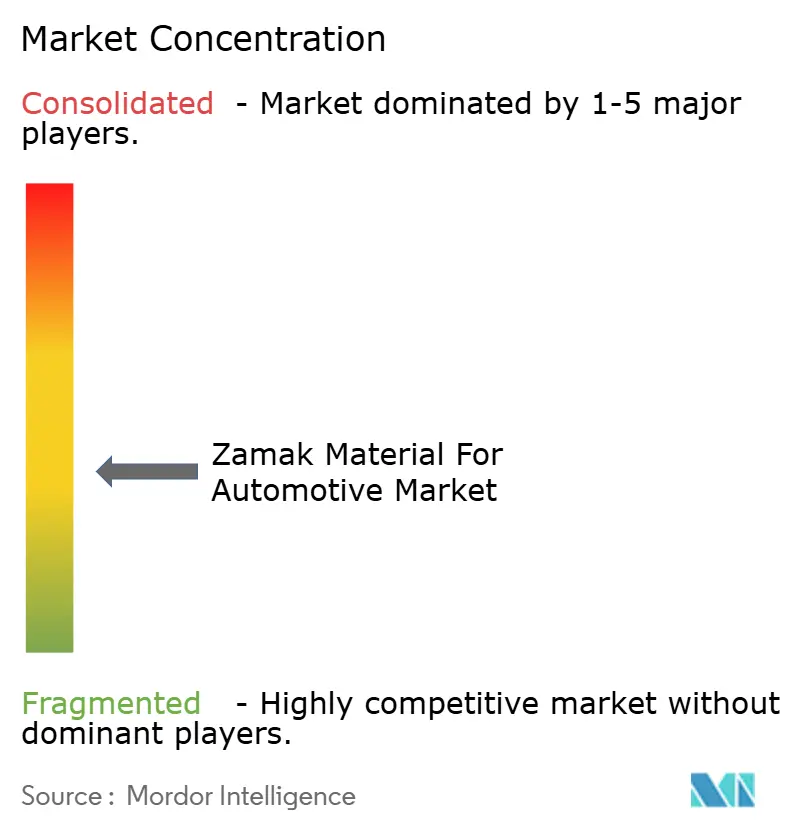
| Market Concentration | Medium |
Major Players *Disclaimer: Major Players sorted in no particular order Image © Mordor Intelligence. Reuse requires attribution under CC BY 4.0. | |
Zamak Material For Automotive Market Analysis by Mordor Intelligence
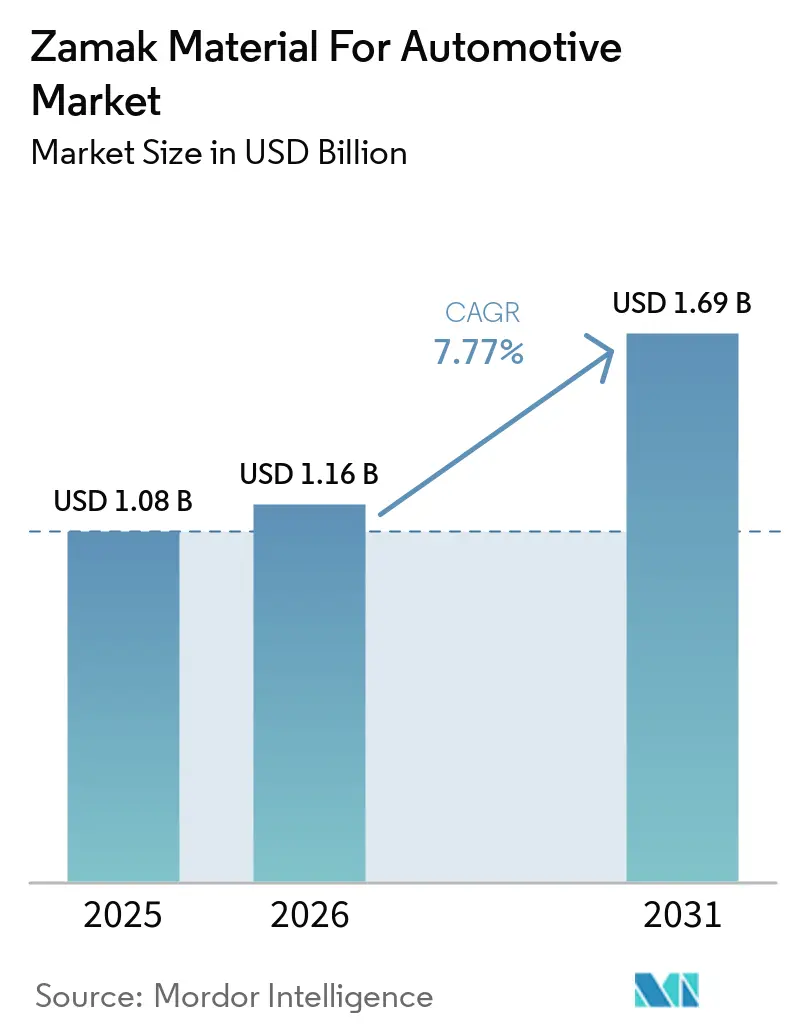
The Zamak Material for Automotive Market size was valued at USD 1.08 billion in 2025 and is estimated to grow from USD 1.16 billion in 2026 to reach USD 1.69 billion by 2031, at a CAGR of 7.77% during the forecast period (2026-2031). The Zamak material for automotive market benefits from the material's suitability for hot-chamber die casting, thin walls, dimensional control, and electromagnetic interference and radio-frequency interference shielding, particularly for compact components that must combine mechanical and electrical functions. Vehicle electrification is increasing demand for connector housings, control-unit covers, and high-voltage enclosures that can be cast without secondary shielding operations, creating a wider component base for the Zamak material for automotive market. Local alloy supply is becoming more important in India and Southeast Asia as vehicle makers and suppliers seek shorter supply chains, lower import exposure, and greater confidence in material availability. Competition is centered on alloy purity, tooling durability, surface finishing, and proximity to original equipment manufacturer assembly plants, with suppliers seeking to meet technical and sustainability requirements at the same time. Aluminum mega-castings and engineering thermoplastics limit the Zamak material for automotive market in large structural and low-load applications, while small precision components remain an important use case because of their tolerance and shielding requirements.
Key Report Takeaways
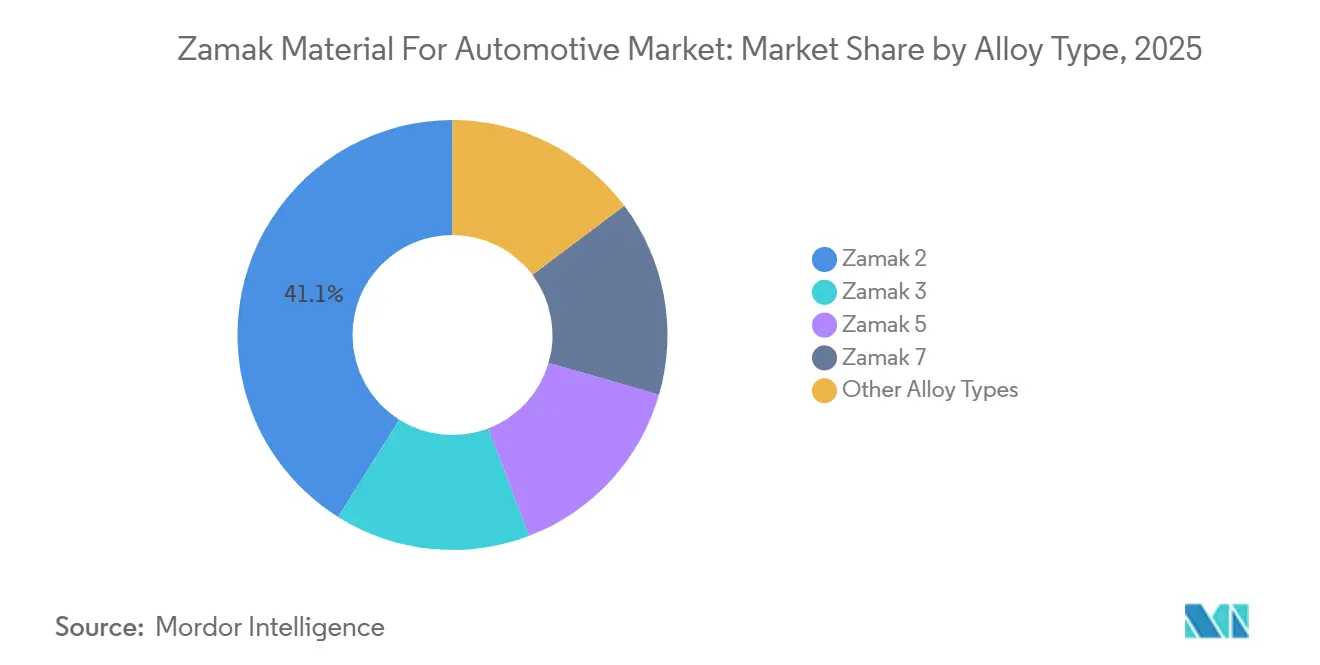
- By alloy type, Zamak 3 held 41.08% of the Zamak material for automotive market share in 2025 and is projected to advance at an 8.25% CAGR through 2031.
- By vehicle type, passenger vehicles held 54.13% of the Zamak material for automotive market share in 2025, while electric vehicles (battery electric vehicle (BEV), plug-in hybrid electric vehicle (PHEV), and hybrid electric vehicle (HEV)) are projected to advance at a 9.18% CAGR through 2031.
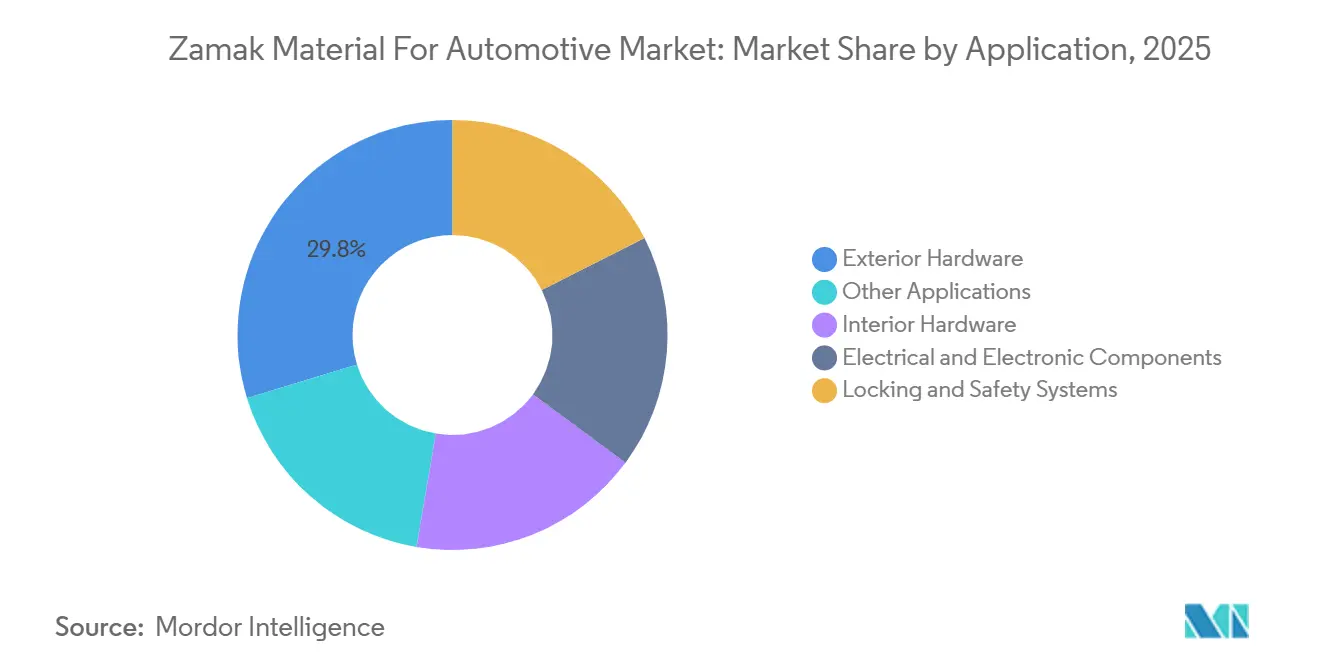
- By application, exterior hardware held 29.75% of the Zamak material for automotive market share in 2025, while electrical and electronic components are projected to advance at an 8.62% CAGR through 2031.
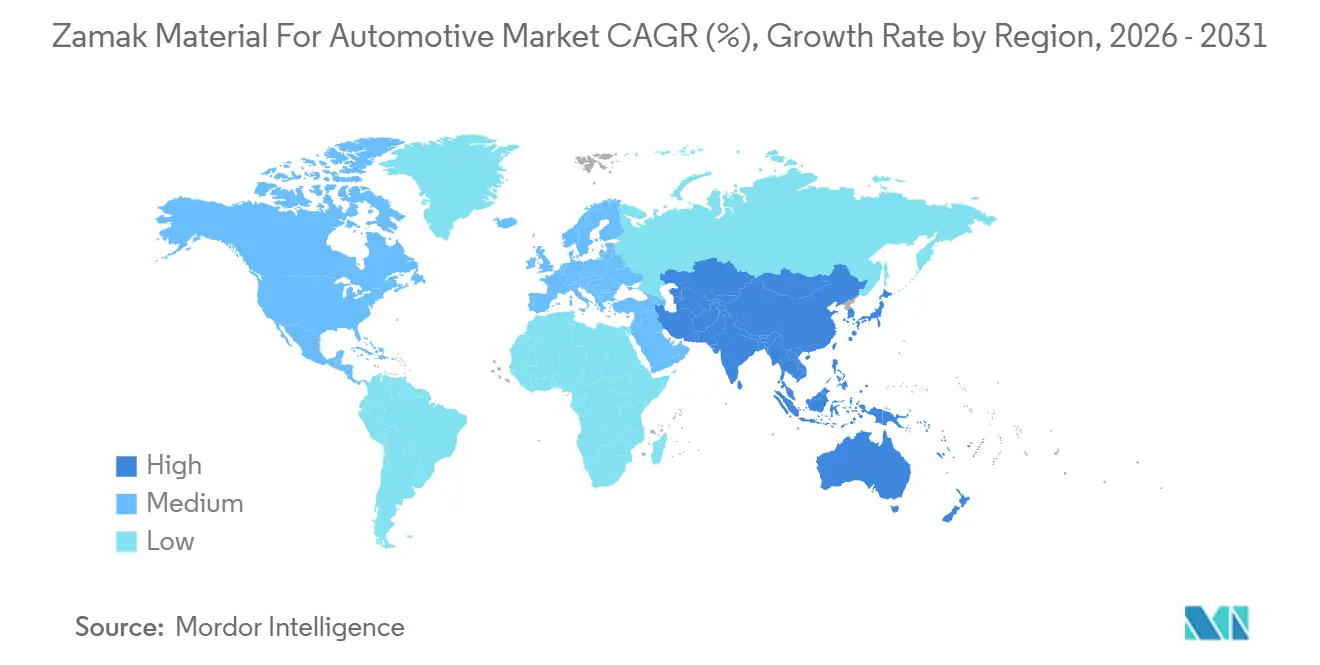
- By geography, Asia-Pacific held 37.02% of the Zamak material for automotive market share in 2025 and is projected to advance at an 8.19% CAGR through 2031.
Note: Market size and forecast figures in this report are generated using Mordor Intelligence’s proprietary estimation framework, updated with the latest available data and insights as of January 2026.
Market Trends and Insights
Drivers Impact Analysis of Zamak Material For Automotive Market*
| Driver | (~) % Impact on CAGR Forecast | Geographic Relevance | Impact Timeline |
|---|---|---|---|
| Electrification of Vehicle Electrical and Electronic Systems | +2.8% | Global, with primary gains in China, South Korea, and Germany | Short term (≤ 2 years) |
| OEM Lightweighting and Part-Integration Targets | +2.1% | North America & EU, spillover to APAC | Medium term (2-4 years) |
| Demand for Thin-Wall, Complex, Near-Net-Shape Components | +1.5% | APAC core (China, South Korea), spill-over to Mexico | Medium term (2-4 years) |
| Expansion of Localized Automotive Supplier Ecosystems | +1.0% | India, ASEAN Countries, Mexico | Short term (≤ 2 years) |
| Recyclability and Lower Energy Requirements of Zamak Processing | +0.7% | EU and NORDIC Countries | Long term (≥ 4 years) |
| Source: Mordor Intelligence | |||
Electrification of Vehicle Electrical and Electronic Systems
Battery electric vehicles, plug-in hybrid electric vehicles, and hybrid electric vehicles use more electromagnetic interference-sensitive enclosures, connector housings, and control-unit covers than comparable internal combustion engine vehicles. This increases component demand across the Zamak material for automotive market, particularly where battery-management and onboard-charging systems require compact shielded covers. Zinc die-cast components provide electromagnetic interference and radio-frequency interference shielding above 150 kHz, reducing the need for metallized coatings on plastic housings[1]. The International Automotive Task Force 16949 quality-management standard supports traceability in high-volume automotive casting programs, which reduces requalification challenges for suppliers moving into electrified vehicle programs. Advanced driver assistance systems, including radar and light detection and ranging sensor housings, require tight dimensional control and can use walls below 0.5 mm in production castings. The International Lead and Zinc Study Group expected global zinc usage to rise 1.6% in 2025, with automotive and electronics demand among the main drivers.
OEM Lightweighting and Part-Integration Targets
Original equipment manufacturer (OEM) lightweighting programs increasingly focus on reducing part counts as well as mass. This favors near-net-shape castings that combine bracket, fastener, and connector functions within a single part and can reduce secondary assembly steps. A 10% reduction in vehicle weight has been associated with a 6% to 8% improvement in battery electric vehicle driving range. European Union carbon dioxide fleet requirements and Corporate Average Fuel Economy standards in North America have moved lightweighting into component specifications rather than treating it as a later optimization. The ZinkGuss project demonstrated the potential of Zamak 5 in seat belt pretensioner components subjected to high cyclic loads. The Automotive Component Manufacturers Association of India reported USD 2.5 billion to USD 3 billion of automotive component investments in fiscal year 2025, with lightweight materials identified as a strategic area that supports the Zamak material for automotive market.
Demand for Thin-Wall, Complex, Near-Net-Shape Components
Automotive electronics miniaturization and the wider use of advanced driver assistance systems have raised demand for thin-wall and complex-geometry parts. Zamak die casting can achieve walls as thin as 0.15 mm, compared with 1.5 mm to 2.0 mm for aluminum die casting, giving designers more flexibility in compact component geometry. This capability can combine shielding, mechanical retention, and heat dissipation in a single part and can eliminate secondary assembly operations. Saga Poland completed a program for zinc alloy automotive window-fitting positioners with titanium and other micro-additives in September 2025. The program replaced sintered steel components, reduced production energy consumption, and met automotive dimensional requirements. Long tool life and repeatable dimensions reduce machining, assembly, and quality risks in high-volume connector programs within the Zamak material for automotive market.
Expansion of Localized Automotive Supplier Ecosystems
China-plus-one sourcing strategies have directed automotive supplier investment toward India and Southeast Asian countries. The Indian auto component sector received USD 2.5 billion to USD 3 billion in investments in fiscal year 2025, and the localization of cast-metal components was a priority. Hindustan Zinc launched HZDA 3 and HZDA 5, Hindustan Zinc Die Casting Alloy, at the Bharat Mobility Global Expo in January 2025 to support domestic die-casting supply. The alloys enabled Indian Tier-1 foundries to source Zamak locally and improve quotations to original equipment manufacturers. The India for India and India for Global sourcing model supports local supply for domestic assembly while building an export base. Greater domestic alloy production can encourage downstream foundry investment and strengthen India's role in the Zamak material for automotive market.
Restraints Impact Analysis of Zamak Material For Automotive Market*
| Restraint | (~) % Impact on CAGR Forecast | Geographic Relevance | Impact Timeline |
|---|---|---|---|
| Competition from Aluminum, Magnesium, Plastics and Composites | -1.8% | Global, with strongest substitution pressure in Europe and North America | Long term (≥ 4 years) |
| Zinc-Price and Energy-Cost Volatility | -1.2% | Global, with acute impact in EU, North America, and South Korea | Short term (≤ 2 years) |
| Tooling, Die-Life and Qualification Costs for Low-Volume Programs | -0.8% | North America & Europe | Medium term (2-4 years) |
| Source: Mordor Intelligence | |||
Competition from Aluminum, Magnesium, Plastics and Composites
Zinc has a density of 6.6 g/cm³, compared with 2.7 g/cm³ for aluminum. This limits its role in large body-in-white structures where aluminum giga-castings can replace multiple stampings. Glass-fiber-reinforced polyamides also compete in low-load interior trim and bracket applications where weight and appearance govern specifications. Large one-piece aluminum castings increase substitution pressure in structural positions and reduce the addressable space for other materials. Zamak retains a role in sub-kilogram parts where thin walls, tooling longevity, and shielding performance are important. Early vehicle architecture decisions can determine material selection for a 7-to-10-year platform life, making design-stage engagement important for the Zamak material for automotive market.
Zinc-Price and Energy-Cost Volatility
Zinc-price volatility has challenged Zamak foundries that operate with thin conversion margins under long-term supply agreements. The U.S. Geological Survey reported that the average zinc price declined to 126 cents per pound in 2024[2]. The International Lead and Zinc Study Group recorded a 90,000-metric-ton zinc surplus for January through May 2025. Lower prices can reduce raw material costs, but price uncertainty can complicate forward pricing in multiyear vehicle contracts and affect alloy premiums. Nyrstar restarted its Budel smelter in April 2024 after temporary Dutch government relief on indirect energy costs. Korea Zinc reported an Asia benchmark treatment charge of USD 80 per metric ton for 2025, down from USD 165 per metric ton in 2024, a cost pattern that can restrain the Zamak material for automotive market.
*Our forecasts treat driver/restraint impacts as directional, not additive. The impact forecasts reflect baseline growth, mix effects, and variable interactions.
Zamak Material For Automotive Market Segment Analysis
By Alloy Type:
Zamak 3 Supports Demand Across Established Automotive ComponentsZamak 3 held a 41.08% market share in 2025 and is projected to advance at an 8.25% CAGR through 2031. Its castability, dimensional stability, and electroplating compatibility supported use in exterior door handles, sensor connector bodies, and other automotive subcomponents. Its fine-grain structure supported chrome-alternative surface treatments and decorative finishes. Zamak 5 contains 1% copper and offers a higher tensile strength of 330 MPa with improved creep resistance. The grade serves high-stress applications such as seat belt pretensioners and door-latch mechanisms.
Fraunhofer Institute for Structural Durability and System Reliability validated Zamak 5 fatigue-strength data under high cyclic loads in October 2025. Zamak 7 has lower copper and magnesium content, which supports thin-wall flow in connector housings and advanced driver assistance system sensor covers where fill uniformity is important. Zamak 2 has higher copper content and the highest hardness among standard grades, supporting selected high-wear bracket uses where surface durability is required. Other alloy types include high-strength and creep-resistant grades such as EZAC, which has a yield strength up to 396 MPa and was designed by Eastern Alloys Inc. for more demanding parts previously served by cold-chamber alloys. European original equipment manufacturer qualification continues to rely on Deutsches Institut für Normung European Norm 1774, supporting consistent alloy specifications across suppliers and confidence in approved material grades within the Zamak material for automotive market.

By Vehicle Type:
Passenger Vehicles Provide Scale While Electric Vehicles Drive GrowthPassenger vehicles held 54.13% market share in 2025. Their high production volumes supported demand for interior hardware, exterior trim, locking mechanisms, and precision connector components across Asia-Pacific, Europe, and North America. Electric Vehicles (BEV, PHEV, and HEV) are projected to advance at a 9.18% CAGR through 2031. Their architecture requires high-voltage battery-management connector housings, shielded power-electronics enclosures, and onboard charging covers that expand the Zamak material for automotive market. International Automotive Task Force 16949 quality requirements support the use of established die-casting processes within electrified vehicle supply chains.
Light commercial vehicles support demand for durable door hardware, lock mechanisms, and powertrain ancillary components. Last-mile logistics activity in Asian and Latin American cities supports this application base because fleet vehicles require robust hardware in frequent-use conditions. Heavy commercial vehicles and two-wheelers address growing opportunities, especially in India and the Association of Southeast Asian Nations (ASEAN). Two-wheeler electrification raises component complexity and expands the use of small precision castings in component categories that require close dimensional control. Hyundai Motor Group partnered with Korea Zinc on electric vehicle value-chain materials in 2025, reflecting stronger original equipment manufacturer attention to traceable nonferrous-metal supply chains. Localized and auditable supply chains can support alloy suppliers serving the Zamak material for automotive market.
By Application:
Exterior Hardware Dominates Share While Electrical and Electronic Components Grow FasterExterior hardware held 29.75% market share in 2025. Door handles, mirror mounts, sunroof brackets, and exterior decorative trim use the material's corrosion resistance, plating compatibility, and ability to form complex shapes. Electrical and electronic components are projected to advance at an 8.62% CAGR through 2031. Connector bodies, sensor covers, onboard-charger housings, and bus-bar shields use native electromagnetic interference and radio-frequency interference shielding above 150 kHz. This can reduce the need for shielding gaskets or metallized polymer coatings and supports product demand in the Zamak material for automotive market.
The German Aerospace Center's InDruTec-E program developed die-casting process innovations for electric-mobility applications in December 2025. Interior hardware includes seatbelt buckles, window-regulator brackets, and gear-shift components where tolerances and surface finish are important to functional performance and appearance. Locking and safety systems use the material in pretensioner mechanisms and door-latch strikes, where stable dimensions and strength support established design requirements. Powertrain and engine components experience pressure from aluminum mega-castings in larger positions. Small ancillary mounts, sensors, and brackets maintain a defined application space within the Zamak material for automotive market because their geometry is less suited to large-format alternatives.
Geography Analysis
APAC Zamak Material for Automotive Market
Asia-Pacific held 37.02% market share in 2025 and is projected to advance at an 8.19% CAGR through 2031. China combines large vehicle production with a major zinc-smelting base. The International Lead and Zinc Study Group reported that Chinese passenger car production rose 10.5% year over year in 2024 and 17.2% in the first 2 months of 2025. India received USD 2.5 billion to USD 3 billion of auto component investment in fiscal year 2025. Local alloy procurement can reduce lead times and import costs for Indian foundries.
North America, Europe and APAC Zamak Material for Automotive Market
South Korea and Japan support demand for high-purity grades through their established original equipment manufacturer and Tier-1 supplier bases. Smart-factory retrofits at South Korean foundries focus on yield and energy management. Thailand and Indonesia are adding demand as Japanese and Korean vehicle makers expand regional assembly capacity. North America supports high-volume connector and bracket programs through Corporate Average Fuel Economy standards and Environmental Protection Agency requirements, while Mexico-based Tier-1 suppliers serve assembly plants in the United States. Europe remains important for precision electric vehicle connector and sensor applications because of its dense original equipment manufacturer and supplier ecosystem.
EMEA and South America Zamak Material for Automotive Market
France, Italy, and the United Kingdom contribute through their established foundry industries, while Nordic procurement standards place greater emphasis on recyclability and lifecycle information. Secondary Zamak with 10% primary zinc had a footprint below 671 kg carbon dioxide per metric ton, compared with 3,610 kg carbon dioxide per metric ton for primary alloy. REAZN S.A. participated in the EMEA Automotive Carbon Neutral Summit in November 2025, while GRILLO-Werke AG promoted its Low Carbon Zinc offering. Brazil anchors demand in South America, while Argentina's recovering vehicle production adds demand for locally assembled vehicles, and Saudi Arabia's Vision 2030 program and South Africa's assembly sector support a smaller Middle-East and Africa application base for the Zamak material for automotive market.
Competitive Landscape
The Zamak material for automotive market is moderately concentrated, with the top five players including Belmont Metals, Form Technologies, Pace Industries, Bruschi Srl, and PHB Corporation. Nyrstar, GRILLO-Werke AG, REAZN S.A., Eastern Alloys Inc., and Hindustan Zinc compete on alloy purity, technical support, and sustainability credentials. Bruschi Srl, Form Technologies, Pace Industries, PHB Corporation, and Phoenix Industries Ltd. compete on precision engineering, tooling longevity, and proximity to assembly plants. Nyrstar's Balen-Pelt operations received The Zinc Mark certification in September 2024, supporting responsible production credentials in original equipment manufacturer supplier qualification. Supply-chain sustainability audits have consequently become a more visible factor in supplier selection.
Alloy innovation, vertical integration, and geographic expansion remain important competitive approaches in the Zamak material for automotive market. GRILLO-Werke AG developed Zamak Ultra with grain-refining elements that improve coating adhesion and wear resistance. Bruschi Srl completed its merger with Sapre in December 2024, adding aluminum die-casting capability to its established zinc expertise. This expanded its ability to offer mixed-material solutions to original equipment manufacturers. The combined offering addresses vehicle platforms that use several casting materials and reduces supplier consolidation risk for buyers who need zinc and aluminum capabilities.
REAZN S.A. produces Zamak alloys with 80% to 100% recycled content and positions recycled-content provenance as a commercial factor for lower upstream emissions. The company highlighted this approach at the EMEA Automotive Carbon Neutral Summit in November 2025 and at EUROGUSS 2026. Eastern Alloys Inc. developed the proprietary EZAC alloy, while conformal-cooling die inserts can extend tool life, improve solidification control, and lower cost per part in demanding programs. India and Southeast Asia offer room for local alloy production where import dependence remains, and Hindustan Zinc's HZDA program is addressing this need through domestic alloy supply that can strengthen the Zamak material for automotive market.
Zamak Material For Automotive Industry Leaders
-
Belmont Metals
-
Form Technologies
-
Pace Industries
-
Bruschi Srl
-
PHB Corporation
- *Disclaimer: Major Players sorted in no particular order
Zamak Material For Automotive Market Companies Covered in this Report
- Belmont Metals
- BN Industries
- Bruschi Srl
- Chem Zinc Die Casting Alloys
- Eastern Alloys Inc.
- Form Technologies
- GRILLO-Werke AG
- Hindustan Zinc
- Ital Leghe S.r.l.
- Nyrstar
- Pace Industries
- PHB Corporation
- Phoenix Industries Ltd.
- Radiant Metals and Alloys Pvt. Ltd.
- REAZN S.A.
Recent Industry Developments in Zamak Material For Automotive Market
- January 2026: REAZN S.A. highlighted recycling at EUROGUSS 2026 in Nuremberg, showcasing 80%–100% recycled-content Zamak as a solution for reducing upstream Scope 3 emissions in die-casting applications. This reflects increasing demand for sustainable Zamak materials in automotive die casting, where OEMs are seeking lower-carbon alloy inputs and greater recycled content.
- January 2025: Hindustan Zinc launched HZDA 3 and HZDA 5 at Bharat Mobility Global Expo 2025, providing domestically produced hot-chamber die-casting alloys with high dimensional stability and improved plating performance. The development supports greater use of locally produced Zamak alloys in automotive die-casting applications while reducing dependence on imported materials.
Global Zamak Material For Automotive Market Report Scope
Zamak is a family of zinc-based alloys containing aluminum, magnesium, and copper, known for its dimensional accuracy, castability, strength, and corrosion resistance. These properties make Zamak suitable for producing complex automotive components with precise geometries and consistent surface quality.
The Zamak Material for Automotive Market is segmented by alloy type, vehicle type, application, and geography. By alloy type, the market is segmented into Zamak 2, Zamak 3, Zamak 5, Zamak 7, and other alloy types. By vehicle type, the market is segmented into passenger vehicles, light commercial vehicles (LCVs), heavy commercial vehicles (HCVs), two-wheelers, and electric vehicles (BEV, PHEV, and HEV). By application, the market is segmented into exterior hardware, interior hardware, electrical and electronic components, locking and safety systems, and other applications (powertrain and engine components). The report also covers the market size and forecasts for Zamak material for automotive in 15 countries across major regions. For each segment, the market sizing and forecasts have been done on the basis of value (USD).
Segmentation Overview
| Zamak 2 |
| Zamak 3 |
| Zamak 5 |
| Zamak 7 |
| Other Alloy Types |
| Passenger Vehicles |
| Light Commercial Vehicles (LCVs) |
| Heavy Commercial Vehicles (HCVs) |
| Two-Wheelers |
| Electric Vehicles (BEV, PHEV, and HEV) |
| Exterior Hardware |
| Interior Hardware |
| Electrical and Electronic Components |
| Locking and Safety Systems |
| Other Applications (Powertrain and Engine Components) |
| Asia-Pacific | China |
| India | |
| Japan | |
| South Korea | |
| ASEAN Countries | |
| Rest of Asia-Pacific | |
| North America | United States |
| Canada | |
| Mexico | |
| Europe | Germany |
| United Kingdom | |
| France | |
| Italy | |
| NORDIC Countries | |
| Rest of Europe | |
| South America | Brazil |
| Argentina | |
| Rest of South America | |
| Middle-East and Africa | Saudi Arabia |
| South Africa | |
| Rest of Middle-East and Africa |
| By Alloy Type | Zamak 2 | |
| Zamak 3 | ||
| Zamak 5 | ||
| Zamak 7 | ||
| Other Alloy Types | ||
| By Vehicle Type | Passenger Vehicles | |
| Light Commercial Vehicles (LCVs) | ||
| Heavy Commercial Vehicles (HCVs) | ||
| Two-Wheelers | ||
| Electric Vehicles (BEV, PHEV, and HEV) | ||
| By Application | Exterior Hardware | |
| Interior Hardware | ||
| Electrical and Electronic Components | ||
| Locking and Safety Systems | ||
| Other Applications (Powertrain and Engine Components) | ||
| By Geography | Asia-Pacific | China |
| India | ||
| Japan | ||
| South Korea | ||
| ASEAN Countries | ||
| Rest of Asia-Pacific | ||
| North America | United States | |
| Canada | ||
| Mexico | ||
| Europe | Germany | |
| United Kingdom | ||
| France | ||
| Italy | ||
| NORDIC Countries | ||
| Rest of Europe | ||
| South America | Brazil | |
| Argentina | ||
| Rest of South America | ||
| Middle-East and Africa | Saudi Arabia | |
| South Africa | ||
| Rest of Middle-East and Africa | ||
Key Questions Answered in the Report
What is the size of the Zamak material for automotive market?
The Zamak material for automotive market stands at USD 1.16 billion in 2026 and is projected to reach USD 1.69 billion by 2031.
What is driving demand for Zamak in vehicle components?
Electrification increases demand for connector housings, control-unit covers, and shielded enclosures. Thin-wall casting also supports compact parts with integrated mechanical and electrical functions.
Which alloy type held the largest share in 2025?
Zamak 3 held 41.08% market share in 2025, and its castability and dimensional stability support broad automotive use.
Which vehicle type is projected to grow fastest through 2031?
Electric Vehicles (BEV, PHEV and HEV) are projected to advance at a 9.18% CAGR through 2031.