
Wireless Battery Monitoring System Market Size and Share
Market Overview
| Study Period | 2022 - 2032 |
|---|---|
| Market Size (2027) | USD 6.59 Billion |
| Market Size (2032) | USD 13.14 Billion |
| Growth Rate (2027 - 2032) | 14.81 % |
| Fastest Growing Market | Asia-Pacific |
| Largest Market | Asia-Pacific |
| Market Concentration | Medium |
Major Players *Disclaimer: Major Players sorted in no particular order Image © Mordor Intelligence. Reuse requires attribution under CC BY 4.0. | |
Wireless Battery Monitoring System Market Analysis by Mordor Intelligence
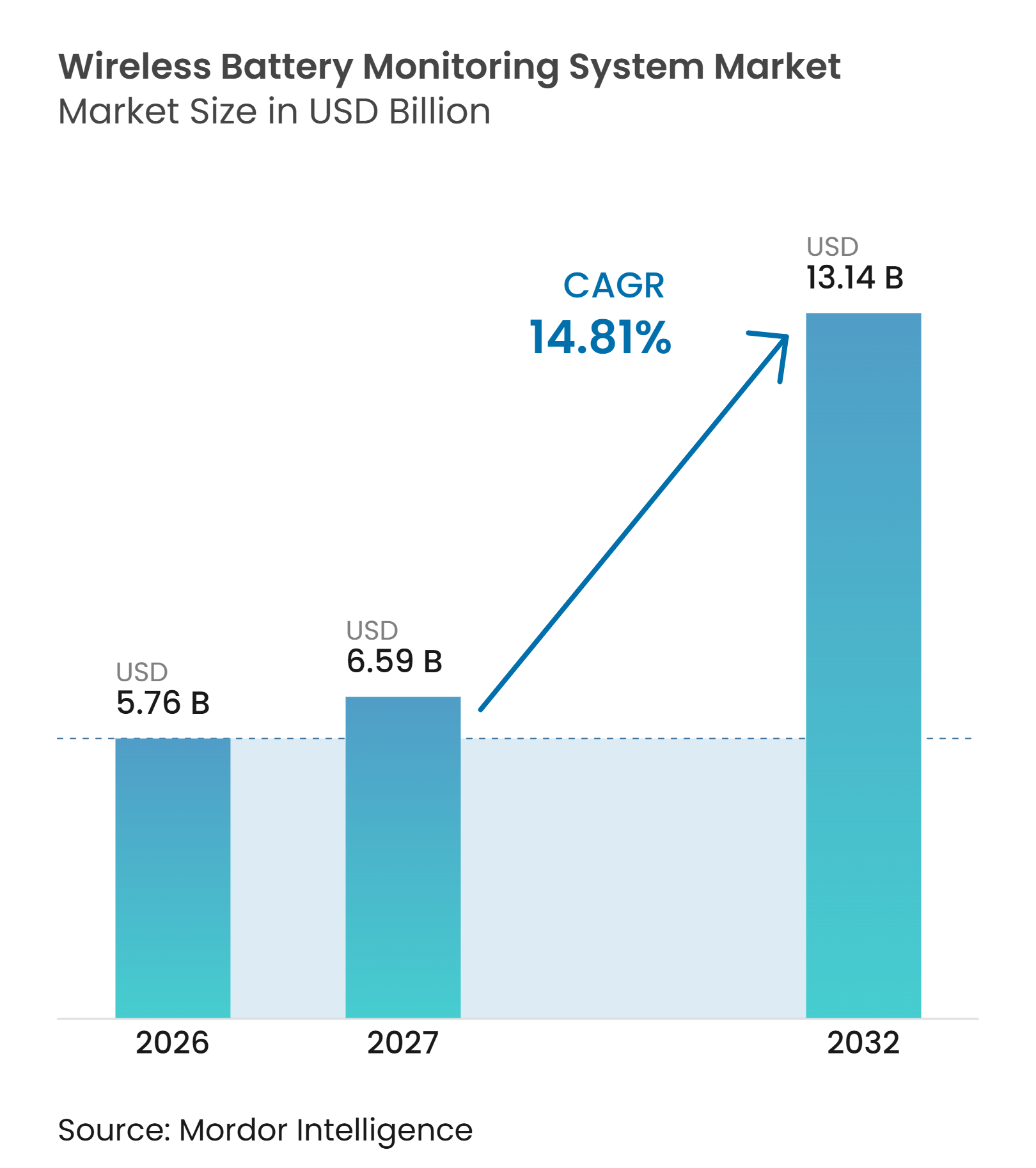
The global wireless battery monitoring system market size is expected to increase from USD 5.76 billion in 2026 to USD 6.59 billion in 2027 and reach USD 13.14 billion by 2032, growing at a CAGR of 14.81% over 2027-2032. The wireless battery monitoring system market is supported by the expansion of battery-dependent transport, stationary storage, and backup power assets. Operators need dependable cell-level information to manage safety, service schedules, and asset life across larger fleets in the wireless battery monitoring system market. Grid storage and distributed storage add more sites that cannot be inspected frequently, which increases the value of remote monitoring. Suppliers are responding with systems that combine sensing hardware, wireless communications, and analytics rather than selling isolated devices. Regulation is also becoming more important, since the European Union will require a digital battery passport for relevant batteries from February 2027.[1]
Key Report Takeaways
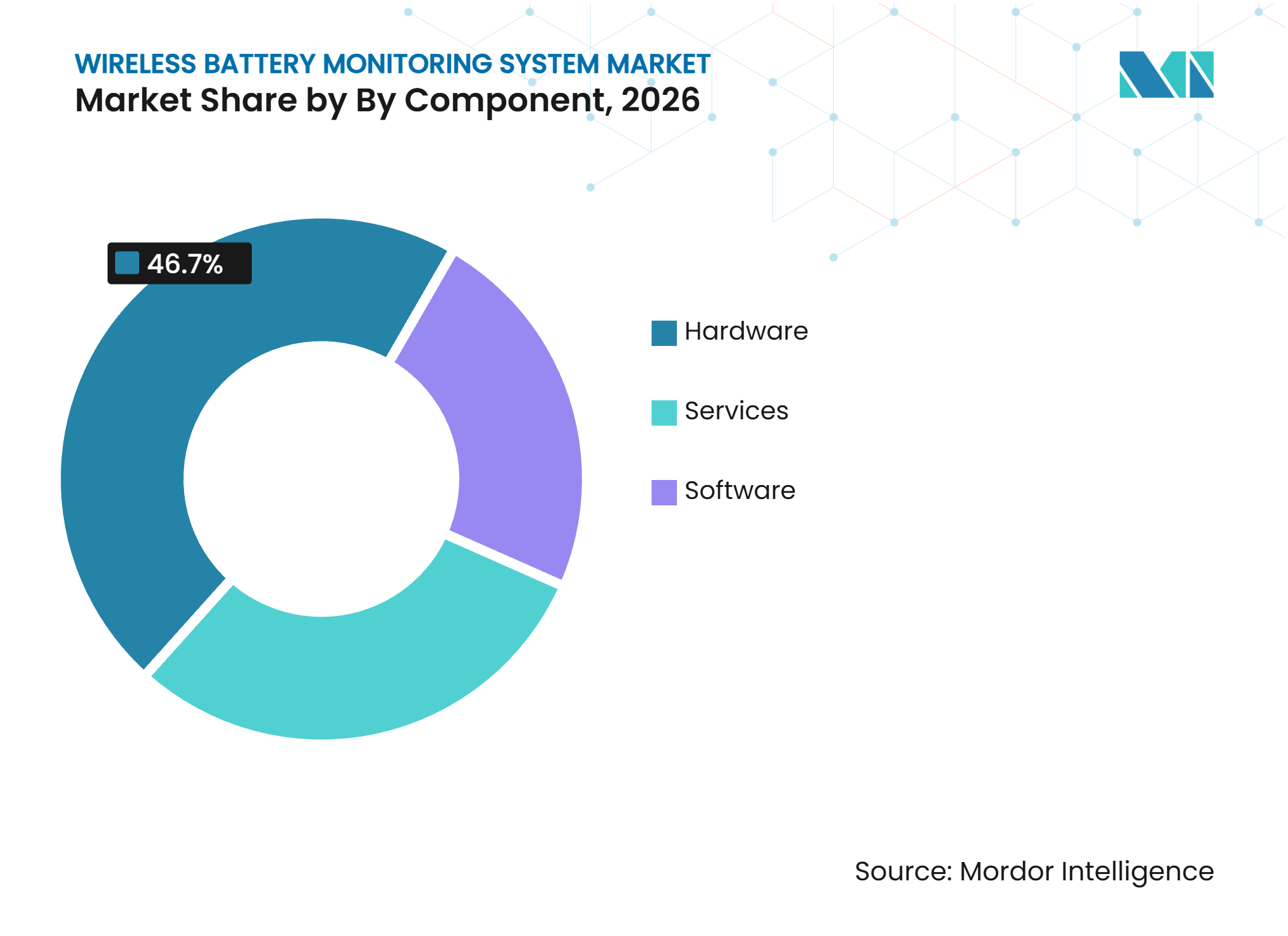
- By component, hardware held 46.7% of the wireless battery monitoring system market share in 2026, while software is forecast to grow at a 15.6% CAGR through 2032.
- By system architecture, distributed wireless monitoring systems held 37.2% of the wireless battery monitoring system market share in 2026, while integrated wireless battery management systems are forecast to grow at a 16.4% CAGR through 2032.
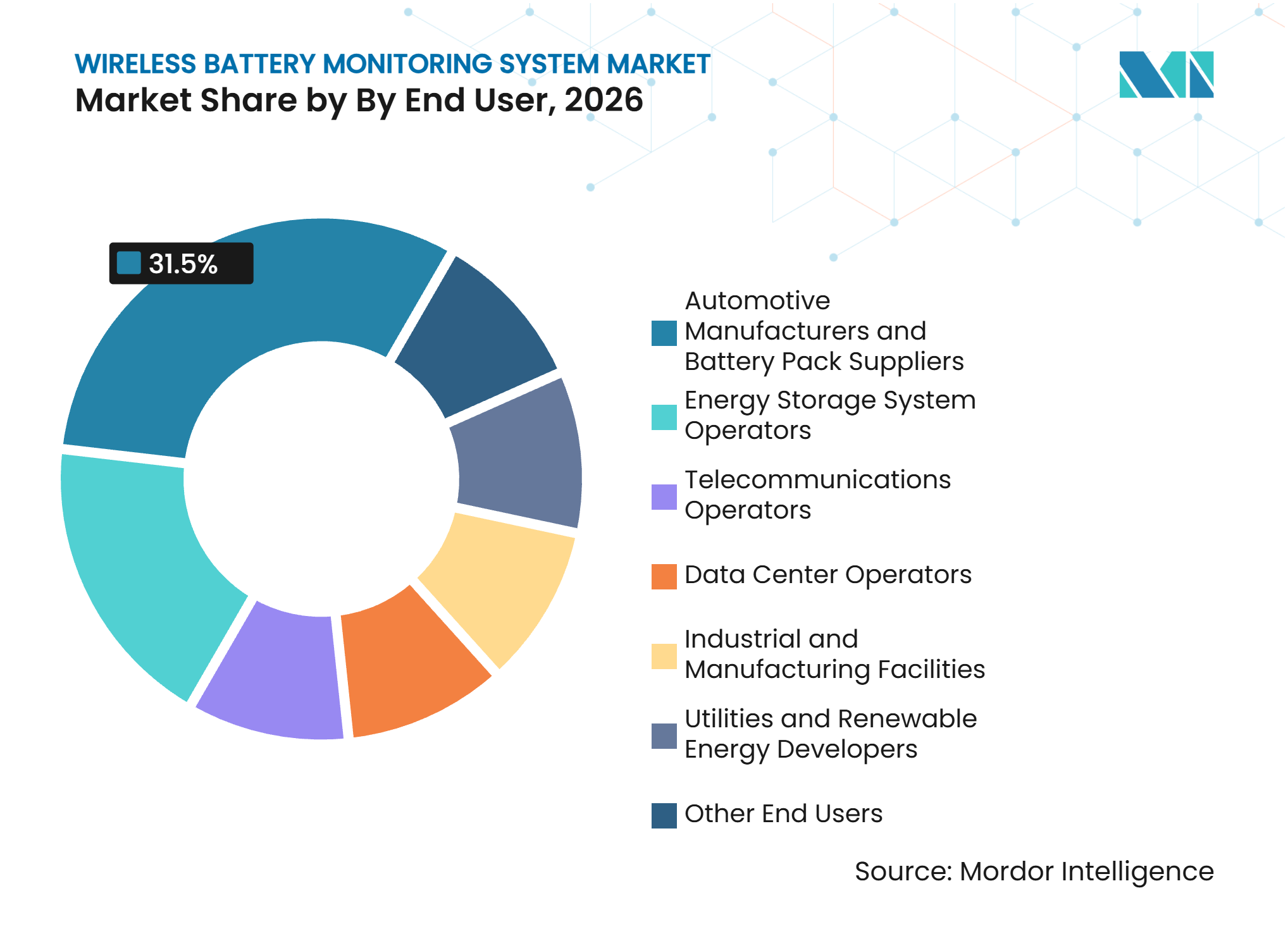
- By end user, automotive manufacturers and battery pack suppliers held 31.5% revenue share in 2026, while energy storage system operators are forecast to grow at a 16.7% CAGR through 2032.
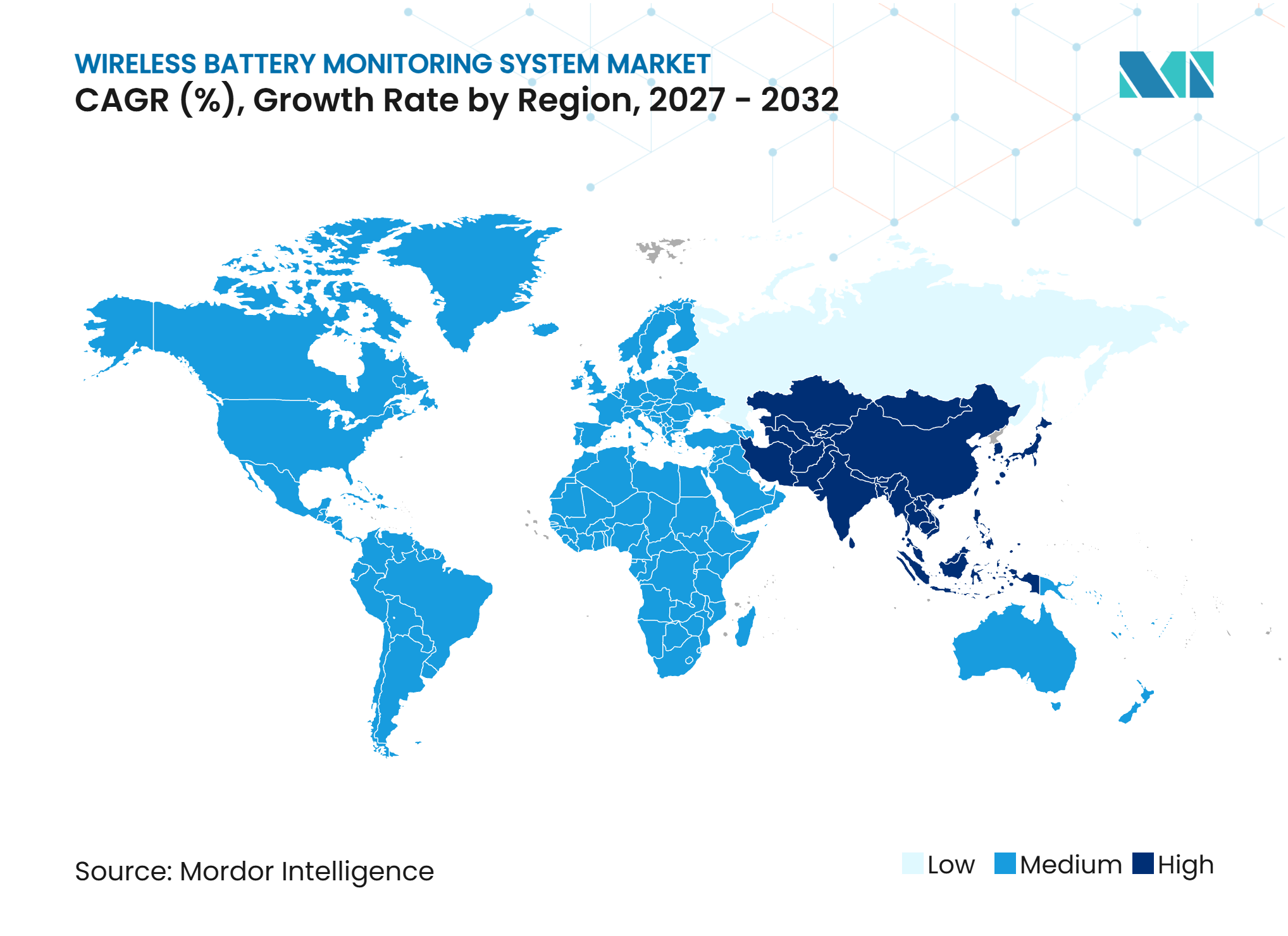
- By geography, Asia-Pacific held 39.4% revenue share in 2026 and is forecast to grow at a 15.8% CAGR through 2032.
Note: Market numbers in this report are based on Mordor Intelligence's proprietary estimation framework, which combines nine months of actuals with Q4 projections for base year 2026.
Market Trends and Insights
Drivers Impact Analysis of Wireless Battery Monitoring System Market*
| Driver | (~) % Impact on CAGR Forecast | Geographic Relevance | Impact Timeline |
|---|---|---|---|
| Battery-Pack Electrification and Cell-Level Data Demand | +3.5% | Global, concentrated in APAC and North America | Short term (≤ 2 years) |
| Grid-Scale and Behind-the-Meter Storage Expansion | +3.0% | Global, led by China, United States, and Europe | Short term (≤ 2 years) |
| Data-Center and Telecom Reliability Requirements | +2.2% | Global, with strongest demand in North America and APAC data center clusters | Medium term (2–4 years) |
| Predictive Maintenance and Battery-Health Analytics | +1.8% | Global | Medium term (2–4 years) |
| Wireless Monitoring for Distributed and Retrofit Assets | +1.5% | APAC, North America, Europe | Medium term (2–4 years) |
| Battery-Passport and Lifecycle-Traceability Requirements | +1.2% | Europe (mandatory), spillover to North America and APAC | Long term (≥ 4 years) |
| Source: Mordor Intelligence | |||
Battery-Pack Electrification and Cell-Level Data Demand
Wireless cell-supervisory architecture removes data cables between cell-monitoring units and the master controller. This can reduce harness weight, reduce potential failure points, and support more flexible pack layouts during design, assembly, service, and replacement activities across complex battery programs and varied product configurations. A 2025 study assessed Bluetooth Low Energy, Zigbee, and Ultra-Wideband for automotive battery management applications, with protocol choice depending on power, throughput, and interference requirements. The wireless battery monitoring system market benefits when manufacturers need cell-level records that stay with the cell through use, reuse, and assessment. A 2025 IEEE demonstration showed that a chip-on-cell approach can connect up to 8 cell-monitoring units to a system hub at 0.09 A average consumption.[2] NXP Semiconductors introduced an electrochemical impedance spectroscopy chipset in October 2025 that is designed to provide per-cell diagnostic information in electric vehicles and energy storage systems.[3]
Grid-Scale and Behind-the-Meter Storage Expansion
Grid-scale storage growth expands the installed base that needs continuous monitoring from commissioning onward. The American Clean Power Association announced in April 2025 that the United States energy storage sector committed USD 100 billion to American-made grid batteries.[4] Large storage fleets often operate across remote locations, which increases the need for reliable monitoring without frequent site visits, particularly when limited field teams oversee several installations with different operating conditions and service schedules. The wireless battery monitoring system market also serves behind-the-meter installations where site teams may not include dedicated battery specialists. Remote access can help these operators review battery condition, prioritize service work, compare patterns across installations, and document decisions for internal maintenance and asset-management teams. This supports demand for monitoring offers that combine installed devices with software access and technical support for operations, maintenance planning, and battery asset management decisions overall.
Data-Center and Telecom Reliability Requirements
Data centers require dependable backup power because battery degradation can affect continuity during a grid interruption. EnerSys stated in March 2025 that it added embedded real-time monitoring to DataSafe Thin Plate Pure Lead batteries for data center backup applications. Its deployment with a European data center involved 260 monitored batteries and was intended to reduce emergency maintenance interventions. The wireless battery monitoring system market can address this requirement by giving operators current voltage and temperature information through a connected platform that can be reviewed before a backup-power issue becomes urgent. Telecom operators face a similar need at dispersed tower sites, where manual inspections require travel and local service capacity. Continuous state-of-health tracking can therefore reduce inspection activity while helping operators focus attention on assets that show deterioration, unusual temperature behavior, or declining voltage performance.
Predictive Maintenance and Battery-Health Analytics
Predictive analytics shifts battery monitoring from a record of past conditions toward earlier identification of abnormal behavior. A 2025 Scientific Reports study reported 99.99% anomaly-detection accuracy for an improved random forest method across battery parameter data. A 2025 Joule study described an onboard health approach that reconstructs degradation paths using operational measurements without offline diagnostic tests. These approaches make recurring analytics services more relevant to the wireless battery monitoring system market because users can apply the same information to maintenance planning, warranty oversight, operational decisions, and reviews of asset performance over time. As analytics improve, suppliers can compete on the usefulness of maintenance decisions rather than on sensing hardware alone. Operators still need tools that turn complex battery data into actions that maintenance teams can carry out with confidence.
Restraints Impact Analysis of Wireless Battery Monitoring System Market*
| Restraint | (~) % Impact on CAGR Forecast | Geographic Relevance | Impact Timeline |
|---|---|---|---|
| Hardware, Integration, and Software Implementation Costs | -1.8% | Global, most acute in price-sensitive emerging markets | Short term (≤ 2 years) |
| Interoperability Gaps Across Chemistries and Control Platforms | -1.2% | Global | Medium term (2–4 years) |
| Cybersecurity and Communications-Reliability Risks | -0.8% | Global, heightened in grid-connected and telecom applications | Medium term (2–4 years) |
| Limited Cell-Level Data in Legacy and Second-Life Batteries | -0.6% | Europe, APAC second-life markets | Long term (≥ 4 years) |
| Source: Mordor Intelligence | |||
Hardware, Integration, and Software Implementation Costs
Wireless monitoring requires more than sensors and gateways, since deployment can also require firmware work, network commissioning, cloud access, and cybersecurity checks. These costs can limit adoption at commercial sites with large legacy fleets and narrow operating budgets. The wireless battery monitoring system market faces greater friction where local service coverage is limited because installation and maintenance then require additional external support. Automotive-grade component availability can also affect project timing and procurement budgets. Operators must judge whether monitoring can prevent enough unplanned work, downtime, early replacement, and unnecessary field travel to justify the initial outlay in each individual deployment. Vendors that offer clear integration plans, staged commissioning, and service support can lower this barrier for smaller or remote installations that cannot manage every technical activity internally.
Interoperability Gaps Across Chemistries and Control Platforms
Monitoring systems must work across lithium iron phosphate, nickel manganese cobalt, nickel cobalt aluminum, and lead-acid chemistries. Each chemistry has different voltage behavior, thermal conditions, and impedance characteristics. The absence of a universal communication standard means equipment validated for one application may need further engineering and certification for another. The wireless battery monitoring system market also needs data to move into supervisory control, energy management, and analytics platforms that can use different interfaces. Until interoperability frameworks develop further, integrators will continue to manage bespoke connections, repeated validation work, and the related cost for end users operating assets from several battery and control-system suppliers. This can make procurement slower because users must test whether new devices, interfaces, and reporting workflows work with established systems.
*Our forecasts treat driver/restraint impacts as directional, not additive. The impact forecasts reflect baseline growth, mix effects, and variable interactions.
Wireless Battery Monitoring System Market Segment Analysis
By Component:
Hardware Anchors Deployments While Software Monetizes DataHardware held 46.7% of the wireless battery monitoring system market size in 2026. Sensor nodes, gateway controllers, and radio-frequency communication modules are required before a battery fleet can be monitored. That requirement gives hardware a durable role in near-term deployments. Component suppliers nonetheless face pressure as module designs become more standardized and buyers seek hardware that can operate across different platforms without extensive adaptation, specialized programming, or lengthy validation work. The wireless battery monitoring system industry is therefore moving toward offers that combine physical equipment with information services.
Software is forecast to expand at a 15.6% CAGR from 2027 to 2032. Operators use software for state-of-health tracking, degradation alerts, and records that support battery passport requirements. A 2025 Automotive Innovation review described how wireless battery management architecture supports modular battery packs and reduces the wiring associated with conventional designs. Layered software can allow diagnostic algorithms to change without redesigning the installed hardware. Services such as integration, calibration, cybersecurity support, and managed monitoring also become more relevant as multi-site deployments become harder to run internally, especially when operating teams have limited battery diagnostic expertise.



By System Architecture:
Distributed Systems Lead While Integrated Platforms Gain GroundDistributed wireless monitoring systems held 37.2% of the wireless battery monitoring system market size in 2026. These systems support granular sensing at the cell or module level across large battery arrays. A problem at one sensing node does not necessarily remove visibility across the rest of the pack. Distributed designs also suit spatially dispersed assets that need information from several locations, including storage containers, vehicle packs, and large backup-power installations with different maintenance cycles and operating loads. These characteristics help explain their leading position in the wireless battery monitoring system market.
Integrated wireless battery management systems are forecast to grow at a 16.4% CAGR from 2027 to 2032. Electric vehicle manufacturers and storage integrators increasingly seek a single stack that combines monitoring information and battery protection logic. The 2025 IEEE work on chip-on-cell monitoring demonstrated a technical route for this design. Centralized systems remain relevant where arrays are smaller and cost needs are more pressing. Modular wireless monitoring systems also address retrofit requirements where operators want more data without replacing the core battery management system, interrupting established operating procedures, or making major changes to existing asset controls.
By End User:
Automotive Leads by Share, Energy Storage System (ESS) Operators Drive the Fastest GrowthAutomotive manufacturers and battery pack suppliers held 31.5% of the wireless battery monitoring system market size in 2026. Electric vehicle makers continue to assess wireless cell-supervisory systems as a way to reduce wiring and support modular battery configurations. They also require strong functional safety, reliable communication, and diagnostics that operate in constrained pack environments with temperature changes, electrical noise, limited physical space, and demanding vehicle-level performance requirements. The 2025 Automotive Innovation Review identified wiring reduction and modularity as key design considerations for wireless battery management systems. Those requirements favor suppliers that can meet automotive validation needs while supporting platform updates.
Energy storage system operators are forecast to grow at a 16.7% CAGR from 2027 to 2032. Larger utility-scale portfolios create a need to observe battery condition across sites that may be geographically dispersed. Telecommunications and data center operators are also valuable users because battery failure can disrupt network availability or computing operations. Industrial and manufacturing facilities add demand through electrified forklifts and logistics fleets. Utilities and renewable energy developers use battery information for dispatch, warranty management, safety reviews, and storage asset oversight across the wireless battery monitoring system market, where availability and lifecycle performance are closely linked.

Geography Analysis
Asia-Pacific held 39.4% of the wireless battery monitoring system market size in 2026 and is forecast to grow at a 15.8% CAGR through 2032. The region combines battery manufacturing capacity, electric vehicle supply chains, and growing stationary storage activity. China is central to regional demand because its battery deployment base requires continuing operational oversight across manufacturing, transport, and stationary energy storage applications. This can intensify price competition in domestic storage projects. India adds demand through large storage tenders and new project commissioning, where monitoring can be specified alongside control systems, operational service arrangements, commissioning checks, and longer-term maintenance planning.
North America is the second-largest regional market, supported by storage deployment and growing data center power requirements. The American Clean Power Association's USD 100 billion commitment to American-made grid batteries supports visibility for storage investment. Monitoring suppliers can benefit when they are selected early in storage project design, since early selection can simplify interfaces, commissioning plans, operational data management, and the assignment of technical responsibility among project participants. Data center clusters in Northern Virginia, Silicon Valley, and Texas also create concentrated demand for backup battery monitoring. Mexico contributes industrial backup applications and material-handling battery demand, where fleets require practical visibility into battery condition and maintenance needs.
European Commission guidance published in August 2026 clarified 71 data points for the Digital Battery Passport for specified batteries above 2 kWh from February 2027. This requirement makes accessible battery data more important for participants in the wireless battery monitoring system market. Germany benefits from utility-scale storage, industrial facilities, and telecom backup installations that require dependable monitoring across assets with different operating patterns, usage profiles, and maintenance responsibilities. South America and the Middle East and Africa remain earlier-stage regions where commercial storage and off-grid telecom sites provide entry points, particularly where remote supervision can support limited local maintenance resources.
Competitive Landscape
Market Concentration
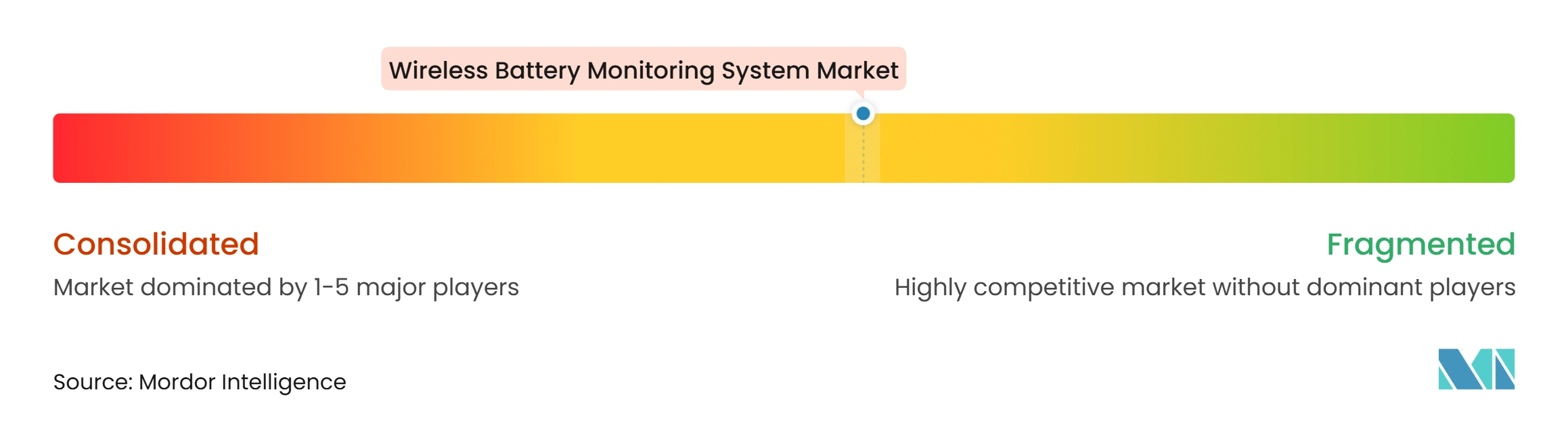
The wireless battery monitoring system market is moderately fragmented across semiconductor suppliers, specialized monitoring vendors, and industrial automation companies. Texas Instruments, Analog Devices, and NXP Semiconductors compete in cell-level battery management integrated circuits that support sensing, communications, protection, and diagnostic functions across automotive and stationary storage applications. EnerSys, PowerShield, and Eagle Eye Power Solutions focus on monitoring applications for stationary and data center environments, where service knowledge, clear fault information, and practical maintenance support are important. The wireless battery monitoring system industry therefore includes both component specialists and application-focused providers.
Honeywell, Schneider Electric, ABB, Eaton, and Vertiv can bundle battery monitoring with broader power management and automation offers. Honeywell introduced Ionic in September 2025 as a modular battery energy storage automation platform with remote operations capability. Emerson introduced Ovation Green battery energy and asset management software in June 2025, adding Zitara edge monitoring and control capabilities to its automation platform. Schneider Electric introduced Boost Pro in May 2025, a storage solution with EcoStruxure Microgrid Advisor for real-time energy-flow optimization. These moves show how integrated vendors are linking monitoring with storage control and site-level energy management.
Second-life battery monitoring remains an open area because retired electric vehicle cells can have varied histories and degradation patterns. Cross-chemistry software is another open area because operators may manage lithium-ion and lead-acid assets in the same portfolio. NXP's October 2025 impedance-spectroscopy chipset raises the diagnostic capability available at the integrated-circuit level. This could increase pressure on suppliers that offer only software-based state-of-health estimation, particularly where customers expect diagnostics that are closely linked to battery hardware. The wireless battery monitoring system market is likely to reward suppliers that can link reliable sensing, useful analytics, practical system integration, and service models that help customers use the data effectively across a changing mix of assets.
Wireless Battery Monitoring System Industry Leaders
-
Texas Instruments Incorporated
-
Analog Devices, Inc.
-
NXP Semiconductors N.V.
-
Infineon Technologies AG
-
Dukosi Limited
- *Disclaimer: Major Players sorted in no particular order
Wireless Battery Monitoring System Market Companies Covered in this Report
- ABB Ltd.
- Analog Devices, Inc.
- BatteryDAQ LLC
- Dukosi Limited
- Eagle Eye Power Solutions LLC
- Eaton Corporation plc
- EnerSys
- Generex Systems GmbH
- HBL Power Systems Limited
- Honeywell International Inc.
- Infineon Technologies AG
- NDSL Group Limited
- Nuvation Energy Systems, Inc.
- NXP Semiconductors N.V.
- PowerShield Limited
- Schneider Electric SE
- Socomec Group S.A.
- Storage Battery Systems, LLC
- Texas Instruments Incorporated
- Vertiv Holdings Co
Recent Industry Developments in Wireless Battery Monitoring System Market
- October 2025: NXP Semiconductors unveiled an industry-first Electrochemical Impedance Spectroscopy Battery Management System (BMS) chipset, including the BMA7418 cell sensing device, BMA6402 gateway, and BMA8420 battery junction box controller, integrating hardware-based nanosecond-level synchronization across all devices to enable lab-grade per-cell impedance diagnostics in Electric Vehicles (EVs) and energy storage systems. The complete solution is expected to be available for production programs beginning in 2026.
- October 2025: Honeywell and LS ELECTRIC announced a global partnership to develop integrated microgrid solutions combining battery energy storage systems and data-center power infrastructure, pairing Honeywell's remote operations and control capabilities with LS ELECTRIC's power conversion and distribution expertise.
- September 2025: Honeywell launched Honeywell Ionic, a modular all-in-one battery energy storage automation platform offering 250 kWh to 5 MWh of capacity per unit. It is globally available and incorporates ISA Secure® 2 cybersecurity certification and remote operations capability through Honeywell's Remote Operations Center.
- June 2025: Emerson launched Ovation Green Battery Energy Storage System (BESS) solutions featuring battery energy and asset management software. The solutions integrate Zitara's edge monitoring and control capabilities into the Ovation automation platform to aggregate and contextualize battery storage data from multiple manufacturers into operational information.
Global Wireless Battery Monitoring System Market Report Scope
The global wireless battery monitoring system market comprises the hardware, software, and services used to remotely monitor, assess, and manage the operating condition and performance of battery systems through wireless communication technologies. These systems collect and transmit battery-level and cell-level parameters, such as voltage, current, temperature, state of charge, and state of health, enabling continuous monitoring, fault detection, performance optimization, and predictive maintenance. Wireless battery monitoring systems integrate sensors, communication modules, data management platforms, and analytics software to reduce manual inspection requirements and improve battery reliability, safety, and operational efficiency. They are deployed across automotive battery packs, energy storage installations, telecommunications infrastructure, data centers, industrial facilities, and utility-scale energy systems.
The global wireless battery monitoring system market is segmented by component, system architecture, end user, and geography. By component, the market is segmented into Hardware, Software, and Services. By system architecture, the market is segmented into Centralized Wireless Monitoring Systems, Distributed Wireless Monitoring Systems, Modular Wireless Monitoring Systems, and Integrated Wireless Battery Management Systems. By end user, the market is segmented into Automotive Manufacturers and Battery Pack Suppliers, Energy Storage System Operators, Telecommunications Operators, Data Center Operators, Industrial and Manufacturing Facilities, Utilities and Renewable Energy Developers, and Other End Users. The report also covers the market size and forecasts for the global wireless battery monitoring system market across 26 countries. For each segment, the market sizing and forecasts are provided on the basis of value (USD).
Segmentation Overview
| Hardware |
| Software |
| Services |
| Centralized Wireless Monitoring Systems |
| Distributed Wireless Monitoring Systems |
| Modular Wireless Monitoring Systems |
| Integrated Wireless Battery Management Systems |
| Automotive Manufacturers and Battery Pack Suppliers |
| Energy Storage System Operators |
| Telecommunications Operators |
| Data Center Operators |
| Industrial and Manufacturing Facilities |
| Utilities and Renewable Energy Developers |
| Other End Users |
| North America | United States |
| Canada | |
| Mexico | |
| Europe | Germany |
| France | |
| Italy | |
| Spain | |
| United Kingdom | |
| Poland | |
| Netherlands | |
| Russia | |
| Rest of Europe | |
| Asia-Pacific | China |
| India | |
| Japan | |
| South Korea | |
| Australia | |
| Indonesia | |
| Malaysia | |
| Thailand | |
| Philippines | |
| Rest of Asia-Pacific | |
| South America | Brazil |
| Argentina | |
| Colombia | |
| Rest of South America | |
| Middle East and Africa | Saudi Arabia |
| United Arab Emirates | |
| South Africa | |
| Kenya | |
| Egypt | |
| Nigeria | |
| Rest of Middle East and Africa |
| By Component | Hardware | |
| Software | ||
| Services | ||
| By System Architecture | Centralized Wireless Monitoring Systems | |
| Distributed Wireless Monitoring Systems | ||
| Modular Wireless Monitoring Systems | ||
| Integrated Wireless Battery Management Systems | ||
| By End User | Automotive Manufacturers and Battery Pack Suppliers | |
| Energy Storage System Operators | ||
| Telecommunications Operators | ||
| Data Center Operators | ||
| Industrial and Manufacturing Facilities | ||
| Utilities and Renewable Energy Developers | ||
| Other End Users | ||
| By Geography | North America | United States |
| Canada | ||
| Mexico | ||
| Europe | Germany | |
| France | ||
| Italy | ||
| Spain | ||
| United Kingdom | ||
| Poland | ||
| Netherlands | ||
| Russia | ||
| Rest of Europe | ||
| Asia-Pacific | China | |
| India | ||
| Japan | ||
| South Korea | ||
| Australia | ||
| Indonesia | ||
| Malaysia | ||
| Thailand | ||
| Philippines | ||
| Rest of Asia-Pacific | ||
| South America | Brazil | |
| Argentina | ||
| Colombia | ||
| Rest of South America | ||
| Middle East and Africa | Saudi Arabia | |
| United Arab Emirates | ||
| South Africa | ||
| Kenya | ||
| Egypt | ||
| Nigeria | ||
| Rest of Middle East and Africa | ||
Key Questions Answered in the Report
What is the value of the wireless battery monitoring system market?
The wireless battery monitoring system market is valued at USD 5.76 billion in 2026 and is forecast to reach USD 13.14 billion by 2032 at a 14.81% CAGR. Growth is supported by transport, stationary storage, and backup-power deployments.
Which component has the largest wireless BMS revenue share?
Hardware holds the largest share at 46.7% in 2026 because sensor nodes, gateways, and communication modules are required for each deployment. Software is the faster-growing component at a 15.6% CAGR through 2032.
Which wireless BMS architecture is growing the fastest?
Integrated wireless battery management systems are forecast to grow at a 16.4% CAGR through 2032 as manufacturers seek combined monitoring and protection functions. Distributed wireless monitoring systems remain the largest architecture with 37.2% share in 2026.
Which end users create the strongest demand for wireless battery monitoring?
Automotive manufacturers and battery pack suppliers lead with 31.5% share in 2026, while energy storage system operators are forecast to grow at a 16.7% CAGR. Telecom and data center operators also need dependable backup-power information.
Which region leads adoption of wireless battery monitoring systems?
Asia-Pacific leads with 39.4% share in 2026 and is forecast to expand at a 15.8% CAGR through 2032. The region combines battery manufacturing, electric vehicle supply chains, and stationary storage deployment, which creates demand across production, deployment, operations, and maintenance activities for connected battery assets.
What limits deployment of wireless battery monitoring solutions?
Integration costs and cross-chemistry interoperability needs can delay adoption, particularly for legacy fleets and cost-sensitive projects. They can also make adoption difficult when operators manage several battery chemistries and rely on multiple control platforms. Firmware work, network commissioning, cloud access, and cybersecurity checks, staff training, and ongoing technical support can also add to the initial requirement, especially for sites without specialized battery engineering resources, local commissioning capability, established data-management practices, and dedicated maintenance teams across remote operating locations, assets, and service arrangements.