
Wine, Scotch, and Whiskey Barrels Market Size and Share
Market Overview
| Study Period | 2021 - 2031 |
|---|---|
| Market Size (2026) | USD 2.27 Billion |
| Market Size (2031) | USD 2.85 Billion |
| Growth Rate (2026 - 2031) | 4.66 % |
| Fastest Growing Market | Asia-Pacific |
| Largest Market | North America |
| Market Concentration | Medium |
Major Players *Disclaimer: Major Players sorted in no particular order Image © Mordor Intelligence. Reuse requires attribution under CC BY 4.0. | |
Wine, Scotch, and Whiskey Barrels Market Analysis by Mordor Intelligence
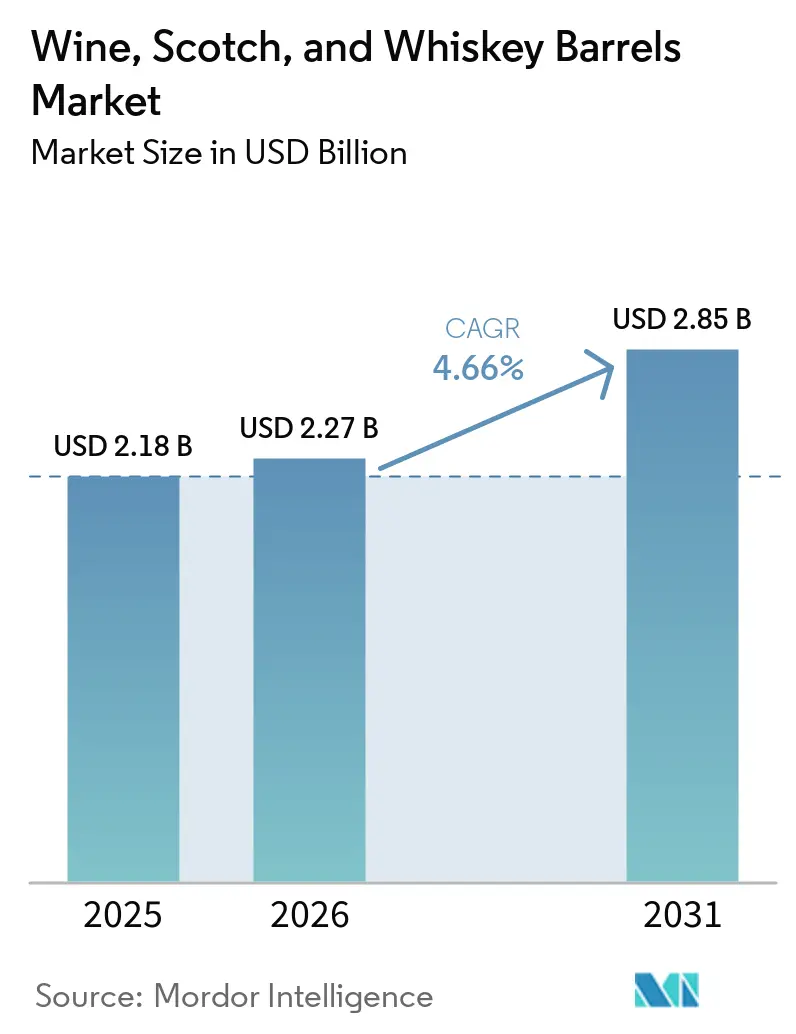
The wine and whiskey barrels market size was valued at USD 2.18 billion in 2025 and is estimated to grow from USD 2.27 billion in 2026 to reach USD 2.85 billion by 2031, at a CAGR of 4.66% during the forecast period (2026-2031). The wine and whiskey barrels market is being supported by demand for vessels that help producers create differentiated aged drinks with consistent flavor profiles, improved maturation characteristics, and premium positioning. Premium wine and spirits producers are prioritizing barrel specifications, flavor consistency, oak origin, toast levels, and provenance over simple order volume. This shift supports value per barrel when broader beverage alcohol volumes are under pressure, as producers continue investing in high-quality aging and finishing solutions to protect brand equity. Producers are also broadening the use of barrels across whisky, tequila, rum, and wine programs, which creates demand for specialized finishing casks and customized barrel formats. The wine and whiskey barrels market, therefore, depends increasingly on product mix, supply reliability, technical expertise, and exposure to growing regions rather than barrel count alone.
Key Report Takeaways
- By material type, American oak held 67.51% of the wine and whiskey barrels market share in 2025, while Japanese oak is forecast to grow at a 6.46% CAGR through 2031.
- By toast/char level, Heavy Toast/Char accounted for 54.62% of the wine and whiskey barrels market size in 2025, while Medium-Plus Toast/Char is projected to expand at a 5.11% CAGR through 2031.
- By application, wine held 44.90% revenue share in 2025, while bourbon recorded the highest projected CAGR at 5.32% through 2031.
- By end user, large distilleries accounted for 36.13% of revenue in 2025, while craft distilleries are forecast to grow at a 6.91% CAGR through 2031.
- By geography, North America held 42.91% revenue share in 2025, while Asia-Pacific is projected to grow at a 5.98% CAGR through 2031.
Note: Market size and forecast figures in this report are generated using Mordor Intelligence’s proprietary estimation framework, updated with the latest available data and insights as of January 2026.
Global Wine, Scotch, and Whiskey Barrels Market Trends and Insights
Drivers Impact Analysis*
| Driver | (~) % Impact on CAGR Forecast | Geographic Relevance | Impact Timeline |
|---|---|---|---|
| Premiumization of wine and aged spirits | +1.2% | Global | Medium term (2-4 years) |
| Expansion of craft distilleries and boutique wineries | +0.8% | North America and Europe | Medium term (2-4 years) |
| Demand for customized toast, char, and flavor profiles | +0.7% | Global | Short term (≤ 2 years) |
| Growth of cross-category aging | +0.5% | Global | Short term (≤ 2 years) |
| Underdeveloped white oak recruitment and regeneration programs | +0.4% | North America | Long term (≥ 4 years) |
| Digital traceability of oak origin and barrel fill history | +0.2% | Europe and North America | Medium term (2-4 years) |
| Source: Mordor Intelligence | |||
Premiumization of wine and aged spirits
Despite broad softening in beverage alcohol volumes during 2025, with global spirits volumes declining approximately 1% excluding national spirits according to IWSR, premiumization continues to redirect value toward oak-aged and barrel-finished categories. Consumers increasingly prioritize distinctive flavor, provenance, craftsmanship, and maturation quality, supporting demand for higher-specification barrels even when overall beverage volumes remain subdued. For the cooperage market, this creates an opportunity to offset slower unit demand through premium barrel specifications, customized toast and char profiles, longer wood seasoning, and specialty oak varieties such as French, Mizunara, and Eastern European oak. The less-obvious implication is that cooperages capable of offering consistent wood provenance, controlled seasoning, precise toasting, and application-specific barrel design can command stronger margins than suppliers competing primarily on volume and standardized products. Premium spirits such as Suntory’s Yamazaki 18 Years Old Mizunara demonstrate how distinctive oak provenance can become an integral part of product differentiation and premium positioning. Similarly, the increasing use of specialty cask finishes across whiskey, rum, tequila, and other aged spirits is encouraging distillers to experiment with different wood origins and maturation techniques, creating additional demand for specialized cooperage products.
Expansion of craft distilleries and boutique wineries
U.S. craft distillery counts declined 25.6% to 2,282 active producers by August 2025, per the American Craft Spirits Association (ACSA) 2025 Craft Spirits Data Project, but the demand dynamic from surviving operators is more favorable than the headline attrition suggests[1]. Craft spirits value reached USD 7.58 billion in 2024 despite a 6.1% volume decline, per the American Craft Spirits Association (ACSA), with in-state sales accounting for 48.5% of the total, reflecting a pivot toward direct-to-consumer, high-margin programming rather than wholesale-volume growth. The cooperages gaining from this dynamic are those capable of fulfilling small-lot, high-specification orders for single-barrel programs: tight-grain French oak, virgin new oak, or custom toast profiles above standard medium specifications. Internationally, craft distillery growth in Japan, India, the UK, and Australia is partially offsetting U.S. attrition, bringing fresh demand for premium cooperage from markets that historically purchased commodity barrels from large producers. Boutique wineries across Chile, Argentina, New Zealand, and Australia maintain elevated barrel replacement rates, refreshing cooperage every 1–2 vintages, to maximize wood contribution in premium cuvées, providing a steady base of value-dense orders outside the troubled mainstream wine volume market.
Demand for customized toast, char, and flavor profiles
Demand for customized toast, char, and flavor profiles is increasingly supporting growth in the global wine, Scotch, and whiskey barrels market as producers seek greater control over the sensory characteristics and differentiation of their beverages. The Australian Wine Research Institute (AWRI) notes that toast intensity materially influences the extraction of oak-derived compounds, with compounds associated with smoky, spicy, and toasted characteristics increasing at different toast levels. This makes barrel specification an important tool for winemakers seeking particular flavor outcomes rather than treating barrels as standardized inputs. The trend is also evident in the cooperage industry, with Cooperages 1912 expanding its Custom Barrel Program in 2025 to develop barrels around customers' desired organoleptic profiles, supported by oak selection and GCMS analysis. Tonnellerie Ô similarly introduced its Bespoke Selections program in April 2025, offering tailored barrels and oak-sample analysis to achieve specific sensory profiles. In spirits, the Scotch Whisky Association's 2025 guidance recognizes maturation and finishing across new oak and casks previously holding bourbon, whisky, wine, rum, fortified wine, and beer, expanding the scope for producers to create differentiated maturation profiles while maintaining Scotch's required sensory characteristics. The American Craft Spirits Association's 2025 awards also demonstrate the breadth of cask experimentation, with recognized whiskeys using double oak, rum, Madeira, bourbon, and other cask-finishing approaches. Consequently, cooperages capable of offering precise toast/char customization, differentiated wood origins, cask finishing options, and reproducible flavor profiles can capture higher-value orders and strengthen customer relationships, making customization an increasingly important growth driver.
Growth of cross-category aging
The use of wine and spirits barrels across categories has escalated from a craft-segment curiosity to a mainstream brand-strategy lever. Lost Explorer's May 2026 launch of a reposado tequila aged simultaneously in Sauternes wine, Pedro Ximénez Sherry, and Bourbon casks, a first for the category, and Ron Matusalem's July 2026 Sublime Kiku rum finished in Japanese sake casks illustrate how cross-category barrel use now attracts ultra-premium positioning and global press coverage. For cooperage market participants, this trend sustains demand for spent primary aging barrels repurposed as finishing vessels, particularly Sherry butts, Sauternes casks, and ex-bourbon hogsheads, as secondary-market assets with measurable flavor value. The structural hedge this provides is underappreciated: even as global still wine volumes declined approximately 5% in 2025 per IWSR data, ex-wine barrels are finding active demand from spirits producers who prize the residual wine compounds that leach into the finishing liquid. Equally, the bourbon overstock situation in Kentucky is inadvertently creating a supply of affordable ex-bourbon barrels for rum, gin, and tequila producers, a counter-cyclical demand channel that partially absorbs bourbon cooperage's near-term overcapacity.
Restraints Impact Analysis*
| Restraint | (~) % Impact on CAGR Forecast | Geographic Relevance | Impact Timeline |
|---|---|---|---|
| High cost and long lead time of cooperage-grade oak | -1.0% | Global | Long term (≥ 4 years) |
| Storage, transport, cleaning, and maintenance costs | -0.6% | Global | Short term (≤ 2 years) |
| Climate and trade-policy exposure across oak supply chains | -0.8% | Europe and North America | Medium term (2-4 years) |
| Limited standardization of reused-barrel sensory performance | -0.3% | Global | Medium term (2-4 years) |
| Source: Mordor Intelligence | |||
High cost and long lead time of cooperage-grade oak
The structural mismatch between oak supply cycles measured in decades and cooperage demand measured in quarters is an underappreciated risk for buyers planning multi-year barrel procurement. French standing oak timber averaged EUR 190/m³ in 2025, down 17% from EUR 228/m³ in 2024, the third consecutive annual decline, per France Bois Forêt data, yet this price correction reflects demand collapse in the cooperage sector rather than improved supply fundamentals: cooperage-grade timber had tripled in price over the prior decade before the 2025 slump, and traditional cooperage methods utilize only 15–20% of harvested logs as usable stave material. In Poland, structural supply deficits deepened into 2026, with W_STANDARD oak prices holding near EUR 306/m³ despite weak demand, driven by administrative harvesting restrictions. Kentucky white oak stave bolt prices for bourbon cooperage reached USD 1,050–3,600 per MBF in Q1 2026, with high-grade white oak up 12.8% year-over-year per the University of Kentucky's quarterly delivered price survey, underscoring tightness at the premium end of American oak supply. Regulatory influence through SFI (Sustainable Forestry Initiative) chain-of-custody certification requirements, and the bipartisan U.S. Senate bill introduced in February 2025 concerning American white oak forest management, adds compliance factors that will further extend procurement lead times and verification costs across the global oak barrel supply chain.
Climate and trade-policy exposure across oak supply chains
Climate stress on European oak forests and escalating tariff regimes represent compounding, partially correlated risks materially reshaping cooperage supply chains. French cooperage-grade Quercus petraea, requiring over 150 years to reach maturity, has been subjected to prolonged droughts, particularly the 2022 event, resulting in premature tree mortality and reduced organoleptically suitable timber, with Tonnellerie Allaume working with the French National Forestry Office (ONF) on replanting programs in northern France as a long-horizon mitigation. On the trade front, U.S. bourbon exports fell 15% in 2025 per U.S. Census data, compounding an earlier 26% decline from 2018 tariff impacts, with exports to Canada dropping approximately 70% over 12 months as retaliatory measures took effect, according to the Kentucky Distillers' Association[2]. California wineries importing French barrels faced an estimated USD 36,000 additional cost per 150-barrel container under a 20% tariff scenario, directly compressing barrel budgets at high-end producers. The convergence of climate-stressed timber supply and trade-policy-constrained demand creates a cost-revenue squeeze, documented by TFF Group's FY2026 revenue decline of 26.5% and ISC's closure of multiple cooperage facilities in 2025–2026, that will influence cooperage investment decisions well beyond the near-term cycle.
*Our forecasts treat driver/restraint impacts as directional, not additive. The impact forecasts reflect baseline growth, mix effects, and variable interactions.
Segment Analysis
By Material Type: American Oak Dominance Masks Mizunara's Strategic Ascent
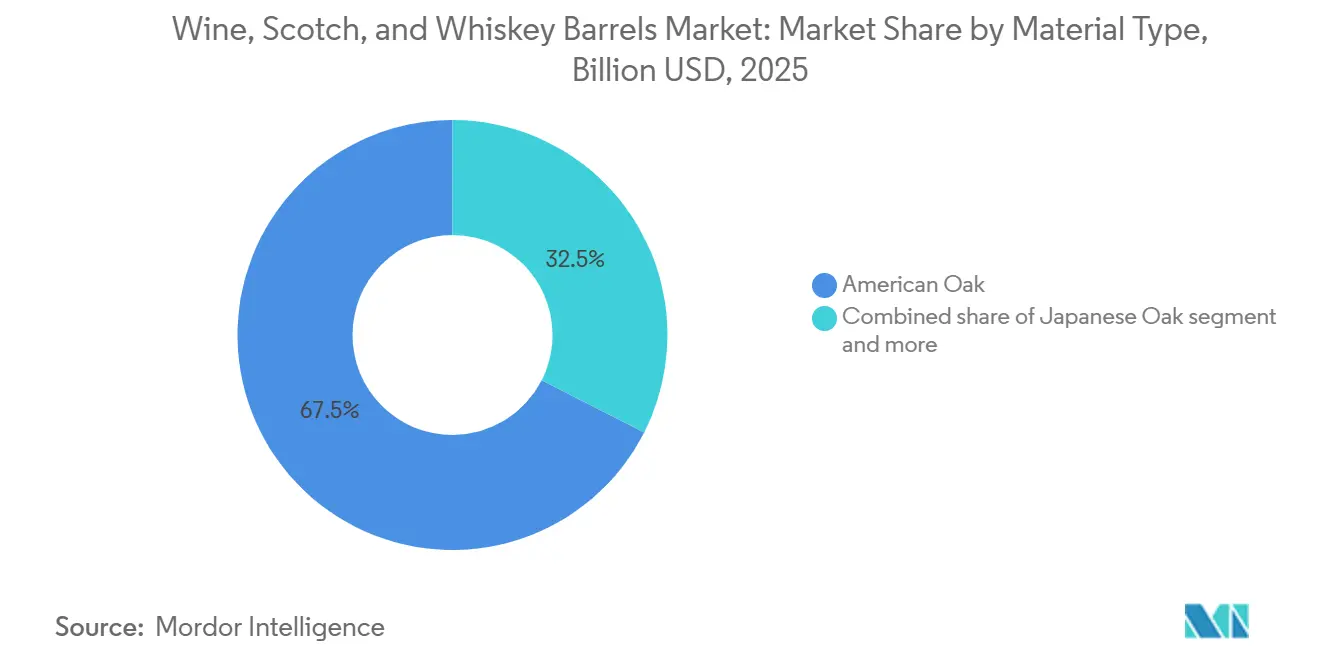
American oak accounted for 67.51% of 2025 market revenues, supported by the U.S. mandate that bourbon mature only in new, charred American white oak containers. This requirement ties Kentucky's record 16.1-million-barrel aging inventory directly to American cooperage demand and provides greater demand certainty than French or Eastern European peers, while increasing exposure to the bourbon cycle. French oak remains the second-largest material type, favored by premium wine producers and Scotch malt whisky distillers for its tighter grain and higher ellagitannin content. Eastern European oak is gaining share as a lower-cost alternative, though Poland's supply deficit deepening into 2026 is challenging that advantage. Other materials, including acacia, chestnut, and emerging species, serve niche applications in natural wine and craft brewing.
Japanese oak (Mizunara) is the fastest-growing material type at a 6.46% CAGR (2026–2031), driven by consumer demand and supply constraints. Mizunara trees require about 200 years to reach cooperage maturity, and Japan tightly regulates logging. Only Suntory's in-house cooperage and Oumi Cooperage currently fabricate Mizunara barrels, limiting output and keeping single-cask prices above USD 5,000–6,000. By February 2026, Japanese wineries such as Musashi Winery were experimenting with Mizunara aging for red wine from indigenous grape varieties, extending demand beyond whisky. Mizunara remains a high-value, low-volume segment with strong pricing power for participating cooperages.

By Toast/Char Level: Flavor Science Shifting the Heavy Toast/Char Majority
Heavy Toast/Char held 54.62% of the 2025 market value, supported by bourbon's legal charring mandate and the popularity of heavily charred barrels among American and Irish whiskey producers. Research shows heavy toasting at temperatures up to 230°C converts wood macromolecules into volatile phenols, caramelized sugars, vanillin, furfural, and guaiacol, which define classic bourbon character. Medium Toast/Char and Light Toast/Char serve wine and delicate whisky segments, while untoasted/raw barrels remain a small but growing niche in natural wine and experimental craft spirits.
Medium-Plus Toast/Char is the fastest-growing segment at a 5.11% CAGR (2026–2031), filling the specification gap between medium and heavy profiles. At 190–210°C for up to 5 minutes, Medium-Plus delivers vanilla, spice, and brown-sugar complexity without the full smoky dominance of heavy char, making it suitable for Scotch finishing, rum aging, and premium new-world wine maturation. Cooperages are responding with proprietary toast-curve protocols; OENEO's Icône process at Seguin Moreau uses barrel chemical composition analysis to ensure consistent wooded profiles. This documentation capability is becoming a differentiator for cooperages targeting premium distillers that prioritize barrel performance.
By Application: Wine's Revenue Lead Belies Bourbon's Long-Cycle Growth Momentum
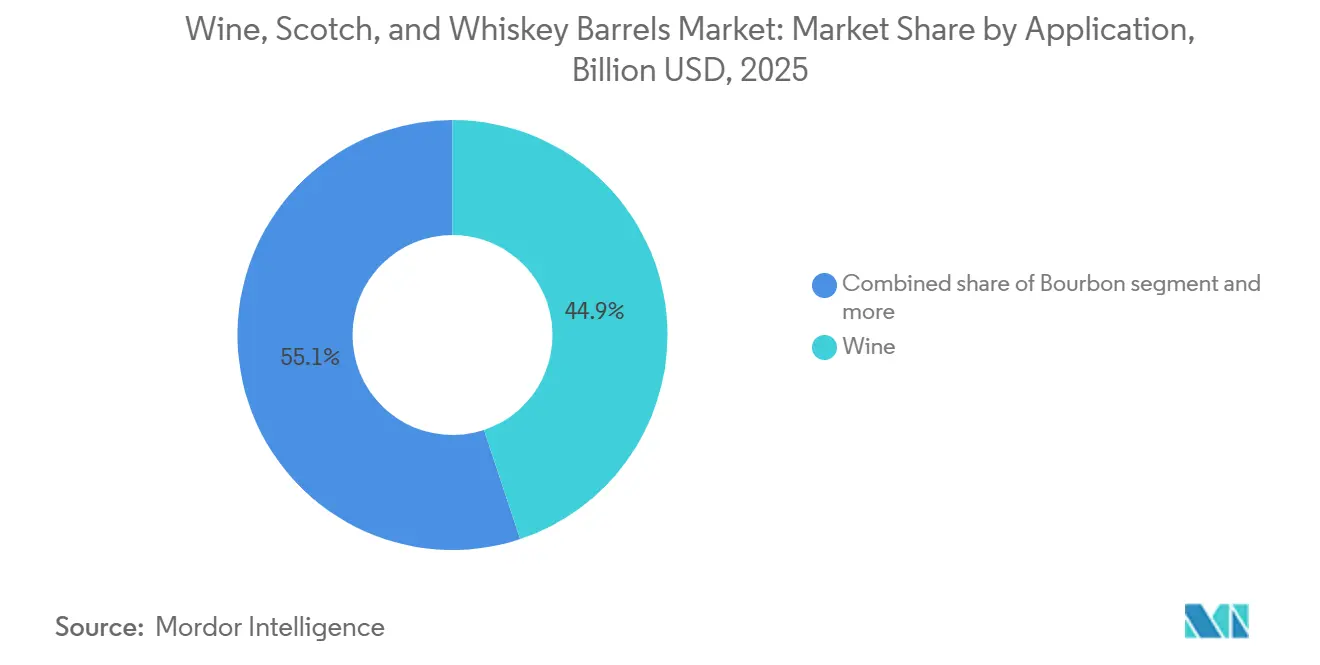
Wine maintained the largest application share at 44.90% of 2025 revenues, though the structural context is nuanced: global still wine volumes declined approximately 5% in 2025 per IWSR, with notable falls in China, France, Germany, Italy, the UK, and the United States. Persistent barrel demand from wine producers reflects premium New World winery growth, particularly in Chile, Argentina, Australia, and New Zealand, partially offsetting Old World contraction, combined with high barrel replacement rates at estates targeting premium cuvées that maximize wood influence. Scotch is the second-largest application, sustaining demand through single malt aging programs and cask-finish innovations, though Scotch cask prices softened in 2025 per TFF Group's disclosures. Other spirits aging, rum, tequila, gin, and non-whiskey categories, remain small by value but are the segment growing fastest in specification diversity and geographic breadth.
Bourbon is the fastest-growing application at a 5.32% CAGR (2026–2031), appearing paradoxical against Kentucky's record 16.1-million-barrel inventory as of 2026, but reflecting long-cycle production commitments and emerging market demand that are not yet reflected in near-term orders. Kentucky distillers filled 3.03 million barrels in 2024 per the Kentucky Distillers' Association, 25% above 2020 production volumes, and collectively planned USD 1.45 billion in capital expenditure over the next five years at the time of the report, betting on an India-anchored demand recovery. India's reduction of bourbon import tariffs from 150% to 50% effective February 13, 2025, combined with its premium spirits segment posting double-digit volume growth, creates a meaningful long-run barrel demand corridor that producers are already positioning for through forward procurement.
By End User: Large Distilleries Anchor Volumes while Craft Operators Drive Specification Premiums
Large distilleries held 36.13% of the 2025 market value, reflecting the volume concentration of global barrel procurement within a relatively small number of major spirits producers. Wineries represent the second-largest end-user segment, with procurement closely correlated to annual harvest volume; climatic variability in both 2024 and 2025 vintages introduced significant uncertainty into winery barrel budgets, particularly in Europe and California. Breweries are a smaller but expanding segment as barrel-aged craft beer, finished in ex-bourbon, ex-wine, and ex-spirit barrels, becomes a standard premium offering at craft breweries globally. Other end users include independent bottlers, cask investment platforms, and hospitality operators running bespoke aging programs for on-site consumption.
Craft distilleries are the fastest-growing end-user segment at a 6.91% CAGR (2026–2031), a projection that resolves the apparent contradiction with the 25.6% drop in U.S. craft distillery counts by August 2025. The operators exiting were disproportionately low-margin, commodity-style producers; survivors are investing in single-barrel programs and custom cooperage specifications that command retail premiums above USD 60–100 per bottle. ACSA data confirms that craft spirits value reached USD 7.58 billion in 2024 despite volume declines, confirming value growth among remaining operators. Internationally, craft distillery growth in Japan, Australia, India, and the UK is adding fresh demand from markets that historically relied on standard-specification barrels, a structural shift that diversifies craft cooperage demand geographically while sustaining its premium specification profile.
Geography Analysis
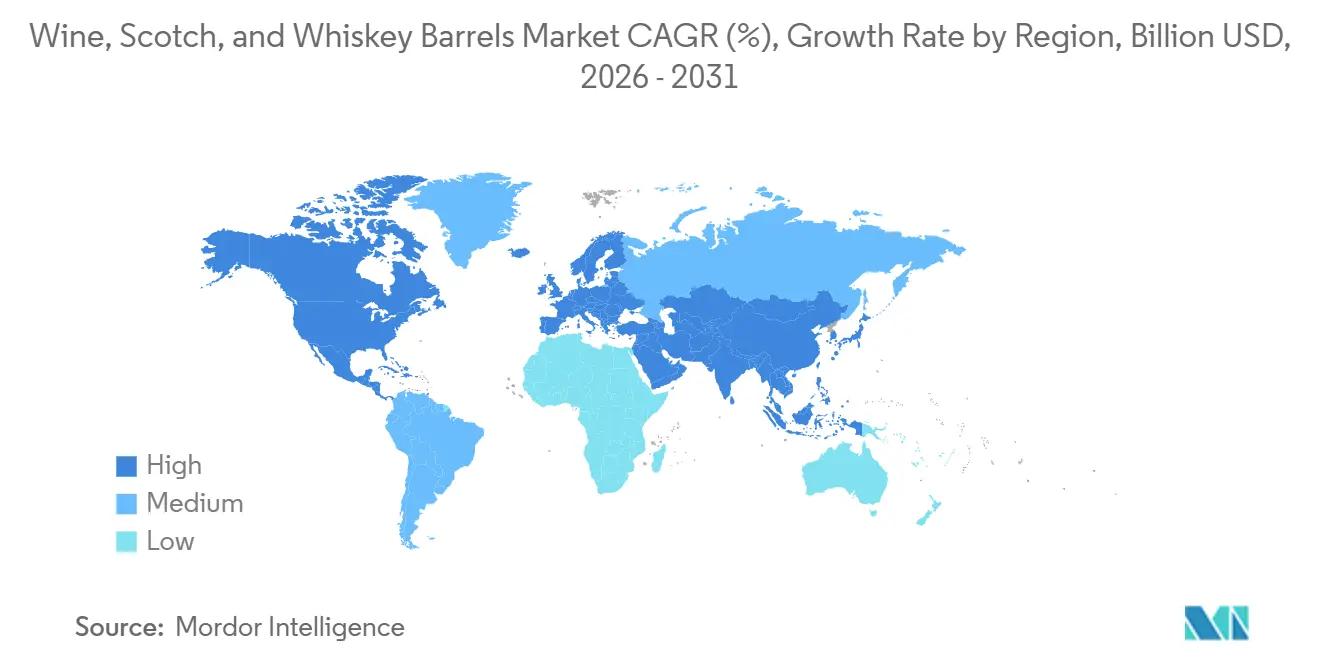
North America held 42.9% revenue share in 2025, making it the largest regional position. The region’s importance is tied to American white oak supply and the requirement for bourbon to mature in new charred oak containers. Kentucky is the core demand center because it combines substantial distilling capacity with a large aging inventory. The Kentucky bourbon sector generated USD 10.6 billion in annual economic impact and supported nearly 24,000 jobs, according to the Kentucky Distillers’ Association[3]. California and the Pacific Northwest provide a complementary demand base through wine production. Canada and Mexico contribute smaller but expanding sources of demand through premium Canadian whisky and tequila finishing programs. Their requirements can include new oak as well as barrels that have been used for bourbon, wine, or other spirits. North American suppliers must balance long-term bourbon demand with short-term capacity adjustments during periods of high inventory. The region also offers a deep base of stave mills, cooperages, distillers, wineries, and logistics providers. This breadth makes North America important to the wine and whiskey barrels market even when individual beverage categories are under pressure.
Europe remains the historic center of artisanal cooperage and premium French oak barrel production. The region combines forest resources, established cooperages, and regulated wine and spirit traditions. Protected product traditions for Cognac, Armagnac, Scotch, and recognized wine areas help sustain demand for certified European barrels. TFF Group completed its acquisition of the remaining 45% of Tonnellerie Remond in March 2026, strengthening its ultra-premium French oak offering. OENEO’s Twood addresses cost and wood-yield concerns through a different barrel construction approach.
Asia-Pacific is projected to grow at a 6.0% CAGR through 2031, the fastest regional rate. Japan anchors an ultra-premium segment through whisky production and the use of scarce Mizunara oak. Suntory has invested in production infrastructure at Yamazaki and Hakushu as it manages future demand for Japanese whisky. India adds a growing base of single malt producers using barrel aging to support domestic and export plans. China adds demand for imported wine barrels, while Chile and Argentina support Southern Hemisphere wine demand.
Competitive Landscape
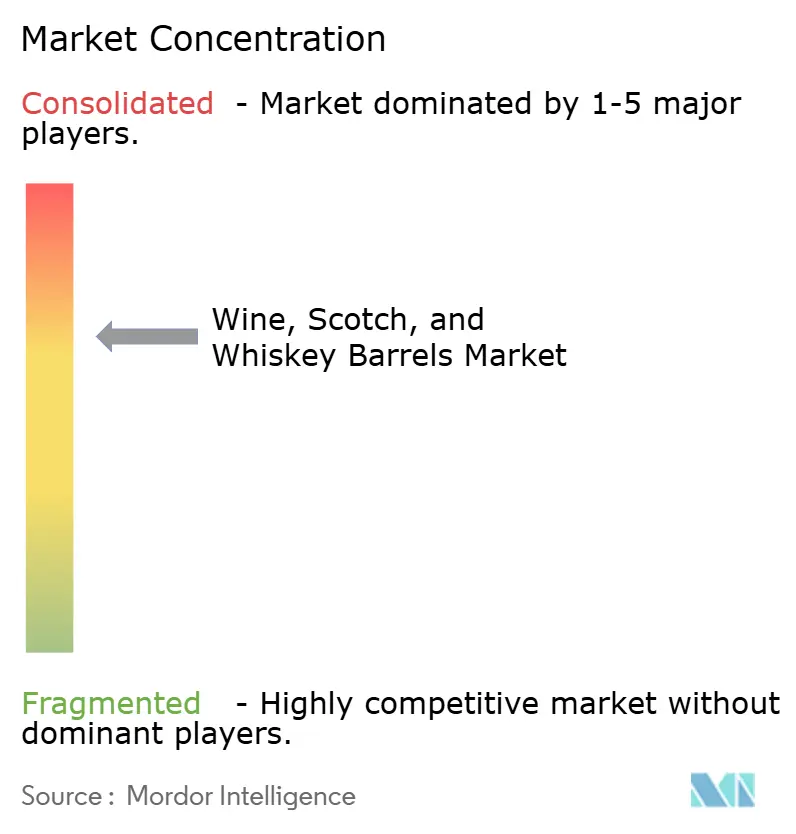
The wine and whiskey barrels market is moderately consolidated among 6 major global cooperage platforms, alongside specialty and regional producers serving local or narrow applications. Independent Stave Company, TFF Group, and OENEO are important participants because they operate across regions and combine barrel production with sourcing and seasoning capabilities. Their scale supports links with forest owners, stave mills, large beverage producers, and customers that need a consistent supply. Smaller cooperages can compete through regional material access, specific barrel formats, or recognized sensory expertise. Longer seasoning periods and reliable timber access make entry difficult in many premium categories. The wine and whiskey barrels market, therefore, favors companies that manage several stages of the value chain. A supplier needs appropriate timber, drying and seasoning capacity, controlled production, and dependable delivery. Large customers also expect continuity across long product maturation cycles. This makes supply relationships and material planning as important as production capacity. It also gives established platforms an advantage when customers need consistent performance across a broad barrel program.
Independent Stave Company has adjusted production capacity while investing in sustainability initiatives. The company announced solar installations at facilities in South America, Australia, and Kentucky in April 2026, linking energy investment with its wider operating strategy. It established a dedicated Sustainability Division in December 2025 to coordinate emissions reduction, renewable energy use, and resource stewardship. TFF Group’s full acquisition of Tonnellerie Remond reflects an approach centered on ultra-premium French oak specialization. These strategies show how leading suppliers are responding to demand pressure through capacity discipline, sustainability work, and premium differentiation.
Opportunity areas include certified sourcing, cask traceability, and products that improve timber yield. Heinrich Cooperage in South Australia achieved SFI Chain of Custody certification in July 2025, according to Independent Stave Company. OENEO’s Twood illustrates the commercial value of a barrel designed to use more of the harvested tree. Digital records of oak origin and barrel fill history can improve confidence in reused casks. Competition is therefore based on verified materials, repeatable barrel performance, and the ability to serve premium buyers as well as annual capacity.
Wine, Scotch, and Whiskey Barrels Industry Leaders
-
Independent Stave Company
-
Tonnellerie François Frères SA
-
OENEO SA
-
Speyside Cooperage
-
Kelvin Cooperage
- *Disclaimer: Major Players sorted in no particular order
Recent Industry Developments
- March 2026: TFF Group (Tonnellerie François Frères) completed the acquisition of the remaining 45% stake in Tonnellerie Remond, achieving 100% ownership four years ahead of the original 2028 shareholder agreement timeline. The transaction strengthened TFF's ultra-premium French oak wine barrel offering and secured sourcing and business development synergies built over the prior four years.
- January 2026: Proof 8 partnered with DPS Group's Cockayne Systems to integrate real-time cask-filling data directly into its blockchain-based digital deed platform, eliminating manual data entry and enabling a continuous, tamper-proof chain-of-custody record from the moment of cask filling, a recognition level that came with its DISCUS Innovation Showcase top-3 designation in 2025.
- September 2025: OENEO Group launched Twood, a next-generation French oak barrel using a patented bilayer stave assembly process at a launch price of EUR 690 excluding tax (approximately one-third below traditional cooperage). The process utilizes up to 50% of harvested timber compared to the 15–20% yield of conventional barrel-making, addressing both oak supply scarcity and winemaker cost pressure in a single innovation.
Global Wine, Scotch, and Whiskey Barrels Market Report Scope
Barrels used for wine, Scotch, and whiskey are specialized wooden containers crafted to age and mature alcoholic beverages, shaping their color, aroma, and flavor. The wine, scotch, and whiskey barrels market report is segmented by material type, toast/char level, application, end user, and geography. By material type, the market is segmented into American, French, Eastern European, Japanese Oak, and other. By toast/char level, the market is segmented into untoasted, light, medium, medium-plus, and heavy. By application, the market is segmented into wine, scotch, bourbon, and other. By end user, the market is segmented into wineries, large and craft distilleries, breweries, and other. By geography, the market is segmented into North America, Europe, Asia-Pacific, South America, and the Middle East and Africa. Forecasts are in value (USD).
| American Oak |
| French Oak |
| Eastern European Oak |
| Japanese Oak |
| Other Materials |
| Untoasted/Raw |
| Light Toast/Char |
| Medium Toast/Char |
| Medium-Plus Toast/Char |
| Heavy Toast/Char |
| Wine |
| Scotch |
| Bourbon |
| Other Spirits Aging |
| Wineries |
| Large Distilleries |
| Craft Distilleries |
| Breweries |
| Other End Uers |
| North America | United States |
| Canada | |
| Mexico | |
| Rest of North America | |
| Europe | United Kingdom |
| Germany | |
| France | |
| Italy | |
| Spain | |
| Sweden | |
| Belgium | |
| Poland | |
| Netherlands | |
| Rest of Europe | |
| Asia-Pacific | China |
| Japan | |
| India | |
| Thailand | |
| Singapore | |
| Indonesia | |
| South Korea | |
| Australia | |
| Rest of Asia-Pacific | |
| South America | Brazil |
| Argentina | |
| Colombia | |
| Peru | |
| Chile | |
| Rest of South America | |
| Middle East and Africa | United Arab Emirates |
| South Africa | |
| Saudi Arabia | |
| Nigeria | |
| Egypt | |
| Morocco | |
| Turkey | |
| Rest of Middle East and Africa |
| Material Type | American Oak | |
| French Oak | ||
| Eastern European Oak | ||
| Japanese Oak | ||
| Other Materials | ||
| Toast/Char Level | Untoasted/Raw | |
| Light Toast/Char | ||
| Medium Toast/Char | ||
| Medium-Plus Toast/Char | ||
| Heavy Toast/Char | ||
| Application | Wine | |
| Scotch | ||
| Bourbon | ||
| Other Spirits Aging | ||
| End User | Wineries | |
| Large Distilleries | ||
| Craft Distilleries | ||
| Breweries | ||
| Other End Uers | ||
| Geography | North America | United States |
| Canada | ||
| Mexico | ||
| Rest of North America | ||
| Europe | United Kingdom | |
| Germany | ||
| France | ||
| Italy | ||
| Spain | ||
| Sweden | ||
| Belgium | ||
| Poland | ||
| Netherlands | ||
| Rest of Europe | ||
| Asia-Pacific | China | |
| Japan | ||
| India | ||
| Thailand | ||
| Singapore | ||
| Indonesia | ||
| South Korea | ||
| Australia | ||
| Rest of Asia-Pacific | ||
| South America | Brazil | |
| Argentina | ||
| Colombia | ||
| Peru | ||
| Chile | ||
| Rest of South America | ||
| Middle East and Africa | United Arab Emirates | |
| South Africa | ||
| Saudi Arabia | ||
| Nigeria | ||
| Egypt | ||
| Morocco | ||
| Turkey | ||
| Rest of Middle East and Africa | ||
Key Questions Answered in the Report
What is the forecast for wine and whiskey barrels?
The wine and whiskey barrels market is forecast to grow from USD 2.27 billion in 2026 to USD 2.85 billion by 2031, at a 4.66% CAGR.
Which wood type leads barrel demand?
American oak led with 67.51% revenue share in 2025, supported by the requirement that bourbon use new charred oak containers.
Why are custom toast and char profiles important?
Producers use tailored heat treatments to manage flavor, aroma, color, and mouthfeel, while repeatable specifications support premium product positioning.
Which application has the strongest forecast growth?
Bourbon has the highest projected application CAGR at 5.32% through 2031, despite short-term pressure from elevated barrel inventories.