
Wind Turbine Gearbox and Direct Drive Systems Market Size and Share
Market Overview
| Study Period | 2021 - 2031 |
|---|---|
| Forecast Data Period | 2026 - 2031 |
| Historical Data Period | 2021 - 2024 |
| Growth Rate | 3.11 % |
| Fastest Growing Market | Asia Pacific |
| Largest Market | Asia Pacific |
Major Players *Disclaimer: Major Players sorted in no particular order Image © Mordor Intelligence. Reuse requires attribution under CC BY 4.0. | |
Wind Turbine Gearbox and Direct Drive Systems Market Analysis by Mordor Intelligence
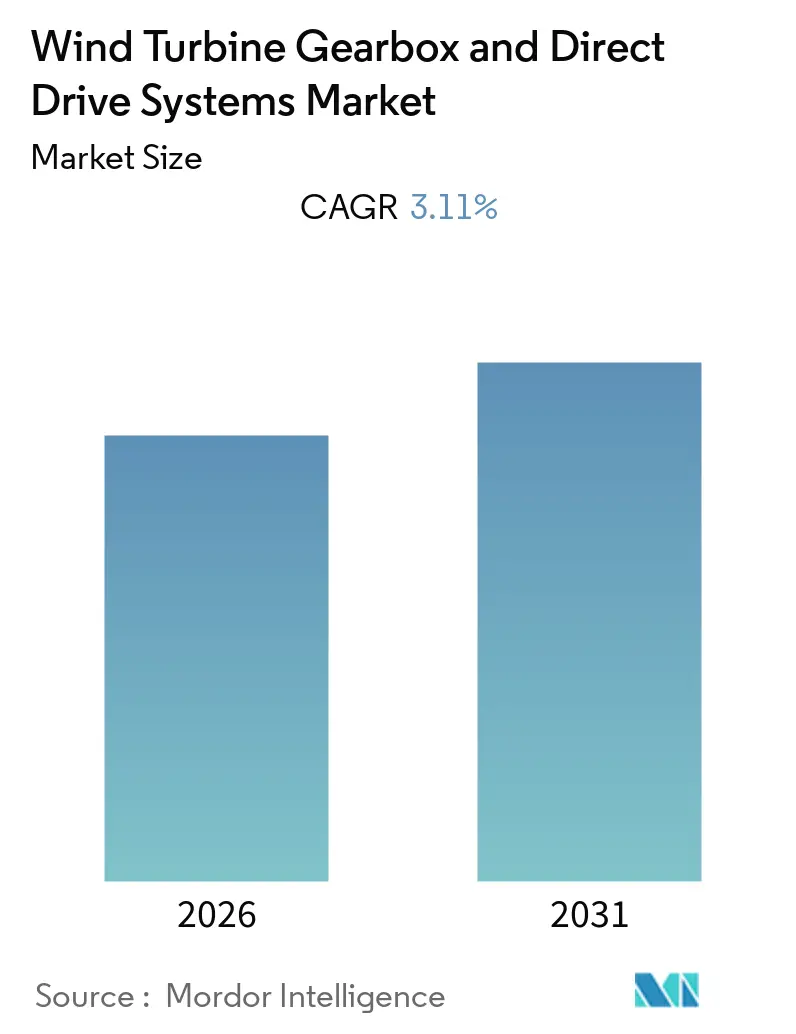
The Wind Turbine Gearbox and Direct Drive Systems Market size is expected to register a CAGR of 3.11% during the forecast period (2026-2031).
- The overall cost of offshore wind power reached to the lowest level and opened up new offshore locations that were previously inaccessible due to lack of investment and technology. These developments are accelerating the adoption of wind power worldwide and hence, these trends are likely to drive the wind turbine gearbox and direct drive systems market during the forecast period.
- Moreover, the integration of advanced technology in wind turbines gearbox and direct drive system will enable advanced condition monitoring and predictive maintenance which result in increased efficiency and reduced operational and maintenance costs, which is likely to provide the opportunity to a growth in the deployment of gearbox and direct drive system for wind turbines in coming future.
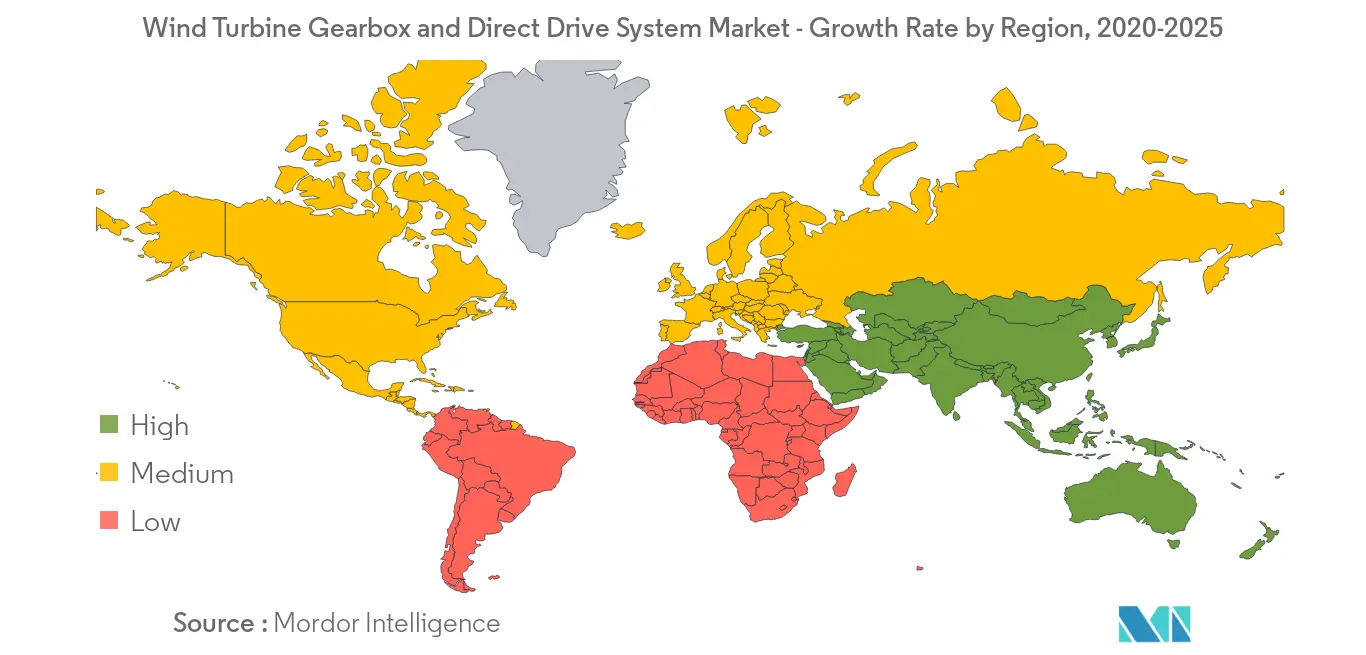
- Asia-Pacific is the largest as well as the fastest-growing wind turbine gearbox and direct drive systems market. According to the global wind energy council (GWEC), Asia-Pacific has the largest installed capacity of wind energy, majorly in China with 21.2 GW onshore wind power capacity.
Note: Market size and forecast figures in this report are generated using Mordor Intelligence’s proprietary estimation framework, updated with the latest available data and insights as of 2026.
Market Trends and Insights
Offshore Segment to Register Higher Growth
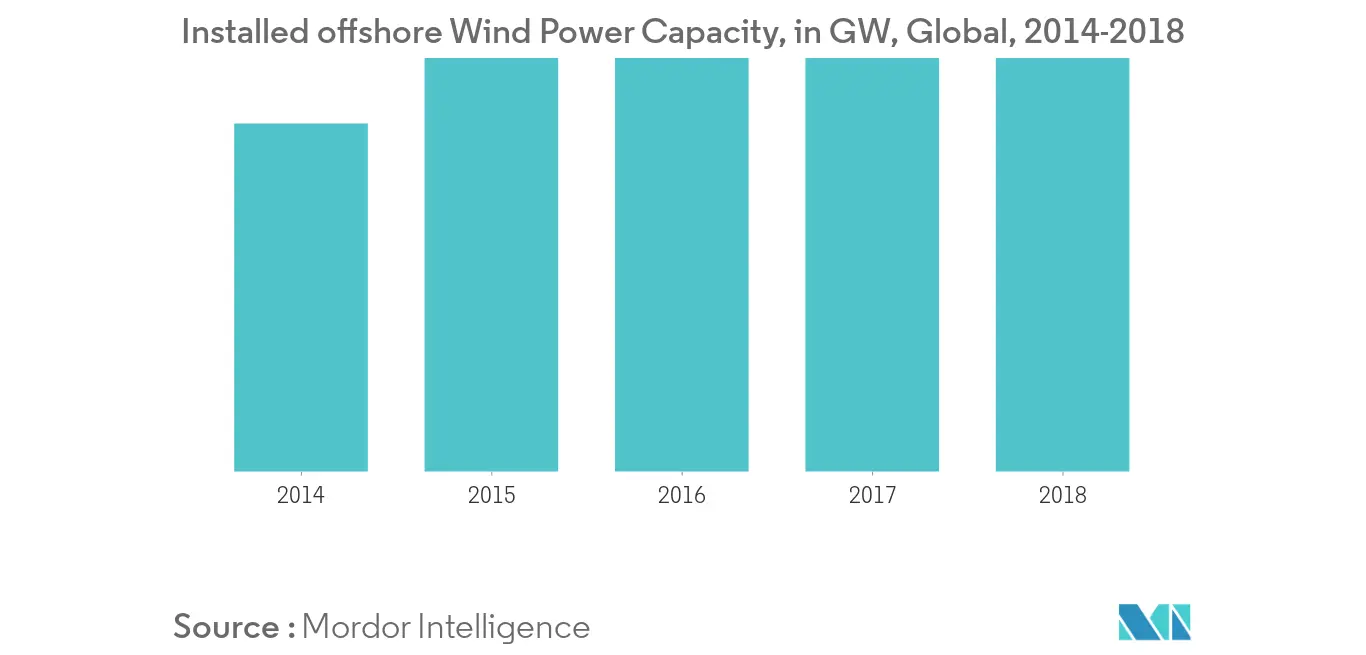
- The global offshore market remained stable in 2018 with 4.49 GW of new additions, almost the same market size as in 2017. The total cumulative offshore installations have reached 23.14 GW, representing a 24% increase in cumulative offshore wind installed capacity over the previous year.
- Globally, the share of offshore installations continues to increase and reached 8% for new installations and 4% of the total installations in 2018. By 2025, the share of the new installation is expected to exceed 10%, and the total installed based is expected to reach 100 GW.
- Global demand for the wind turbine gearbox market in the offshore sector is increasing at a significant rate. Even though Europe dominated the market with 59.9% of global annual offshore wind energy generation capacity at the end of 2018, Asia saw a substantial increase in offshore wind energy deployment, installation of 1.8 GW. By the end of 2018, the installed offshore wind power capacity has risen to 23.140 GW from 18.658 GW at the end of 2017, with a significant fraction of investments coming from the private sector.
- The wind turbine gearbox and direct drive systems market are required to be more robust and more efficient and, in turn, are costlier, as the wind speed in offshore regions is higher. Hence, the growth of the offshore wind energy sector is expected to have a significant positive impact on the market during the forecast period.
Asia-Pacific Region to Dominate the Market
- The installed wind capacity in Asia-Pacific increased to 256 GW in 2018 from 231.41 GW in 2017. The increase in wind capacity has been primarily dominated by the increase in China's installed capacity.
- According to IRENA, Asia-Pacificis poised to become the world's dominant wind market, accounting for more than 50% of onshore and 60% of offshore wind installations by 2050. Asia's onshore wind capacity is expected to grow from 256 GW in 2018 to over 2,600 GW by 2050.
- Furthermore, Owing to the large investments in countries like China and India, and emerging countries like Taiwan the wind sector investments are dominated by the Asia-Pacific region. Chinese manufacturers comprise nearly 95% of the overall wind power market. The government policy and incentives have made China a favorable hotspot for investment. At the beginning of 2017, China announced its plan to invest about USD 360 billion on renewable energy by 2020, turning down the plan of building 85 coal-fired power plants. In 2018, the country accounted for the largest share of about 45% of the new onshore global wind installed capacity.
- In addition, India holds the fourth-largest wind power installed capacity in the world. These projects are majorly spread in the northern, southern, and western parts of the country.The government has set a target of 60GW by 2022, and in order to achieve the target, the number of the project during the next two year are expected to increase drastically.
- This, in turn, is expected to present Asia-Pacific as an excellent business destination for players involved in the wind turbine gearbox and direct drive systems business during the forecast period.
Regulatory Landscape
International standards serve as a key compliance anchor for drivetrain and gearbox design, qualification, and documentation in the wind sector. In April 2025, the International Electrotechnical Commission published IEC 61400-4:2025 (replacing the 2012 edition) for wind turbine gearbox design requirements, including updated verification and validation clauses, requirements for plain bearings, and explicit alignment of compliance documentation with IECRE OD-501-2. In April 2026, IEC issued IEC/TS 61400-4-1:2026 on reliability assessment of drivetrain components, which supports more standardized benchmarking of drivetrain reliability and failure-mode assumptions across turbine classes.
Trade policy also feeds into the broader wind supply chain cost structure used in drivetrain procurement and project economics. The U.S. Department of Commerce continued antidumping and countervailing duty orders on utility-scale wind towers from China and Vietnam in October 2024. In July 2026, the U.S. International Trade Commission instituted sunset reviews on AD/CVD orders covering utility-scale wind towers from India, Malaysia, and Spain, keeping trade uncertainty in focus for developers and suppliers coordinating nacelle, tower, and drivetrain sourcing into the U.S. market.
Value Chain Analysis
The wind turbine gearbox and direct drive systems value chain starts with upstream materials and critical inputs such as specialized steel alloys and castings/forgings, large-diameter bearings, copper windings, power electronics, and, for permanent-magnet direct drive architectures, NdFeB rare-earth magnets. Core manufacturing covers gearbox design and machining, heat treatment, bearing integration, generator manufacturing for direct-drive systems, and system-level assembly and validation, followed by OEM integration into nacelles and delivery to onshore and offshore projects. Downstream activities include commissioning, condition monitoring, spare-parts provisioning, and overhaul or remanufacturing services that are increasingly tied to availability guarantees and lifecycle service agreements.
Constraints differ by drivetrain type. Direct-drive systems carry material supply risk due to heavy NdFeB dependence (commonly cited at roughly 1.5-2 tons per turbine) concentrated in China, while gearbox-based systems face bottlenecks in specialized bearing manufacturing and high-precision casting or forging capacity for large platforms. This has increased interest in medium-speed geared drivetrains for 10-15 MW classes as a compromise that reduces nacelle mass and rare-earth intensity versus DD-PMG while keeping geared complexity. In Europe, offshore supply chain pressures and contract-term resets have raised the emphasis on supplier qualification, lead-time management, and service readiness for complex nacelle and drivetrain subassemblies.
Competitive Landscape
The wind turbine gearbox and direct drive systems market is moderately fragmented due to many companies operating in the industry. The key players in this market include Dana Brevini SpA, Moventas Gears Oy, Winergy Group,Voith GmbH, NGC Gears, and others.
Wind Turbine Gearbox and Direct Drive Systems Industry Leaders
-
Dana Brevini SpA
-
Voith GmbH
-
Moventas Gears Oy
-
Winergy Group
-
NGC Gears
- *Disclaimer: Major Players sorted in no particular order

Wind Turbine Gearbox and Direct Drive Systems Market Companies Covered in this Report
- Dana Brevini SpA
- Siemens Gamesa Renewable Energy SA
- Moventas Gears Oy
- Winergy Group
- ISHIBASHI Manufacturing Co., Ltd.
- Suzlon Energy Ltd
- ZF Friedrichshafen AG
- NGC Gears
- Enercon GmbH
- China High Speed Transmission Equipment Group Co., Ltd
- Hitachi, Ltd.
- Voith GmbH
Read Analysis of Wind Turbine Gearbox and Direct Drive Systems Companies
Market Opportunities and Future Outlook
Opportunities center on drivetrain architectures and components that reduce mass, limit rare-earth exposure, and lower lifecycle service burden for large turbines, particularly as offshore scaling accelerates. Medium-speed geared solutions are gaining attention as developers and OEMs weigh gearbox maintenance considerations against direct-drive mass and NdFeB sourcing risk, and academic work in 2026 highlighted sizable mass-reduction potential for optimized 15 MW medium-speed drivetrain configurations compared with direct-drive alternatives. Parallel R&D on alternative drivetrain concepts, including the HyDrive hydraulic power-split drivetrain studied in 2026, points to active design exploration to improve operational flexibility and manage torque and speed variability at larger rotor diameters.
Reliability-driven component innovation and digitalization also widen the opportunity set across onshore repowering and offshore operations, where unplanned downtime and difficult access raise the value of improved bearing and monitoring solutions. In March 2025, Envision Energy reported large-scale application of in-house sliding bearings across 500 wind turbines, indicating OEM willingness to qualify new bearing approaches to address known drivetrain failure points. On the manufacturing side, June 2026 disclosures around a 15 MW onshore main gearbox entering mass production (with a stated 6% weight reduction versus comparable models) reinforce demand for lighter, higher-capacity gearbox platforms that can be industrialized for high-volume delivery and serviceability.
Recent Industry Developments in Wind Turbine Gearbox and Direct Drive Systems Market
- April 2026: NGC Transmission reported that its annual deliveries of yaw and pitch gearboxes exceeded 100,000 units in 2025, with cumulative deliveries reaching nearly one million units by the end of 2025. The scale reflects standardization and high-volume manufacturing leverage in critical nacelle subcomponents, supporting tighter lead times and cost-down efforts for turbine OEM platforms.
- September 2025: Voith introduced the E-Pack DS, an integrated electromechanical drive system combining an electrical machine with a high-speed gearbox for space-constrained industrial and power generation applications. The introduction highlights continued engineering investment in compact, integrated drivetrain modules that blend gearing and electrical elements, a direction aligned with efficiency and packaging requirements across large rotating equipment.
- June 2025: Dana Incorporated entered a definitive agreement for Allison Transmission to acquire Dana's Off-Highway business for approximately USD 2.7 billion. The transaction supports supplier portfolio reshaping that can influence capital allocation and strategic focus for drivetrain and power transmission capabilities across industrial end markets.
Wind Turbine Gearbox and Direct Drive Systems Market Report Scope and Research Methodology
Market Definition and Coverage
This market covers revenue earned from supplying wind turbine drivetrain solutions, focused on gearboxes and direct drive systems used in onshore and offshore wind turbines, across new installations and major replacements where the drive system is the primary item being purchased.
Scope exclusions: We exclude blades, towers, foundations, standard power electronics not sold as part of the drive system, and routine service work that does not involve a gearbox or direct drive replacement.
Segments Covered in This Report
- Location of Deployment
- Onshore
- Offshore
- Type
- Wind Turbine Gearbox
- Wind Turbine Direct Drive System
- Geography
- North America
- Europe
- Asia-Pacific
- South America
- Middle-East and Africa
Data Sources, Market Sizing, and Validation
Desk Research
Desk work starts with pinning down the demand base for wind turbines and the technical split between geared and direct drive designs, so the model does not drift into adjacent components. Public sources such as IEA wind statistics, IRENA renewable capacity data, the Global Wind Energy Council, and national energy agencies help map annual additions and the onshore versus offshore mix.
We also review customs trade statistics for major drivetrain component flows, patent databases for design shifts, and peer-reviewed engineering literature to sanity check drivetrain architecture trends. On the supply side, company filings, investor presentations, and credible industry press are used to understand production footprints and pricing direction. Where needed, paid subscriptions for company financials and for shipment-level import and export records are used only to sharpen assumptions, not to replace primary inputs. These examples are not exhaustive, and many other public sources were also used for data collection, validation, and clarification.
Primary Interviews and Surveys
Primary work is used to pressure test the desk assumptions on drivetrain choice, replacement cycles, and pricing, since these points often change faster than public datasets. We speak with a mix of drivetrain suppliers, wind project developers, and service channel participants, and we cover APAC, EMEA, and the Americas so regional design preferences and procurement patterns are captured.
Distribution of primary research fieldwork respondents
| Company type | Respondent position | Region |
|---|---|---|
| Top tier: 34% | CXOs: 13% | APAC: 45% |
| Mid tier: 52% | Functional/Unit leaders: 33% | EMEA: 37% |
| Smaller Players: 14% | Managers: 54% | Americas: 18% |
Market-Sizing & Forecasting
Sizing is built using a top-down pathway where annual wind capacity additions are reconstructed by region and then translated into drivetrain demand using the geared versus direct drive mix and typical drivetrain value per MW, which are then adjusted for offshore share and average turbine rating changes. Once the demand pool is built, we corroborate the results with selective bottom-up checks, such as sampling supplier shipment disclosures, channel checks on average selling prices, and comparing implied revenue to the capacity footprint of major manufacturing hubs.
Key inputs include annual onshore and offshore installations, average turbine nameplate ratings, drivetrain architecture share by region, replacement and refurbishment timing for older fleets, and price movement linked to materials and logistics. When bottom-up indicators are thin in a country, the gap is handled by applying regionally validated ratios and then re-checking them against import and export signals and interview feedback.
For forecasting, scenario analysis is used so the outlook reflects policy-driven build rates and offshore pipeline variability, and then the selected case is aligned to the consensus we hear from industry participants on near-term order books and medium-term technology direction. Each forecast year keeps the same variable logic so clients can reproduce the steps and see what changed when the output moves.
Data Validation & Update Cycle
Validation is done by comparing the model output to independent signals, including implied drivetrain value per MW, regional installation totals, and the observed mix shift between geared and direct drive designs. Outliers are flagged, and the underlying drivers are re-checked before sign-off, which often leads to a re-contact with interviewees if a price or mix assumption looks off.
A second analyst review is completed to confirm arithmetic, unit consistency, and that currency timing is applied the same way across regions. Reports are refreshed annually, and interim updates are triggered when material events happen, such as major policy changes, sudden installation slowdowns, or visible pricing resets. Before delivery, we do a fresh pass so the final view reflects the latest available public data and market feedback.
Mordor Intelligence's Wind Turbine Gearbox and Direct Drive Systems Market Size Measured Against Other Published Estimates
Published estimates for this market can vary a lot because firms do not always count the same drivetrain content, and they also use different timing for pricing and currency conversion. The result is that two numbers can look far apart even when both are directionally reasonable.
The main gap comes from whether direct drive is counted as a full turbine system or only as the drivetrain package. In addition, Mordor Intelligence counts only the gearbox and direct drive system value tied to wind turbine drivetrain procurement rather than folding in the full nacelle or turbine revenue.
Benchmark comparison
| Source | Market Size | Gaps in Research Methodology |
|---|---|---|
| Mordor Intelligence | USD 0.00 B (2026) | |
| Industry Research House A | USD 31.91 B (2024) | This figure appears to treat the scope more like a turbine-level market, which can pull in adjacent nacelle or broader turbine system revenue, and it also uses a different base year and forecast window that changes pricing assumptions. |
| Market Blog B | USD 7.20 B (2023) | The published number shows internal inconsistencies across stated base figures, and it likely uses simplified pricing progression without reconciling turbine rating shifts and the onshore versus offshore mix, which can compress the total. |
The spread in the table is mostly explained by scope handling and by how installation volumes are translated into drivetrain value per MW. By keeping the demand pool tied to wind builds, mix, and realistic drivetrain pricing checks, the estimate stays traceable to inputs that can be reviewed and updated year to year.
Key Questions Answered in the Report
What is the current Wind Turbine Gearbox and Direct Drive Systems Market size?
The Wind Turbine Gearbox and Direct Drive Systems Market is projected to register a CAGR of 3.11% during the forecast period (2026-2031)
Who are the key players in Wind Turbine Gearbox and Direct Drive Systems Market?
Dana Brevini SpA, Voith GmbH, Moventas Gears Oy, Winergy Group and NGC Gears are the major companies operating in the Wind Turbine Gearbox and Direct Drive Systems Market.
Which is the fastest growing region in Wind Turbine Gearbox and Direct Drive Systems Market?
Asia Pacific is estimated to grow at the highest CAGR over the forecast period (2026-2031).
Which region has the biggest share in Wind Turbine Gearbox and Direct Drive Systems Market?
In 2025, the Asia Pacific accounts for the largest market share in Wind Turbine Gearbox and Direct Drive Systems Market.
What years does this Wind Turbine Gearbox and Direct Drive Systems Market cover?
The report covers the Wind Turbine Gearbox and Direct Drive Systems Market historical market size for years: 2020, 2021, 2022, 2023 and 2024. The report also forecasts the Wind Turbine Gearbox and Direct Drive Systems Market size for years: 2026, 2027, 2028, 2029, 2030 and 2031.