
Wi-Fi 7 Router Market Size and Share
Market Overview
| Study Period | 2020 - 2031 |
|---|---|
| Market Size (2026) | USD 2.30 Billion |
| Market Size (2031) | USD 20.20 Billion |
| Growth Rate (2026 - 2031) | 54.43 % |
| Fastest Growing Market | Middle East |
| Largest Market | Asia-Pacific |
| Market Concentration | Medium |
Major Players *Disclaimer: Major Players sorted in no particular order Image © Mordor Intelligence. Reuse requires attribution under CC BY 4.0. | |
Wi-Fi 7 Router Market Analysis by Mordor Intelligence
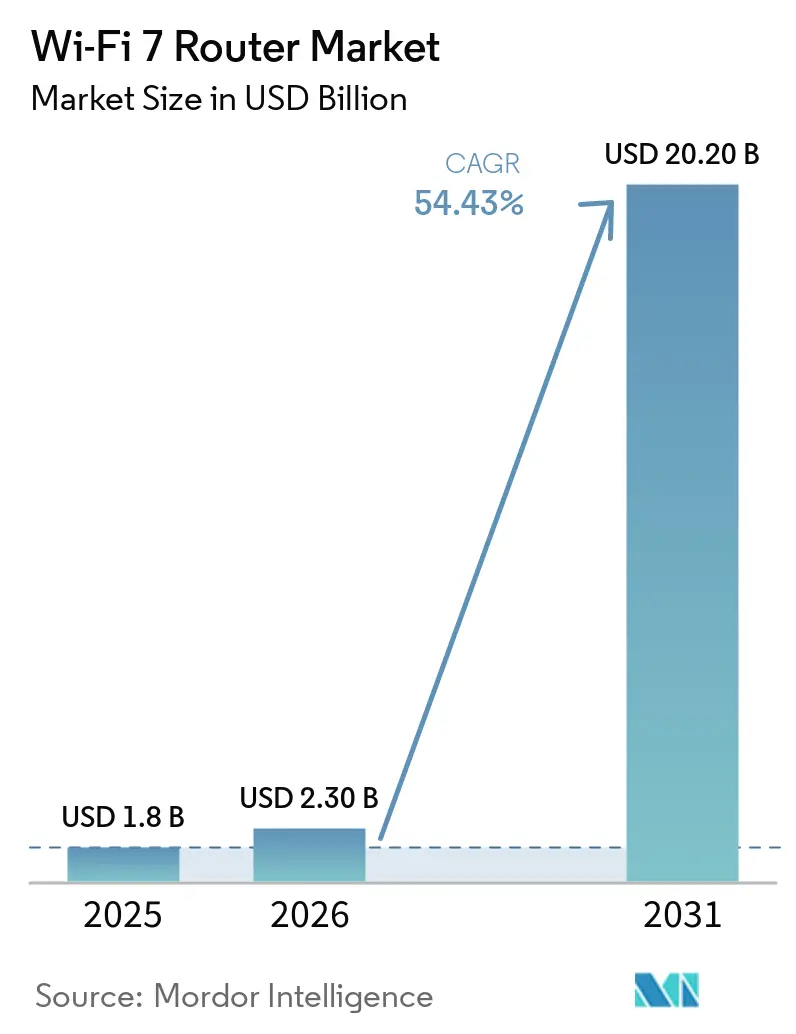
The Wi-Fi 7 router market size was valued at USD 1.8 billion in 2025 and is estimated to grow from USD 2.3 billion in 2026 to reach USD 20.2 billion by 2031, at a CAGR of 54.43% during the forecast period 2026-2031. New revenue models that bundle advanced customer-premises equipment with multi-gig broadband, together with enterprise demand for deterministic wireless links, are accelerating product refresh cycles. IEEE 802.11be’s combination of multi-link operation, 4096-QAM modulation, and 320 MHz channel bonding aligns with the rollout of 10 Gbps residential fiber tiers and latency-sensitive mixed-reality workloads. By early 2026, Wi-Fi 7 routers were outselling Wi-Fi 6 units in North America by a three-to-one margin, underscoring the speed of the current upgrade wave. The Wi-Fi 7 router market is also benefiting from falling entry-level prices, which have opened adoption to mass-market households while still creating premium niches for quad-band, industrial, and gaming-optimized designs.
Key Report Takeaways
- By Wi-Fi standard, tri-band configurations captured 46.22% of 2025 revenue, while quad-band models are poised to expand at a 60.12% CAGR through 2031.
- By design, mesh systems accounted for 51.72% of 2025 shipments, whereas gaming-optimized routers are forecast to register the fastest growth at 62.53% CAGR through 2031.
- By end-user application, residential deployments accounted for 37.93% of 2025 demand, while industrial IoT use cases are advancing at a 56.23% CAGR through 2031.
- By distribution channel, online retail accounted for 48.34% of 2025 sales, but enterprise direct procurement is projected to grow at a 55.41% CAGR during 2026-2031.
- By geography, Asia-Pacific led with a 34.12% revenue share in 2025, while the Middle East is set to grow the quickest at 57.81% CAGR through 2031.
Note: Market size and forecast figures in this report are generated using Mordor Intelligence’s proprietary estimation framework, updated with the latest available data and insights as of January 2026.
Global Wi-Fi 7 Router Market Trends and Insights
Drivers Impact Analysis*
| Driver | (~) % Impact on CAGR Forecast | Geographic Relevance | Impact Timeline |
|---|---|---|---|
| Surge in Multi-Gig Internet Plans Offered by ISPs | +12.5% | North America, Europe, Middle East | Medium term (2-4 years) |
| Enterprise Adoption of High-Density Wi-Fi in Smart Offices | +10.8% | Global urban centers | Medium term (2-4 years) |
| Expanding Rollout of 6 GHz Spectrum Across Major Economies | +9.2% | North America, Europe, Middle East, India, South Korea | Long term (≥ 4 years) |
| Proliferation of AR and VR Streaming Use-Cases | +7.6% | North America, Europe, Asia-Pacific | Short term (≤ 2 years) |
| Integrated Wi-Fi 7 CPE Bundling Deals by Telecom Operators | +6.9% | North America, Europe, Middle East, Southeast Asia | Short term (≤ 2 years) |
| 4K QAM Algorithm Enhancements Enabling Stable Throughput | +5.4% | Global | Medium term (2-4 years) |
| Source: Mordor Intelligence | |||
Surge in Multi-Gig Internet Plans Offered by ISPs
Telecom operators are bundling Wi-Fi 7 routers with 5 Gbps and 10 Gbps fiber tiers, shifting the device from a discretionary purchase to an embedded service layer. Google Fiber integrated Wi-Fi 7 hardware into its Home 3 Gig and Edge 8 Gig plans in February 2026, reinforcing contract lock-ins and reducing churn. Regional carriers are replicating this model, linking router demand directly to broadband differentiation. Compressed amortization cycles are pushing OEMs toward software-led monetization, while resale markets for Wi-Fi 6 devices are expanding in parallel.[1]
Enterprise Adoption of High-Density Wi-Fi in Smart Offices
Corporate campuses are upgrading from Wi-Fi 6 to Wi-Fi 7 access points to support densities above 100 devices per 1,000 square feet. Cisco Catalyst 9170-series uses multi-link operation to segregate latency-sensitive traffic on 6 GHz while shifting routine loads to 5 GHz, reducing contention. Ruckus Networks T670sn extends this into industrial settings with IEEE 802.[2]1AS-based timing for deterministic machine control. Wider 320-MHz channels increase per-radio throughput, lowering the total access point count and deployment cost. However, the complexity of spectrum coordination is accelerating enterprise adoption of cloud-managed network architectures.
Expanding Rollout of 6 GHz Spectrum Across Major Economies
Spectrum policy divergence is creating localized growth pockets for the Wi-Fi 7 router market. The Federal Communications Commission authorized general-vicinity-power operation with geofencing in January 2026, enabling outdoor deployments across stadiums and transit hubs. South Korea increased indoor power limits to 1 W EIRP in 2025, allowing tri-band routers to operate at full throughput. India de-licensed 5925-6425 MHz in January 2026, accelerating enterprise and residential upgrades.[3] In contrast, China allocated 6 GHz to IMT services, restricting domestic offerings to dual-band designs. This regulatory fragmentation forces chipset vendors to maintain region-specific SKUs, increasing BOM costs and extending development cycles
Proliferation of AR and VR Streaming Use-Cases
Mixed-reality headsets require sustained ~150 Mbps throughput and sub-20 ms latency, levels that saturate shared Wi-Fi 6 networks under multi-user loads. Wi-Fi 7 addresses this via multi-link operation across 6 GHz and 5 GHz bands, effectively increasing usable bandwidth while stabilizing latency for time-sensitive applications such as esports, simulation training, and industrial visualization. Gaming arenas are standardizing on Wi-Fi 7 to meet single-digit millisecond responsiveness requirements. ASUS TUF Gaming BE9400 router reflects this shift by prioritizing headset traffic with 4096-QAM to reduce packet loss. Despite limited consumer VR content, enterprises are deploying Wi-Fi 7 preemptively to support future high-fidelity collaboration workloads.
Restraints Impact Analysis*
| Restraint | (~) % Impact on CAGR Forecast | Geographic Relevance | Impact Timeline |
|---|---|---|---|
| Elevated Average Selling Prices of Wi-Fi 7 Chipsets | -8.3% | Global | Short term (≤ 2 years) |
| Supply Chain Constraints for Advanced (≤ 6 nm) Nodes | -6.7% | Global, acute in North America and Europe | Medium term (2-4 years) |
| Regulatory Delays on 6 GHz Co-existence Certification | -4.2% | Europe, Middle East, Africa | Medium term (2-4 years) |
| Competition From Lower-Cost Wi-Fi 6E Install Base | -3.8% | North America, Europe | Short term (≤ 2 years) |
| Source: Mordor Intelligence | |||
Elevated Average Selling Prices of Wi-Fi 7 Chipsets
Advanced Wi-Fi 7 chipsets fabricated on 5 nm and 6 nm nodes carry a 40%–60% cost premium over Wi-Fi 6E silicon, yet vendors have been unable to fully transfer this to end users. Entry-level tri-band router prices fell from USD 450 to ~USD 250 within 2025, compressing gross margins below 15%. In markets where 1 Gbps broadband dominates, incremental performance gains are not sufficiently visible to justify upgrades, weakening price realization. To offset this, chipset suppliers are introducing dual-band variants that exclude the 6 GHz band, but this compromises performance differentiation and risks fragmenting consumer understanding of Wi-Fi 7's value.
Supply Chain Constraints for Advanced (≤ 6 nm) Nodes
Advanced-node constraints are tightening Wi-Fi 7 supply. Foundries prioritize smartphones and AI accelerators for 6 nm capacity, leaving networking chipsets with residual wafer allocation. Smaller vendors are facing ~26-week lead times, delaying launches and narrowing portfolio breadth.[4] Export controls on leading-edge lithography tools further restrict supply, forcing some designers to back-port to 7 nm, which increases die size and power consumption. Capacity relief is expected only after new fabs scale in Arizona and Kumamoto, implying continued component tightness across multiple product cycles.
*Our forecasts treat driver/restraint impacts as directional, not additive. The impact forecasts reflect baseline growth, mix effects, and variable interactions.
Segment Analysis
By Wi-Fi Standard: Quad-Band Architectures Gain Enterprise Traction
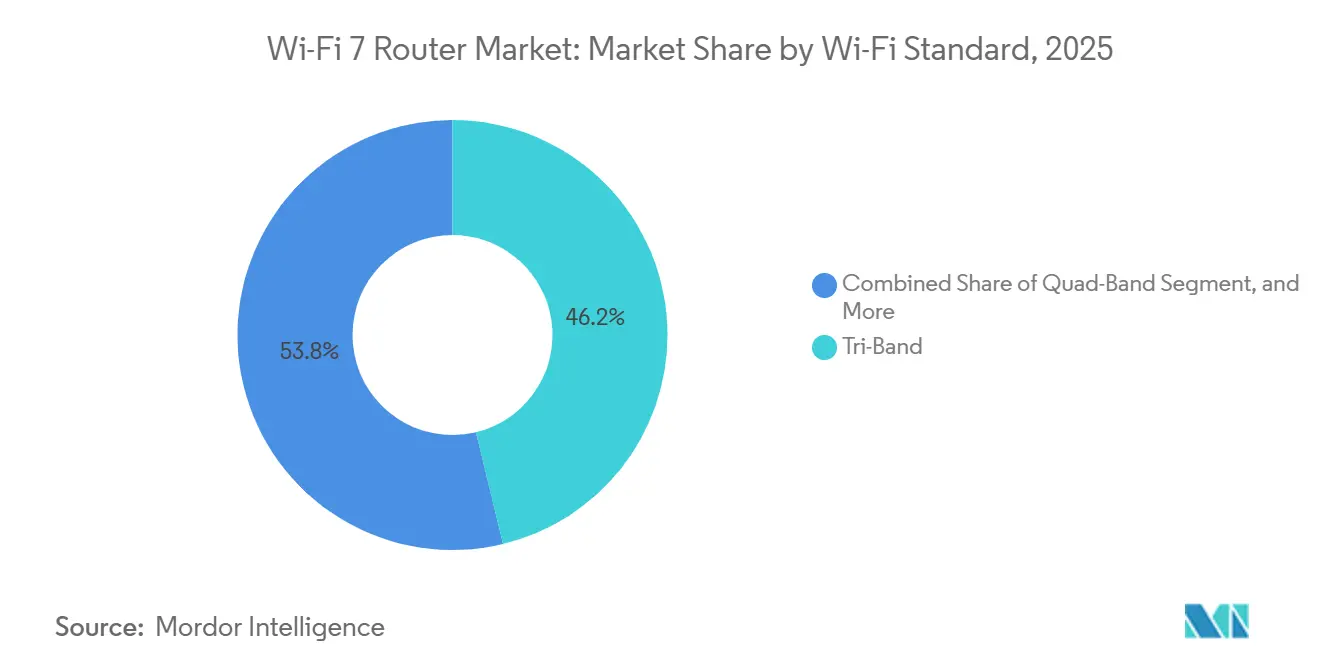
Quad-band Wi-Fi 7 equipment is projected to expand at a 60.12% CAGR through 2031, surpassing tri-band models that accounted for 46.22% of 2025 revenue. Vendors deploy two separate 6 GHz radios alongside 5 GHz and 2.4 GHz, enabling precise traffic segmentation across latency-critical, best-effort, and IoT workloads. This architecture allows enterprises to reduce access point density while maintaining deterministic throughput, improving the total cost of ownership. In markets without 6 GHz availability, dual-band devices remain relevant but lack differentiation, limiting pricing power and constraining their contribution to the overall Wi-Fi 7 router market value.
Client-side readiness is reinforcing the upgrade cycle. By mid-2026, over 40% of flagship Android devices integrated FastConnect 7800, creating immediate demand for higher-bandwidth routers. Tri-band systems will continue to dominate residential deployments due to simpler configuration and lower RF management complexity. However, enterprise refresh cycles, typically aligned with infrastructure renovation timelines, are shifting toward quad-band deployments to support dense device environments. This transition is expected to lift average selling prices and shift market share toward vendors focused on enterprise-grade networking solutions.

By Design: Gaming Routers Leverage MLO for Competitive Advantage
Gaming-optimized Wi-Fi 7 routers are projected to grow at a 62.53% CAGR, driven by esports venues and livestream creators requiring sustained multi-gigabit throughput and single-digit millisecond latency. Multi-Link Operation enables simultaneous use of 5 GHz and 6 GHz bands, reducing jitter and packet loss in competitive scenarios. While mesh systems accounted for 51.72% of 2025 shipments due to demand for whole-home coverage, gaming routers have established a premium niche where users pay for advanced quality of service controls, traffic prioritization, and hardware differentiation. This segment demonstrates stronger pricing resilience relative to commoditizing mass-market router categories.
Price compression in mesh systems is intensifying as Amazon's eero 7 lineup undercuts legacy offerings by ~30%, expanding adoption among cost-sensitive households. Single-unit routers remain viable for smaller spaces but continue to lose share. Enterprise access points represent a higher-value growth vector as organizations prioritize centralized management and network orchestration. Concurrently, industrial-grade Wi-Fi 7 hardware is emerging as a niche segment, with ruggedized designs, temperature tolerance, and PoE+ support addressing the needs of manufacturing and logistics environments that require reliable, deterministic wireless connectivity.
By End-User Application: Industrial IoT Drives Mission-Critical Adoption
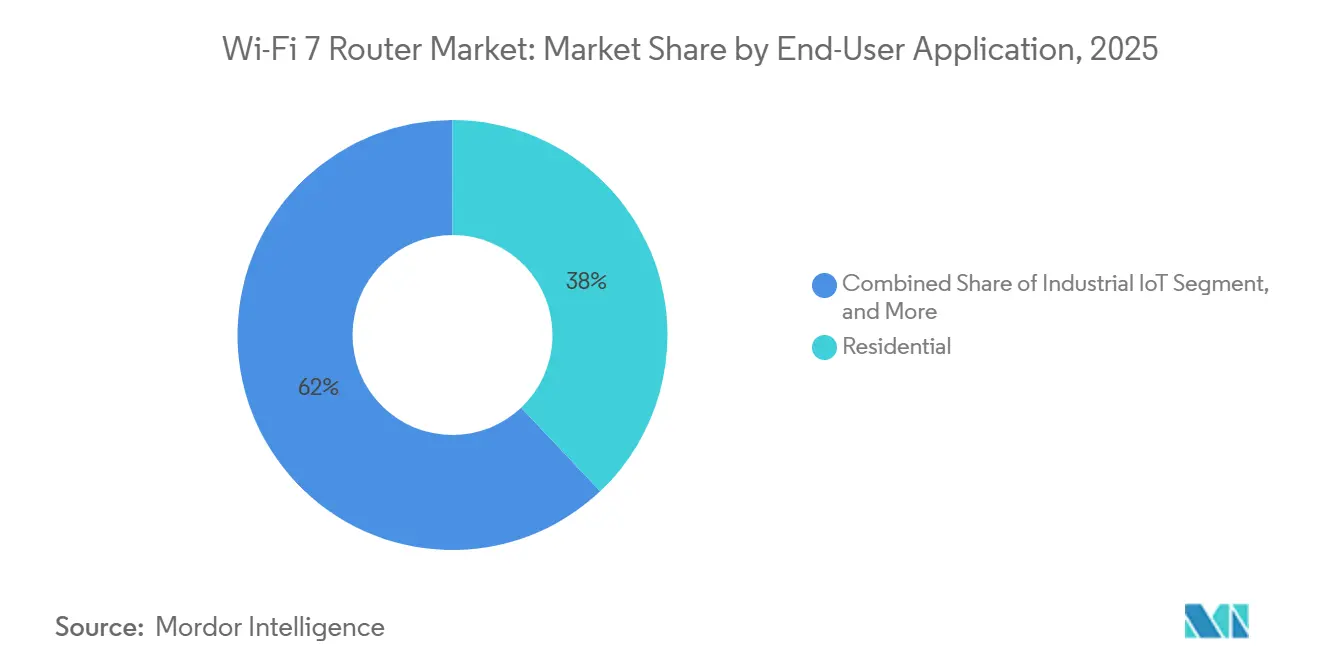
Enterprises are reducing reliance on structured cabling by deploying time-synchronized Wi-Fi 7 links that lower installation costs and increase layout flexibility. Residential usage still accounts for 37.93% of 2025 demand, but growth is slowing as Wi-Fi 6E meets most household needs. Small and medium enterprises are upgrading to address congestion in collaboration areas, while large campuses prioritize deterministic wireless performance for auditoriums and open spaces with more than 100 devices per 1,000 square feet. This shift indicates a gradual rebalancing from volume-led residential demand toward performance-driven enterprise adoption.
Public venues and hospitality operators are adopting Wi-Fi 7 to improve high-density connectivity and deliver a premium user experience. King Abdullah Financial District demonstrates this with large-scale 4K streaming deployments. In manufacturing environments, Ruckus Networks T670sn combines multi-link operation with IEEE 802.1AS timing to deliver the sub-10 ms latency required for robotic coordination and automated guided vehicles. These mission-critical deployments validate industrial IoT as a structurally durable revenue driver within the Wi-Fi 7 router market.
By Distribution Channel: Enterprise Direct Sales Accelerate
Enterprise direct procurement is expected to grow at a 55.41% CAGR as IT departments prioritize firmware customization, security control, extended warranties, and SLA-backed support that intermediaries cannot consistently deliver. Direct sourcing also enables tighter integration with enterprise network policies and lifecycle management frameworks. Meanwhile, online marketplaces retain 48% of 2025 revenue through pricing transparency, wide SKU availability, and rapid fulfillment, thereby maintaining dominance in consumer-led upgrades. Offline retail continues to contract as digital-first purchasing, assisted chat, and virtual demonstrations reduce reliance on physical electronics stores.
Service-provider bundling represents the most structural disruption in Wi-Fi 7 router distribution. By embedding premium routers within broadband subscriptions, operators are scaling unit volumes while compressing standalone hardware margins. This model resets upgrade behavior, with subscribers receiving new routers alongside plan upgrades, reducing replacement cycles and stabilizing OEMs' demand visibility. It also shifts bargaining power toward telecom operators, forcing vendors to align product development cycles with broadband speed tiers rather than discretionary consumer refresh patterns.
Geography Analysis
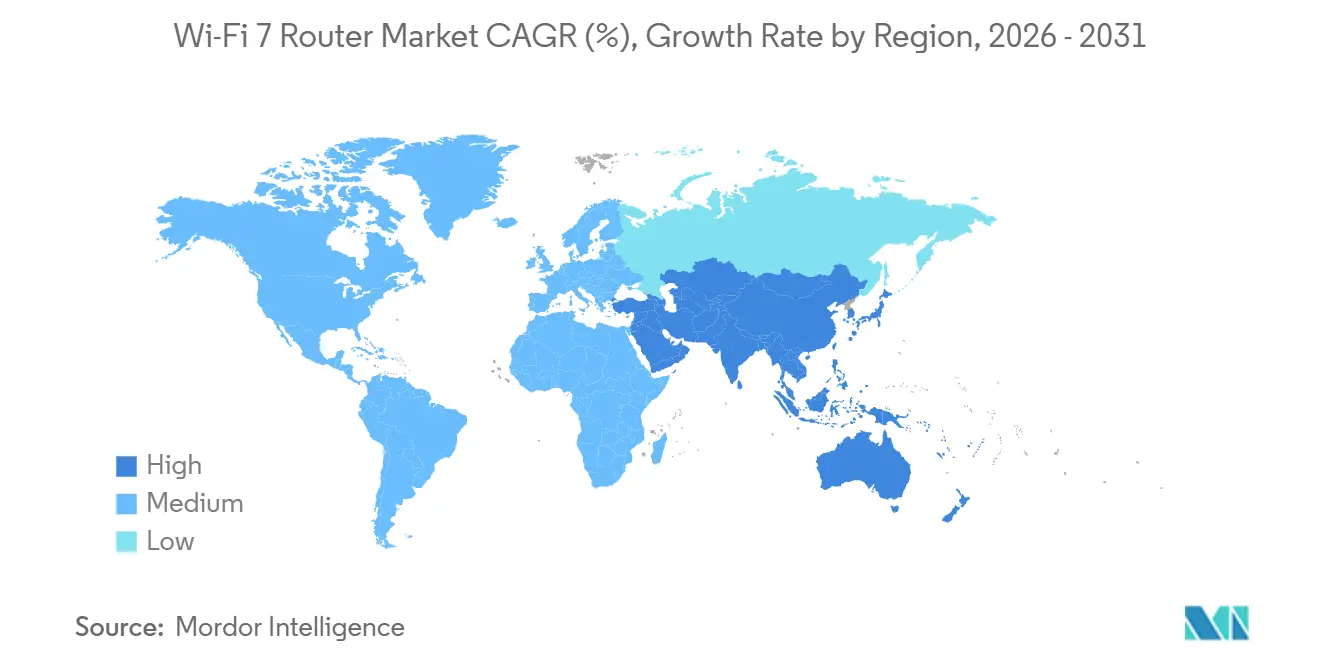
Asia-Pacific accounted for 34% of Wi-Fi 7 router revenue in 2025, driven by early 6 GHz enablement across South Korea, India, and Japan. South Korea’s 1 W indoor EIRP limit enables full exploitation of 320 MHz channels without proximity constraints, while India’s January 2026 de-licensing of 500 MHz is accelerating enterprise campus upgrades across major technology clusters. Japan allows 5925-7125 MHz for unlicensed use, though dynamic frequency coordination increases deployment complexity. In contrast, China assigns 6 GHz to IMT services, restricting domestic routers to dual-band configurations and pushing vendors toward export-driven growth strategies.
The Middle East is projected to register the fastest growth at a 57.81% CAGR through 2031, underpinned by large-scale smart-city investments in Saudi Arabia and the United Arab Emirates. King Abdullah Financial District deployed a city-wide Wi-Fi 7 network in April 2025, supporting high-density connectivity and AR-enabled public services. Anticipated harmonization of 6 GHz spectrum policies across the Gulf Cooperation Council by late 2026 is expected to reduce certification barriers, streamline device interoperability, and accelerate shipment volumes across adjacent regional markets.
Adoption trends diverge across North America and Europe. U.S. providers such as Brightspeed are bundling Wi-Fi 7 routers with multi-gig broadband plans, but over 25% of households still rely on Wi-Fi 4 and Wi-Fi 5, slowing mass-market conversion. European adoption remains below 2% in several fiber-dense countries due to consumer satisfaction with Wi-Fi 6 and regulatory delays under ETSI EN 303 687. In South America and Africa, investment priorities continue to favor fiber rollout and fixed-wireless expansion over upgrades to advanced customer-premises equipment.
Competitive Landscape
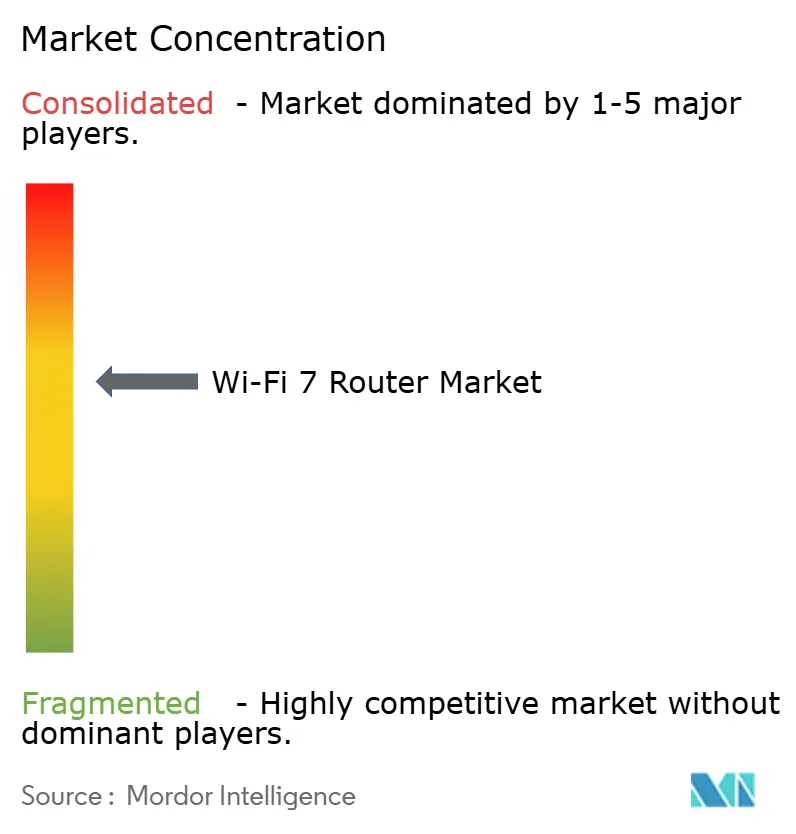
The Wi-Fi 7 router market remains structurally fragmented, with leading vendors including TP-Link, ASUS, Netgear, Xiaomi, and Huawei collectively accounting for under 40% of unit shipments. This fragmentation leaves room for niche players targeting enterprise mesh and industrial-grade deployments. Competitive differentiation is shifting from hardware specifications to firmware and software ecosystems, with vendors embedding AI-driven channel optimization, automated frequency coordination, and cloud-native orchestration. Ubiquiti appeals to SMEs with integrated management platforms that eliminate recurring licensing costs, while Zyxel focuses on PoE+ support and ruggedized enclosures for industrial environments.
Chipset vendors such as Qualcomm, Broadcom, and MediaTek are already advancing Wi-Fi 8 silicon roadmaps targeted for late 2026, compressing the effective lifecycle of Wi-Fi 7 and forcing OEMs to accelerate product refresh cycles. ZTE has signaled convergence trends through its G6 Max gateway, integrating 5G-Advanced with next-generation Wi-Fi standards, which may redefine the architecture of customer-premises equipment. Certification frameworks led by the Wi-Fi Alliance ensure interoperability, but regional delays, particularly in Europe and parts of the Middle East, are enabling gray-market activity, increasing fragmentation risks, and complicating vendor go-to-market strategies.
Industrial IoT is emerging as a structurally resilient growth vector within the Wi-Fi 7 ecosystem. Vendors such as Ruckus Networks, Cisco, and Zyxel are embedding time-sensitive networking, deterministic latency, and extended temperature tolerances into their offerings, features largely absent in consumer-grade devices. As manufacturing environments transition from wired Ethernet to wireless architectures, the demand for ruggedized, low-latency connectivity is expected to expand. This shift enables industrial-focused vendors to sustain higher average selling prices and margin defensibility, even as consumer router categories face ongoing commoditization pressures.
Wi-Fi 7 Router Industry Leaders
-
TP-Link Technologies Co., Ltd.
-
ASUSTeK Computer Inc.
-
Netgear, Inc.
-
Huawei Technologies Co., Ltd.
-
Xiaomi Corporation
- *Disclaimer: Major Players sorted in no particular order
Recent Industry Developments
- April 2026: Zyxel Communications rolled out the WBE665S IP67-rated Wi-Fi 7 access point with multi-link support for warehouse and factory environments.
- April 2026: The King Abdullah Financial District and Huawei activated Saudi Arabia’s first smart Wi-Fi 7 public network covering retail and tourism venues.
- February 2026: Google Fiber began a 25 G PON pilot in Austin, Texas, bundling Wi-Fi 7 routers to showcase end-to-end multi-gig capability.
- February 2025: Qualcomm introduced the FastConnect 8800 Wi-Fi 8 chipset featuring 16-stream multi-link and 8192-QAM modulation.
Global Wi-Fi 7 Router Market Report Scope
The Wi-Fi 7 router market comprises hardware, software, and services built around routers compliant with IEEE 802.11be, enabling multi-gigabit wireless connectivity with low latency. These devices use 320 MHz channels, 4096-QAM, and multi-link operation across 2.4 GHz, 5 GHz, and 6 GHz bands. The market includes standalone routers, mesh systems, enterprise access points, and carrier-supplied equipment across residential, commercial, and industrial use cases. Growth is driven by fiber broadband expansion, rising device density, and demand for real-time applications such as AR, gaming, and automation.
The Wi-Fi 7 Router Market Report is Segmented by Wi-Fi Standard (Dual-Band, Tri-Band, and Quad-Band), Design (Traditional Single-Unit, Mesh Systems, Gaming-Optimized, and Enterprise Access Points), End-User Application (Residential, SME, Large Enterprises, Public Venues, and Industrial IoT), Distribution Channel (Online, Offline, Service Provider Bundling, and Enterprise Direct), and Geography (North America, South America, Europe, Asia-Pacific, Middle East, and Africa). Market Forecasts are Provided in Terms of Value (USD)
| Dual-Band Wi-Fi 7 Routers |
| Tri-Band Wi-Fi 7 Routers |
| Quad-Band Wi-Fi 7 Routers |
| Traditional Single-Unit Routers |
| Mesh Wi-Fi Systems |
| Gaming-Optimized Routers |
| Enterprise Access Points |
| Residential |
| Small and Medium Enterprises |
| Large Enterprises and Campuses |
| Public Venues and Hospitality |
| Industrial IoT |
| Online Retail |
| Offline Retail |
| Service Provider/CPE Bundling |
| Enterprise Direct Sales |
| North America | United States |
| Canada | |
| Mexico | |
| South America | Brazil |
| Argentina | |
| Chile | |
| Rest of South America | |
| Europe | Germany |
| United Kingdom | |
| France | |
| Italy | |
| Spain | |
| Russia | |
| Rest of Europe | |
| Asia-Pacific | China |
| Japan | |
| India | |
| South Korea | |
| Australia | |
| Rest of Asia-Pacific | |
| Middle East | United Arab Emirates |
| Saudi Arabia | |
| Turkey | |
| Rest of Middle East | |
| Africa | South Africa |
| Nigeria | |
| Kenya | |
| Rest of Africa |
| By Wi-Fi Standard | Dual-Band Wi-Fi 7 Routers | |
| Tri-Band Wi-Fi 7 Routers | ||
| Quad-Band Wi-Fi 7 Routers | ||
| By Design | Traditional Single-Unit Routers | |
| Mesh Wi-Fi Systems | ||
| Gaming-Optimized Routers | ||
| Enterprise Access Points | ||
| By End-User Application | Residential | |
| Small and Medium Enterprises | ||
| Large Enterprises and Campuses | ||
| Public Venues and Hospitality | ||
| Industrial IoT | ||
| By Distribution Channel | Online Retail | |
| Offline Retail | ||
| Service Provider/CPE Bundling | ||
| Enterprise Direct Sales | ||
| By Geography | North America | United States |
| Canada | ||
| Mexico | ||
| South America | Brazil | |
| Argentina | ||
| Chile | ||
| Rest of South America | ||
| Europe | Germany | |
| United Kingdom | ||
| France | ||
| Italy | ||
| Spain | ||
| Russia | ||
| Rest of Europe | ||
| Asia-Pacific | China | |
| Japan | ||
| India | ||
| South Korea | ||
| Australia | ||
| Rest of Asia-Pacific | ||
| Middle East | United Arab Emirates | |
| Saudi Arabia | ||
| Turkey | ||
| Rest of Middle East | ||
| Africa | South Africa | |
| Nigeria | ||
| Kenya | ||
| Rest of Africa | ||
Key Questions Answered in the Report
How large will the Wi-Fi 7 router market be by 2031?
The Wi-Fi 7 router market size is forecast to reach USD 20.2 billion by 2031, expanding at a 54.43% CAGR between 2026-2031.
Which Wi-Fi standard segment is growing fastest?
Quad-band architectures lead growth, projected to expand at a 60.12% CAGR as enterprises dedicate separate radios for 6 GHz, 5 GHz, and 2.4 GHz traffic.
What end-user application shows the highest growth potential?
Industrial IoT is the fastest-growing application, advancing at a 56.23% CAGR as factories adopt time-sensitive networking over Wi-Fi 7 to synchronize automation.
Which region is expected to record the quickest adoption through 2031?
The Middle East is set to grow at 57.81% CAGR, driven by smart-city mandates in Saudi Arabia and the United Arab Emirates that integrate Wi-Fi 7 in public infrastructure.
How concentrated is competition among router vendors?
The top five manufacturers hold under 40% of unit shipments, creating a moderately fragmented landscape where specialized players can still gain share.
Why are chipset prices a restraint for adoption?
Wi-Fi 7 chipsets fabricated on 5 nm and 6 nm processes cost up to 60% more than Wi-Fi 6E silicon, limiting vendors' ability to price routers for mass-market consumers.