
Warehouse Execution Systems Market Size and Share
Market Overview
| Study Period | 2020 - 2031 |
|---|---|
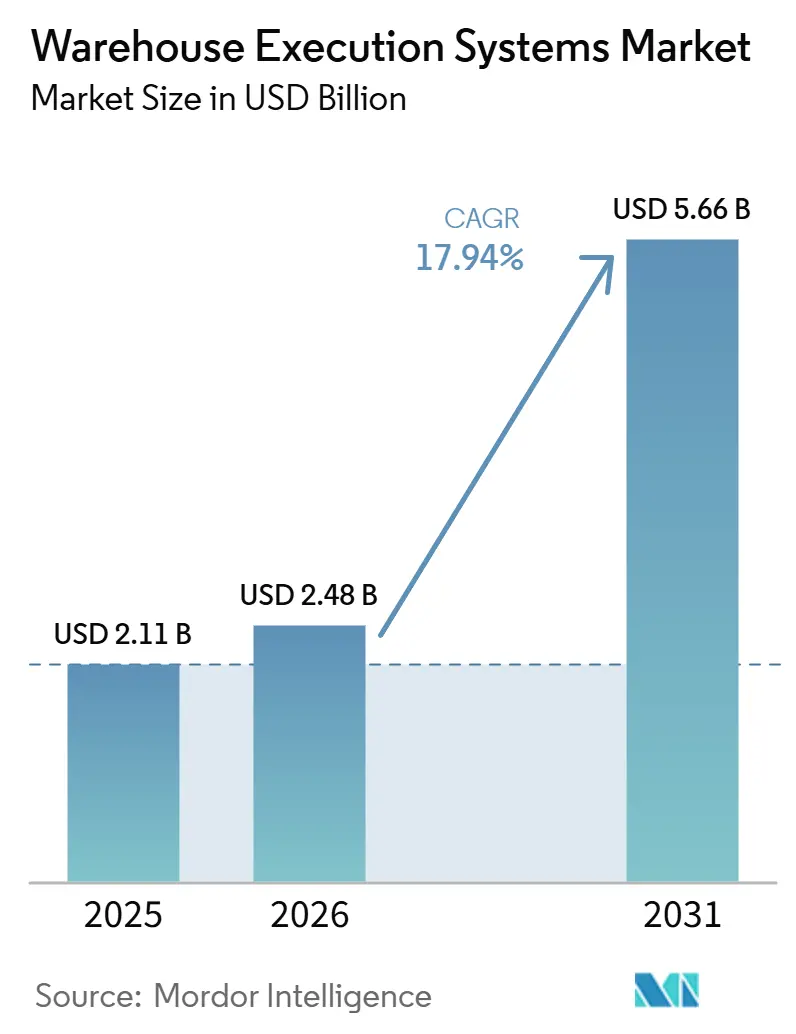
| Market Size (2026) | USD 2.48 Billion |
| Market Size (2031) | USD 5.66 Billion |
| Growth Rate (2026 - 2031) | 17.94% CAGR |
| Fastest Growing Market | Asia-Pacific |
| Largest Market | North America |
| Market Concentration | Medium |
Major Players *Disclaimer: Major Players sorted in no particular order Image © Mordor Intelligence. Reuse requires attribution under CC BY 4.0. | |
Warehouse Execution Systems Market Analysis by Mordor Intelligence
The warehouse execution systems market size is projected to expand from USD 2.11 billion in 2025 and USD 2.48 billion in 2026 to USD 5.66 billion by 2031, registering a CAGR of 17.94% between 2026 to 2031. The warehouse execution systems market is expanding because operators need a common software layer that connects warehouse management, automation, and enterprise systems in real time. E-commerce order complexity, labor cost pressure, and cloud-based deployment are increasing the need for this coordination. Vendors are responding by combining task assignment, fleet coordination, and operational visibility in broader platforms. Integration effort, investment requirements, and data-residency rules may slow decisions where operators have legacy systems or several automation suppliers.
Key Report Takeaways
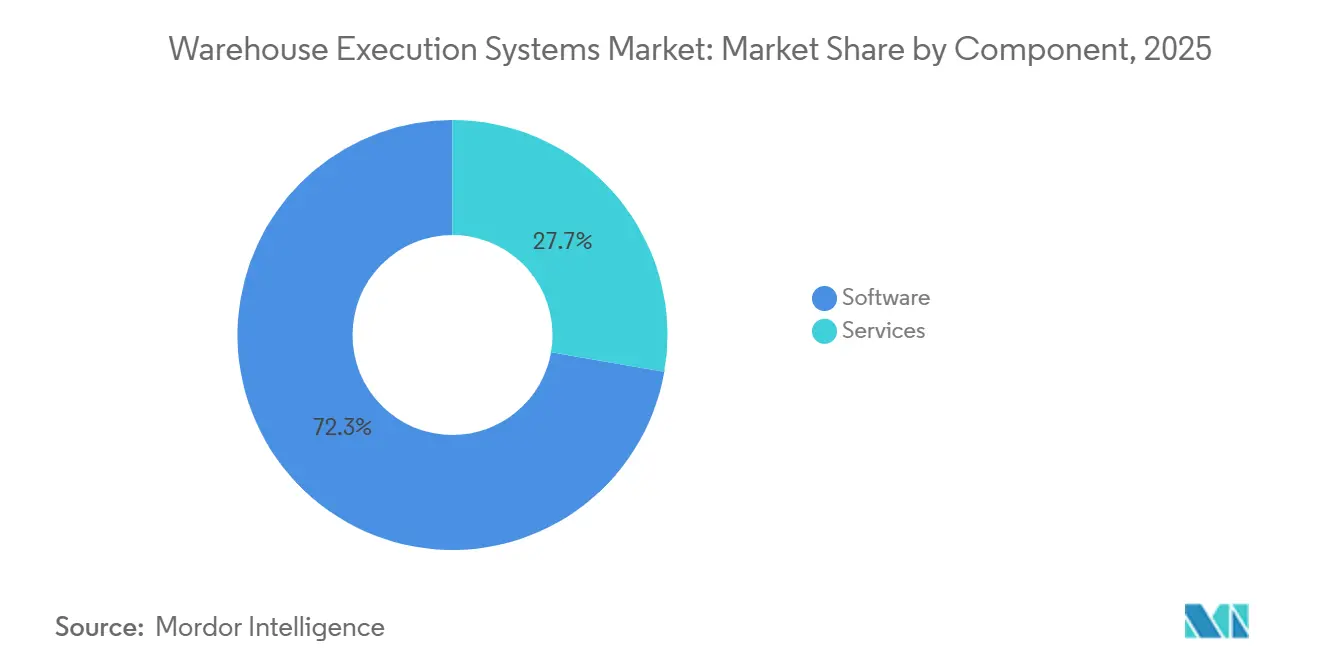
- By component, software held 72.26% of the warehouse execution systems market share in 2025, while services are projected to expand at a CAGR of 18.11% through 2031.
- By deployment, cloud held 42.77% of the warehouse execution systems market share in 2025 and is projected to expand at a CAGR of 18.27% through 2031.
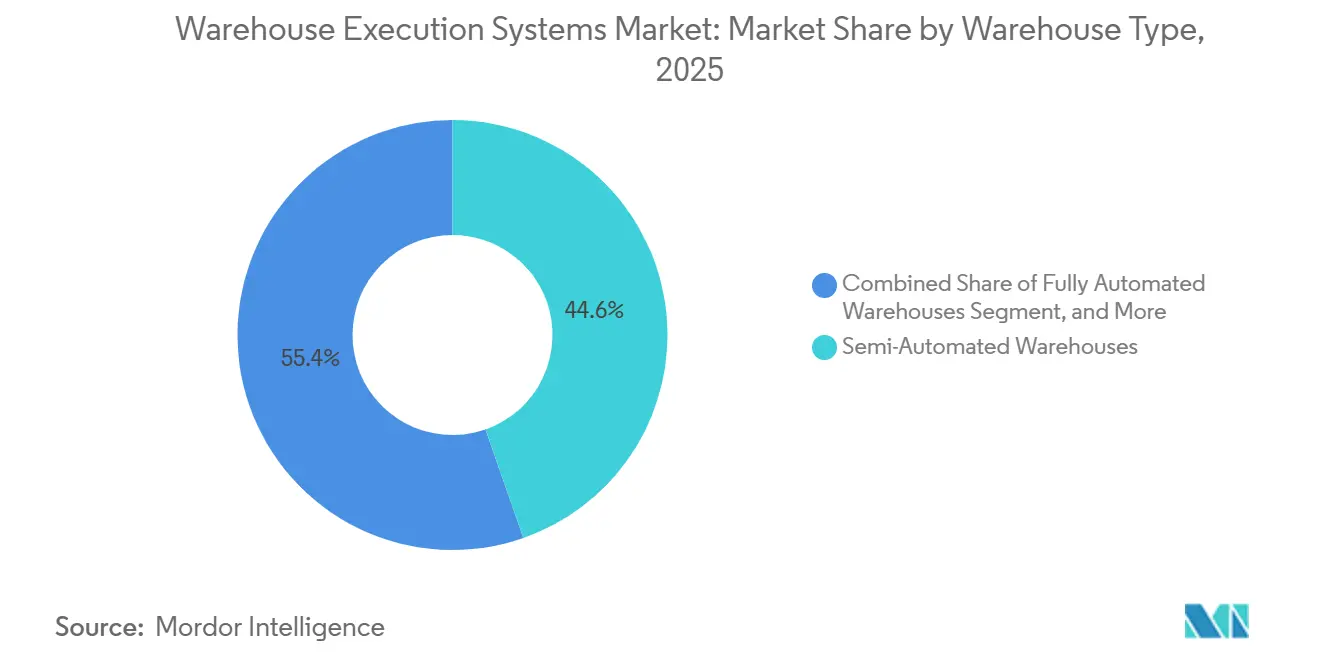
- By warehouse type, semi-automated warehouses held 44.64% of revenue in 2025, while fully automated warehouses are projected to expand at a CAGR of 18.41% through 2031.
- By end user, retail, consumer goods, and e-commerce accounted for 31.24% of revenue in 2025 and are projected to expand at a CAGR of 18.37% through 2031.
- By geography, North America held 38.33% of revenue in 2025, while Asia-Pacific is projected to expand at a CAGR of 18.63% through 2031.
Note: Market size and forecast figures in this report are generated using Mordor Intelligence’s proprietary estimation framework, updated with the latest available data and insights as of January 2026.
Global Warehouse Execution Systems Market Trends and Insights
Drivers Impact Analysis*
| Driver | (~) % Impact on CAGR Forecast | Geographic Relevance | Impact Timeline |
|---|---|---|---|
| E-Commerce and Omnichannel Fulfillment Complexity | +3.8% | Global, concentrated in North America, Western Europe, and Asia-Pacific e-commerce hubs | Medium term (2-4 years) |
| Warehouse Automation and Robotics Adoption | +3.2% | Global, strongest in North America, Europe, and China | Long term (≥ 4 years) |
| Real-Time Execution Intelligence and Throughput Optimization | +2.5% | Global, with highest near-term uptake in North America and Western Europe | Medium term (2-4 years) |
| Cloud-Based WES Scalability and Lower Deployment Friction | +2.2% | Global, accelerating in Asia-Pacific and South America mid-market operations | Short term (≤ 2 years) |
| Chronic Warehouse Labor Shortages and Wage Pressure | +1.6% | North America and Europe, with spillover to the Middle East and Australia | Short term (≤ 2 years) |
| India-Led Modular Automation Retrofits in Semi-Automated Facilities | +1.2% | India, with early spillover to Southeast Asia and the Middle East and Africa | Medium term (2-4 years) |
| Source: Mordor Intelligence | |||
E-Commerce and Omnichannel Fulfillment Complexity
The warehouse execution systems market benefits from the growing number of decisions required to fulfill orders across channels and facilities. Buy-online-pickup-in-store, ship-from-store, direct-to-consumer, and B2B orders each have distinct service levels, inventory rules, and packing requirements. Each added channel can introduce a separate order class that must be sequenced against changing delivery commitments. A static warehouse management system may not sequence these orders continuously when conditions change during a shift. An execution layer can prioritize work as inventory, labor availability, order deadlines, and fulfillment capacity change. Multi-site fulfillment also requires software that can coordinate distributed inventory and routing across facilities, making continuous orchestration more important as omnichannel operations become normal.
Warehouse Automation and Robotics Adoption
The warehouse execution systems market is supported by the wider adoption of automated material-handling equipment and robotics. Facilities increasingly operate autonomous mobile robots, conveyors, automated storage and retrieval systems, sortation equipment, and manual workstations at the same time. These assets need shared task priorities when volumes, equipment status, and staffing change. A common orchestration layer can assign work across equipment and people instead of treating each system as a separate process. Dematic and GreyOrange announced a partnership in April 2026 to integrate GreyMatter orchestration with Dematic's flexible automation portfolio. The arrangement is intended to coordinate autonomous mobile robots, fixed automation, and human workflows in fulfillment operations, reflecting the need for unified control of heterogeneous automation fleets.[1]Dematic, “Dematic Expands Flexible Automation Capabilities Through GreyOrange Partnering Relationship,” Dematic, dematic.com
Real-Time Execution Intelligence and Throughput Optimization
The warehouse execution systems market is also shaped by the move from scheduled waves to event-based fulfillment. Continuous execution can change priorities when a dock delay, labor shortfall, equipment exception, or urgent order affects the work plan. This approach differs from periodic batch releases that may not reflect conditions on the warehouse floor. Manhattan Associates made its AI Agent Workforce commercially available in January 2026 within its Active Platform. Its Wave Coordinator, Labor, and Dock Agents were designed to monitor operations, automate repetitive work, and address exceptions in real time.[2]Manhattan Associates, “Manhattan Associates Announces Commercial Availability of Its AI Agent Workforce,” Manhattan Associates, manh.com This capability can help facilities allocate people and equipment across fulfillment zones more consistently while linking operating decisions to current conditions.
Cloud-Based WES Scalability and Lower Deployment Friction
Cloud deployment is widening access to the warehouse execution systems market for operators that do not want to build extensive local infrastructure. Honeywell introduced Momentum Warehouse Execution Software as a cloud-based platform in March 2025. Honeywell positioned remote configuration, continuous monitoring, built-in encryption, and lower upfront infrastructure needs as key operating features.[3]Honeywell, “Honeywell Introduces Warehouse Execution Software on the Cloud,” Honeywell Press Room, honeywell.com Cloud architecture can support software updates, new automation connections, and expansion to additional facilities without rebuilding the full execution layer. It can also help operators respond to volume changes without waiting for hardware procurement or major local system work. Kuehne+Nagel began a global rollout of its cloud-native contract logistics platform across more than 1,000 sites in nearly 100 countries in April 2026, showing that cloud-based execution infrastructure can support complex logistics networks.
Restraints Impact Analysis*
| Restraint | (~) % Impact on CAGR Forecast | Geographic Relevance | Impact Timeline |
|---|---|---|---|
| Integration Complexity Across WMS, WCS, ERP, and Multi-Vendor Automation | -2.8% | Global, most acute in North America and Europe with legacy enterprise systems | Long term (≥ 4 years) |
| High Upfront Investment and Uncertain Mid-Market ROI | -2.0% | Global, most restrictive in South America, Southeast Asia, and the Middle East and Africa | Medium term (2-4 years) |
| Shortage of WES-Robotics Integration Talent | -1.4% | North America, Europe, and core Asia-Pacific markets | Medium term (2-4 years) |
| Cybersecurity, Data Residency, and Operational Technology Risk | -1.0% | Global, with regulatory influence concentrated in Europe and North America | Short term (≤ 2 years) |
| Source: Mordor Intelligence | |||
Integration Complexity Across WMS, WCS, ERP, and Multi-Vendor Automation
Integration remains a principal restraint in the warehouse execution systems market because each added system can introduce different data formats, protocols, and exception rules. Modern sites may combine enterprise resource planning, warehouse management, warehouse control, labor management, transport management, visibility tools, and robotics software. Maintaining reliable exchanges among these systems is difficult when they were implemented in different periods and use incompatible data structures. Batch updates from older enterprise systems can leave execution software with outdated information during a busy fulfillment window. KNAPP released the AeroBot App on SAP Business Technology Platform in February 2026 with standard APIs and a clean-core approach. The app separates automation extensions from core SAP modules, which can reduce regression-testing demands, architectural risk, and the burden on teams managing automation changes.
High Upfront Investment and Uncertain Mid-Market ROI
Upfront spending can limit adoption in the warehouse execution system (WES) market, especially for mid-sized operators. License costs are only one part of the project because organizations may also need integration work, application programming interfaces, staff training, process changes, and planned cutover downtime. These needs are harder to absorb when internal technology teams are small and operational staff cannot be removed from daily work. The cost of change management can be missed during early planning, which may weaken the business case. Financing conditions and capital-budget timing can further affect project approval even where the operational case is clear. Vendors that offer modular scope, phased deployment, and lower infrastructure needs may be better placed to address this constraint.
*Our forecasts treat driver/restraint impacts as directional, not additive. The impact forecasts reflect baseline growth, mix effects, and variable interactions.
Segment Analysis
By Component: Software Holds the Largest Revenue Base While Services Grows Faster
Software held 72.26% of the warehouse execution systems market share in 2025. It remains the main commercial element because operators need software to control task flow, automation, and real-time operational visibility. Warehouse execution, orchestration, control, automation, and analytics functions are becoming more closely connected. AI capabilities are also narrowing the distinction between tools that were previously bought as separate modules. This creates a broader software requirement for vendors serving complex warehouse operations.
Services are projected to grow at a CAGR of 18.11% through 2031 in the warehouse execution system (WES) market. Integration consulting, managed operations, and support are increasingly important where sites use multiple automation providers. Manhattan Associates launched Solution Design Studio in May 2026 to help business users configure complex supply chain systems using natural language. Such tools seek to reduce the technical effort required during implementation. Software vendors, therefore, need strong product capability and reliable service delivery to protect their installed-base position.


By Deployment: Cloud Combines the Largest Share With the Fastest Growth
Cloud held 42.77% of revenue in 2025 and led the warehouse execution systems market by deployment mode. Operators use cloud systems to scale capacity, add sites, and update software with less dependence on local infrastructure. The model can support operational changes without replacing the full execution platform. It also allows the software layer to support seasonal volume changes more flexibly. These features explain why the cloud has moved beyond a limited alternative to local deployment.
Cloud is projected to expand at a CAGR of 18.27% through 2031. On-premises systems still serve settings that need very low latency, isolated connectivity, or strict local data controls. Hybrid architecture offers a transition path by keeping equipment control close to the facility while placing orchestration and analytics in the cloud. Blue Yonder and NVIDIA announced work on a domain-specific model training factory for AI agents at ICON 2026. The initiative reflects ongoing work to support AI functions that operate at machine speed. The warehouse execution system (WES) market is likely to retain all 3 deployment models because operating requirements vary across sites.
By Warehouse Type: Semi-Automated Sites Lead While Fully Automated Sites Advance
Semi-automated warehouses held 44.64% of the warehouse execution systems market share in 2025. These sites combine people with conveyors, sortation equipment, and selected robotics. This mixed operating model creates frequent choices over which task, worker, or equipment asset should be prioritized. WES software is useful in these environments because it can coordinate activities that a basic warehouse management system may release in batches. The large installed base of mixed facilities supports continued demand for these capabilities.
Fully automated warehouses are projected to expand at a CAGR of 18.41% through 2031. Their growth reflects broader use of goods-to-person equipment, autonomous mobile robots, and AI-supported orchestration. KNAPP implemented South Korea's largest shuttle system for Asung Daiso in May 2025. The Yangju facility can handle up to 50,000 e-commerce orders each day and supply more than 1,000 stores. Manual warehouses with digital execution tools remain the smallest category, but they provide a lower-capital route to more structured execution management.

By End User: Retail and E-Commerce Set the Pace for Adoption
Retail, consumer goods, and e-commerce accounted for 31.24% of the warehouse execution systems market size in 2025. These users manage high order volumes, varied stock-keeping units, and service commitments across several channels. Their operations often need continuous prioritization rather than fixed order waves. Buy-online-pickup-in-store, ship-from-store, direct-to-consumer, and B2B orders require different handling and sequencing logic. This makes the sector a key user of execution software.
Retail, consumer goods, and e-commerce are projected to expand at a CAGR of 18.37% through 2031. Third-party logistics providers also need scalable execution platforms as brands outsource complex fulfillment work. Blue Yonder and GXO Logistics announced a strategic global agreement in May 2025 that named Blue Yonder as one of GXO's preferred off-the-shelf warehouse management software providers. Manufacturing and automotive users focus on inbound sequencing and just-in-time lineside delivery, where delays can interrupt production. Healthcare and pharmaceutical users need traceability, expiry control, and audit-ready processes, which can support demand for specialized systems.
Geography Analysis
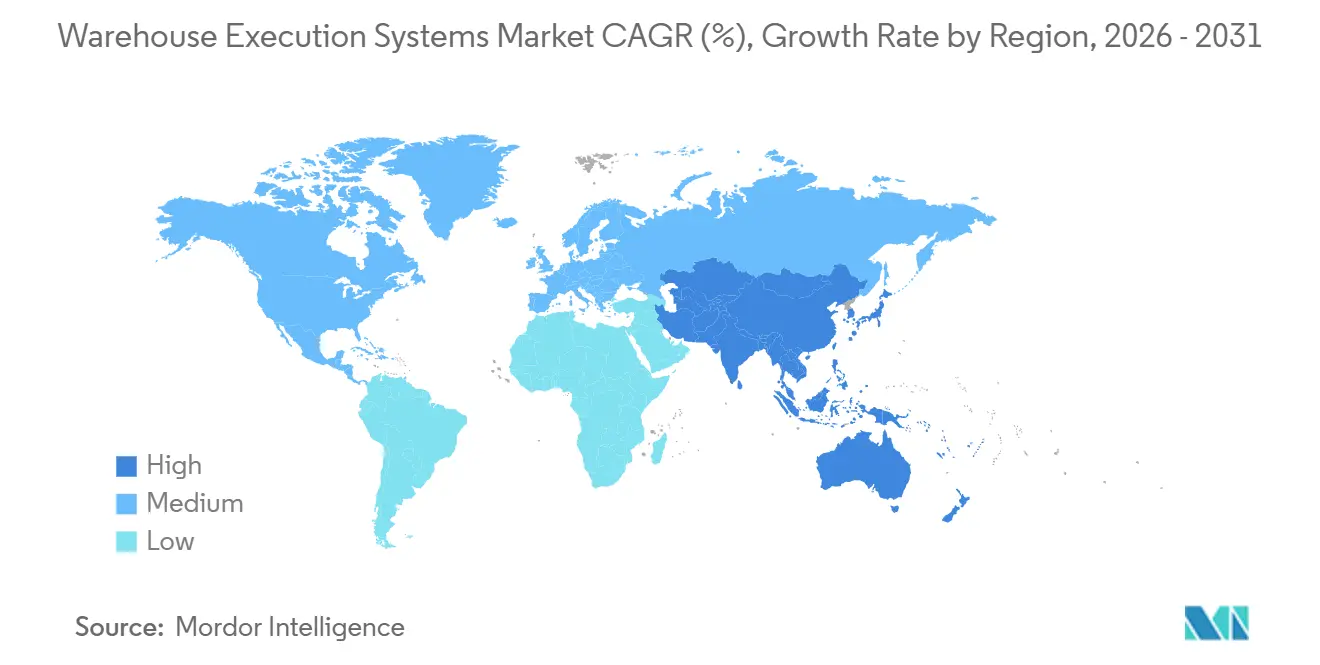
North America held 38.33% of the warehouse execution systems market share in 2025. The region has a mature e-commerce fulfillment base, a high concentration of robotics-enabled distribution centers, and extensive enterprise software adoption across retail, logistics, and industrial operations. These conditions support demand for software that coordinates automation, inventory, and labor across large facilities. Staples deployed Manhattan Active Warehouse Management across 9 U.S. B2B fulfillment locations over 18 months. The deployment managed more than 2,000 autonomous guided vehicles and robotics across highly automated facilities.
Europe is the second-largest regional market. Its operators face cybersecurity and data-residency requirements that influence the selection of cloud and local deployment models. Blue Yonder and Rhenus Warehousing Solutions announced a partnership in January 2025 to standardize warehouse systems across more than 180 sites in over 20 countries. Asia-Pacific is projected to expand at a CAGR of 18.63% through 2031, giving it the highest regional growth rate.
South America is an emerging opportunity for the warehouse execution systems market, supported by e-commerce logistics and food and beverage distribution. Currency volatility and infrastructure limits can constrain near-term investment. The Middle East is building smart logistics capacity through new fulfillment facilities and diversification programs, including greenfield sites in the United Arab Emirates and Saudi Arabia. Africa remains the smallest regional market, with South Africa and Kenya acting as early adoption centers.

Competitive Landscape
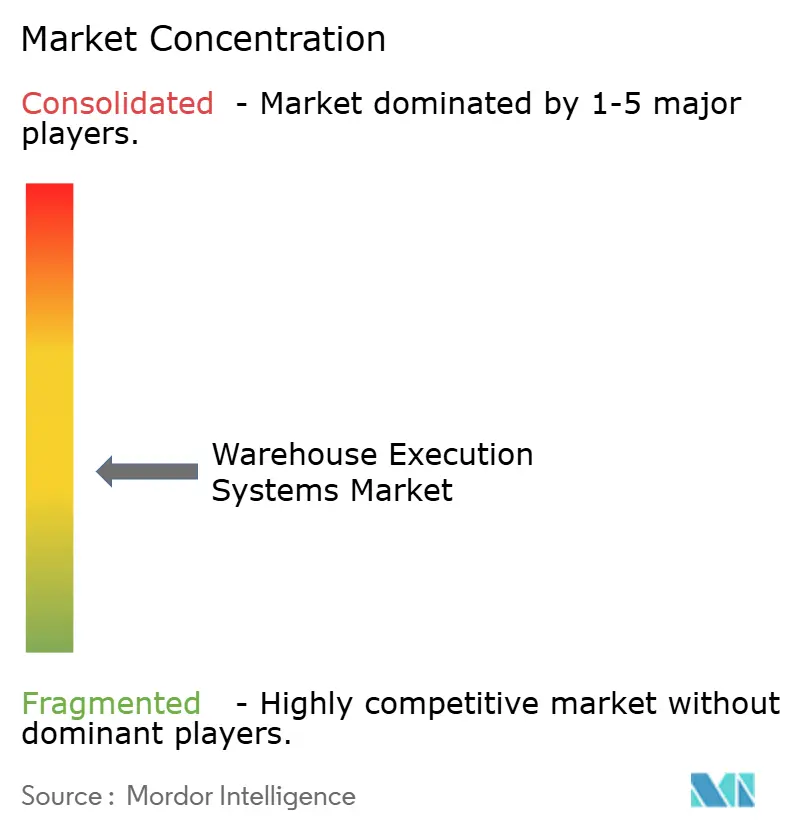
The warehouse execution systems market has moderate fragmentation. Large supply chain software companies compete with specialized orchestration vendors, systems integrators, and robotics software providers. Each group offers different strengths in warehouse control, automation connectivity, implementation, and broader supply chain functions. Competition is increasingly centered on the orchestration layer because operators want a single view of work across people and equipment. No company shares data to establish a more concentrated market structure.
Software and hardware alliances are a central competitive approach in the warehouse execution systems market. Dematic and GreyOrange partnered in April 2026 to integrate GreyMatter with Dematic's automation portfolio. The move addresses buyers who want coordinated autonomous mobile robots, fixed automation, and manual workflows. Manhattan Associates commercialized its AI Agent Workforce in January 2026 and released Solution Design Studio in May 2026, placing AI-supported execution and configuration within a broader supply chain software environment.
KNAPP launched KNAPP Brain in March 2026 as a unified AI platform for forecasting, resource planning, order fulfillment optimization, and last-mile efficiency. The move shows how automation suppliers are extending into the software layer. Opportunities remain among mid-sized users with limited internal integration resources. Healthcare, pharmaceutical, and emerging-market logistics providers need specialized or lighter systems. Data localization requirements in the European Union, India, and Saudi Arabia may favor suppliers that can meet local hosting expectations.
Warehouse Execution Systems Industry Leaders
Softeon, Inc.
FORTNA Inc.
Manhattan Associates, Inc.
Blue Yonder Group, Inc.
Ehrhardt Partner Group - EPG
- *Disclaimer: Major Players sorted in no particular order



Global Warehouse Execution Systems Market Report Scope
Warehouse Execution System (WES) Market refers to software solutions that coordinate and optimize real-time warehouse operations such as picking, packing, sorting, replenishment, and shipping. It acts as the execution layer between warehouse management systems and warehouse control systems, translating plans into actual floor-level actions.
The Warehouse Execution Systems Market Report is Segmented by Component (Software, and Services), Deployment (Cloud, On-Premises, and Hybrid), Warehouse Type Semi-Automated Warehouses, Fully Automated Warehouses, and Manual Warehouses with Digital Execution), End-user (Retail and E-Commerce, Third-Party Logistics, Industrial Manufacturing, Automotive, Food and Beverage, and Healthcare and Pharmaceuticals), and Geography (North America, South America, Europe, Asia-Pacific, Middle East, Africa). The Market Forecasts are Provided in Terms of Value (USD).
| Software | Warehouse Execution Software |
| Warehouse Control and Automation Software | |
| Warehouse Orchestration Software | |
| Real-Time Visibility and Analytics | |
| Services |
| Cloud |
| On-Premises |
| Hybrid |
| Semi-Automated Warehouses |
| Fully Automated Warehouses |
| Manual Warehouses with Digital Execution |
| Retail, Consumer Goods and E-Commerce (Includes Consumer Electronics) |
| Third-Party Logistics |
| Industrial Manufacturing |
| Automotive |
| Food and Beverage |
| Healthcare and Pharmaceuticals |
| Other End-users |
| North America | United States |
| Canada | |
| Mexico | |
| South America | Brazil |
| Argentina | |
| Rest of South America | |
| Europe | United Kingdom |
| Germany | |
| France | |
| Rest of Europe | |
| Asia-Pacific | China |
| Japan | |
| India | |
| South Korea | |
| Australia | |
| Rest of Asia-Pacific | |
| Middle East | United Arab Emirates |
| Saudi Arabia | |
| Rest of Middle East | |
| Africa | South Africa |
| Kenya | |
| Rest of Africa |
| By Component | Software | Warehouse Execution Software |
| Warehouse Control and Automation Software | ||
| Warehouse Orchestration Software | ||
| Real-Time Visibility and Analytics | ||
| Services | ||
| By Deployment | Cloud | |
| On-Premises | ||
| Hybrid | ||
| By Warehouse Type | Semi-Automated Warehouses | |
| Fully Automated Warehouses | ||
| Manual Warehouses with Digital Execution | ||
| By End-user | Retail, Consumer Goods and E-Commerce (Includes Consumer Electronics) | |
| Third-Party Logistics | ||
| Industrial Manufacturing | ||
| Automotive | ||
| Food and Beverage | ||
| Healthcare and Pharmaceuticals | ||
| Other End-users | ||
| By Geography | North America | United States |
| Canada | ||
| Mexico | ||
| South America | Brazil | |
| Argentina | ||
| Rest of South America | ||
| Europe | United Kingdom | |
| Germany | ||
| France | ||
| Rest of Europe | ||
| Asia-Pacific | China | |
| Japan | ||
| India | ||
| South Korea | ||
| Australia | ||
| Rest of Asia-Pacific | ||
| Middle East | United Arab Emirates | |
| Saudi Arabia | ||
| Rest of Middle East | ||
| Africa | South Africa | |
| Kenya | ||
| Rest of Africa | ||


Key Questions Answered in the Report
What is the warehouse execution systems market size?
The warehouse execution systems market size is USD 2.48 billion in 2026 and is projected to reach USD 5.66 billion by 2031 at a CAGR of 17.94%.
What is driving warehouse execution system adoption?
Operators need to coordinate e-commerce orders, automation assets, labor, and inventory decisions in real time across increasingly complex fulfillment operations.
Which component leads revenue in warehouse execution systems?
Software led revenue with a 72.26% share in 2025, while services is projected to grow at a CAGR of 18.11% through 2031.
Why is cloud deployment important for warehouse execution software?
Cloud held 42.77% of revenue in 2025 and is projected to grow at a CAGR of 18.27% because it supports scaling, remote updates, and multi-site deployment.
Which end users have the strongest demand for WES?
Retail, consumer goods, and e-commerce led with 31.24% of revenue in 2025 and are projected to grow at a CAGR of 18.37% through 2031.
Which region is growing fastest for warehouse execution systems?
Asia-Pacific is projected to grow at a CAGR of 18.63% through 2031, supported by logistics modernization and automated distribution investment.
Page last updated on:






