
Warehouse Dimensioning Vision Systems Market Size and Share
Market Overview
| Study Period | 2020 - 2031 |
|---|---|
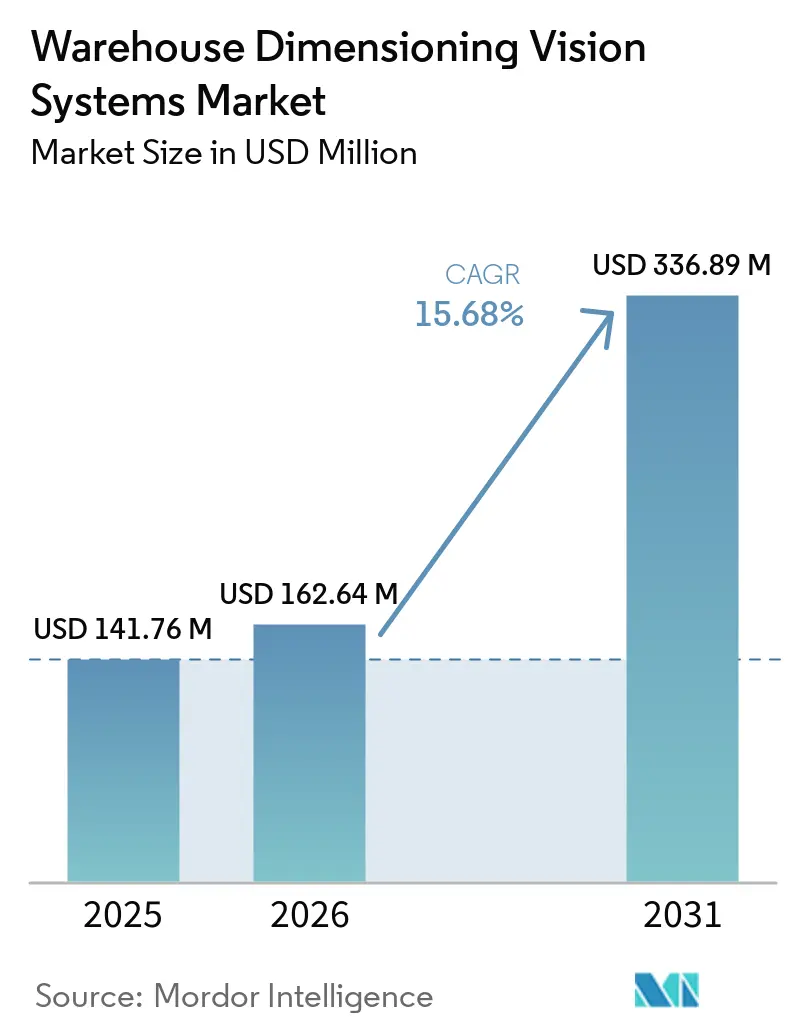
| Market Size (2026) | USD 162.64 Million |
| Market Size (2031) | USD 336.89 Million |
| Growth Rate (2026 - 2031) | 15.68 % |
| Fastest Growing Market | Asia-Pacific |
| Largest Market | North America |
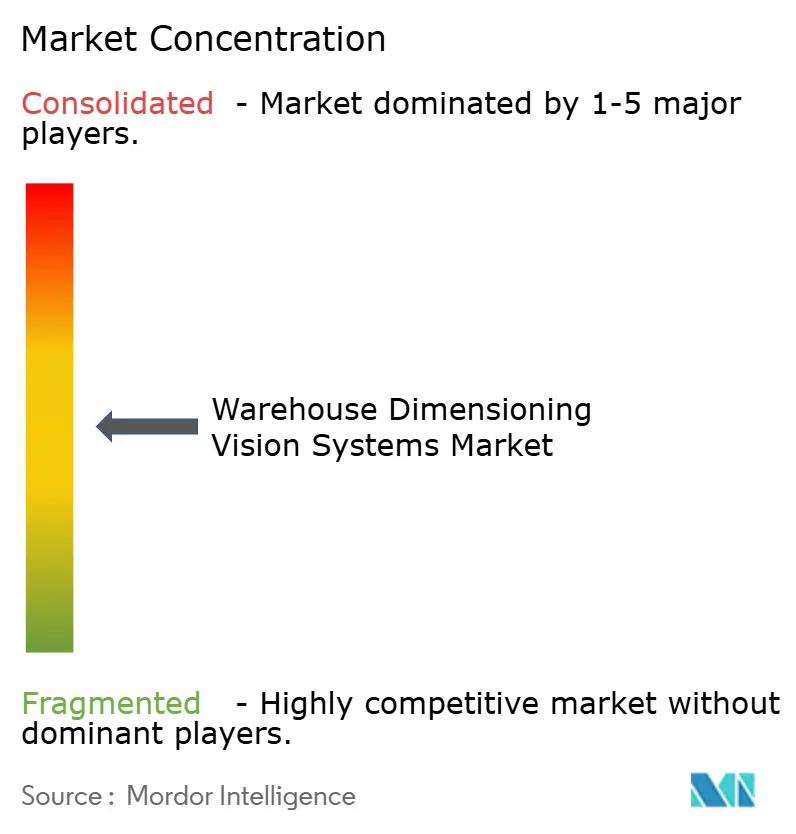
| Market Concentration | Medium |
Major Players *Disclaimer: Major Players sorted in no particular order Image © Mordor Intelligence. Reuse requires attribution under CC BY 4.0. | |
Warehouse Dimensioning Vision Systems Market Analysis by Mordor Intelligence
The warehouse dimensioning vision systems market size was valued at USD 141.76 million in 2025 and is estimated to expand from USD 162.64 million in 2026 to reach USD 336.89 million by 2031, at a CAGR of 15.68% during the forecast period (2026-2031). Carrier billing rules made accurate parcel measurements more valuable because a small error can affect dimensional-weight charges across many shipments. The warehouse dimensioning vision systems market also benefits from higher parcel volumes, which put pressure on facilities to measure goods without slowing conveyor operations. Warehouse operators are connecting measurement tools to warehouse management systems so dimensional data can guide carton selection, routing, storage, and invoice review. Large carriers and e-commerce operators remain central buyers, so weaker capital budgets could postpone new projects and replacement cycles. High integration costs, cyber risk, and inaccurate readings on soft or reflective goods still limit adoption, although compliance needs and packaging savings continue to support demand.
Key Report Takeaways
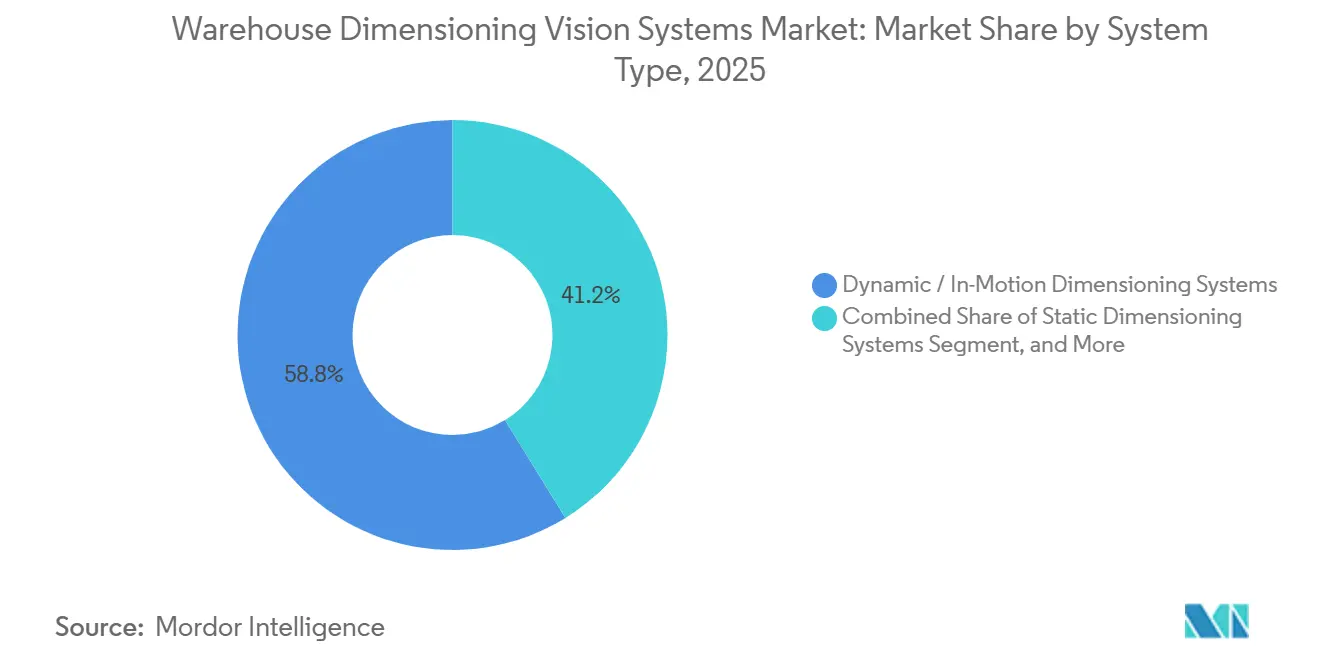
- By system type, Dynamic/In-Motion Dimensioning Systems held 58.81% of the warehouse dimensioning vision systems market share in 2025, while Mobile/Portable Dimensioning Systems are projected to expand at a 16.14% CAGR through 2031.
- By vision technology, 3D Stereo Vision held 34.56% revenue share in 2025, while Structured-Light 3D Vision is projected to record the highest CAGR of 16.27% through 2031.
- By object type, Parcels and Cartons accounted for 55.21% of dimensioned object throughput in 2025, while Irregular/Non-Standard Objects are projected to expand at a 16.12% CAGR through 2031.
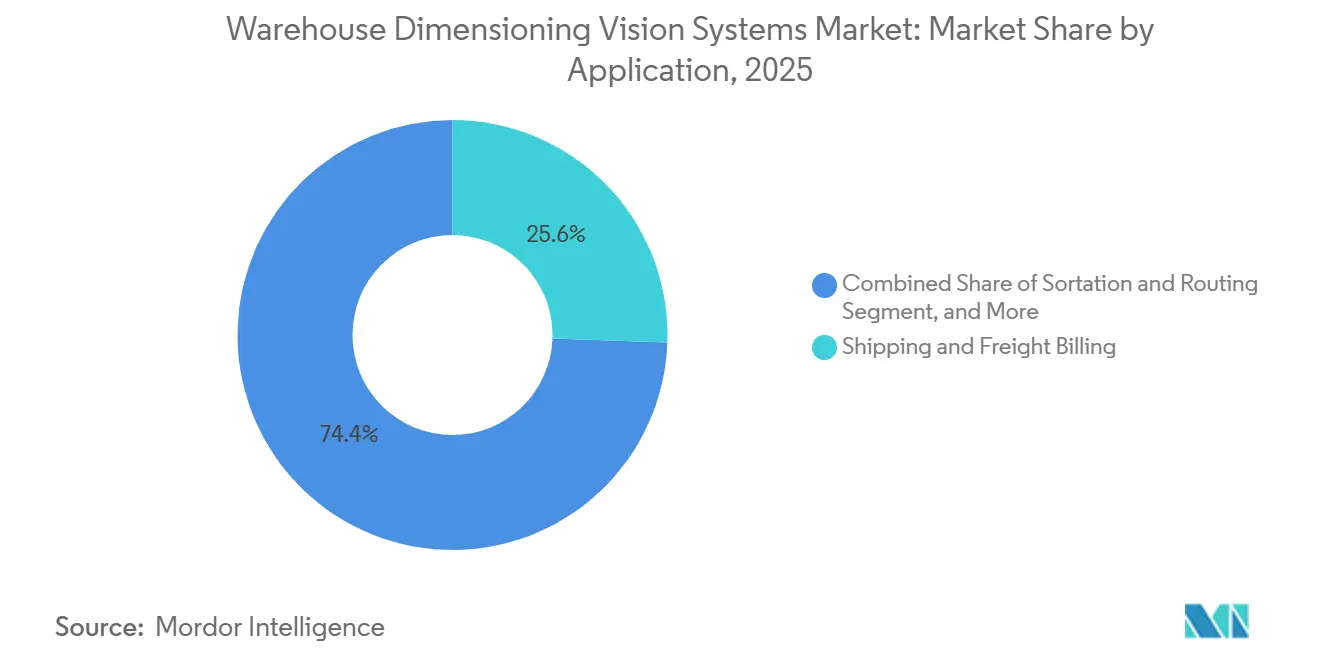
- By application, Shipping and Freight Billing held 25.56% revenue share in 2025, while Cartonization and Packaging Optimization is projected to expand at a 16.33% CAGR through 2031.
- By end-user, E-commerce and Fulfillment Centers held 27.71% revenue share in 2025 and are projected to expand at a 16.28% CAGR through 2031.
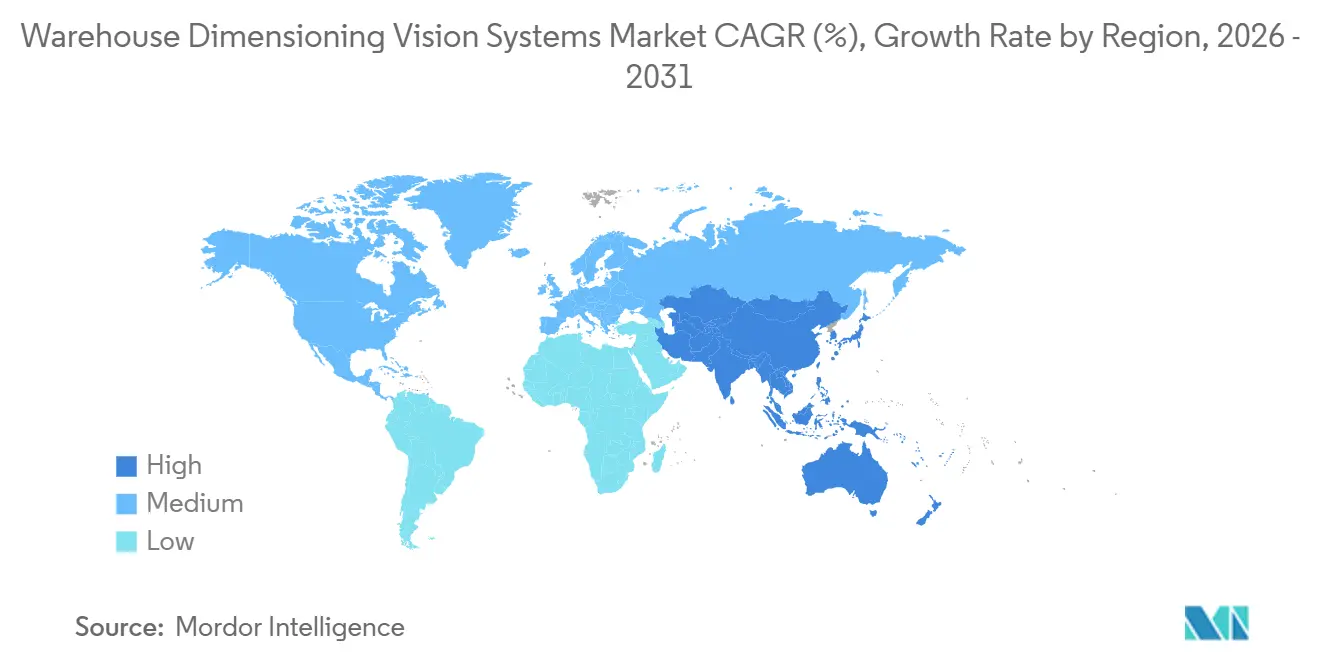
- By geography, North America held 33.51% revenue share in 2025, while Asia-Pacific is projected to expand at a 16.38% CAGR through 2031.
Note: Market size and forecast figures in this report are generated using Mordor Intelligence’s proprietary estimation framework, updated with the latest available data and insights as of January 2026.
Global Warehouse Dimensioning Vision Systems Market Trends and Insights
Drivers Impact Analysis*
| Driver | (~) % Impact on CAGR Forecast | Geographic Relevance | Impact Timeline |
|---|---|---|---|
| E-Commerce Parcel Volume Expansion | +3.5% | Global, with the highest concentration in North America, China, and Western Europe | Short term (≤ 2 years) |
| Dimensional-Weight Billing and Freight-Cost Recovery | +3.0% | North America and Europe, with growing relevance in Asia-Pacific and South America | Short term (≤ 2 years) |
| Warehouse Automation and Labor Shortages | +2.8% | North America, Europe, Japan, and South Korea | Medium term (2-4 years) |
| Integration of Dimensioning Data With Warehouse Management Systems | +2.2% | Global, with early adoption concentrated in North America and Northern Europe | Medium term (2-4 years) |
| Edge AI for Irregular-Parcel Classification | +1.8% | Global, with the fastest uptake in Asia-Pacific and North America | Long term (≥ 4 years) |
| Dimensioning Data for Dynamic Cartonization | +1.2% | North America and the EU, expanding to core Asia-Pacific markets | Long term (≥ 4 years) |
| Source: Mordor Intelligence | |||
E-Commerce Parcel Volume Expansion Sustains Baseline Demand
Global e-commerce parcel volumes continued to grow strongly, indicating sustained demand rather than a brief volume rebound. China recorded robust growth in express delivery volumes, supporting both domestic fulfillment investment and automated dimensioning deployments. These volumes make manual measurement harder to manage at large sites because small errors repeat across large shipment flows and can affect freight charges, storage decisions, and throughput. Facilities that process high volumes of parcels each day can face material freight and storage losses from minor measurement inaccuracies, especially when parcel dimensions enter several operating systems. The warehouse dimensioning vision systems market is therefore linked to the need for reliable, high-throughput measurement during receiving, sorting, and outbound handling. In India, Southeast Asia, and Brazil, new fulfillment sites are increasingly designed with automated measurement in place rather than added later, which gives operators more consistent data from their opening day.
Dimensional-Weight Billing and Freight-Cost Recovery Create Direct ROI Triggers
FedEx and UPS applied package-dimension rounding rules on August 2025, rounding every fractional package inch upward before calculating dimensional weight. The revised approach raised the cost of imprecise measurements for lightweight and bulky e-commerce shipments that occupy considerable shipping space without having a high actual weight. Repeated rounding across 3 dimensions can raise cubic volume and may lead to additional handling surcharges, so even modest errors can accumulate across a large shipment base. The National Motor Freight Classification update in July 2025 introduced new density-based classes for less-than-truckload shipments, reinforcing the need for accurate dimensions in freight classification.[1]National Motor Freight Traffic Association, “National Motor Freight Classification Update,” National Motor Freight Traffic Association, nmfta.org Certified systems provide auditable records that can support invoice disputes, retrospective reviews, and freight-cost recovery after carriers have issued bills. This role gives the warehouse dimensioning vision systems market a clearer financial case in purchasing decisions that otherwise require longer return-on-investment periods.
Warehouse Automation and Labor Shortages Embed Dimensioning in Broader Programs
Warehouse automation investment rises when operators cannot reliably staff repetitive logistics work across receiving, sorting, storage, and dispatch. In the United States, warehouse wages increased, while the transportation, warehousing, and utilities sector faced a substantial number of unfilled positions. Dimensioning systems replace an error-prone manual task while supplying data for sortation, slotting, and picking equipment that requires dependable item profiles. An automated picking operation still depends on reliable dimensional information if it is to select suitable storage locations, packaging, and downstream handling methods. Manual measurement can become a data bottleneck when other warehouse processes are automated, because unreliable input affects every decision that follows it. Research on labor shortages and automation found that operators increasingly assessed automation through both throughput and data-quality outcomes.
WMS Integration Transforms Dimensioning From Data Collection to Execution Intelligence
The warehouse dimensioning vision systems market is shifting from stand-alone measurement tools toward connected systems that update operating records in real time across warehouse management, carrier rating, and cartonization processes. When a measurement enters a warehouse management system before a pallet leaves the dock, it can support box selection, route planning, load planning, and invoice preparation while there is still time to act. Honeywell and Stereolabs announced a collaboration in August 2025 that combined ZED stereoscopic cameras with SwiftDecoder software for real-time package data and trailer-load optimization.[2]Honeywell International Inc., “Honeywell and Stereolabs Develop Innovative Mobile Solution to Simplify Logistics Across the Supply Chain,” Honeywell, honeywell.com The solution does not require fixed conveyor infrastructure, which broadens its use at docks, trailer operations, and other flexible work areas. Operators increasingly expect compatibility with systems from Manhattan Associates, Blue Yonder, SAP WM, and Oracle WMS Cloud because isolated measurement records have less operational value. Vendors without verified application programming interfaces can face displacement as customers simplify their warehouse technology stacks and seek fewer manual data transfers.
Restraints Impact Analysis*
| Restraint | (~) % Impact on CAGR Forecast | Geographic Relevance | Impact Timeline |
|---|---|---|---|
| High Initial Investment and Integration Costs | -2.5% | Global, most acute in South America, the Middle East and Africa, and Southeast Asia | Medium term (2-4 years) |
| Measurement Errors With Soft, Reflective, and Irregular Packages | -1.8% | Global, particularly in polybag-heavy e-commerce and retail distribution operations | Long term (≥ 4 years) |
| Cybersecurity and Data-Residency Exposure From Connected Vision Systems | -1.2% | North America and Europe, where data sovereignty frameworks are most stringent | Medium term (2-4 years) |
| Limited Availability of Vision-System Integration Specialists | -0.8% | Global, most acute in emerging markets and non-metropolitan facilities | Medium term (2-4 years) |
| Source: Mordor Intelligence | |||
High Initial Investment and Integration Costs Constrain Mid-Market Access
Production-grade dynamic systems require spending on sensors, conveyor changes, information technology middleware, application programming interfaces, and certification testing, rather than a single equipment purchase. These costs can place the technology beyond the immediate reach of smaller logistics operators with narrow fulfillment margins and less predictable shipment volumes. Older sites often require custom middleware for legacy warehouse management and enterprise resource planning systems, making a technically workable project harder to approve financially. This can extend project timing from weeks to months and add service costs that can match hardware spending. The result is a two-tier warehouse dimensioning vision systems market in which large carriers, major 3PLs, and national retailers adopt sooner than independent operators. Subscription offerings and modular hardware are easing access, but total cost of ownership remains a procurement barrier in markets where operating margins are under continued pressure.
Measurement Errors on Non-Standard Packages Sustain Manual Measurement Pathways
Conventional laser-array and time-of-flight designs were built for opaque, rectangular cartons, where a clear bounding box can be produced with relatively consistent accuracy. Polybags, soft-packaged apparel, and multi-piece loads can create bounding-box errors that feed into billing mistakes, storage errors, and sortation faults. A recent study found that dimensional errors persisted for irregular packages, even when an edge-based deep-learning system processed images at high speeds. The finding shows that non-standard package measurement remains an unresolved technical challenge even as edge-processing speeds improve. No single sensing method reliably handles every surface and parcel profile at acceptable accuracy across the full range of warehouse goods. Hybrid sensor systems can improve coverage, but they also add cost and complexity for mid-market operators that are already evaluating difficult integration requirements.
*Our forecasts treat driver/restraint impacts as directional, not additive. The impact forecasts reflect baseline growth, mix effects, and variable interactions.
Segment Analysis
By System Type: In-Motion Systems Lead High-Throughput Operations
Dynamic/In-Motion Dimensioning Systems held 58.81% of revenue in 2025, which gave them the largest warehouse dimensioning vision systems market share among system types. Their position reflects the needs of high-throughput sites where stopping packages for static measurement can reduce sortation efficiency and interrupt the wider conveyor flow. These systems can measure packages at speeds up to 3.3 meters per second. They can also combine dimensional measurement and barcode reading during 1 conveyor pass, which reduces the need for separate identification and measurement stages. This design supports consistent data capture while goods move through a busy facility.
Static Dimensioning Systems serve receiving docks and compliance stations where operators need controlled measurements and have less need for uninterrupted conveyor processing. Mettler-Toledo’s TLD870 can measure up to 240 pallets per hour and drew interest from Japanese logistics operators because of its warehouse management system integration. Mobile/Portable Dimensioning Systems are projected to expand at a 16.14% CAGR through 2031. Forklift-mounted and handheld units support trailer measurement, temporary work areas, and changing warehouse layouts. The Honeywell and Stereolabs solution showed how mobile equipment can capture parcel and pallet data without fixed conveyors. Portable designs can reduce the rigidity of fixed installations when workflows change.



By Vision Technology: Stereo Vision Leads While Structured Light Expands
3D Stereo Vision held 34.56% of revenue in 2025, accounting for the leading warehouse dimensioning vision systems market share by technology. Its installed base reflects decades of industrial use and a record of calibration and reliability in settings where measured data must be dependable. These characteristics matter when logistics operators seek production certification. Stereo vision also serves mixed stock-keeping unit environments that require dependable depth measurement across varied items. Its established position supports continued use in many dimensioning deployments.
Structured-Light 3D Vision is projected to expand at a 16.27% CAGR through 2031. It can better manage non-cuboidal and transparent packages when stereo algorithms lose feature correspondence. Its use with artificial intelligence inference can extend measurement coverage for profiles that laser-only systems handle poorly. Zivid introduced the Zivid 3 XL250 in November 2025 with millimeter-level accuracy up to 4.5 meters, a 2.5 square meter field of view, and point-cloud capture in under 500 milliseconds.[3]Zivid, “Zivid 3 Sets a New Standard for Big Robots in Depalletization and Large Bin-Picking,” Zivid, blog.zivid.com Time-of-Flight 3D Vision, Laser and Camera Vision, and other systems serve the remaining demand, while sensor fusion gains relevance in docks with difficult lighting. SICK introduced its Nova platform in August 2026, combining deep-learning artificial intelligence with precise 3D height-data profiling for detection that does not depend on color or contrast.
By Object Type: Parcels and Cartons Anchor Demand as Irregular Objects Advance
Parcels and Cartons represented 55.21% of dimensioned object throughput in 2025, which made them the largest object category. Existing sensors can measure this package type with legally certifiable precision. The category therefore anchors current revenue for the warehouse dimensioning vision systems market. Standard cartons also fit the handling patterns of conventional conveyor systems and established freight workflows. Their prevalence gives suppliers a large base of familiar measurement tasks.
Pallets and Large Freight require systems that work at forklift speeds and can manage difficult surfaces, larger loads, and different handling paths. Mettler-Toledo launched the TLD970 dynamic pallet dimensioner in Japan in August 2025 for speeds of 3-15 km/h and for poor-reflectivity materials and wooden crates. Polybags and Soft Packages offer the strongest opportunity for artificial intelligence-based measurement systems because fixed algorithms struggle with their forms. Irregular/Non-Standard Objects are projected to expand at a 16.12% CAGR through 2031. Marketplace fulfillment brings tools, sporting goods, and unpackaged items into warehouse flows. Artificial intelligence systems achieve ±3-5 mm bounding-box accuracy on irregular forms, compared with ±2 mm on rectangular cartons, so the performance gap still supports further investment.
By Application: Freight Billing Leads While Cartonization Accelerates
Shipping and Freight Billing held 25.56% of application revenue in 2025, which represented the largest application share. The leading position follows the carrier compliance need to prevent inaccurate dimensional data from becoming an auditable cost exposure. The warehouse dimensioning vision systems market size for freight billing is supported by systems that retain verifiable measurement records throughout shipment handling. The 2025 carrier rounding changes and the NMFC density-class update reinforced the case for certified measurement in shipping and less-than-truckload operations. These requirements tie measurement accuracy directly to invoice control.
Cartonization and Packaging Optimization is projected to expand at a 16.33% CAGR through 2031. Real-time dimensions can help cartonization engines reduce void fill, packaging material use, and dimensional weight before a shipment is sealed. One measurement investment can therefore create savings across several operating cost lines. Space and Slotting Optimization and Inventory Master-Data Capture are also expanding applications. Measuring an item at first receipt can create a permanent verified product record and reduce repeated measurements for the same stock-keeping unit. Sortation and Routing, plus Quality/Dimension Verification, complete the application mix and are increasingly used in returns processing.
By End-User: Fulfillment Centers Remain the Largest and Fastest-Growing Buyers
E-commerce and Fulfillment Centers held 27.71% of end-user revenue in 2025 and are projected to expand at a 16.28% CAGR through 2031. This combination makes the group both the largest and fastest-growing end-user segment. The warehouse dimensioning vision systems market share for these facilities reflects their need to process large parcel volumes with consistent measurements across fast-moving fulfillment operations. Their expansion is tied to greenfield development by the same buyer group rather than a broad shift across all end users. These sites also require data that can move directly into order fulfillment decisions.
3PL and Contract Logistics providers form the second-largest end-user group and use dimensional data transparency to support shipper clients and carrier invoice reviews. Courier, Express, and Parcel operators use high-speed in-motion systems at sortation hubs, making many purchases incremental upgrades to established infrastructure. Retail Distribution Centers use measurements for slotting and returns, especially when consumer-returned items need verification before re-storage. Manufacturing and Industrial Warehouses are an emerging user group because dimensions can support robotic pick-and-place cells and automated pallet building. These applications extend the warehouse dimensioning vision systems market beyond its traditional logistics base.
Geography Analysis
North America held 33.51% of global revenue in 2025, accounting for the leading warehouse dimensioning vision systems market share by region. Dense e-commerce fulfillment networks and mature carrier compliance programs support the region’s position. FedEx and UPS package-dimension rounding rules gave United States operators a direct reason to upgrade measurement systems. Warehouse wages remained elevated, while transportation, warehousing, and utilities faced persistent job vacancies. These labor conditions favor investment in systems that reduce manual measurement work.
Canada is a secondary regional market through its national carrier networks and retailer-owned distribution centers, while Mexico’s nearshoring-led manufacturing expansion is creating new warehouses with vision systems included at the design stage.Europe is a major regional cluster, led by Germany, the United Kingdom, and France. European packaging regulation supports right-sizing, which increases interest in cartonization applications. SICK’s group revenue demonstrates the scale of European sensor manufacturing. Mettler-Toledo’s Norwegian production site and Zivid’s Oslo base support Scandinavia’s role in product development and manufacturing.
Asia-Pacific is projected to expand at a 16.38% CAGR through 2031, the fastest regional rate in the warehouse dimensioning vision systems market. China processed a substantial volume of express delivery shipments, with strong annual growth, supporting demand for domestic and multinational dimensioning systems. Japan’s aging workforce supports labor-substitution investments, including pallet and static dimensioners used by logistics operators. India’s expanding e-commerce industry, South Korea’s advanced logistics network, and Vietnam’s manufacturing-park fulfillment projects provide additional regional demand. South America, the Middle East, and Africa remain smaller developing markets, where the extension of dimensional-weight billing by global logistics companies serves as an important adoption catalyst.

Competitive Landscape
The warehouse dimensioning vision systems market is moderately concentrated among global industrial machine-vision suppliers and specialist providers. Cognex, SICK, and Mettler-Toledo have installed-base advantages because customers value certified accuracy and broad warehouse management system integration. Specialist suppliers such as Cubiscan, vMeasure, VITRONIC, and Parcelcube compete through parcel-type flexibility and simpler deployment. Certification requirements from NTEP in the United States and OIML/MID standards in Europe establish an accuracy threshold for credible suppliers. Competition, therefore, extends beyond price to system performance, integration, and the ability to handle diverse package profiles.
Cognex maintained a rapid product cycle in recent years. It launched the SLX Logistics Portfolio, featuring artificial intelligence-enabled devices that warehouse staff without technical training can deploy, and Purolator adopted the portfolio across its terminal network. Cognex subsequently launched an NVIDIA Jetson-powered In-Sight Vision Controller with high-performance edge artificial intelligence inference capabilities. This was followed by OneVision, which enables distributed teams to train, refine, and deploy inspection models across facilities. Cognex also uses patented symbolic-light 3D capture in its vision systems, supporting technical differentiation and increasing switching costs for existing accounts.
Mettler-Toledo, Datalogic, and Honeywell compete for mid-market projects through integrated dimensioning, weighing, and scanning systems. Datalogic presented its Matrix 830/930 platform at LogiMAT 2026 for large-area conveyor scanning and parcel identification at primary sortation speeds. Honeywell’s work with Stereolabs targeted mobile measurement and real-time warehouse management system integration. Polybag and irregular-object measurement remains an open area where artificial intelligence-assisted systems can widen automation coverage. vMeasure, Parcelcube, and BeeVision offer OIML/MID-certified artificial intelligence-assisted dimensioners that challenge mid-tier suppliers on coverage and price. Körber and Vanderlande increasingly include dimensioning systems within larger automation projects, which moves purchasing decisions toward system integrators.
Warehouse Dimensioning Vision Systems Industry Leaders
Cognex Corporation
SICK AG
Keyence Corporation
Mettler-Toledo International Inc.
Datalogic S.p.A.
- *Disclaimer: Major Players sorted in no particular order

Recent Industry Developments
- August 2026: SICK AG launched AI-powered 3D quality inspection, through its Nova machine vision platform, combining deep-learning with high-precision 3D height-data profiling for color-and-contrast-independent detection, logistics applications include package-deformation detection and tote completeness verification, marking SICK's first AI-embedded capability in its high-precision 3D machine vision product line. SICK reported EUR 1.8 billion group revenue in fiscal 2025.
- May 2026: Cognex Corporation released OneVision, a collaborative AI vision development environment enabling distributed teams to train, refine, and deploy AI inspection models across global facility networks without facility-level AI specialist staffing.
- May 2026: Cognex Corporation launched the In-Sight 6900 Vision Controller, powered by NVIDIA Jetson and supporting up to 157 TOPS of AI inference, with a modular camera-interchangeable architecture enabling parallel multi-model execution for warehousing and distribution inspection workflows.
- March 2026: Datalogic S.p.A. unveiled the Matrix 830/930 high-speed conveyor and parcel-handling platform at LogiMAT 2026 in Stuttgart for large-area conveyor scanning and high-speed parcel identification at primary sortation speeds, the company simultaneously previewed the Falcon X60/X65 and Skorpio X40/X45 next-generation mobile logistics computers.


Global Warehouse Dimensioning Vision Systems Market Report Scope
Warehouse Dimensioning Vision Systems Market refers to automated measurement solutions that use vision-based sensors (3D cameras, structured light, time-of-flight, laser triangulation, and photogrammetry) to capture the length, width, height, and often weight of parcels, cartons, totes, and pallets in warehouses and distribution centers.
The Warehouse Dimensioning Vision Systems Market Report is Segmented by System Type (Static, In-Motion, and Portable), Vision Technology (3D Stereo, Structured-Light, ToF, Laser+Camera, and Other Vision Technologies), Object Type (Parcels and Cartons, Polybags and Soft Packages, Pallets and Large Freight, and Irregular / Non-Standard Objects), Application (Space and Slotting Optimization, Shipping and Freight Billing, Cartonization and Packaging Optimization, Inventory Master-Data Capture, Sortation and Routing, and Quality / Dimension Verification), End-User (E-commerce and Fulfillment Centers, 3PL / Contract Logistics, Retail Distribution Centers, Courier, Express, and Parcel, Manufacturing and Industrial Warehouses, Wholesale and Distribution, and Other End-Users), and Geography (North America, South America, Europe, Asia-Pacific, and Middle East and Africa). The Market Forecasts are Provided in Terms of Value (USD).
| Static Dimensioning Systems |
| Dynamic / In-Motion Dimensioning Systems |
| Mobile / Portable Dimensioning Systems |
| 3D Stereo Vision |
| Structured-Light 3D Vision |
| Time-of-Flight (ToF) 3D Vision |
| Laser + Camera Vision |
| Other Vision Technologies |
| Parcels and Cartons |
| Polybags and Soft Packages |
| Pallets and Large Freight |
| Irregular / Non-Standard Objects |
| Space and Slotting Optimization |
| Shipping and Freight Billing |
| Cartonization and Packaging Optimization |
| Inventory Master-Data Capture |
| Sortation and Routing |
| Quality / Dimension Verification |
| E-commerce and Fulfillment Centers |
| 3PL / Contract Logistics |
| Retail Distribution Centers |
| Courier, Express, and Parcel |
| Manufacturing and Industrial Warehouses |
| Wholesale and Distribution |
| Other End-Users |
| North America | United States | |
| Canada | ||
| Mexico | ||
| South America | Brazil | |
| Argentina | ||
| Rest of South America | ||
| Europe | Germany | |
| United Kingdom | ||
| France | ||
| Italy | ||
| Spain | ||
| Rest of Europe | ||
| Asia-Pacific | China | |
| Japan | ||
| India | ||
| South Korea | ||
| ASEAN | ||
| Rest of Asia-Pacific | ||
| Middle East and Africa | Middle East | Saudi Arabia |
| United Arab Emirates | ||
| Turkey | ||
| Rest of the Middle East | ||
| Africa | South Africa | |
| Nigeria | ||
| Egypt | ||
| Rest of Africa | ||
| By System Type | Static Dimensioning Systems | ||
| Dynamic / In-Motion Dimensioning Systems | |||
| Mobile / Portable Dimensioning Systems | |||
| By Vision Technology | 3D Stereo Vision | ||
| Structured-Light 3D Vision | |||
| Time-of-Flight (ToF) 3D Vision | |||
| Laser + Camera Vision | |||
| Other Vision Technologies | |||
| By Object Type | Parcels and Cartons | ||
| Polybags and Soft Packages | |||
| Pallets and Large Freight | |||
| Irregular / Non-Standard Objects | |||
| By Application | Space and Slotting Optimization | ||
| Shipping and Freight Billing | |||
| Cartonization and Packaging Optimization | |||
| Inventory Master-Data Capture | |||
| Sortation and Routing | |||
| Quality / Dimension Verification | |||
| By End-User | E-commerce and Fulfillment Centers | ||
| 3PL / Contract Logistics | |||
| Retail Distribution Centers | |||
| Courier, Express, and Parcel | |||
| Manufacturing and Industrial Warehouses | |||
| Wholesale and Distribution | |||
| Other End-Users | |||
| By Geography | North America | United States | |
| Canada | |||
| Mexico | |||
| South America | Brazil | ||
| Argentina | |||
| Rest of South America | |||
| Europe | Germany | ||
| United Kingdom | |||
| France | |||
| Italy | |||
| Spain | |||
| Rest of Europe | |||
| Asia-Pacific | China | ||
| Japan | |||
| India | |||
| South Korea | |||
| ASEAN | |||
| Rest of Asia-Pacific | |||
| Middle East and Africa | Middle East | Saudi Arabia | |
| United Arab Emirates | |||
| Turkey | |||
| Rest of the Middle East | |||
| Africa | South Africa | ||
| Nigeria | |||
| Egypt | |||
| Rest of Africa | |||


Key Questions Answered in the Report
What is the warehouse dimensioning vision systems market size?
The warehouse dimensioning vision systems market size is estimated at USD 162.64 million in 2026 and is projected to reach USD 336.89 million by 2031 at a 15.68% CAGR.
What is driving demand for warehouse dimensioning vision systems?
Parcel-volume expansion, dimensional-weight billing, warehouse automation, and real-time warehouse management system integration are supporting adoption.
Which system type leads warehouse dimensioning deployments?
Dynamic/In-Motion Dimensioning Systems led with 58.81% revenue share in 2025 because they measure parcels without stopping conveyor movement.
Which vision technology is expected to expand fastest?
Structured-Light 3D Vision is projected to expand at a 16.27% CAGR through 2031, supported by its ability to handle non-cuboidal and transparent packages.
Which region is expected to expand fastest for dimensioning vision systems?
Asia-Pacific is projected to expand at a 16.38% CAGR through 2031, supported by parcel growth and logistics automation investment.
What limits adoption of warehouse dimensioning systems?
Upfront integration costs, package-measurement errors, cyber exposure, and limited integration skills can delay projects, particularly among smaller operators.
Page last updated on:





