
Warehouse Control Systems (WCS) Market Size and Share
Market Overview
| Study Period | 2020 - 2031 |
|---|---|
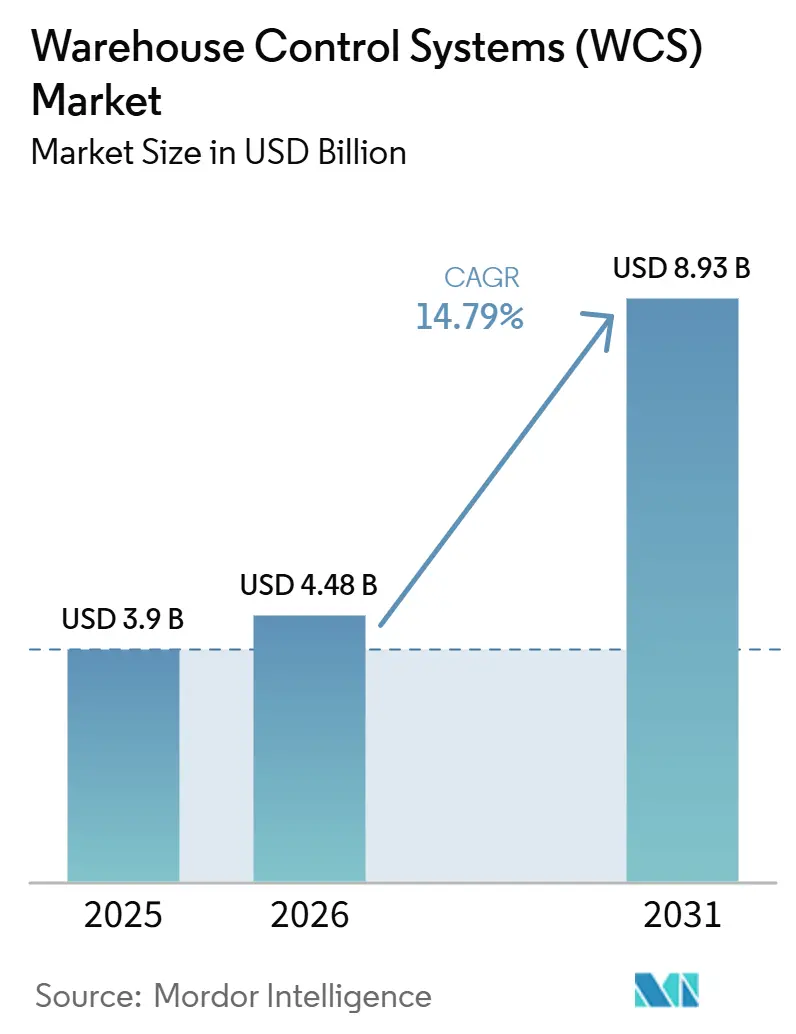
| Market Size (2026) | USD 4.48 Billion |
| Market Size (2031) | USD 8.93 Billion |
| Growth Rate (2026 - 2031) | 14.79% CAGR |
| Fastest Growing Market | Asia-Pacific |
| Largest Market | North America |
| Market Concentration | Medium |
Major Players *Disclaimer: Major Players sorted in no particular order Image © Mordor Intelligence. Reuse requires attribution under CC BY 4.0. | |
Warehouse Control Systems (WCS) Market Analysis by Mordor Intelligence
The warehouse control systems (WCS) market size was valued at USD 3.90 billion in 2025 and estimated to grow from USD 4.48 billion in 2026 to reach USD 8.93 billion by 2031, at a CAGR of 14.79% during the forecast period (2026-2031). The warehouse control systems market is expanding as operators coordinate e-commerce, store replenishment, and wholesale orders from the same facilities. Higher labor costs and limited labor availability are strengthening the case for automated task routing and exception handling. The growing use of conveyors, autonomous mobile robots, automated storage and retrieval systems, and shuttle systems is increasing the need for a common control layer. Providers are responding by combining warehouse control, execution, and machine-control capabilities in more unified software platforms. Brownfield upgrades and contract renewal periods are creating openings for suppliers that can connect equipment from several vendors.
Key Report Takeaways
- By component, software held 56.60% of revenue in 2025 and is projected to expand at a 14.94% CAGR through 2031 in warehouse control systems (WCS) market.
- By functional module, conveyor and sorter control held 24.28% of revenue in 2025, while robotic and goods-to-person control is projected to expand at a 15.88% CAGR through 2031.
- By deployment mode, on-premises deployments held 46.50% of revenue in 2025, while cloud-based deployments are projected to expand at a 15.98% CAGR through 2031 in warehouse control systems (WCS) market.
- By enterprise size, large enterprises held 66.70% of warehouse control systems market share in 2025, while SMEs are projected to expand at a 15.41% CAGR through 2031.
- By end-use industry vertical, e-commerce held 27.31% of revenue in 2025, while pharmaceutical and healthcare is projected to expand at a 15.22% CAGR through 2031.
- By automation environment, conveyors and sorters held 25.29% of revenue in 2025, while autonomous mobile robots are projected to expand at a 15.38% CAGR through 2031 in warehouse control systems (WCS) market.
- By geography, North America held 34.56% of revenue in 2025, while Asia-Pacific is projected to expand at a 15.23% CAGR through 2031.
Note: Market size and forecast figures in this report are generated using Mordor Intelligence’s proprietary estimation framework, updated with the latest available data and insights as of January 2026.
Global Warehouse Control Systems (WCS) Market Trends and Insights
Drivers Impact Analysis*
| Driver | (~) % Impact on CAGR Forecast | Geographic Relevance | Impact Timeline |
|---|---|---|---|
| Omnichannel Fulfillment Complexity | +3.2% | Global, concentrated in North America and Europe | Short term (≤ 2 years) |
| Warehouse Labor Shortages and Rising Labor Costs | +2.8% | North America and Europe, with spillover to Asia-Pacific | Short term (≤ 2 years) |
| Expansion of Automated Storage and Retrieval Systems | +2.5% | Global, strongest in North America, Europe, and Asia-Pacific | Medium term (2-4 years) |
| Integration of Robotics and Autonomous Mobile Robots | +2.2% | Global, with early gains in North America and Asia-Pacific | Medium term (2-4 years) |
| Event-Driven Control for Mixed-Fleet Automation | +1.8% | Global, concentrated in large e-commerce and 3PL hubs | Medium term (2-4 years) |
| Digital Twin-Based Commissioning and Exception Simulation | +1.5% | North America and Europe, with early Asia-Pacific adoption | Long term (≥ 4 years) |
| Source: Mordor Intelligence | |||
Omnichannel Fulfillment Complexity Redefines WCS Scope
Omnichannel fulfillment is changing the operating requirements of the warehouse control systems (WCS) market. A 2026 survey of 647 supply chain leaders found that nearly 80% reported continuing e-commerce growth, while a similar share was implementing or planning omnichannel distribution strategies. These facilities handle wholesale orders, direct-to-consumer picks, and store replenishment from the same inventory and equipment pool. The competing workflows require the control platform to assign labor and equipment capacity as conditions change during a shift. Rules-based approaches can struggle when order priorities change at the same time as equipment availability. This makes real-time routing, slot release, and exception recovery important requirements for operators seeking to protect service levels during peak periods.
Warehouse Labor Shortages and Rising Labor Costs Accelerate Deployment
Labor economics are making the warehouse control systems (WCS) market more important to distribution operators. Mean hourly wages for hand laborers and material movers reached USD 20.50 in May 2024, compared with USD 17.00 in May 2019.[1]U.S. Bureau of Labor Statistics, “Occupational Employment and Wage Statistics,” U.S. Bureau of Labor Statistics, bls.gov The Bureau of Labor Statistics projected employment for hand laborers and material movers to grow at 0.4% annually through 2033. These conditions raise the value of the warehouse control systems (WCS) market for operators that direct work to available employees and reduce time spent resolving routine exceptions. Automated task allocation can help facilities sustain throughput with fewer manual touches. As automation expands, warehouse roles are also moving toward system monitoring and exception resolution rather than purely repetitive movement tasks.
Expansion of Automated Storage and Retrieval Systems Extends WCS Demand
New automated storage and retrieval system installations are broadening the operating scope of the warehouse control systems (WCS) market. Shuttle arrays, unit-load cranes, and bin-storage grids each require coordinated lane allocation, load sequencing, and goods-to-person dispatch. Swisslog launched its AgileStore 4-way pallet shuttle in March 2026 for high-density pallet storage. Maersk opened World Gateway II in Singapore in March 2026 with multi-shuttle systems, automated storage and retrieval systems, and autonomous case-handling robots operating within one facility.[2]A.P. Moller-Maersk, “Maersk Boosts Asia Pacific Logistics Footprint With New Fully Automated Global and Regional Distribution Centre in Singapore,” A.P. Moller-Maersk, maersk.com Such sites require warehouse control systems (WCS) market software to coordinate different automation types rather than manage them as separate islands. The wider range of storage technologies is increasing the software and integration work required in automated facilities.
Integration of Robotics and Autonomous Mobile Robots Demands Dynamic Task Dispatch
The expansion of autonomous mobile robots is increasing the need for dynamic task dispatch in the warehouse control systems (WCS) market. Mobile robots have variable travel times because battery status, traffic density, and exception recovery change during operations. A control platform must coordinate those mobile agents with fixed equipment such as conveyors and stacker cranes. Handoffs between fixed and mobile systems can become a source of delay if work queues are not adjusted in real time. Dematic and GreyOrange announced a partnership in April 2026 to integrate GreyMatter AI-powered robot orchestration into Dematic's software portfolio. The partnership reflects the warehouse control systems (WCS) market move toward software that can assign and reassign work across several types of automated equipment.
Restraints Impact Analysis*
| Restraint | (~) % Impact on CAGR Forecast | Geographic Relevance | Impact Timeline |
|---|---|---|---|
| High Upfront Implementation and Retrofit Costs | -1.8% | Global, most acute in South America, the Middle East, and Africa | Short term (≤ 2 years) |
| Integration Complexity With Legacy WMS, ERP, and PLC Environments | -1.5% | Global, concentrated in brownfield facilities across North America and Europe | Medium term (2-4 years) |
| Cybersecurity Exposure Across Connected Operational Technology | -1.3% | Global, with Asia-Pacific and North America most exposed | Medium term (2-4 years) |
| Cloud Latency and Network Resilience Requirements in High-Throughput Facilities | -1.0% | North America and Europe, where fixed automation is concentrated | Long term (≥ 4 years) |
| Source: Mordor Intelligence | |||
High Upfront Implementation and Retrofit Costs Constrain Mid-Market Adoption
High implementation and retrofit costs limit adoption in the warehouse control systems (WCS) market, especially among mid-sized operators. A full project can require software integration, equipment changes, testing, and staff training before the site begins operating under the new system. The cost rises further when legacy enterprise resource planning, warehouse management, and programmable logic controller systems need custom connections. Large operators can spread these costs across multi-site networks, while smaller facilities commonly need a narrower initial deployment. Subscription licensing can reduce the initial software expense for some users. However, facilities with high-throughput fixed automation may still prefer local systems that require a larger upfront commitment.
Integration Complexity with Legacy WMS, ERP, and PLC Environments Elevates Project Risk
Integration with legacy systems remains a major project risk for the warehouse control systems market. Many distribution centers use warehouse management systems that were designed before mobile robots and real-time equipment coordination became common. These environments can require custom data connections for each equipment provider and communication protocol. The resulting work can extend implementation timelines and increase testing requirements in active facilities. MIT identified 26 vulnerabilities in highly automated warehouses and noted that poorly configured security controls can interrupt legitimate operational technology traffic. Dematic launched Command Center in March 2026 as a vendor-agnostic platform for monitoring, decision support, and operational analytics.[3]Dematic, “Dematic Redefines Warehouse Intelligence With Launch of Command Center,” Dematic, dematic.com
*Our forecasts treat driver/restraint impacts as directional, not additive. The impact forecasts reflect baseline growth, mix effects, and variable interactions.
Segment Analysis
By Component: Software Platforms Define Competitive Differentiation
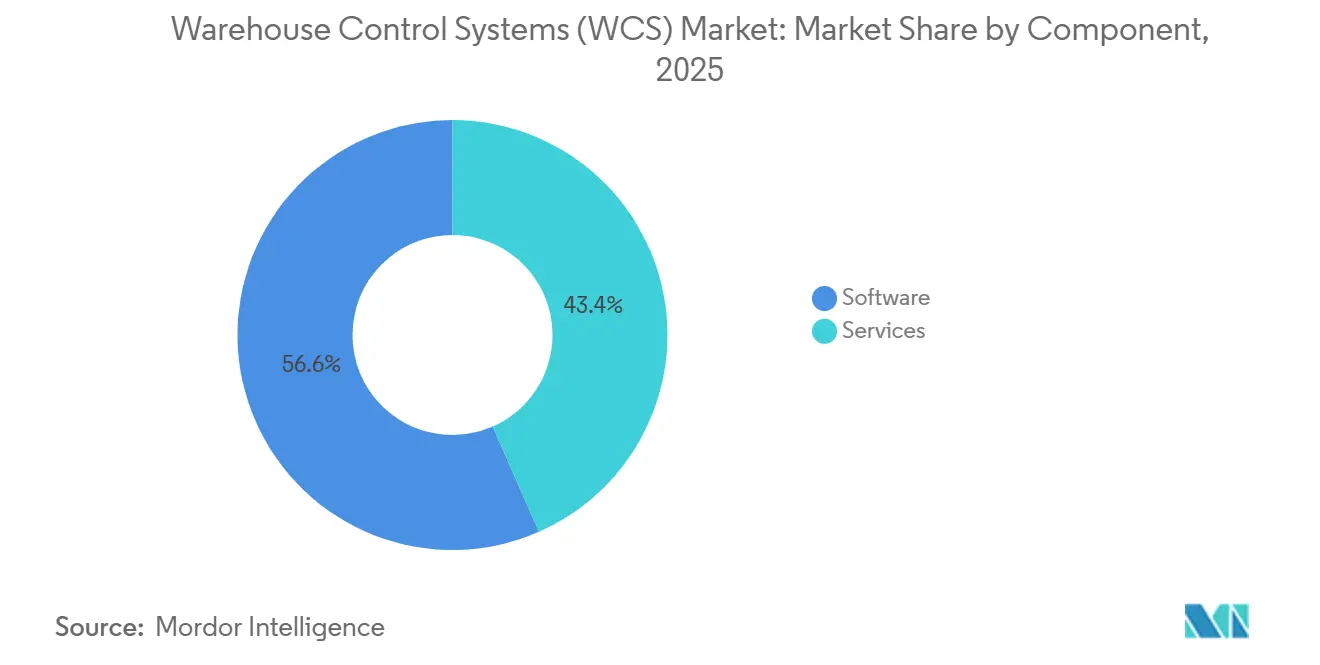
Software represented 56.60% of revenue in 2025 and is projected to expand at a 14.94% CAGR through 2031. This segment leads the warehouse control systems market because software selection increasingly shapes how an operator connects equipment and manages workflows. The software layer combines work release, equipment communication, monitoring, and exception handling. Providers are also joining warehouse execution and machine-control functions with traditional WCS functions. Honeywell introduced Momentum Core in April 2026 as a modular platform that combines warehouse control, warehouse execution, and machine control. This approach can reduce the number of interfaces that an operator must maintain across an automated site in the warehouse control systems (WCS) market.
Services remain necessary for integration, maintenance, testing, and lifecycle support. Their role is particularly important where one facility uses equipment from several manufacturers. At the same time, configuration tools and simulation capabilities can reduce the need for fully custom work in repeatable deployments. The warehouse control systems industry is therefore shifting more value toward reusable software capabilities and operational data. Platforms with larger installed bases can learn from a broader range of operating conditions. That installed-base advantage may matter more as customers expect analytics and decision support alongside basic equipment control.


By Functional Module: Real-Time Orchestration Gains Over Static Control
Conveyor and sorter control held 24.28% of revenue in 2025, reflecting the large installed base of conveyor-centered sites. It remains important in parcel, retail, and established e-commerce facilities where fixed material flow systems still handle much of the volume. Robotic and goods-to-person control is projected to expand at a 15.88% CAGR through 2031. The faster growth reflects investment in autonomous mobile robots and goods-to-person workflows in high-velocity fulfillment operations. Material flow control and automated storage and retrieval system control are also gaining importance as facilities combine more storage technologies. Task dispatch and equipment synchronization are becoming central functions where operators need to balance work across several automation types.
Exception management and equipment visualization are receiving more attention because real performance is often determined by how a site recovers from disruptions. A platform that maintains throughput during a fault can be more valuable than one designed only for normal operating conditions. KNAPP deployed KiSoft WCS at Asung Daiso's shuttle system in South Korea in 2025. The site was designed to handle up to 50,000 e-commerce orders per day while supplying more than 1,000 stores. This example shows why operators increasingly seek a shared control layer instead of isolated modules. It also supports demand for platforms that can coordinate routing, mobile equipment, storage retrieval, and recovery processes within one operating environment.
By Deployment Mode: Cloud Gains Ground as Data Requirements Shape On-Premises Logic
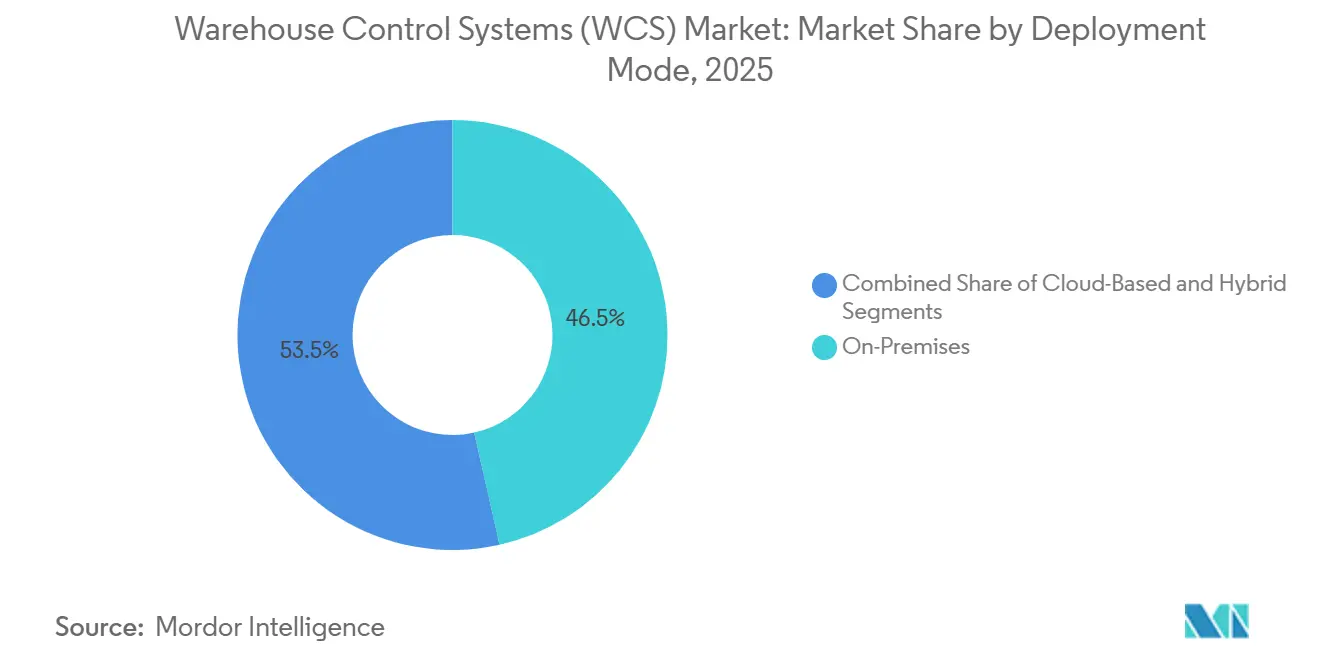
On-premises deployments held 46.50% of revenue in 2025, supported by high-throughput facilities that require local equipment control. These sites use fixed automation where consistent response times are important for safety and material flow. Cloud-based deployments are projected to expand at a 15.98% CAGR through 2031. Multi-site operators value cloud access for centralized reporting, software updates, and network-level analytics. Hybrid arrangements can keep time-sensitive machine control close to the equipment while making performance data available across the organization. Honeywell's Momentum Core illustrates this model through local control functions with accessible monitoring and configuration tools.
Pure cloud deployment does not fit every operating environment. Data sovereignty requirements and cybersecurity controls can lead regulated operators to keep sensitive operational information on-site or in private environments. Cloud-based analytics also depend on reliable connectivity, which can be a concern in sites with dense, high-throughput automation. These requirements support continued demand for on-premises and hybrid architectures within the warehouse control systems market. Operators are likely to choose deployment models based on the mix of equipment, data, and compliance needs at each location. As a result, cloud growth will not remove the need for local control in all facilities.
By Enterprise Size: Large Enterprises Lead While SMEs Expand Gradually
Large enterprises held 66.70% of revenue in 2025 because they can manage the capital intensity and organizational work associated with full deployments. Multi-site networks can spread platform costs, training, and support across several facilities. They also have more resources to standardize systems across regions. SMEs are projected to expand at a 15.41% CAGR through 2031. Their adoption is supported by smaller autonomous mobile robot fleets, modular storage systems, and subscription-based software options. Smaller operators commonly begin with a limited use case and add capabilities as the facility proves the value of automation.
This gradual approach changes the supplier requirements for SME customers. These customers need platforms that can scale without a complete replacement when additional equipment is installed. They also place greater weight on integration simplicity and the ability to use existing warehouse processes during the transition. Large enterprises, in contrast, often select a common platform for broad facility networks and require support across several regions. The warehouse control systems market can therefore develop through different buying patterns in its large-enterprise and SME customer groups. A growing base of partially automated SMEs may become a longer-term source of demand as their operations add robots, storage automation, and more complex fulfillment workflows.
By End-Use Industry Vertical: E-Commerce Sets the Operating Requirement
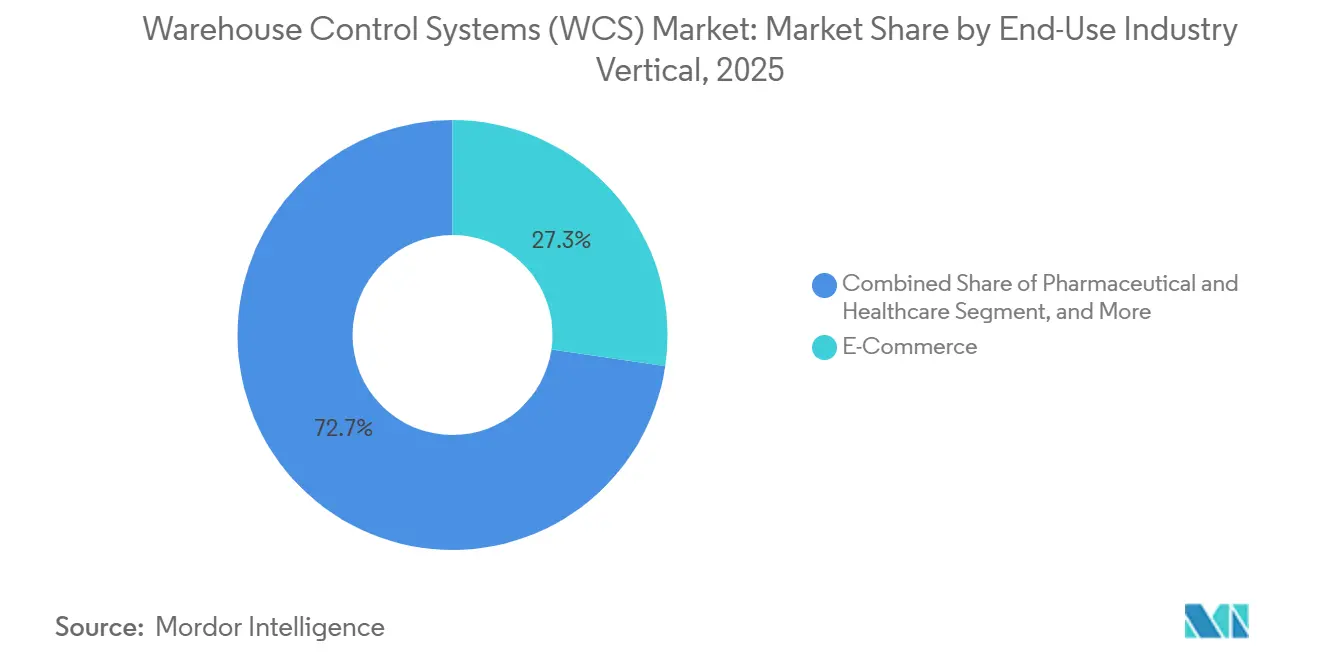
E-commerce held 27.31% of revenue in 2025, making it the largest end-use vertical. Its facilities manage high order velocity, broad product ranges, unpredictable peaks, and demanding delivery commitments. These needs make real-time work allocation and rapid exception recovery essential. Pharmaceutical and healthcare is projected to expand at a 15.22% CAGR through 2031. That growth is supported by requirements for serialization, lot traceability, temperature-sensitive handling, and reliable movement records. Industrial manufacturing and food and beverage use WCS in production support and multi-temperature storage operations, while retail investment is rising where store replenishment and direct-to-consumer orders share the same site.
Pharmaceutical deployments differ from e-commerce applications because compliance records are a core part of the operational requirement. Good Distribution Practice expectations make reliable storage, retrieval, and transport records important for medicinal products. Cardinal Health confirmed a 2025 distribution center project that uses AutoStore supported by Swisslog's SynQ WCS. The 340,000-square-foot facility is intended to manage inventory fulfillment, exceptions, and host-system integration. Third-party logistics providers also remain closely connected to e-commerce demand because they provide fulfillment capacity to brands that do not operate their own automated networks. Parcel and express delivery represents a further opportunity as sorting and scan operations move beyond equipment-specific controls.

By Automation Environment: AMR Fleets Create the Key Integration Challenge
Conveyors and sorters held 25.29% of revenue in 2025 because they remain common in parcel, retail, and e-commerce distribution centers. Their fixed routes and predictable cycle times support established control approaches. Autonomous mobile robots are projected to expand at a 15.38% CAGR through 2031. They offer layout flexibility and can be introduced in smaller increments than some fixed systems. Shuttle systems and automated storage and retrieval systems are also advancing where land costs support high-density vertical storage. Print-and-apply equipment and scan tunnels remain smaller applications, though traceability requirements continue to support their use.
Mobile robots make orchestration more complex because travel time can vary with traffic, battery condition, and physical obstructions. Fixed systems usually follow known routes, while mobile equipment requires the platform to revise tasks and traffic priorities as conditions change. Dematic's partnership with GreyOrange addresses this issue by adding robot orchestration to its control portfolio. Automated guided vehicles occupy a middle position because their fixed paths provide more predictable movement than autonomous mobile robots. The warehouse control systems market will need software that coordinates both predictable and variable equipment behaviors. This requirement favors systems that can manage task queues, handoffs, charging, and exceptions across the full facility.
Geography Analysis
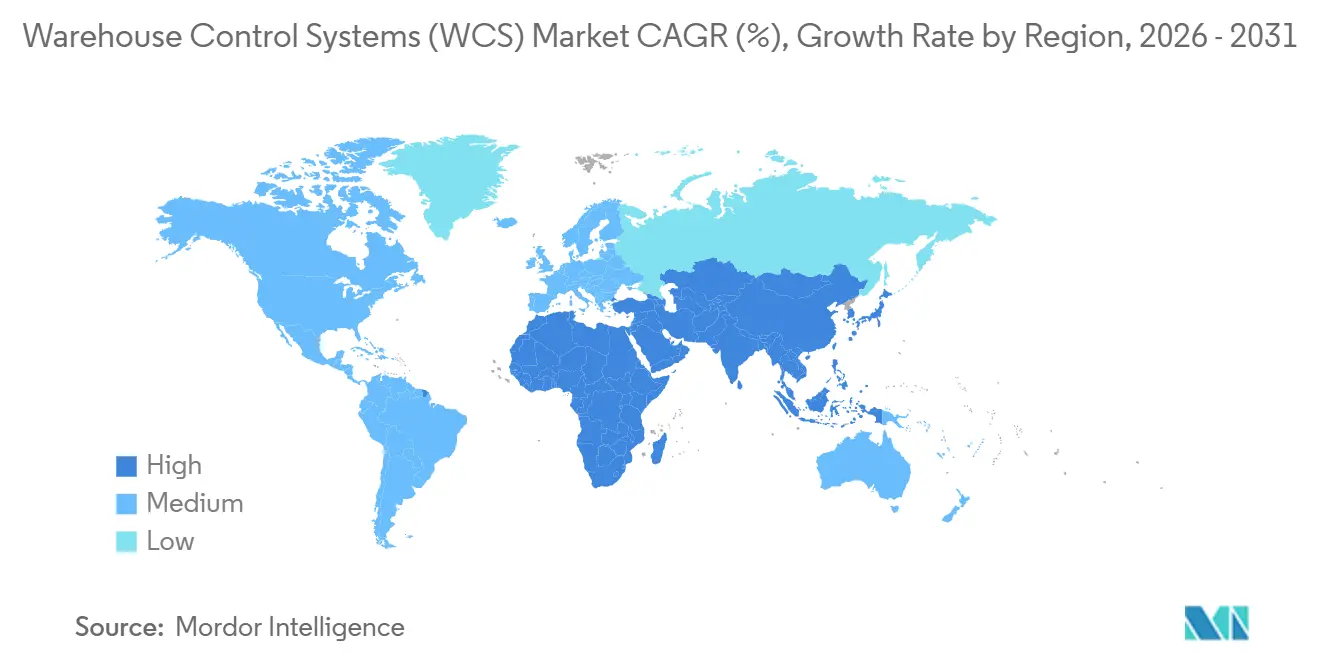
North America held 34.56% of revenue in 2025, making it the largest regional position in the warehouse control systems (WCS) market. The United States has a dense e-commerce fulfillment network and high labor costs that support automation investment. Canada is also increasing investment in automated distribution capacity. Element Logic and lululemon opened a 1 million-square-foot distribution center in Brampton, Ontario, in June 2026. The facility uses high-density automated storage, conveyance, and an integrated control layer for e-commerce operations.
Mexico remains at an earlier stage of adoption, where nearshoring activity and 3PL investment are key sources of demand. South America is the smallest regional area, with Brazil and Argentina accounting for much of the present activity. Infrastructure gaps and currency volatility constrain investment, although logistics modernization is creating initial opportunities. Europe benefits from Germany's position as a major automation center and from established 3PL corridors across the region. Swisslog confirmed a June 2026 Vectura pallet stacker crane installation for Lebkuchen-Schmidt in Nuremberg, where SynQ will coordinate manual, semi-automated, and fully automated processes. European operators also face growing requirements for records and controls in automated processes.
Asia-Pacific is projected to expand at a 15.23% CAGR through 2031, the fastest regional rate. China, India, Japan, and Southeast Asia are adding fulfillment capacity as e-commerce activity and labor costs increase. Maersk opened its 1.1 million-square-foot World Gateway II facility in Singapore in March 2026 with an investment of over SGD 200 million (USD 149 million). Amazon Australia announced more than USD 750 million for a robotics fulfillment center in Queensland that is expected to be completed in 2028. The Middle East is building greenfield logistics capacity, led by Saudi Arabia and the United Arab Emirates. Africa remains the least mature region, with South Africa and Egypt providing the main initial opportunities as cold-chain and 3PL infrastructure develops.

Competitive Landscape
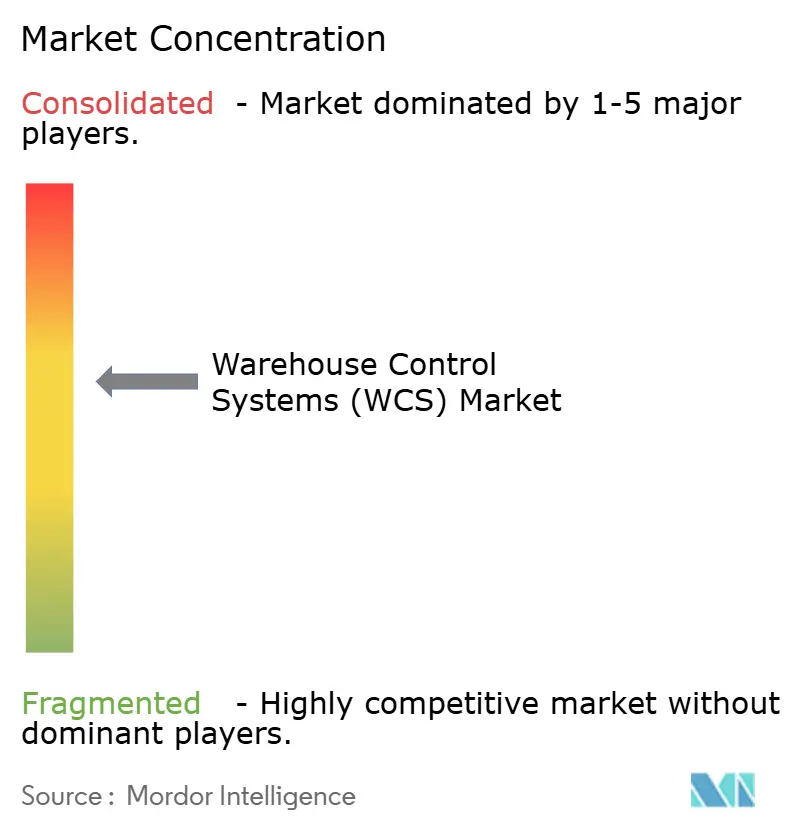
The warehouse control systems (WCS) market is moderately concentrated among system integrators with established installed bases. Dematic, Honeywell Intelligrated, Swisslog, Vanderlande, and KNAPP compete through software capabilities, implementation capacity, service agreements, and relationships with automation users. Their platforms can create switching costs in the warehouse control systems market because the software is connected to equipment, operating procedures, and support arrangements. Competition is moving toward combined warehouse control, execution, and machine-control functions. Suppliers are also building vendor-agnostic capabilities to serve facilities that use equipment from several manufacturers. This direction creates an opportunity to support brownfield sites where a single proprietary equipment controller is no longer sufficient.
Dematic expanded its flexible automation capabilities in April 2026 through its partnership with GreyOrange. Honeywell introduced Momentum Core in April 2026, combining WCS, WES, and machine control in one modular platform. Swisslog launched AgileStore in March 2026, adding a 4-way pallet shuttle to its pallet automation range managed through SynQ software. These moves show that suppliers are adding software functions and equipment options to address multi-technology sites. They also show that hardware additions are increasingly sold with a connected control environment.
Smaller specialists can compete by adding mobile robot capabilities to existing conveyor-based operations without requiring a full platform replacement. This approach is relevant for customers that want to preserve installed equipment while solving a specific orchestration gap. Suppliers must also demonstrate reliable interfaces and cybersecurity practices for regulated facilities and public-sector logistics contracts. IEC 62264, also known as ISA-95, remains relevant to enterprise and control-system integration. The National Institute of Standards and Technology Cybersecurity Framework also provides a common basis for managing cybersecurity risk. The available draft does not provide combined market shares for leading companies, so a numeric concentration score cannot be assigned under the specified scoring method.
Warehouse Control Systems (WCS) Industry Leaders
Dematic GmbH
Honeywell International Inc.
Swisslog Holding AG
Vanderlande Industries B.V.
SSI SCHAEFER Gruppe
- *Disclaimer: Major Players sorted in no particular order

Recent Industry Developments
- July 2026: A.P. Moller-Maersk announced the opening of a USD 100 million fulfillment hub in Hopedale, Massachusetts, a 617,000-square-foot facility expected to create close to 1,000 jobs and expand Northeast delivery capacity. The facility integrates transportation, warehousing, and fulfillment.
- June 2026: Element Logic and lululemon opened a 1 million-square-foot distribution center in Brampton, Ontario, featuring high-density automated storage and retrieval systems, robotic conveyance, and a coordinated WCS layer supporting e-commerce operations across eastern Canada and the United States.
- May 2026: Swisslog secured a contract to deliver frozen warehouse automation for Magnavale at Avonmouth, United Kingdom, with 10 Vectura stacker cranes, 1,500 meters of ProMove conveyor, and SynQ Warehouse Control System providing stock visibility and FEFO and FIFO management.
- April 2026: Dematic and GreyOrange announced a strategic partnership to integrate GreyOrange's GreyMatter AI-powered robot orchestration platform into Dematic's WCS software portfolio, expanding flexible automation capabilities for multi-agent warehouse environments.


Global Warehouse Control Systems (WCS) Market Report Scope
The Global Warehouse Control Systems (WCS) Market refers to the market for software platforms and control solutions that manage, coordinate, and optimize the real-time operations of automated material handling equipment within warehouses, distribution centers, and fulfillment facilities.
The Warehouse Control Systems (WCS) Market Report is Segmented by Component (Software, and Services), Functional Module (Material Flow Control, Conveyor and Sorter Control, AS/RS Control, Robotic and Goods-to-Person Control, Task Dispatch and Equipment Synchronization, Equipment Monitoring and Visualization, and Exception Management and Recovery), Deployment Mode (On-Premises, Cloud-Based, and Hybrid), Enterprise Size (Large Enterprises and Small and Medium-Sized Enterprises), Industry Vertical (E-Commerce, Industrial Manufacturing, Retail and Consumer Goods, Food and Beverage, Pharmaceutical and Healthcare, Third-Party Logistics, and Parcel and Express Delivery), Automation Environment (Conveyors and Sorters, Shuttle Systems, Automated Storage and Retrieval Systems, Autonomous Mobile Robots, Automated Guided Vehicles, Robotic Picking Systems, and Print-and-Apply and Scan Tunnels), and Geography (North America, South America, Europe, Asia-Pacific, Middle East, and Africa). The Market Forecasts are Provided in Terms of Value (USD).
| Software |
| Services |
| Material Flow Control |
| Conveyor and Sorter Control |
| AS/RS Control |
| Robotic and Goods-to-Person Control |
| Task Dispatch and Equipment Synchronization |
| Equipment Monitoring and Visualization |
| Exception Management and Recovery |
| On-Premises |
| Cloud-Based |
| Hybrid |
| Large Enterprises |
| Small and Medium-Sized Enterprises |
| E-Commerce |
| Industrial Manufacturing |
| Retail and Consumer Goods |
| Food and Beverage |
| Pharmaceutical and Healthcare |
| Third-Party Logistics |
| Parcel and Express Delivery |
| Conveyors and Sorters |
| Shuttle Systems |
| Automated Storage and Retrieval Systems |
| Autonomous Mobile Robots |
| Automated Guided Vehicles |
| Robotic Picking Systems |
| Print-and-Apply and Scan Tunnels |
| North America | United States |
| Canada | |
| Mexico | |
| South America | Brazil |
| Argentina | |
| Rest of South America | |
| Europe | Germany |
| United Kingdom | |
| France | |
| Italy | |
| Spain | |
| Russia | |
| Rest of Europe | |
| Asia-Pacific | China |
| Japan | |
| India | |
| South Korea | |
| Australia | |
| Southeast Asia | |
| Rest of Asia-Pacific | |
| Middle East | Saudi Arabia |
| United Arab Emirates | |
| Turkey | |
| Rest of Middle East | |
| Africa | South Africa |
| Egypt | |
| Rest of Africa |
| By Component | Software | |
| Services | ||
| By Functional Module | Material Flow Control | |
| Conveyor and Sorter Control | ||
| AS/RS Control | ||
| Robotic and Goods-to-Person Control | ||
| Task Dispatch and Equipment Synchronization | ||
| Equipment Monitoring and Visualization | ||
| Exception Management and Recovery | ||
| By Deployment Mode | On-Premises | |
| Cloud-Based | ||
| Hybrid | ||
| By End Use Enterprise Size | Large Enterprises | |
| Small and Medium-Sized Enterprises | ||
| By End Use Industry Vertical | E-Commerce | |
| Industrial Manufacturing | ||
| Retail and Consumer Goods | ||
| Food and Beverage | ||
| Pharmaceutical and Healthcare | ||
| Third-Party Logistics | ||
| Parcel and Express Delivery | ||
| By Automation Environment | Conveyors and Sorters | |
| Shuttle Systems | ||
| Automated Storage and Retrieval Systems | ||
| Autonomous Mobile Robots | ||
| Automated Guided Vehicles | ||
| Robotic Picking Systems | ||
| Print-and-Apply and Scan Tunnels | ||
| By Geography | North America | United States |
| Canada | ||
| Mexico | ||
| South America | Brazil | |
| Argentina | ||
| Rest of South America | ||
| Europe | Germany | |
| United Kingdom | ||
| France | ||
| Italy | ||
| Spain | ||
| Russia | ||
| Rest of Europe | ||
| Asia-Pacific | China | |
| Japan | ||
| India | ||
| South Korea | ||
| Australia | ||
| Southeast Asia | ||
| Rest of Asia-Pacific | ||
| Middle East | Saudi Arabia | |
| United Arab Emirates | ||
| Turkey | ||
| Rest of Middle East | ||
| Africa | South Africa | |
| Egypt | ||
| Rest of Africa | ||


Key Questions Answered in the Report
What is the warehouse control systems market size?
The warehouse control systems market size is estimated at USD 4.48 billion in 2026 and is forecast to reach USD 8.93 billion by 2031 at a 14.79% CAGR.
What is driving demand for warehouse control systems?
Omnichannel fulfillment, higher labor costs, and the integration of robots, conveyors, shuttles, and automated storage systems are increasing demand.
Which component leads warehouse control system spending?
Software led with 56.60% of revenue in 2025 and is projected to grow at a 14.94% CAGR through 2031.
Which deployment model is growing fastest?
Cloud-based deployment is projected to grow at a 15.98% CAGR through 2031, while on-premises systems led revenue in 2025.
Which end-use sector is growing fastest?
Pharmaceutical and healthcare is projected to expand at a 15.22% CAGR through 2031, supported by traceability and compliance requirements.
Which region is growing fastest for warehouse control systems?
Asia-Pacific is projected to expand at a 15.23% CAGR through 2031, supported by investment across China, India, Japan, and Southeast Asia.
Page last updated on:






