
Virtual Influencer Marketing Services Market Size and Share
Market Overview
| Study Period | 2020 - 2031 |
|---|---|
| Market Size (2026) | USD 1.43 Billion |
| Market Size (2031) | USD 3.21 Billion |
| Growth Rate (2026 - 2031) | 17.54 % |
| Fastest Growing Market | Asia-Pacific |
| Largest Market | North America |
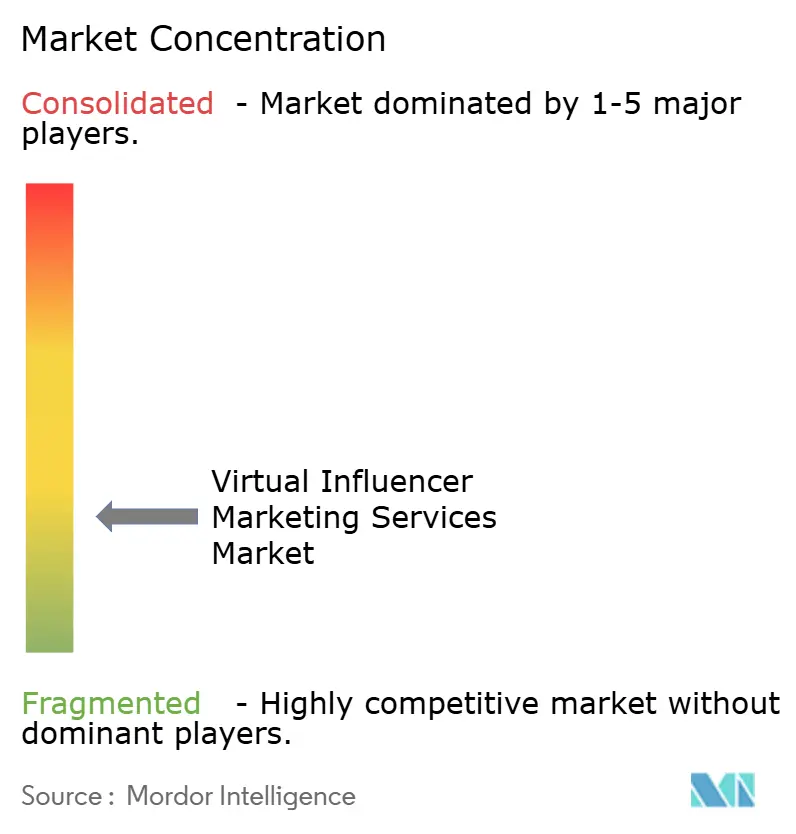
| Market Concentration | Low |
Major Players *Disclaimer: Major Players sorted in no particular order Image © Mordor Intelligence. Reuse requires attribution under CC BY 4.0. | |
Virtual Influencer Marketing Services Market Analysis by Mordor Intelligence
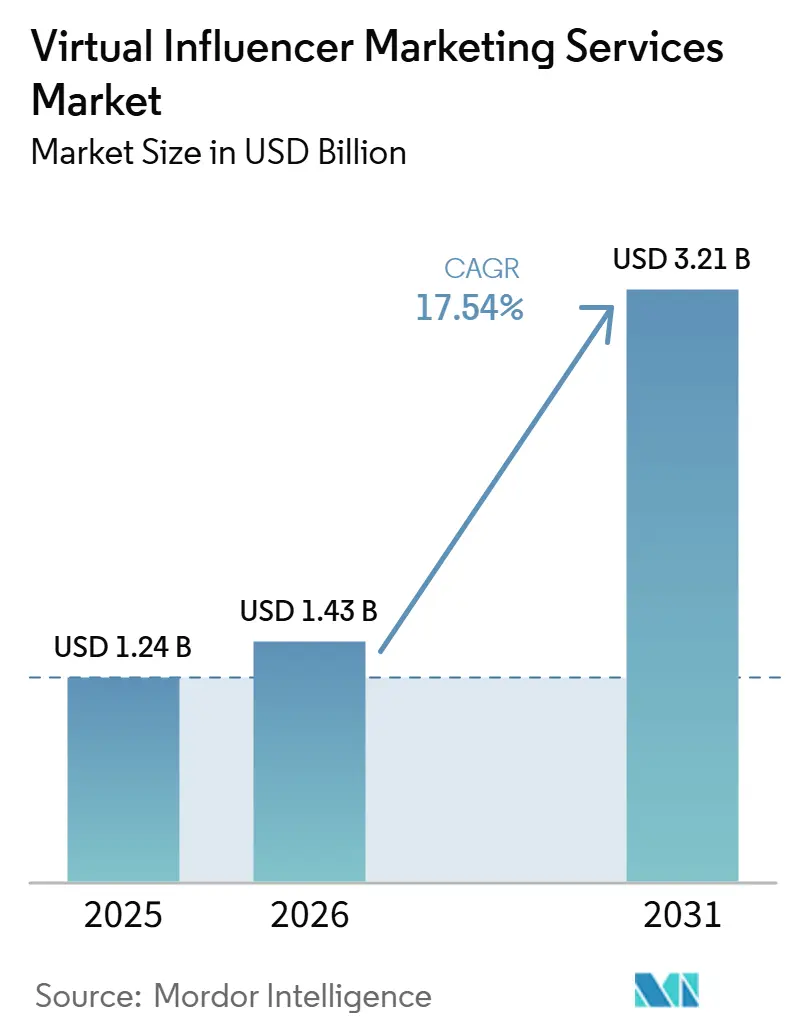
The Virtual Influencer Marketing Services Market size was valued at USD 1.24 billion in 2025 and estimated to grow from USD 1.43 billion in 2026 to reach USD 3.21 billion by 2031, at a CAGR of 17.54% during the forecast period (2026-2031). The market is moving from isolated brand experiments toward organized programs that require content creation, campaign operations, audience engagement, and performance measurement. Brands are using virtual personas across social platforms, commerce channels, and live experiences because the same character can support repeated activity without scheduling or location limits. This changes the role of service providers, which increasingly combine creative development with media operations and measurement. The Virtual Influencer Marketing Services Market also faces limits from credibility concerns and stricter disclosure rules, which make transparent campaign design and clear contract terms more important. Providers with integrated delivery, reliable reporting, and experience in regional compliance are positioned to compete for broader enterprise assignments.
Key Report Takeaways
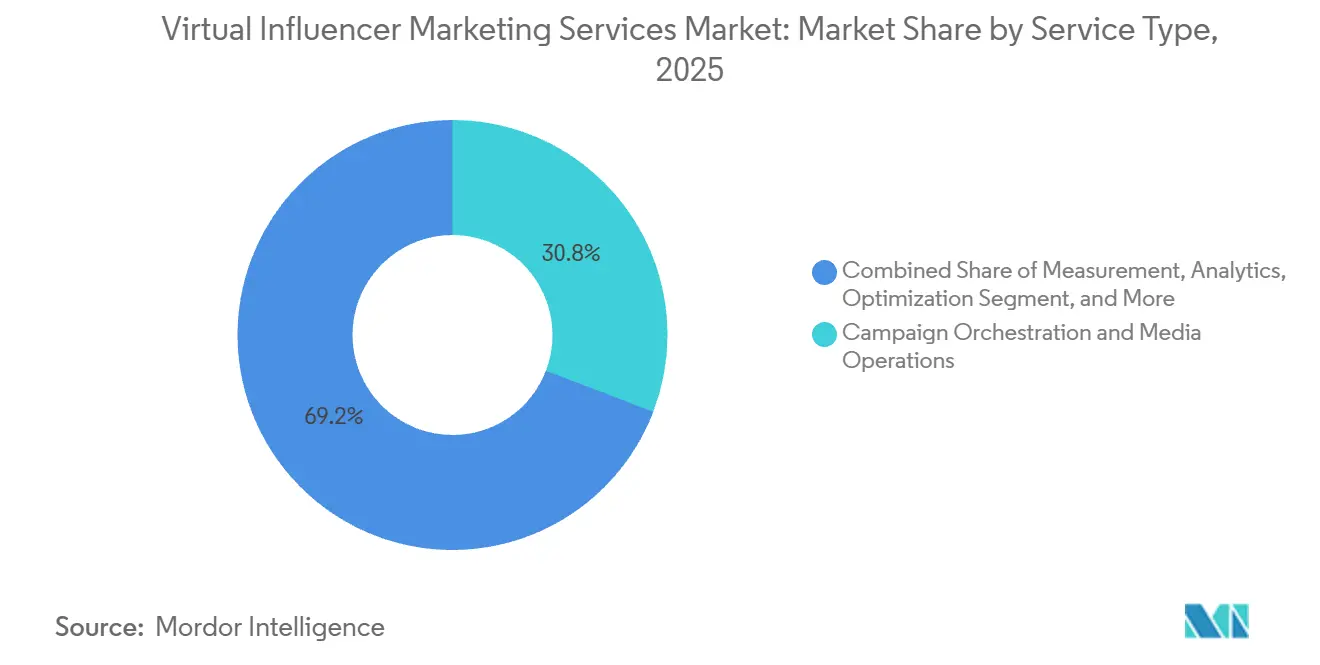
- By service type, Campaign Orchestration and Media Operations held 30.81% share in 2025, while Measurement, Analytics, and Optimization is projected to expand at a 17.98% CAGR through 2031.
- By application, Social Commerce held 46.24% share of the Virtual Influencer Marketing Services Market in 2025, while Event Marketing is projected to expand at an 18.06% CAGR through 2031.
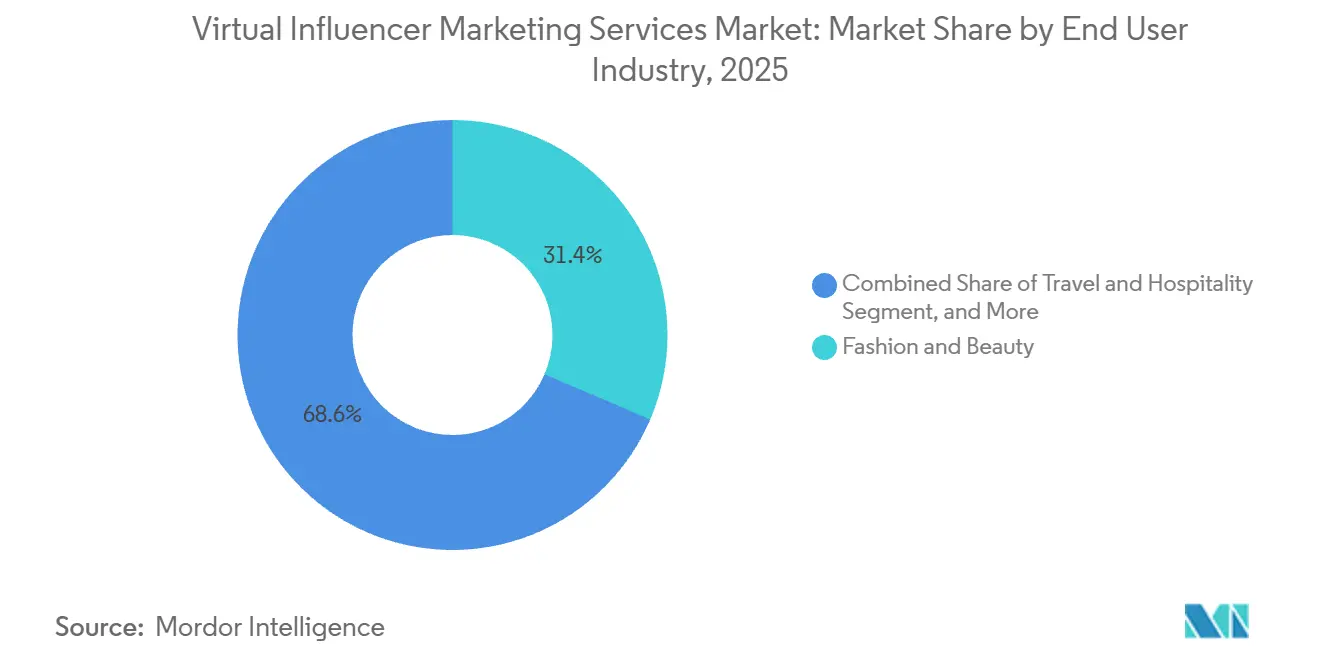
- By end user industry, Fashion and Beauty held 31.42% share in 2025, while Travel and Hospitality is projected to expand at an 18.11% CAGR through 2031.
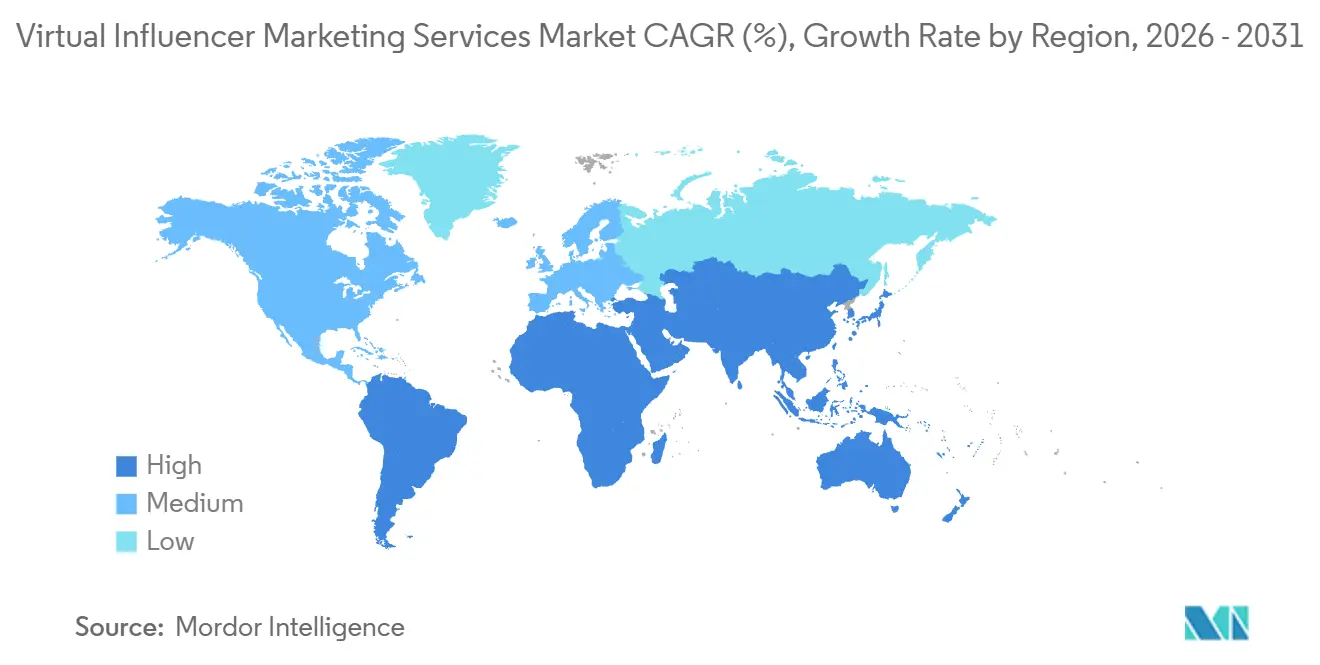
- By geography, North America held a 35.18% share of the Virtual Influencer Marketing Services Market in 2025, while the Asia-Pacific is projected to expand at a 20.11% CAGR through 2031.
Note: Market size and forecast figures in this report are generated using Mordor Intelligence’s proprietary estimation framework, updated with the latest available data and insights as of January 2026.
Global Virtual Influencer Marketing Services Market Trends and Insights
Drivers Impact Analysis*
| Driver | (~) % Impact on CAGR Forecast | Geographic Relevance | Impact Timeline |
|---|---|---|---|
| Rising Demand for Always-On Brand-Safe Creator Assets | 3.2% | Global, strongest uptake in North America and Europe | Short term (≤ 2 years) |
| Expansion of Social Commerce and Shoppable Avatar Formats | 3.0% | Asia-Pacific core, accelerating in North America | Short term (≤ 2 years) |
| Higher Gen Z and Gen Alpha Receptivity to Virtual Personas | 2.5% | Global, highest in Japan, South Korea, Southeast Asia, and U.S. gaming communities | Medium term (2-4 years) |
| Falling AI, CGI, and Localization Production Costs | 2.2% | Global | Short term (≤ 2 years) |
| Creator Burnout Encouraging Hybrid Human-Digital Talent Stacks | 1.5% | North America, Europe, Asia-Pacific | Medium term (2-4 years) |
| Owned Avatar IP Emerging as a Reusable First-Party Media Asset | 1.2% | North America and Europe, emerging in Asia-Pacific | Long term (≥ 4 years) |
| Source: Mordor Intelligence | |||
Rising Demand for Always-On Brand-Safe Creator Assets
Brand safety has become a core consideration in creator marketing procurement. found that 74% of enterprise marketers considered brand safety more important in 2025 than in the prior year, while 82% of organizations that prioritized it reported higher return on investment from creator programs.[1]CreatorIQ, “CreatorIQ Introduces SafeIQ The First Enterprise-Grade, AI-Native Brand Safety Infrastructure for Creator Marketing,” BusinessWire, businesswire.com Virtual personas can follow defined content rules and cannot make unscripted personal decisions that create reputation risk. This gives the Virtual Influencer Marketing Services Market a practical advantage where brands need a consistent public voice across frequent posts and campaigns. reported that 89% of enterprise respondents valued lower-risk creators, which reinforces the need for controlled creator assets. The same operating model can reduce the governance burden when a brand needs content at a scale that owned channels cannot provide. Service providers still need active review processes because automated delivery does not remove the need for cultural judgment, disclosure, and quality control.[2]Interactive Advertising Bureau, “IAB Creator Ad Spend and Strategy Report 2025,” Interactive Advertising Bureau, iab.com
Expansion of Social Commerce and Shoppable Avatar Formats
Social commerce is making virtual personas more useful as direct product-discovery tools. A character can support repeated shoppable content, live activity, and product education without the scheduling limits that affect human creators. This strengthens the role of the Virtual Influencer Marketing Services Market in programs where content needs to be closely linked to commerce activity. Event Marketing is projected to grow at an 18.06% CAGR through 2031, indicating that brands are also connecting commerce activity to launch moments and live experiences. Virtual avatar formats may give platform owners greater control over inventory and content standards, potentially changing the commercial relationship among brands, agencies, and creator talent. Providers need to carefully manage product accuracy, content suitability, and customer interactions when avatars support ongoing shopping activity.
Higher Gen Z and Gen Alpha Receptivity to Virtual Personas
Younger audiences are more familiar with digital characters through gaming, animation, livestreaming, and social platforms. A study found that product and avatar fit influences advertising effectiveness, with hyper-realistic personas supporting functional products and cartoon-like personas supporting hedonic products.[3]Management World, “Research on the Impacts of Virtual Influencer Imagery on the Advertising Effectiveness of Generation Z,” Management World, kygl.net.cn This means that visual realism alone does not determine whether a virtual character will persuade an audience. Research on 400 Gen Z TikTok users found a positive relationship between virtual influencer characteristics and purchase decisions, although the effect was lower than that of an equivalent human influencer. The Virtual Influencer Marketing Services Market, therefore, needs creative teams that can match character form, product type, and local audience expectations. Culturally relevant avatar design is particularly important for younger audiences in diverse Asian markets. As AI literacy grows, synthetic origin may become less important to purchase decisions, but trust and content relevance will remain central.
Falling AI, CGI, and Localization Production Costs
AI and computer-generated imagery are lowering the cost of producing some virtual influencer content. The creation of a fully custom character can still require substantial investment, but software-based workflows reduce the cost of routine assets and regional versions. reported that an AI-generated television advertisement aired during the 2025 NBA Finals for USD 2,000 in hard production costs, compared with USD 250,000 to USD 500,000 for a comparable traditional commercial.[4]National Public Radio, “An AI-Generated Ad Ran During the NBA Finals It Cost USD 2,000 to Make,” National Public Radio, npr.org This cost gap broadens access to the Virtual Influencer Marketing Services Market for smaller teams and brands that cannot fund a traditional production model. AI-supported lip-syncing and language adaptation can also allow a single persona to support content across several markets without separate physical reshoots. Narrative governance does not decline at the same rate as asset-production costs because a persistent character still requires a brand bible, approval rules, and platform-specific adaptations. The result is a shift in spending from basic asset generation toward management, continuity, and localized campaign operations.
Restraints Impact Analysis*
| Restraint | (~) % Impact on CAGR Forecast | Geographic Relevance | Impact Timeline |
|---|---|---|---|
| Consumer Authenticity Concerns and Trust Gaps | -1.8% | Global, most pronounced in Western markets and collectivist cultures | Short term (≤ 2 years) |
| High Build and Ongoing Narrative Management Costs | -1.2% | Global, highest burden in North America and Europe | Medium term (2-4 years) |
| Disclosure Labels and Provenance Metadata May Depress Synthetic Content Performance | -0.8% | North America, Europe, and India | Short term (≤ 2 years) |
| Expanding Digital-Likeness Rules Increase Contracting and Clearance Friction | -0.6% | North America and Europe | Medium term (2-4 years) |
| Source: Mordor Intelligence | |||
Consumer Authenticity Concerns and Trust Gaps
Authenticity remains the most important barrier when a campaign depends on credibility or emotional connection. They reported that 95% of brands had concerns about AI in creator marketing, with a lack of authentic human connection among the main concerns. A systematic review of 73 peer-reviewed studies found that trust and emotional connection in virtual influencer interactions generally remained below human benchmarks. Studies also found that prominent disclosure reduced purchase intention through lower source credibility. This creates tension for the Virtual Influencer Marketing Services Market because transparent labeling is required in many contexts, but it can affect audience response. Providers must design personas with a clear purpose, realistic audience expectations, and content that does not overstate human qualities. Trust can improve where the avatar is presented honestly as a digital character rather than as an undisclosed substitute for a person.
High Build and Ongoing Narrative Management Costs
Low per-asset costs do not capture the full expense of building an owned virtual character. Initial investment for a persistent branded persona can range from USD 250,000 to USD 2 million, followed by monthly content-production costs of USD 20,000 to USD 100,000. The build cost for a custom AI influencer in Japan was reported to range from JPY 3 million to JPY 10 million (USD 20,000 to USD 67,000), while monthly operations were estimated at JPY 2 million to JPY 8 million (USD 13,000 to USD 54,000). Research has indicated that virtual settings and video content can require weeks of work per cycle, making governance and continuity a material, ongoing commitment. The Virtual Influencer Marketing Services Market favors retailers and platforms with frequent content needs, as they can spread costs across many uses. Brands with occasional campaigns may find a licensed activation model more suitable because it limits commitment to a defined period. An underperforming character can also create exit friction because brand guidelines, visual assets, and audience expectations have already been developed around it.
*Our forecasts treat driver/restraint impacts as directional, not additive. The impact forecasts reflect baseline growth, mix effects, and variable interactions.
Segment Analysis
By Service Type: Campaign Operations Leads While Analytics Gains Importance
Campaign Orchestration and Media Operations held 30.81% of the Virtual Influencer Marketing Services Market share in 2025. The leading position reflects the work needed to use a virtual persona consistently across social, commerce, and programmatic channels. Providers must coordinate avatar production, platform adjustments, publishing schedules, community scripts, and media activity within the same campaign. This requirement is more demanding as brand programs shift from single-channel tests to recurring activity across several platforms. Strategy and Concept Development remain important because brand teams need a clear character role and content direction before production begins. Avatar Creation and Design provides the visual and technical base for a character that can appear repeatedly without losing brand consistency. The service mix favors providers that can move from early planning to live campaign management without relying on several disconnected vendors. This supports the client's preference for a smaller group of partners that can manage the complete process. Within the Virtual Influencer Marketing Services Market, this combination makes operational coordination a central part of provider value.
Measurement, Analytics, and Optimization is projected to expand at a 17.98% CAGR through 2031. The faster growth reflects demand for auditable results that can be linked to commercial objectives. Community Management and Audience Engagement is also becoming more important because virtual characters need sustained interaction, not only scheduled posts, to maintain audience interest. The Virtual Influencer Marketing Services industry is increasingly shaped by services that combine creative delivery with measurement and audience operations. These functions help brands move from content output to managed programs with defined performance reviews. The growing use of automation does not remove the need for human oversight, because tone, audience trust, and brand suitability still require active management. Providers that demonstrate both operational control and measurement capability are likely to be more relevant to enterprise buyers. The Virtual Influencer Marketing Services Market will therefore place greater importance on reporting that supports budget decisions.



By Application: Social Commerce Holds the Largest Role While Events Grow Faster
Social Commerce accounted for 46.24% of the Virtual Influencer Marketing Services Market size by application in 2025. It is the main commercial setting for virtual personas because content, product discovery, and transactions can occur on connected platforms. Virtual characters can provide steady content output and remain available outside the working hours or travel schedules of human creators. This can be useful for product-led campaigns that need frequent content updates and clear brand control. Research found that virtual influencers can match human influencers in engagement effectiveness. That finding supports their use in commerce programs where repeated engagement is important. Community Building remains a steady application because brands need a structured way to maintain interaction with followers over time. Digital Marketing Procurement, Market Research Procurement, and Events Procurement form the spend-management layer through which larger enterprises govern service investments.
Event Marketing is projected to expand at an 18.06% CAGR from 2026 to 2031. Virtual influencers can participate in product launches and branded experiences without the travel, appearance, or scheduling requirements of human talent. This can shorten the preparation period for some activations and give brands a consistent character across physical and digital settings. In July 2026, a conversational AI virtual human was deployed at a POP Culture Style venue, combining outdoor LED advertising with interactive in-store engagement. The case shows how a virtual persona can be used in a public setting while also supporting direct visitor interaction. Event services still need careful planning because the experience must be reliable, safe, and aligned with local disclosure requirements. The application is likely to appeal to brands that want a reusable character across launches, retail activations, and digital content. It also underscores the importance of service providers that can manage technology, creative design, and live operations in tandem.
By End User Industry: Fashion and Beauty Leads While Travel and Hospitality Expands Faster
Fashion and Beauty held 31.42% of the category share in 2025. Beauty and personal care brands recorded an 89% adoption rate of virtual influencers in 2026, the highest rate among the listed verticals. The category is well-suited to visual content and has a long history of aspirational brand presentation. Documented examples include BMW's Lil Miquela campaign and Balmain's digital fashion collaborations. These examples show how established brands use virtual personas for brand-building activity. Retail and e-commerce are the second-largest category because its product offers fit naturally with social commerce formats. Entertainment and Media also gain relevance when streaming and content platforms use virtual characters to encourage viewer interest and subscription intent. Fashion and beauty campaigns will continue to require a clear distinction between creative appeal and audience trust, particularly when the persona resembles a real person. The Virtual Influencer Marketing Services Market benefits when category-specific creative standards are clearly established.
Travel and Hospitality is projected to expand at an 18.11% CAGR through 2031. Virtual personas can create destination content without visa requirements, physical access limits, or the travel costs associated with human influencer campaigns. This can make campaigns easier to adapt across several locations and languages. Food and Beverage is also increasing its use of virtual personas as live-stream commerce creates new product discovery formats. BFSI brands are using these characters cautiously for financial literacy content, where regulated advice and reputational risk require close oversight. Automotive activity remains focused on premium use cases, such as concept vehicle reveals and electric-vehicle awareness campaigns. The category pattern shows that virtual-influencer programs are not limited to fashion content, although visual consumer sectors remain the most established users. Providers need different creative, review, and compliance practices for each category because the risks and audience expectations vary significantly.
Geography Analysis
North America held 35.18% of the Virtual Influencer Marketing Services Market share in 2025. The region has large enterprise influencer marketing budgets and an established digital media infrastructure. Its brands are also familiar with campaign measurement and procurement processes, which support more structured service buying. The U.S. Federal Trade Commission's endorsement rules and New York's Synthetic Performer Advertising Law, effective June 9, 2026, are shaping provider operations by requiring more attention to disclosure and contract compliance. These requirements can increase administrative work, but they also make transparent operating practices more valuable. Canada and Mexico remain smaller contributors, while their digital commerce activity provides additional room for service adoption. The Virtual Influencer Marketing Services Market in the region relies on providers capable of managing both creative activities and compliance processes.
Asia-Pacific is projected to expand at a 20.11% CAGR from 2026 to 2031. Japan has a strong culture of engagement with digital characters, while South Korea has developed a virtual idol ecosystem connected with K-pop audiences. China combines a growing virtual-influencer ecosystem with governance frameworks for deep-synthesis technology. In July 2026, an activation in Tokyo demonstrated the use of a conversational virtual human across outdoor advertising and in-store experiences. The region's growth creates opportunities for providers that can localize characters, manage cultural expectations, and meet local technology requirements. It also raises the standard for international entrants because local consumer preferences and disclosure rules differ across markets.
Europe follows North America in maturity, with the United Kingdom, Germany, and France serving as the main demand centers. Buyers in these countries place strong importance on measurement, transparent data handling, and compliance with the General Data Protection Regulation. The Middle East is developing quickly in the UAE and Saudi Arabia, supported by young, connected audiences and government-backed creative economy programs. Africa remains at an earlier stage, with South Africa, Nigeria, and Egypt building demand through mobile-first social commerce and Gen Z engagement. South America is anchored by Brazil, where Lu do Magalu demonstrates that virtual personas can reach broad consumer audiences. These developing regions give providers a longer-term opportunity, but campaign strategies need to reflect local language, platform use, and consumer trust.

Competitive Landscape
The Virtual Influencer Marketing Services Market is fragmented, and no provider holds a dominant position across all service types. Established influencer marketing platforms compete with specialist avatar studios and AI video companies. The platforms that began with human creator networks are expanding into virtual persona services as generative AI reduces the time and cost of creating digital characters. Competition increasingly centers on whether a provider can integrate creation, operations, data, and measurement into a single service relationship. This favors firms with a broader set of capabilities rather than a narrow focus on creator discovery. It also creates pressure on smaller studios to differentiate through design quality, technical specialization, or category expertise. The Virtual Influencer Marketing Services Market remains open to specialists who meet these needs with focused services.
An acquisition in May 2025 that combines a 15-million-creator network and social commerce engine with identity infrastructure shows how large agency groups are building more connected creator commerce and measurement capabilities. The launch of an AI-supported creator-economy marketing operations platform in March 2026 reflects a shift toward more automated workflows and analytics tools. A live retail use case demonstrated in July 2026 through a deployment at a Tokyo venue also highlights this shift. These moves show that companies are competing through linked technology, campaign operations, and real-world activation capabilities. They also indicate that the market is moving beyond basic avatar creation toward integrated service delivery.
The remaining opportunities lie in standardized performance reporting, sustainability-oriented sourcing frameworks, and the localization of generative AI content across markets. Providers that can make pricing, creative scope, rights, and outcomes easier to assess may reduce one of the main barriers for procurement teams. Credibility remains a central competitive issue because virtual influencers were rated lower than human influencers on perceived credibility in a recent meta-analysis. High levels of human-like design can intensify the effect of low credibility, so providers need to strike the right balance between realism and audience trust. Regulatory disclosure requirements add another factor, since providers must design creative work that identifies synthetic content clearly where required. Firms that manage production efficiency, sourcing controls, disclosure, and measurement together are likely to compete more effectively through 2031. This gives the Virtual Influencer Marketing Services Market a strong reason to value transparent delivery practices.
Virtual Influencer Marketing Services Industry Leaders
Viral Nation Inc.
IZEA Worldwide, Inc.
Soul Machines Limited
Superplastic, Inc.
Captiv8, Inc.
- *Disclaimer: Major Players sorted in no particular order

Recent Industry Developments
- July 2026: Aww Inc. deployed its conversational AI virtual human "Zinn," powered by the HITO service, at KDDI Corporation's POP Culture Style IKEBUKURO venue in Tokyo, creating a dual-format activation where Zinn appeared simultaneously in outdoor LED advertising and as a real-time interactive in-store guide. This deployment marks a commercial benchmark for bridging virtual persona advertising with conversational customer experience at retail scale.
- May 2026: IZEA Worldwide reported Q1 2026 revenue of USD 6.6 million and confirmed the successful commercial launch of ZED, its AI-powered creator economy marketing operations platform designed for enterprise clients. CEO Patrick Venetucci stated IZEA had achieved a nearly USD 19 million net profit swing in 2025, rebuilding the company's economic model around enterprise accounts with double-digit portfolio growth.
- May 2026: DeepBrain AI integrated Seedance 2.0, ByteDance's latest multimodal AI video generation model, into AI STUDIOS, delivering enterprise-level video quality enhancements for avatar content production, with improvements tuned specifically for live commerce and short-form video use cases.
- April 2026: DeepBrain AI surpassed 100 on-device AI avatar agent deployments across banking, retail, healthcare, and public services globally, with named enterprise customers including Shinhan Bank and Samsung Securities, demonstrating the scalability of real-time interactive digital human technology in commerce-adjacent environments.


Global Virtual Influencer Marketing Services Market Report Scope
The Virtual Influencer Marketing Services Market refers to professional services that help brands conceptualize, create, and manage marketing campaigns using computer-generated (CGI) or AI-driven virtual avatars. This includes strategy development, custom avatar design and animation, campaign orchestration across digital platforms, community management, and performance analytics. These services cater to diverse industries such as fashion, retail, entertainment, and BFSI, enabling brands to leverage highly controlled, scandal-free, and always-available digital personas to drive social commerce, event marketing, and deeper audience engagement without the logistical and reputational risks associated with human influencers.
The Virtual Influencer Marketing Services Market Report is Segmented by Service Type (Strategy and Concept Development, Avatar Creation and Design, Campaign Orchestration and Media Operations, Community Management and Audience Engagement, and Measurement, Analytics, and Optimization), Application (Event Marketing, Social Commerce, Community Building), End User Industry (Fashion and Beauty, Retail and E-commerce, Entertainment and Media, Food and Beverage, Travel and Hospitality, BFSI, and Automotive), and Geography (North America, South America, Europe, Asia-Pacific, Middle East, and Africa). The Market Forecasts are Provided in Terms of Value (USD).
| Strategy and Concept Development |
| Avatar Creation and Design |
| Campaign Orchestration and Media Operations |
| Community Management and Audience Engagement |
| Measurement, Analytics, and Optimization |
| Event Marketing |
| Social Commerce |
| Community Building |
| Fashion and Beauty |
| Retail and E-commerce |
| Entertainment and Media |
| Food and Beverage |
| Travel and Hospitality |
| BFSI |
| Automotive |
| Other End User Industries |
| North America | United States |
| Canada | |
| Mexico | |
| South America | Brazil |
| Argentina | |
| Chile | |
| Rest of South America | |
| Europe | Germany |
| United Kingdom | |
| France | |
| Italy | |
| Spain | |
| Rest of Europe | |
| Asia-Pacific | China |
| Japan | |
| India | |
| South Korea | |
| Australia | |
| Rest of Asia-Pacific | |
| Middle East | United Arab Emirates |
| Saudi Arabia | |
| Qatar | |
| Rest of Middle East | |
| Africa | South Africa |
| Egypt | |
| Nigeria | |
| Rest of Africa |
| By Service Type | Strategy and Concept Development | |
| Avatar Creation and Design | ||
| Campaign Orchestration and Media Operations | ||
| Community Management and Audience Engagement | ||
| Measurement, Analytics, and Optimization | ||
| By Application | Event Marketing | |
| Social Commerce | ||
| Community Building | ||
| By End User Industry | Fashion and Beauty | |
| Retail and E-commerce | ||
| Entertainment and Media | ||
| Food and Beverage | ||
| Travel and Hospitality | ||
| BFSI | ||
| Automotive | ||
| Other End User Industries | ||
| By Geography | North America | United States |
| Canada | ||
| Mexico | ||
| South America | Brazil | |
| Argentina | ||
| Chile | ||
| Rest of South America | ||
| Europe | Germany | |
| United Kingdom | ||
| France | ||
| Italy | ||
| Spain | ||
| Rest of Europe | ||
| Asia-Pacific | China | |
| Japan | ||
| India | ||
| South Korea | ||
| Australia | ||
| Rest of Asia-Pacific | ||
| Middle East | United Arab Emirates | |
| Saudi Arabia | ||
| Qatar | ||
| Rest of Middle East | ||
| Africa | South Africa | |
| Egypt | ||
| Nigeria | ||
| Rest of Africa | ||


Key Questions Answered in the Report
What is the size of the Virtual Influencer Marketing Services Market?
The Virtual Influencer Marketing Services Market is estimated at USD 1.43 billion in 2026 and is projected to reach USD 3.21 billion by 2031 at a 17.54% CAGR. It includes services for character development, campaign operations, community activity, media support, and performance measurement.
Which service type has the largest share?
Campaign Orchestration and Media Operations led with a 30.81% share in 2025 because brands need coordinated delivery across several channels. The work includes content adaptation, publishing controls, audience-response processes, and media coordination.
What is the fastest-growing application?
Event Marketing is projected to expand at an 18.06% CAGR through 2031 as brands use virtual personas in launches and interactive experiences. These programs need reliable technology, visitor engagement design, and clear local disclosure practices.
Which end user Industry leads adoption of virtual influencer services?
Fashion and Beauty led with a 31.42% share in 2025, supported by its visual content model and strong brand adoption. Retail and E-commerce also benefits from the ability to connect virtual content directly with social commerce.
Which region is expected to grow the fastest?
Asia-Pacific is projected to expand at a 20.11% CAGR through 2031, supported by strong digital-character engagement in Japan, South Korea, and China. Providers need localization and regional compliance skills to serve varied audiences in these markets.
What limits wider adoption of virtual influencers?
Trust concerns, disclosure requirements, high narrative-management costs, and digital-likeness rules can slow adoption. Clear scope, rights, approval processes, and performance reporting can help brands manage these challenges. Brands also need to decide whether an owned character fits their content frequency, regional needs, risk tolerance, and ability to maintain consistent narrative oversight over time. This decision becomes more important when campaigns require regular multilingual content and live audience interaction.
Page last updated on:


 Your data is secure and never sold or shared.


