
Vietnam Textile Manufacturing Market Size and Share
Market Overview
| Study Period | 2020 - 2031 |
|---|---|
| Forecast Data Period | 2026 - 2031 |
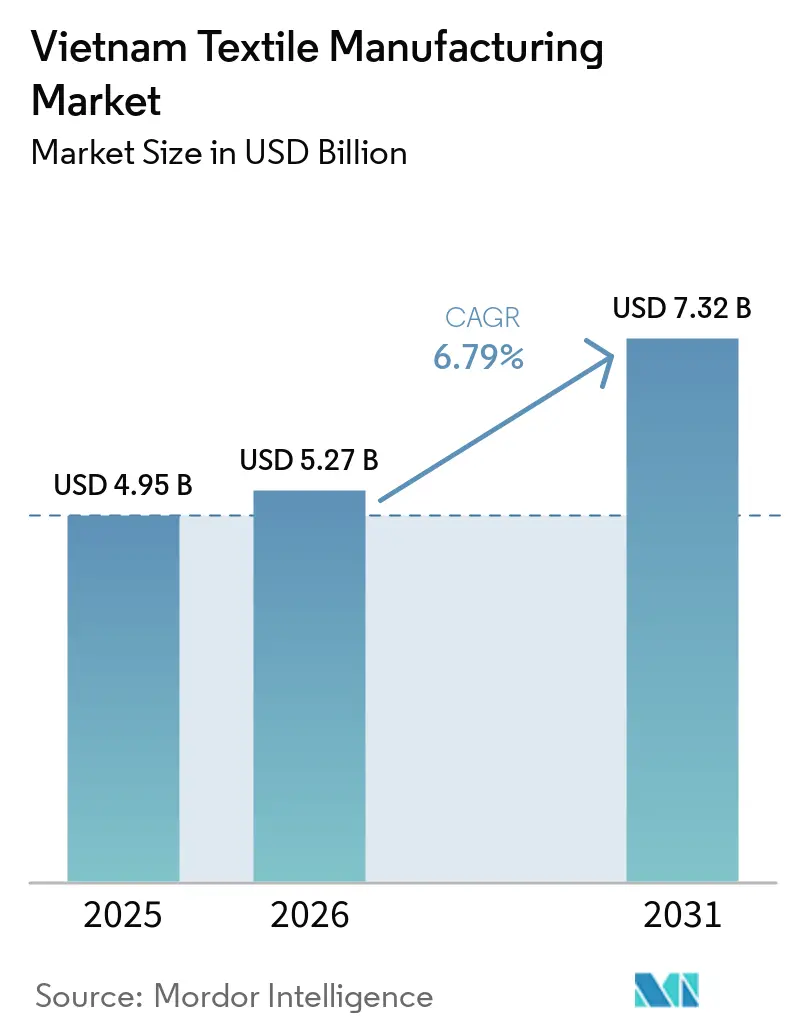
| Base Year Market Size (2025) | USD 4.95 Billion |
| Market Size (2026) | USD 5.27 Billion |
| Market Size (2031) | USD 7.32 Billion |
| Growth Rate (2026 - 2031) | 6.79 % |
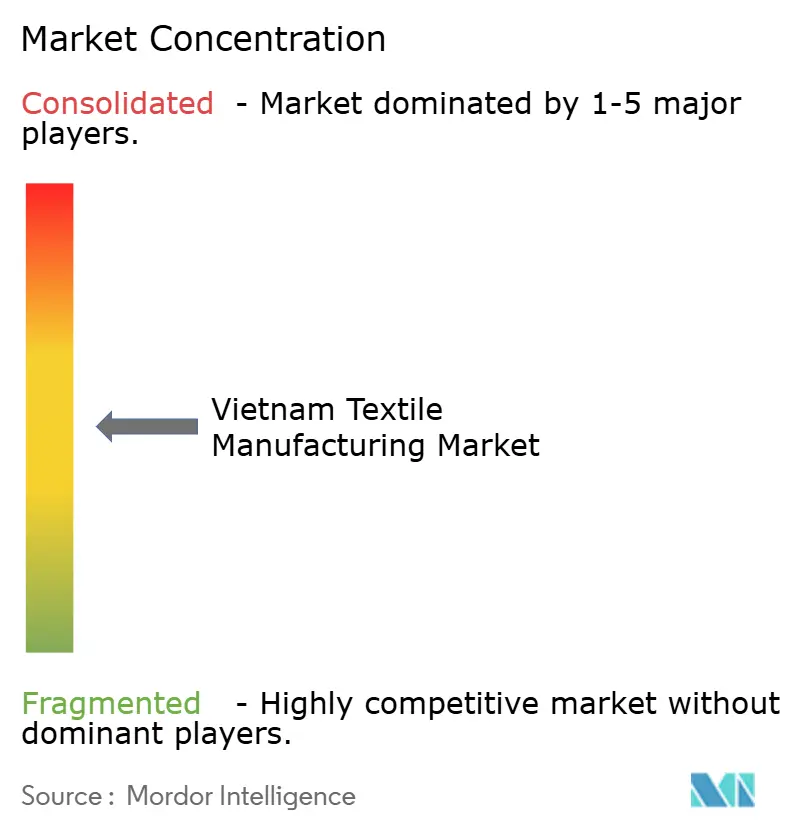
| Market Concentration | Medium |
Major Players *Disclaimer: Major Players sorted in no particular order Image © Mordor Intelligence. Reuse requires attribution under CC BY 4.0. | |
Vietnam Textile Manufacturing Market Analysis by Mordor Intelligence
The Vietnam Textile Manufacturing Market size is expected to increase from USD 4.95 billion in 2025 to USD 5.27 billion in 2026 and reach USD 7.32 billion by 2031, growing at a CAGR of 6.79% over 2026-2031.
The Vietnam textile manufacturing market is supported by export demand and investment in the fiber, spinning, weaving, knitting, dyeing, and finishing stages. Vietnam Textile and Apparel Association reported textile and garment export turnover of USD 46 billion in 2025 and set a USD 50 billion target for 2026. Free trade agreements are increasing the value of domestic processing because tariff preferences depend on rules of origin. Foreign investment is adding capacity in recycling, specialty fibers, fabrics, and accessories, while import dependence continues to limit local value capture. The Vietnam textile manufacturing market also faces a widening difference between large producers that can fund traceability and smaller firms that remain exposed to compliance costs.
Key Report Takeaways
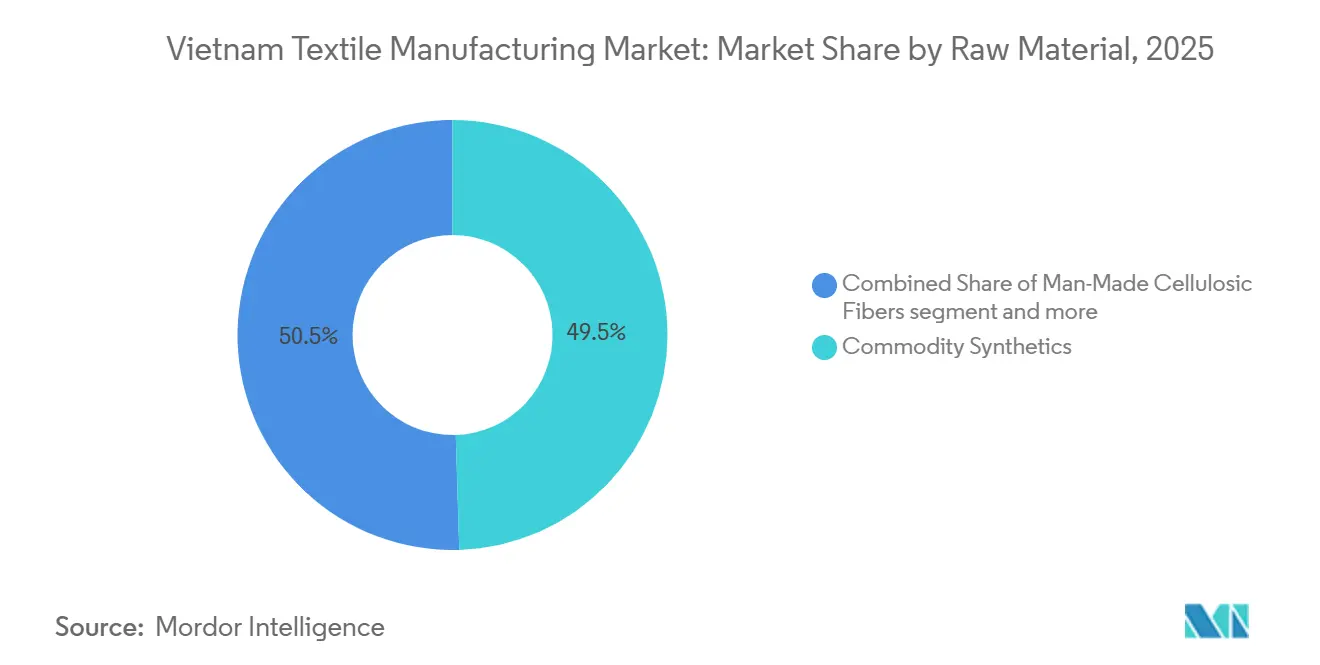
- By raw material, commodity synthetics held 49.5% of the Vietnam textile manufacturing market share in 2025, while specialty and high-performance fibers are forecast to expand at an 8.2% CAGR through 2031.
- By manufacturing process, fabric manufacturing held 43.5% of the Vietnam textile manufacturing market size in 2025, while nonwoven and felt manufacturing is projected to grow at a 9.8% CAGR through 2031.
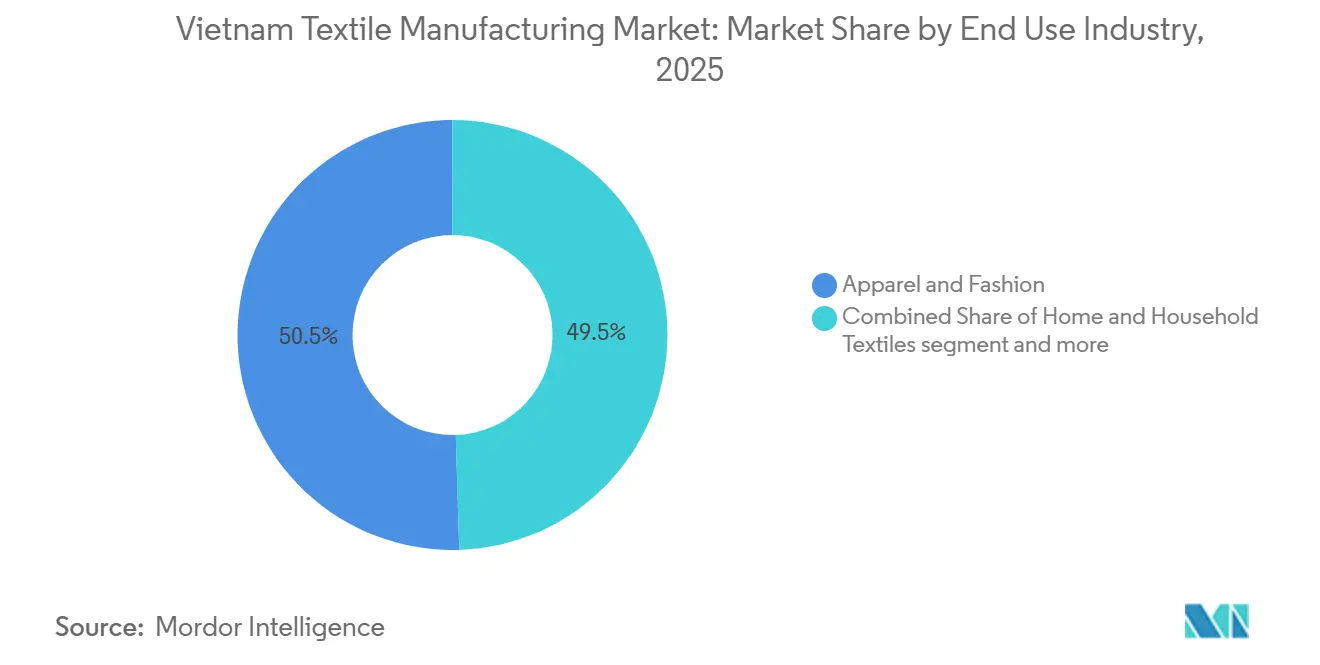
- By end-use industry, apparel and fashion held 50.5% of the Vietnam textile manufacturing market share in 2025, while technical and industrial textiles are expected to advance at a 7.7% CAGR through 2031.
- By enterprise scale, MSMEs and the unorganized sector held 57% of market value in 2025, while large organized manufacturers are forecast to record a 7.9% CAGR through 2031.
Note: Market size and forecast figures in this report are generated using Mordor Intelligence’s proprietary estimation framework, updated with the latest available data and insights as of January 2026.
Vietnam Textile Manufacturing Market Trends and Insights
Drivers Impact Analysis*
| Driver | (~) % Impact on CAGR Forecast | Geographic Relevance | Impact Timeline |
|---|---|---|---|
| Supply-Chain Diversification Away from China-Centric Sourcing | +1.8% | Global, with gains concentrated in the North and Central Vietnam industrial clusters | Short term (≤ 2 years) |
| New-Generation Free Trade Agreement Access | +1.5% | Global, with the strongest activation in EVFTA and CPTPP corridors | Short term (≤ 2 years) |
| Green and Traceable Textile Procurement by Global Buyers | +1% | North America and the EU, with spillover to CPTPP markets | Medium term (2-4 years) |
| Rising FDI Inflows and Industrial Zone Expansion | +0.8% | National, with early capacity gains in Binh Dinh, Nghe An, Hung Yen, and Dong Nai | Long term (≥ 4 years) |
| Recycled Fiber and Circular Processing Capacity Expansion | +0.6% | National, linked to Binh Dinh and Central Vietnam renewable-energy zones | Long term (≥ 4 years) |
| Industrial Digitalization and Process Automation | +0.5% | National, with leading deployment across factories | Medium term (2-4 years) |
| Source: Mordor Intelligence | |||
Supply-Chain Diversification Away from China-Centric Sourcing
Global apparel and home-textile buyers have continued to place more sourcing activity in Vietnam after tariff tensions and earlier supply disruptions exposed the risk of China-centered supply chains. Vietnam's share of United States garment imports rose to 21.1% in 2025 from 18.9% in 2024, while Chinese suppliers lost share in United States and Japanese import baskets.[1] Buyers are moving product development, quality auditing, and supplier-management work closer to Vietnamese production facilities. This raises expectations for manufacturers in the Vietnam textile manufacturing market because the relationship extends beyond basic cut-make-trim orders. Exports to the Middle East reached USD 700 million in the first 7 months of 2025 after generating USD 1 billion in 2024. Higher order flows support spinning and knitting utilization, but they also place added pressure on dyeing and finishing capacity needed for origin-compliant fabric.
New-Generation Free Trade Agreement Access
Vietnam has 17 free trade agreements that provide differentiated tariff access to more than 60 export markets. The EVFTA allows qualifying woven and knitted products made from Vietnam-originating or EVFTA-originating fabric to enter the European Union tariff-free.[2] This rule favors investment in weaving, knitting, and wet processing, which are still underdeveloped relative to garment assembly. CPTPP yarn-forward requirements place more emphasis on spinning and on links between fiber, fabric, and garments within member economies.[3] Textile and garment exports to the Europe-America region increased 10.8% year over year in the first 9 months of 2025, while textile fiber and yarn exports to that corridor increased 13.3%. The Vietnam textile manufacturing market benefits most when producers can meet these origin requirements with local or qualifying inputs.
Green and Traceable Textile Procurement by Global Buyers
Sustainability requirements are becoming purchasing conditions for suppliers serving European and North American brands. The EU Ecodesign for Sustainable Products Regulation and corporate due diligence rules extend supply-chain review to indirect suppliers in Vietnam. The EU began requiring certificate purchases under the Carbon Border Adjustment Mechanism in January 2026, and textile producers are preparing for possible future inclusion as carbon pricing expands. Cold-pad-batch dyeing can reduce water, steam, electricity, and salt costs by 72.8% and cut carbon dioxide emissions by 0.336 kilograms per kilogram of fabric compared with conventional dyeing. These process improvements make traceable and lower-impact production relevant to cost control as well as buyer qualification. Producers without certified processes or reliable traceability records may face exclusion from preferred supplier lists.
Rising FDI Inflows and Industrial Zone Expansion
Foreign investment is bringing capital-intensive projects to areas where domestic companies face funding limits. Syre Group received an investment registration certificate for a USD 1 billion polyester recycling and fabric complex in Binh Dinh, with a capacity of up to 250,000 tons per year and a 2029 operating target. Best Pacific began construction of its USD 940 million Mega Textile-Vietnam project in Nghe An across 67.5 hectares, with Phase 1 production planned for Q2 2028. HS Hyosung Quảng Nam started construction of a USD 100 million polyester curtain fabric and industrial fiber plant in Da Nang during Q1 2026. The new projects support a shift from basic labor-cost advantages toward more complex processing and circular-fiber capacity. Industrial zone expansion also gives the Vietnam textile manufacturing market more room to develop production closer to ports, garment clusters, and renewable-energy resources.
Restraints Impact Analysis*
| Restraint | (~) % Impact on CAGR Forecast | Geographic Relevance | Impact Timeline |
|---|---|---|---|
| Imported Fabric, Cotton, Fiber, Chemicals, and Dyes Dependence | -1.2% | National, with the highest exposure in spinning and dyeing clusters reliant on China-origin inputs | Short term (≤ 2 years) |
| Tariff, Rules of Origin, and Geopolitical Exposure | -0.9% | North America, the EU, and APAC geopolitical corridors | Short term (≤ 2 years) |
| High Compliance Cost for Wet Processing and Carbon Reduction | -0.7% | National, with acute pressure on SME dyeing and finishing operators | Medium term (2-4 years) |
| Skilled-Labor Shortage and Workforce Volatility | -0.4% | National, especially Northern Vietnam, clusters near technology and electronics hubs | Medium term (2-4 years) |
| Source: Mordor Intelligence | |||
Imported Fabric, Cotton, Fiber, Chemicals, and Dyes Dependence
Dependence on imported raw materials remains the most persistent constraint on domestic value addition. Vietnam imported 100% of its cotton, consuming 400,000 tons annually against a domestic supply of less than 3,000 tons, and imported up to 95% of its synthetic fibers. Domestic fabric production covered only 25% to 30% of market needs, leaving manufacturers dependent on imported materials and accessories. Vietnam imported 1.71 million tons of cotton valued at USD 2.88 billion in 2025, and the United States supplied 45.6% of the import volume. Imported fabric had reached USD 11 billion in 2024, while China accounted for 59% of raw material and accessory sourcing. These dependencies limit the Vietnam textile manufacturing market’s ability to use CPTPP preferences when input materials do not qualify under yarn-forward rules.
Tariff, Rules of Origin, and Geopolitical Exposure
Vietnam’s concentration in a limited set of export destinations creates exposure to changes in trade policy. The United States purchased USD 18 billion of Vietnam's textile and garment exports in 2025, which was more than 39% of the total export value. United States forced-labor audits add verification work and can delay orders for manufacturers without full fiber traceability. CPTPP requirements also favor larger vertically integrated firms that can establish qualifying sourcing at scale. Compliance spending is especially difficult for smaller dyeing and finishing companies that must upgrade treatment systems, energy use, and documentation. Labor shortages near Northern technology and electronics clusters add further pressure to operating stability. Together, these factors can delay investment decisions even when the Vietnam textile manufacturing market has strong structural export opportunities.
*Our forecasts treat driver/restraint impacts as directional, not additive. The impact forecasts reflect baseline growth, mix effects, and variable interactions.
Segment Analysis
By Raw Material: Commodity Synthetics Lead, While Specialty Fibers Grow Faster
Commodity synthetics held 49.5% market value in 2025, supported by demand from mass-market apparel and performance-wear exports. Polyester, nylon, polypropylene, acrylic, and elastane are the principal materials in this category. Polyester staple fiber and polyester filament yarn remain the highest-volume inputs for the domestic production base. identified synthetic-fiber integration as a priority for reducing import leakage and retaining more upstream value in Vietnam. Artificial cellulosic fibers such as viscose, lyocell, modal, and acetate are gaining interest from buyers seeking biodegradable alternatives to conventional synthetics. Natural cotton-based fibers also provide an option for suppliers that can demonstrate traceable, UFLPA-compliant sourcing.
Specialty and high-performance fibers are forecast to record an 8.2% CAGR through 2031, making them the fastest-growing raw-material category. Demand comes from transportation, protective equipment, medical devices, construction, and geotextile applications. This raises the importance of technical standards and controlled processing for suppliers entering the Vietnam textile manufacturing industry. Toray’s Vietnam operations in polyester and nylon specialty fabrics show the FDI-led development of a more advanced raw-material base. ISO 9001 process management and international quality-system compliance are increasingly relevant to specialty-fiber procurement. These requirements favor larger certified manufacturers over fragmented processors. The category offers a path to higher-value output, but its development depends on consistent quality and customer qualification.

By Manufacturing Process and Product Type: Fabric Holds the Largest Value, While Nonwovens Expand
Fabric manufacturing held 43.5% of the Vietnam textile manufacturing market size in 2025 and remained the leading process segment. The country had 121 operating cotton-yarn-containing spinning mills with 10.4 million spindle-equivalents in calendar year 2025. This spinning base supplies fabric production that feeds the country’s garment export system. Yarn and thread manufacturing remains high volume, but cotton-yarn export unit values declined 5% in calendar year 2025 as global prices softened, even though export volumes rose 8%. Finishing activities such as pretreatment, bleaching, dyeing, and printing face the closest scrutiny from European environmental requirements. Digital textile printing is gaining relevance because it can lower water and chemical use in these activities.
Nonwoven and felt manufacturing is projected to grow at a 9.8% CAGR through 2031, the highest rate among process categories. Medical hygiene, industrial filtration, geotextiles, and automotive interiors support this demand. Investment in spunbond and meltblown lines has increased after post-pandemic demand confirmed the commercial depth of hygiene and medical applications. YKK began Phase 3 of its Nhon Trach facility in Dong Nai in January 2026, committing USD 83.6 million to expand accessories production and advanced product development. The project supports the components and accessories ecosystem around apparel production. It also reflects confidence in the broader mid-stream base that supports technical fabrics and nonwoven applications. Expansion in this category depends on reliable equipment, quality control, and access to specialized buyers.
By End Use Industry: Apparel Provides Scale, While Technical Textiles Draw Investment
Apparel and fashion held 50.5% of the market value in 2025 and remained the largest end-use category. The Vietnam textile manufacturing market depends heavily on garment assembly, which consumes most domestically manufactured fabric and supports one of the world’s largest garment export bases. Buyer relationships with U.S. and European brands are extending beyond cut-make-trim activity. Manufacturers are moving toward original design manufacturing and original brand manufacturing models. This change increases demand for specialty-processed fabrics with consistent color, finish, and functional performance. Home and household textiles remain a stable secondary outlet, supported by European demand and EVFTA tariff preferences.
Technical and industrial textiles are expected to grow at a 7.7% CAGR through 2031. The category includes transportation fabrics, medical and hygiene textiles, industrial filtration materials, construction geotextiles, and protective products. The Vietnam textile manufacturing market has an opportunity to deepen its position in these uses as industrial production broadens. Entry into medical and automotive uses requires ISO 13485 and IATF 16949 quality certifications. These standards favor quality-audited manufacturers that can support product validation and repeatability. Small processors may find the required systems difficult to fund or maintain. The result is a greater divide between compliant large plants and commodity-focused firms.
By Enterprise Scale: MSMEs Retain Breadth, While Large Firms Gain from Compliance
MSMEs and the unorganized sector held 57% of market value in 2025, showing the broad fragmentation of production across spinning, weaving, and garment-linked processors. This structure concentrates many firms on commodity activities with limited margins and capacity for technology investment. The localization rate stood at 52% in 2025, against an industry target of more than 60% by 2030. Smaller companies, therefore, remain more exposed to imported-input costs, buyer audits, and environmental requirements. Their role remains important because they provide production breadth and flexibility across the supply chain.
Large, organized manufacturers are forecast to grow at a 7.9% CAGR through 2031. Origin requirements, sustainability audits, and the economics of automation support their relative advantage. The group has made digital transformation a strategic priority for 2026, using real-time productivity monitoring, RFID tracking, and Power BI analytics across spinning, weaving, dyeing, and garment operations. Century Synthetic Fiber opened its USD 130 million Unitex factory in Tay Ninh in January 2026 to produce recycled yarn. Its recycled-yarn revenue increased 25.2% in 2025 and approached 50% of the company's revenue.
Geography Analysis
Southern Vietnam held 44% of installed spinning capacity in calendar year 2025, with 54 of the country’s 121 operating spinning mills. Ho Chi Minh City, Dong Nai, Tay Ninh, and Binh Duong form the largest production zone in the Vietnamese textile manufacturing market. The region benefits from export ports, established garment clusters, and a mature FDI base. Hyosung operates spandex and nylon facilities in Dong Nai, while Far Eastern Polytex has a polyester fiber plant in Binh Duong. Century Synthetic Fiber’s USD 130 million Unitex recycled-yarn plant strengthened Tay Ninh’s synthetic-fiber base in January 2026. Higher land costs and competition for workers from electronics and consumer-goods plants are reducing the South’s cost advantage.
Northern Vietnam is the fastest-growing manufacturing zone, based on lower land costs, provincial incentives, and overland links to Chinese raw-material suppliers. Hung Yen, Ninh Binh, Nam Dinh, Thai Nguyen, and the Hanoi industrial periphery are central to this expansion. Administrative consolidation from 63 to 34 provinces has reorganized mill geography around industrial hubs such as Hung Yen and Ninh Binh. Xielong Vietnam Textile Technology started a USD 40 million mesh-fabric factory in Nam Dinh in 2025, with Phase 1 production scheduled for Q2 2026. Carvico Group also broke ground on a third production block at its Hung Yen knitting and dyeing facility in 2025. Its digital systems have been effective in Northern units where connectivity supports real-time production monitoring.
Central Vietnam is adding capital-intensive capacity through projects in Binh Dinh, Nghe An, Thanh Hoa, Hue, and Da Nang. Syre’s USD 1 billion Binh Dinh recycling complex is planned to start operations in 2029. Best Pacific’s USD 940 million project in Nghe An and Hyosung’s USD 100 million Da Nang plant add fabric and industrial-fiber capacity to the Vietnam textile manufacturing market. Billion Union started work on a USD 70 million, 18,000-ton fabric plant in Thanh Hoa in 2025, with operations targeted from June 2026. The region’s wind and solar resources can support manufacturers seeking lower-carbon electricity and green-certified investment. Its growing role reflects the movement of greenfield projects away from more costly Southern locations.
Competitive Landscape
The Vietnam textile manufacturing market exhibits a medium level of market concentration, with FDI manufacturers operating alongside domestic conglomerates and a wide MSME base. FDI enterprises accounted for 60% to 62% of the textile sector's export value in 2026. South Korean, Japanese, Taiwanese, and Chinese companies tend to operate larger integrated or specialty facilities. Their systems for technology, environmental management, and trade-rule compliance set an operational benchmark for domestic mid-tier producers. Thanh Cong, and other domestic groups compete by pursuing localization, recycling, and digital production systems. MSMEs remain essential to supply-chain breadth, but face greater difficulty meeting traceability and green-procurement requirements.
Competitive strategies increasingly focus on high-performance materials, circular production, and larger-scale processing. Hyosung’s Da Nang project targets polyester curtain fabric and industrial fiber, and Syre’s Binh Dinh project targets recycled polyester and fabric. YKK’s January 2026 expansion in Dong Nai adds accessories capacity and product-development capability to its Vietnam platform. These investments allow leading companies to respond to customer requirements that smaller processors cannot address as quickly. They also raise the importance of data discipline and process consistency in the Vietnam textile manufacturing market.
The largest opportunity remains in mid-stream fabric manufacturing and wet processing because domestic fabric output meets only 25% to 30% of requirements. Each additional meter of qualifying fabric can help downstream garment exporters use EVFTA tariff preferences. This opportunity attracts both foreign and domestic capital because it addresses import dependence and buyer requirements at the same time. Competitive intensity is rising at the premium end, where integrated operators can combine specialty materials, environmental compliance, and traceability. The broader market remains fragmented because no company-level combined share data is available for the leading players.
Vietnam Textile Manufacturing Industry Leaders
-
Vietnam National Textile and Garment Group (Vinatex)
-
Thanh Cong Textile Garment
-
Century Synthetic Fiber Corporation
-
Phong Phu Corporation
-
Hoa Tho Textile
- *Disclaimer: Major Players sorted in no particular order
Recent Industry Developments
- January 2026: Century Synthetic Fiber Corporation inaugurated the Unitex Factory in Tay Ninh province, a USD 130 million facility designed for recycled yarn production at Thanh Thanh Cong Industrial Park. Recycled yarn revenue grew 25.2% in 2025 and reached nearly 50% of total revenue.
- January 2026: YKK held a groundbreaking ceremony for Phase 3 of its Nhon Trach Factory in Dong Nai province. The USD 83.6 million expansion covers a 110,460 square meter site and targets accessories capacity and advanced product development.
Vietnam Textile Manufacturing Market Report Scope
The Vietnam Textile Manufacturing Market is Segmented by Raw Material (Natural Fibers, Commodity Synthetics, and More), by Manufacturing Process and Product Type (Fabric Manufacturing, Yarn and Thread Manufacturing, and More), by End Use Industry (Apparel and Fashion, and More), by Enterprise Scale (Large Organized Manufacturers, and More). The Report Offers Market Size and Value (USD) Forecasts for all the Above Segments.
| Natural Fibers | Plant-Based Fibers | Cotton |
| Others (jute, flax, hemp, ramie, coir) | ||
| Animal-Based Fibers (wool, silk and other animal fibers) | ||
| Man-Made Cellulosic Fibers (viscose/rayon, lyocell, modal and acetate) | ||
| Commodity Synthetics (polyester, nylon/polyamide, polypropylene, acrylic and elastane) | ||
| Specialty and High-Performance Fibers (aramid, UHMWPE, etc.) |
| Yarn and Thread Manufacturing | |
| Fabric Manufacturing | Weaving |
| Knitting and Crocheting | |
| Nonwoven and Felt Manufacturing | |
| Other Fabric-Formation Processes | |
| Textile Finishing and Surface Treatment (Pretreatment, Bleaching, Dyeing, Printing, etc.) |
| Apparel and Fashion | |
| Home and Household Textiles | |
| Technical and Industrial Textiles | Transportation and Mobility |
| Medical and Hygiene | |
| Industrial Processing and Filtration | |
| Construction and Geotextiles | |
| Protective and Safety | |
| Packaging | |
| Other Technical Applications - Agriculture, etc. |
| Large Organized Manufacturers |
| Micro, Small, and Medium Enterprises (MSMEs) and the unorganized sector |
| By Raw Material | Natural Fibers | Plant-Based Fibers | Cotton |
| Others (jute, flax, hemp, ramie, coir) | |||
| Animal-Based Fibers (wool, silk and other animal fibers) | |||
| Man-Made Cellulosic Fibers (viscose/rayon, lyocell, modal and acetate) | |||
| Commodity Synthetics (polyester, nylon/polyamide, polypropylene, acrylic and elastane) | |||
| Specialty and High-Performance Fibers (aramid, UHMWPE, etc.) | |||
| By Manufacturing Process and Product Type | Yarn and Thread Manufacturing | ||
| Fabric Manufacturing | Weaving | ||
| Knitting and Crocheting | |||
| Nonwoven and Felt Manufacturing | |||
| Other Fabric-Formation Processes | |||
| Textile Finishing and Surface Treatment (Pretreatment, Bleaching, Dyeing, Printing, etc.) | |||
| By End Use Industry | Apparel and Fashion | ||
| Home and Household Textiles | |||
| Technical and Industrial Textiles | Transportation and Mobility | ||
| Medical and Hygiene | |||
| Industrial Processing and Filtration | |||
| Construction and Geotextiles | |||
| Protective and Safety | |||
| Packaging | |||
| Other Technical Applications - Agriculture, etc. | |||
| By Enterprise Scale | Large Organized Manufacturers | ||
| Micro, Small, and Medium Enterprises (MSMEs) and the unorganized sector | |||
Key Questions Answered in the Report
What is the projected value of Vietnam's textile manufacturing by 2031?
The Vietnam textile manufacturing market size is forecast to reach USD 7.32 billion by 2031, growing at a 6.8% CAGR from 2026.
What is driving textile production growth in Vietnam?
Export diversification, free trade agreement access, traceability requirements, FDI, and capacity investment in fabric and recycling support growth.
Which raw material category is growing fastest in Vietnam?
Specialty and high-performance fibers are forecast to expand at an 8.2% CAGR through 2031, supported by technical applications.
Which manufacturing process is expanding fastest?
Nonwoven and felt manufacturing is projected to grow at a 9.8% CAGR through 2031, supported by hygiene, filtration, geotextile, and automotive uses.
Why is local fabric production important for Vietnamese exporters?
Domestic fabric output meets only 25% to 30% of needs, and qualifying fabric can help garment exporters use EVFTA tariff preferences.
What is the main challenge for smaller textile manufacturers in Vietnam?
Smaller producers face imported-input dependence and higher costs for traceability, wastewater management, sustainability systems, and origin compliance.