
Vietnam Reverse Logistics Market Size and Share
Market Overview
| Study Period | 2021 - 2032 |
|---|---|
| Forecast Data Period | 2027 - 2032 |
| Base Year Market Size (2026) | USD 3.58 Billion |
| Market Size (2027) | USD 3.88 Billion |
| Market Size (2032) | USD 5.75 Billion |
| Growth Rate (2027 - 2032) | 8.16 % |
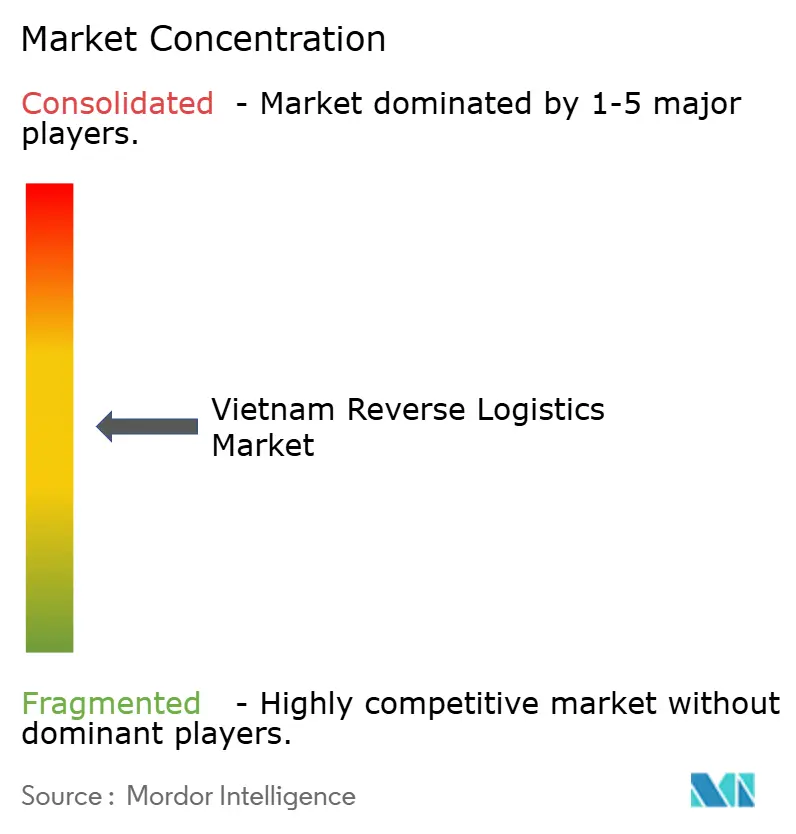
| Market Concentration | Medium |
Major Players *Disclaimer: Major Players sorted in no particular order Image © Mordor Intelligence. Reuse requires attribution under CC BY 4.0. | |
Vietnam Reverse Logistics Market Analysis by Mordor Intelligence
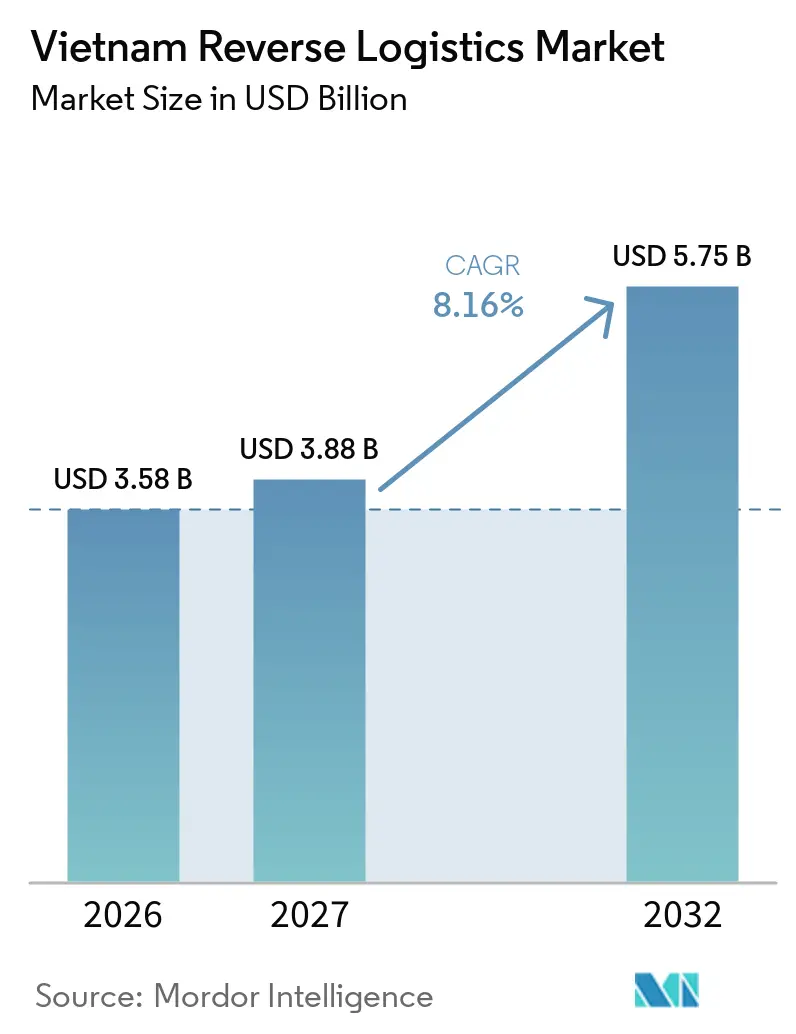
The Vietnam reverse logistics market is valued at USD 3.58 billion in 2026 and is estimated to reach USD 3.88 billion in 2027 and USD 5.75 billion by 2032, registering a CAGR of 8.16% during 2027–2032.
Market expansion is supported by the growth of e-commerce, the country's manufacturing base, and increasing demand for product returns, inspection, recovery, and redistribution services. Reverse logistics covers the movement and handling of products from customers or downstream distribution points back to sellers, manufacturers, or recovery facilities. Its functions include transportation, returns processing, inspection, restocking, refurbishment, recycling, and disposal. As e-commerce and manufacturing supply chains expand, providers can support retailers and manufacturers by improving product traceability, reducing unnecessary handling, and directing returned goods toward the most appropriate recovery channel.
Key Report Takeaways
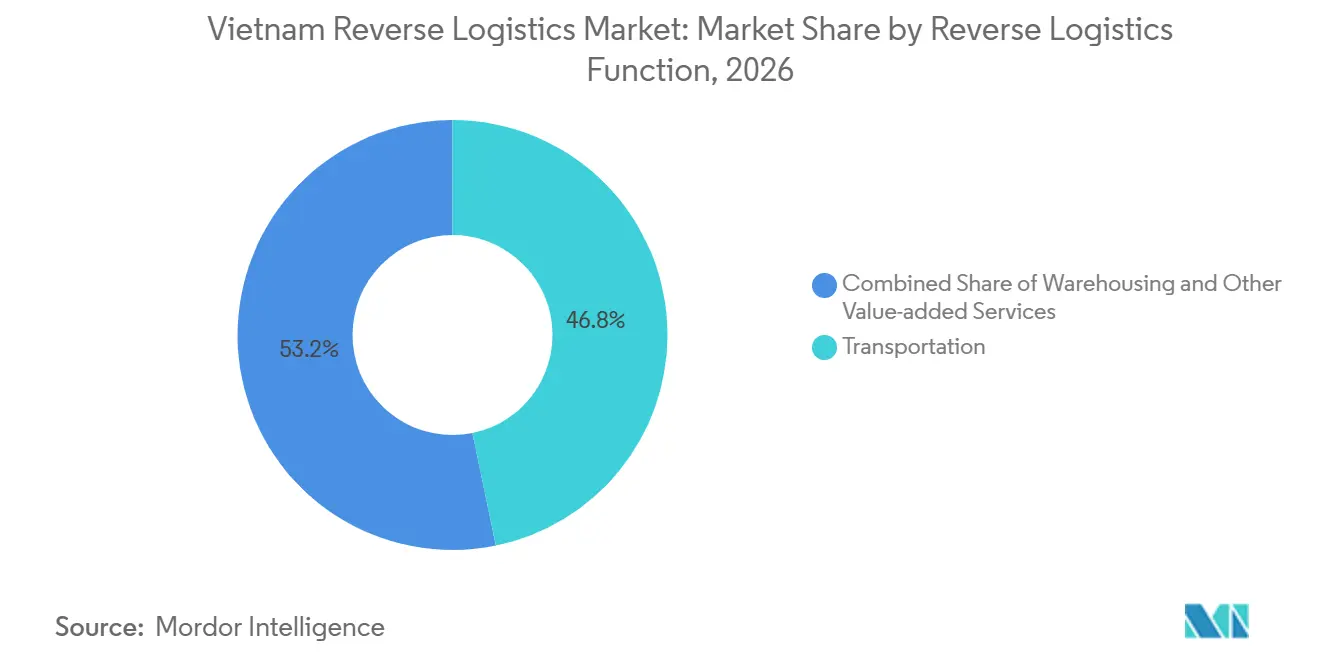
- By reverse logistics function, transportation accounts for 46.78% of the Vietnam reverse logistics market share in 2026, while other value-added services are projected to register a 10.34% CAGR from 2027 to 2032.
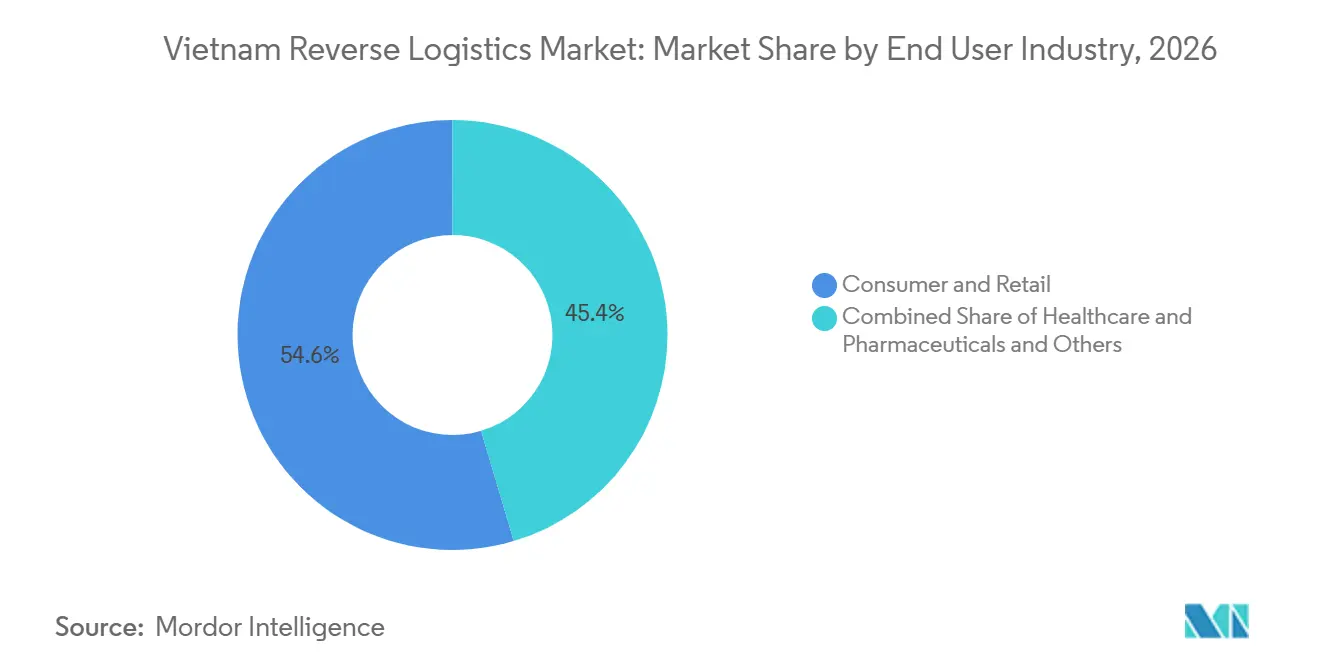
- By end-user industry, consumer and retail accounts for 54.65% of the Vietnam reverse logistics market size in 2026, while healthcare and pharmaceuticals are projected to register a 9.36% CAGR from 2027 to 2032.
- By region, Southern Vietnam accounts for 52.95% of the Vietnam reverse logistics market size in 2026, while Central Vietnam is projected to register a 10.26% CAGR from 2027 to 2032.
Note: Market numbers in this report are based on Mordor Intelligence's proprietary estimation framework, which combines nine months of actuals with Q4 projections for base year 2026.
Vietnam Reverse Logistics Market Trends and Insights
Drivers Impact Analysis*
| Driver | (~) % IMPACT ON CAGR FORECAST | Geographic relevance | Impact timeline |
|---|---|---|---|
| E-Commerce Returns Increasing Reverse Logistics Service Demand | +2.5% | National, with early concentration in Ho Chi Minh City and Hanoi | Short term (≤ 2 years) |
| Circular Economy Adoption Strengthening Product Recovery Activities | +1.2% | National, with opportunities in Southern Vietnam's industrial zones | Medium term (2–4 years) |
| Electronics Growth Expanding Warranty and Returns Processing | +1.0% | Northern Vietnam, including the Hanoi, Hung Yen, and Bac Ninh corridor | Medium term (2–4 years) |
| Digital Visibility Improving Returns Tracking and Processing | +1.0% | National, with stronger relevance in major commercial centers | Short term (≤ 2 years) |
| Marketplace Claims Increasing Structured Returns Data Requirements | +0.8% | National, particularly multi-platform seller operations | Medium term (2–4 years) |
| Backhaul Monetization Improving Reverse-Flow Network Economics | +0.7% | Southern and Northern Vietnam, with potential to extend into Central Vietnam | Medium term (2–4 years) |
| Source: Mordor Intelligence | |||
E-Commerce Returns Increasing Reverse Logistics Service Demand
Vietnam's expanding online retail market is increasing the need for structured product collection, returns processing, and disposition services. As online transaction volumes rise, retailers and marketplaces need return processes that enable customers to send products back, track their status, and receive timely decisions on refunds, replacement, or resale. A December 2025 study on electronic reverse logistics service quality in Vietnam found that clear information and convenient return processes improve customer satisfaction, while effective solutions to return-related problems and reliable information help build customer trust.[1] This reinforces the importance of reverse logistics as part of the post-purchase experience. Logistics providers can serve this demand through scheduled pickups, return tracking, centralized inspection, and clear records of product disposition. Providers that integrate these services with forward distribution networks can also improve visibility for retailers managing orders across multiple sales channels.
Circular Economy Adoption Strengthening Product Recovery Activities
Vietnam's logistics development strategy for 2025–2035, with a vision to 2050, was approved in October 2025[2]. The strategy seeks to improve logistics efficiency, increase the sector's value contribution, and support sustainable development. These priorities create a policy context for reverse logistics services that recover value from returned products, reusable packaging, and materials that would otherwise be discarded. Reverse logistics providers can support manufacturers and retailers through repair, refurbishment, restocking, recycling, and documented disposal. Such services help companies determine whether products can be returned to inventory, repaired for continued use, or routed to an appropriate recovery channel. However, the extent to which these activities are adopted depends on product condition, residual value, available processing capacity, and the cost of recovering goods. Providers that combine transportation with inspection and recovery services can offer a broader solution than carriers focused only on moving returned products.
Electronics Growth Expanding Warranty and Returns Processing
Vietnam's manufacturing activity creates potential demand for reverse logistics services associated with defective components, warranty claims, repairs, and product replacement. Electronics and other high-value goods can require item-level identification, controlled storage, inspection records, and manufacturer authorization before returned products are repaired, replaced, or returned to inventory. These requirements distinguish industrial reverse flows from standard consumer parcel returns. NX Vietnam's Dinh Vu Logistics Center Phase II in Hai Phong entered operation in May 2025. The facility includes constant-temperature and low-humidity storage designed for products such as medical equipment and electronic devices. NX Group announced the opening ceremony in June 2025. This development demonstrates investment in specialized logistics infrastructure in Northern Vietnam, although the facility announcement alone does not establish the volume of electronics returns processed. The opportunity for reverse logistics providers depends on their ability to connect inspection and storage services with manufacturers' warranty, repair, and disposition procedures.
Digital Visibility Improving Returns Tracking and Processing
Digitalization can improve reverse logistics by connecting return authorization, pickup, inspection, inventory updates, and final disposition. Better data exchange can reduce uncertainty about a returned product's location and condition, help retailers monitor service performance, and support decisions on whether goods should be restocked, repaired, refurbished, or disposed of. Vietnam's Ministry of Industry and Trade has identified digitalization as part of the country's logistics development priorities. For reverse logistics operators, the practical benefits of digital tools depend on the quality of data captured at each stage and the ability to exchange information with sellers, marketplaces, and manufacturers. Tracking systems, barcode or serial-number scanning, and warehouse-management platforms can support these requirements. Advanced automation may also improve sorting and handling, but claims about specific deployments should be tied to dated company announcements and verified operational details[3].
Restraints Impact Analysis*
| Restraint | (~) % IMPACT ON CAGR FORECAST | Geographic relevance | Impact timeline |
|---|---|---|---|
| Fragmented Providers Reducing Process Consistency and Efficiency | -1.5% | National, particularly outside major urban centers | Long term (≥ 4 years) |
| Collection and Inspection Costs Increasing Recovery Expenses | -1.2% | National, with potential pressure in lower-density collection areas | Medium term (2–4 years) |
| Uncertain Return Quality Limiting Resale Value Recovery | -0.8% | National, particularly consumer electronics and fashion | Medium term (2–4 years) |
| Platform Interoperability Gaps Increasing Returns Processing Complexity | -0.7% | National, particularly multi-platform seller operations | Short term (≤ 2 years) |
| Source: Mordor Intelligence | |||
Fragmented Providers Reducing Process Consistency and Efficiency
Reverse logistics involves multiple stages, including pickup, consolidation, inspection, repair, restocking, and disposal. When these stages are managed by different providers without common operating procedures or compatible data systems, service consistency can be difficult to maintain. Differences in inspection criteria, tracking records, and handover processes can increase delays and make it harder for retailers to determine the final status of returned products. However, achieving consistent reverse logistics service requires investment in network coordination, staff training, information systems, and standardized processes. Providers operating across smaller cities and lower-density collection areas may face particular challenges in achieving sufficient volumes to support dedicated return infrastructure. Partnerships, subcontractor standards, and shared processing facilities can help reduce these gaps, although the results depend on implementation and local demand.
Collection and Inspection Costs Increasing Recovery Expenses
Collection and inspection costs can reduce the economic value of reverse logistics, particularly when the returned product is inexpensive or has limited resale potential. A returned item may require pickup, transportation, sorting, condition checks, repackaging, and a decision on its next destination. When the cost of these activities exceeds the recoverable value of the product, retailers may have limited incentive to route it through a full recovery process. The cost challenge is affected by return density, distance to inspection facilities, labor requirements, and the condition of returned goods. Lower-density routes can make individual pickups expensive, while products requiring specialized inspection or controlled storage may generate additional handling costs. Consolidated collection, route optimization, and coordinated forward and reverse transportation can help reduce expenses. However, these approaches depend on adequate volumes and the ability to combine shipments without compromising product condition or traceability.
*Our forecasts treat driver/restraint impacts as directional, not additive. The impact forecasts reflect baseline growth, mix effects, and variable interactions.
Segment Analysis
By Reverse Logistics Function: Transportation Anchors Volumes, Value-Added Services Lead Growth
Transportation accounts for 46.78% of the Vietnam reverse logistics market share in 2026, making it the largest functional segment. It covers the movement of returned products from customers, retail outlets, collection points, and distribution centers to inspection, repair, restocking, or disposal facilities. Road transportation is particularly relevant to domestic parcel collection and transfers between warehouses, while air and other transport modes can support time-sensitive or high-value shipments. The segment's importance reflects the need for a reliable physical network before returned products can be inspected or recovered. Providers that coordinate return pickups with existing distribution routes can also improve vehicle utilization and limit additional collection costs.
Other value-added services, including return processing, restocking, refurbishment, and disposition, are projected to register at a 10.34% CAGR from 2027 to 2032, the fastest rate among reverse logistics functions. These services allow retailers and manufacturers to assess product condition and determine whether goods can be resold, repaired, returned to suppliers, recycled, or disposed of. Their commercial value depends on the cost of inspection, product condition, residual value, and the availability of suitable recovery facilities. As customers require more complete records of returned goods, providers that combine transportation with processing and recovery services can offer a more integrated solution. NX Vietnam's Dinh Vu Logistics Center Phase II, which entered operation in May 2025 with temperature-controlled and low-humidity storage, illustrates investment in specialized logistics infrastructure.

By End-user Industry: Consumer Returns Set the Volume Baseline, Healthcare Drives Future Growth
Consumer and retail accounts for 54.65% of the Vietnam reverse logistics market size in 2026, making it the largest end-user segment. Demand comes from returns of apparel, electronics, household goods, personal care products, and other items sold through online and offline channels. Vietnam’s expanding online retail market is increasing demand for convenient parcel collection, transparent return tracking, product inspection, and timely refund or replacement decisions. As online shopping becomes more widely adopted, efficient reverse logistics services are becoming increasingly important for improving customer satisfaction and managing returned goods. Product condition and resale potential determine whether returned goods can be restocked or require further processing. Providers that can connect collection networks with seller inventory and returns-management systems are well placed to support retailers handling multiple product categories and sales channels.
Healthcare and pharmaceuticals are projected to register at a 9.36% CAGR from 2027 to 2032. Reverse flows in this segment can include medical-device warranty returns, pharmaceutical recalls, expired products, and goods requiring controlled handling or documented disposal. Unlike ordinary consumer returns, these flows may require batch or serial-number traceability, defined storage conditions, and a documented chain of custody. DHL's guidance on biologics and vaccine transportation highlights the importance of maintaining appropriate temperature conditions for sensitive healthcare products.
Geography Analysis
Southern Vietnam is the largest regional market, with a 52.95% share in 2026. The concentration of consumer demand and commercial activity around Ho Chi Minh City supports frequent collection routes and links between customers, sellers, and distribution centers. The region also serves manufacturing and export-related supply chains, creating potential demand for warranty returns, defective-product handling, and the movement of goods between domestic facilities and overseas counterparties. Providers can strengthen their position by coordinating parcel collection, consolidation, inspection, and onward transportation.
Northern Vietnam's reverse logistics opportunity is linked to manufacturing and specialized logistics requirements around Hanoi, Hung Yen, Bac Ninh, and Hai Phong. In July 2026, DHL Supply Chain broke ground on the DHL North Logistics Campus in Hung Yen, with an announced investment of VND 1.9 trillion (USD 76 million). The planned campus covers more than 82,500 m², with the first phase scheduled for completion in the first half of 2027.
Central Vietnam is projected to expand at a 10.26% CAGR from 2027 to 2032. Da Nang and nearby industrial areas may benefit from improved regional logistics connections, local collection services, and the development of transport infrastructure. Nevertheless, the case for additional reverse logistics capacity will depend on the number of returns generated locally, the availability of inspection and repair services, and the cost of moving goods to recovery facilities. Providers seeking to expand in the region can evaluate shared collection points, partnerships with local carriers, and consolidated movements to larger processing hubs.
Competitive Landscape
The Vietnam reverse logistics market is partially consolidated and includes domestic parcel and e-commerce carriers, international third-party logistics providers, and specialized logistics operators. Domestic networks such as GHN, GHTK, Viettel Post, and SPX Express can support consumer returns through established collection and delivery operations. International providers, including DHL Supply Chain, DSV, Kuehne+Nagel, and Nippon Express, offer broader contract logistics, freight, warehousing, and specialized handling capabilities.
Infrastructure, technology, and network partnerships are important competitive considerations. In April 2026, FedEx announced a collaboration with Viettel Post, with Viettel Post designated as FedEx's National Network Provider in Vietnam[4]. The collaboration covers nationwide pickup and delivery and supports cross-border logistics connectivity. These agreements demonstrate network cooperation in the broader logistics market.
Investment in specialized facilities is another competitive factor. DHL Supply Chain broke ground on its Hung Yen logistics campus in July 2026, while NX Vietnam's Quang Minh Logistics Center obtained an air cargo CFS license in April 2026. Such developments can strengthen warehouse and cargo-handling capabilities. Potential opportunities remain in integrated returns management, electronics warranty processing, healthcare product returns, and regional collection networks.
Vietnam Reverse Logistics Industry Leaders
-
TikiNOW Smart Logistics Company Limited
-
Viettel Post Joint Stock Corporation
-
Giao Hang Nhanh (GHN)
-
DHL Supply Chain Vietnam
-
DSV Vietnam
- *Disclaimer: Major Players sorted in no particular order
Recent Industry Developments
- July 2026: DHL Supply Chain broke ground on the DHL North Logistics Campus in Hung Yen. The planned campus covers more than 82,500 m², with an announced investment of VND 1.9 trillion (USD 76 million) using the specified exchange rate. The first phase is scheduled for completion in the first half of 2027.
- July 2026: Vietnam Post Logistics and DSV Contract Logistics Vietnam renewed their principal cooperation agreement to develop business-to-business supply chain solutions.
- April 2026: FedEx announced its collaboration with Viettel Post. Viettel Post became FedEx's National Network Provider in Vietnam, supporting nationwide pickup and delivery operations and cross-border logistics connectivity.
- June 2025: NX Vietnam announced the opening of Dinh Vu Logistics Center Phase II in Hai Phong. The facility includes constant-temperature and low-humidity storage for products such as medical equipment and electronic devices.
Vietnam Reverse Logistics Market Report Scope
| Transportation | Road |
| Air | |
| Other Modes | |
| Warehousing (Storage, Distribution, Consolidation) | |
| Other Value-added Services (Return Processing, Restocking, Refurbishment, Disposition) |
| Consumer and Retail |
| Home and Decor |
| Healthcare and Pharmaceuticals |
| FMCG |
| Other End Users |
| Northern Vietnam |
| Central Vietnam |
| Southern Vietnam |
| By Reverse Logistics Function | Transportation | Road |
| Air | ||
| Other Modes | ||
| Warehousing (Storage, Distribution, Consolidation) | ||
| Other Value-added Services (Return Processing, Restocking, Refurbishment, Disposition) | ||
| By End-user Industry | Consumer and Retail | |
| Home and Decor | ||
| Healthcare and Pharmaceuticals | ||
| FMCG | ||
| Other End Users | ||
| By Region | Northern Vietnam | |
| Central Vietnam | ||
| Southern Vietnam |
Key Questions Answered in the Report
What is the forecast growth rate for reverse logistics in Vietnam?
The Vietnam reverse logistics market is projected to register an 8.16% CAGR from 2027 to 2032, reaching USD 5.75 billion by 2032.
Which reverse logistics function is growing fastest in Vietnam?
Other value-added services are projected to register a 10.34% CAGR from 2027 to 2032, supported by demand for return processing, restocking, refurbishment, and disposition services.
Which end-user segment is largest in Vietnam's reverse logistics market?
Consumer and retail accounts for 54.65% of the market in 2026.
Why are healthcare reverse flows important in Vietnam?
Healthcare and pharmaceuticals are projected to register a 9.36% CAGR from 2027 to 2032. Product recalls, medical-device returns, and controlled handling requirements create demand for specialized processes.
Which Vietnamese region offers the fastest growth opportunity?
Central Vietnam is projected to register a 10.26% CAGR from 2027 to 2032.
What challenges affect the Vietnam reverse logistics market?
Key challenges include collection and inspection costs, inconsistent service standards, uncertain product recovery value, and difficulties integrating returns data across platforms.