
Vietnam Project Cargo Logistics Market Size and Share
Market Overview
| Study Period | 2021 - 2032 |
|---|---|
| Forecast Data Period | 2027 - 2032 |
| Base Year Market Size (2026) | USD 3.53 Billion |
| Market Size (2027) | USD 3.77 Billion |
| Market Size (2032) | USD 5.15 Billion |
| Growth Rate (2027 - 2032) | 6.46 % |
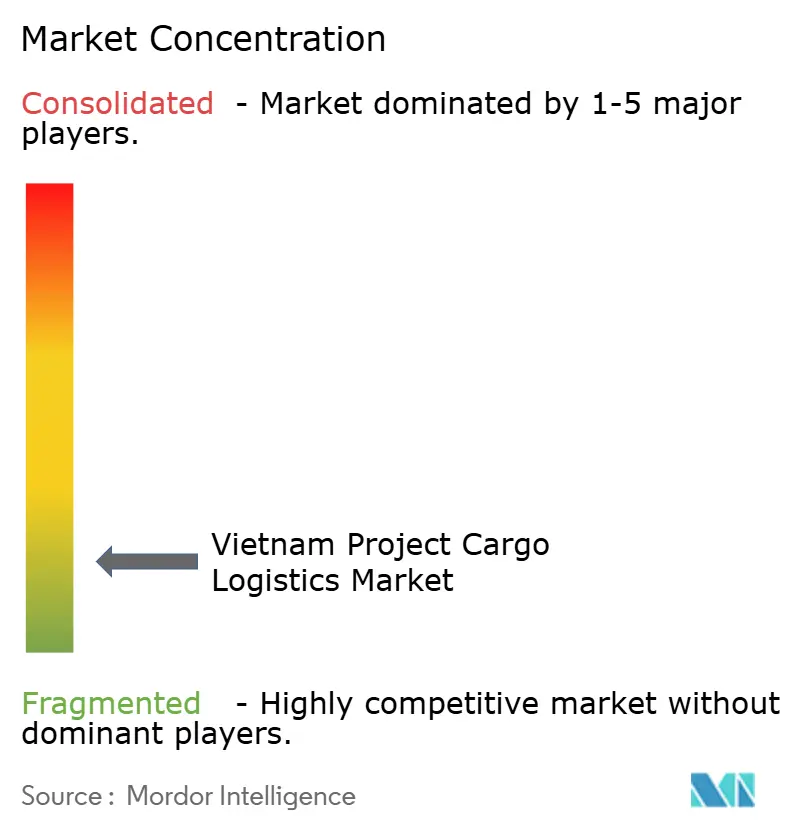
| Market Concentration | Low |
Major Players *Disclaimer: Major Players sorted in no particular order Image © Mordor Intelligence. Reuse requires attribution under CC BY 4.0. | |
Vietnam Project Cargo Logistics Market Analysis by Mordor Intelligence
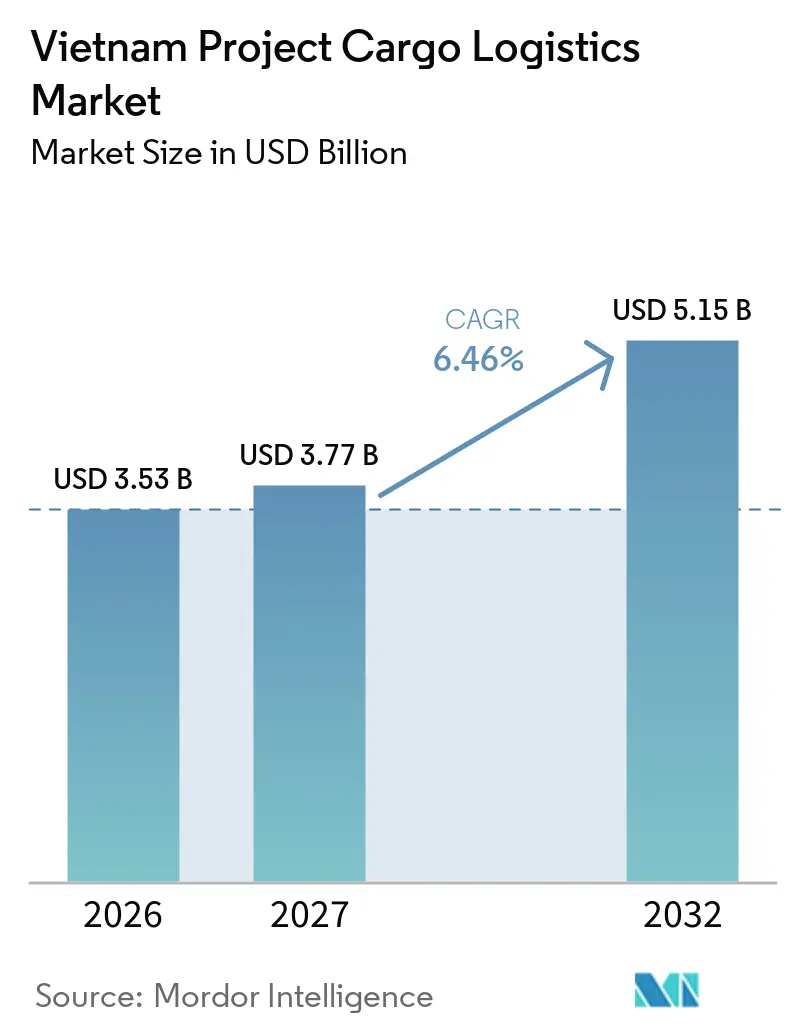
The Vietnam project cargo logistics market size is valued at USD 3.53 billion in 2026 and is estimated to grow from USD 3.77 billion in 2027 to reach USD 5.15 billion by 2032, at a CAGR of 6.46% during the forecast period 2027-2032.
Demand is supported by manufacturing investment, renewable energy development, port expansion, and transport infrastructure projects that require specialized equipment, route planning, permits, and coordinated cargo handling. Vietnam's total registered foreign direct investment reached USD 34.65 billion in the first half of 2026, including newly registered investment, adjusted capital, and foreign share acquisitions. Renewable energy projects and infrastructure development also create demand for oversized and heavy-lift cargo services. In June 2025, PPL transported and loaded out an offshore substation topside weighing nearly 4,000 tons at PV Shipyard Port in Vung Tau, using 156 SPMT axle lines. This operation demonstrates the technical capability required for complex cargo movements in Vietnam.
Key Report Takeaways
- By service, transportation accounts for 63.27% of the Vietnam project cargo logistics market size in 2026, while value-added services & others are projected to record an 8.23% CAGR through 2032.
- By cargo type, oversized / out-of-gauge cargo accounts for 43.87% of the Vietnam project cargo logistics market share in 2026, while heavy-lift cargo is projected to record a 7.54% CAGR through 2032.
- By end-user industry, the manufacturing and industrial plants segment accounts for 35.13% of the Vietnam project cargo logistics market size in 2026, while energy generation and transmission, including renewable energy, is projected to record an 8.57% CAGR through 2032.
- By region, Southern Vietnam accounts for 42.49% of the Vietnam project cargo logistics market share in 2026, while Central Vietnam is projected to record an 8.46% CAGR through 2032.
Note: Market numbers in this report are based on Mordor Intelligence's proprietary estimation framework, which combines nine months of actuals with Q4 projections for base year 2026.
Vietnam Project Cargo Logistics Market Trends and Insights
Drivers Impact Analysis*
| Driver | (~) % Impact on CAGR Forecast | Geographic Relevance | Impact Timeline |
|---|---|---|---|
| Manufacturing FDI Raising Specialized Cargo Demand | +1.8% | Northern Vietnam, with spillover to Southern Vietnam | Medium term (2–4 years) |
| Infrastructure Investment Raising Heavy Transport Requirements | +0.9% | National, concentrated along the North–South corridor and Southern logistics belt. | Long term (4 years or more) |
| Renewable Energy Projects Raising Oversized Cargo Movements | +1.4% | Central and Southern Vietnam, including southern coastal areas | Short term (2 years or less) |
| Multimodal Integration Supporting Complex Project Logistics | +0.6% | National, particularly major port and industrial corridors | Medium term (2–4 years) |
| Offshore Wind Development Raising Heavy-Lift Port Requirements | +1.1% | Southern Vietnam and the Central coast | Short term (2 years or less) |
| Digital Route Engineering Improving Cargo Visibility | +0.4% | National, led by major port and industrial corridors | Short term (2 years or less) |
| Source: Mordor Intelligence | |||
Manufacturing FDI Raising Specialized Cargo Demand
Manufacturing investment supports demand for project logistics by creating requirements to transport production machinery, industrial equipment, precision components, and complete production-line modules. In the first half of 2026, Vietnam recorded USD 34.65 billion in total registered FDI across all reported investment categories. Investment in electronics and other capital-intensive industries can generate demand for specialized handling, protective packaging, route surveys, permits, and coordinated delivery to industrial facilities. Northern Vietnam is an important area for electronics manufacturing, while Southern Vietnam supports a broad industrial and manufacturing base. These requirements favor providers that can coordinate international freight, port handling, inland transport, and site delivery.
Renewable Energy Projects Raising Oversized Cargo Movements
Onshore wind, offshore wind, and utility-scale solar projects require the movement of equipment that may exceed standard container dimensions or conventional road transport limits. Turbine blades, tower sections, transformers, and electrical infrastructure may require specialized trailers, lifting equipment, escorts, route engineering, and carefully planned staging areas. Vietnam's energy-policy framework continued to develop in 2026. Decree 272/2026/ND-CP, effective July 4, 2026, provides implementation details for the mechanisms under Resolution 253/2025/QH15 concerning national energy development during 2026–2030[1]. In June 2025, PPL completed the site movement and load-out of an offshore substation topside weighing nearly 4,000 tons at Vung Tau. The project demonstrates the importance of specialized engineering and heavy-lift capability in supporting offshore energy infrastructure.
Offshore Wind Development Raising Heavy-Lift Port Requirements
Offshore wind construction requires ports and staging areas capable of handling large structural components, offshore substation modules, and other heavy equipment. Suitable facilities need adequate quay load capacity, storage and marshalling areas, access for specialized transporters, and coordination between fabrication yards and marine transport operators. PPL's June 2025 load-out of a nearly 4,000-ton offshore substation topside at Vung Tau provides a documented example of this capability. As offshore energy projects progress, logistics providers with engineering expertise and access to suitable port infrastructure may be better positioned to handle complex cargo.
Infrastructure Investment Raising Heavy Transport Requirements
Vietnam's transport infrastructure development is improving connections between ports, industrial centers, and project sites. The Ministry of Construction reported in January 2026 that the country had exceeded its 3,000-kilometer expressway target by the end of 2025[2]. Road development can improve access to industrial and infrastructure projects, but oversized movements still require route assessment, bridge and pavement checks, overhead-clearance verification, and coordination with local authorities. Providers must plan around road geometry, traffic restrictions, construction activity, and the physical dimensions and weight distribution of individual loads.
Restraints Impact Analysis*
| Restraint | (~) % Impact on CAGR Forecast | Geographic Relevance | Impact Timeline |
|---|---|---|---|
| Fragmented Specialized Capacity Limiting Complex Execution | -1.5% | National, particularly locations with limited access to specialized contractors | Medium term (2–4 years) |
| Infrastructure Constraints Restricting Oversized Cargo Efficiency | -1.2% | National, including Central Vietnam and inland provinces | Long term (4 years or more) |
| Permitting Complexity Increasing Project Coordination Delays | -0.8% | National, including routes crossing multiple provinces | Medium term (2–4 years) |
| Skilled Workforce Shortages Constraining Heavy-Lift Operations | -0.9% | National | Short term (2 years or less) |
| Source: Mordor Intelligence | |||
Fragmented Specialized Capacity Limiting Complex Project Execution
Project cargo operations require a combination of engineering, specialized transport equipment, lifting expertise, route planning, and on-site coordination. These capabilities are not interchangeable with ordinary freight forwarding or general road transport. When several energy, industrial, or infrastructure projects require the same specialized equipment or technical personnel at the same time, capacity constraints can complicate scheduling and increase subcontracting requirements. Providers may also need to coordinate local execution with international project owners, engineering contractors, and equipment suppliers. The market's ability to handle increasingly complex shipments therefore depends on access to qualified personnel, suitable equipment, and reliable local partners.
Infrastructure Constraints Restricting Oversized Cargo Movement Efficiency
Despite ongoing road and port development, individual routes may still be unsuitable for oversized or overweight cargo. Bridges, narrow roads, turning radii, overhead utilities, weak pavement, and limited staging space can require additional surveys or alternative transport plans. Cross-province movements may also require coordination among several authorities, depending on the shipment and route. These factors can increase preparation time and complicate delivery schedules, particularly for wind turbine components and large industrial modules.
*Our forecasts treat driver/restraint impacts as directional, not additive. The impact forecasts reflect baseline growth, mix effects, and variable interactions.
Segment Analysis
By Service: Transportation Leads While Value-Added Services Expand
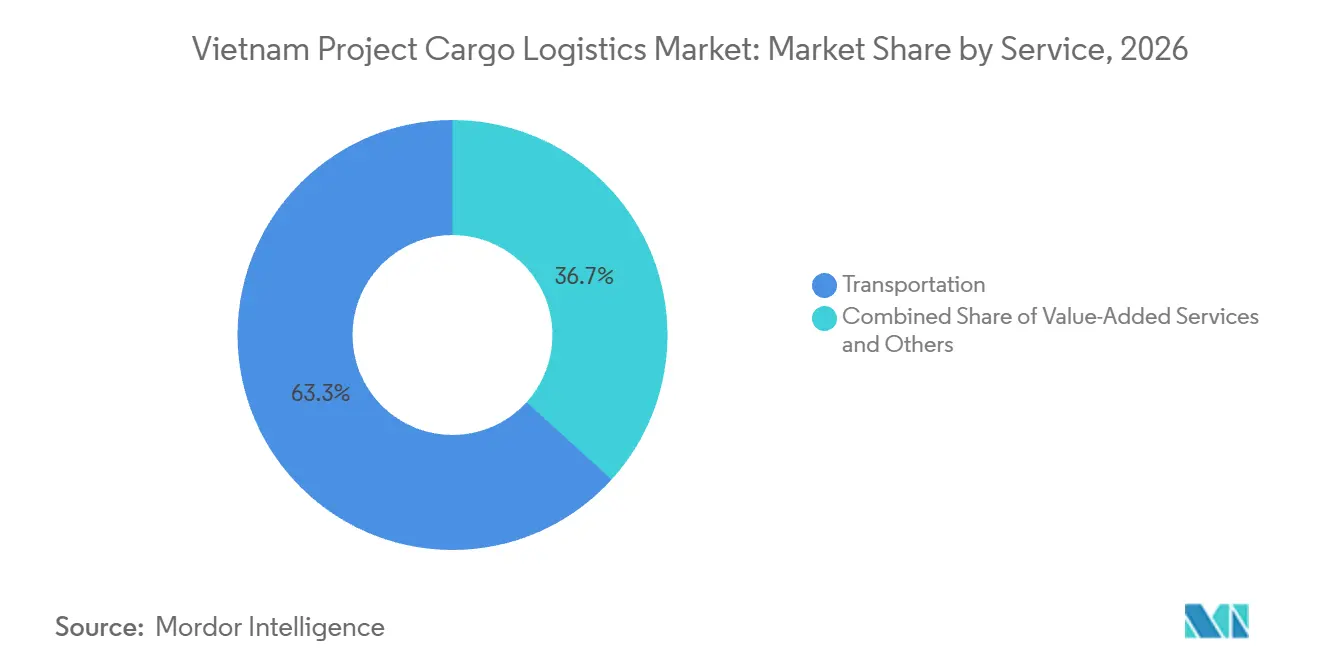
Transportation accounts for 63.27% of the Vietnam project cargo logistics market share in 2026. This segment covers the physical movement of oversized, heavy, or otherwise specialized cargo between manufacturing locations, ports, storage yards, and project sites. Ocean freight and inland waterways can be important for moving large structures and equipment, while specialized road transport is often required for the final delivery leg. Execution involves cargo securing, equipment selection, route assessment, permits, and coordination with loading and unloading teams. The segment's leading share reflects the central role of physical cargo movement within project logistics.
Value-added services & others are projected to register an 8.23% CAGR through 2032. This category includes services such as cargo engineering, route surveys, lifting plans, project coordination, temporary storage, and specialized handling. Engineering, procurement, and construction contractors may benefit from coordinating these activities through a single logistics provider. In July 2026, Portcoast reported deploying a digital twin for the Cai Mep–Thi Vai port system, providing an example of how digital tools can support port planning and operational coordination.

By Cargo Type: Oversized / Out-of-Gauge Cargo Leads While Heavy-Lift Cargo Grows
Oversized / out-of-gauge cargo accounts for 43.87% of the Vietnam project cargo logistics market size in 2026. This category includes equipment and structures whose dimensions exceed standard container limits, such as wind turbine blades, transformers, industrial machinery, and large prefabricated modules. Depending on the shipment, movement may require specialized trailers, cargo securing, escorts, route surveys, and temporary storage. Accurate measurements and load-distribution information are essential to selecting suitable transport equipment and confirming route feasibility. These operational requirements make oversized cargo a major component of project logistics demand.
Heavy-lift cargo is projected to register a 7.54% CAGR through 2032. This segment includes exceptionally heavy structures and equipment that require specialized lifting, load-out, or modular transport systems. In June 2025, PPL moved and loaded out an offshore substation topside weighing nearly 4,000 tons at Vung Tau, using 156 SPMT axle lines. The operation illustrates the engineering requirements associated with large energy-sector modules[3].
By End-User Industry: Manufacturing Anchors Demand While Energy Gains Momentum
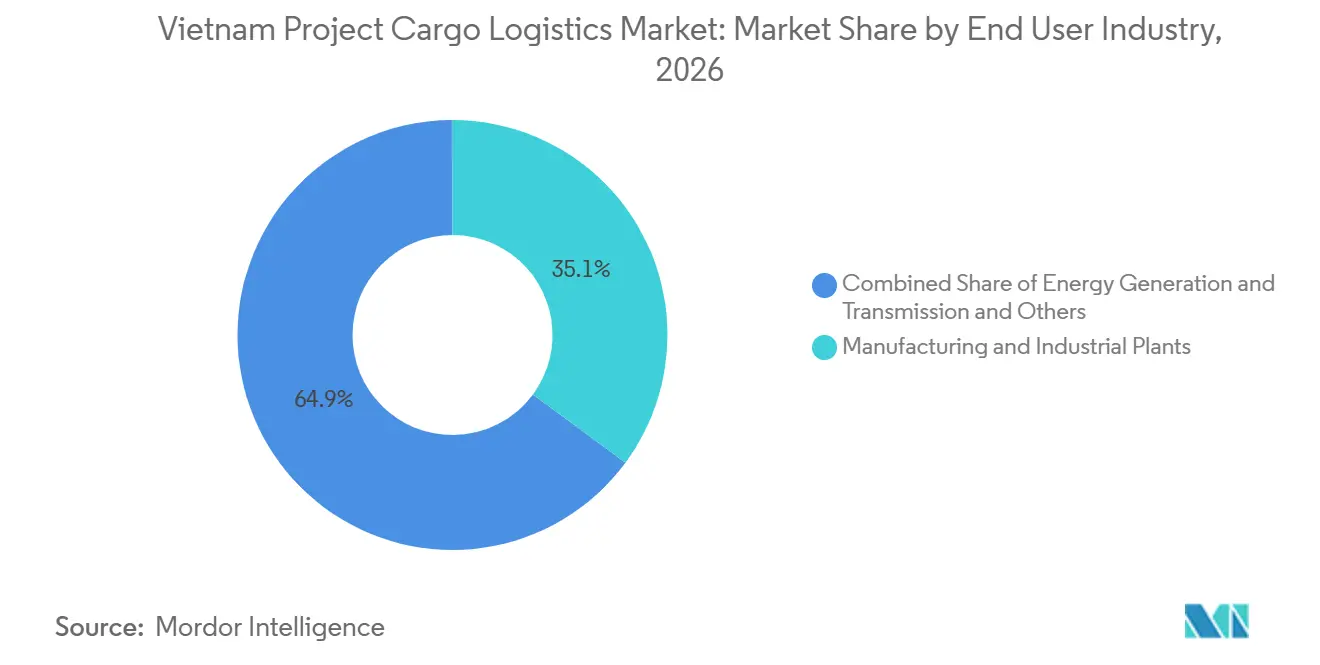
Manufacturing and industrial plants accounts for 35.13% of the Vietnam project cargo logistics market share in 2026. Manufacturing projects require the delivery of production machinery, processing equipment, factory modules, and supporting infrastructure. Electronics and other industrial investments can generate shipments that require protective handling and carefully planned final delivery to production facilities. Project schedules often depend on coordinating international transport with site readiness, installation contractors, and commissioning activities. These requirements support demand for logistics providers that can manage the movement from port or supplier to the final industrial location.
Energy generation and transmission, including renewable energy, is projected to register an 8.57% CAGR through 2032. The segment includes equipment for wind and solar projects, substations, transmission infrastructure, and other power-generation facilities. Such projects can require oversized components, heavy-lift operations, specialized trailers, and port-based staging. PPL's June 2025 offshore substation topside operation provides a documented example of the scale of equipment that may need to be handled. Construction and other infrastructure projects also generate demand for the movement of bridge components, industrial modules, and large machinery.
Geography Analysis
Southern Vietnam accounted for 42.49% of the market in 2026. The region benefits from the Cai Mep–Thi Vai deep-water port cluster, industrial facilities around Ho Chi Minh City and neighboring provinces, and established logistics links serving manufacturing and energy projects. Vung Tau also provides an important location for specialized offshore energy operations. In April 2026, Gemadept and CMA CGM began construction of Gemalink Deep-Sea Port Phase 2. The expansion is intended to raise the port's total capacity to more than 3 million TEUs annually once completed.
Northern Vietnam benefits from the port infrastructure around Hai Phong and its proximity to major manufacturing and electronics clusters. In June 2026, the Vietnam Government Portal reported that Hateco Hai Phong International Container Terminal had handled more than 800,000 TEUs during its first year of operation, with a target of 1.4 million TEUs for 2026. Industrial investment can generate demand for specialized equipment deliveries, but the scale and timing of project cargo movements depend on individual manufacturing projects and their procurement schedules.
Central Vietnam is projected to record the fastest regional growth, at an 8.46% CAGR through 2032. The region's potential is linked to port development, industrial investment, transport infrastructure, and prospective energy projects along the coast. These developments could strengthen the region’s role as a manufacturing and trade hub, creating greater demand for freight transport, warehousing, and distribution services. Improved connectivity between industrial zones, ports, and inland markets could also attract logistics investment and support more integrated supply chains
Competitive Landscape
The Vietnam project cargo logistics market is fragmented and includes domestic specialists, integrated logistics providers, port operators, and international freight-management companies. Domestic providers such as Vietranstimex and PPL are relevant to heavy transport and specialized cargo operations, while port and logistics groups provide complementary access to maritime infrastructure and inland distribution. International providers, including CEVA Logistics, DHL, DSV, Kuehne+Nagel, Maersk, Nippon Express, and Rhenus, offer international networks and broader freight-management capabilities.
In December 2025, CEVA Logistics announced an agreement to acquire 100% of Fagioli Group, a specialist in project logistics, heavy lifting, and specialized transport. CEVA completed the acquisition in March 2026 after the required approvals. Fagioli's engineering expertise and heavy-lift assets complement CEVA's project logistics operations and expand its ability to coordinate complex shipments. In July 2026, Vietnam Post Logistics and DSV Contract Logistics Vietnam renewed their B2B supply-chain partnership, providing a further example of cooperation between an international logistics network and a domestic operator.
Port infrastructure, engineering capability, and digital coordination are important areas of competition. In July 2026, Portcoast reported deploying a digital twin for the Cai Mep–Thi Vai port system[4]. In April 2026, Gemadept and CMA CGM started the second phase of Gemalink Deep-Sea Port. Providers seeking to differentiate themselves can focus on engineering capability, access to suitable handling facilities, project management, specialized equipment, and coordination across the transport chain.
Vietnam Project Cargo Logistics Industry Leaders
-
Vietranstimex Multimodal Transport Joint Stock Company
-
CJ Logistics
-
Transimex Corporation
-
deugro Vietnam
-
DSV
- *Disclaimer: Major Players sorted in no particular order
Recent Industry Developments
- July 2026: DSV Contract Logistics Vietnam and Vietnam Post Logistics signed a 3-year B2B supply-chain partnership renewal combining DSV's 80+ country global network with Vietnam Post Logistics' local execution capabilities, targeting mega-projects and new opportunities as high-technology manufacturing foreign direct investment accelerates.
- July 2026: DHL Supply Chain broke ground on the DHL North Logistics Campus in Hung Yen province, a Grade A facility spanning 82,500 m² with total investment of VND 1.9 trillion (USD 76 million) phase 1 targets completion in H1 2027, with Phase 2 in H2 2028. The campus integrates rooftop solar power and infrastructure for electric material-handling equipment.
- June 2026: CEVA Logistics launched a Hanoi-Chicago Boeing 777 freighter service 3 times weekly, with pickup across Hanoi, Da Nang, and Ho Chi Minh City for time-critical project and industrial cargo.
- April 2026: Gemadept and CMA CGM started construction of Gemalink Deep-sea Port Phase 2 with VND 6 trillion (USD 240 million) in investment. The project targets completion in the fourth quarter of 2027 and capacity above 3 million TEUs per year.
Vietnam Project Cargo Logistics Market Report Scope
| Transportation | Road |
| Rail | |
| Air | |
| Sea / Barge | |
| Warehousing, Distribution and Inventory Management | |
| Value-Added Services and Others |
| Oversized / Out-of-Gauge Cargo |
| Heavy-Lift Cargo |
| Breakbulk Project Cargo |
| Other Specialized Project Cargo |
| Oil and Gas, Mining and Quarrying |
| Energy Generation and Transmission (Includes Renewable Energy) |
| Construction and Infrastructure |
| Manufacturing and Industrial Plants |
| Aerospace and Defense |
| Others (Maritime and Shipbuilding, Telecommunications, etc.) |
| Northern Vietnam |
| Central Vietnam |
| Southern Vietnam |
| By Service | Transportation | Road |
| Rail | ||
| Air | ||
| Sea / Barge | ||
| Warehousing, Distribution and Inventory Management | ||
| Value-Added Services and Others | ||
| By Cargo Type | Oversized / Out-of-Gauge Cargo | |
| Heavy-Lift Cargo | ||
| Breakbulk Project Cargo | ||
| Other Specialized Project Cargo | ||
| By End-User Industry | Oil and Gas, Mining and Quarrying | |
| Energy Generation and Transmission (Includes Renewable Energy) | ||
| Construction and Infrastructure | ||
| Manufacturing and Industrial Plants | ||
| Aerospace and Defense | ||
| Others (Maritime and Shipbuilding, Telecommunications, etc.) | ||
| By Region | Northern Vietnam | |
| Central Vietnam | ||
| Southern Vietnam |
Key Questions Answered in the Report
What is the Vietnam project cargo logistics market size?
The market is valued at USD 3.53 billion in 2026 and is projected to reach USD 5.15 billion by 2032.
Which service is the largest in Vietnam project cargo logistics?
Transportation is the largest service segment, accounting for 63.27% of the market in 2026.
What is driving demand for project cargo services in Vietnam?
Manufacturing investment, renewable energy projects, port development, and transport infrastructure create demand for specialized cargo movement, route engineering, heavy-lift handling, and coordinated delivery.
Which cargo category is projected to grow the fastest?
Heavy-lift cargo is projected to record a 7.54% CAGR through 2032.
Which region has the strongest growth outlook?
Central Vietnam is projected to record the fastest regional growth, with an 8.46% CAGR through 2032.
What constraints affect project cargo execution in Vietnam?
Key constraints include access to specialized transport equipment and technical personnel, route limitations, permit coordination, and the availability of suitable port and staging infrastructure.