
Vietnam Ocean Freight Transport Market Size and Share
Market Overview
| Study Period | 2021 - 2032 |
|---|---|
| Forecast Data Period | 2027 - 2032 |
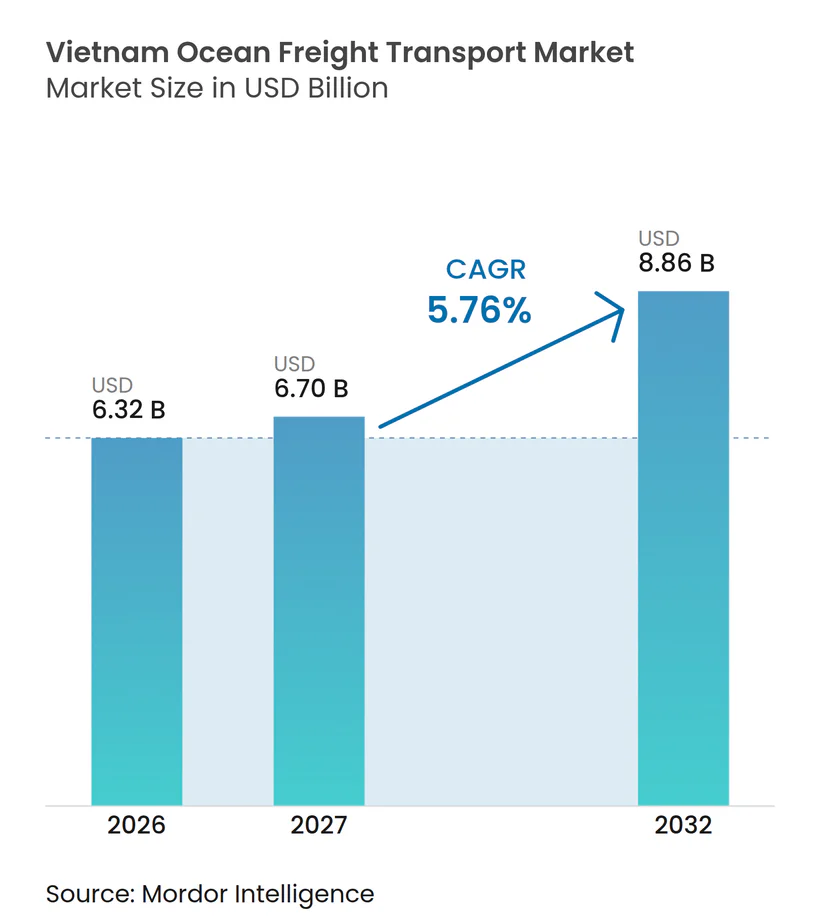
| Base Year Market Size (2026) | USD 6.32 Billion |
| Market Size (2027) | USD 6.70 Billion |
| Market Size (2032) | USD 8.86 Billion |
| Growth Rate (2027 - 2032) | 5.76 % |
| Market Concentration | Low |
Major Players *Disclaimer: Major Players sorted in no particular order Image © Mordor Intelligence. Reuse requires attribution under CC BY 4.0. | |
Vietnam Ocean Freight Transport Market Analysis by Mordor Intelligence
The Vietnam ocean freight transport market size is valued at USD 6.32 billion in 2026 and is estimated to grow from USD 6.70 billion in 2027 to reach USD 8.86 billion by 2032, at a CAGR of 5.76% during the forecast period from 2027 to 2032.
Trade and investment are increasing the volume of export cargo routed through Vietnam, while the country remains closely linked to regional component supply chains. Manufacturing relocation supports both inbound shipments of machinery and components and outbound shipments of finished goods, which raises two-way demand for container capacity. Port investment is also changing how carriers compete, because direct services and access to terminal capacity have become more important for serving large exporters. At the same time, fleet overcapacity and limited inland transport options can weaken freight rates and create delays between factories and ports.
Key Report Takeaways
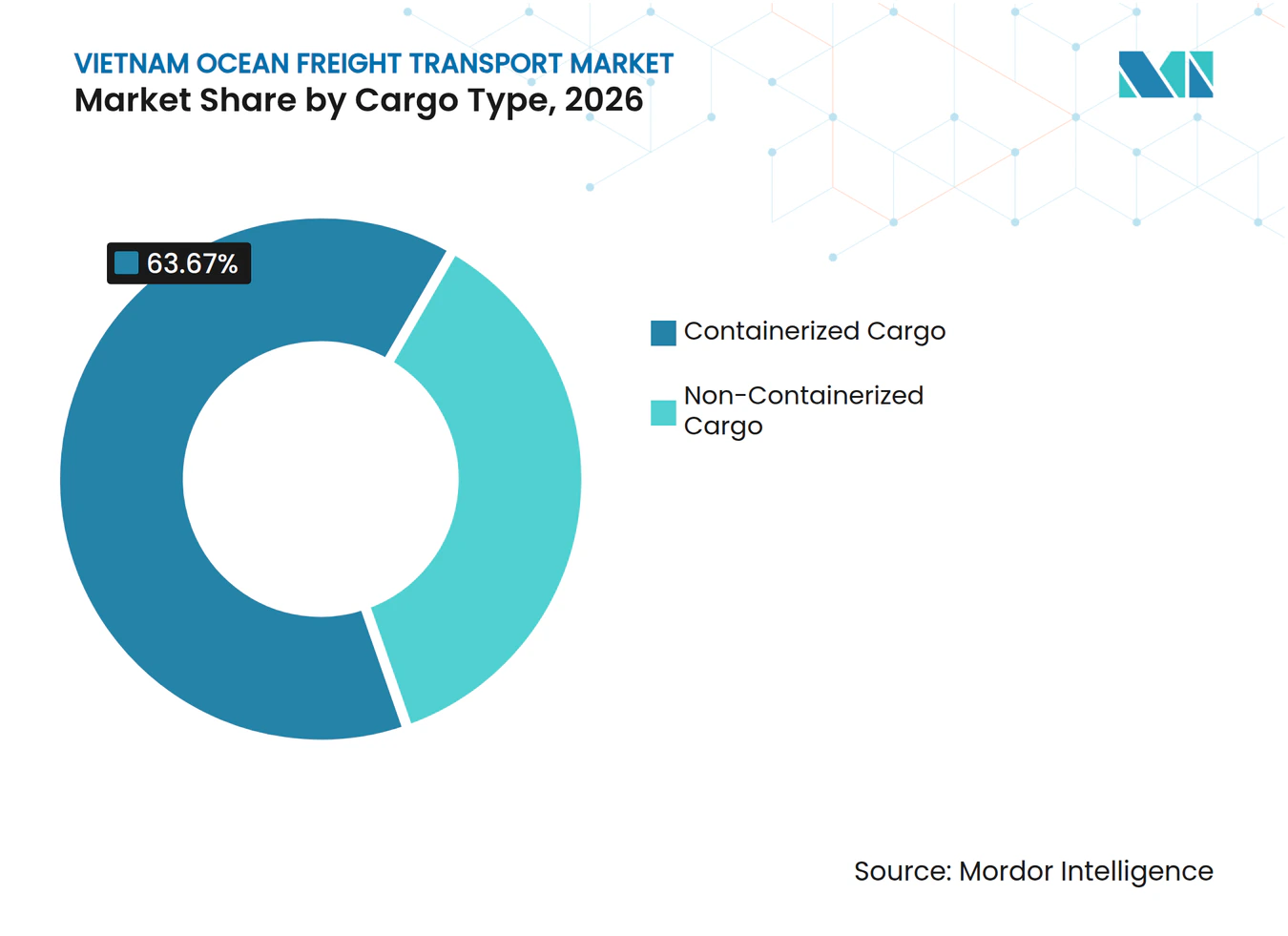
- By cargo type, containerized cargo accounts for 63.67% of the Vietnam ocean freight transport market share in 2026, while non-containerized cargo is forecast to register a CAGR of 6.34% through 2032.
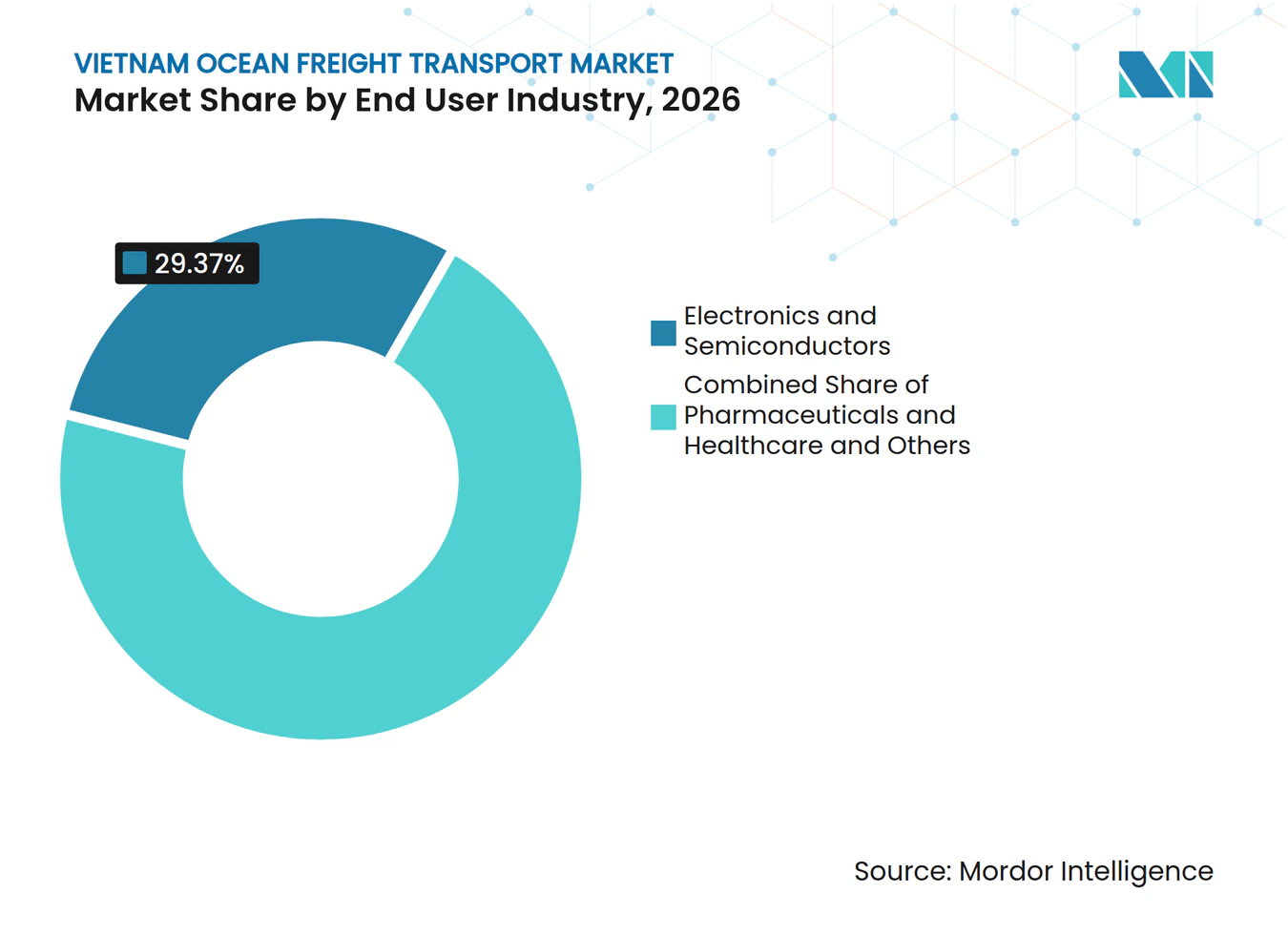
- By end-user industry, electronics and semiconductors account for 29.37% of the Vietnam ocean freight transport market size in 2026, while pharmaceuticals and healthcare are forecast to register a CAGR of 7.29% through 2031.
- By geography, Southern Vietnam accounts for 51.34% of the Vietnam ocean freight transport market share in 2026, while Northern Vietnam is forecast to register a CAGR of 7.53% through 2031.
Note: Market numbers in this report are based on Mordor Intelligence's proprietary estimation framework, which combines nine months of actuals with Q4 projections for base year 2026.
Vietnam Ocean Freight Transport Market Trends and Insights
Drivers Impact Analysis*
| Driver | (~) % Impact on CAGR Forecast | Geographic Relevance | Impact Timeline |
|---|---|---|---|
| Manufacturing Relocation Increasing Export-Oriented Cargo Volumes | +1.8% | Global, with primary gains in Northern and Southern Vietnam | Medium term (2–4 years) |
| Electronics Production Strengthening International Shipping Demand | +1.2% | Global; concentrated in Northern Vietnam (Bac Ninh–Hai Phong corridor) | Short term (≤ 2 years) |
| Deep-Water Port Expansion Increasing Vessel Handling Capacity | +0.7% | Southern Vietnam (Cai Mep–Thi Vai), Northern Vietnam (Lach Huyen) | Medium term (2–4 years) |
| Customs Digitalization Improving Cargo Clearance and Visibility | +0.5% | National, with early adoption in Hai Phong and Ho Chi Minh City | Short term (≤ 2 years) |
| Industrial Specialization Increasing Higher-Value Cargo Movements | +0.4% | Global | Long term (≥ 4 years) |
| Cold-Chain Growth Expanding Specialized Maritime Cargo Demand | +0.3% | APAC core, Southern Vietnam | Medium term (2–4 years) |
| Source: Mordor Intelligence | |||
Manufacturing Relocation Increasing Export-Oriented Cargo Volumes
The Vietnam ocean freight transport market is supported by the continued relocation of export manufacturing into Vietnam. Realized foreign direct investment disbursements reached USD 13.03 billion in the first half of 2026, the highest first-half level in 5 years[1]. New plants add exports of finished goods and inbound shipments of machinery, components, and production materials before export operations mature. The Federal Reserve reported that Chinese-owned firms moving production to Vietnam continued to source inputs through Chinese supply networks. This structure creates two-way container movement between Vietnam and regional supply centers, rather than demand based solely on final exports to the United States or Europe. Electronics, machinery, and textiles all depend on imported inputs before finished products leave Vietnamese ports, so shipping demand spans several stages of the manufacturing cycle.
Electronics Production Strengthening International Shipping Demand
Electronics production remains a major cargo source for the Vietnam ocean freight transport market. The shift from consumer-electronics assembly into higher-value semiconductor work raises the importance of dependable schedules, controlled handling, and direct connections to major destination markets. Foxconn's Shunsin subsidiary began trial integrated-circuit production in Bac Giang in June 2026, while another Foxconn facility in Quang Ninh was expected to begin operations later in 2026. These investments add cargo from equipment installation and components, as well as the finished semiconductor and electronics products that will later be exported. They also connect the growth of Hai Phong and Lach Huyen more closely to the manufacturing activity inland from the coast.
Deep-Water Port Expansion Increasing Vessel Handling Capacity
Port expansion is increasing the ability of the Vietnam ocean freight transport market to handle larger vessels and more direct calls. Gemadept and CMA CGM began Gemalink Phase 2 in April 2026, with VND 8.4 trillion (USD 336 million) in planned investment, 450 meters of additional quay, and total capacity above 3 million TEU by the fourth quarter of 2027[2]. The project expands yard space to 44 hectares and increases the port's ability to serve a larger volume of direct export calls. This investment matters because congestion can lead shippers to face uncertainty even when cargo demand and vessel schedules remain strong.
Customs Digitalization Improving Cargo Clearance and Visibility
Digital customs procedures can lower administrative friction across the Vietnam ocean freight transport market. The customs authority processed 75,897,137 dossiers electronically from January 1 through July 19, 2026, and 99.98% were submitted online. A centralized clearance model began at Hai Phong Regional Sub-Department III on June 1, 2026, allowing a declaration filed at one customs unit to be physically cleared at another port. This removes a geographic filing constraint for northern manufacturers whose production, administrative, and shipping locations may not be in the same area. It can be especially useful for exporters that need to align documentation with tight vessel cutoffs and regular factory dispatch schedules.
Restraints Impact Analysis*
| Restraint | (~) % Impact on CAGR Forecast | Geographic Relevance | Impact Timeline |
|---|---|---|---|
| Vessel Overcapacity Pressuring Freight Rates and Margins | -1.0% | Global | Short term (≤ 2 years) |
| Port-Hinterland Congestion Increasing Inland Transit Delays | -0.8% | Northern and Southern Vietnam | Medium term (2–4 years) |
| Container Imbalances Increasing Equipment Repositioning Costs | -0.5% | Global | Short term (≤ 2 years) |
| Inland Connectivity Gaps Limiting Port Network Efficiency | -0.4% | National, particularly the Red River Delta | Long term (≥ 4 years) |
| Source: Mordor Intelligence | |||
Vessel Overcapacity Pressuring Freight Rates and Margins
Global vessel capacity can limit revenue growth in the Vietnam ocean freight transport market even when cargo volumes rise. A large increase in container fleet capacity between 2023 and 2025 intensified supply on major east-west routes. Transpacific rates fell sharply during mid-2025 before recovering by July 2026. Carriers responded by using blank sailings to manage active capacity, but this action does not remove the underlying risk of excess tonnage. Volatile freight rates make it harder for ports, carriers, and logistics providers to plan investments and contracts. The effect is most visible for operators that depend on spot rates or leased vessel space rather than integrated terminal and network operations.
Port-Hinterland Congestion Increasing Inland Transit Delays
Port-side investment does not fully solve the inland transport limitations affecting the Vietnam ocean freight transport market. More than 98% of containers moving through Hai Phong are transported by road. The Bac Ninh-Bac Giang electronics corridor faces recurring pressure during peak shipment periods, which can make factory-to-vessel timing less predictable. Shippers may respond with additional inventory, longer buffers, or the use of alternative ports. These costs can reduce the value of faster terminal operations when inland connections do not keep pace.
*Our forecasts treat driver/restraint impacts as directional, not additive. The impact forecasts reflect baseline growth, mix effects, and variable interactions.
Segment Analysis
By Cargo Type: Containerization Supports Electronics-Led Trade
Containerized cargo accounts for 63.67% of the Vietnam ocean freight transport market share in 2026, supported by exports of electronics, furniture, garments, and footwear. Standard dry containers handle general export shipments, while refrigerated containers serve seafood and other temperature-sensitive goods. Vietnam’s container exports to the United States showed strong momentum from January through early August 2026, supported by sustained demand and consistently high weekly booking volumes. The extended period of elevated shipments indicates resilient trade flows and reinforces Vietnam’s growing importance as a manufacturing and export hub for the U.S. market. Growing volumes support demand for direct long-haul port calls, while Gemalink Phase 2 and additional Lach Huyen berths are expected to improve quay availability after 2027. In 2026, VASEP recommended developing a domestic refrigerated container fleet, highlighting continued reliance on foreign carriers for specialized equipment.
Non-containerized cargo is projected to register at a CAGR of 6.34% through 2031, supported by industrial diversification and demand for dry bulk, liquid bulk, breakbulk, and general cargo transportation. However, specialized project-cargo facilities and weak inland connections continue to constrain near-term efficiency. Improving port infrastructure and inland connectivity will be important to support the movement of these cargo types and accommodate evolving industrial freight requirements.



By End-User Industry: Electronics Leads While Healthcare Grows Fastest
Electronics and semiconductors account for 29.37% of the Vietnam ocean freight transport market size in 2026, supported by the country’s electronics manufacturing and export activity. Electronics producers depend on reliable sailing schedules because component imports and finished-goods exports often follow short production cycles. Vietnam’s electronics and semiconductor exports reached USD 107.75 billion in 2025. Given the high value of these shipments, service reliability and predictable terminal windows can be as important as freight rates, benefiting carriers with direct Vietnam services and consistent schedules.
Pharmaceuticals and healthcare are forecast to register at a CAGR of 7.29% through 2031, driven by demand for temperature-controlled transport, continuous monitoring, and cargo-handling processes that maintain product integrity beyond the port. GDP-compliant maritime logistics could support shipments between Vietnam and overseas markets. Other end-user segments also contribute to cargo demand. Chemicals and petrochemicals generate flows of resins, plastics, and solvents, alongside refinery-related exports, while food and beverage relies on refrigerated containers. Retail and e-commerce support consolidation and bonded warehousing, while automotive components, construction materials, and agricultural inputs help diversify cargo volumes during weaker electronics cycles.

Geography Analysis
Southern Vietnam accounts 51.34% share in 2026, supported by manufacturing concentration around Ho Chi Minh City and Ba Ria-Vung Tau. Cai Mep-Thi Vai can receive 24,000-TEU-class vessels on deep natural drafts. Vietnam approved the Can Gio International Transshipment Port on January 16, 2025, targeting 4.8 million TEU by 2030 and up to 16.9 million TEU by 2047[3]. Gemalink Phase 2 and the connected CMIT-TCTT berth add capacity in the same region.
Northern Vietnam is projected to register at a 7.53% CAGR through 2031, the fastest rate among the geographic areas in the Vietnam ocean freight transport market. Hai Phong and Lach Huyen serve manufacturers in the Bac Ninh and Bac Giang electronics corridor. Lach Huyen recorded strong volume momentum in early 2026, while Hai Phong’s substantial first-half throughput reinforces its position as a major maritime gateway in northern Vietnam. Together, these trends indicate rising trade activity and strengthening port capacity in the region. PSA Vietnam and LHF plan 4.5 million TEU of capacity across berths 9 through 12. Centralized clearance can further reduce procedural friction for eligible exporters.
Central Vietnam remains the smallest contributor in 2026 and relies mainly on feeder, bulk, and breakbulk cargo. Steel, machinery, and garment production provide its current cargo base. Much containerized cargo has historically moved through southern gateways, adding handling and transit time. Direct calls could gradually improve the region's freight economics if supporting transport infrastructure develops in parallel.
Competitive Landscape
Market Concentration
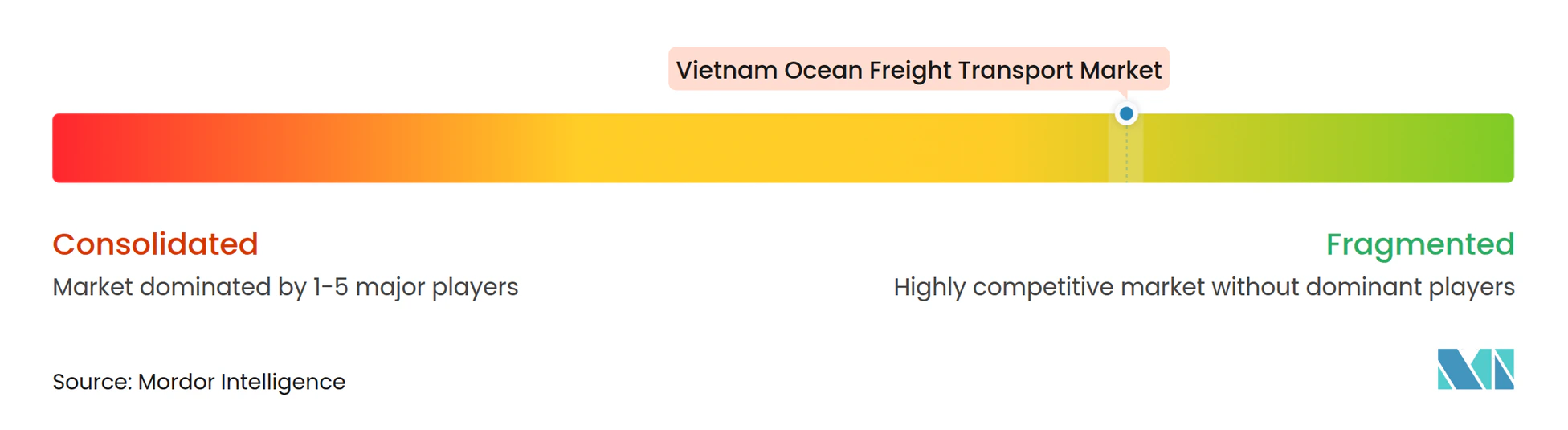
The Vietnam ocean freight transport market is fragmented among global mainline carriers and domestic port, logistics, and forwarding businesses. The Ocean Alliance, Gemini Cooperation, and Premier Alliance operate important transpacific and Asia-Europe capacity from Vietnam. Terminal access has become more important since the Maersk-MSC 2M alliance ended in February 2025. Carriers can use equity participation to improve access to berths during busy periods. CMA CGM operates 29 weekly services across 7 Vietnamese ports. Its Gemalink Phase 2 partnership and Mekong Transpacific Express demonstrate the link between terminal investment and network coverage.
VIMC, Gemadept, Hai An, and Viconship are broadening their roles across ports, shipping, and logistics. Gemadept's 2026 to 2030 strategy extends beyond terminals toward the maritime ecosystem. Hai An and Viconship established Hai An Green Shipping Lines in August 2025 for intra-Asia services using eco-friendly container vessels[4]. Viconship owns 60% of this venture, and Hai An owns 40%. Viconship also acquired a 65% stake in Harbour City Co. Ltd. in March 2026, strengthening its position near Hai Phong port activities.
Network quality, terminal access, equipment availability, and shipment visibility are central competitive factors. Maersk launched its TPX service from CMIT on June 16, 2026, using a Cai Mep-Busan-Long Beach rotation. Hai An's HACT subsidiary launched the CVI service in September 2026, linking Nansha, Hai Phong, Port Klang, and Chennai.
Vietnam Ocean Freight Transport Industry Leaders
-
Mediterranean Shipping Company (MSC)
-
A.P. Moller - Maersk
-
CMA CGM
-
Vietnam Maritime Corporation (VIMC)
-
Gemadept Corporation
- *Disclaimer: Major Players sorted in no particular order
Recent Industry Developments
- October 2026: CMIT and TCTT launched commercial operations at their interconnected 1,200-meter berth, improving operational flexibility for berth planning and large-vessel handling.
- September 2026: Hai An Transport subsidiary HACT launched the CVI service, Vietnam's first carrier-operated direct connection linking Nansha, Hai Phong, Port Klang, and Chennai via M/V HAIAN BETA with 1,781 TEU.
- May 2026: ZIM launched the ZXB trans-Pacific service at HTIT Hai Phong, connecting Vietnam directly with United States East Coast ports using the LNG-powered ZIM MOUNT RAINIER with 15,124 TEU.
- May 2026: CMA CGM launched the Mekong Transpacific Express, with the maiden voyage of APL DANUBE, as a dedicated weekly Vietnam-United States West Coast service.
Vietnam Ocean Freight Transport Market Report Scope
| Containerized Cargo | Dry |
| Reefer | |
| Non-Containerized Cargo | Dry Bulk Cargo |
| Liquid Bulk Cargo | |
| Breakbulk and General Cargo |
| Electronics and Semiconductors |
| Chemicals and Petrochemicals |
| Food and Beverage |
| Pharmaceuticals and Healthcare |
| Retail and E-commerce |
| Others |
| Northern Vietnam |
| Central Vietnam |
| Southern Vietnam |
| By Cargo Type | Containerized Cargo | Dry |
| Reefer | ||
| Non-Containerized Cargo | Dry Bulk Cargo | |
| Liquid Bulk Cargo | ||
| Breakbulk and General Cargo | ||
| By End-User Industry | Electronics and Semiconductors | |
| Chemicals and Petrochemicals | ||
| Food and Beverage | ||
| Pharmaceuticals and Healthcare | ||
| Retail and E-commerce | ||
| Others | ||
| By Region | Northern Vietnam | |
| Central Vietnam | ||
| Southern Vietnam | ||
Key Questions Answered in the Report
What is the forecast growth rate for ocean freight transport in Vietnam?
The Vietnam ocean freight transport market is forecast to register at a 5.76% CAGR from 2027 to 2032, reaching USD 8.86 billion by 2032.
Which cargo type has the largest share in Vietnam?
Containerized cargo held 63.67% in 2026, supported by electronics, furniture, garments, and footwear exports.
Which end-user segment is expanding fastest?
Pharmaceuticals and healthcare are projected to register at a 7.29% CAGR through 2031, supported by temperature-controlled shipping needs.
Which Vietnamese region leads ocean freight activity?
Southern Vietnam held 51.34% in 2026, supported by Cai Mep-Thi Vai and the Ho Chi Minh City and Ba Ria-Vung Tau industrial belt.
Why is Northern Vietnam growing faster than other regions?
Northern Vietnam is forecast to register at a 7.53% CAGR through 2031 because of electronics production around Bac Ninh, Bac Giang, Hai Phong, and Lach Huyen.
What factors constrain maritime freight growth in Vietnam?
Vessel overcapacity can pressure freight rates, while road dependence around Hai Phong can delay the movement of containers from factories to ports.