
Vietnam Cross-Border B2C E-commerce Logistics Market Size and Share
Market Overview
| Study Period | 2020 - 2031 |
|---|---|
| Forecast Data Period | 2026 - 2031 |
| Base Year Market Size (2025) | USD 124.74 Million |
| Market Size (2026) | USD 153.63 Million |
| Market Size (2031) | USD 368.45 Million |
| Growth Rate (2026 - 2031) | 19.12 % |
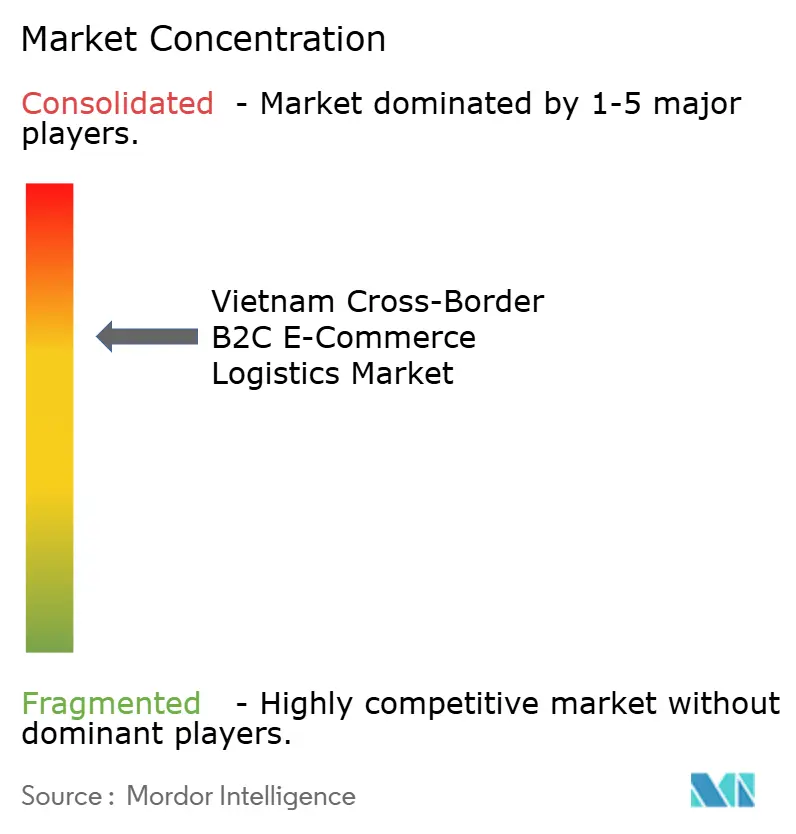
| Market Concentration | Medium |
Major Players *Disclaimer: Major Players sorted in no particular order Image © Mordor Intelligence. Reuse requires attribution under CC BY 4.0. | |
Vietnam Cross-Border B2C E-commerce Logistics Market Analysis by Mordor Intelligence
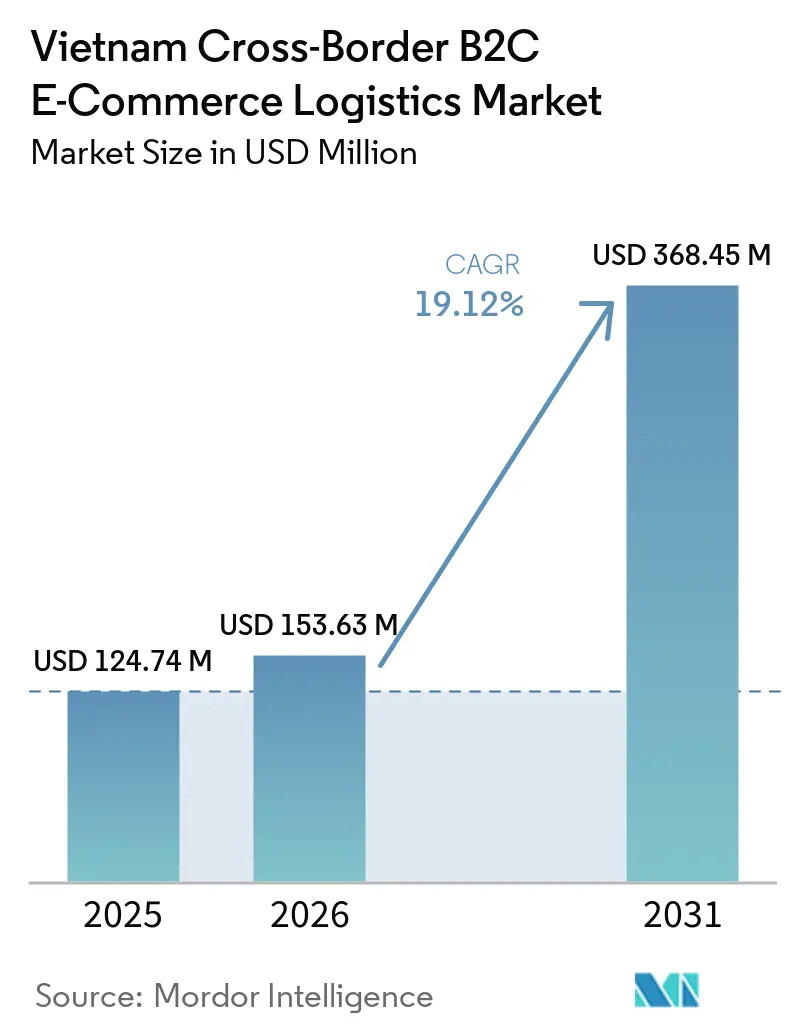
The Vietnam Cross-Border B2C E-commerce Logistics Market was valued at USD 124.74 million in 2025 and is estimated to grow from USD 153.63 million in 2026 to reach USD 368.45 million by 2031, at a CAGR of 19.12% during the forecast period 2026 to 2031.
Vietnam’s cross-border B2C e-commerce logistics market is currently experiencing rapid expansion, driven by soaring internet penetration, a burgeoning middle class with rising disposable incomes, and the widespread adoption of social commerce formats such as livestreaming. Imports from China dominate the market due to proximity and competitive pricing, while major platforms like Shopee and Lazada drive accessibility through robust logistics networks and customer protection policies. However, the sector faces challenges, including complex regulatory compliance requirements, fragmented logistics infrastructure, and consumer concerns about data security. Looking ahead, the market is poised for sustained growth driven by continued digital transformation, advancements in AI and blockchain for supply chain transparency, and expanding mobile payment adoption. Government initiatives supporting the National Digital Transformation Program and new e-commerce decrees are expected to streamline customs procedures and enhance consumer protection.
Key Report Takeaways
- By delivery speed, standard services accounted for 70.01 % of the Vietnam Cross-Border B2C E-commerce Logistics Market size in 2025, while express delivery is advancing at a 22.15% CAGR through 2031.
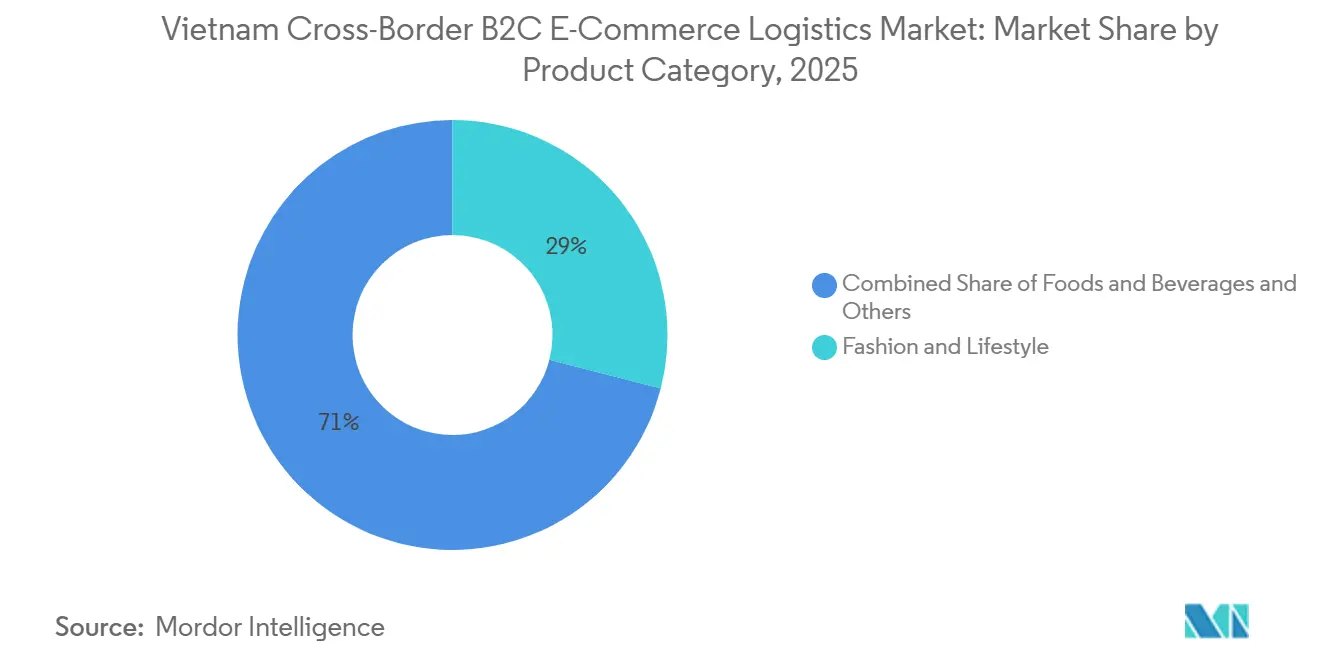
- By product category, fashion and lifestyle led with 29% revenue share in 2025, while foods and beverages are forecast to expand at a 20.11% CAGR to 2031.
- By logistics function, transportation held 57.46% of the Vietnam Cross-Border B2C E-commerce Logistics Market share in 2025, while warehousing, distribution, and inventory management recorded the highest projected CAGR at 24.29% through 2031.
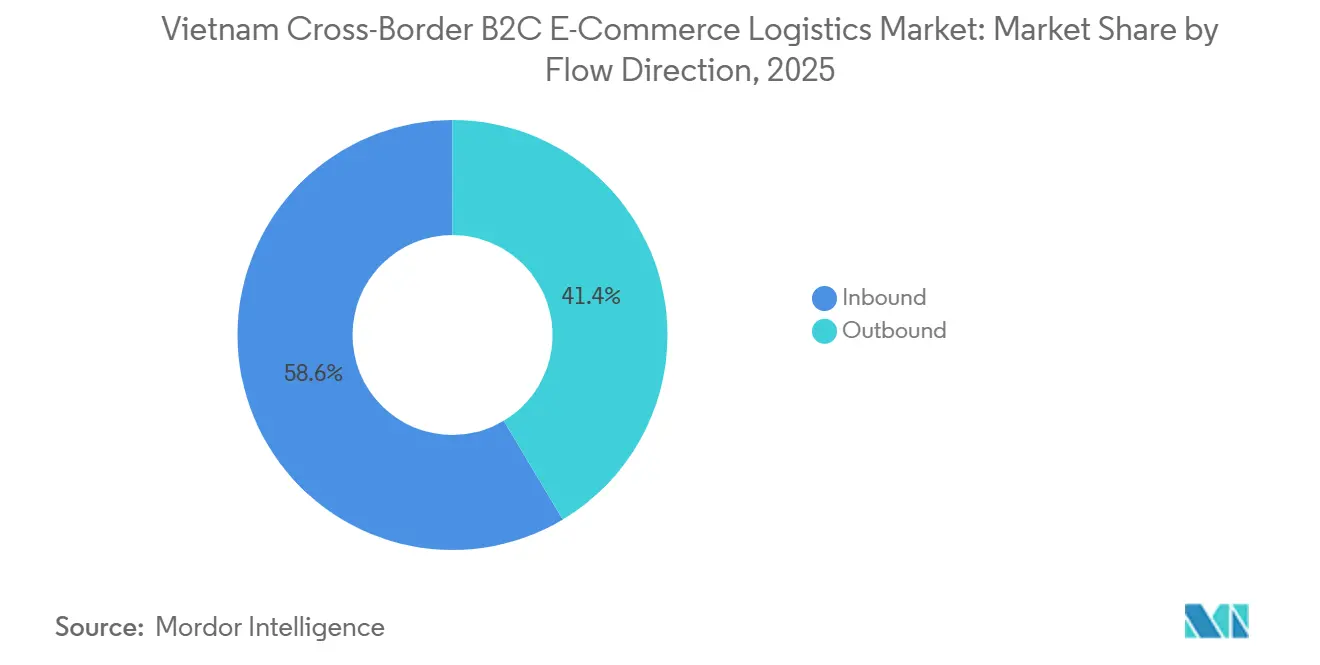
- By flow direction, inbound accounted for 58.58% share of the Vietnam Cross-Border B2C E-commerce Logistics Market size in 2025, while outbound is projected to grow at a 20.11% CAGR through 2031.
Note: Market size and forecast figures in this report are generated using Mordor Intelligence’s proprietary estimation framework, updated with the latest available data and insights as of January 2026.
Vietnam Cross-Border B2C E-commerce Logistics Market Trends and Insights
Drivers Impact Analysis*
| Driver | (~) % Impact on CAGR Forecast | Geographic Relevance | Impact Timeline |
|---|---|---|---|
| Rapid Expansion Of Vietnam Online Retail Demand | +4.8% | National, with a concentration in Ho Chi Minh City and Hanoi | Short term (≤ 2 years) |
| FTA-Led And ASEAN-Enabled Trade Corridor Expansion | +3.2% | ASEAN core, with spillover to Northeast Asia and Europe | Medium term (2-4 years) |
| Bonded Warehousing And Fulfillment Investment Near Gateways | +2.4% | Northern corridor and Southern corridor | Medium term (2-4 years) |
| Rising Willingness To Pay For Faster Cross-Border Delivery | +2.6% | National, with early traction in Ho Chi Minh City and Hanoi | Short term (≤ 2 years) |
| NSW And ASW Customs Data Integration | +2.0% | National, with primary gains at major air gateways | Medium term (2-4 years) |
| Reallocation Of E-Commerce Air Capacity Into Southeast Asia | +2.5% | Global, with direct impact on Vietnam’s main cargo airports | Short term (≤ 2 years) to Medium term (2-4 years) |
| Source: Mordor Intelligence | |||
Rapid Expansion of Vietnam Online Retail Demand
The Vietnam Cross-Border B2C E-commerce Logistics Market benefits from both sides of that flow, because Vietnamese consumers are buying more from foreign sellers while local SMEs are using digital channels to sell abroad. That dual movement increases parcel volumes, customs touchpoints, return handling, and fulfillment complexity faster than order counts alone would suggest. It also moves the value pool away from stand-alone delivery toward providers that can manage warehouse-to-door visibility and cross-border service coordination. As this demand base broadens, the Vietnam Cross-Border B2C E-commerce Logistics Market becomes less dependent on a single category or corridor and more reliant on service reliability across multiple use cases.
FTA-Led and ASEAN-Enabled Trade Corridor Expansion
Vietnam’s trade corridors are supported by major agreements such as RCEP, CPTPP, EVFTA, and ASEAN frameworks, which lower tariff friction and make cross-border movement more predictable for shippers and marketplaces. The Greater Mekong Subregion Cross-Border Transport Facilitation Agreement route linked China to the Long Bien Inland Container Depot in May 2025, widening practical routing options for inbound parcels and outbound goods moving through northern Vietnam. In the Vietnam Cross-Border B2C E-commerce Logistics Market, this matters because corridor growth also increases documentation requirements, which favor operators with integrated customs and brokerage capabilities. The same FTAs that expand trade are also lifting the operational premium on compliance-ready logistics services, especially for sellers moving through multiple destination markets.
NSW and ASW Customs Data Integration
The National Single Window and the ASEAN Single Window have already reduced transit times and broadened electronic document exchange across ASEAN, supporting faster customs processing for regional trade flows[1]. Vietnam is moving toward a Digital Customs System, scheduled to replace the legacy platform by December 31, 2026, which will create a more centralized, real-time operating environment for declarations and risk management. In the Vietnam Cross-Border B2C E-commerce Logistics Market, this shift favors carriers and fulfillment players that already run API-ready customs workflows and structured shipment data. Faster clearance matters more in B2C cross-border logistics because marketplace service levels are closely tied to delivery timing and exception handling. The result is a market where customs digitization not only removes friction but also raises the competitive threshold for participation.
Reallocation of E-Commerce Air Capacity into Southeast Asia
Air corridor development is becoming more relevant to the Vietnam Cross-Border B2C E-commerce Logistics Market as exporters push more time-sensitive parcels into international routes. CMA CGM Air Cargo launched a dedicated freighter route connecting Hanoi to France in 2025, adding direct capacity for high-priority shipments moving to Europe[2]. Vietnam Airlines also confirmed plans for a dedicated cargo airline in 2026, which would add capacity to a system that has long faced cargo bottlenecks on outbound lanes. Long Thanh International Airport entered service in December 2025 with a first-phase cargo capacity of 1.2 million tons per year, expanding the gateway's capacity available to the Vietnam Cross-Border B2C E-commerce Logistics Market. As more air capacity is allocated through Vietnam, faster fulfillment becomes easier to offer across outbound export lanes and premium inbound services.
Restraints Impact Analysis*
| Restraint | (~) % Impact on CAGR Forecast | Geographic Relevance | Impact Timeline |
|---|---|---|---|
| VAT And Low-Value Import Tax Tightening | -1.5% | National, with the highest impact on inbound consumer-goods parcels via express delivery | Short term (≤ 2 years) |
| Fragmented Infrastructure And Customs Complexity | -1.8% | National, with bottlenecks concentrated at northern border gates and secondary airports | Medium term (2-4 years) |
| Express-Speed Economics And Emissions Pressure | -1.0% | Global, with rising compliance pressure on Europe and North America export corridors | Long term (≥ 4 years) |
| Data Fragmentation Across Logistics Systems | -0.8% | National, especially for multimodal cross-border operators | Medium term (2-4 years) |
| Source: Mordor Intelligence | |||
VAT and Low-Value Import Tax Tightening
Vietnam tightened the tax treatment of low-value imports in 2025, ending the old VAT exemption for imported goods under VND 1 million (USD 38) delivered through express services, and it also moved e-commerce platform operators toward VAT withholding at the point of transaction confirmation[3]. In the Vietnam Cross-Border B2C E-commerce Logistics Market, this directly affects inbound parcel economics, as low-ticket shipments have less room to absorb additional compliance costs. Operators must now handle declarations and tax treatment with more accuracy, which raises the processing burden per parcel and weakens the low-value import model that drove earlier volume growth. This also narrows the benefit of scale for players that relied mainly on dense, low-ticket inbound traffic. Providers with automated tax and customs workflows are better placed to preserve margins than operators that still depend on manual intervention.
Fragmented Infrastructure and Customs Complexity
Vietnam’s logistics cost-to-GDP ratio remained at 16% to 18%, against a global average of 10% to 12%, indicating that structural inefficiencies remain a real drag on service consistency. The Vietnam Cross-Border B2C E-commerce Logistics Market is especially exposed because cross-border B2C shipments depend on predictable handoffs across borders, airports, warehouses, and last-mile nodes. Congestion at northern border gates and uneven investment across secondary nodes create variability that is hard to reconcile with premium delivery promises. The Bac Giang International Logistics Center also faced land-clearance issues in 2026, underscoring how execution delays can slow capacity additions even as demand rises. Until infrastructure and customs workflows become more even across corridors, the Vietnam Cross-Border B2C E-commerce Logistics Market will continue to reward operators that can buffer delays through network depth and data visibility.
*Our forecasts treat driver/restraint impacts as directional, not additive. The impact forecasts reflect baseline growth, mix effects, and variable interactions.
Segment Analysis
By Product Category: Fashion Anchors Share While Food-Agri Corridors Reshape Growth
Fashion and lifestyle accounted for 29% of the Vietnam Cross-Border B2C E-commerce Logistics Market share in 2025, making it the largest product segment in the category mix. That position reflects Vietnam’s deep apparel and footwear base, which supports both inbound flows from international brands and outbound shipments from local producers. The segment benefits from repeat ordering patterns, light parcel formats, and a large seller base that fits marketplace-led cross-border trade.
Foods and beverages are projected to expand at a 20.11% CAGR through 2031, making it the fastest-growing product line in the Vietnam Cross-Border B2C E-commerce Logistics Market. Growth in that segment is tied to premium agri-food exports moving through digital channels, especially seafood, coffee, specialty rice, and tropical fruit formats that need better cold-chain handling. This trend is driving demand for temperature-controlled storage, compliant packaging, and faster international shipping solutions to preserve product quality. It also reflects increasing alignment between e-commerce platforms and exporters to enable direct-to-consumer cross-border sales. As a result, logistics providers are scaling specialized cold chain capabilities and end-to-end visibility solutions to support perishable product flows.

By Logistics Function: Transport Leads but Warehousing Commands the Growth Premium
Transportation accounted for 57.46% of the Vietnam Cross-Border B2C E-commerce Logistics Market size in 2025, making it the largest logistics function by revenue contribution. That position is expected because every cross-border shipment still depends first on movement across road, air, rail, or sea links. Road remains central on China-Vietnam and intra-ASEAN movements, while air carries the time-sensitive and higher-value portion of the flow.
Warehousing, distribution, and inventory management are forecast to expand at a 24.29% CAGR through 2031, which is the fastest pace among logistics functions in the Vietnam Cross-Border B2C E-commerce Logistics Market. The growth gap shows that cross-border fulfillment is moving from pass-through handling to inventory positioning near customs gateways. This shift is enabling faster last-mile delivery timelines and reducing cross-border transit uncertainties. It also reflects increasing investments in bonded warehousing, localized fulfillment centers, and technology-driven inventory optimization to support rising e-commerce volumes. As a result, logistics providers are transitioning toward integrated, value-added service models rather than pure transportation offerings
By Delivery Speed: Standard Holds the Volume Base, Express Claims the Value Premium
Standard delivery accounted for 70.01% of the Vietnam Cross-Border B2C E-commerce Logistics Market size in 2025. It remained the dominant option, as cost still matters more than speed for a large share of marketplace-driven orders. Much of that scale comes from highly consolidated China-Vietnam parcel networks, where 7 to 15-day delivery is still acceptable for low-ticket goods.
Express delivery is projected to grow at a 22.15% CAGR through 2031, which shows that the premium tier is expanding faster than the volume tier. In the Vietnam Cross-Border B2C E-commerce Logistics Market, that shift is tied to urban buyer expectations, seller pressure to protect ratings, and platform rules that increasingly connect seller visibility with fulfillment performance. Faster service is also becoming increasingly valuable for outbound SMEs competing in export marketplaces, where delivery timing affects conversion and repeat orders. This is driving higher adoption of priority shipping lanes, air freight capacity, and integrated express networks. As a result, logistics providers are repositioning their offerings toward time-definite, trackable services with stronger last-mile coordination and delivery reliability.
By Flow Direction: Imports Lead Volume, Exports Drive the Value Narrative
Inbound shipments accounted for 58.58% of the Vietnam Cross-Border B2C E-commerce Logistics Market share in 2025, making imports the largest flow direction by value. That lead reflects strong Vietnamese demand for goods from China, South Korea, and Japan, especially in electronics, beauty products, fashion, and household goods. It also reflects the fact that local e-commerce infrastructure has been more developed for imports than for export-oriented SME fulfillment. Tax tightening on low-value imported parcels adds friction mainly on the inbound side, meaning the largest flow direction now faces more policy pressure than before.
Outbound is projected to grow at a 20.11% CAGR through 2031, making exports the fastest-growing segment of the Vietnam Cross-Border B2C E-commerce Logistics Market. Fashion, furniture, handicrafts, and processed food are the most visible export categories across the United States, Europe, Japan, South Korea, and ASEAN. Viettel Post’s stated Go Global push, together with new regional partnerships and corridor development, shows that domestic operators are starting to build export-oriented assets rather than leaving most outbound complexity to global integrators.
Geography Analysis
Asia-Pacific is the largest corridor for the Vietnam Cross-Border B2C E-commerce Logistics Market, as Vietnam sits within the China-ASEAN trade axis and remains closely linked to Northeast Asian sourcing and demand. Inbound flows from China are the largest within that regional system, while outbound ASEAN movements benefit from low tariff treatment under ASEAN arrangements.
North America is the highest-value outbound route group for the Vietnam Cross-Border B2C E-commerce Logistics Market, even though it is not the largest by shipment count. Demand from the United States supports export lanes for fashion, furniture, and consumer products that carry higher basket values than many regional parcels. Maersk introduced its Seasonal Transpacific Loader Service from Vung Tau to the United States West Coast in 2026, which added peak-season ocean capacity for Vietnamese exporters. The FedEx and Viettel Post partnership also strengthens access to North America by combining domestic collection and warehouse coordination in Vietnam with long-haul freight and destination delivery capability abroad.
The Middle East and Africa corridor is smaller today, but it is becoming more relevant for food, fashion, and consumer exports as Gulf-linked air connections expand the market reach. Aramex Vietnam is well-positioned to benefit from that development, as its network is already well-suited to Gulf-market distribution. South America remains a newer opportunity and is still long-dated within the Vietnam Cross-Border B2C E-commerce Logistics Market. Brazil is the most visible destination in that group, especially for selected handicraft and agri-food exports sold through international platforms.
Competitive Landscape
The Vietnam Cross-Border B2C E-commerce Logistics Market is moderately consolidated. Global integrators remain strongest in premium service tiers because they offer broader multimodal networks, stronger customs capability, and deeper enterprise account coverage. Chinese specialists compete more aggressively in platform-driven inbound traffic because they operate dense consolidation models and lower-cost routing on high-volume parcel lanes. Domestic operators are moving beyond parcel delivery into broader platform logistics, intensifying competition in Vietnam's cross-border B2C e-commerce logistics market. The result is a field where no single player dominates every corridor, every customer type, or every service layer.
Strategic moves in 2025 and 2026 are reshaping the market. FedEx named Viettel Post as its National Network Provider in Vietnam in April 2026, expanding the partnership's scope to include pickup, delivery, warehousing, and customs coordination, and demonstrating how foreign and domestic networks are being combined to expand reach[4]. J&T Global Express and SF Holding also announced a strategic cross-shareholding in January 2026, which linked J&T’s Southeast Asian ground strength with SF’s air freight and premium express capabilities. Boxme Global launched OMS 2.0 in March 2026, which strengthened multi-channel order management and API integration for cross-border B2C fulfillment. These moves show that competition is no longer centered only on line-haul scale, because software, integration, and service design now matter just as much.
Infrastructure positioning is becoming another decisive factor in the Vietnam Cross-Border B2C E-commerce Logistics Market. Maersk’s bonded warehouse move in northern Vietnam established a strong fulfillment template near customs gateways, while newer cold-chain and off-airport projects are widening the usable infrastructure base for export categories that need more controlled handling. At the same time, the coming Digital Customs System is likely to favor incumbents and better-funded challengers that already have structured data workflows and integration capability. White space persists in outbound SME fulfillment, especially for providers that can combine bonded storage, brokerage, platform integration, and last-mile coordination into a single export-ready service. Smaller operators can still find room in corridor niches or category-specific handling, but broad-based competition is moving toward capital depth, automation, and compliance readiness. That keeps the Vietnam Cross-Border B2C E-commerce Logistics Market structurally fragmented while still pushing concentration upward within the most demanding service tiers.
Vietnam Cross-Border B2C E-commerce Logistics Industry Leaders
-
Viettel Post
-
VNPost EMS
-
SF Express Vietnam
-
J&T Express Vietnam
-
GHTK (Giao Hang Tiet Kiem)
- *Disclaimer: Major Players sorted in no particular order
Recent Industry Developments
- April 2026: CJ Logistics announced the full acquisition of the remaining 49.1% stake in CJ Gemadept Logistics Holding, gaining 100% control of its Vietnam 3PL contract logistics operations, while simultaneously transferring its 49% stake in CJ Gemadept Shipping Holding back to Gemadept.
- April 2026: FedEx forged a strategic alliance with Viettel Post, appointing the latter as its National Network Provider in Vietnam. Under this partnership, Viettel Post will oversee comprehensive services, including pickup, delivery, warehousing, and customs clearance. Together, they aim to handle close to 2 million shipments each year, amounting to over 26,000 tons, linking Vietnam to over 220 global markets.
- April 2026: Viettel Post signed an MOU with Thailand Post and LEO Global Logistics to expand cross-border services to Southeast Asian countries and China, advancing the company's "Go Global" strategy with operational legal entities already established across Cambodia, Laos, Myanmar, and China.
- March 2026: DHL Express renewed its partnership agreement with Vietnam Post, deepening cooperation on international delivery services for Vietnamese businesses and expanding access to DHL's global network for domestic shippers.
Vietnam Cross-Border B2C E-commerce Logistics Market Report Scope
| Foods and Beverages |
| Personal and Household Care |
| Fashion and Lifestyle (Accessories, Apparel, Footwear) |
| Furniture |
| Consumer Electronics and Household Appliances |
| Other Products |
| Transportation | Road |
| Air | |
| Sea and Inland Waterways | |
| Rail | |
| Warehousing, Distribution and Inventory Management | |
| Value-added Services and Others |
| Express |
| Standard |
| Outbound (Exports) | North America |
| Europe | |
| Asia-Pacific | |
| Middle East and Africa | |
| South America | |
| Inbound (Imports) | North America |
| Europe | |
| Asia-Pacific | |
| Middle East and Africa | |
| South America |
| By Product Category | Foods and Beverages | |
| Personal and Household Care | ||
| Fashion and Lifestyle (Accessories, Apparel, Footwear) | ||
| Furniture | ||
| Consumer Electronics and Household Appliances | ||
| Other Products | ||
| By Logistics Function | Transportation | Road |
| Air | ||
| Sea and Inland Waterways | ||
| Rail | ||
| Warehousing, Distribution and Inventory Management | ||
| Value-added Services and Others | ||
| By Delivery Speed | Express | |
| Standard | ||
| By Flow Direction | Outbound (Exports) | North America |
| Europe | ||
| Asia-Pacific | ||
| Middle East and Africa | ||
| South America | ||
| Inbound (Imports) | North America | |
| Europe | ||
| Asia-Pacific | ||
| Middle East and Africa | ||
| South America | ||
Key Questions Answered in the Report
What is driving growth in cross-border B2C e-commerce logistics in Vietnam through 2031?
Rising online trade volumes are supporting growth, with the cross-border B2C e-commerce value of USD 124.74 million in 2025, stronger policy support, and continued investment in warehousing, customs digitization, and export corridors.
How large is Vietnam cross-border B2C e-commerce logistics expected to become by 2031?
The sector is projected to reach USD 368.45 million by 2031, up from USD 153.63 million in 2026, with a forecast CAGR of 19.12%.
Which logistics function is growing the fastest in Vietnam’s cross-border B2C online trade flows?
Warehousing, distribution, and inventory management is the fastest-growing function, with a projected CAGR of 24.29% through 2031, even though transportation remained the largest function in 2025.
Why does Standard delivery still lead if Express is growing faster?
Standard delivery held a 70.01% share in 2025 because price-sensitive parcel flows still dominate, while Express is growing faster at a 22.15% CAGR as buyers and exporters place greater value on speed and service reliability.
Which product categories matter most in Vietnam’s cross-border parcel flows?
Fashion and lifestyle led with a 29% share in 2025, while foods and beverages is the fastest-growing category, with a 20.11% CAGR, as premium agri-food exports increasingly require cold-chain and export-ready fulfillment.
Is Vietnam more import-led or export-led in cross-border B2C logistics?
The current structure is still import-led, with inbound holding 58.58% share in 2025, but outbound is growing faster at 20.11% CAGR as Vietnamese SMEs expand into global marketplaces.