
Vietnam Commercial Roofing Market Size and Share
Market Overview
| Study Period | 2021 - 2032 |
|---|---|
| Forecast Data Period | 2027 - 2032 |
| Base Year Market Size (2026) | USD 0.93 Billion |
| Market Size (2027) | USD 1.01 Billion |
| Market Size (2032) | USD 1.46 Billion |
| Growth Rate (2027 - 2032) | 7.65 % |
| Market Concentration | Low |
Major Players *Disclaimer: Major Players sorted in no particular order Image © Mordor Intelligence. Reuse requires attribution under CC BY 4.0. | |
Vietnam Commercial Roofing Market Analysis by Mordor Intelligence
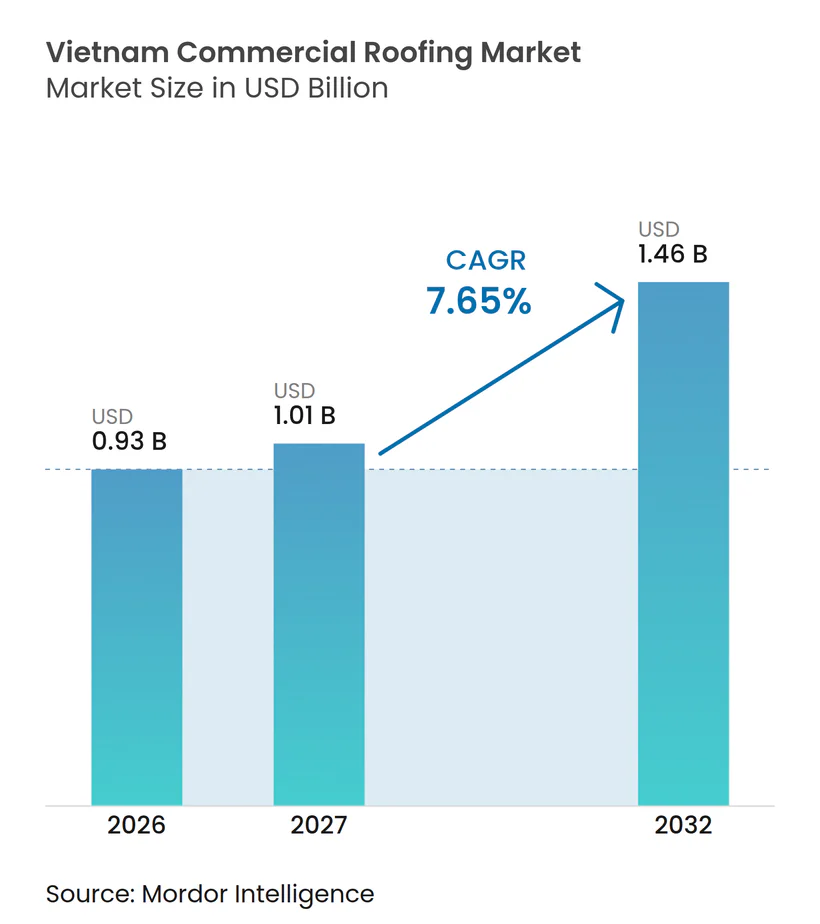
The Vietnam Commercial Roofing Market size is expected to increase from USD 0.93 billion in 2026 to USD 1.01 billion in 2027 and reach USD 1.46 billion by 2032, growing at a CAGR of 7.65% over 2027-2032.
Industrial construction, logistics facilities, and commercial developments form the main demand base for the Vietnam commercial roofing market. Public investment and factory construction are expanding the number of projects that need durable roofing systems, particularly in the south and in established industrial corridors. The August 2025 anti-dumping decision on coated steel changes material pricing and supports domestic producers in the standard metal roofing tier. At the same time, factory owners and international tenants are placing greater weight on insulation, waterproofing, wind resistance, and energy performance. This favors suppliers that can provide engineered systems, installation support, and clear product warranties.
Key Report Takeaways
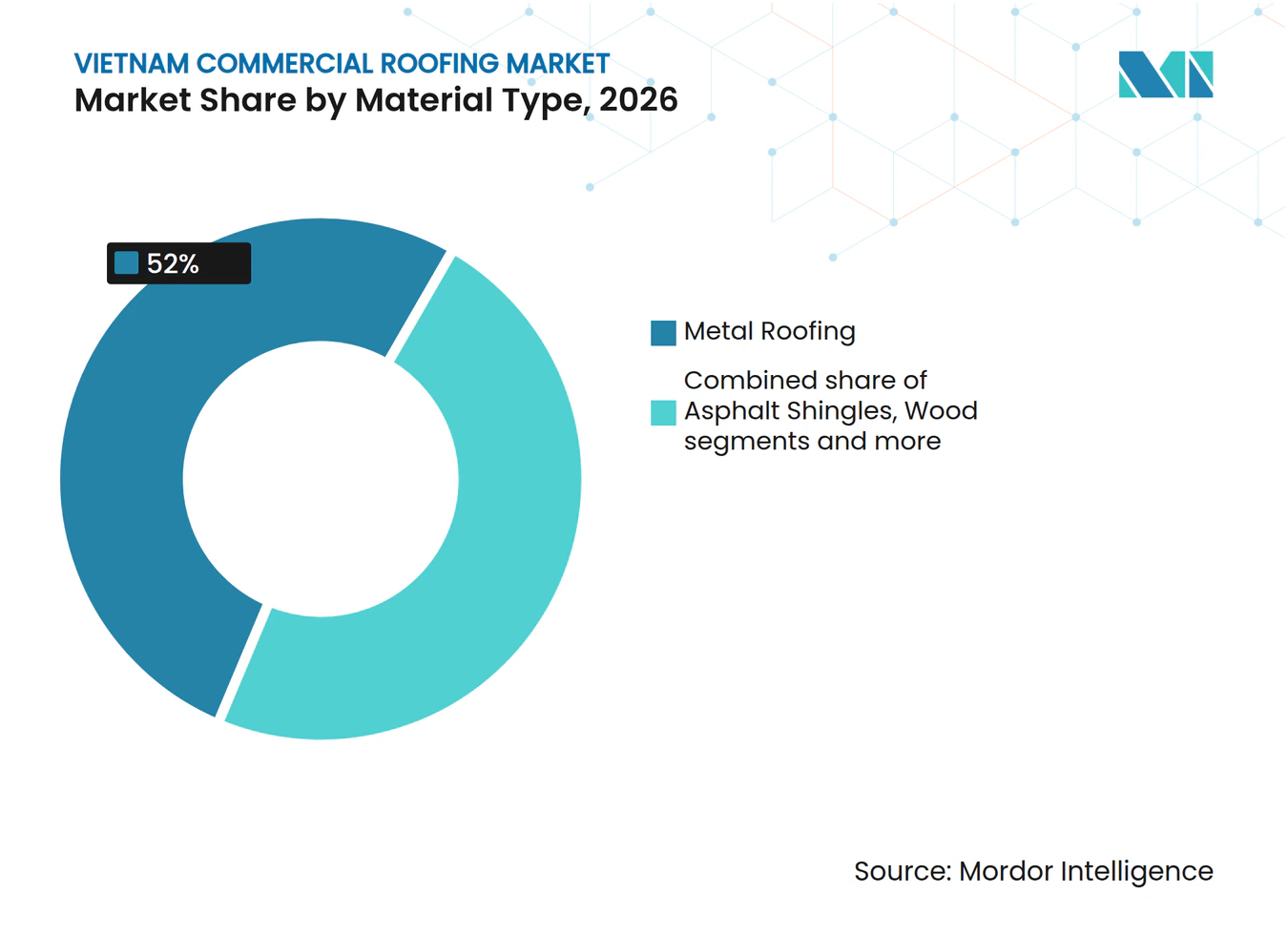
- By material type, metal roofing held 52.00% of the Vietnam commercial roofing market share in 2026, while single-ply membranes are forecast to grow at a 10.00% CAGR through 2032.
- By construction type, new construction held 74.00% of the Vietnam commercial roofing market share in 2026 and is projected to expand at a 9.80% CAGR through 2032.
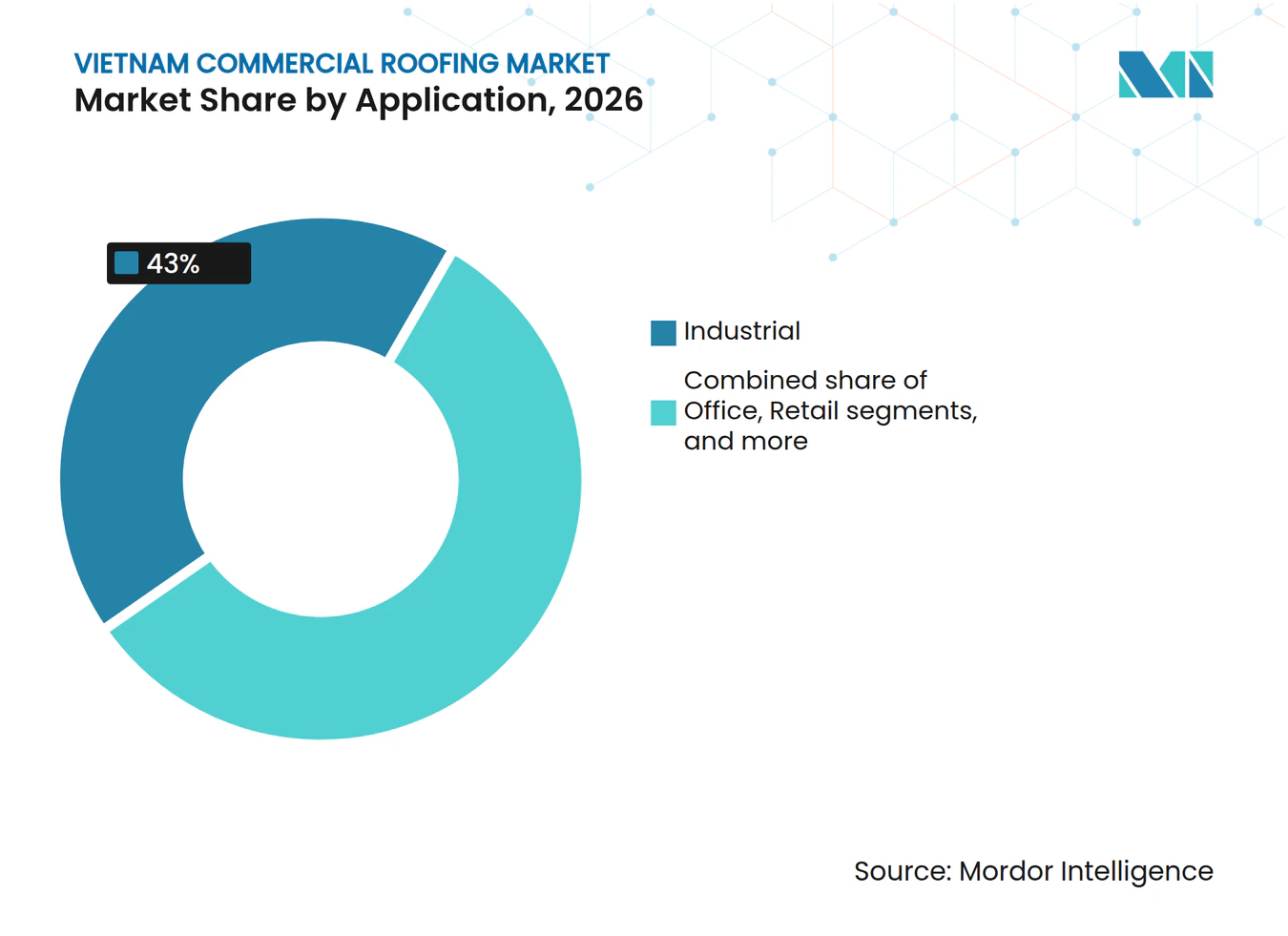
- By application, industrial facilities accounted for 43.00% of the Vietnam commercial roofing market size in 2026 and are forecast to grow at a 10.20% CAGR through 2032.
- By geography, Ho Chi Minh City held 31.00% of the Vietnam commercial roofing market size in 2026 and is forecast to expand at a 10.50% CAGR through 2032.
Note: Market numbers in this report are based on Mordor Intelligence's proprietary estimation framework, which combines nine months of actuals with Q4 projections for base year 2026.
Market Trends and Insights
Drivers Impact Analysis of Vietnam Commercial Roofing Market*
| Drivers | (~) % Impact on CAGR Forecast | Geographic Relevance | Impact Timeline |
|---|---|---|---|
| Export Manufacturing and Industrial Park Expansion | +2.0% | National, strongest in Ho Chi Minh City, Binh Duong, and Dong Nai | Medium term (2-4 years) |
| Foreign Direct Investment Factory Development | +1.8% | National, with activity in northern industrial provinces | Medium term (2-4 years) |
| E-Commerce Fulfillment and Cold Storage Construction | +1.4% | Southern Vietnam, including Long An, Dong Nai, and Binh Duong | Short term (≤ 2 years) |
| Pre-Engineered Building Adoption | +1.2% | National, with early gains in Ho Chi Minh City, Hanoi, and industrial provinces | Medium term (2-4 years) |
| Typhoon, Monsoon, and High-Humidity Roof Specifications | +0.7% | National, especially coastal provinces, Ho Chi Minh City, and Da Nang | Long term (≥ 4 years) |
| Local Production of Metal Roof and Insulation Systems | +0.5% | National | Medium term (2-4 years) |
| Source: Mordor Intelligence | |||
Export Manufacturing and Industrial Park Expansion
Industrial park development is a direct source of demand for the Vietnam commercial roofing market because every factory, warehouse, and service building requires roof and cladding systems. Vietnam Plus reported that Hung Yen began work on 10 industrial parks and clusters in September 2026, with a combined investment of USD 701.7 million[1]. New projects create demand for metal panels, insulated cladding, ridge ventilation, and waterproofing systems. Electronics, semiconductor, and precision manufacturing tenants also require stronger temperature control and condensation resistance than conventional garment factories. These requirements support the use of insulated panels, reflective coatings, and membrane systems in higher-specification facilities. The resulting mix can increase roofing value per square meter even when construction activity is concentrated in standard factory formats.
Foreign Direct Investment Factory Development
Foreign direct investment continues to support factory construction and the Vietnam commercial roofing market. Becamex IDC and Sembcorp Development signed 4 memoranda of understanding in March 2025 to expand the Vietnam-Singapore Industrial Park network into Hung Yen, Hai Phong, Hai Duong, and Binh Duong. The network also received approvals for additional industrial parks in Haiphong, Nghe An, Hue, Ha Nam, and Ho Chi Minh City. Large foreign-backed facilities typically require documented quality, thermal performance, and weather resistance. The LEGO factory at Vietnam-Singapore Industrial Park III used a thermoplastic polyolefin roof system with more than 750,000 EJOT tube-washer fasteners, illustrating demand for more specialized roof assemblies[2]. Phased industrial parks also create a steadier sequence of demand from initial factory shells through offices, amenities, and later replacement work.
E-Commerce Fulfillment and Cold Storage Construction
Cold storage and fulfillment projects create higher-value requirements for the Vietnam commercial roofing market. LOTTE Global Logistics Vietnam started construction of a USD 34 million cold-chain center in Dong Nai in March 2025, and the facility began operations in May 2026. Igarashi Vietnam started a high-tech cold storage and dry warehouse complex at Long Hau Industrial Park in December 2025, with the first phase planned for completion in the first quarter of 2027[3]. Cold buildings need vapor barriers, insulation continuity, and condensation control at the roof-to-wall connection. These conditions support mechanically attached membranes, insulated metal panels, and composite sandwich systems. The technical requirements make this construction activity important to suppliers of complete roof assemblies rather than basic panels alone. It also increases the value placed on trained installation teams and dependable warranty coverage.
Pre-Engineered Building Adoption
Pre-engineered buildings support roofing demand because roof selection is closely tied to the design of the steel frame. Standing-seam metal panels suit these buildings because clip-based installation can accommodate thermal movement and wind uplift without placing stress on purlin connections. Pebsteel’s LokSeam system is certified for wind speeds of up to 300 kilometers per hour, which is relevant to exposed projects in Vietnam. Wider adoption of this format gives design-build contractors more influence over material specifications. This can reduce project-level substitution by generic material suppliers. It also favors companies that combine structural, roofing, cladding, and installation services. The Vietnam commercial roofing market therefore benefits not only from higher building volumes but also from more standardized system specifications.
Restraints Impact Analysis of Vietnam Commercial Roofing Market*
| Restraints | (~) % Impact on CAGR Forecast | Geographic Relevance | Impact Timeline |
|---|---|---|---|
| Monsoon and Typhoon Installation Interruptions | -1.2% | National, especially central coastal provinces, Ho Chi Minh City, and Da Nang | Medium term (2-4 years) |
| Uneven Substrate Quality in Rapid-Build Projects | -0.8% | National, especially tier 2 and tier 3 cities and rapid-build industrial parks | Short term (≤ 2 years) |
| Import Duties on Specialty Membranes and Coatings | -0.7% | National | Medium term (2-4 years) |
| Shortage of Certified Applicators Outside Major Cities | -0.6% | Outside Ho Chi Minh City, Hanoi, and Da Nang | Long term (≥ 4 years) |
| Inconsistent Warranty Enforcement Across Projects | -0.5% | National | Long term (≥ 4 years) |
| Source: Mordor Intelligence | |||
Monsoon and Typhoon Installation Interruptions
Seasonal weather limits installation windows for the Vietnam commercial roofing market, especially in central and southern provinces. Heavy rain and typhoons can delay work, reduce labor productivity, and increase the risk of poor installation quality. Projects completed under pre-monsoon deadlines can face greater exposure to panel disengagement and water intrusion. Vietnam’s construction standards set requirements for wind loads and exposure conditions that affect roof fastening, seam profiles, and cladding design. Contractors may have to choose between delaying handover and working within narrow weather windows. This pressure can increase warranty claims and weaken margins across the supply chain.
Uneven Substrate Quality in Rapid-Build Projects
Fast construction schedules can result in inconsistent purlin alignment, deck flatness, and surface preparation before roofing installation. This is particularly difficult for thermoplastic polyolefin, ethylene propylene diene monomer, and polyvinyl chloride membranes because their systems need controlled substrate conditions. Tropical humidity makes these site conditions harder to manage. Contractors often need to add labor allowances where surface preparation is uncertain. Warranty responsibility can also become disputed between roofing applicators and structural contractors. These risks can lead price-sensitive projects to select simpler metal panel systems instead of premium membrane assemblies.
*Our forecasts treat driver/restraint impacts as directional, not additive. The impact forecasts reflect baseline growth, mix effects, and variable interactions.
Vietnam Commercial Roofing Market Segment Analysis
By Material Type:
Metal Roofing Leads, Membranes AccelerateMetal roofing held 52.00% of the Vietnam commercial roofing market in 2026, supported by domestic steel capacity and its fit with pre-engineered building frames. The August 2025 anti-dumping ruling imposed duties of up to 37.13% on Chinese coated steel and up to 15.67% on South Korean products. The decision improves the relative position of domestic producers in standard roofing grades. Hoa Sen Group launched its Mag Shield zinc-aluminum-magnesium panel in August 2025, stating that the product has corrosion resistance 3 to 5 times that of conventional galvanized steel. The company distributed the product through more than 126 Hoa Sen Home stores within 15 days of launch, showing a move toward higher-value products rather than volume alone.
Single-ply membranes are forecast to be the fastest-growing material group, at a 10.00% CAGR through 2032. Thermoplastic polyolefin, ethylene propylene diene monomer, and polyvinyl chloride systems are suited to large, flat, and performance-sensitive roofs. The LEGO factory project at Vietnam-Singapore Industrial Park III used a thermoplastic polyolefin membrane assembly for humidity and thermal expansion management. Bituminous membranes remain relevant for reroofing and lower-budget buildings because their installation methods are more widely available. Clay and concrete tiles, asphalt shingles, and wood serve smaller architectural uses such as resorts, heritage work, and decorative commercial buildings.



By Construction Type:
New Builds Drive Structural DemandNew construction accounted for 74.00% of the Vietnam commercial roofing market in 2026 and is projected to grow at a 9.80% CAGR through 2032. Public investment disbursements reached USD 13.5 billion in the first half of 2026, supporting transport, public-use, and related construction activity. Factory shells, logistics facilities, airports, and commercial projects support the Vietnam commercial roofing market size for new construction. The HANTA2 consortium won the USD 128.1 million cargo terminal No. 1 package at Long Thanh International Airport in September 2025, where ATAD’s structural steel and cladding scope covered 8.4 hectares of gross floor area. Projects of this size require coordination between structural steel, cladding, and roofing suppliers.
Reroofing and replacement remain smaller but important parts of demand. Early industrial facilities in Binh Duong and Dong Nai have operated for several decades and will require replacement systems as roof panels age in humid conditions. This work needs different skills from greenfield construction because installation must proceed around operating facilities. The segment can favor contractors with in-place project management, trained crews, and a documented warranty record. It supports demand for membranes and coatings where building owners seek life extension instead of complete replacement.
By Application:
Industrial Facilities Set the PaceIndustrial applications held 43.00% of the Vietnam commercial roofing market in 2026 and are forecast to grow at a 10.20% CAGR through 2032. Export manufacturing and logistics projects produce more roof area than office and retail developments. Industrial buildings also need higher levels of ventilation, thermal performance, and weather resistance. The KIZUNA GOLD serviced-factory project uses a combined solution of MR-24 roofing, Butler structural frames, and BONDEK II composite decking, with a Leadership in Energy and Environmental Design Gold target. This type of integrated specification makes certification, installation quality, and engineering support important procurement criteria.
Retail buildings continue to use pre-engineered steel structures and metal roofing because developers value construction speed and cost control. Office projects often use reflective membranes, waterproofing systems, and integrated façade solutions where environmental performance matters. Grade A office supply in Ho Chi Minh City is projected to rise from 1.7 million square meters in 2026 to 2 million square meters by 2030. Data centers, hospitals, and food-processing facilities also require stronger waterproofing and thermal control than standard commercial structures. The industrial segment remains the main volume base, while other applications broaden demand for specialized assemblies.

Geography Analysis
Ho Chi Minh City held 31.00% of the Vietnam commercial roofing market in 2026 and is forecast to grow at a 10.50% CAGR through 2032. The city and its surrounding provinces combine manufacturing, cold-chain logistics, serviced factories, and high-grade commercial projects. UOB Vietnam began construction of a 36-story USD 450 million headquarters in the Vietnam International Financial Centre area in July 2026. Long An, Dong Nai, Binh Duong, and Tay Ninh extend the city’s effective demand area.
Hanoi is the second-largest geography, supported by industrial activity across Bac Ninh, Hung Yen, Bac Giang, and Hai Phong. Bac Ninh gained approval for 9 industrial parks in 2025, with registered capital exceeding USD 700 million. The northern cluster has a concentration of electronics and higher-value manufacturing tenants. These facilities can require controlled-environment roofing assemblies and insulated metal panels. Coteccons reported a contract backlog above USD 2 billion in 2026, indicating a broad construction pipeline in the country.
Da Nang is the main gateway to central Vietnam and has demand from hospitality, logistics, and public-use facilities. High humidity and typhoon exposure make reflective roofing and multilayer waterproofing relevant to project specifications. The rest of Vietnam includes the Central Highlands, the Mekong Delta, and smaller provincial centers. These locations are adding demand through agri-food processing, aquaculture-related cold storage, and smaller industrial clusters. The expansion of pre-engineered building formats helps developers in these areas use standardized systems.
Competitive Landscape
Market Concentration
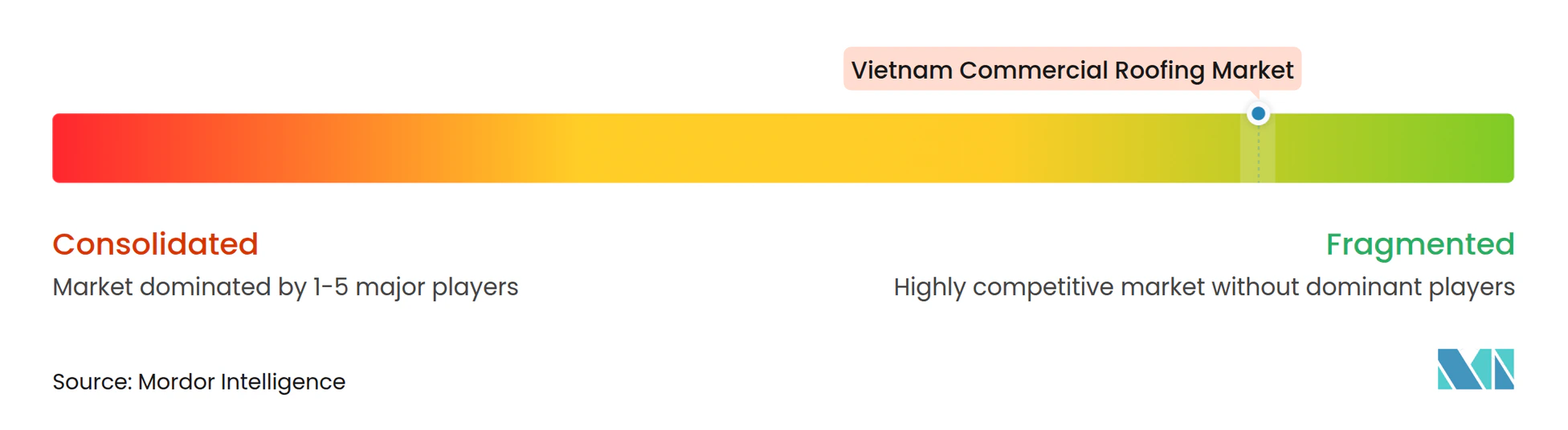
The Vietnam commercial roofing market is moderately fragmented. Hoa Sen Group, Ton Dong A Corporation, Nam Kim Steel Joint Stock Company, and Vietnam Steel Corporation compete through price, distribution reach, and product breadth. BlueScope Lysaght Vietnam, Zamil Steel Vietnam, Pebsteel Buildings, Kirby Building Systems Vietnam, and Sika Vietnam compete through engineering, system integration, and project support. Hoa Sen Group reported a distributor network of more than 3,000 and 126 Hoa Sen Home stores in July 2026. This distribution scale provides an advantage in the standard metal roofing category.
Competition is stronger in green-certified and foreign-invested projects, where buyers prefer unified responsibility for structural, cladding, and roofing performance. In July 2026, Lysaght and KIZUNA partnered on the KIZUNA GOLD serviced-factory project, combining MR-24 roofing, Butler frames, and BONDEK II composite decking. This approach reduces coordination work for developers and favors established system providers. Pebsteel’s wind-rated standing-seam offering addresses a specific need for exposed industrial sites. The Vietnam commercial roofing market is therefore shifting toward competition based on engineering performance and installation reliability in higher-value projects.
Companies are also improving control over installation quality. BlueScope Lysaght Vietnam launched the Lysaght Builder distributor network in April 2025 with 10 certified installation and construction partners. Hoa Sen Group expanded its premium Mag Shield offering through a rapid national retail rollout. The mid-market remains open to local applicators that can demonstrate third-party product certification and reliable completed projects. This leaves room for specialists, even as larger brands retain an advantage on complex projects.
Vietnam Commercial Roofing Industry Leaders
-
Hoa Sen Group
-
Ton Dong A Corporation
-
Nam Kim Steel Joint Stock Company
-
VNSTEEL
-
Dong A Plastic Joint Stock Company
- *Disclaimer: Major Players sorted in no particular order
Vietnam Commercial Roofing Market Companies Covered in this Report
- Hoa Sen Group
- Ton Dong A Corporation
- Nam Kim Steel Joint Stock Company
- VNSTEEL
- Dong A Plastic Joint Stock Company
- Phuong Nam Waterproofing Technology Joint Stock Company
- Sika Vietnam
- Saint-Gobain Vietnam
- Tôn Đông Á
- Bluescope Lysaght Vietnam
- Zamil Steel Vietnam
- Pebsteel Buildings
- Kirby Building Systems Vietnam
- ATAD Steel Structure Corporation
- Searefico Corporation
- Coteccons Construction Joint Stock Company
- Hoa Binh Construction Group Joint Stock Company
- Vinaconex
- Delta-Galil Industries Vietnam
- TNG Investment and Trading Joint Stock Company
Recent Industry Developments in Vietnam Commercial Roofing Market
- October 2026: Ton Dong A Corporation promoted KINGALUZIN, an AZ150 aluminum-zinc alloy coating with a 20-year perforation warranty, and KINGCOLOR, an AZ100 substrate with a 4-layer, 25-micron paint system, a 15-year perforation warranty, and a 5-year color warranty. Factory-printed specifications on each coil allow grade verification at receipt and support procurement of higher-specification roofing for industrial and commercial projects.
- July 2026: LYSAGHT® and KIZUNA® signed a strategic partnership for the KIZUNA GOLD project at Tan Kim Industrial Park, Can Giuoc, Tay Ninh. The 8.5-hectare project has an investment exceeding USD 68 million, targets Leadership in Energy and Environmental Design Gold certification, and uses MR-24® roofing, Butler® structural frames, SPANDEK® wall cladding, and BONDEK® II composite decking as an integrated solution.
- June 2026: Pebsteel partnered with D.MAG Light Metal Technology Vietnam for an 80,000-square-meter manufacturing facility at Vietnam-Singapore Industrial Park III in Ho Chi Minh City. The project uses LokSeam®, PebSeam128®, and Ridge Vent 5.0 systems and represents a large pre-engineered roofing scope.
Vietnam Commercial Roofing Market Report Scope
Segmentation Overview
| Asphalt Shingles |
| Clay & Concrete Tiles |
| Metal Roofing |
| Bituminous / Modified Bitumen Membranes |
| Single-Ply Membranes (TPO, EPDM, and PVC) |
| Wood |
| Others |
| New Construction |
| Reroofing and Replacement |
| Retail |
| Office |
| Industrial |
| Others |
| Ho Chi Minh City |
| Hanoi |
| Da Nang |
| Rest of Vietnam |
| By Material Type | Asphalt Shingles |
| Clay & Concrete Tiles | |
| Metal Roofing | |
| Bituminous / Modified Bitumen Membranes | |
| Single-Ply Membranes (TPO, EPDM, and PVC) | |
| Wood | |
| Others | |
| By Construction Type | New Construction |
| Reroofing and Replacement | |
| By Application | Retail |
| Office | |
| Industrial | |
| Others | |
| By Geography | Ho Chi Minh City |
| Hanoi | |
| Da Nang | |
| Rest of Vietnam |
Key Questions Answered in the Report
What is the forecast growth rate for commercial roofing in Vietnam?
The sector is projected to grow at a 7.65% CAGR from 2027 to 2032, reaching USD 1.46 billion by 2032.
Which roofing material has the largest position in Vietnam?
Metal roofing held 52.00% of revenue in 2026, supported by domestic steel production and pre-engineered building demand.
Which material category is growing fastest through 2032?
Single-ply membranes are forecast to grow at a 10.00% CAGR as industrial projects require better waterproofing, insulation, and thermal performance.
What is driving industrial roofing demand in Vietnam?
Factory development, industrial park expansion, cold-chain facilities, and logistics buildings support demand for engineered roofing systems.
Which construction type creates the most demand for commercial roofs?
New construction held 74.00% of revenue in 2026 and is forecast to grow at a 9.80% CAGR through 2032.
Which city leads commercial roofing demand in Vietnam?
Ho Chi Minh City held 31.00% of revenue in 2026 and is forecast to grow at a 10.50% CAGR through 2032.