
Vietnam Bottled Water Market Size and Share
Market Overview
| Study Period | 2021 - 2031 |
|---|---|
| Forecast Data Period | 2026 - 2031 |
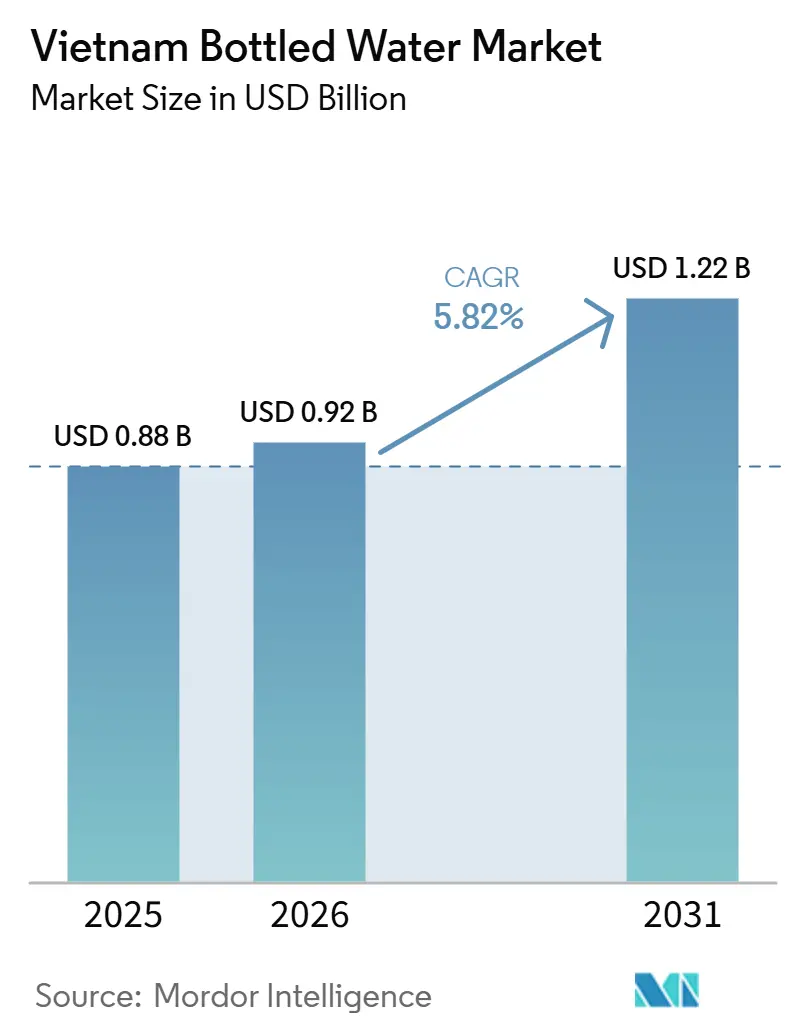
| Base Year Market Size (2025) | USD 0.88 Billion |
| Market Size (2026) | USD 0.92 Billion |
| Market Size (2031) | USD 1.22 Billion |
| Growth Rate (2026 - 2031) | 5.82 % |
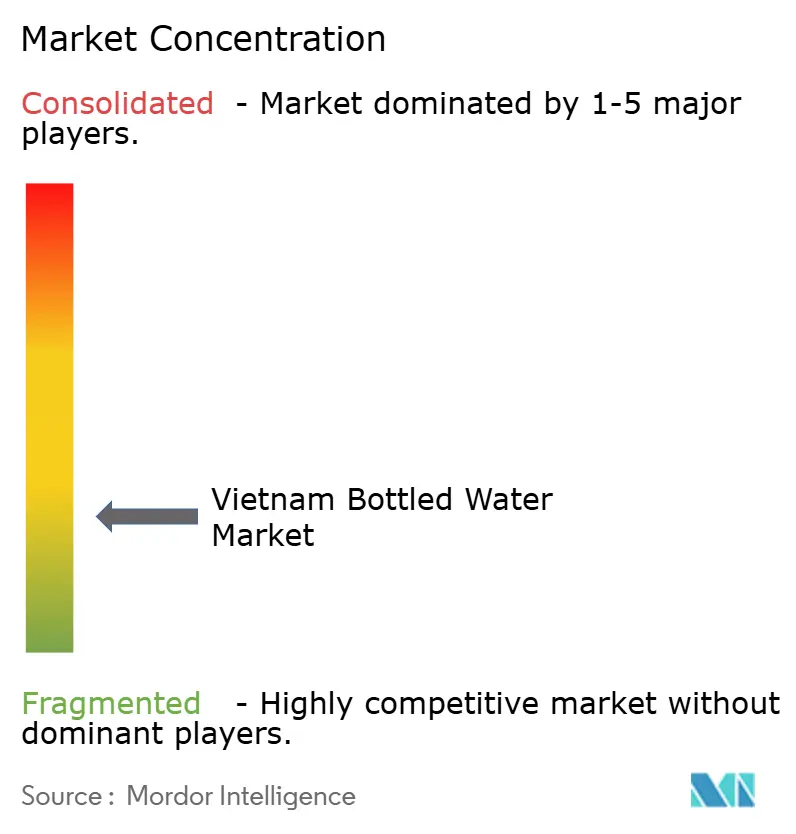
| Market Concentration | Low |
Major Players
*Disclaimer: Major Players sorted in no particular order Image © Mordor Intelligence. Reuse requires attribution under CC BY 4.0. |
|
Vietnam Bottled Water Market Analysis by Mordor Intelligence
The Vietnam bottled water market size is expected to grow from USD 0.88 billion in 2025 to USD 0.92 billion in 2026, and is forecast to reach USD 1.22 billion by 2031 at a 5.82% CAGR over 2026-2031. Rising demand for safe drinking water, evolving urban lifestyles, and tourism are supporting regular purchases across retail and foodservice channels. Vietnam received 21.2 million international visitors in 2025, and the national tourism authority has set a target of 25 million visitors for 2026, according to the National Statistics Office of Vietnam. This demand favors brands that can serve both large retail networks and hospitality customers. At the same time, stricter packaging regulations and competition in purified water are increasing the focus on product quality, packaging choices, and credible source narratives. As a result, the Vietnam bottled water market is expanding through a mix of everyday consumption and higher-value occasions, rather than volume growth alone.
Key Report Takeaways
- By product type, still water led the Vietnam bottled water market with a share of 68.83% in 2025, while functional/flavoured water is anticipated to register the fastest CAGR of 7.01% during 2026-2031.
- By packaging material, PET bottles retained an 86.12% share in 2025, whereas glass bottles are forecast to expand at 7.24% CAGR through 2031.
- By pricing, mass led the market with a 91.83% share in 2025, while premium/luxury is anticipated to register the fastest CAGR of 6.99% during 2026-2031.
- By distribution channel, off-trade led the market with a share of 82.22% in 2025, while on-trade is anticipated to register the fastest CAGR of 6.88% during 2026-2031.
Note: Market size and forecast figures in this report are generated using Mordor Intelligence’s proprietary estimation framework, updated with the latest available data and insights as of January 2026.
Vietnam Bottled Water Market Trends and Insights
Drivers Impact Analysis*
| Driver | (~) % Impact on CAGR Forecast | Geographic Relevance | Impact Timeline |
|---|---|---|---|
| Urbanization and packaged water use | +1.2% | National, with early gains in Ho Chi Minh City, Hanoi, Da Nang, and Binh Duong | Short term (≤ 2 years) |
| Health awareness and lower sugary drink intake | +1.3% | National, concentrated in urban middle-class segments | Medium term (2-4 years) |
| Tourism and hospitality demand for premium water | +0.9% | Da Nang, Hanoi, Ho Chi Minh City, Hoi An, and Phu Quoc | Short term (≤ 2 years) |
| Functional and alkaline water demand is emerging as a distinct value pool | +0.7% | Urban Vietnam within a wider APAC trend | Medium term (2-4 years) |
| On-the-go demand for single-serve water | +0.6% | Ho Chi Minh City, Hanoi, and Da Nang | Short term (≤ 2 years) |
| Focus on purity, source transparency, and certified quality | +0.5% | National, with greater intensity in urban centers | Long term (≥ 4 years) |
| Source: Mordor Intelligence | |||
Urbanization and packaged water use
According to the World Bank, Vietnam’s urbanization rate reached 39.47% in 2025[3]Source: World Bank, "Urban population (% of total population)," data.worldbank.org, with secondary cities, including Binh Duong, Dong Nai, and Can Tho, continuing to absorb migration. This shift places more consumers near convenience stores, supermarkets, workplaces, and food service outlets where packaged water is readily available. The Vietnam bottled water market benefits as water purchases become part of commuting, work, and daily hydration routines. Urban households often require single-serve water outside the home, even when they have access to household water treatment. This trend gives manufacturers with broad distribution networks in secondary cities a practical advantage as these cities develop.
Health awareness and lower sugary drink intake
Health-focused beverage choices are strengthening bottled water’s role in daily consumption. Urban consumers increasingly prefer beverages without added sugar and products that demonstrate safety and quality credentials. This trend supports the Vietnam bottled water market, particularly mineral, alkaline, and functional offerings that clearly communicate their ingredients and positioning. Food safety systems, such as ISO 22000:2018 and Hazard Analysis Critical Control Point (HACCP), help brands demonstrate operational discipline to customers who cannot independently assess water chemistry. This shows that distribution expansion and premium positioning can support revenue growth within health-oriented beverage portfolios.
Tourism and hospitality demand for premium water
Tourism is expected to strengthen demand across hotels, restaurants, cafes, and entertainment venues. International arrivals reached 21.2 million in 2025, the highest annual total reported for Vietnam, while the official 2026 target stands at 25 million visitors, according to the National Statistics Office of Vietnam[1]Source: Vietnam National Authority of Tourism, "Vietnam's Tourism" vietnamtourism.gov.vn. According to the same source, Vietnam welcomed 12.3 million international visitors in the first half of 2026, up 14.7% from the same period in 2025. The Vietnam bottled water market benefits from this tourism activity, as hospitality venues require reliable packaged water supplies throughout the day. Premium mineral and spring water products are more relevant in hotels and higher-end dining establishments than in routine retail purchases. Therefore, tourism supports both channel demand and a higher-value product mix.
Functional and alkaline water demand is emerging as a distinct value pool
Functional water is gaining attention from consumers who associate hydration with exercise, wellness, and reduced sugar intake. The Ministry of Industry and Trade identified health consciousness, urbanization, and sports participation as factors supporting functional beverages in Vietnam. Nestlé Waters Vietnam launched La Vie+ Alkaline in April 2026, featuring a pH of 8.6, essential minerals, and no added sugar. Thach Bich Mineral Water launched Quater alkaline ionized water in April 2025, using automated electrolysis equipment and offering a pH above 8. These launches indicate that both multinational and domestic manufacturers view functional water as a continuing portfolio category. The Vietnam bottled water industry can use this category to reduce its reliance on price-led competition in purified water.
Restraints Impact Analysis*
| Restraint | (~) % Impact on CAGR Forecast | Geographic Relevance | Impact Timeline |
|---|---|---|---|
| Bottled water quality compliance requirements | -0.5% | National, with pressure in Ho Chi Minh City and Hanoi manufacturing hubs | Medium term (2-4 years) |
| Price competition from local manufacturers | -0.7% | National, concentrated in rural and semi-urban markets | Medium term (2-4 years) |
| Shift toward reusable water filtration | -0.4% | Urban Vietnam, particularly high-income households | Long term (≥ 4 years) |
| Plastic-waste concerns and packaging costs | -0.5% | National, with faster enforcement in Ho Chi Minh City and Hanoi | Long term (≥ 4 years) |
| Source: Mordor Intelligence | |||
Price competition from local manufacturers
Regional and local manufacturers offer similar purified water at aggressive prices, particularly in rural and semi-urban markets. In the Vietnam bottled water market, this limits suppliers’ ability to recover higher packaging, energy, and logistics costs. Premium and functional brands have more room to defend pricing because they compete on source origin, mineral content, or product benefits. Smaller companies without broad distribution networks or established brand recognition face the greatest pressure. Over the forecast period, this trend may encourage consolidation in mass purified water while leaving differentiated formats less exposed.
Plastic-waste concerns and packaging costs
Plastic packaging remains central to bottled water distribution, making recycling obligations relevant for most manufacturers. Vietnam amended its extended producer responsibility framework through Decree No. 05/2025/ND-CP, which clarified several implementation rules for manufacturers and importers. The Vietnam bottled water market must adapt as the framework requires packaging manufacturers and importers to meet recycling responsibilities or make the required financial contributions. Vietnam bottled water market participants that lack investment capacity for recycled PET, collection partnerships, or alternative formats may face tighter margins. Manufacturers may find it harder to pass on these costs in lower-priced purified water, where consumers can readily switch brands. Brands that have already invested in sustainable packaging can turn compliance efforts into a purchasing advantage with institutional and hospitality customers.
*Our forecasts treat driver/restraint impacts as directional, not additive. The impact forecasts reflect baseline growth, mix effects, and variable interactions.
Segment Analysis
By Product Type: Functional Variants Are Redefining The Premium End
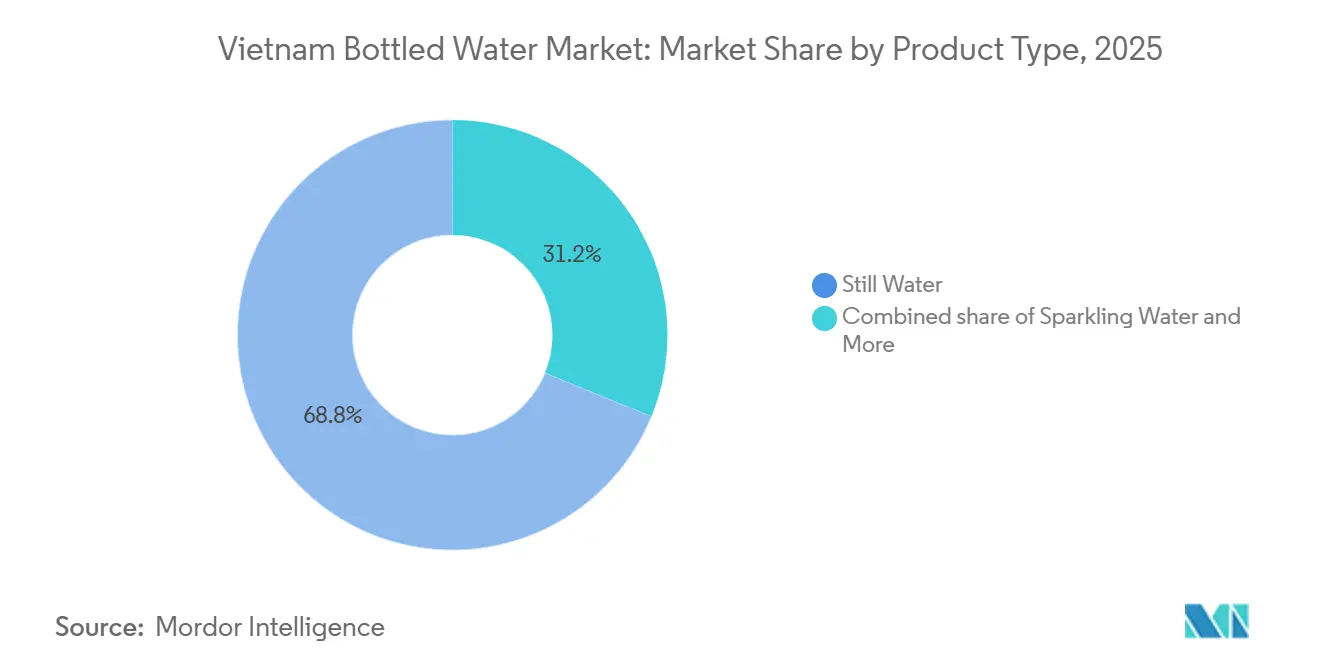
Still water accounted for 68.83% of the market value in 2025, confirming its role as the standard option for household use, work, travel, and institutional purchases. Its broad demand base supports the Vietnam bottled water market across all income groups and retail formats. Sparkling water remains a smaller niche, with stronger visibility in hotels, restaurants, and urban dining venues. Functional/flavored water is the fastest-growing product group, with a forecast CAGR of 7.01% from 2026 to 2031. This growth reflects rising demand for alkaline, electrolyte, vitamin-enhanced, and botanical or fruit-infused water. The category gives consumers options for exercise, wellness, and social occasions beyond routine hydration.
Vitamin-enhanced, electrolyte/sports, and botanical/fruit-infused options serve different consumption occasions and price points. Electrolyte products align with sports and outdoor activities, while botanical products occupy a position between premium water and wellness beverages. Hoang Minh Water JSC’s i-on Life uses Japanese electrolysis technology to produce alkaline ionized water with a pH of 8.5 to 9.5 and no added salt. This positioning allows domestic producers to highlight product attributes rather than compete only on retail price. Functional water does not need the same volume as still water to be commercially significant because it commands higher pricing. The Vietnam bottled water industry uses these products to improve margins and bring consumers into more specialized water consumption occasions.



By Packaging Material: Glass And Aluminium Are Challenging PET’s Dominance At The Premium Tier
PET bottles accounted for 86.12% of market value in 2025, supported by their cost efficiency, familiarity among manufacturers, and wide availability across the supply chain. The Vietnam bottled water market size for PET remains closely tied to demand from mass retail, delivery, and single-serve consumption. Glass bottles are forecast to record the fastest growth among packaging formats, at a CAGR of 7.24% through 2031. Hotels and fine-dining venues use glass bottles to support premium service standards and reduce the visibility of single-use plastic. Aluminum cans and bottles are also gaining relevance where functional positioning aligns with environmental concerns. Packaging decisions increasingly influence both compliance costs and brand presentation to customers.
Vietnam’s recycling conditions complicate the shift away from PET. The Asia Pacific International Spirits and Wines Alliance reported glass recycling at 15% in Vietnam, compared with 70% for aluminum cans and 32% to 45% for PET bottles, as of 2024[2]Source: Asia Pacific International Spirits and Wines Alliance (APISWA), "Industry report urges greater information dissemination and infrastructure support to improve Vietnam glass recycling rate," apiswa.org. Glass may have a stronger sustainability perception in premium hospitality, but Vietnam’s collection and processing system for glass remains less developed. As recycling responsibilities become more demanding, packaging investments will increasingly differentiate companies with established systems from those that need to retrofit their operations.
By Pricing: Mass Dominance Masks A Rapid Premiumization Layer Above It
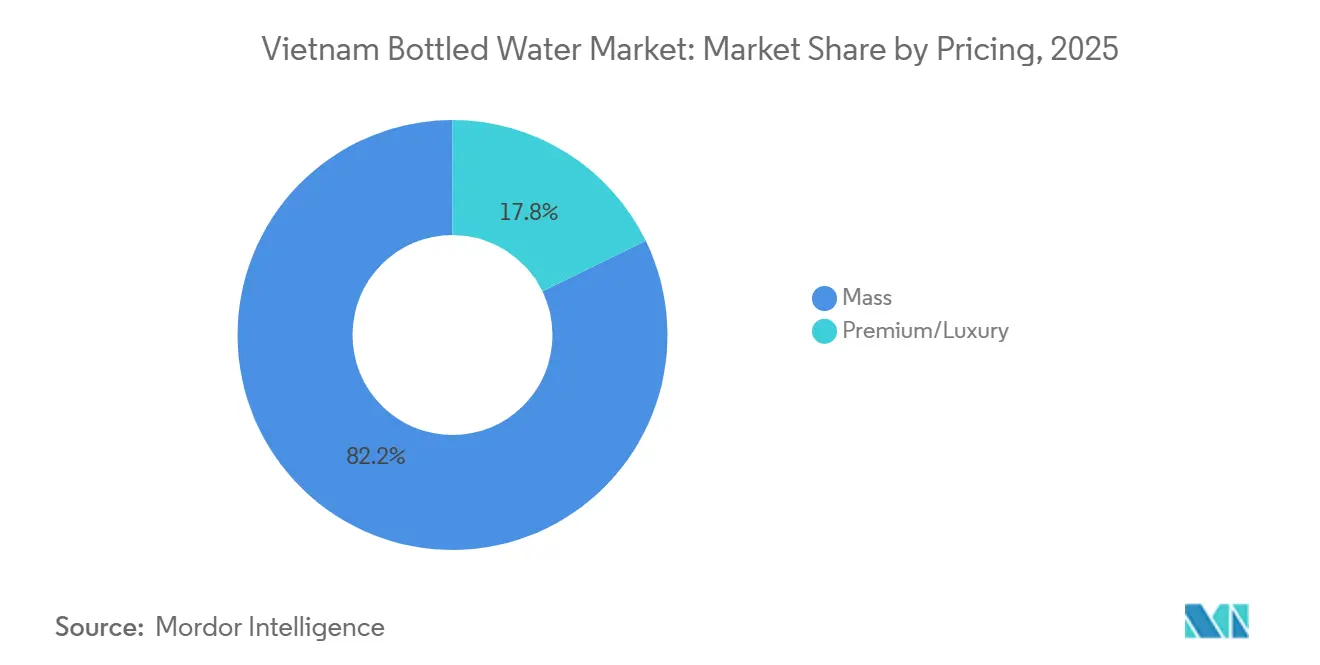
The mass tier commands 91.83% of the market’s value in 2025, reflecting the broad reach of purified water through traditional trade channels and among lower-to-middle-income households. This position indicates that affordability remains critical in the Vietnam bottled water market. Premium/luxury water is projected to register the fastest growth within the pricing segmentation, at a CAGR of 6.99% through 2031. Urban consumers with higher disposable incomes are purchasing mineral water for work, fitness, travel, and hospitality occasions. The premium tier does not replace mass consumption, as it serves different needs. Instead, it encourages customers to spend more on selected occasions while continuing to purchase purified water for everyday use.
Vivant sources water from the Vinh Hao and Quang Hanh high-mountain mineral springs and highlights minerals such as calcium, magnesium, and potassium. This source-based positioning shows how mineral content and origin can support a differentiated value proposition. La Vie’s 2024 4-S Journey campaign uses personalized well-being recommendations. Premium brands must continue to communicate their value clearly, as mass alternatives remain widely available. Their advantage comes from a combination of trusted sourcing, product experience, and placement in selected retail and hospitality settings. This dynamic supports a separate higher-value demand layer without changing the central role of mass water.
By Distribution Channel: Off-Trade Scale Meets On-Trade’s Faster-Growth Trajectory
Off-trade channels accounted for 82.22% of the market value in 2025, making supermarkets, hypermarkets, convenience stores, home and office delivery, and online retail the primary routes to consumers. This distribution base enables the Vietnam bottled water market to reach households across a wide range of consumption occasions. Chains such as Co.opmart, VinMart, and Big C give manufacturers broad shelf access in major cities. Online ordering supports recurring deliveries to homes and offices, particularly in Ho Chi Minh City and Hanoi. Large 19-liter bottles continue to support office hydration for brands such as Bidrico and Saigon Pure Water. These channels provide established brands with steady sales volumes and allow customers to compare prices easily.
On-trade distribution is forecast to grow at a CAGR of 6.88% from 2026 to 2031, outpacing the broader channel mix. Hotels, restaurants, cafes, and entertainment venues benefit directly from rising visitor numbers and increased urban foodservice activity. Hospitality customers are more likely to purchase premium mineral and natural spring water, increasing revenue per unit. Origin Water Phu Quoc operates a closed-cycle glass water bottling facility designed to supply resorts and hotels. Its model demonstrates how manufacturers can build operations around the requirements of a tourist destination rather than treat hospitality as an extension of retail. The faster expansion of on-trade sales strengthens the role of premium formats, even as off-trade remains the larger route to market.
Geography Analysis
Southern Vietnam is the primary revenue area for the Vietnam bottled water market, as Ho Chi Minh City and the surrounding Southeast corridor combine a dense urban population with strong modern retail and food service activity. The region includes Binh Duong, Dong Nai, and Ba Ria–Vung Tau, where manufacturing activity, commuting patterns, and rising household spending drive regular demand for packaged water. Its tropical climate also supports frequent hydration purchases throughout the year. Ho Chi Minh City’s cafes, restaurants, hotels, and online delivery networks generate demand across both on-trade and off-trade channels. In July 2026, Suntory PepsiCo Vietnam Beverage inaugurated its USD 300 million Tây Ninh Plant, the company’s largest and most technologically advanced facility in Vietnam. The plant has an annual capacity of 1.24 billion liters and is expected to create around 3,000 jobs across the supply chain. Its production lines can produce 120,000 cans and 84,000 PET bottles per hour. The facility also houses the first fully automated warehouse owned by Suntory PepsiCo Vietnam Beverage and Suntory Beverage and Food Asia.
Northern Vietnam is the second-largest demand cluster, led by Hanoi and the Red River Delta industrial belt. Household demand is more price-sensitive in parts of the region, while in-home filtration has a stronger historical presence in some urban areas. Rising income and visitor activity around Ha Long Bay, Ninh Binh, and the northern highlands are creating more opportunities for hospitality sales. La Vie’s plant in Hung Yen supports mineral water supply to Hanoi and the north’s developing modern retail network. Therefore, the Vietnam bottled water market requires both price-accessible offerings and differentiated products that can serve tourism and premium dining demand.
Central Vietnam is the fastest-growing regional area, supported by urbanization, tourism infrastructure, and rising income in locations that previously had more limited branded water distribution. Da Nang, Hoi An, Hue, Quang Nam, and the Central Highlands are adding demand through hotels and retail outlets. Da Nang was one of the Vietnam’s most-visited destinations during the record 2025 tourism year, according to the Da Nang Department of Culture, Sports and Tourism. This geography demonstrates why tourism-led locations can support faster adoption of premium packaging and source-led water offerings.
Competitive Landscape
The Vietnam bottled water market has a fragmented landscape with more than a dozen active brands and no reported high combined share among leading suppliers. Suntory PepsiCo Vietnam Beverage leads volume sales in purified water through Aquafina. Its investment in Long An and planned expansion of northern capacity highlight its focus on production scale and geographic coverage. La Vie Limited, part of Nestlé Waters, holds a leading position in natural mineral water and has Alliance for Water Stewardship certification, the first such certification reported in Vietnam. Coca-Cola’s Dasani, Vinh Hao, Thanh Tan, and Kim Bio Water also compete across price points and product formats. This market structure keeps price pressure high in standard purified water while allowing specialized brands to build distinct positions.
Sustainability, functional innovation, and source authenticity remain the key differentiation strategies. Suntory PepsiCo Vietnam uses recycled and lightweight bottle designs to address material usage and producer responsibility requirements. La Vie launched La Vie+ Alkaline in April 2026, extending its mineral water brand into functional hydration. In the Vietnam bottled water market, these developments show that packaging, product formulation, and supply models are becoming as important as price. The market rewards companies that can link these choices to practical customer needs.
Domestic challengers are most visible in the mid-premium functional segment, positioned between mass purified water and higher-priced imported mineral water. Hoang Minh Water JSC uses i-on Life to position alkaline ionized water as a daily health product. In April, 2025 Thach Bich entered the alkaline segment with Quate. These brands do not need to match the largest companies in scale to compete for defined consumer occasions. Their focus on category creation can support stronger pricing in a market where standard purified water remains highly contested. The Vietnam bottled water industry remains open to regional producers, but quality compliance costs and sustainable packaging requirements can favor companies with stronger operating resources.
Vietnam Bottled Water Industry Leaders
-
Suntory PepsiCo.
-
The Coca‑Cola Company
-
La Vie
-
Thach Bich Mineral Water Factory
-
Saigon Pure Water Limited Liability Company
- *Disclaimer: Major Players sorted in no particular order

Recent Industry Developments
- July 2026: Suntory PepsiCo Vietnam Beverage inaugurated its USD 300 million Tây Ninh Plant, the company’s largest and most technologically advanced facility in Vietnam. The plant has an annual capacity of 1.24 billion liters and is expected to create around 3,000 jobs across the supply chain. Its production lines can produce 120,000 cans and 84,000 PET bottles per hour. The facility also houses the first fully automated warehouse owned by Suntory PepsiCo Vietnam Beverage and Suntory Beverage and Food Asia.
- April 2025: Thach Bich Mineral Water launched its Quater alkaline ionized water line, produced using automated electrolysis technology imported from Europe, with a pH level above 8. The product targets the premium digestive health segment and marks Thach Bich's first entry into functional alkaline water.
- January 2025: Suntory Pepsico Vietnam Beverage increased the output of its factory in Vietnam’s northern province of Bac Ninh by 65%, from 500 million liters to 825 million liters per year. The facility covers 12.3 hectares in Bac Ninh, an industrial park developed under the Vietnam-Singapore Industrial Park (VSIP) model.


Vietnam Bottled Water Market Report Scope
Bottled water comprises potable water packaged in sealed containers for human consumption. The category includes still, sparkling, and functional/flavored water sourced from natural springs, mineral sources, groundwater, or purified water, and distributed through on-trade and off-trade channels.
The Vietnam bottled water market is segmented by product type, packaging material, pricing, and distribution channel. By product type, the market is segmented into still water, sparkling water, and functional/flavoured water (vitamin-enhanced, electrolyte/sports, botanical/fruit-infused). By packaging material, the market is segmented into PET bottles, glass bottles, aluminium cans and bottles, and others. By pricing, the market is segmented into mass and premium/luxury. By distribution channel, the market is segmented into on-trade and off-trade (supermarkets/hypermarkets, convenience/grocery stores, home and office space, online retail, and other off-trade channels). The market forecasts are provided in terms of value (USD) and Volume (Liters).
| Still Water | |
| Sparkling Water | |
| Functional/Flavoured Water | Vitamin-Enhanced |
| Electrolyte/Sports | |
| Botanical/Fruit-Infused |
| PET Bottles |
| Glass Bottles |
| Aluminium Cans and Bottles |
| Others |
| Mass |
| Premium/Luxury |
| On-Trade | |
| Off-Trade | Supermarkets/Hypermarkets |
| Convenience/Grocery Stores | |
| Home and Office Space | |
| Online Retail | |
| Other Off-Trade Channels |
| By Product Type | Still Water | |
| Sparkling Water | ||
| Functional/Flavoured Water | Vitamin-Enhanced | |
| Electrolyte/Sports | ||
| Botanical/Fruit-Infused | ||
| By Packaging Material | PET Bottles | |
| Glass Bottles | ||
| Aluminium Cans and Bottles | ||
| Others | ||
| By Pricing | Mass | |
| Premium/Luxury | ||
| By Distribution Channel | On-Trade | |
| Off-Trade | Supermarkets/Hypermarkets | |
| Convenience/Grocery Stores | ||
| Home and Office Space | ||
| Online Retail | ||
| Other Off-Trade Channels | ||


Key Questions Answered in the Report
What is the current and forecasted size of the Vietnam bottled water market?
The Vietnam bottled water market was valued at USD 0.88 billion in 2025 and is projected to reach USD 0.92 billion in 2026, with further growth expected to USD 1.22 billion by 2031.
Which product type held the largest market share in 2025?
Still Water was the leading product type, accounting for 68.83% of the market in 2025.
Which packaging material dominated the Vietnam bottled water market in 2025?
PET Bottles dominated the market with a 86.12% share in 2025.
Which pricing segment held the largest market share in 2025?
The mass segment led the market, accounting for 91.83% of total sales in 2025.
Which distribution channel accounted for the largest share of the market in 2025?
The off-trade channel dominated distribution, holding 82.22% of the market share in 2025.
What is the expected CAGR of the Vietnam bottled water market during 2026–2031?
The Vietnam bottled water market is projected to grow at a CAGR of 5.82% during the forecast period from 2026 to 2031.
Page last updated on:





