
Vietnam Agricultural Biologicals Market Size and Share
Market Overview
| Study Period | 2021 - 2031 |
|---|---|
| Forecast Data Period | 2026 - 2031 |
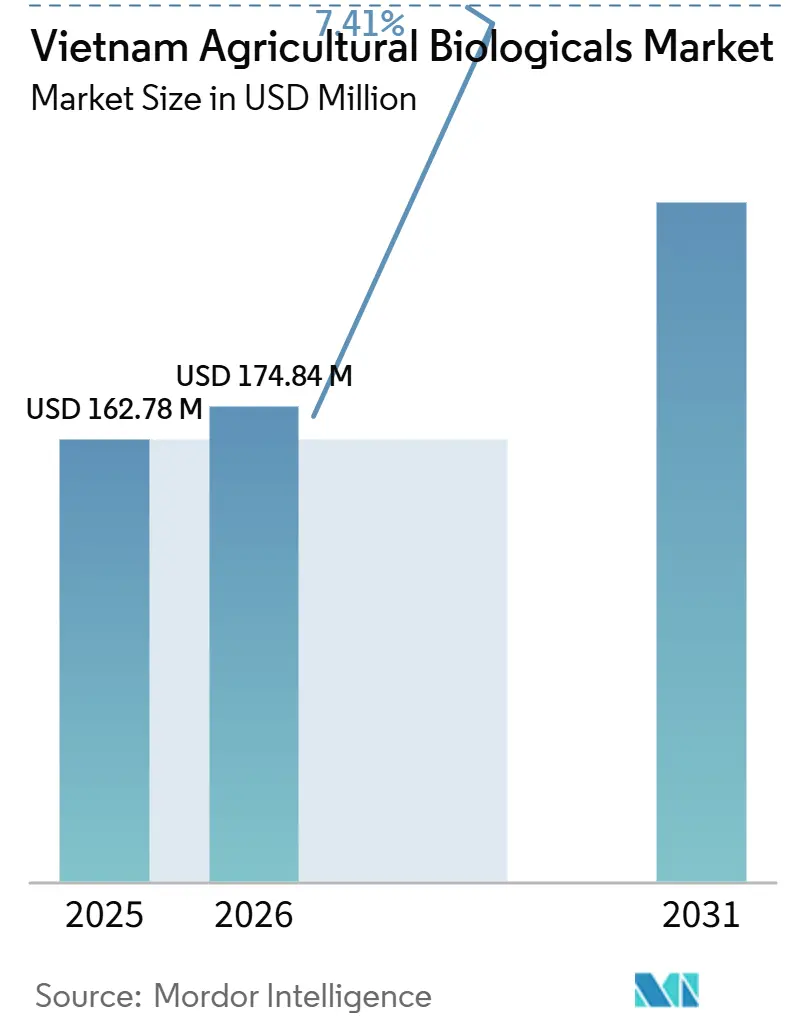
| Base Year Market Size (2025) | USD 162.78 Million |
| Market Size (2026) | USD 174.84 Million |
| Market Size (2031) | USD 249.96 Million |
| Growth Rate (2026 - 2031) | 7.41 % |
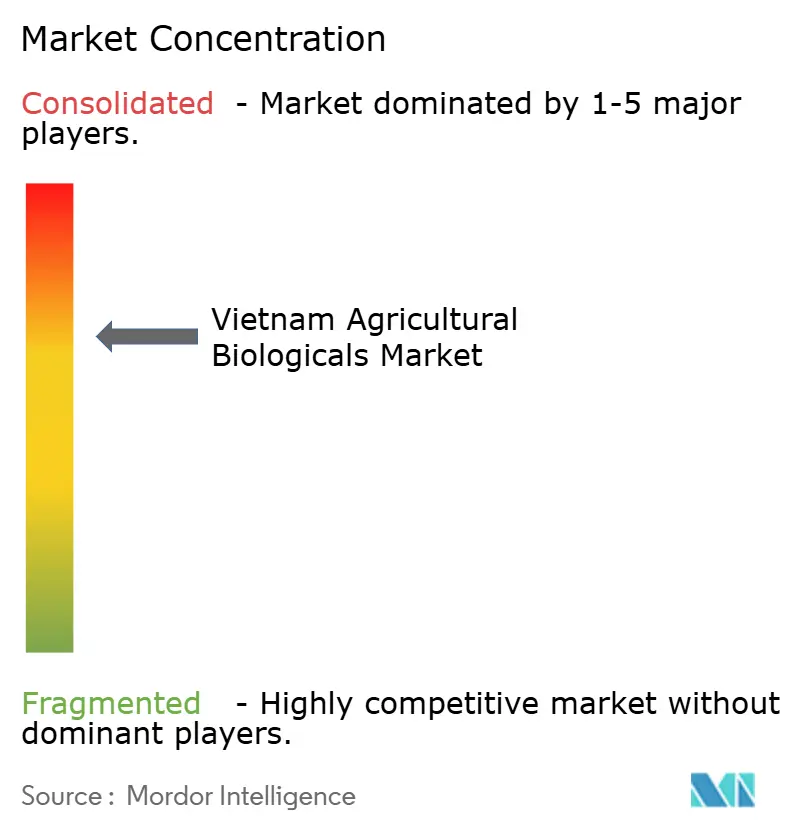
| Market Concentration | Medium |
Major Players *Disclaimer: Major Players sorted in no particular order Image © Mordor Intelligence. Reuse requires attribution under CC BY 4.0. | |
Vietnam Agricultural Biologicals Market Analysis by Mordor Intelligence
The Vietnam Agricultural Biologicals Market size is projected to expand from USD 162.78 million in 2025 and USD 174.84 million in 2026 to USD 249.96 million by 2031, registering a CAGR of 7.41% between 2026 to 2031. The Vietnam agricultural biologicals market is expanding as export agriculture moves away from synthetic inputs amid tighter residue controls, stronger sustainability mandates, and visible stress on soil and crop systems. In February 2026, Vietnam's Circular No. 75/2025/TT-BNNMT updated the national list of permitted plant protection products, including biological plant protection products. The revised regulatory framework expands the range of approved biological solutions, supporting their broader commercialization within Vietnam's crop protection market[1]Source: Ministry of Agriculture and Environment, Vietnam, “Circular No. 75/2025/TT-BNNMT on the Lists of Plant Protection Products Permitted and Banned for Use in Vietnam,” LuatVietnam, luatvietnam.vn. The Vietnam agricultural biologicals market also benefits from national rice decarbonization programs, expanding biological control initiatives, and rising interest in soil-restoration tools that can work in intensive farming systems. At the same time, market expansion is still shaped by import dependence, uneven cold-chain access, product quality variation, and slower adoption among smallholders, which keeps the competitive environment moderately fragmented.
Key Report Takeaways
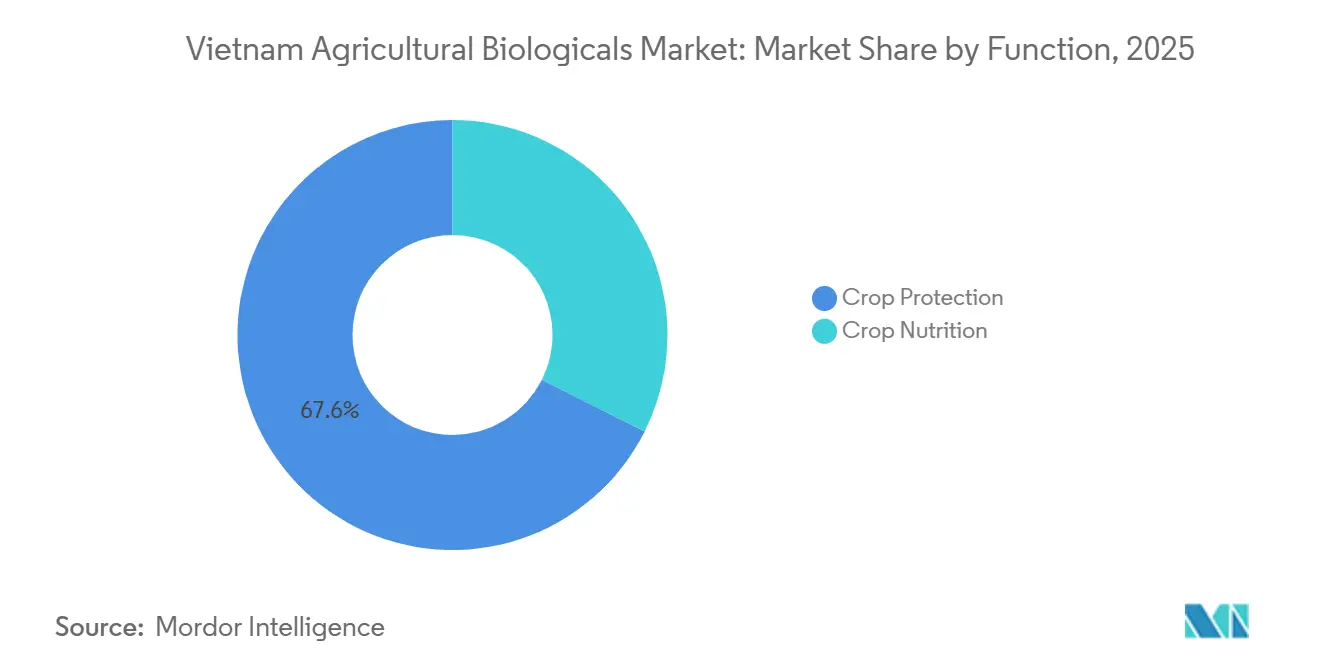
- By function, the largest segment was crop protection, which accounted for 67.6% of the Vietnam agricultural biologicals market share in 2025, while the fastest-growing segment is crop nutrition, projected to grow at a 9.4% CAGR between 2026 to 2031.
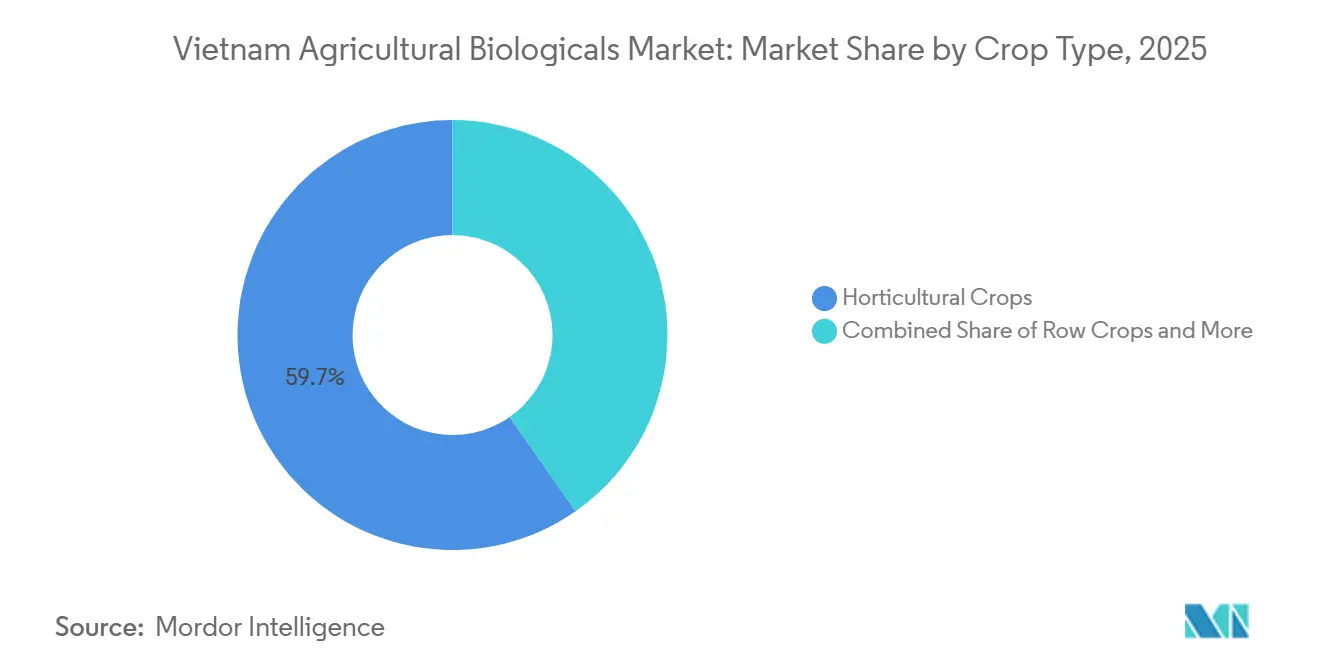
- By crop type, horticultural crops accounted for 59.7% of the Vietnam agricultural biologicals market size in 2025, while row crops are the fastest-growing segment, projected to expand at a 7.5% CAGR between 2026 to 2031.
Note: Market size and forecast figures in this report are generated using Mordor Intelligence’s proprietary estimation framework, updated with the latest available data and insights as of January 2026.
Vietnam Agricultural Biologicals Market Trends and Insights
Drivers Impact Analysis*
| Driver | (~) % Impact on CAGR Forecast | Geographic Relevance | Impact Timeline |
|---|---|---|---|
| Rising adoption of residue-free export crops | +1.3% | Mekong Delta, Central Highlands, and southern coastal export zones | Short term (≤ 2 years) |
| Government support for low-carbon rice and climate-smart farming | +1.1% | Mekong Delta, with scale-up across Long An, An Giang, Can Tho, and Soc Trang | Medium term (2-4 years) |
| Soil health degradation across intensive cropping zones | +0.9% | National, with concentration in the Mekong Delta and Central Highlands | Medium term (2-4 years) |
| Expansion of integrated pest management in high-value horticulture | +1.0% | Lam Dong, Son La, Dak Lak Province, and Central Highlands horticulture zones | Short term (≤ 2 years) |
| Climate stress, salinity, and crop resilience needs | +0.7% | Mekong Delta coastal provinces including Ben Tre, Tra Vinh, Soc Trang, and Kien Giang | Medium term (2-4 years) |
| Digital agri-advisory improves product targeting and trial adoption | +0.5% | National, with early traction in the Mekong Delta and Dak Lak Province | Long term (≥ 4 years) |
| Source: Mordor Intelligence | |||
Rising Adoption of Residue-Free Export Crops
Export compliance remains the clearest near-term growth driver in the Vietnam agricultural biologicals market. Vietnamese fruit and vegetable supply chains are facing stricter residue checks in export channels, and dragon fruit, chili peppers, and okra have already been subject to elevated inspection frequencies in the European market. That pressure is pushing growers toward biological pesticides and biological control measures because residue records now affect commercial access, not just technical compliance. In 2025, the Ministry of Agriculture and Environment, in collaboration with the Food and Agriculture Organization (FAO), launched a project to strengthen Vietnam's capacity to adopt biological plant protection solutions and nature-based pest management. In parallel, the Ministry updated the national register of permitted plant protection products, facilitating the commercialization of approved biological pesticides and supporting wider adoption of sustainable crop protection technologies. As a result, the Vietnam agricultural biologicals market is gaining demand from growers who need traceable input programs that can support export continuity.
Government Support for Low-Carbon Rice and Climate-Smart Farming
The Vietnam agricultural biologicals market is also being supported by state-led rice decarbonization efforts. Pilot models in the Mekong Delta recorded production-cost reductions of 8.2% to 24.2% between 2024 and 2025, supported by lower seed use and reduced applications of synthetic fertilizers and pesticides[2]Source: National Agricultural Extension Center, “Scaling Up High-Quality, Low-Emission Rice Farming Models,” Nhân Dân Online, en.nhandan.vn. In November 2025, the Ministry of Agriculture and Environment has already agreed on a roadmap to implement Measurement, Reporting, and Verification (MRV) protocols across 300,000 hectares of high-quality rice, which will support the wider use of biological inputs in monitored cultivation systems. This program matters because biologicals help farms show lower synthetic input intensity in a format that buyers and policy programs can track. In this setting, the Vietnam agricultural biologicals market is tied to a formal production model rather than to isolated field trials.
Soil Health Degradation Across Intensive Cropping Zones
Soil deterioration in intensive farming areas is creating a longer-term need base for the Vietnam agricultural biologicals market. A 2025 journal study on Ben Tre Province documented major shifts in agricultural land use under salinity intrusion pressure, which underlines how soil and water stress are reshaping crop viability in the Mekong Delta. In this environment, biofertilizers, organic fertilizers, and microbial biostimulants are attracting more attention because they better align with soil-restoration and root-recovery strategies than synthetic-heavy programs. The demand pattern is important because soil repair usually requires repeat use across several seasons, which supports steadier product consumption once adoption begins. That is why the Vietnam agricultural biologicals market is seeing growing interest beyond crop protection and into crop nutrition tools that address structural field stress.
Expansion of Integrated Pest Management in High-Value Horticulture
High-value horticulture is making integrated pest management (IPM) more relevant to the Vietnam agricultural biologicals market. Vietnam’s Department of Crop Production and Plant Protection signed a memorandum of understanding (MOU) with CAB International (CABI) in September 2025 to establish biological control centers, standardize biocontrol protocols, and strengthen phytosanitary diagnostic capacity. In Son La’s Moc Chau district, the Food and Agriculture Organization of the United Nations (FAO) supported greenhouse biological control programs that trained nearly 60 farmers and nursery owners in the use of natural enemies for pest management. These programs matter because vegetables and fruits sold in stricter supply chains need predictable pest control with lower residue risk. That makes the Vietnam agricultural biologicals market stronger in horticulture clusters where advisory support and compliance pressure already exist.
Restraints Impact Analysis*
| Restraint | (~) % Impact on CAGR Forecast | Geographic Relevance | Impact Timeline |
|---|---|---|---|
| Higher upfront cost versus synthetic alternatives | -1.1% | National, with stronger pressure in smallholder-heavy northern and delta farming regions | Short term (≤ 2 years) |
| Limited local fermentation scale and cold-chain reach | -0.7% | National, especially rural Mekong Delta districts and remote northern areas | Medium term (2-4 years) |
| Inconsistent product quality and farmer trust gaps | -0.7% | National, across provinces with weak technical support coverage | Medium term (2-4 years) |
| Slow registration and fragmented product acceptance | -0.5% | National, especially in newer microbial categories | Long term (≥ 4 years) |
| Source: Mordor Intelligence | |||
Higher Upfront Cost Versus Synthetic Alternatives
Higher upfront product cost remains the most persistent adoption restraint in the Vietnam agricultural biologicals market. Many Vietnamese farms operate on small landholdings, so growers tend to judge input economics within a single crop cycle instead of across several seasons. In that setting, a biological program can appear expensive even when it supports better compliance or soil recovery over time. Biological products also often require better timing, handling, and advisory support, which adds indirect cost for growers who lack technical assistance. This means the Vietnam agricultural biologicals market still expands fastest among more commercial farms and organized cooperative structures.
Limited Local Fermentation Scale and Cold-Chain Reach
The Vietnam agricultural biologicals market is still limited by supply-side infrastructure. In 2024, Vietnam imported 18,000 to 20,000 metric tons of biological plant protection products, accounting for nearly 20% of total plant protection product imports, indicating that local fermentation capacity remains insufficient to meet current demand. This dependence matters because microbial products need consistency in production, storage, and transport to perform well at the farm level. Rural cold-chain gaps in parts of the Mekong Delta and remote northern areas limit the reach of sensitive formulations and complicate distribution. That keeps the Vietnam agricultural biologicals market from scaling as quickly as policy ambition suggests.
*Our forecasts treat driver/restraint impacts as directional, not additive. The impact forecasts reflect baseline growth, mix effects, and variable interactions.
Segment Analysis
By Function: Crop Protection Commands Share While Crop Nutrition Scales Fast
Crop Protection is the largest function, accounting for 67.6% of the Vietnam agricultural biologicals market in 2025. This position reflects strong demand for biopesticides in export-oriented horticulture and in rice systems, where scrutiny of residues is rising. Vietnam's biological crop protection market encompasses a diverse array of registered trade names. The agricultural biologicals market in Vietnam benefits from a regulatory framework that has elevated the prominence of biological active ingredients within the national plant protection list. This regulatory support has encouraged the adoption of biological solutions, fostering sustainable agricultural practices and reducing dependency on chemical inputs. Additionally, the inclusion of biological products in the national plant protection list has enhanced their accessibility and acceptance among farmers, further driving market growth.
The segment is led by microbial-based biopesticides, such as Bacillus thuringiensis, Beauveria bassiana, Metarhizium anisopliae, and Trichoderma species, which are already well established in the commercial market. Biocontrol agents still represent a smaller volume base, but their use is increasing where protected horticulture, training support, and traceability standards are already in place. Crop Nutrition is the fastest-growing segment, and the Vietnam agricultural biologicals market size for this segment is projected to expand at a 9.4% CAGR between 2026 to 2031. That growth is being supported by concerns about soil degradation, low-emission rice programs, and demand for biostimulants and biofertilizers to help reduce dependence on synthetic nutrient programs.



By Crop Type: Horticultural Crops Anchor Value While Row Crops Drive Scale
Horticultural Crops are the largest crop type, accounting for 59.7% of the Vietnam agricultural biologicals market share in 2025. This reflects the high value of fruit, vegetable, coffee, pepper, and floriculture chains, where compliance with maximum residue limit (MRL) requirements directly affects market access. The horticulture base is especially important because growers of these crops face greater pressure to document input quality, manage pest control, and minimize residue risk. That makes the Vietnam agricultural biologicals market more commercially mature in horticultural clusters than in many broad-acre systems.
Company activity also supports this pattern. In May 2025, UPL Limited is expanding biological demonstrations in durian through its Pronutiva model, including the use of Foltron XL and Calibra to improve root recovery and reduce the risk of cadmium residues in export orchards. Row Crops are the fastest-growing crop type, and the Vietnam agricultural biologicals market size for this segment is projected to expand at 7.5% CAGR between 2026 to 2031. Rice is the main reason, because the One Million Hectares low-emission program and related MRV rollout are steadily moving biological inputs into formal crop management protocols.
Geography Analysis
The Mekong Delta represented the largest demand center in the Vietnam agricultural biologicals market in 2025. It combines rice scale, fruit export intensity, and policy-backed low-emission cultivation, which gives biological inputs a direct path into commercial field programs. During 2025–2026, the Ministry of Agriculture and Environment is applying MRV protocols across 300,000 hectares of high-quality rice in the region, and that supports stronger use of biological crop protection and crop nutrition products in monitored production systems. The same region also faces salinity and soil stress, so growers are placing more value on inputs that support resilience and reduce synthetic intensity over time.
The Central Highlands form the next major node in the Vietnam agricultural biologicals market. Lam Dong and Dak Lak provinces are especially important because export horticulture, coffee, pepper, and durian create stronger compliance and quality incentives than lower-value field crops. Bayer AG signed a memorandum of understanding with the Western Highlands Agro-Forestry Science Institute in March 2025 to support sustainable agriculture in coffee, durian, and pepper through training, trials, and technology transfer. International programs in Lam Dong and Gia Lai also strengthened good agricultural practices,Integrated Pest Management (IMP), and climate-smart farming capacity among coffee households, which supports more practical field adoption of biological inputs. This makes the Central Highlands a concentrated commercial zone where advisory services and product validation can spread faster across organized value chains.
The Red River Delta and Northern Mountain regions constitute a smaller but still significant part of the Vietnam agricultural biologicals market. These areas matter because vegetables and greenhouse crops for domestic and China-bound channels are facing increasingly stringent traceability requirements. The Food and Agriculture Organization of the United Nations supported work in Son La that trained farmers and nursery owners in natural enemy release for greenhouse pest management of sweet peppers, tomatoes, and lettuce in 2025. Digital support is also helping these regions, with the 2NÔNG application and the AGRIN ecosystem extending diagnostics, records, and traceability into areas with thinner physical extension coverage.
Competitive Landscape
The Vietnam agricultural biologicals market remains moderately fragmented. Bayer AG, BASF SE, Syngenta Group, UPL Limited, and Corteva, Inc. hold stronger positions in technology, registrations, and distribution for crop protection lines, while specialist players such as Koppert B.V., Biobest Group NV, Novonesis, and Certis Biologicals compete on biological efficacy and local adaptation. The market structure is layered because multinational companies lead formulation development and product credibility, while domestic distributors often manage local reach and grower relationships. This arrangement means no single group fully controls the Vietnam agricultural biologicals market, and commercial success depends on both product performance and field execution.
Bayer AG has been especially active in government-linked partnerships. It signed a memorandum of understanding with the National Agricultural Extension Center in April 2025 to expand sustainable farming models for rice, durian, and coffee, including the ForwardFarming program in Mekong Delta rice areas. It also signed a memorandum of understanding with the Western Highlands Agro-Forestry Science Institute in March 2025, providing it with another platform in the Central Highlands crop system. Syngenta Group also strengthened its position in April 2026 through the launch of Banjo Forte 400SC with Vietnam Fumigation Joint Stock Company in Can Tho, supported by participation from more than 300 distributors and retailers[3]Source: Vietnam Fumigation Joint Stock Company, “Ra Mắt Banjo Forte™ 400SC, Giải Pháp Đột Phá Trong Quản Lý Nấm Bệnh Kháng Thuốc,” Vietnam Fumigation Joint Stock Company, vfc.com.vn. These moves show that the Vietnam agricultural biologicals market rewards companies that combine product portfolios with training, demonstrations, and local channel access.
UPL Limited is using a different approach in the Vietnam agricultural biologicals market by bundling biological and conventional inputs under its Pronutiva model. Its durian work in Dong Thap Province shows how biological products can be introduced through crop-quality and export-readiness programs rather than through standalone product sales. Koppert B.V. adds another strategic layer by leveraging its five-year distribution agreement with Amoéba to improve access to biofungicide technology that could become relevant to protected vegetables and high-value horticulture. Over the next phase, companies with cold-chain-stable formulations, localized fermentation know-how, and advisory systems tied to traceability will have the clearest room to differentiate.
Vietnam Agricultural Biologicals Industry Leaders
Bayer AG
BASF SE
Syngenta Group
Corteva, Inc.
UPL Limited
- *Disclaimer: Major Players sorted in no particular order

Recent Industry Developments
- May 2026: UPL Limited expanded its Pronutiva biological demonstration model for durian in Dong Thap Province, in collaboration with Vietnam's Department of Crop Production and Plant Protection, applying Foltron XL and Calibra to restore root systems and reduce cadmium residue risk in export-bound durian orchards.
- April 2026: Syngenta Group, in partnership with the Vietnam Fumigation Joint Stock Company (VFC), launched Banjo Forte 400SC in Can Tho to address fungicide-resistant diseases in rice and vegetable crops across the Mekong Delta. More than 300 distributors and retailers participated in the launch, reflecting Syngenta's focus on expanding its crop protection distribution network in Vietnam. This launch also aligns with the growing adoption of agricultural biologicals in the region.
- April 2025: Bayer AG signed an MOU with the National Agricultural Extension Center (NAEC) in Can Tho to expand sustainable farming models for rice, durian, and coffee, including the use of agricultural biologicals. The agreement includes expansion of the Forward Farming satellite program in Mekong Delta rice-producing provinces, aligned with the One Million Hectares initiative.


Vietnam Agricultural Biologicals Market Report Scope
Agricultural biologicals are crop input solutions derived from living organisms or natural materials, including microbes, plant-based compounds, and beneficial organisms, designed to improve nutrient efficiency, pest and disease control, and overall crop performance. The agricultural biologicals market report is segmented by function (crop nutrition and crop protection) and by crop type (row crops, horticultural crops, and cash crops). The market forecasts are provided in value (USD) and volume (metric tons).
| Crop Nutrition | Organic Fertilizers |
| Biofertilizers | |
| Biostimulants | |
| Crop Protection | Biopesticides |
| Biocontrol Agents |
| Row Crops |
| Horticultural Crops |
| Cash Crops |
| By Function | Crop Nutrition | Organic Fertilizers |
| Biofertilizers | ||
| Biostimulants | ||
| Crop Protection | Biopesticides | |
| Biocontrol Agents | ||
| By Crop Type | Row Crops | |
| Horticultural Crops | ||
| Cash Crops | ||


Key Questions Answered in the Report
What is the forecast value of agricultural biologicals in Vietnam by 2031?
The report projects the category to reach USD 249.96 million by 2031, rising from USD 174.84 million in 2026 at a 7.41% CAGR over 2026 to 2031.
Which function leads demand in Vietnam?
Crop Protection was the largest function in 2025, with 67.6% share, supported by stronger demand for biopesticides in export-linked horticulture and rice systems.
Which crop group is expanding the fastest?
Row Crops are the fastest-growing crop type, with a projected 7.5% CAGR through 2031, driven mainly by low-emission rice programs in the Mekong Delta.
Why are biological inputs gaining traction in export agriculture?
Export growers are under stronger residue and traceability pressure, so biological products are being used more often to support compliance in fruits, vegetables, and other high-value crops.
What is the main barrier to wider farmer adoption?
The biggest challenge remains the higher effective cost of adoption, especially for smallholders who evaluate returns over one crop cycle and often lack technical support.
Which region matters most for demand?
The Mekong Delta is the largest demand center because it combines rice scale, fruit exports, and policy-backed low-emission cultivation programs that favor biological input use.
Page last updated on:





