
Video Delivery Platform Market Size and Share
Market Overview
| Study Period | 2020 - 2031 |
|---|---|
| Market Size (2026) | USD 5.35 Billion |
| Market Size (2031) | USD 10.12 Billion |
| Growth Rate (2026 - 2031) | 13.60 % |
| Fastest Growing Market | Asia-Pacific |
| Largest Market | North America |
| Market Concentration | Medium |
Major Players *Disclaimer: Major Players sorted in no particular order Image © Mordor Intelligence. Reuse requires attribution under CC BY 4.0. | |
Video Delivery Platform Market Analysis by Mordor Intelligence
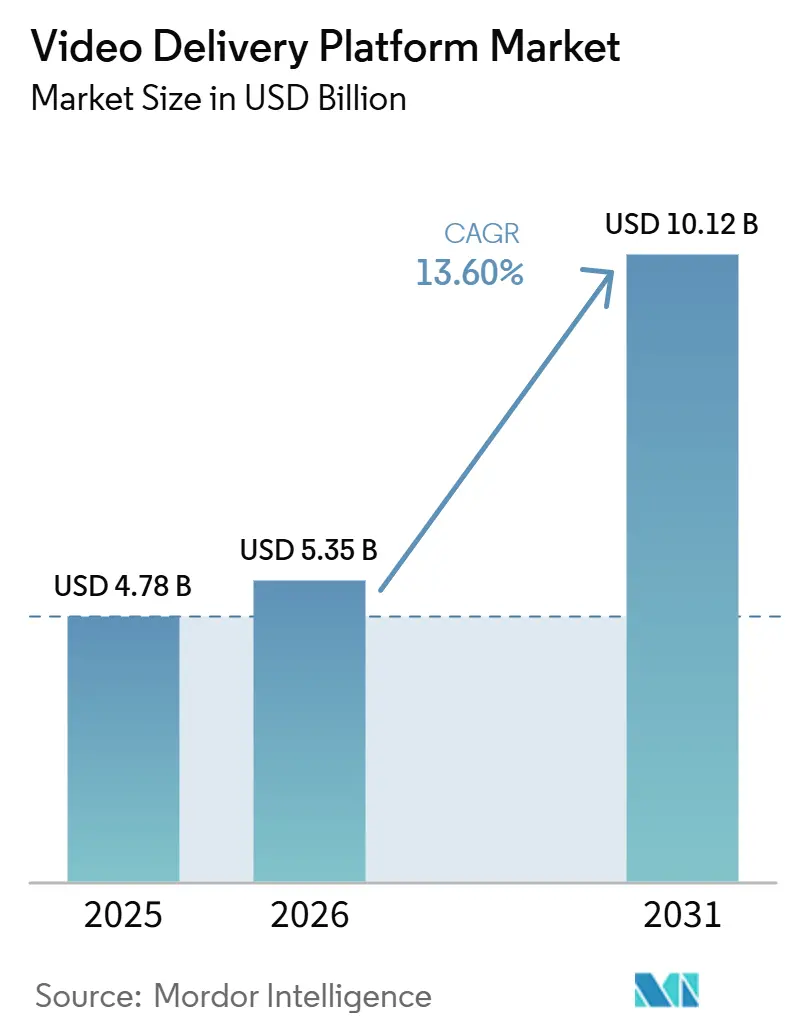
The video delivery platform market size is expected to increase from USD 4.78 billion in 2025 to USD 5.35 billion in 2026 and reach USD 10.12 billion by 2031, growing at a CAGR of 13.60% over 2026-2031. Organizations are moving from appliance-based delivery stacks toward modular cloud-native systems that can support live events and on-demand libraries at variable scale. Spending on premium sports rights, faster production workflows, and broader edge coverage are raising demand for ingestion, encoding, packaging, and distribution tools. Providers in the video delivery platform market are competing through low-latency delivery, codec improvements, workflow automation, and regional capacity, rather than solely through content delivery, because enterprise customers increasingly assess performance across the entire video workflow. The video delivery platform market also faces pressure from bandwidth and egress costs, device compatibility requirements, and different data rules across regions. Demand in the video delivery platform market remains supported by local content investment and sovereign digital media programs in the Asia Pacific and the Middle East through the forecast period.
Key Report Takeaways
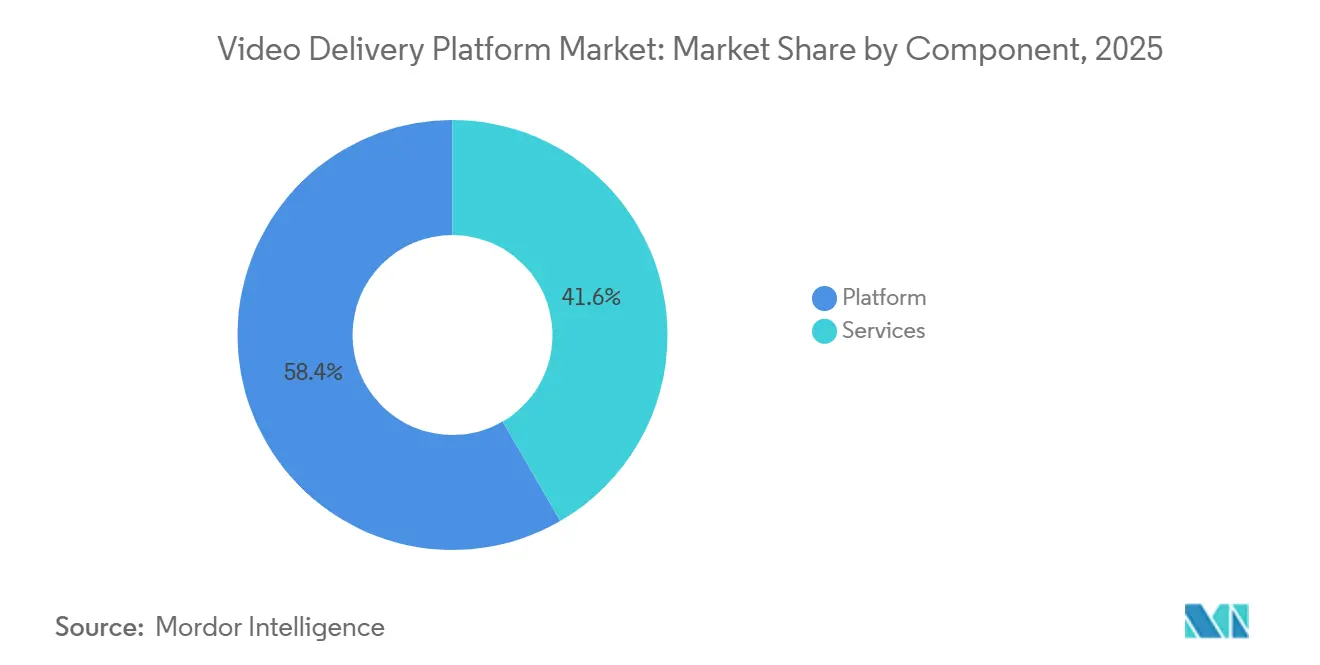
- By component, the Platform segment held 58.36% of the video delivery platform market share in 2025, while Services is projected to expand at a 14.18% CAGR through 2031.
- By streaming type, Video-on-Demand held 68.74% of revenue in 2025, while Live Video Streaming is projected to expand at a CAGR of 14.55% through 2031.
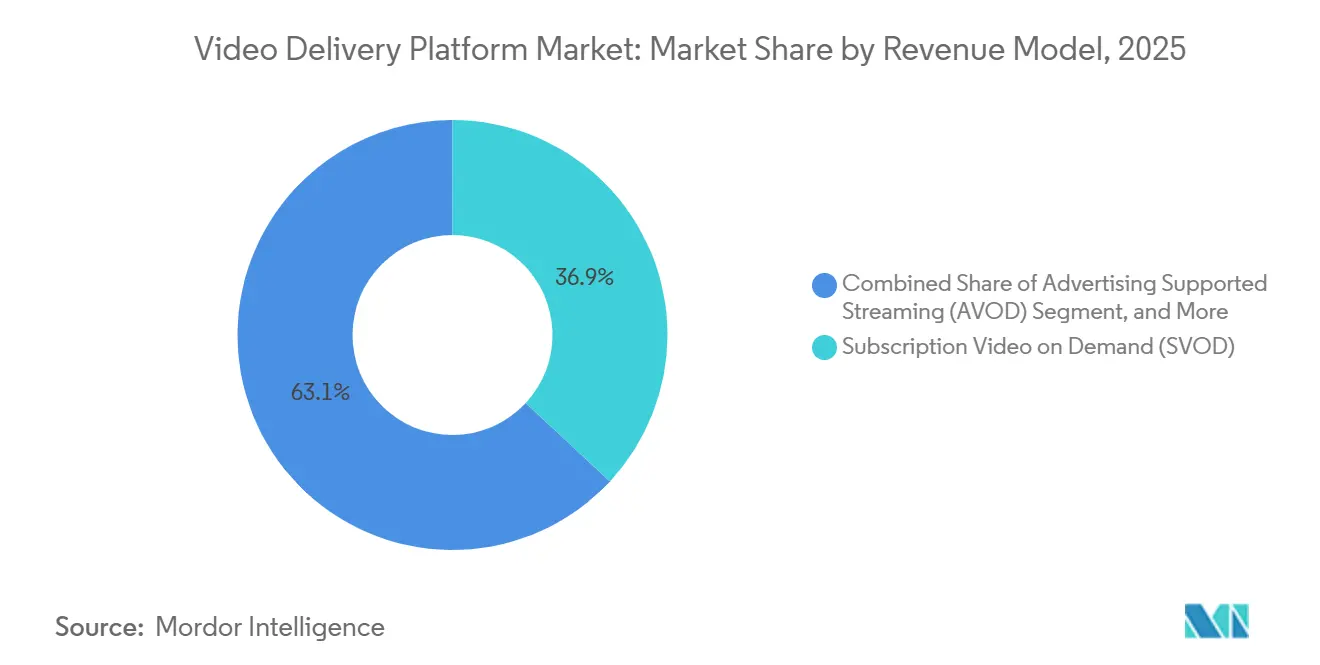
- By revenue model, Subscription Video on Demand (SVOD) held 36.92% of revenue in 2025, while Advertising Supported Streaming (AVOD) is projected to expand at a CAGR of 14.21% through 2031.
- By end user, Media and Entertainment held 35.72% of revenue in 2025, while Retail and E-commerce is projected to expand at a CAGR of 13.96% through 2031.
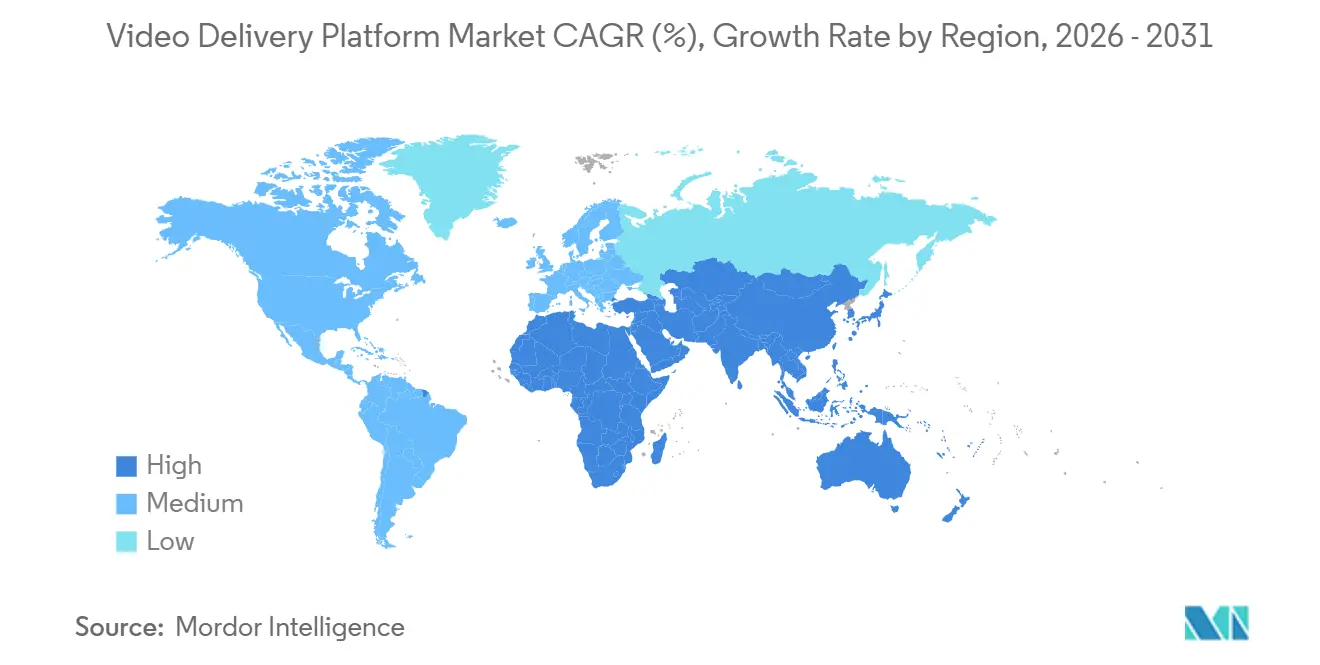
- By geography, North America held 37.68% of revenue in 2025, while Asia Pacific is projected to expand at a CAGR of 14.38% through 2031.
Note: Market size and forecast figures in this report are generated using Mordor Intelligence’s proprietary estimation framework, updated with the latest available data and insights as of January 2026.
Market Trends and Insights
Drivers Impact Analysis of Video Delivery Platform Market*
| Driver | (~) % Impact on CAGR Forecast | Geographic Relevance | Impact Timeline |
|---|---|---|---|
| Monetized Live Sports and Event Streaming Growth | +2.8% | Global, with peak concentration in North America, India, and Western Europe | Short term (≤ 2 years) |
| Rising Demand for Low-Latency Live Delivery | +2.5% | Global, with highest urgency in North America, Asia Pacific, and Western Europe | Short term (≤ 2 years) |
| AI-Driven Workflow Automation and Localization | +2.2% | Global, with early adoption concentrated in North America and Western Europe | Medium term (2-4 years) |
| Multi-CDN and Edge Compute Expansion | +1.8% | Global, with critical node expansion across Asia Pacific, Middle East, and Africa | Medium term (2-4 years) |
| Cloud-Native Delivery Reducing Infrastructure Burden | +1.5% | Global, with high impact in India, Southeast Asia, and South America | Medium term (2-4 years) |
| Content-Aware Network Optimization for Peak Traffic Events | +1.2% | Global, with the greatest need during large live events with concentrated regional audiences | Long term (≥ 4 years) |
| Source: Mordor Intelligence | |||
Monetized Live Sports and Event Streaming Drives Infrastructure Investment
Live sports and premium events are a central source of demand for the video delivery platform market, because rights holders need dependable capacity during short, concentrated audience peaks. Streaming services were projected to spend USD 14.2 billion on sports rights in 2026, compared with USD 13.2 billion in 2025. Amazon Prime Video was projected to account for USD 3.8 billion, or 27%, of streamer sports-rights spending in 2026. Each rights commitment requires ingest, transcoding, origin, and content delivery network capacity.[1]Amazon Web Services, “Announcing AWS Elemental Inference - Generally Available,” AWS News, aws.amazon.com Platforms must retain capacity during traffic peaks, even when events are infrequent. This can create an opportunity for providers to rent unused capacity through a content delivery network-as-a-service offering.
Rising Demand for Low-Latency Live Delivery Reshapes Protocol Standards
Viewer expectations have moved beyond the latency levels supported by conventional HTTP Adaptive Streaming, creating a clear upgrade need across the video delivery platform market. Media over QUIC entered commercial production deployment in May 2026, with BEAM Media Corp reporting sub-100 millisecond end-to-end latency for live streams across 210 countries. Oracle expanded its Video Edge architecture in 2026 to support relay deployment across third-party content delivery networks and internet service provider networks, using Media over QUIC for coordination. The protocol removes the fixed segment timing constraints of HLS and DASH. Its object-based transport approach supports quality adjustment at shorter intervals. This matters for interactive video and social commerce settings, where latency can affect audience participation and transaction completion.
AI-Driven Workflow Automation and Localization Improves Production Efficiency
AI capabilities are moving into encoding pipelines rather than remaining a separate post-production function, changing how the video delivery platform market approaches production speed and content reuse. AWS Elemental Inference became generally available in February 2026 as a managed service placed alongside encoding workflows. During beta testing, large media companies reported savings of more than 34% in AI-enabled live video workflows compared with several point solutions. The service can create vertical crops and social clips from live video without a dedicated production staff. This lets broadcasters distribute clips to TikTok, Instagram Reels, and YouTube Shorts during an event. Providers that combine inference at encoding and delivery stages can improve both operational speed and service differentiation.
Multi-CDN and Edge Compute Expansion Reduces Latency and Delivery Risk
Multi-CDN architectures are becoming necessary for platforms serving concurrent audiences of over 100,000 viewers, underscoring the importance of traffic control in the video delivery platform market. NPAW introduced Orion MulticastABR for commercial deployment in the second quarter of 2026 to deliver a single adaptive bitrate stream at the network edge via multicast. Google expanded Media CDN capacity in regions with concentrated live-event demand in 2026. Google also increased the service's maximum segment size to 25 MiB for 4K and 8K content. Multi-CDN deployment is now used for active traffic management and resilience. Platforms can route traffic among providers according to current pricing and performance conditions.
Restraints Impact Analysis of Video Delivery Platform Market*
| Restraint | (~) % Impact on CAGR Forecast | Geographic Relevance | Impact Timeline |
|---|---|---|---|
| Escalating Bandwidth, Transcoding, and Egress Costs | -1.8% | Global, with the strongest effect in Asia Pacific and South America, where egress rates are 2-4 times North American levels | Short term (≤ 2 years) |
| Fragmented Device, Codec, and Player Compatibility | -1.4% | Global, with greater complexity in Asia Pacific because of device diversity | Medium term (2-4 years) |
| Rights, Privacy, and Data Residency Complexity | -1.1% | Europe, Southeast Asia, and India | Medium term (2-4 years) |
| Inconsistent QoE in Emerging Network Environments | -0.9% | Africa, South and Southeast Asia, and parts of South America | Long term (≥ 4 years) |
| Source: Mordor Intelligence | |||
Escalating Bandwidth, Transcoding, and Egress Costs Constrain Margin Expansion
Large-scale video delivery costs remain difficult for operators to control, and the video delivery platform market must address this pressure without weakening delivery quality. AWS CloudFront charged USD 0.085 per GB for the first 10 TB of monthly delivery traffic in 2026. Asia Pacific and South American egress rates were 2-4 times the North American baseline. The EU Data Act is expected to prohibit cloud switching and egress fees for in-scope providers serving EU customers from January 2027. The rule can alter supplier negotiations in Europe, but it does not resolve structural delivery costs elsewhere. Operators are using content-aware encoding, edge caching, and storage configurations that avoid egress charges to limit cost growth.
Fragmented Device, Codec, and Player Compatibility Increases Engineering Overhead
The coexistence of H.264, HEVC, AV1, VVC, and older device formats increases the encoding workload for each content release across the video delivery platform market. The affected device base includes smart televisions, mobile handsets, set-top boxes, game consoles, and web browsers. Bitmovin received 2 U.S. patents in December 2025 for scalable per-title encoding and video encoding complexity prediction. The work extends beyond compute spending to player software development kits, bitrate profile validation, and session-level quality monitoring. Providers that cannot automate codec selection and compatibility testing face higher engineering costs and slower feature delivery. Smaller vendors can lose complex enterprise accounts to providers with larger engineering teams.
*Our forecasts treat driver/restraint impacts as directional, not additive. The impact forecasts reflect baseline growth, mix effects, and variable interactions.
Video Delivery Platform Market Segment Analysis
By Component:
Integrated Platforms Lead While Services ExpandThe Platform segment held 58.36% of the video delivery platform market share in 2025, encompassing ingest, capture, processing, encoding, transcoding, analytics, quality-of-experience monitoring, and content security. Enterprise buyers prefer unified vendor stacks because they reduce the integration work across the video workflow and provide clearer operational accountability. The Platform segment also concentrates on the technologies that shape delivery quality in the video delivery platform market, from contribution intake through playback protection and session monitoring. Services, including professional and managed services, are projected to grow at a CAGR of 14.18% through 2031 as operating models become more difficult to manage internally. Multi-CDN coordination, AI model management, and continuous live operations are increasing the value of expert support for organizations without large dedicated teams.
The line between platform software and managed services is becoming less clear as AI-enabled tasks are added to hosted products. Functions formerly handled by managed service teams can now be incorporated into automated live operations workflows, thereby reducing standalone service revenue while increasing the total contract value for the platform provider. GDPR requirements and emerging national AI governance frameworks also create demand for professional services that assess content moderation and analytics modules. Ingest and capture functions are receiving targeted investment as organizations replace dedicated satellite or fiber contribution links with IP workflows using SRT and RTMP. Harmonic presented VOS360 enhancements at the 2026 NAB Show, including AI-driven orchestration and a server-side multiview function that can work with in-stream advertising.


By Streaming Type:
VOD Scale Contrasts with Live Video MomentumVideo-on-Demand accounted for 68.74% of the video delivery platform market in 2025, reflecting the accumulated libraries and persistent origin and CDN requirements of global subscription streaming services. Its large installed base means that VOD will remain the largest absolute revenue contributor through 2031 even if its relative share moderates. The European audiovisual market generated EUR 142 billion (USD 153.5 billion) at the 2024 yearly average exchange rate, while consumer streaming expenditure exceeded EUR 72 billion (USD 77.9 billion).[2]European Audiovisual Observatory, “The Value of Europe’s Audiovisual Market Is Estimated at EUR 142 Billion,” Council of Europe, obs.coe.int This base of on-demand viewing requires continuous investment in origin capacity, storage management, delivery resilience, and playback quality across the video delivery platform market. Providers are using cache efficiency, multi-region origin replication, and AV1 adoption to control traffic costs while maintaining consistent quality.
Live Video Streaming is projected to grow at a CAGR of 14.55% through 2031, supported by sports rights, corporate communication, e-learning, and live retail activity. The Interactive Advertising Bureau projected that digital video spending, including live streaming, would grow 11% year over year in 2026 and exceed 60% of total television and video spending. Live workflows require low-latency ingest, real-time encoding, dynamic content delivery configuration, and redundant failover paths that cannot be pre-cached. These requirements make live delivery operationally different from serving a stored library through conventional on-demand distribution. Platforms with Media over QUIC, sub-second packaging, and elastic cloud-burst transcoding are better positioned to win contracts with strict latency requirements.
By Revenue Model:
SVOD Leads While AVOD Changes Platform RequirementsSubscription Video on Demand held 36.92% of revenue in 2025, supported by the large subscriber bases of global streaming services and the higher revenue per user associated with subscription tiers. The supporting infrastructure needs highly available origin systems, multi-DRM enforcement, subscriber-level entitlement management, and delivery capacity that can consistently serve large libraries. These needs create a complicated but relatively predictable deployment pattern for video delivery providers. Transactional and pay-per-view offerings, hybrid monetization, and freemium tiers make up the remaining revenue models in the video delivery platform market. Hybrid models are gaining use as streaming services add advertising-supported plans to existing subscription bases, requiring providers to manage several delivery configurations in parallel.
Advertising-Supported Streaming is projected to grow at a CAGR of 14.21% through 2031 and requires more demanding delivery controls than SVOD. Server-side ad insertion must add advertising segments to a stream without buffering, manifest errors, or playback disruption that viewers can identify. AWS made server-side ad insertion available for Amazon IVS Low-Latency Streaming in April 2026 through integration with AWS Elemental MediaTailor. The capability supports real-time stream monetization while retaining low-latency playback, which had limited advertiser use of these formats. AVOD growth makes sub-segment ad decisioning, audience measurement, and campaign confirmation more important, expanding the role of quality monitoring and analytics in a delivery platform.

By End User:
Media Supports Revenue While Retail Changes Growth ExpectationsMedia and Entertainment accounted for 35.72% of revenue in 2025, driven by high video traffic volumes from broadcast networks, over-the-top services, and digital publishers. These customers use the full platform stack, from contribution ingest and multibitrate encoding through global CDN delivery and digital rights management. Their sustained content output makes this group the principal revenue anchor for enterprise video delivery providers and supports durable demand in the video delivery platform market. E-learning and education use scalable hosting and analytics for corporate learning and academic delivery, while BFSI organizations use video for investor communication, compliance training, and frequent market updates. Healthcare and Life Sciences, along with Government and Public Sector organizations, add smaller but premium opportunities where telemedicine or public broadcasting mandates support demand.
Retail and e-commerce are projected to grow at a CAGR of 13.96% through 2031 as live commerce and shoppable video become more common in digital sales journeys. This use case requires reliable, real-time delivery; transaction-ready advertising insertion; audience measurement; and the ability to handle unpredictable audience peaks. MercadoLibre expanded Mercado Play to smart televisions across 72 million devices in South America by April 2025. The company reported that viewing time on smart televisions was 50% longer per session than on desktop devices. The service provides a regional precedent for advertising-supported and live commerce delivery infrastructure that larger platforms are evaluating. Video providers must also support PCI DSS compliance when payment and advertising functions interact within shoppable video streams.
Geography Analysis
North America Video Delivery Platform Market
North America held 37.68% of the video delivery platform market share in 2025, supported by the region's large concentration of hyperscale CDN infrastructure, premium subscription streaming services, sports investment, and enterprise video deployments. Streaming providers were projected to spend USD 14.2 billion on sports rights in 2026, increasing the need for capacity across ingest, transcoding, origin, and delivery layers. Major AWS, Akamai, and Google Cloud data center networks are readily accessible to regional platforms, and North American providers are early adopters of Media over QUIC transport, server-side ad insertion, and other capability-led delivery functions. Mexico is expanding through mobile-focused streaming plans and content rights distribution that can be coordinated with the United States.
APAC Video Delivery Platform Market
Asia Pacific is projected to grow at a CAGR of 14.38% through 2031, with India and Southeast Asia accounting for the highest demand. JioHotstar averaged 530 million monthly active users during the first quarter of fiscal year 2027. The IPL 2026 tournament reached 700 million digital viewers and recorded a peak concurrent stream of 72.5 million, requiring extensive capacity planning and creating a demanding environment for live delivery platforms. Regional linguistic and geographic diversity also supports demand for localized content, wider CDN node coverage, and encoding profiles optimized for mobile viewing. AWS expanded Elemental Media Services to the Asia Pacific Malaysia Region in February 2026, enabling broadcasters to process video closer to Southeast Asian audiences.
EMEA and South America Video Delivery Platform Market
Europe had a meaningful share of the video delivery platform market in 2025 because of its large audiovisual economy and established consumer streaming activity. Germany, the United Kingdom, France, Italy, and Spain account for much of Western Europe's delivery spending, while Eastern European markets are growing from lower penetration levels. Synamedia and MoMe launched Spain's first streaming-optimized CDN service in March 2026 through Synamedia Fluid EdgeCDN.[3]Synamedia, “MoMe Selects Synamedia to Power Spain’s First CDN for Streaming,” Synamedia Press Release, synamedia.com The service provides low-latency video in Spain and multi-CDN delivery for wider European markets. The Middle East and Africa remain earlier-stage areas where digital media investment is creating new demand, while South America adds traffic to the video delivery platform market as streaming distribution grows around major sports events.

Competitive Landscape
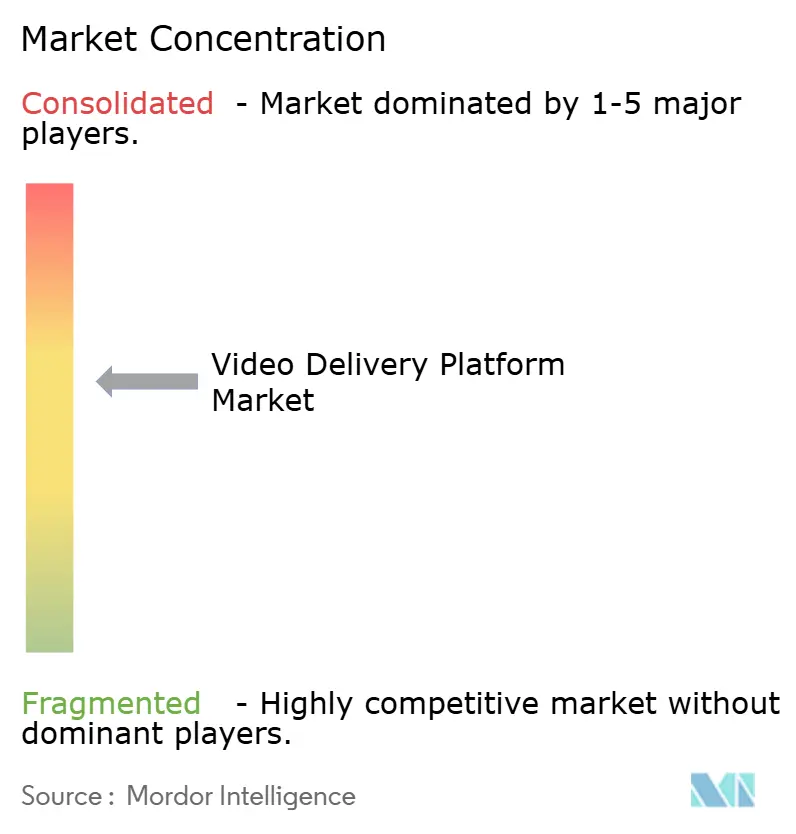
The video delivery platform market is moderately concentrated at the infrastructure layer, where Amazon Web Services, Microsoft Azure Media Services, and Google Cloud have advantages in CDN reach, transcoding capacity, and AI service availability. Below this group, the competitive structure is more fragmented, with Akamai, Kaltura, Mux, Bitmovin, Wowza, Synamedia, and MediaKind competing through expertise in specific video delivery platform market needs. These specialists focus on use cases including live sports, enterprise communication, retail video, and broadcast-grade contribution workflows. The rising cost of maintaining codec, AI, and protocol capabilities is encouraging consolidation among mid-sized providers, illustrated by MediaKind's June 2026 merger with Harmonic's video business, which created an independent provider with more than USD 100 million in annual recurring revenue and more than USD 150 million in annual appliance revenue.
Hyperscalers are integrating video capabilities more deeply into their broader media workflow portfolios, which can make a cloud provider's offering more central to a customer's operations. AWS introduced Elemental Inference as a managed service that connects AI capabilities directly to encoding and can reduce the need for separate AI tools. Specialist vendors are using encoding and playback technology to retain differentiation in deployments where quality expectations are high. Bitmovin's 2025 patents cover scalable per-title encoding and complexity prediction, supporting its approach to content-adaptive delivery. Providers that can improve quality while limiting delivery costs are better placed in enterprise procurement, especially where multiple devices and audiences must be served together.
Another group is extending video platforms into content intelligence and personalized digital experiences for enterprise and education customers, broadening the role of the video delivery platform market. Kaltura signed a definitive agreement to acquire PathFactory in March 2026 for USD 22 million in cash. The transaction links video delivery infrastructure to AI-based content decisioning and supports the provider's position beyond distribution alone.[4]Kaltura, “Kaltura Signs Definitive Agreement to Acquire PathFactory.ai,” GlobeNewswire, globenewswire.com Opportunities remain in ultra-low-latency interactive streaming, AI-based localization at scale, and energy-aware encoding. EU AI Act transparency obligations for AI-generated media can add a new compliance category for providers that deploy automated moderation and AI dubbing at scale.
Video Delivery Platform Industry Leaders
Amazon Web Services, Inc.
Akamai Technologies, Inc.
Microsoft Corporation
Alphabet Inc.
Cisco Systems, Inc.
- *Disclaimer: Major Players sorted in no particular order
Video Delivery Platform Market Companies Covered in this Report
- Amazon Web Services, Inc.
- Akamai Technologies, Inc.
- Microsoft Corporation
- Alphabet Inc.
- Cisco Systems, Inc.
- Kaltura, Inc.
- Brightcove Inc.
- Vimeo.com, Inc.
- Wowza Media Systems, LLC
- Synamedia Limited
- Haivision Inc.
- Bitmovin Inc.
- Comcast Technology Solutions, Inc.
- MediaKind
- Dacast Inc.
- JW Player, Inc.
- Panopto, Inc.
- Mux, Inc.
- Vbrick Systems, Inc.
- Vidyard, Inc.
- Amagi Media Labs Private Limited
- Ateme S.A.

Recent Industry Developments in Video Delivery Platform Market
- June 2026: MediaKind completed its merger with Harmonic Inc.'s video business for USD 145 million in cash, creating the world's largest independent video infrastructure company with more than USD 100 million in ARR and over USD 150 million in annual appliance revenue. The combined entity entered the market with complementary strengths across SaaS streaming, cloud, and appliance deployments, serving a global blue-chip customer base.
- April 2026: Amazon Web Services launched server-side ad insertion support for Amazon IVS Low-Latency Streaming, integrating with AWS Elemental MediaTailor to stitch ads directly into live streams. This capability enables AVOD monetization of real-time streams without degrading low-latency playback, directly addressing the monetization gap that had limited advertiser investment in sub-5-second live streams.
- March 2026: Synamedia and MoMe launched Spain's first streaming-optimized CDN service powered by Synamedia Fluid EdgeCDN, delivering low-latency video across Spain and supporting multi-CDN delivery for broader European markets. The service represents a significant regional infrastructure milestone for broadcaster-grade IP delivery outside the US-centric hyperscaler network.
- March 2026: Harmonic introduced AI-driven enhancements to VOS360 Media SaaS at the 2026 NAB Show, including a server-side multiview solution with in-stream ad monetization and a next-generation Spectrum X media server targeting broadcasters seeking to reduce workflow complexity while expanding live sports fan engagement.


Global Video Delivery Platform Market Report Scope
The video delivery platform market covers software and services that enable organizations to upload, manage, process, secure, distribute, and monetize video content across devices and networks. The scope of the report includes platforms used for live streaming, video-on-demand, enterprise video, over-the-top (OTT) content delivery, and related content management and analytics capabilities across end-user industries.
The Video Delivery Platform Market Report is Segmented by Component (Platform [Ingest and Capture, Processing, Encoding, and Transcoding, Analytics and QoE Monitoring, and Content Security and DRM], and Services [Professional Services, and Managed Services]), Streaming Type (Live Streaming, and Video on Demand Streaming), Revenue Model (Subscription Video on Demand (SVOD), Advertising Supported Streaming (AVOD), Transactional and Pay-Per-View (TVOD), Hybrid Monetization, and Freemium), End User (Media and Entertainment, E-Learning and Education, BFSI, Retail and E-commerce, IT and Telecommunication, Healthcare and Life Sciences, Government and Public Sector, and Other End Users), and Geography (North America, South America, Europe, Asia Pacific, Middle East, and Africa). The Market Forecasts are Provided in Terms of Value (USD).
| Platform | Ingest and Capture |
| Processing, Encoding, and Transcoding | |
| Analytics and QoE Monitoring | |
| Content Security and DRM | |
| Services | Professional Services |
| Managed Services |
| Live Video Streaming |
| Video on Demand Streaming |
| Subscription Video on Demand (SVOD) |
| Advertising Supported Streaming (AVOD) |
| Transactional and Pay-Per-View (TVOD) |
| Hybrid Monetization |
| Freemium |
| Media and Entertainment |
| E-Learning and Education |
| BFSI |
| Retail and E-commerce |
| IT and Telecommunication |
| Healthcare and Life Sciences |
| Government and Public Sector |
| Other End Users |
| North America | United States |
| Canada | |
| Mexico | |
| South America | Brazil |
| Argentina | |
| Chile | |
| Rest of South America | |
| Europe | Germany |
| United Kingdom | |
| France | |
| Italy | |
| Spain | |
| Rest of Europe | |
| Asia-Pacific | China |
| Japan | |
| India | |
| South Korea | |
| Australia | |
| Rest of Asia-Pacific | |
| Middle East | Saudi Arabia |
| United Arab Emirates | |
| Qatar | |
| Rest of Middle East | |
| Africa | South Africa |
| Egypt | |
| Nigeria | |
| Rest of Africa |
| By Component | Platform | Ingest and Capture |
| Processing, Encoding, and Transcoding | ||
| Analytics and QoE Monitoring | ||
| Content Security and DRM | ||
| Services | Professional Services | |
| Managed Services | ||
| By Streaming Type | Live Video Streaming | |
| Video on Demand Streaming | ||
| By Revenue Model | Subscription Video on Demand (SVOD) | |
| Advertising Supported Streaming (AVOD) | ||
| Transactional and Pay-Per-View (TVOD) | ||
| Hybrid Monetization | ||
| Freemium | ||
| By End User | Media and Entertainment | |
| E-Learning and Education | ||
| BFSI | ||
| Retail and E-commerce | ||
| IT and Telecommunication | ||
| Healthcare and Life Sciences | ||
| Government and Public Sector | ||
| Other End Users | ||
| By Geography | North America | United States |
| Canada | ||
| Mexico | ||
| South America | Brazil | |
| Argentina | ||
| Chile | ||
| Rest of South America | ||
| Europe | Germany | |
| United Kingdom | ||
| France | ||
| Italy | ||
| Spain | ||
| Rest of Europe | ||
| Asia-Pacific | China | |
| Japan | ||
| India | ||
| South Korea | ||
| Australia | ||
| Rest of Asia-Pacific | ||
| Middle East | Saudi Arabia | |
| United Arab Emirates | ||
| Qatar | ||
| Rest of Middle East | ||
| Africa | South Africa | |
| Egypt | ||
| Nigeria | ||
| Rest of Africa | ||


Key Questions Answered in the Report
What is the video delivery platform market size?
The video delivery platform market is expected to increase from USD 4.78 billion in 2025 to USD 5.35 billion in 2026 and reach USD 10.12 billion by 2031 at a CAGR of 13.60%.
What is driving demand for video delivery platforms?
What is driving demand for video delivery platforms? Live sports, low-latency delivery needs, AI-enabled production workflows, and wider edge infrastructure are supporting demand.
Which component leads video delivery platform spending?
The Platform component led with 58.36% of revenue in 2025, while Services is projected to grow at a CAGR of 14.18% through 2031.
Why is live streaming important for video delivery providers?
Live Video Streaming is projected to grow at a CAGR of 14.55% through 2031 and requires low-latency ingest, real-time encoding, and resilient delivery paths.
Which region is growing fastest for video delivery platforms?
Asia Pacific is projected to grow at a CAGR of 14.38% through 2031, supported by demand in India and Southeast Asia.
What challenges do video delivery platform providers face?
Key challenges include bandwidth and egress costs, fragmented device and codec requirements, data rules, and inconsistent network quality in some regions.
Page last updated on:





