
Vaginal Fungi Infections Treatment Market Size and Share
Market Overview
| Study Period | 2021 - 2032 |
|---|---|
| Market Size (2027) | USD 1.79 Billion |
| Market Size (2032) | USD 2.67 Billion |
| Growth Rate (2027 - 2032) | 6.82 % |
| Fastest Growing Market | Asia-Pacific |
| Largest Market | North America |
| Market Concentration | Low |
Major Players *Disclaimer: Major Players sorted in no particular order Image © Mordor Intelligence. Reuse requires attribution under CC BY 4.0. | |
Vaginal Fungi Infections Treatment Market Analysis by Mordor Intelligence
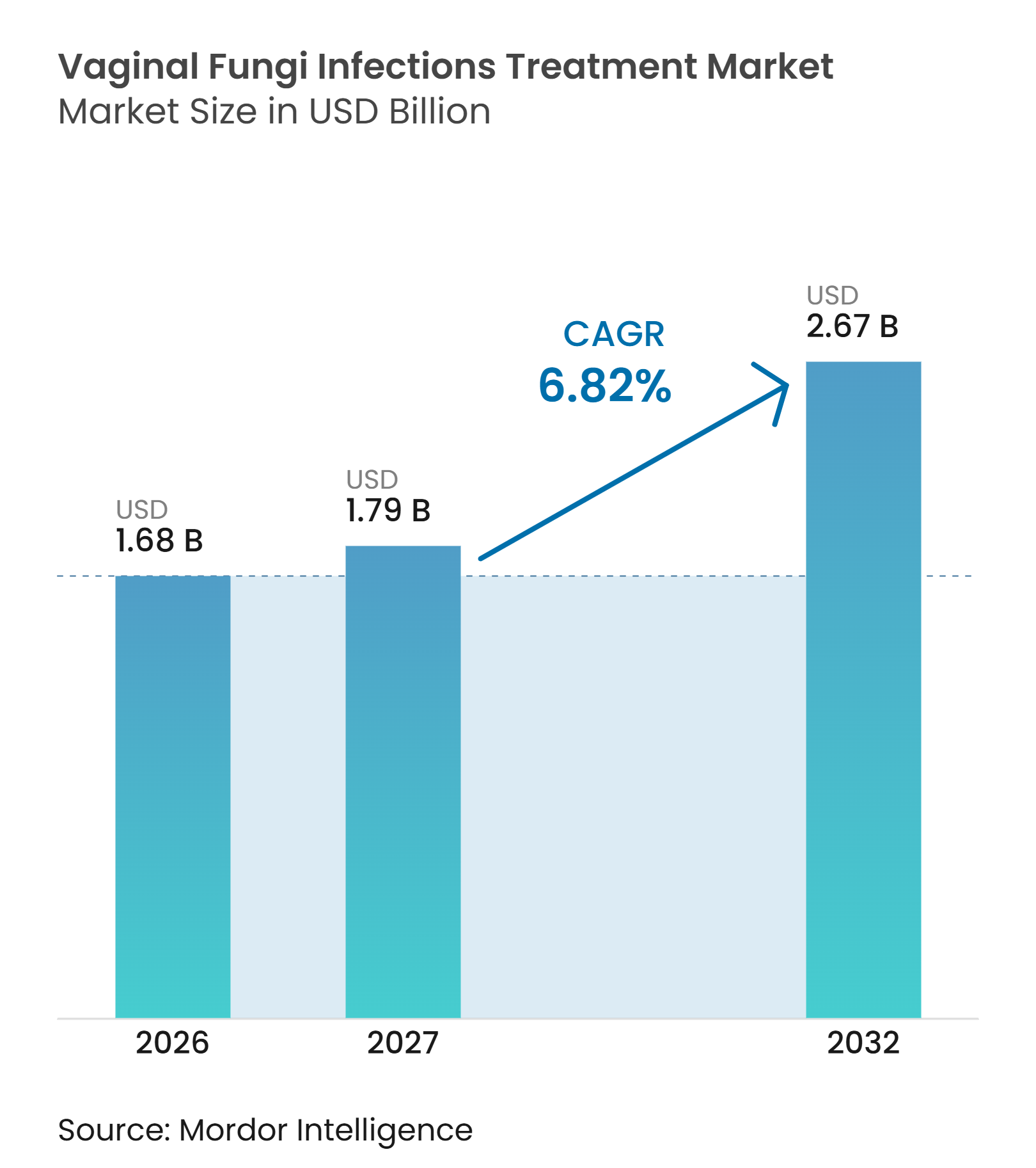
The Vaginal fungi infections treatment market size is projected to expand from USD 1.68 billion in 2026 and USD 1.79 billion in 2027 to USD 2.67 billion by 2032, registering a CAGR of 6.82% between 2027 to 2032. The market is supported by the large number of women who experience vulvovaginal candidiasis, while recurrent disease creates demand for longer treatment courses. The Vaginal fungi infections treatment market also reflects a split between low-cost generic azoles used for acute episodes and branded therapies intended for recurrent disease. Wider over-the-counter access keeps treatment available for uncomplicated cases, although limited disease awareness can delay appropriate use. Resistance in non-albicans Candida species is increasing the clinical need for therapies outside the standard azole class. Digital dispensing and telehealth prescribing are making access more private and convenient, especially for repeat treatment needs.
Key Report Takeaways
- By drug class, azoles held 65.36% of the vaginal fungi infections treatment market share in 2026, while polyenes are forecast to expand at a 7.24% CAGR through 2032.
- By dosage form, vaginal creams accounted for 45.69% of the vaginal fungi infections treatment market size in 2026, while oral tablets and capsules are forecast to grow at a 7.51% CAGR through 2032.
- By route of administration, oral administration held a 43.58% share in 2026, while topical and intravaginal administration is forecast to grow at a 7.89% CAGR through 2032.
- By infection type, acute vulvovaginal candidiasis held a 68.41% share in 2026, while recurrent vulvovaginal candidiasis is forecast to grow at an 8.31% CAGR through 2032.
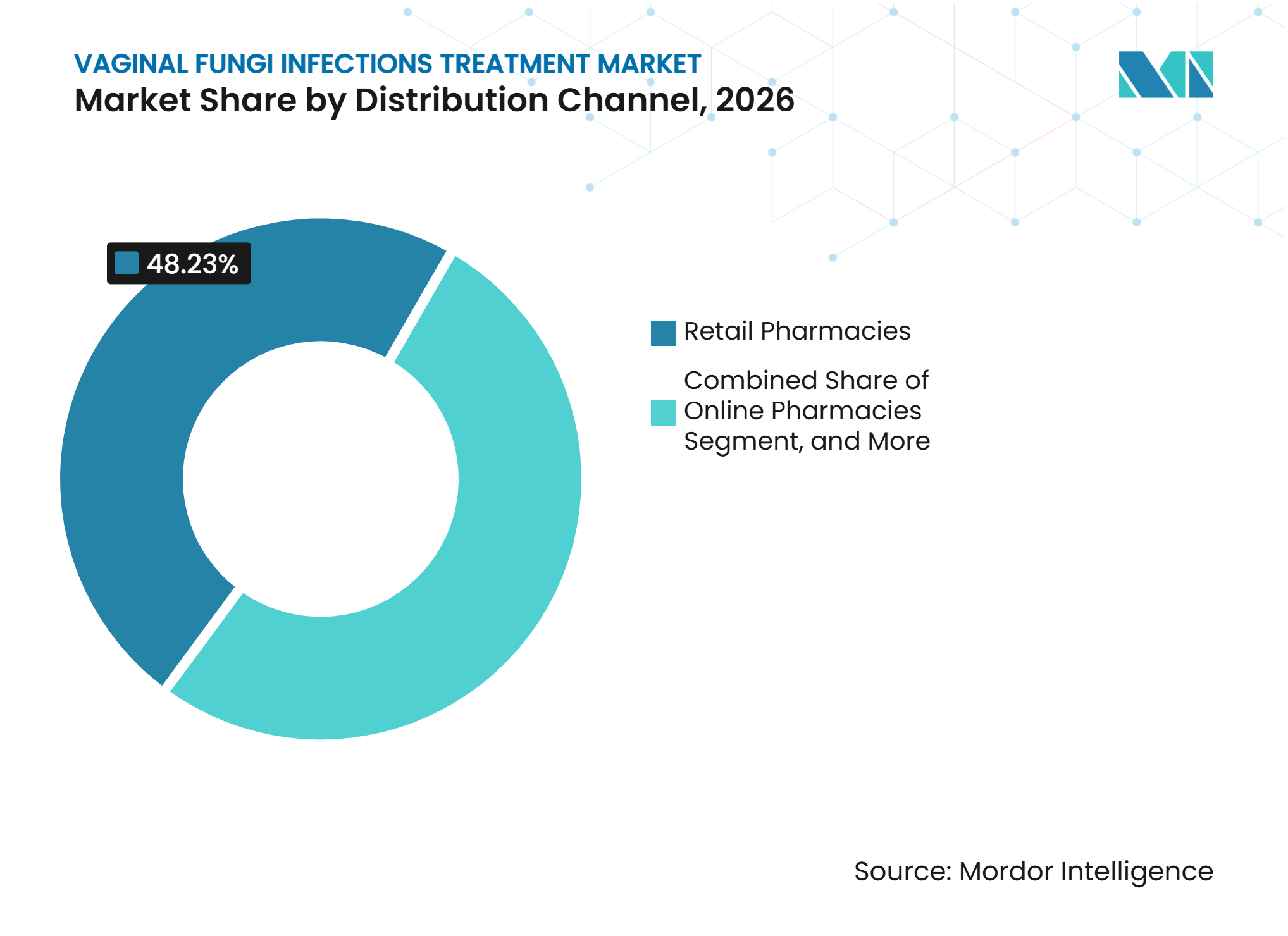
- By distribution channel, retail pharmacies held a 48.23% share in 2026, while online pharmacies are forecast to grow at an 8.67% CAGR through 2032.
- By end user, gynecology clinics held a 35.68% share in 2026, while homecare settings are forecast to grow at a 9.45% CAGR through 2032 in the vaginal fungi infections treatment market.
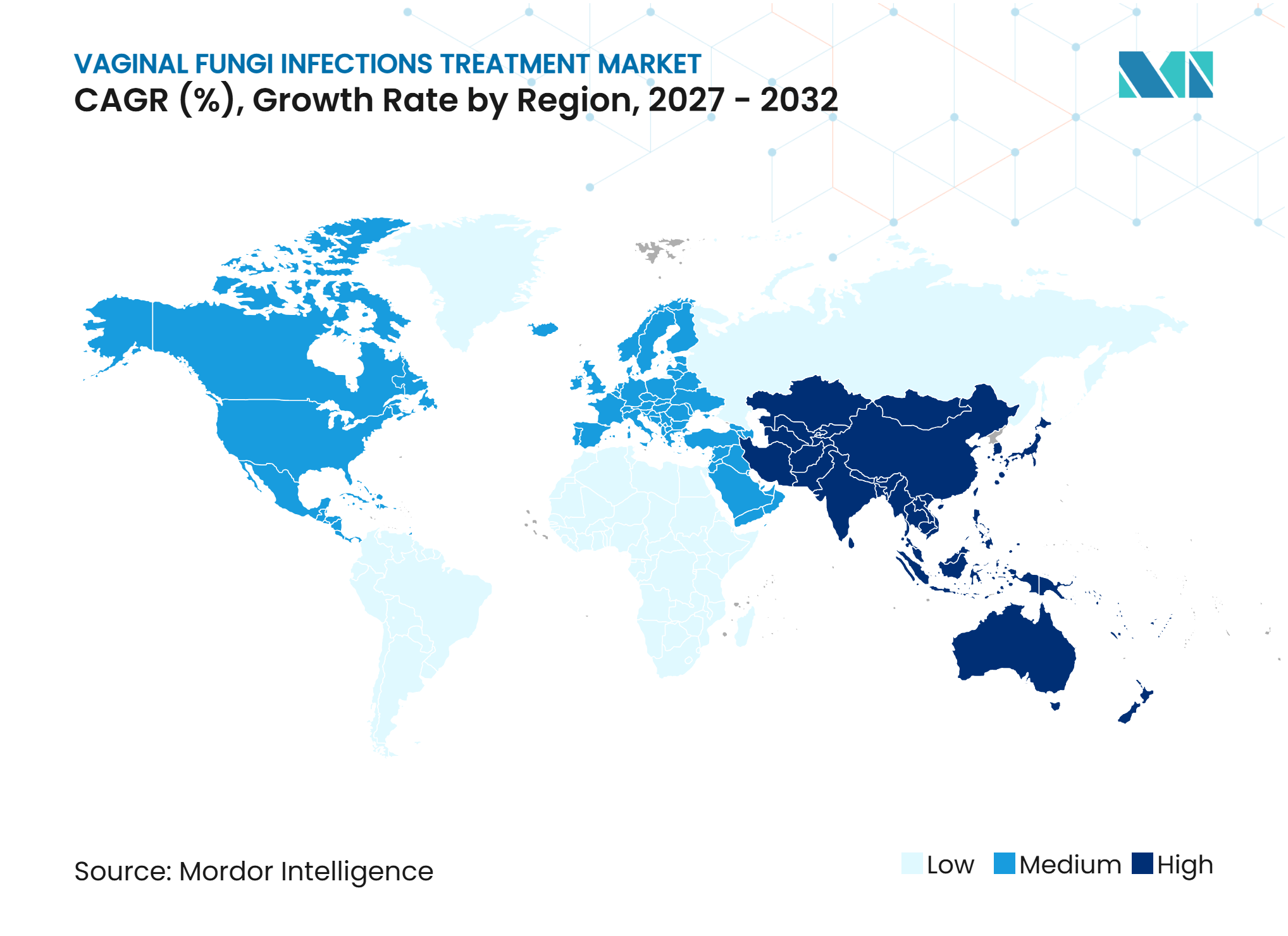
- By geography, North America held a 36.44% share in 2026, while Asia-Pacific is forecast to grow at a 10.11% CAGR through 2032.
Note: Market numbers in this report are based on Mordor Intelligence's proprietary estimation framework, which combines nine months of actuals with Q4 projections for base year 2026.
Market Trends and Insights
Drivers Impact Analysis of Vaginal Fungi Infections Treatment Market*
| Driver | (~) % Impact on CAGR Forecast | Geographic Relevance | Impact Timeline |
|---|---|---|---|
| Rising Burden of Vulvovaginal Candidiasis | +1.8% | Global | Long term (≥ 4 years) |
| Growing OTC and Self-Care Access | +1.2% | North America, Europe, Asia-Pacific | Medium term (2-4 years) |
| Growing Demand for Recurrent and Resistant Infection Management | +1.4% | Global | Long term (≥ 4 years) |
| Growing Adoption of Novel Non-Azole Therapies | +0.9% | North America and Europe | Medium term (2-4 years) |
| Rising Women’s Health Awareness and Diagnostic Uptake | +1.0% | Asia-Pacific, Middle East and Africa, South America | Medium term (2-4 years) |
| Growing Digital Pharmacy and Telehealth Dispensing | +0.8% | North America, Asia-Pacific | Short term (≤ 2 years) |
| Source: Mordor Intelligence | |||
Rising Burden of Vulvovaginal Candidiasis
Vulvovaginal candidiasis creates a large recurring treatment need because an estimated 138 million new cases occur globally each year. The condition affects a substantial share of women over their lifetimes, which supports baseline demand across the Vaginal fungi infections treatment market. Recurrent vulvovaginal candidiasis affects an estimated 372 million women over their lifetimes and requires a different care pathway from a single uncomplicated episode. The 25-34 age group has the highest reported recurrent disease prevalence at 9%, placing much of the burden among working-age women. A 2025 study estimated Uganda’s annual recurrent disease burden at USD 75.70 million, with direct medical costs accounting for 71.50% of that amount. Formal recognition of recurrent disease within reimbursement and diagnostic pathways can shift spending from informal self-treatment to recorded care.
Growing OTC and Self-Care Access
Short-course topical azoles remain a practical first treatment option for uncomplicated disease. The Centers for Disease Control and Prevention identifies several intravaginal azole regimens as recommended treatment options for uncomplicated vulvovaginal candidiasis.[1] Over-the-counter availability supports the Vaginal fungi infections treatment market by letting patients address familiar acute symptoms without a clinic visit. This channel is especially important for creams and suppositories that patients recognize from prior use. Patient education remains a constraint because a 2025 study found limited medicine awareness and self-treatment confidence among surveyed Portuguese women. Education programs can therefore improve appropriate product selection while also directing persistent symptoms toward clinical assessment. These patterns support steady self-care demand but do not remove the need for diagnosis when symptoms recur or fail to resolve.
Growing Demand for Recurrent and Resistant Infection Management
Recurrent vulvovaginal candidiasis is forecast to grow at an 8.31% CAGR through 2032, faster than acute disease. This portion of the Vaginal fungi infections treatment market requires extended treatment and follow-up rather than a one-time retail purchase. Non-albicans Candida species, particularly Candida glabrata, respond less reliably to standard azoles and complicate routine management.[2] The same study found that 23% of Candida glabrata isolates in the cited Greek clinical cohort were resistant to fluconazole. Dedicated therapies are also bringing more women with recurrent symptoms into gynecology clinics for a defined diagnosis and a reimbursement-supported treatment plan. Differences between clinical definitions of 3 or 4 annual episodes still affect trial enrollment and prevalence reporting.
Growing Adoption of Novel Non-Azole Therapies
Non-azole options address patients whose infections recur despite azole maintenance therapy. In the Phase 3 CANDLE trial, 70.80% of patients receiving ibrexafungerp remained free from mycologically proven recurrence at week 24, compared with 58.50% receiving placebo. Ibrexafungerp acts through beta-(1,3)-D-glucan synthase inhibition and retains activity against fluconazole-resistant Candida species. The Vaginal fungi infections treatment market is gaining a premium treatment tier as evidence supports use in recurrent disease. The Food and Drug Administration has granted Qualified Infectious Disease Product and Fast Track designations to OCF001, supporting its development pathway. Novel therapies may broaden choice for resistant infections, although coverage requirements remain important to their real-world uptake.
Restraints Impact Analysis of Vaginal Fungi Infections Treatment Market*
| Restraint | (~) % Impact on CAGR Forecast | Geographic Relevance | Impact Timeline |
|---|---|---|---|
| Growing Azole Resistance and Non-Albicans Candida | -0.9% | Global | Long term (≥ 4 years) |
| Growing Pregnancy and Systemic-Safety Restrictions | -0.4% | Global | Long term (≥ 4 years) |
| Persistent Underdiagnosis and Symptom-Based Self-Treatment | -0.6% | Asia-Pacific, Middle East and Africa, South America | Long term (≥ 4 years) |
| Growing Reimbursement Constraints for Premium Recurrent-Infection Therapies | -0.5% | North America and Europe | Medium term (2-4 years) |
| Source: Mordor Intelligence | |||
Growing Azole Resistance and Non-Albicans Candida
Azole resistance can turn a common infection into a longer and more expensive treatment episode. A 2025 study reported fluconazole resistance in 23% of Candida glabrata isolates from the cited Greek cohort. The study also reported a 35% clotrimazole non-wild-type rate in those isolates, which can limit the utility of common frontline products. In the United Kingdom, fluconazole non-susceptibility among isolates from recurrent disease patients rose from 3.50% in 2018-2019 to 9.60% in 2020-2021. There are no established vaginal clinical breakpoints for most azoles, leaving clinicians with limited susceptibility guidance in many cases. This challenge can increase demand for newer drugs but also raises the risk of failed treatment and delayed care.
Growing Reimbursement Constraints for Premium Recurrent-Infection Therapies
Coverage rules can delay use of newer recurrent disease treatments. Cigna’s policy requires specified step-therapy criteria for covered treatment of vulvovaginal candidiasis with ibrexafungerp and oteseconazole. A 2025 Rhode Island Medicaid policy also defined prior-authorization requirements for ibrexafungerp. These controls can require documentation of prior treatment failure before coverage is granted. The resulting delay reduces immediate access for women with confirmed recurrent disease. Health technology assessment and formulary review processes can add further time before new therapies are broadly available in European systems. Price-sensitive access remains a limitation for the premium end of the Vaginal fungi infections treatment market.
*Our forecasts treat driver/restraint impacts as directional, not additive. The impact forecasts reflect baseline growth, mix effects, and variable interactions.
Vaginal Fungi Infections Treatment Market Segment Analysis
By Drug Class:
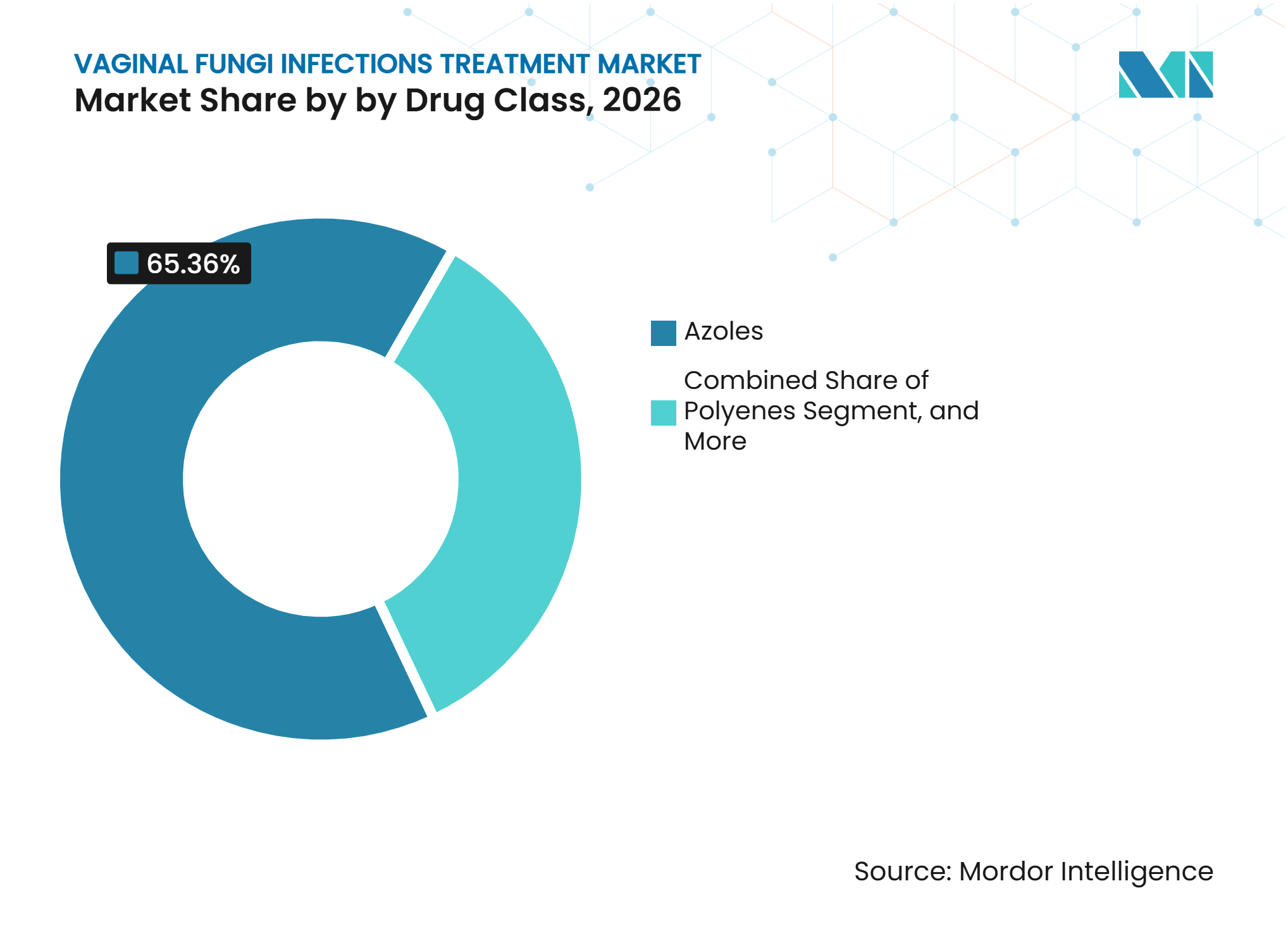
Azoles Retain Their Broad Treatment RoleAzoles held 65.36% of drug-class revenue in 2026. Their position rests on broad availability, clinician familiarity, and use across uncomplicated cases. Fluconazole, clotrimazole, and miconazole address much of the acute treatment volume. The CDC includes oral fluconazole and several intravaginal azole regimens among recommended options for uncomplicated disease. Generic competition keeps these products accessible across many care settings. This supports retail sales and keeps the drug class central to clinic prescribing.
Polyenes are forecast to grow at a 7.24% CAGR through 2032. Nystatin is relevant where systemic exposure is a concern or clinicians seek an alternative treatment approach. A 2025 formulation study reported improved antifungal performance from a nystatin-loaded novasomal gel compared with conventional formulations.[3] A separate 2025 study examined coated nystatin liposomes to improve stability and antifungal efficacy.[4] Ibrexafungerp provides a separate non-azole option for recurrent disease prevention. Boric acid preparations remain in the other category for off-label use in resistant Candida glabrata cases.



By Dosage Form:
Vaginal Creams Remain Established While Oral Treatment ExpandsVaginal creams accounted for 45.69% of the Vaginal fungi infections treatment market size in 2026. Local administration is familiar to patients and fits self-care for uncomplicated episodes. Creams have broad retail availability in branded and generic formats. The CDC lists intravaginal creams among recommended regimens for uncomplicated vulvovaginal candidiasis. Their local delivery can appeal to patients who want to avoid systemic exposure. This keeps creams relevant when prescription oral therapy is available.
Oral tablets and capsules are forecast to grow at a 7.51% CAGR through 2032. Their growth is tied to recurrent disease protocols that depend on scheduled oral dosing. The CANDLE study evaluated monthly oral ibrexafungerp for recurrent disease prevention. Weekly fluconazole maintenance also uses oral delivery in eligible patients. Vaginal tablets and pessaries continue to provide a single-dose local option. Other formats include boric acid capsules and intravaginal gels under clinical and academic investigation.
By Route of Administration:
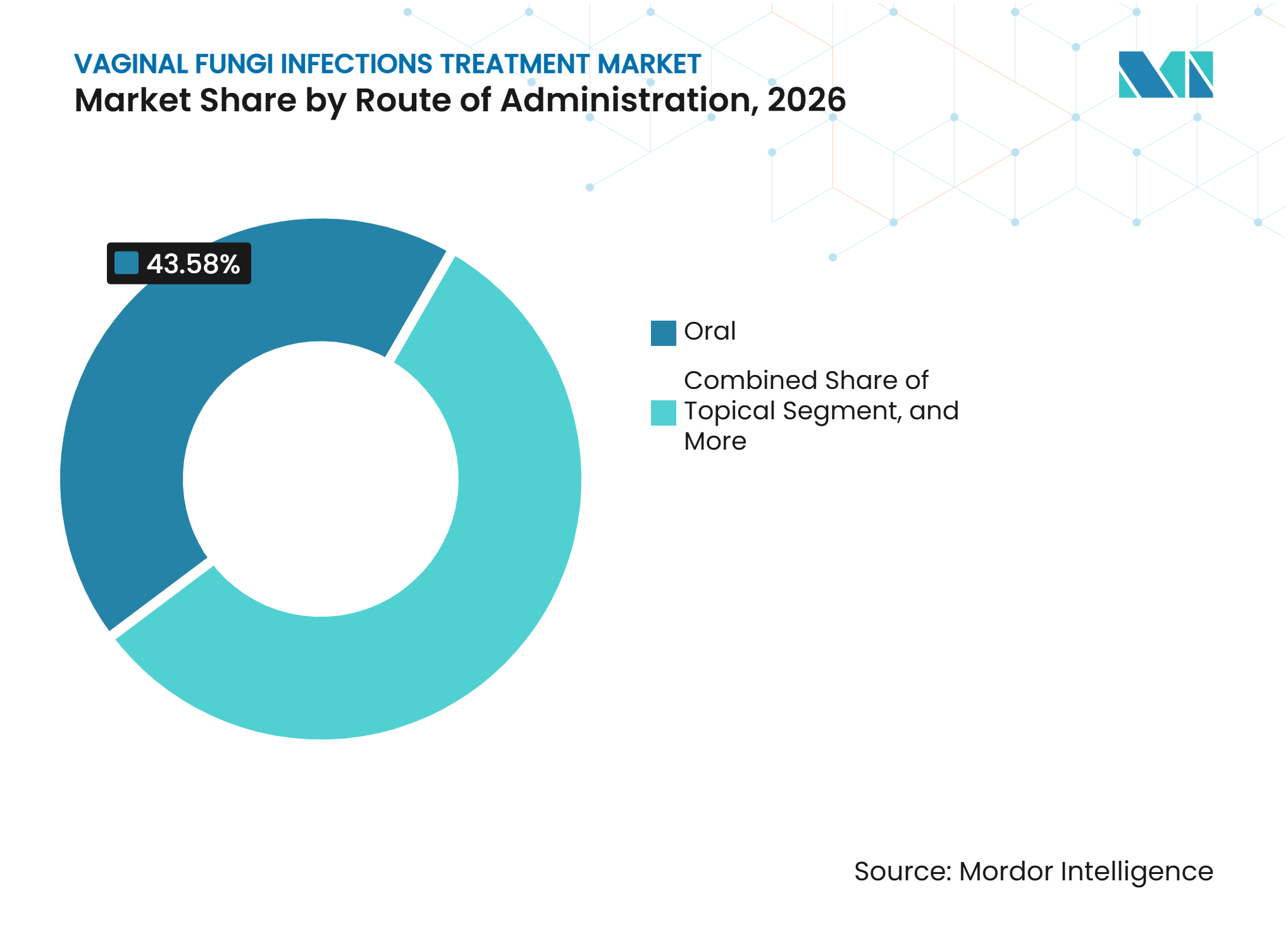
Oral Treatment Leads While Local Routes Gain GroundOral administration held a 43.58% share in 2026 because single-dose fluconazole is widely used where permitted. The route fits preferences that favor a simple prescription or pharmacy transaction. Oral use also supports longer maintenance regimens for recurrent infections. The CDC identifies oral fluconazole as an option for uncomplicated disease and recommends a longer approach for recurrent disease. This gives oral delivery a continuing role in clinician-led care. The Vaginal fungi infections treatment industry remains dependent on oral generics for a substantial share of prescriptions.
Topical and intravaginal administration is forecast to grow at a 7.89% CAGR through 2032. Local therapy offers an alternative for patients who need to limit systemic drug exposure. The CDC recommends only topical azole therapies for 7 days during pregnancy. This guidance supports creams, suppositories, and pessaries in an important patient group. Concern about fetal exposure to oral fluconazole reinforces the role of local routes. Recurrent users may also choose local products when they prefer to avoid systemic effects.

By Infection Type:
Acute Disease Sustains Volume While Recurrent Disease Drives GrowthAcute vulvovaginal candidiasis accounted for 68.41% of infection-type revenue in 2026. It generates the highest treatment volume because most patients experience isolated or infrequent episodes. These cases are commonly treated with generic azoles through retail channels. The CDC describes uncomplicated disease as sporadic, infrequent, and mild to moderate in severity. This limits the need for prolonged branded treatment in many cases. It also links the acute category closely to over-the-counter purchasing behavior.
Recurrent vulvovaginal candidiasis is forecast to grow at an 8.31% CAGR through 2032. It creates more value per patient because management can involve induction therapy, maintenance therapy, culture testing, and specialist consultation. The CDC defines recurrent disease as 3 or more symptomatic episodes within 1 year. Dedicated preventive therapies have increased attention to this patient group. Resistance and non-albicans infections can make repeated episodes harder to manage. Complicated infections in immunocompromised patients remain a smaller, specialist-managed category.
By Distribution Channel:
Retail Pharmacies Lead While Online Pharmacies Change AccessRetail pharmacies held a 48.23% share in 2026, making them the leading channel for acute treatment purchases. Their role reflects the symptom-led and time-sensitive nature of uncomplicated episodes. Branded and generic miconazole and clotrimazole products are widely available in retail formats. Retail access also supports patients who want direct advice from a pharmacist. This channel remains central to the Vaginal fungi infections treatment market because it connects self-care with immediate availability. In-person pharmacies also remain important when a patient needs referral for persistent symptoms.
Online pharmacies are forecast to grow at an 8.67% CAGR through 2032. Privacy and home delivery matter for a condition many patients prefer to manage discreetly. Telehealth-linked services can combine a virtual consultation, prescription, and delivery. Licensed dispensing requirements protect the integrity of the prescription channel. The online route can shorten the path from recurring symptoms to clinician-directed treatment. Hospital pharmacies remain important for complicated cases, while clinics may dispense treatment directly in some settings.
By End User:
Gynecology Clinics Guide Complex Care While Homecare GrowsGynecology clinics held a 35.68% share in 2026. They diagnose recurrent disease, confirm the causative organism, and document prior treatment history. This workflow is important when reimbursement requires evidence of treatment failure. Specialist care can separate recurrent candidiasis from other causes of vaginal symptoms. The CDC advises clinical evaluation and testing when symptoms persist after over-the-counter treatment or recur within 2 months. These clinical needs sustain the role of gynecology clinics in the Vaginal fungi infections treatment market.
Homecare settings are forecast to grow at a 9.45% CAGR through 2032. Patients use them for over-the-counter creams, repeat treatment, and telehealth-enabled prescriptions. Digital care models can make follow-up more convenient for patients with familiar symptoms. Home treatment is most suitable when symptoms are uncomplicated and the patient has clear guidance. Persistent or recurrent symptoms still need clinical testing to avoid inappropriate treatment. Hospitals retain a role for immunocompromised patients, while community health centers support access in lower-income settings.
Geography Analysis
North America
North America held 36.44% of the Vaginal fungi infections treatment market share in 2026. The region combines high healthcare spending with broad over-the-counter access and an established specialist referral base. Retail brands support routine treatment, while gynecology care supports the recurrent disease pathway. The Food and Drug Administration’s oversight of prescription treatments shapes product access and evidence requirements. In November 2025, SCYNEXIS completed the transfer of the BREXAFEMME new drug application to GSK, allowing GSK to begin Food and Drug Administration interactions on a planned United States relaunch. This may renew payer and prescriber attention to non-azole recurrent disease treatment. Canada follows a similar pattern of regulated pharmacy access, while Mexico remains more strongly shaped by generic product volume.
Asia-Pacific
Asia-Pacific is forecast to grow at a 10.11% CAGR through 2032, the fastest regional rate. Population scale, expanding online access, and rising attention to reproductive health support demand. India’s generic manufacturers help reduce treatment costs across the region. Urban reimbursement systems in China can encourage formal treatment seeking rather than informal self-treatment. Digital pharmacies are becoming more relevant in large cities because they can connect patients with prescription and delivery services. Regulatory conditions vary across the region, which makes local registration and pharmacy rules important for suppliers. Established prescription markets in Japan and Australia add stable demand alongside faster growth in emerging economies.
Europe, Middle East and Africa, and South America
Europe has a stable treatment base supported by national health systems and established generic azole use. European Medicines Agency pharmacovigilance requirements influence how companies communicate and monitor systemic treatments. The Vaginal fungi infections treatment market size in Europe benefits from routine access to primary care and pharmacy dispensing. Middle East and Africa are gaining formal treatment demand as primary care access improves. A 2025 study in Saudi Arabia found that 20.70% of participants correctly identified Lactobacillus as the dominant genus in a healthy vaginal microbiome. That gap supports education-led approaches that link awareness with appropriate care. South America remains volume-driven, with Brazil and Argentina important for generic and branded antifungal sales.
Competitive Landscape
Market Concentration
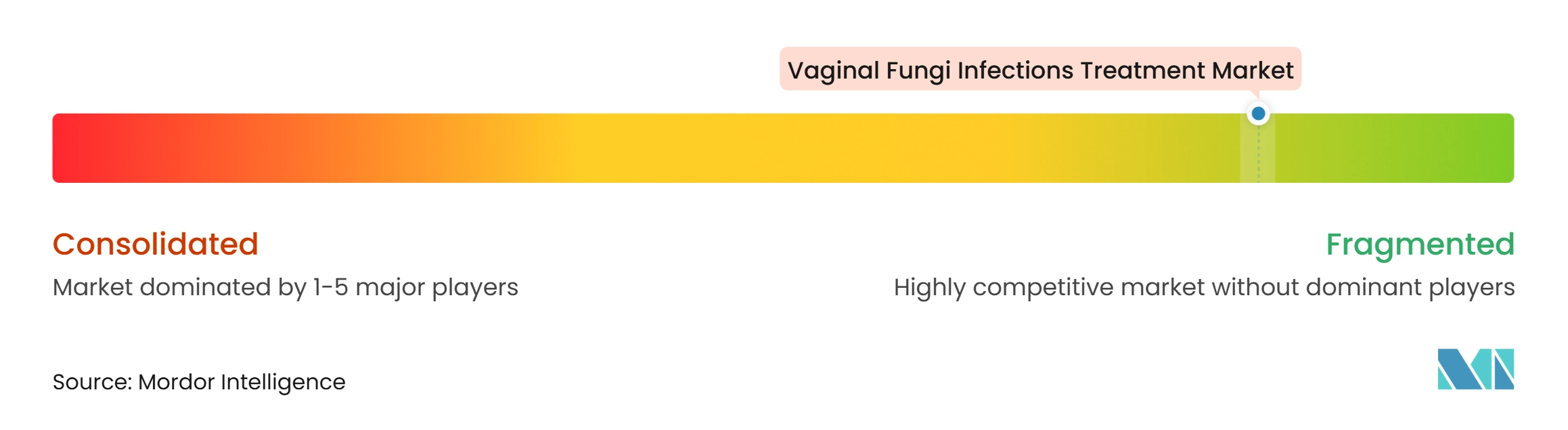
The Vaginal fungi infections treatment market has a fragmented volume tier and a more concentrated premium treatment tier. Aurobindo, Cipla, Dr. Reddy’s, Lupin, Alkem, Glenmark, Sun Pharmaceutical, and Zydus Lifesciences compete in generic azoles, particularly in emerging economies. Pfizer, Bayer, and Perrigo have recognizable positions in branded prescription and over-the-counter formats. GSK and Mycovia Pharmaceuticals are associated with the recurrent disease innovation segment. Price competition is strongest where fluconazole and clotrimazole are mature generics.
GSK’s transfer of the BREXAFEMME new drug application in November 2025 created a pathway for future regulatory discussions on a United States relaunch. SCYNEXIS and GSK also resolved their dispute related to the Phase 3 MARIO study in October 2025. The resolution allowed the companies to focus their collaboration on the vulvovaginal candidiasis pathway. Sandoz, Hikma, Teva, Viatris, and Amneal compete in the generic formulary tier. Telehealth-linked prescription fulfillment is becoming a distribution differentiator.
Aurobindo received final Food and Drug Administration approval in 2025 for Nystatin Cream USP, 100,000 units per gram. This approval adds a polyene option to its United States women’s health generic portfolio. Innovation is focused on patients for whom azoles do not provide durable control. The Vaginal fungi infections treatment market has to balance low-cost access with effective options for patients whose infection pattern is more complex. Appropriate diagnosis remains important before a patient moves from common azoles to a newer therapy. Reimbursement policies will affect how quickly newer products can move beyond specialist settings. Companies with evidence in recurrent disease, regulatory progress, and payer engagement are better positioned in the premium category.
Vaginal Fungi Infections Treatment Industry Leaders
-
Alkem Laboratories Ltd
-
Amneal Pharmaceuticals Inc.
-
Aurobindo Pharma Ltd
-
Bayer AG
-
Cipla Ltd
- *Disclaimer: Major Players sorted in no particular order
Vaginal Fungi Infections Treatment Market Companies Covered in this Report
- Alkem Laboratories
- Amneal Pharmaceuticals
- Aurobindo Pharma
- Bayer
- Bausch Health
- Cipla
- Dr. Reddy’s Laboratories
- Glenmark Pharmaceuticals
- Hikma Pharmaceuticals
- Lupin
- Mycovia Pharmaceuticals
- Organon
- Perrigo Company
- Pfizer
- Sandoz Group
- SCYNEXIS
- Sun Pharmaceuticals Industries
- Teva Pharmaceutical Industries
- Viatris
- Zydus Lifesciences Ltd
Recent Industry Developments in Vaginal Fungi Infections Treatment Market
- November 2025: SCYNEXIS completed the transfer of the BREXAFEMME New Drug Application to GSK, enabling GSK to initiate regulatory interactions with the Food and Drug Administration in 2026 to discuss the United States relaunch of BREXAFEMME for vulvovaginal candidiasis and recurrent vulvovaginal candidiasis. SCYNEXIS may receive up to USD 145.50 million in annual net sales milestones plus royalties upon relaunch.
- October 2025: SCYNEXIS received a one-time, non-refundable payment of USD 24.80 million from GSK after resolving their disagreement regarding the Phase 3 MARIO study of ibrexafungerp in invasive candidiasis. The study was wound down, allowing both parties to refocus collaboration on the vulvovaginal candidiasis and recurrent vulvovaginal candidiasis pathway.
- March 2025: Aurobindo Pharma received Food and Drug Administration final approval for Nystatin Cream USP, 100,000 units per gram, an AB-rated generic equivalent to Taro Pharmaceuticals’ reference listed drug.
Global Vaginal Fungi Infections Treatment Market Report Scope
As per the scope of the report, vaginal fungal infection treatment refers to the use of antifungal medications and therapeutic interventions to eliminate fungal infections of the vagina, most commonly caused by Candida species, and to relieve associated symptoms such as itching, burning, irritation, redness, and abnormal vaginal discharge.
The vaginal fungal infection treatment market is segmented by drug class, dosage form, route of administration, infection type, distribution channel, end user, and geography. By drug class, the market is segmented into azoles, polyenes, triterpenoid antifungals, and others. By dosage form, the market is segmented into vaginal creams, vaginal tablets & pessaries, oral tablets & capsules, and others. By route of administration, the market is segmented into oral, topical & intravaginal, and others. By infection type, the market is segmented into acute vulvovaginal candidiasis, recurrent vulvovaginal candidiasis, complicated fungal infections, and others. By distribution channel, the market is segmented into hospital pharmacies, retail pharmacies, online pharmacies, and others. By end user, the market is segmented into hospitals, gynecology clinics, homecare settings, and others. By geography, the market is segmented into North America, Europe, Asia-Pacific, the Middle East and Africa, and South America. The market report also covers estimated market sizes and market trends for 17 countries across major regions worldwide. The report offers market value (in USD) for the above segments.
Segmentation Overview
| Azoles |
| Polyenes |
| Triterpenoid Antifungals |
| Others |
| Vaginal Creams |
| Vaginal Tablets and Pessaries |
| Oral Tablets and Capsules |
| Others |
| Oral |
| Topical and Intravaginal |
| Others |
| Acute Vulvovaginal Candidiasis (VVC) |
| Recurrent Vulvovaginal Candidiasis (RVVC) |
| Complicated Fungal Infections |
| Others |
| Hospital Pharmacies |
| Retail Pharmacies |
| Online Pharmacies |
| Others |
| Hospitals |
| Gynecology Clinics |
| Homecare Settings |
| Others |
| North America | United States |
| Canada | |
| Mexico | |
| Europe | Germany |
| United Kingdom | |
| France | |
| Italy | |
| Spain | |
| Rest of Europe | |
| Asia-Pacific | China |
| India | |
| Japan | |
| Australia | |
| South Korea | |
| Rest of Asia-Pacific | |
| Middle East and Africa | GCC |
| South Africa | |
| Rest of Middle East and Africa | |
| South America | Brazil |
| Argentina | |
| Rest of South America |
| By Drug Class | Azoles | |
| Polyenes | ||
| Triterpenoid Antifungals | ||
| Others | ||
| By Dosage Form | Vaginal Creams | |
| Vaginal Tablets and Pessaries | ||
| Oral Tablets and Capsules | ||
| Others | ||
| By Route of Administration | Oral | |
| Topical and Intravaginal | ||
| Others | ||
| By Infection Type | Acute Vulvovaginal Candidiasis (VVC) | |
| Recurrent Vulvovaginal Candidiasis (RVVC) | ||
| Complicated Fungal Infections | ||
| Others | ||
| By Distribution Channel | Hospital Pharmacies | |
| Retail Pharmacies | ||
| Online Pharmacies | ||
| Others | ||
| By End User | Hospitals | |
| Gynecology Clinics | ||
| Homecare Settings | ||
| Others | ||
| By Geography | North America | United States |
| Canada | ||
| Mexico | ||
| Europe | Germany | |
| United Kingdom | ||
| France | ||
| Italy | ||
| Spain | ||
| Rest of Europe | ||
| Asia-Pacific | China | |
| India | ||
| Japan | ||
| Australia | ||
| South Korea | ||
| Rest of Asia-Pacific | ||
| Middle East and Africa | GCC | |
| South Africa | ||
| Rest of Middle East and Africa | ||
| South America | Brazil | |
| Argentina | ||
| Rest of South America | ||
Key Questions Answered in the Report
What is driving growth in vaginal fungi infections treatment?
The Vaginal fungi infections treatment market is projected to grow at a 6.82% CAGR from 2027 to 2032. Recurrent disease management supports growth because it involves longer care pathways than isolated episodes. Wider access to creams, prescription products, and telehealth-linked dispensing also supports demand. Resistance concerns create a need for additional treatment options when standard azoles do not provide durable control. The Vaginal fungi infections treatment market has to balance low-cost access with effective options for patients whose infection pattern is more complex. Appropriate diagnosis remains important before a patient moves from common azoles to a newer therapy.
Which drug class has the largest share in vaginal fungi infections treatment?
Azoles lead with 65.36% share in 2026 because generic fluconazole, clotrimazole, and miconazole remain widely available. The Vaginal fungi infections treatment market continues to depend on this class for routine acute treatment. Its reach across retail pharmacies and clinics gives it a larger volume role than newer therapies. Polyenes are expected to grow faster through 2032 as alternatives are considered in specific treatment settings. The Vaginal fungi infections treatment market therefore contains both a high-volume generic segment and smaller clinical niches that need alternative mechanisms. Product availability alone does not determine use because clinician guidance and patient characteristics remain relevant.
Why is recurrent vulvovaginal candidiasis important for treatment companies?
Recurrent disease is forecast to grow at an 8.31% CAGR through 2032 and often requires longer treatment and specialist follow-up. In the Vaginal fungi infections treatment market, this creates a distinct opportunity for therapies designed to prevent repeat episodes. The patient pathway can include diagnostic testing, maintenance treatment, and payer review. This differs from the short retail transaction that often characterizes uncomplicated acute symptoms. The Vaginal fungi infections treatment market can support preventive therapy when diagnosis, coverage, and follow-up align. This means patient access depends on clinical as well as commercial factors.
Which route is growing fastest for vaginal fungi infections treatment?
Topical and intravaginal administration is forecast to grow at a 7.89% CAGR through 2032. This route is relevant when systemic exposure should be limited, including during pregnancy. The Vaginal fungi infections treatment market retains oral delivery for maintenance and other clinician-led use, but local products serve different needs. Creams, suppositories, and pessaries also remain accessible through common retail channels. The Vaginal fungi infections treatment market will continue to use both routes in parallel rather than shift entirely to one form of delivery. Patient preference and safety considerations determine which route is suitable.
Which region is expected to grow fastest through 2032?
Asia-Pacific is forecast to grow at a 10.11% CAGR, supported by population scale, generic access, and growing digital pharmacy infrastructure. The Vaginal fungi infections treatment market in the region also benefits from greater attention to women’s reproductive health. India’s manufacturers support cost-sensitive access, while urban digital channels can improve convenience. Registration rules, reimbursement systems, and pharmacy regulations will continue to shape country-level growth. The Vaginal fungi infections treatment market will not develop at the same pace across every country because health systems and channels differ. Local product strategy must account for these differences.
How are online pharmacies changing access to treatment?
Online pharmacies are forecast to grow at an 8.67% CAGR through 2032 as telehealth, privacy, and delivery simplify access to clinician-directed care. The Vaginal fungi infections treatment market benefits when these services connect patients with licensed pharmacies and appropriate clinical support. Digital services can make follow-up and delivery easier for patients with recurring symptoms. Persistent symptoms still require clinical assessment rather than repeated unverified self-treatment. The Vaginal fungi infections treatment market benefits from channel models that make referral simple when home management is not appropriate. This protects treatment quality while retaining the convenience of digital access.